What does spider poop look like?
Spider poop looks like tiny drops of paint. Each spot is a flat splat or dot, usually about the size of a pinhead and rarely over 1/8 inch (3 mm), and often white or cream with dark flecks. It lands wet and dries in place. Groups of spots build up directly below where a spider rests.
The mix of colors is the best clue. In a study of crab spiders, the biologist Douglass Morse described their waste as drops of whitish liquid with dark brown flecks. These dried in the air to a dirty light brown. Some spots are mostly white. Others look mostly black, especially on a light wall, because the dark part stands out.
The shape matters too. Spider droppings are never pellets. They are flat, because they leave the spider as a liquid. Fresh spots on a wall can run a little before they dry, so you may see a short drip line.
Size is the weak point in every guide, including this one. Pest control companies say “pinhead-size”. A biologist quoted by the keeper site Tarantula Heaven, Blaine Hebert, gives 1/16 to 1/8 inch (about 1.5 to 3 mm). However, no scientific paper we found gives a measurement, and tarantula keepers report bigger splats from their spiders.
Is it spider poop? Check these
Check each clue below to narrow down what you saw.
Flat splats or dots, not pellets or grains
Pellets mean mice, geckos or insects. Grains like pepper mean cockroaches.
White, cream or gray, often with dark flecks, or dark with a white rim
The white part is guanine. Few other spots have it.
About the size of a pinhead, sometimes with a short drip line
Fresh spots run a little on a wall before they dry.
Stuck to the surface. They do not roll or crumble
Droppings that crumble are not from a spider.
In a group directly below a web, a ceiling corner, a ledge or a light
Look straight up to find the spider.
Webs, shed spider skins or dead insects nearby
Spots on a mattress seam point to bed bugs instead.
Why is spider poop white?
Spider poop is white because of guanine, the same white compound found in fish scales and in DNA. Spiders turn their nitrogen waste into guanine instead of urine. Studies put it at 70 to 85% of the nitrogen a spider excretes. Guanine barely dissolves in water, so a spider can get rid of waste while losing very little water.
Spiders also use guanine for color. Some store it in special cells just under the skin, where the crystals reflect light. That is where the white markings on a garden spider come from. So the white spots on your wall and the white cross on a garden spider’s back are the same material.
Many websites say the white part is uric acid, and so does Wikipedia’s main spider article. Spiders do make a little uric acid, but guanine is the main waste. When researchers tested the waste of 34 spider species in the 1960s, guanine was the only nitrogen waste they detected.
Why some spider droppings look black or brown
The dark part is what is left of the spider’s meal after digestion. It mixes with the white guanine on the way out. So one spot can be mostly white, mostly dark or speckled, depending on how the two parts mix. On white paint or vinyl siding, the dark spots stand out more, and that is why many people describe spider poop as “black spots”.
Do spiders poop?
Yes, spiders poop. Anything that eats has waste to get rid of. A spider cannot chew, so it pumps digestive juices into its prey and sucks up the liquid. About 80% of known spider species feed this way. The waste leaves through one opening at the tip of the abdomen, as a single liquid drop.
Because a spider drinks its food, there is very little solid waste. Most of what comes out is not undigested food at all. Instead, it is guanine made by the spider’s Malpighian tubules, which work a bit like kidneys. The hard outer shell of the prey stays outside the spider. It drops the empty husk when it has finished.
How do spiders poop?
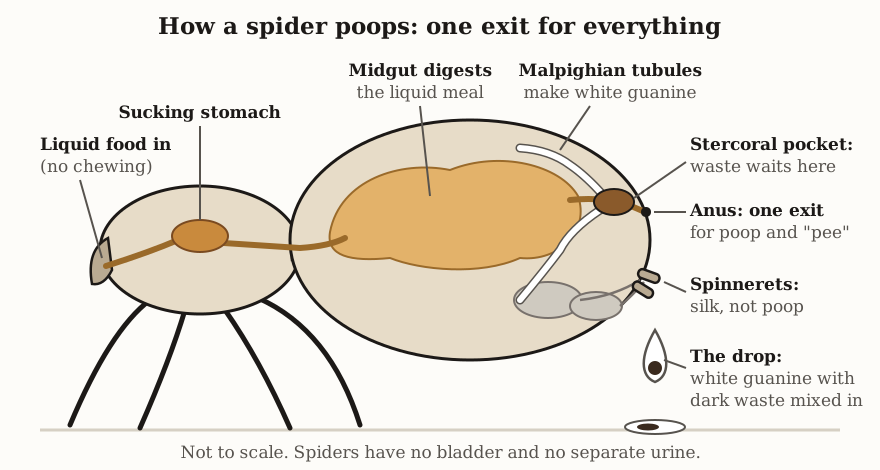
Spider poop follows a short path through the body. Our diagram above shows each step.
- The spider sucks in its liquid meal through the mouth.
- A muscular sucking stomach pumps the liquid into the midgut, which fills most of the abdomen.
- The midgut takes up the food. Meanwhile, the Malpighian tubules collect nitrogen waste and turn it into guanine.
- Both streams meet in a small sac called the stercoral pocket, where the waste waits.
- The spider releases it through the anus, which sits on a small bump just above the spinnerets at the tip of the abdomen.
Do spiders pee?
No, spiders do not pee, at least not the way people do. They have no bladder and no separate opening for urine. The waste that would be urine in a mammal becomes solid guanine, and it leaves through the same opening as the rest of the waste. So every spider dropping is poop and “pee” in one drop.
This is a water-saving trick. Many spiders live in dry places and get most of their water from their prey. Guanine lets them get rid of nitrogen without losing water to make urine.
Do spiders poop out of their webs?
No. Silk and poop come out of two different openings. Silk is made in silk glands inside the abdomen and leaves through the spinnerets, small finger-like tubes at the back. The anus is a separate opening just above them. A web is never made from waste.
In fact, some spiders do the opposite: they eat their old webs. Orb weavers often take down and swallow their web, then reuse some of the silk protein. In one study with labelled silk, the spiders recycled up to 32% of it into new silk.
How often do spiders poop?
There is no simple answer, because it depends on how much the spider eats. A spider that has not caught anything for weeks has little to pass. What surprised researchers is how long spiders can hold it.
In a 2008 study, crab spiders kept in small vials almost never excreted, even over 50 days of regular meals. When the same spiders were let out onto plants, more than two-thirds of them excreted within 5 minutes. They walked to the edge of a leaf first, so the drop fell away from them. The researcher thought this might help them avoid giving away their position to predators or prey.
That habit may explain why many keepers say a pet spider often poops right after it is handled or moved.
Where do spiders poop?
Spiders let their waste drop straight down, so spider poop lands directly below where a spider rests or hunts. Most of it turns up in five places: under webs in ceiling corners, on windowsills, under ledges and furniture, under porch lights, and on outside siding near doors and windows.
A good tip from pest control companies: find the droppings first, then look straight up. The web or the spider is usually right above them.
Where spider poop shows up, and why
A wall or floor below a ceiling corner
- What it usually means
- A web-building spider, often a cellar or house spider, living in the corner above
A windowsill or window frame
- What it usually means
- A spider hunting insects that fly to the light
Under a porch light, on siding or soffits
- What it usually means
- Spiders feeding on insects drawn to the light at night
Under a table, shelf or bed frame
- What it usually means
- A spider resting on the underside above the spots
The walls of a tarantula or jumping spider enclosure
- What it usually means
- Normal waste from a pet spider
Spider poop on walls and ceilings
Indoors, the classic sign is a cluster of spots on a wall just below a ceiling corner. Cellar spiders, often called daddy long legs, are the usual source. The entomologist Michael Raupp of the University of Maryland describes the “telltale white droplets” of their waste below their loose webs. House spiders, which build tangled cobwebs in corners and windows, leave the same kind of marks.
A few spots do not mean many spiders. One spider in one corner can leave dozens of spots over a few months. Fresh spots after you have cleaned are the real sign that a spider is still there.
Spider poop outside: siding, porches and boats
Outside, spider poop collects under porch lights, eaves and window frames. Insects fly to the light at night, and spiders build their webs where the food comes to them. On white vinyl siding, the dark spots are easy to see. Some orb weavers even leave their web at night to excrete, yet the spots still end up below the web.
Boat owners know this problem well. Pontoon and boat owners’ groups trade tips on removing the black spots every summer.
Wolf spider, black widow and house spider poop
All spiders produce the same kind of droppings. What changes is where you find them, because each spider lives a different way. You cannot name the spider from its poop alone. To do that, look at the spider or its web, or try our spider identifier.
Where different spiders leave their poop
Cellar spider (daddy long legs)
- How it lives
- Loose web in ceiling corners and basements
- Where the spots end up
- In clusters on the wall or floor below the web
House spider
- How it lives
- Tangled cobweb in corners and windows
- Where the spots end up
- Below the cobweb, often on a sill
Black widow
- How it lives
- Messy web outdoors under boards, debris or stacked flowerpots; indoors mostly in garages and sheds
- Where the spots end up
- Below the web, in dark, hidden spots. Do not reach in by hand
Wolf spider
- How it lives
- Hunts on the ground at night, no catching web
- Where the spots end up
- Scattered, rarely in a pile. Often never noticed
Jumping spider
- How it lives
- Hunts by day on walls and windows
- Where the spots end up
- On windowsills and frames, and on enclosure walls if kept as a pet
Orb weaver
- How it lives
- Large round web outside
- Where the spots end up
- Below the web, on siding, railings and plants
If the spider over the spots has a shiny black body and a red hourglass, leave it alone and read our black widow guide before you clean.
Spider poop or something else?
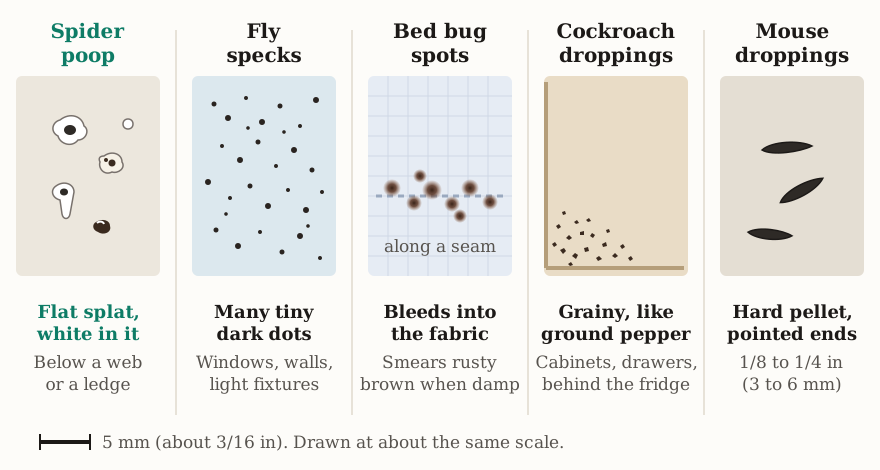
Many small pests leave dark spots, and spider poop is easy to mix up with them. The surest test is the shape. Spider droppings are flat splats, often with white in them, below a web or a ledge. Bed bug spots soak into fabric, cockroach droppings look like ground pepper, and mouse droppings are pellets 1/8 to 1/4 inch (3 to 6 mm) long.
Spider poop or a look-alike? The feature that separates them
Flat splat, white or mixed with dark flecks
- What it is
- Spider poop
- Where you find it
- Below webs, corners, ledges, lights
- What it means
- A spider rests above. Harmless
Many tiny dark dots, slightly raised
- What it is
- Fly specks
- Where you find it
- Windows, walls, light fixtures
- What it means
- Flies, often cluster flies in fall
Dots that soak into fabric like a marker and smear rusty brown when damp
- What it is
- Bed bug spots
- Where you find it
- Mattress seams, sheets, bed frame joints
- What it means
- Bed bugs. Check the bed
Specks like ground pepper, in clusters
- What it is
- German cockroach droppings
- Where you find it
- Kitchen cabinets, drawers, behind appliances
- What it means
- Cockroaches nearby
Hard pellets, 1/8–1/4 in (3–6 mm), pointed ends
- What it is
- Mouse droppings
- Where you find it
- Along walls, in drawers and cupboards
- What it means
- Mice. Do not sweep or vacuum
Brown pellet with a white tip
- What it is
- Gecko or lizard droppings
- Where you find it
- Floors and sills below where lizards rest
- What it means
- A house gecko. Harmless
Reddish or brown stains on fabric and walls
- What it is
- Boxelder bug or stink bug spots
- Where you find it
- Curtains, walls, window frames in fall and winter
- What it means
- Overwintering bugs indoors
Small dark balls on the ground or a leaf
- What it is
- Caterpillar frass
- Where you find it
- Under plants, trees, tomato vines
- What it means
- Caterpillars feeding above
Spider poop vs bed bug poop
This is the mix-up that worries people most. The quickest test is where the spots are. Bed bug spots gather along mattress seams, sheet edges and bed frame joints. Spider spots gather on walls, sills and floors below a web.
The second test is the fabric. The EPA says bed bug droppings can bleed on fabric the way a marker does, because they are digested blood. Press a damp white cloth onto a speck. A bed bug speck smears rusty brown. Spider poop sits on top of a hard surface and has white in it. If you find dark dots on bedding, our guide to the early signs of bed bugs walks you through the full check.
Spider poop vs fly specks
Fly specks are tiny dark dots, and they usually come in large numbers. They show up on a window, a wall or a light fixture, often with no web nearby. Cluster flies, which gather in houses in fall, are a common cause. Penn State Extension notes their spots stain windows and walls, but that they are not known to spread disease.
Spider poop, on the other hand, usually has white in it, comes in smaller groups, and sits under a web.
Spider poop vs cockroach droppings
German cockroach droppings look like specks of ground pepper, in brown to black clusters. They gather in kitchen cabinets, drawer corners and behind the fridge, where roaches hide. Spider poop is rarely in those places, and it is never grainy. If the specks are in your kitchen, our German cockroach guide explains what to do next.
Spider poop vs mouse droppings
Mouse droppings are solid pellets, 1/8 to 1/4 inch (3 to 6 mm) long, with pointed ends. Spider poop is never a pellet. This difference matters for your health, because mouse droppings need a different clean-up. Do not sweep or vacuum them (see the warning in the cleaning section below).
Gecko droppings are the other pellet people find. Texas A&M describes them as elongated and brownish, and often tipped with white.
Is spider poop dangerous?
No. Spider poop has no documented disease risk for people or pets. The one published spider allergy case we found, from 2011, tested spider bodies, not droppings. University of Kentucky entomologists describe spider spotting as an “unsightly nuisance”, not a hazard. The main problem is the stain, which is hard to remove once it dries.
A-Z Animals says spider poop “needs to be treated like it’s toxic”, and some pest control blogs say it triggers allergies. We found no evidence for either claim. That 2011 case was a farmer who developed asthma while working in a warehouse full of cellar spiders. The doctors tested extracts of whole spider bodies, and it was a single patient.
There is even a small test on germs. A Washington State University graduate student swabbed droppings from western black widows and looked for bacteria by their DNA. She found none she could identify. It was a preliminary test of one species, reported in the trade magazine PCT in 2013, so treat it as a hint, not proof.
That said, all animal waste deserves basic hygiene. Wear gloves when you clean, and wash your hands afterwards. If a pet spider poops on your hand, wash it off with soap and water.
The real risk is a mistake in identification. If the “spider poop” is actually mouse droppings, clean-up needs extra care. If it is bed bug spotting, you need to act fast. So check the look-alike table above before you clean.
How to clean spider poop
Fresh spider poop wipes off with a damp cloth in seconds. Dried spots take longer, because the guanine crusts and sticks. The 7 steps below soften dried spots first, and test any cleaner on a hidden spot. Then they remove the web above, or new spots will appear.
No university or government guide gives a tested method for spider droppings, so treat these steps as plain household cleaning.
How to clean spider poop
Check what it is
Look at the shape. If the spots are pellets, they are probably mouse droppings: stop and follow the CDC steps in the warning below.
Remove the spider and its web first
Vacuum the web and the spider with a hose attachment, or brush the web down with a broom. Otherwise the spots will come back.
Put on gloves
Spider poop is not known to be harmful, but gloves keep the job simple.
Wipe fresh spots
Use a soft cloth dampened with warm water and a little dish soap. Most fresh spots come off in one wipe.
Soak dried spots
Hold the soapy cloth on the spot for a few minutes to soften it. Then wipe gently. Do not scrub hard on flat or matte paint, which marks easily.
Rinse and dry
Wipe with a clean damp cloth, then dry the area. Wash your hands when you finish.
Check again in a week
New spots mean a spider is still living above them.
Spider poop on painted walls and ceilings
Painted walls need a gentle touch. Use as little water as possible, especially on ceilings and flat paint, where water can leave a ring. Blot rather than rub. An old, dried spot may leave a faint yellow or brown shadow even after the crust is gone. If so, stop before you damage the paint. A dab of touch-up paint often looks better than a scrubbed patch.
Avoid rubbing alcohol and solvents on painted or finished surfaces. They can soften or strip the finish.
Spider poop on siding, decks and boats
Outside, follow the siding or boat maker’s care instructions first. A soft brush, a bucket of soapy water and a hose rinse handle most fresh spots on vinyl siding. Old, baked-on spots are much harder. Many boat owners use cleaners made for boat finishes. If you buy one, check that it is safe for your surface, and use it as its label says.
Treat a pressure washer with care. Too much pressure can damage siding, paint and boat finishes, and can force water behind siding.
Spider poop on fabric and carpet
Blot fresh spots on fabric with a damp cloth. Do not rub, which spreads the stain. Then wash the item as its care label says. On carpet, blot with a little soapy water and rinse by blotting with clean water.
Spider poop in a pet spider’s enclosure
Pet spiders poop on the walls of their enclosure, on decorations, and often in or near their water dish. Experienced tarantula keepers treat it as an eyesore rather than a danger. Most spot-clean the glass with a damp paper towel or cotton swab. A full clean is needed only when waste builds up.
Avoid bleach and strong cleaners inside an enclosure. Keepers warn that the residue can harm the spider. Move the spider to a safe container before any deep clean, and do not tear down the main web a jumping spider uses as a home.
How to stop spider poop from coming back
Spider poop stops when the spider above it leaves. So the fix is fewer spiders indoors, and fewer insects for them to eat. The 6 steps in the table below cost little or nothing. For most homes they are enough, and you do not need a spray.
Ways to cut down on spider poop
Vacuum webs and spiders regularly, especially ceiling corners
- Why it works
- Removes the spider above the spots, and its egg sacs
- Cost
- Free
Turn off outdoor lights when not needed, or fit yellow or sodium vapor bulbs at entrances
- Why it works
- These draw fewer night-flying insects, so spiders find less food
- Cost
- Free to low
Seal gaps around doors, windows, pipes and cables
- Why it works
- Keeps spiders and their prey outside
- Cost
- Low
Fit tight window screens and door sweeps
- Why it works
- Gaps under doors are a common way in
- Cost
- Low
Clear clutter in basements, garages and closets
- Why it works
- Leaves fewer quiet places to build webs
- Cost
- Free
Move firewood and debris away from the foundation, and trim plants touching the house
- Why it works
- Removes hiding places and bridges into the house
- Cost
- Free
If spiders keep coming back after you remove webs and seal gaps, the reason is usually a supply of insects. Fix that first. If exclusion and cleaning are successful, insecticide treatments are not required. If you do use a spray, choose an EPA-registered product labelled for spiders and the place you plan to treat, and follow the label exactly. The label is the law.
Do spider droppings mean you have an infestation?
Not on their own. One spider can leave many spots, and spiders are normal in most homes. A spider infestation is better judged by what you see: many webs that come back quickly, lots of live spiders, or several egg sacs. Also, keep in mind that dark spots can come from flies, cockroaches, bed bugs or stink bugs too. Check the look-alike table before you decide you have a spider problem.
Spider poop myths
Most spider poop myths come from how little people know about how spiders eat. Here are seven common ones, each with what is actually true. The biggest is that the white part is uric acid, when it is mostly guanine.
Myth 1
Myth: “The white part of spider poop is uric acid.”
Truth: Mostly not. Spiders make a little uric acid, but guanine is their main waste, at 70 to 85% of the nitrogen they excrete.
Myth 2
Myth: “Spiders make their webs from poop.”
Truth: No. Silk comes from silk glands through the spinnerets. Waste leaves through a separate opening just above them.
Myth 3
Myth: “Spiders do not poop, because they only drink.”
Truth: They do. A liquid diet still leaves waste, and spiders also have to get rid of nitrogen as guanine.
Myth 4
Myth: “Spider poop is toxic and must be treated like a hazard.”
Truth: No evidence supports this. No disease or allergy has been traced to spider droppings.
Myth 5
Myth: “Spiders swallow the insect shell and throw it up later.”
Truth: No. A spider never swallows the shell. It sucks out the liquid and drops the empty husk.
Myth 6
Myth: “Dark spots on the wall always mean spiders.”
Truth: Flies, cockroaches, bed bugs and stink bugs leave spots too. Spider spots sit below a web and usually have some white in them.
Myth 7
Myth: “Lots of spider poop means a big infestation.”
Truth: Not necessarily. One spider in one corner can leave dozens of spots over a few months.
When to call someone
Most spider poop is a cleaning job, not a reason to call anyone. But 5 findings point to something else: pellets instead of splats, dark dots on a mattress, a black widow above the spots, stains that will not come off, or a reaction after cleaning. Those are worth an expert’s help.
Who to call, and when
Pellets, not splats, in drawers or along walls
- Who to call
- A licensed pest control company, or follow the CDC clean-up yourself
- Why
- Mice or rats, with a health risk from droppings
Dark spots on mattress seams or sheets
- Who to call
- A licensed pest control company; your landlord if you rent
- Why
- Likely bed bugs, which need a full plan
A shiny black spider with a red hourglass, or many spiders indoors
- Who to call
- A licensed pest control company
- Why
- Black widows, or a supply of insects drawing spiders in
Stains on siding or a boat finish that will not come off
- Who to call
- The siding or boat maker, or a professional cleaner
- Why
- To avoid damaging the finish
A rash, breathing trouble or eye irritation after cleaning
- Who to call
- A doctor, or Poison Control at 1-800-222-1222 if a cleaning product was involved
- Why
- Most likely the cleaner, not the poop
Pest control disclaimer. Photo-based identification can help, but it is not always perfect. For dangerous spiders, large infestations, or anything you are unsure about, contact a licensed pest control professional.
Spider poop FAQ
Can you see spider poop?
Why is there spider poop but no spider?
Do daddy long legs poop?
Is spider poop the same as frass?
Can spider pee or poop on your skin cause a rash?
Why does my tarantula poop in its water dish?
Related guides
Spider identifier
Name the spider above the spots by its color, markings, eyes and web.
Cellar spider
The daddy long legs behind most white droppings in ceiling corners.
House spider
The common cobweb spider of corners and windows, and why its bite rarely matters.
Black widow
How to spot the red hourglass before you reach into a dark corner.
Early signs of bed bugs
Dark spots on a mattress seam, and the damp-cloth test that settles it.
German cockroach
Pepper-like droppings in kitchen cabinets, and what to do about them.
Sources
- Bowman, Experimental and Applied Acarology (2017): guanine as 70–85% of nitrogen excreted by spiders
- Morse, Journal of Arachnology 36 (2008), Excretion behavior of adult female crab spiders
- Walter et al., BMC Genomics (2017), Spider digestive fluids and extra-oral digestion
- Croucher et al., BMC Genomics 14 (2013), Guanine and white coloration in spiders
- Townley and Tillinghast, Journal of Arachnology 16 (1988), Orb web recycling
- Raupp, University of Maryland Bug of the Week (2023), Cellar spider
- University of Kentucky ENTFACT-623, Eliminating spiders around homes and buildings
- UC IPM, Spiders (Pest Notes 7442)
- US EPA, How to find bed bugs
- CDC, How to clean up after rodents
- Tarantula Heaven (2019), Do spiders poop and pee? (keeper site; quotes biologist Blaine Hebert on size)
- Penn State Extension, Cluster flies
- Sargent, PCT (2013), How safe is spider poop? (Washington State University test of black widow droppings)
- Texas A&M AgriLife Extension, House geckos
- Bobolea et al., International Archives of Allergy and Immunology 155 (2011), Cellar spider allergen