What is a drugstore beetle?
The drugstore beetle (Stegobium paniceum) is a small brown beetle that lives in dry stored food. Adults are 1/10 to 1/7 inch (2.25 to 3.5 mm) long, reddish brown and shaped like a short cylinder. Look for rows of tiny pits that run down the wing covers, and antennae that end in a club of three segments.
It goes by several names. In the UK it is the biscuit beetle, and it is also called the bread beetle. Insects Limited adds library beetle, spice beetle and bakery beetle. All of these are the same insect. UF places it in the same beetle family as the cigarette beetle and the furniture beetle, the insect behind woodworm.
It is one of the most common pantry pests in the US. Alabama Extension calls it the most common of the small brown beetles people find indoors. Most of the time it arrives inside a package of food that was already infested, then spreads to other dry goods in the cupboard.
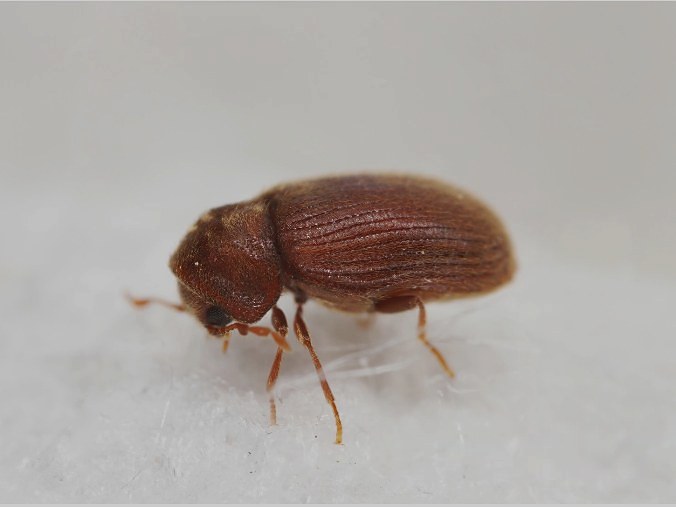
How to recognise a drugstore beetle
Check each clue below to narrow down what you saw.
Size: about 1/10 inch (2.25 to 3.5 mm)
About the size of a sesame seed or smaller. UF gives 2.25 to 3.5 mm.
Color: plain brown to reddish brown
One even color, with no spots or bands. Fine, silky hairs cover the body, according to Clemson.
Shape: a short cylinder, hunched from the side
The head tucks under a hood, so you cannot see it from above. Clemson says this gives a humpbacked look from the side.
Grooves on the wing covers
Rows of tiny pits run from front to back. You need a magnifying glass or a zoomed phone photo to see them.
Antennae that end in a club
The last three segments are longer and wider than the rest. A cigarette beetle's antennae look like a saw blade instead.
Quick, skittering walk, and it flies
Penn State notes its rapid skittering movement. Adults also fly, mostly toward lights.
How big is a drugstore beetle?
An adult drugstore beetle is 2.25 to 3.5 mm long, which is 1/10 to 1/7 inch, according to UF. Clemson gives a typical size of 1/10 inch (2.5 mm). A full-grown larva is a bit longer, at about 3/16 inch (5 mm). The eggs are only 0.2 to 0.5 mm, too small to see without a magnifier.
That size is why people mistake it for so many other bugs. It is about as long as a bed bug nymph and close to the size of a flea. Our guide to tiny dark bugs in the house lines up the common ones side by side.
Do drugstore beetles fly?
Yes. Adult drugstore beetles fly well and head for lights. Insects Limited calls them excellent fliers and says they start flying once it is warmer than 68°F (20°C). Alabama Extension says adults leave the food to look for mates and new food, and fly to light. That is why you see them on windows, lamps and ceilings.
The larvae cannot fly. They have no wings and stay inside the food they hatched in. So the beetles on the window tell you that a colony exists, while the larvae show you where it is.
Drugstore beetle or cigarette beetle?
Check the wing covers and the antennae. A drugstore beetle has rows of grooves on its wing covers and antennae that end in a three-segment club. A cigarette beetle has smooth wing covers and antennae toothed like a saw blade. Both are about 1/10 inch long, light to reddish brown, and eat the same kinds of dry food.
Drugstore beetle vs cigarette beetle, clue by clue
Wing covers
- Drugstore beetle
- Rows of pits, so they look grooved
- Cigarette beetle
- Smooth, no grooves
Antennae
- Drugstore beetle
- End in a club of 3 longer segments
- Cigarette beetle
- Toothed like a saw along their length
Shape
- Drugstore beetle
- Longer, more like a short cylinder
- Cigarette beetle
- Rounder, and more hunched
Larva
- Drugstore beetle
- Cream C-shaped grub with short hairs
- Cigarette beetle
- Similar grub, but covered in long hairs
Favorite foods
- Drugstore beetle
- Pet food, flour, spices, cereal, drugs, books
- Cigarette beetle
- Tobacco, chili powder, paprika, pet food, dried flower and pepper arrangements
Climate
- Drugstore beetle
- More common in temperate areas
- Cigarette beetle
- More common in warm and tropical areas
Pheromone trap
- Drugstore beetle
- Needs a drugstore beetle lure
- Cigarette beetle
- Needs a cigarette beetle lure
Clues from UF, Virginia Tech, Texas A&M, UC IPM, Oklahoma State and Alabama Extension.
For getting rid of them, the difference barely matters. The same steps work for both, because both breed in dry food. It matters in one place: the trap. Alabama Extension points out that the two species do not share the same sex pheromone. Match the lure to the beetle, because a trap baited for one catches few of the other.
Drugstore beetle or bed bug?
A drugstore beetle has a hard, rounded shell and can fly. A bed bug is flat and oval, with no hard shell, and it cannot fly. The EPA describes an adult bed bug as about the size of an apple seed, 5 to 7 mm long. That is about twice the length of a drugstore beetle. Bed bugs also feed on blood, so they leave rusty spots on sheets.
The place you find it helps too. A drugstore beetle on a pillow most often flew toward a reading lamp. Bed bugs hide in mattress seams and the bed frame and come out to feed. If you are not sure, compare it with our photos of every bed bug stage.
Other bugs that look like drugstore beetles
Several small beetles share the pantry with the drugstore beetle. The quickest way to sort them is by body shape and where you found them. A plain brown cylinder in dry food is a drugstore or cigarette beetle. Flat beetles, speckled round beetles and beetles in wood are something else.
Is it a drugstore beetle? The clue that separates each look-alike
Flat, with 6 saw-like teeth on each side behind the head
- Look-alike
- Sawtoothed grain beetle
- What it is
- Slender flat brown beetle, about 1/10 in
- Where you find it
- Cereal, flour, dried fruit, pet food
Flat, shiny and oval
- Look-alike
- Red or confused flour beetle
- What it is
- Reddish-brown beetle, about 1/7 in
- Where you find it
- Flour, cereal, mixes
Round and speckled with white, brown and yellow scales
- Look-alike
- Varied carpet beetle
- What it is
- Round beetle, 1/10 to 1/8 in
- Where you find it
- Windowsills; larvae in wool and lint
Flat, no hard shell, cannot fly
- Look-alike
- Bed bug
- What it is
- Blood feeder, 3/16 to 1/4 in
- Where you find it
- Mattress seams, bed frame
Comes out of small holes in wood
- Look-alike
- Furniture beetle (woodworm)
- What it is
- A wood-feeding relative
- Where you find it
- Old furniture, floors, beams
Grain and flour beetle details from UC IPM and NC State. Carpet beetle details from UC IPM. Bed bug size from the EPA. Furniture beetle from UF and Insects Limited, which notes the two are often confused.
A round, speckled beetle at the window is more likely a carpet beetle, whose larvae eat wool, not food. Our carpet beetle guide covers how to tell its fuzzy larvae apart. If the beetle you found is black and bigger than 1/4 inch, it is a different insect. Our black beetle identification guide sorts the larger ones by size.
Are drugstore beetles harmful?
No. Drugstore beetles do not bite, sting or carry disease. Texas A&M says plainly that neither drugstore nor cigarette beetles bite. Alabama Extension says they are not harmful to people, animals or buildings. The harm is to your food: the larvae eat it and fill it with droppings, insect parts and dead beetles.
That damage adds up. UC IPM warns that pantry pests can bring in microbes that rot food, especially when it is stored warm and damp. So once a package has beetles in it, it belongs in the bin, not back on the shelf.
There is one small health caveat. An Ask Extension expert answered a reader with an itchy rash that drugstore beetles and their larvae do not bite or harm people, but that an allergic reaction to them is possible. We found no study that measures how often this happens, so treat it as rare.
Do drugstore beetles bite?
No. Drugstore beetles do not bite people or pets. A beetle crawling on your skin can feel prickly, which is why many people believe they were bitten. If you are waking up with real bites, something else is biting. The usual suspects are bed bugs, fleas and mites. A less known one is a tiny wasp that lives on pantry beetles.
UF lists small parasitic wasps, including the Bethylidae family, among the natural enemies of the drugstore beetle. One bethylid, Cephalonomia gallicola, is a brown wasp about 2 mm long that does sting people indoors. In Korea, doctors recorded 6 people stung in bedrooms and living rooms in 2013, including a 3-year-old. The stings left painful red bumps that improved within 2 weeks with treatment.
A 2022 report from Mexico found the same wasp in a home where three family members had about 10 stings each. Be clear on one point: both reports name the cigarette beetle, the drugstore beetle’s close relative, as the wasp’s host. We found no case tied to drugstore beetles alone. So treat it as a possibility worth checking, not a diagnosis.
No one can tell what bit you from the bite. Catch the insect instead. Press clear tape on any tiny bug you find on the bed, the windowsill or your skin, and take a sharp photo of it. Our bug bite guide covers the insects that really do bite indoors.
What if you ate food with drugstore beetles in it?
Most likely nothing will happen. Oklahoma State says that after you sift infested food, any insect bits left behind “will not cause harm if consumed.” Drugstore beetles are not known to carry any disease, as Ehrlich Pest Control notes. Still, throw out the rest of the package, and call your doctor if you feel unwell.
Drugstore beetles, pets and medicines
The beetles will not hurt your dog or cat, but pet food is one of their favorite places to breed. UC IPM names pet food, drugs and cereal as the items they infest most at home. Texas A&M says small amounts of pet food can be kept in a cold freezer for two weeks, and then fed to pets safely.
The name comes from medicines, and they still eat them. UF says the beetle feeds on prescription drugs, and Oklahoma State notes it can eat even poisons such as belladonna and strychnine. If you find beetles or holes in any medicine package, do not take it. Ask your pharmacist for a replacement.
Signs of a drugstore beetle infestation
The main signs of a drugstore beetle infestation are small brown beetles at windows and lights, tiny round holes in food packages, fine powder at the bottom of bags, and small white grubs inside the food. Holes and grubs matter most, because they show the beetles are breeding in that item, not just passing through.
- Beetles at windows and lights. Virginia Tech notes that people often miss the problem until many adults gather at windows or fly around lights.
- Tiny round holes. Insects Limited says infested packages usually have shot holes where adults chewed their way out. They look like a spray of pinpricks in the box, bag or even the food.
- Powder or dust. Fine powder like sawdust at the bottom of a package, or on the shelf below it. That is droppings and chewed food.
- Grubs in the food. Small, cream-colored, C-shaped larvae inside flour, kibble, spices or crackers.
- Clumps and cocoons. Bits of food stuck together where a larva built its cocoon. UF says full-grown larvae build a cocoon before they pupate.
- Tiny wasps at the window. Some wasps live on pantry beetle larvae, as the bite section explains. A crowd of them can point to beetles nearby.
I found one drugstore beetle. Is it an infestation?
Not always. One beetle, seen once, may have come home in a grocery bag or flown in toward a lamp. Beetles you see every day, beetles in more than one room, or holes and grubs in a package all mean a colony is breeding indoors. This table matches what you found to what to do next.
What you found, what it means, and what to do
One or two beetles, once
- What it most likely means
- A stray from a grocery item, or one that flew in
- What to do
- Check open dry food, seal it, and watch for a week
A few beetles every day at windows or lamps
- What it most likely means
- A colony is breeding somewhere in the house
- What to do
- Do a full source hunt, room by room
Beetles in a room with no food
- What it most likely means
- They flew to the light, or a non-food item is the source
- What to do
- Check the bedroom list below, then the kitchen
Holes, powder or grubs in a package
- What it most likely means
- That package is a source
- What to do
- Bag it, throw it out, and check everything near it
Beetles again weeks after a clean-out
- What it most likely means
- Late stragglers, or a source you missed
- What to do
- Set a trap, and search again if catches keep coming
Painful red bumps on your skin
- What it most likely means
- Not the beetle. Possibly a tiny wasp, bed bugs or fleas
- What to do
- Catch the insect on tape and see the bite section
Why do I have drugstore beetles?
You most likely carried them in. NC State Extension says many people get pantry pests in food that was infested before they bought it. Ehrlich adds that bulk products such as seed and dry pet food can carry beetles that breed inside for a long time before anyone notices. Once inside, the adults fly to other dry goods and lay eggs there too.
Some do fly in from outside. Alabama Extension says adults feed on pollen and nectar outdoors and can come in at night, drawn to lights. But it adds that most of the time they arrive in infested groceries and dry pet food. So the answer is almost always inside the house.
Having them does not mean your house is dirty. A clean kitchen can still have one forgotten bag of spices or dog treats at the back of a shelf. Spills and old packages make it worse, though. Clemson also calls them moisture-loving pests, so a damp, poorly aired cupboard helps them along.
Drugstore beetles in the bedroom or bathroom
Drugstore beetles turn up in bedrooms and bathrooms for two reasons. First, adults fly to light, so they leave the kitchen and gather at lamps, windows and ceiling lights. Alabama Extension says this is why people see them in bathrooms, bedrooms and offices, far from the food. Second, the source may be in that room and not be food.
The second reason catches most people out. Readers on Reddit who finally found the source describe dried bouquets, old magazines, a picture frame made with flour plaster, macaroni school art on a closet shelf, rabbit hay and hamster food. Texas A&M lists old school art made with beans, nuts or seeds, plus potpourri and forgotten bags of nuts.
So a bedroom with “no food in it” can still feed them. Check anything dry made from plants, grain or seeds, including crafts and decorations. If the room is truly clean, the beetles are likely flying in from a source elsewhere, often the kitchen, a pet area, or a wall or attic.
Where to look: the source checklist, room by room
Search the places that get the least use first. Oklahoma State advises checking seldom-used foods and the least disturbed storage areas, because that is where colonies grow unseen. Use a flashlight and look for holes, powder and grubs. The room with the most beetles is a clue, but not proof, since adults gather at light.
- Kitchen and pantry: flour and baking mixes, spices (paprika and red pepper especially), cereal, crackers, pasta, bread, dried fruit, nuts, dried beans, coffee beans, tea, chocolate and powdered milk.
- Pet area and garage: dry dog and cat food, dog biscuits and treats, birdseed, grass seed, hay and small-pet food. Texas A&M says to check hard-to-clean spots where pet food or birdseed has spilled.
- Bedroom and living room: dried flowers, potpourri, wreaths, crafts or school art made with flour, pasta, beans or seeds, old books and magazines, and furniture with natural stuffing.
- Bathroom and medicine cabinet: pills, dried herbs, herbal teas and remedies.
- Attic, walls and crawl space: seed or pet food that mice have stashed, old rodent nests, rodent bait packets, and bird nests. Virginia Tech and Clemson both link these beetles to mouse caches in walls and attics.
- Closets and storage: old decorations, wool, leather, and anything stored for years.
Rodent bait is easy to forget. Texas A&M says bait packets tossed into an attic or crawl space can feed a colony years after someone put them there. UC IPM adds that pantry pests can breed in rodent and insect nests and then move into the house.
What do drugstore beetles eat?
Drugstore beetles eat almost any dry plant or animal product. UF quotes the old line that they eat “anything but cast iron.” At home that means flour, mixes, bread, cookies, chocolate, spices, cereal, pasta, dried fruit, nuts, seeds and pet food. They also chew books, leather, wool, hair and museum specimens.
Clemson names dry dog food as one item they infest often, and adds raisins, ginger, pasta and dried parsley. Oklahoma State lists coffee beans, powdered milk, dried flowers and even the poisons strychnine and belladonna. UF says they live on such poor food because they carry yeasts that make B vitamins for them.
The larvae do most of the eating, as UF notes. They tunnel through the food until they are ready to pupate. Virginia Tech says the beetles also tunnel through paper, fabric and foil to reach food, and UF reports them boring through tin foil and even lead sheets in some cases.
Drugstore beetle larvae, eggs and life cycle
A drugstore beetle goes from egg to larva to pupa to adult, and the whole cycle usually takes under two months. UF says it can stretch to seven months when it is cool or the food is poor. Most of that time is spent as a larva hidden inside the food, which is why you see the adults first.
What drugstore beetle larvae look like
Drugstore beetle larvae are small, cream-colored grubs that curl into a C shape. They have a large tan head, six short legs near the head and a light coat of short hairs. Full grown, they reach about 3/16 inch (5 mm), says Clemson. Cigarette beetle larvae look much the same but are fuzzier.
A “baby drugstore beetle” is a larva, not a small beetle. The beetle hatches from the egg as a grub and only gets its shell after it pupates. Texas A&M notes that newly hatched larvae are very active and can slip through tiny holes, even the seams of a spice-jar lid. This is how they move into food you thought was sealed.
Drugstore beetle eggs
Drugstore beetle eggs are white, oval and 0.2 to 0.5 mm long, according to Insects Limited, so you cannot see them without a magnifier. Females lay them one at a time in or near food. Clemson counts 23 to 114 eggs per female, and UF says up to 75. They hatch in about 6 to 20 days, faster when it is warm.
How long do drugstore beetles live?
An adult drugstore beetle lives about 2 to 4 weeks, says Oklahoma State. UF says that females live 13 to 65 days. So adults keep turning up for weeks after you remove the source. Warmth speeds everything up. UF says they develop between 60 and 93°F (16 to 34°C) and do best at about 85°F (29°C).
The drugstore beetle life cycle, stage by stage
Egg
- How long
- About 6 to 20 days
- What to know
- White, oval, 0.2 to 0.5 mm, laid in the food
Larva
- How long
- About 4 to 20 weeks
- What to know
- Cream C-shaped grub that tunnels through food
Pupa
- How long
- About 8 to 18 days
- What to know
- Inside a cocoon of silk and food bits
Adult
- How long
- About 2 to 4 weeks; females up to 65 days
- What to know
- Flies to lights, mates, and lays eggs in new food
Whole cycle
- How long
- Usually under 2 months, up to 7
- What to know
- 1 to 4 generations a year
Times from UF, Clemson, Oklahoma State and Penn State. Sources differ, so treat these as ranges.
Season matters too. Alabama Extension calls summer the peak season for mystery bugs in the house, but says drugstore beetles live in home pantries all year round. Texas A&M says development generally stops below 59°F (15°C) and above 94°F (34°C). That is why a cold garage slows them down and a warm kitchen does not.
How to get rid of drugstore beetles
To get rid of drugstore beetles, find every infested item and throw it out, then freeze or heat anything you want to keep. Vacuum the shelves, wipe them and let them dry, and store dry food in sealed glass, metal or thick plastic. Expect a few stragglers for some weeks afterward.
The order matters, and it starts with what costs nothing. UF says preventing and controlling these beetles at home is relatively simple, and that finding the source is the first and most important step. UC IPM goes further. It says that even a large infestation is controlled by removing infested food and cleaning, and that insecticides are not recommended for pantry pests at all.
The drugstore beetle clean-out, step by step
Find the source
Check every dry item in the house, not just the one where you saw beetles. Look for tiny round holes, powder at the bottom of the package, and small white grubs. Use the room-by-room list on this page, and include pet food, birdseed, dried flowers and crafts.
Bag and throw out what is infested
Seal infested items in a heavy plastic bag before you carry them outside, so beetles do not drop along the way. UF advises wrapping heavily infested items in heavy plastic and taking them outdoors. Put them in an outdoor bin.
Freeze or heat what you want to keep
Put food you want to save in a sealed bag in the freezer at 0°F (-18°C) for two weeks. Let it warm up in the bag before you open it, so water does not condense on the food. The temperature table on this page has the oven option.
Vacuum the shelves and cracks
Vacuum every shelf, corner and crack, including shelf-peg holes, the gap under the bottom shelf and the floor below. Use the crevice tool. Empty the vacuum into an outdoor bin when you finish.
Wipe with soapy water, then dry
Once the crumbs and flour are gone, wipe the shelves with soap and water and let them dry fully. Clemson warns that cleaning cabinets with water can leave a pasty residue the beetles like, so vacuum every crumb first.
Store dry food sealed
Move flour, grains, spices, cereal, pet food and birdseed into glass, metal or thick plastic containers with tight lids. UC IPM says plastic bags are not good enough. Clear containers let you spot new activity.
Watch with a trap for a few weeks
Set a sticky trap labeled for drugstore beetles near the old source or a window, and check it weekly, as UC IPM suggests for pantry pests. A few catches fading over 2 to 4 weeks means the plan worked. New catches after that mean a source is still out there.
What temperature kills drugstore beetles?
Cold or heat kills every stage of the drugstore beetle, eggs included, if it lasts long enough. Texas A&M says 0°F (-18°C) for six days, or 125°F (52°C) for two to four hours. UF gives 25°F (-4°C) for seven days, or an oven at 190°F (88°C) for one hour. The sources do not agree, so use the longer time.
Temperatures that kill drugstore beetles, by source
UF
- Cold
- 25°F (-4°C) for 7 days, or 36°F (2°C) for 16 days
- Heat
- 190°F (88°C) for 1 hour, or 120°F (49°C) for 16 to 24 hours
Texas A&M
- Cold
- 0°F (-18°C) for 6 days; pet food 2 weeks in a cold freezer
- Heat
- 125°F (52°C) for 2 to 4 hours
Oklahoma State
- Cold
- 0°F (-18°C) for 7 to 10 days
- Heat
- 130 to 150°F (54 to 66°C) for 30 minutes, in shallow pans
Virginia Tech
- Cold
- Freezer storage
- Heat
- 120°F (49°C) for 1 hour
Clemson
- Cold
- 0°F (-18°C); 3 days for grain after you buy it
- Heat
- Not given
A big bag takes longer to chill or heat all the way through than a small one, so give large items extra time.
Our reading: a sealed bag in a home freezer at 0°F (-18°C) for two weeks meets every source here, and it is the gentlest option. UF advises freezing in a plastic bag to cut down condensation as the food thaws, so let the bag warm up before you open it. For heat, spread food thin in a shallow pan. Oklahoma State warns that freezing or heating can reduce germination in seeds saved for planting.
Cleaning the shelves
Vacuum first, then wipe. UC IPM tells you to wash shelves with soap and water, while Clemson warns against cleaning cabinets with water because it can leave a pasty residue the beetles like. Both are right. Water turns spilled flour into paste, so vacuum up every crumb first, then wipe with soapy water and let the shelf dry fully.
Oklahoma State follows the same order: vacuum, scrub with soap and hot water, and dry. Pay attention to corners, shelf-peg holes, the joint at the back of each shelf, and the floor under the bottom shelf. Pull the fridge and stove out if crumbs collect behind them.
Traps: what they can and cannot do
Pheromone traps find drugstore beetles, but they will not wipe them out. The lure copies the female’s scent, so it catches only males. UF says mass trapping has limited effect for that reason, and that traps work best for detecting beetles and finding where they come from. Set more traps near the one that catches the most.
Texas A&M says placing traps near windows or other light sources helps them work. Match the lure to the species, since cigarette and drugstore beetles use different pheromones. UC IPM adds that most pantry traps last about three months, and that traps made for pantry moths will not attract beetles.
Insecticides, last and only in cracks
If you found and removed the source, you do not need insecticide. UC IPM warns that spraying near food may cause more harm to your family than the pests do. Texas A&M adds that insecticides alone are rarely effective, and that sprays aimed at the adults do not end the larvae breeding inside the food.
If beetles keep coming from cracks you cannot clean, Clemson allows a household insecticide labeled for pantry pests, as a last resort. First remove all food and clean the cabinets. Treat cracks and crevices only. Never treat food, food-storage shelves, or surfaces where you prepare food or keep utensils. Let it dry, and line the shelves with clean paper before you restock.
Drugstore beetle treatments compared
Finding and throwing out the source
- What it does
- Removes the colony and its food
- Evidence
- Strong. UF, Texas A&M, Clemson
- Cost
- Free
- Best for
- Every case
Freezing
- What it does
- Kills all stages
- Evidence
- Strong. UF, Texas A&M, Oklahoma State
- Cost
- Free
- Best for
- Food, pet food and items you want to keep
Oven heat
- What it does
- Kills all stages
- Evidence
- Strong. UF, Virginia Tech, Oklahoma State
- Cost
- Low
- Best for
- Small amounts of food
Vacuuming, then wiping and drying
- What it does
- Removes eggs, larvae and spilled food
- Evidence
- Strong. UF, UC IPM, Oklahoma State
- Cost
- Free
- Best for
- Every case
Glass, metal or thick plastic containers
- What it does
- Keeps beetles out of clean food
- Evidence
- Strong. UF, UC IPM
- Cost
- Low
- Best for
- Flour, grains, spices, pet food
Pheromone traps
- What it does
- Catch males and show where they are
- Evidence
- Good for monitoring. UF
- Cost
- Low
- Best for
- Finding the source, checking progress
Crack and crevice insecticide
- What it does
- Kills beetles hiding in cracks
- Evidence
- Last resort. Clemson
- Cost
- Medium
- Best for
- Cracks you cannot clean
Sprays and bug bombs aimed at the beetles
- What it does
- Kills a few adults for a while
- Evidence
- Weak. Texas A&M says they do not end larval infestations
- Cost
- Low
- Best for
- Not a treatment
What does not work
Many fixes people try do not touch the larvae, which live inside the food. Sprays, vinegar wipes and zip-top bags all get recommended online, but none of them deals with the source. Here is what the evidence says instead.
Myth 1
Myth: “Spraying the beetles will get rid of them.”
Truth: Texas A&M says insecticides alone are rarely effective, and that aerosol sprays knock back adults for a while but do not eliminate the larvae in the food. Readers who sprayed bed bug and insect killers report that it did nothing.
Myth 2
Myth: “Wiping the shelves with vinegar kills them.”
Truth: No extension guide we read recommends vinegar, and it cannot reach larvae inside a package. Soap and water clean the shelves just as well, once you have vacuumed.
Myth 3
Myth: “Zip-top bags keep them out.”
Truth: UC IPM says plastic bags are not good enough, and Virginia Tech says the beetles tunnel through paper, fabric and foil. Use glass, metal or thick plastic with a tight lid.
Myth 4
Myth: “They are wood borers and will damage the house.”
Truth: Their relative the furniture beetle bores into wood, but drugstore beetles breed in dry food. Alabama Extension says they do no harm to buildings.
Myth 5
Myth: “Mix food-grade diatomaceous earth into the food or sprinkle it around.”
Truth: Some sites suggest this, but none of the extension guides we read recommend it. If you use a dust, choose an EPA-registered product labeled for pantry pests, follow the label, and keep it in cracks, away from food.
Myth 6
Myth: “I must have a dirty kitchen.”
Truth: NC State says many people get pantry pests in food that was infested before they bought it. A clean house with one old package can still have them.
Myth 7
Myth: “They came from outside, so I cannot stop them.”
Truth: A few fly in toward lights, but Alabama Extension says most arrive in infested groceries and pet food. The source is almost always inside.
How to keep drugstore beetles out
To keep drugstore beetles out, buy dry food in sealed packages, store it in containers with tight lids, and use it within a few months. Clean up spills, keep cupboards dry, and deal with mice. Most of these steps cost nothing, and they also protect you from other pantry pests.
- Buy sealed, undamaged packages, and only as much as you will use in 2 to 4 months (Clemson).
- Freeze flour and grain for 3 days at 0°F (-18°C) after you buy it, a habit Clemson recommends.
- Store dry food in glass, metal or thick plastic with tight lids (UF, UC IPM).
- Use older packages first, and do not mix old and new food in one container (Clemson, UC IPM).
- Keep pet food and other bulk goods in lidded bins, not plastic bags (UC IPM).
- Clean up spills in cupboards and drawers, and vacuum the cracks now and then (UF).
- Keep storage dry and aired, since moisture favors pantry pests (Clemson, UC IPM).
- Keep mice out, and remove old nests and old bait packets from attics and crawl spaces (UC IPM, Texas A&M).
- Check dried flowers, wreaths and crafts made from plants or grain once a year.
- Fix window screens. Alabama Extension says adults can come in at night, drawn to lights.
Pantry moths are a different pest that breeds in the same foods, and they leave silk webbing. Our clothes moth guide explains how to tell a pantry moth from a clothes moth.
When to call someone
Most drugstore beetle problems are a do-it-yourself job. Call a licensed pest professional if beetles keep coming after a careful search and clean-out, or if you suspect a source in a wall, attic or crawl space that you cannot reach. Rodent caches, old nests and bait are common hidden sources, and a pro can find them.
- A pest professional for sources in walls, attics or bird nests, for mice, or when the beetles keep coming back.
- Your landlord if you rent and the source may be in a shared wall, attic or another unit.
- Your pharmacist if beetles or holes turn up in any medicine.
- A doctor for bites or stings with any of the warning signs above, or a rash that will not settle.
- A conservator for valuable old books, herbarium sheets or museum pieces, which UF says these beetles can ruin.
Not sure it is a drugstore beetle at all? Take a sharp photo from above and run it through our bug identifier by picture before you throw anything out.
Pest control disclaimer. Photo-based identification can help, but it is not always perfect. For dangerous spiders, large infestations, or anything you are unsure about, contact a licensed pest control professional.
Medical disclaimer. This page is for general information only. It is not a medical diagnosis. If you have severe symptoms, trouble breathing, swelling of the face or throat, fast spreading redness, fever, severe pain, pus, or signs of infection, contact a doctor or your local emergency number.
Drugstore beetle FAQ
How long does it take to get rid of drugstore beetles?
Do drugstore beetles go away on their own?
Can drugstore beetles live in a mattress or a couch?
Can drugstore beetles get into sealed containers?
Why is it called a drugstore beetle?
Is a biscuit weevil the same as a drugstore beetle?
Do drugstore beetles come out at night?
Are drugstore beetles in every home?
Will drugstore beetles eat my clothes or carpet?
Related guides
Carpet beetles
The round, speckled beetle at the window, whose fuzzy larvae eat wool instead of food.
Small black bugs
Tiny dark bugs in the house, sorted by room, size and whether they bite.
Black beetle
Bigger black beetles and other pantry beetles, sorted by size and where you found them.
What bed bugs look like
Every bed bug stage with photos, so you can rule them out.
Bug bite identification
The insects that really do bite indoors, and what to look for.
Clothes moths
The fabric moth, and how to tell it from the pantry moth in your kitchen.
Sources
- UF/IFAS EDIS, Drugstore Beetle, Stegobium paniceum, EENY-228, B.J. Cabrera (2021)
- Clemson Home & Garden Information Center, Drugstore Beetles, HGIC 2419, Harahap, Zungoli and Benson
- Alabama Cooperative Extension System, What Are the Small Brown Beetles in My Home? Drugstore Beetles, X.P. Hu (December 7, 2023)
- Texas A&M AgriLife Extension, Insects in the City, Cigarette and Drugstore Beetles, ENT-2004, M. Merchant
- Virginia Cooperative Extension, Drugstore and Cigarette Beetles, 3101-1526, T.A. Dellinger and E. Day (revised December 8, 2021)
- UC Statewide IPM Program, Pest Notes: Pantry Pests, Publication 7452, D.H. Choe (updated 03/2013)
- NC State Extension, Common Pantry Pests and Their Management
- Oklahoma State University Extension, Drugstore Beetle, Cigarette Beetle (Digital Diagnostics)
- Penn State Extension, Drugstore Beetle, D. Calvin (updated June 24, 2026)
- Insects Limited, Drugstore Beetle (Stegobium paniceum)
- Ask Extension, Drugstore beetle, question #786426 (April 2022)
- Ehrlich Pest Control, Are drugstore beetles dangerous? (December 6, 2018)
- Lee I.-Y. et al. (2014), Human Sting of Cephalonomia gallicola (Hymenoptera: Bethylidae) in Korea, Korean Journal of Parasitology 52(6):681-684
- García-Martínez M.Á., Reyes-Zepeda F. and Rosas-Mejía M. (2022), First report of Cephalonomia gallicola in Mexico: a case of stings in humans, Revista Colombiana de Entomología 48(1)
- US EPA, Bed Bugs: Appearance and Life Cycle
- UC Statewide IPM Program, Pest Notes: Carpet Beetles, Publication 7436, D.H. Choe