What is a Joro spider?
A Joro spider is a large orb-weaving spider native to Japan, Korea, China and Taiwan. Its scientific name is Trichonephila clavata. The female has a yellow body with blue-green bands across it, a red patch underneath, and black legs with yellow bands. Scientists confirmed the first one in North America in Georgia in 2014.
That first spider came from Colbert, in Madison County, Georgia, and three researchers described it in 2015. Wikipedia notes earlier sightings in Hoschton, Georgia, in 2013. In 2019 the species moved from the genus Nephila to Trichonephila, so older guides call it Nephila clavata.
Nobody knows exactly how it got here. The researchers who confirmed it think it most likely came with human cargo, such as shipping containers, nursery plants, crates or pallets. DNA from the first Georgia spiders was most like spiders from China or Japan, not Taiwan.
It shares a genus with the golden silk orb-weaver, the native spider many people in the South call a banana spider. That family tie is why the two get mixed up so often.
Where the name comes from
The name comes from Jorōgumo, a spider of Japanese folklore that can take the form of a beautiful woman. Penn State Extension translates the Japanese name as “entangling or binding bride.” People also search for it as the Japanese or Korean banana spider. Even so, it is not the banana spider of the Gulf Coast.
Is the Joro spider dangerous?
No. The Joro spider has venom, like almost every spider, but it is not dangerous to people or pets. Penn State says its fangs are small and have trouble piercing skin. In a 2025 study where spiders were made to bite volunteers, no one rated the pain above 4 on a scale of 0 to 10.
Poisonous and venomous mean different things. Poison harms you when you eat or touch it, while venom goes in through a bite. So a Joro is not poisonous at all, and its venom works on the insects in its web.
Joros are also unusually shy. In a 2023 University of Georgia study, researchers compared how more than 450 spiders of 10 species reacted to two quick puffs of air. Most spiders moved again after about a minute and a half. Joros usually stayed frozen for over an hour. Lead author Andy Davis said they are “really more afraid of you than the reverse.”
What a Joro spider bite feels like
Expect a little redness and some swelling that is mostly gone by the next day. That is how David Coyle of Clemson University sums up a 2025 bite study he worked on. He compares a Joro spider bite to a mosquito bite.
The study, led by David Nelsen of Southern Adventist University, ran in two parts. First, the team touched, poked and squeezed spiders in their webs. Most ran away or did nothing, and bites happened mainly when a spider was held tight. Next, under medical supervision, the team let spiders bite volunteers. Pain never went above 4 on the Wong-Baker faces scale, and most people rated it about 1, Clemson reports.
If one bites you, wash the spot with soap and water and hold a cold, damp cloth on it. That matches the first aid CDC NIOSH gives for spider bites at work. Penn State found no published allergic reaction to a Joro bite. Still, some people may be allergic to the venom, so watch for the warning signs below.
A bite alone cannot tell you which spider made it. If you did not see the spider, our bite and sting chart lists the usual suspects and the signs that need a doctor. In Georgia, the two spiders with bites that can need medical care are the black widow and the brown recluse. Neither looks anything like a Joro.
Kids and pets
The same rules hold for children. A Joro will not chase a child. Bites happen mostly when someone grabs or squeezes one, so teach kids to look and not touch, and to walk around big webs instead of through them.
For pets, Clemson’s Dave Coyle writes that there is no sign these spiders are a danger to people or pets. If a pet’s face swells or it struggles to breathe after any bite or sting, call your vet or an emergency animal clinic right away.
How to identify a Joro spider
Look for bands that run across the back, not along it. An adult female Joro spider has a yellow abdomen with wide blue-green to blue-black bands, a silvery front body, and black legs ringed with yellow. Underneath, near the rear, she has a red patch. She hangs in a large golden web that can span 10 feet or more.
How to tell it is a Joro spider
Most of these should match an adult female in late summer or fall. Males and young spiders look different.
A yellow body with bands across it
The bands are bluish green and run side to side, not head to tail (Hoebeke and colleagues, 2015).
A silvery front end
The front body, where the legs attach, carries silver hairs (Rutgers).
Black legs with yellow bands
With no hairy tufts. The golden silk orb-weaver has tufts that look like fuzzy leg warmers (Mississippi State Extension).
A red patch underneath
UGA describes the underside as black and white checks with red splotches near the tail end.
A huge, messy golden web
Up to 10 feet or more across and set high, with tangled layers in front of and behind the round part (UGA, Wikipedia).
Late summer or fall
Females are easy to recognize from mid-August (UGA), and most sightings come in September and October.
A small brown spider in the same web
That is a male, about 1/4 inch long.
How big do Joro spiders get?
A female Joro spider’s body is about 2/3 to 1 1/4 inches long (17 to 30 mm). Those are the measurements in the first North American record, by Hoebeke and colleagues in 2015. With her legs spread, she can cover about 4 inches (10 cm), says Penn State Extension. Males are tiny, about 1/4 inch (4 to 8 mm).
You will see bigger numbers online. NAISMA gives a body of up to 1.5 inches. That is the top of the range, not the usual size. And the 4 inches people quote is the leg span, not the body.
A US quarter is just under 1 inch across, so a big female’s body is about one quarter long. Her legs would cover about four quarters. Rutgers calls her about the same size as her cousin, the golden silk orb-weaver, though UF/IFAS gives that spider a slightly longer body, up to 1 5/8 inches.
Male vs female Joro spider
Male and female look like different species. The female is the big yellow and blue spider you notice. The male is a slim brown spider about a quarter of her size, with a dark stripe down the middle of his abdomen. Rutgers calls the size gap between them one of the largest known in the animal kingdom.
Males do not build webs of their own. In fall you may see several of them in one female’s web, waiting for a chance to mate.
Young Joro spiders
Young Joros look little like the adults. A young female has a brown front body, a black and yellow abdomen, and black legs with yellow bands, says Rutgers. Their webs are small and made of clear silk. Once in a while they add a zigzag band. Adults never do.
UGA says young Joros start taking on adult colors in mid-summer. By mid-August, the females are easy to recognize.
Joro spider vs banana spider and garden spiders
Three native spiders get mistaken for the Joro spider: the golden silk orb-weaver, often called the banana spider, and two garden spiders. Check the back first. Only the Joro has blue-green bands across a yellow body. The banana spider has black tufts on its legs, and a garden spider puts a zigzag in a web about 2 feet wide.
Joro spider or look-alike? Check the back first
Back of the body
- Joro spider
- Yellow, with wide blue-green to blue-black bands across it
- Banana spider (golden silk orb-weaver)
- Orange-tan, with rows of pale yellow spots and no bands
- Yellow garden spider
- Oval, black down the middle with yellow sides
- Banded garden spider
- Pointed at the rear, with thin silver, yellow and black bands
Legs
- Joro spider
- Black with yellow bands, no tufts
- Banana spider (golden silk orb-weaver)
- Banded, with black hair tufts on the first, second and fourth pairs
- Yellow garden spider
- Black, with yellow-orange or tan near the body, no tufts
- Banded garden spider
- Brown with black bands
Web
- Joro spider
- Up to 10 ft or more, golden, messy, in layers, set high
- Banana spider (golden silk orb-weaver)
- Up to about 6 ft, golden, no zigzag
- Yellow garden spider
- About 2 ft, with a zigzag band
- Banded garden spider
- About 2 ft, often with a zigzag band
Female body length (inches)
- Joro spider
- 2/3 to 1 1/4
- Banana spider (golden silk orb-weaver)
- 1 to 1 5/8
- Yellow garden spider
- Up to 1
- Banded garden spider
- Up to about 1
Native to the US?
- Joro spider
- No, from East Asia
- Banana spider (golden silk orb-weaver)
- Yes
- Yellow garden spider
- Yes
- Banded garden spider
- Yes
Where in the US
- Joro spider
- North Georgia and nearby states, spreading
- Banana spider (golden silk orb-weaver)
- Florida and the Gulf states, north to North Carolina
- Yellow garden spider
- Every state but Alaska
- Banded garden spider
- Native across the Americas
The Joro and the banana spider are close cousins, and their webs can sit side by side. Rutgers notes Joro webs seen next to, and even attached to, golden silk orb-weaver webs. The banana spider is the one with the hairy leg tufts. Our banana spider guide covers it in full, along with the spider that rides in imported bananas.
Garden spiders are the other common mix-up, especially outside the Joro’s range. Penn State Extension points to the web: garden spiders usually weave a zigzag band into it, and Joros rarely or never do. A garden spider also rests head-down in the middle of a smaller web, usually built low in gardens, tall grass or shrubs.
Still not sure? Our spider identifier sorts spiders by web, eyes and markings.
Where do Joro spiders live?
In the US, Joro spiders live mainly in north Georgia, Upstate South Carolina, North Carolina and east Tennessee. Of 17,002 research-grade US records on iNaturalist, 11,222 come from Georgia, about two-thirds. Those four states hold 99% of all records. A smaller group lives around Elkridge, Maryland.
Joro spider records by state, from iNaturalist, read October 13, 2026
Georgia
- Research-grade records
- 11,222
- First record on iNaturalist
- August 2016, Hoschton
- What the sources say
- First confirmed here in 2014. Spread about 75 miles in all directions by 2022 (UGA)
South Carolina
- Research-grade records
- 2,455
- First record on iNaturalist
- August 2018, Anderson
- What the sources say
- Common in the Upstate (Clemson)
Tennessee
- Research-grade records
- 1,686
- First record on iNaturalist
- October 2021, Bradley County
- What the sources say
- First seen in Great Smoky Mountains National Park, at Cades Cove, in October 2024
North Carolina
- Research-grade records
- 1,480
- First record on iNaturalist
- September 2021, Lexington
- What the sources say
- Part of the main range (Penn State)
Maryland
- Research-grade records
- 93
- First record on iNaturalist
- September 2022, Elkridge
- What the sources say
- An established group around Elkridge that appears to be growing (Penn State)
Alabama
- Research-grade records
- 40
- First record on iNaturalist
- October 2024, Mentone
- What the sources say
- Next to the main range (Penn State)
Virginia
- Research-grade records
- 8
- First record on iNaturalist
- August 2024, Accomack County
- What the sources say
- Scattered records
Massachusetts
- Research-grade records
- 5
- First record on iNaturalist
- 2024, Beacon Hill, Boston
- What the sources say
- One photographed on Boston's Beacon Hill in September 2024 (Wikipedia)
Pennsylvania
- Research-grade records
- 3
- First record on iNaturalist
- September 2024
- What the sources say
- Penn State still calls the immediate risk to the state relatively small
California
- Research-grade records
- 2
- First record on iNaturalist
- October 2025, Goleta
- What the sources say
- One lone spider where plant shipments arrive. No other webs found (Santa Barbara Museum of Natural History)
Florida
- Research-grade records
- 2
- First record on iNaturalist
- 2023, Kissimmee
- What the sources say
- Two scattered records, in 2023 and 2025
Ohio
- Research-grade records
- 2
- First record on iNaturalist
- September 2026
- What the sources say
- Two records from one day
Oklahoma
- Research-grade records
- 1
- First record on iNaturalist
- November 2021, Bartlesville
- What the sources say
- UGA says a graduate student once carried a Joro there by accident
Kentucky, West Virginia, Illinois
- Research-grade records
- 1 each
- First record on iNaturalist
- 2026, 2022 and 2025
- What the sources say
- Single records
Michigan, Texas, New Jersey, New York
- Research-grade records
- 0
- First record on iNaturalist
- None
- What the sources say
- No research-grade records yet
Read this table with care. iNaturalist counts photos that people upload, so it tracks people as well as spiders. A zero does not prove a state has none, and one record is one spider, not a population. For official tracking, scientists use Joro Watch, which is covered below.
So if you live in Florida, Texas, Michigan or New Jersey, a big yellow orb weaver is almost certainly a native spider. In Florida and along the Gulf, that is usually the golden silk orb-weaver. Farther north, it is most likely a garden spider.
Joro spiders in Georgia
Georgia is where it started. UGA Extension says the first US Joros turned up in northeast Georgia, centered near Braselton and Hoschton along I-85. By 2022 they had spread about 75 miles in all directions. Now they are common across metro Atlanta, where DeKalb County Extension describes webs across porches, paths and entryways.
The “big yellow spider in Georgia” people search for is usually a Joro, from late summer into fall. Along the coast, though, it may be a golden silk orb-weaver or a garden spider instead. The table above shows how to tell.
How Joro spiders spread
Joro spiders do not fly. Their young balloon: a spiderling about the size of a sesame seed climbs high, lets out a strand of silk and drifts on the wind, NAISMA explains. Many kinds of spiders do this. It happens only while they are tiny, and they cannot steer, so the “flying spider” headlines are wrong.
They also handle cold well. A 2022 UGA study found that Joros have about twice the metabolism of the golden silk spider and a heart rate 77% higher. They also survive a brief freeze that kills many of their relatives. Based on Japan’s climate, the researchers think Joros could live through most of the Eastern Seaboard.
People are the fast lane. UGA researchers say the chance of Joros riding to new places in cars or luggage is high. The spider in California most likely rode in on plants shipped from elsewhere in the country. In all, Joros have moved about 50 to 80 miles from where they started, or about 10 miles a year, says Penn State.
A 2023 study led by Clemson’s David Coyle and Southern Adventist’s David Nelsen put the range at no less than 120,000 square kilometers (about 46,000 square miles) by October 2022. Their model suggests that most of the eastern US could suit Joros.
How to report a Joro spider
Scientists track the spread through Joro Watch, a citizen science project run by the University of Georgia’s Center for Invasive Species and Ecosystem Health. Take a clear, sharp photo and send it through the Joro Watch report page or the EDDMapS app. Each report helps scientists map where Joros live and how fast they spread.
The Joro spider web
A Joro spider web can span 10 feet or more, and its support lines can stretch 20 feet or longer between treetops, says UGA Extension. Mature females spin yellow to golden silk that is very strong and sticky. Webs are often set high, and Rutgers says they sit higher than most other spiders’ webs.
Up close, it looks messy, and that is real. Wikipedia describes three layers: the round orb in the middle, with a tangle of extra threads in front of it and behind it. Young Joros spin small webs of clear silk. The gold color comes later, as they grow.
Why are Joro spider webs so strong? UGA’s DeKalb County Extension says they are much stronger than the webs of related spiders. In a 2022 study, UGA researchers described a northern cardinal perched on a Joro web, picking food from it. Cardinals weigh 42 to 48 grams. When the team tested other Joro webs with a force gauge, typical webs held up to 70 grams before they broke.
Do Joro spiders eat hummingbirds?
We found no published record of a Joro spider catching or eating a hummingbird. Nobody seems to have tested whether one could break free of a Joro web, either. The 70 gram figure above measures how much weight a whole web holds before it collapses, not how sticky it is.
What is known: big orb webs do sometimes trap small birds. Our banana spider guide covers a review of 69 such cases worldwide, many of them in webs of the Joro’s close relatives. So if you keep hummingbird feeders, clearing Joro webs near them is a reasonable step. UGA already advises keeping webs away from pollinator gardens and beehives.
What do Joro spiders eat?
Joro spiders eat whatever lands in the web. A 2026 UGA study read DNA from the guts of more than 200 Joros at 33 sites in Georgia and South Carolina. It found 26 kinds of prey that native orb weavers did not eat, including leafhoppers and aphids. UGA entomologist Jason Schmidt said the diet looks “kind of like popcorn.”
They also catch pests. Joros take the brown marmorated stink bug, an invasive insect that Wikipedia notes native spiders were not known to eat. Rutgers adds the spotted lanternfly. That is why many people see them as useful. But Clemson’s David Coyle warns that a web catches rare native pollinators just as readily.
Monarch butterflies seem to be the exception. In a 2024 UGA test, Joros attacked monarchs tossed into their webs in only 20% of trials. By contrast, they attacked gulf fritillaries in 86% and tiger swallowtails in 58%. Some spiders even cut monarchs loose. Monarchs taste bad because their caterpillars eat milkweed, and Joros seem to know it without trying one.
What eats Joro spiders?
Not much, so far. Rutgers names mud dauber wasps, which paralyze Joros and stock their nests with them. It also says birds have eaten them now and then, though only in casual reports. A northern cardinal has been seen taking food from a Joro web, which is a small win for a native bird.
Are Joro spiders bad for the environment?
Possibly, but the science is split. In 2023, Clemson’s David Coyle and his team reported finding few other spiders where Joros were abundant. A 2026 UGA study found that Joros and native orb weavers mostly eat different insects, and native diets did not change near Joros. NAISMA notes no known economic or health impacts so far.
The two findings do not cancel out. Fewer native spiders near Joros could mean Joros push them out. It could also mean Joros thrive in busy, human-heavy places where native spiders do worse anyway, as UGA’s DeKalb County Extension points out. UGA’s Andy Davis thinks Joros win by numbers rather than force: “They’re simply outbreeding everybody else.”
What is not in doubt: it is an invasive species, and nobody yet knows its full effect. “These things are here to stay,” Coyle said in 2023. That is why researchers ask people to report sightings and to think before spraying. UGA warns that area-wide sprays kill pollinators and other helpful insects.
Joro spider season and life cycle
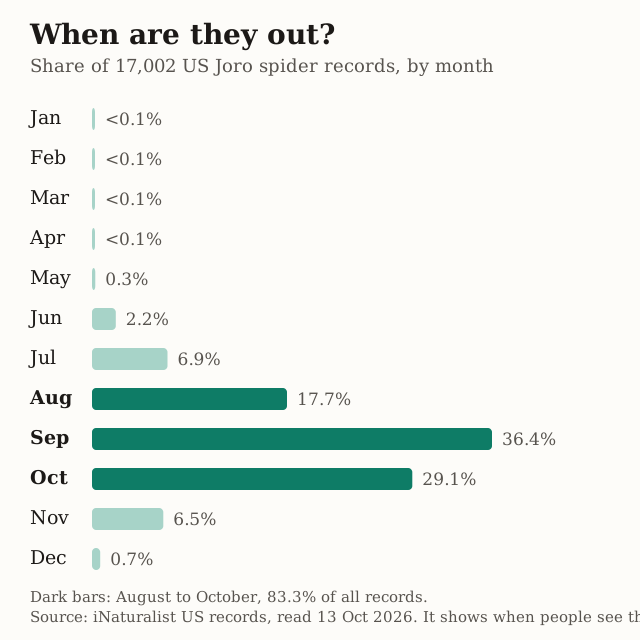
Joro spider season runs from late August to November. Of 17,002 US iNaturalist records, 83% fall in August, September and October, and September alone holds 36%. Eggs hatch in April and May, but the young are small and easy to miss. Females reach full size in late summer, and the adults die with the hard freezes of late fall.
A Joro spider's year in north Georgia
Winter
- What happens
- Eggs wait out the cold inside silk egg sacs (UGA)
April to May
- What happens
- Spiderlings hatch (UGA). Some balloon away on silk (NAISMA)
Summer
- What happens
- Small spiders in small webs of clear silk. Adult colors start to show by mid-summer (UGA)
Mid-August
- What happens
- Females are easy to recognize (UGA)
August to September
- What happens
- Spiders mature (UGA), and males move into the females' webs
September to October
- What happens
- Peak season: 66% of all US iNaturalist records
Mid-October to November
- What happens
- Females spin egg sacs (Rutgers)
Late fall
- What happens
- Freezing weather kills the adults (Rutgers). In Georgia, mature females have been photographed into early December (Penn State)
How long do Joro spiders live? Less than a year. Rutgers puts the whole life cycle at about 6 to 8 months, and there is one generation a year, says UGA.
Why are Joro spiders so bad this year? Two things are going on. First, they seem to appear overnight, because the females only get big and bright in August and September. Second, the records keep climbing. iNaturalist holds 2 US records from 2016, 1,012 from 2021, 2,917 from 2024 and 4,925 from 2025. By mid-October 2026, it had 4,156, with part of the season still to come.
Part of that rise is more people looking and posting, so read it as a trend, not a head count. Big years also come and go. In 2024, Coyle called that summer the third “Joro mania” in as many years.
Joro spider egg sacs
Females lay eggs from mid-October into November, says Rutgers. Each egg sac is a fuzzy, off-white mass of silk that holds several hundred to more than 1,000 eggs, according to UGA. Females fix them to leaves, bark or the sides of buildings. The eggs spend the winter there and hatch in April or May.
If you want fewer Joros nearby next year, this is the easy target. Penn State says egg sacs found in fall or winter can be destroyed before they hatch, and Rutgers agrees for fall. Check that a Joro web hung nearby first, so you do not remove a native spider’s sac by mistake.
Should you kill Joro spiders?
You do not have to, and you do not have to spare them either. UGA Extension’s advice: remove or kill Joros whose webs sit on or next to porches, walkways, decks and doorways, and leave the ones at the edge of the yard. Webs more than about 10 feet up are best left alone unless they are in the way.
No agency in our sources asks people to kill every Joro, and experts disagree. UGA researcher Benjamin Frick said there is “really no reason to go around actively squishing them.” Clemson’s David Coyle, who studies them, says they push out native species and are not as helpful as some claim. Even so, he urges people to “take a measured approach when discussing this pest.”
Are you supposed to kill Joro spiders in Georgia? No rule says so in anything we found. UGA’s advice above is the Georgia answer: deal with the ones by doors, paths and pollinator gardens, and leave the rest. And if you live outside the main range, report the spider before you remove it.
Leave it or remove it
On or next to a porch, walkway, deck or doorway
- What to do
- Remove the spider (UGA). See the steps below
At the edge of the yard, or in shrub beds where nobody walks
- What to do
- Leave it (UGA)
More than about 10 feet up
- What to do
- Leave it, unless it is in the way (UGA)
Near a pollinator garden, flower bed or beehive
- What to do
- Remove it. UGA says not to allow webs there
Near a hummingbird feeder
- What to do
- Clearing it is a reasonable step. Big orb webs sometimes trap small birds
Egg sacs on the house in fall or winter
- What to do
- Destroy them before they hatch in spring (Penn State)
Outside the main range, or the first one you have seen
- What to do
- Photograph it and report it to Joro Watch first
How to get rid of Joro spiders
Start with a broom or a long stick, not a spray. UGA Extension found that wrapping a Joro in its own web and stepping on it works well. Knocking down the web alone fails, because the spider rebuilds it quickly. Carrying a spider off works only if you take it far away, and webs over 10 feet up can stay.
How to remove a Joro spider from a doorway
Make sure it is a Joro
Look for blue-green bands across a yellow back and black legs ringed with yellow. If you live outside Georgia, the Carolinas and Tennessee, take a clear photo and report it to Joro Watch first.
Grab a broom, rake or long stick
UGA Extension lists all three. A long handle keeps your hand well away from the spider. A Joro rarely bites, but there is no reason to test it.
Wind her up in the web
Push the broom into the web beside the spider and twist it, so the spider and her silk wrap around the bristles. UGA Extension found this works very well.
Kill her or carry her far away
Step on the spider once she is on the ground, or carry her well away from the house. UGA warns that a spider moved only a short way may come back.
Clear the rest of the web
Pull down the leftover silk and anchor lines. Then check the same spots over the next few weeks, since a spider can rebuild a web quickly.
Look for egg sacs in late fall
From mid-October on, check eaves, railings and bark near old webs for fuzzy off-white egg sacs. Penn State says sacs found in fall and winter can be destroyed before they hatch.
Skip the area-wide spray
If the broom works, no insecticide is needed. UGA Extension says area-wide sprays and fogging kill pollinators and other helpful insects, and scale insect pests can increase afterward.
Sprays, dish soap and vinegar: what the tests found
Several sprays do kill Joro spiders, but only when they hit the spider. In UGA’s trial, one aerosol spider killer killed every spider it hit. Dawn dish soap at a 1% mix killed only about 40%. Spray that has dried on a wall works poorly, UGA says, because web spiders rarely touch it.
What killed Joro spiders in testing
Black Flag Spider and Scorpion Killer aerosol (lambda-cyhalothrin and prallethrin)
- Result
- 100% killed
- Source
- UGA Extension
Zevo spray (geraniol and cinnamon oil, as tested)
- Result
- Over 97% killed
- Source
- UGA Extension
Sevin ready-to-use spray (lambda-cyhalothrin)
- Result
- Over 80% killed, sprayed from about a foot away
- Source
- UGA Extension
Green Light Insecticidal Soap
- Result
- Over 80% killed, sprayed from about a foot away
- Source
- UGA Extension
Dawn dish soap, 1% in water
- Result
- About 40% killed
- Source
- UGA Extension
Foaming dish soap and machine lubricant
- Result
- High kill rates, but neither is labeled as a pesticide, and the authors do not endorse them
- Source
- Chuang and colleagues, 2025
Low-kill products, checked for whether spiders left their webs
- Result
- None made many spiders leave
- Source
- Chuang and colleagues, 2025
Dried spray on walls and eaves
- Result
- Not very effective. Web spiders rarely touch it
- Source
- UGA Extension
If the broom works, you do not need any of these. If you do spray, spray only the spider. Use a product registered by the EPA for spiders, and follow its label exactly, because the label is the law. UGA notes that today’s formulas may differ from the ones it tested. UGA adds that pyrethroids such as lambda-cyhalothrin are toxic to many other animals, including helpful insects.
Does dish soap or vinegar kill Joro spiders? A 1% Dawn mix failed more often than it worked in UGA’s test. The Clemson-led study found that foaming dish soap killed well. It also tested vinegar, rubbing alcohol, bleach, window cleaner, hair spray and WD-40. Coyle’s warning covers all of them: they are not labeled as insecticides, “therefore it is illegal to use them as such.”
What smell do Joro spiders hate? There is no tested answer. In the 2025 study, none of the products checked for this drove spiders out of their webs in large numbers. We found no study showing that peppermint oil or any other home remedy keeps Joros away.
Joro spider myths
Most Joro spider fear comes from headlines, not from the spider. In 2023, five spider researchers, Clemson’s David Coyle among them, even published a paper calling for “reasonable journalism” about it. Here are 8 claims you will still see, checked against the research. The biggest is the flying giant: only tiny spiderlings drift on silk, and adults never fly.
Myth 1
Myth: “Joro spiders fly.”
Truth: Only spiderlings the size of a sesame seed drift on silk, as many kinds of spiders do. Adults cannot fly (NAISMA).
Myth 2
Myth: “They are giant 8-inch spiders from China.”
Truth: A big female spans about 4 inches with her legs out (Penn State). The first US Joros matched spiders from China or Japan (Hoebeke and colleagues, 2015).
Myth 3
Myth: “A Joro spider bite is dangerous.”
Truth: In a 2025 study, bites were very rare and symptoms were minor and brief (Nelsen and colleagues).
Myth 4
Myth: “Joros will move into your house.”
Truth: They prefer the outdoors. Rutgers says they do not try to get into homes.
Myth 5
Myth: “Joros are good for your yard because they eat stink bugs.”
Truth: They do eat stink bugs. But a web catches rare native pollinators just as readily (Clemson, 2023).
Myth 6
Myth: “Joros are wiping out monarch butterflies.”
Truth: In a UGA test they attacked monarchs in only 20% of trials, and some cut monarchs loose (Davis and colleagues, 2024).
Myth 7
Myth: “A dish soap spray gets rid of them.”
Truth: A 1% Dawn mix killed only about 40% in UGA's test. Clemson's David Coyle says household products are not labeled as insecticides, so using them that way is illegal.
Myth 8
Myth: “Tearing down the web gets rid of the spider.”
Truth: The spider simply rebuilds it, and quickly (UGA Extension).
When to call someone
Usually, nobody. Call 911 for trouble breathing or a swollen face or throat after any bite. See a doctor if a bite keeps getting redder, more swollen or more painful. Report a Joro to Joro Watch. For webs you cannot reach, a licensed pest professional can help, but ask for spot treatment, not fogging.
Who to call, and when
Trouble breathing, swelling of the face, mouth or throat, or fainting after a bite
- Who to call
- 911
- Why
- Signs of a severe allergic reaction (MedlinePlus)
A bite that keeps getting redder, more swollen or more painful
- Who to call
- A doctor
- Why
- Possible infection (MedlinePlus)
Questions about a bite
- Who to call
- Poison Help, 1-800-222-1222
- Why
- Free, confidential and open 24 hours a day (HRSA)
A pet with a swollen face or trouble breathing
- Who to call
- Your vet or an emergency animal clinic
- Why
- The same warning signs as in people
A Joro outside the main range
- Who to call
- Joro Watch, or the EDDMapS app
- Why
- Scientists use the reports to track the spread (UGA)
Dozens of webs on the house, many out of reach
- Who to call
- A licensed pest professional, for spot treatment only
- Why
- UGA warns that area-wide sprays and fogging kill pollinators and helpful insects
Not sure it is a Joro
- Who to call
- Your county Extension office
- Why
- UGA Extension points people to their local office
Pest control disclaimer. Photo-based identification can help, but it is not always perfect. For dangerous spiders, large infestations, or anything you are unsure about, contact a licensed pest control professional.
Medical disclaimer. This page is for general information only. It is not a medical diagnosis. If you have severe symptoms, trouble breathing, swelling of the face or throat, fast spreading redness, fever, severe pain, pus, or signs of infection, contact a doctor or your local emergency number.
Frequently asked questions
Is it safe to pick up a Joro spider?
What is the deadliest spider in Georgia?
Can I keep a Joro spider as a pet?
Do Joro spiders come back every year?
Related guides
Banana spider
The Joro's native cousin with the hairy leg tufts, and the spider that rides in imported bananas.
Spider identifier
Work out which spider you found from its web, eyes and markings.
Black widow spider
Common throughout Georgia, and one of the two US spiders whose bite truly matters.
Brown recluse spider
The violin mark, the six eyes, and where recluses actually live.
House spider
The spiders that really do live indoors, and the cobwebs they leave.
Bug bite identification
If something bit you, compare the usual suspects and the signs that need a doctor.
Sources
- Hoebeke, Huffmaster and Freeman, Nephila clavata L Koch, the Joro spider of East Asia, newly recorded from North America, PeerJ 3: e763 (2015)
- Nelsen and colleagues, Keep calm and carry on: bites from Trichonephila clavata are unlikely and cause minimal discomfort, Journal of Medical Entomology (2025)
- Chuang and colleagues, Chemical management strategies for the invasive Jorō spider, Journal of Economic Entomology (2025)
- Clemson News, Studies show Joro spiders are easy to kill and virtually harmless (October 22, 2025)
- Entomology Today, Jorō spiders: pretty, big, and not very bitey (David Coyle, October 28, 2025)
- UGA Cooperative Extension Circular 1289, Managing Joro spiders in the landscape (Hudson, Joseph and Schmidt)
- Penn State Extension, Jorō spiders (updated September 8, 2025)
- Rutgers NJAES, FS1386: Jorō spider: description, behavior, and contrast with similar species (February 2026)
- UGA Today, Joro spiders likely to spread beyond Georgia (March 3, 2022)
- UGA Today, Joro spiders are shy (May 16, 2023)
- Clemson News, Study shows Joro spiders are here to stay, spreading fast (October 12, 2023)
- University of Georgia via Newswise, Are Joro spiders outcompeting Georgia's native spiders? (August 28, 2026)
- Davis and colleagues, Do invasive Jorō spiders avoid eating unpalatable monarch butterflies in North America?, Insects 15(5): 309 (2024)
- Schronce and Davis, Northern cardinal perches on an invasive Jorō spider web and steals food, Insects 13(11): 1049 (2022)
- NAISMA, The itsy-bitsy Joro spider that's taking the world by storm (Dave Coyle, July 3, 2024)
- UGA Extension, DeKalb County, Joro spiders: friend or foe? (September 12, 2025)
- Joro Watch, University of Georgia Center for Invasive Species and Ecosystem Health
- iNaturalist, Joro spider (Trichonephila clavata) records, read October 13, 2026
- Santa Barbara Museum of Natural History, Joro spider press release (December 16, 2025)
- Biltmore Beacon, Exotic Joro spider discovered in the Smokies (November 25, 2024)
- Mississippi State University Extension, Joro vs. golden silk spider
- UF/IFAS Featured Creatures, Golden silk spider, Trichonephila clavipes, EENY229
- UGA Extension, Towns and Union counties, Spiders (October 22, 2020)
- Chuang, Deitsch, Nelsen, Sitvarin and Coyle, The Jorō spider in the southeastern U.S.: an opportunity for research and a call for reasonable journalism, Biological Invasions 25: 17-26 (2023)
- Wikipedia, Trichonephila clavata (taxonomy, web structure, early sightings)
- Wikipedia, Argiope trifasciata (the banded garden spider)
- Missouri Department of Conservation, Black-and-yellow garden spider
- CDC NIOSH, Venomous spiders at work
- MedlinePlus, Insect bites and stings
- HRSA Poison Help, About the Poison Help line
- US EPA, Introduction to pesticide labels
- United States Mint, Coin specifications