What is a banana spider?
A banana spider is a nickname, not one species. In the US it nearly always means the golden silk orb-weaver, Trichonephila clavipes, a large web spider of the Southeast. Females have a long orange-tan body, banded legs with black tufts, and a golden web 3 to 6 feet across. Males are only about 1/4 inch long.
The name gets stretched to cover at least five spiders. In Hawaii, the Hawaiian garden spider also goes by banana spider. In the Midwest and Northeast, people give it to the black-and-yellow garden spider. And in a grocery store, it means whatever spider rode in with the fruit. That is how the deadly Brazilian wandering spider got mixed up in it.
So the answer depends on where you are and where you found it. Start with this table.
Which banana spider did you find? Start with where you are
A huge golden web in Florida, along the Gulf coast, or in coastal Georgia and the Carolinas
- What it almost certainly is
- Golden silk orb-weaver, Trichonephila clavipes
- Is it dangerous?
- No. It bites only if pinched, and the bite is milder than a bee sting
A big yellow spider with blue-green bands in Georgia or nearby states
- What it almost certainly is
- Joro spider, Trichonephila clavata, an invader from East Asia
- Is it dangerous?
- No. UGA says it poses no threat to people or pets
A black-and-yellow spider in the Midwest, the Northeast or the Plains, with a zigzag in its web
- What it almost certainly is
- Black-and-yellow garden spider, Argiope aurantia
- Is it dangerous?
- No. A bite feels about like a bee sting
A black-and-yellow spider in Hawaii
- What it almost certainly is
- Hawaiian garden spider, Argiope appensa
- Is it dangerous?
- No serious bites reported in the sources we checked
A large brown spider inside a bunch of store bananas
- What it almost certainly is
- Usually a huntsman or a harmless Cupiennius. Rarely a Brazilian wandering spider
- Is it dangerous?
- Treat it as unknown. Keep your hands off it
On a banana plant in Central or South America
- What it almost certainly is
- A Brazilian wandering spider (Phoneutria) or a Cupiennius
- Is it dangerous?
- Phoneutria can be dangerous
Why are they called banana spiders?
There are two stories, and both are true. Clemson’s Home and Garden Information Center says the golden silk orb-weaver got the name from its bright yellow abdomen. The Burke Museum gives an older meaning. At first, banana spider meant any spider that traveled in bunches of bananas, most often the huntsman spider.
That double meaning is why the name scares people. One sense points to a gentle garden spider. The other pulls in every spider that ever hid in a fruit crate, including a venomous one. Texas Master Gardeners list its other names as golden silk spider, calico spider, giant wood spider and writing spider. Many guides, though, including Missouri Conservation, use writing spider for the yellow garden spider.
Carl Linnaeus named the species in 1767. Clavipes means club-footed, a nod to the hairy tufts on its legs. It used to sit in the genus Nephila, so older guides call it Nephila clavipes.
Are banana spiders poisonous?
No. The golden silk orb-weaver has venom, as almost all spiders do, but it is no danger to a healthy person. UF/IFAS says it bites only if held or pinched. The bite causes local pain and slight redness that quickly fade, and it is much less severe than a bee sting.
Poisonous and venomous mean different things. Poison hurts you when you eat or touch it, while venom goes in through a bite or a sting. So a banana spider is not poisonous at all, and its venom matters only to the insects in its web.
It is not aggressive either. A female stays in or near her web and never chases people. Most bites happen when someone grabs one, or walks into a web and pins the spider against bare skin. The garden spiders that share the name bite about like a bee sting too. The one real worry is the Brazilian wandering spider, which has its own section below and almost never reaches a US home.
What a banana spider bite feels like
Expect a sharp pinch, then a small red spot that hurts for a short time. Wash it with soap and water, and hold a cold, damp cloth on it to ease the swelling. These steps match the first aid that NIOSH, part of the CDC, gives for spider bites at work. NIOSH also says to raise the area if you can and not to try to remove the venom. For a black widow or brown recluse bite, it says to get medical care.
A bite on its own cannot tell you which spider made it. If you did not see the spider, our bite and sting chart lists the usual suspects and the signs that need a doctor. In the US, the spiders whose bites truly matter are the black widow and the brown recluse. Neither looks anything like a golden silk orb-weaver.
Kids and pets
The same rules apply to children. This spider will not go after a child, but a child who grabs one may get bitten. Teach kids to look and not touch, and to walk around big webs rather than through them.
We found no reports of a golden silk orb-weaver seriously hurting a dog or a cat. A curious pet may get a mild bite on the nose. If your pet’s face swells or it struggles to breathe, call your vet or an emergency animal clinic right away.
How big do banana spiders get?
A full-grown female banana spider has a body 1 to 1 5/8 inches long (24 to 40 mm), according to UF/IFAS. With her legs spread, she measures about 3 to 5 inches across. Males are tiny by comparison, about 1/4 inch (6 mm). UF/IFAS ranks the female among the largest spiders in North America that are not tarantulas.
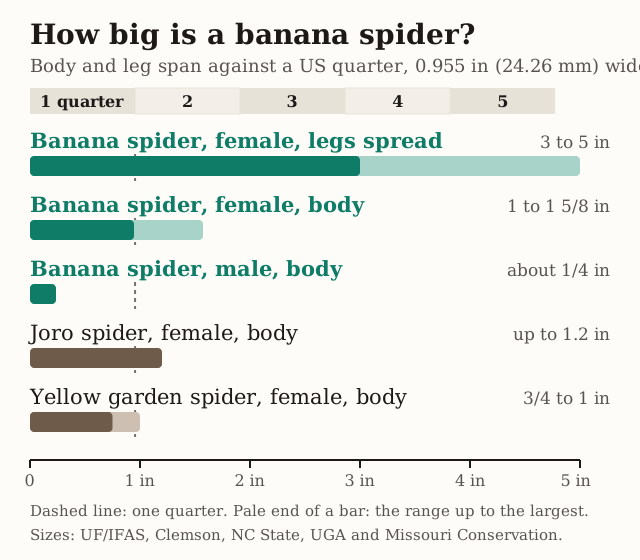
Many websites say a banana spider is 2 to 3 inches long. That figure counts the legs, not the body. Clemson says a female can be 3 inches or more across with her legs spread, and NC State Extension puts the largest near 5 inches. The body alone runs from one US quarter’s width up to about one and two-thirds. Among US spiders, only the tarantulas are much bigger.
Where she lives matters too. In a study published in 2018, Jake Ripp and colleagues measured these spiders along a line from the cities of south Florida out to the countryside. City spiders had legs 60% longer and bodies 35% longer than spiders in parks or rural areas. Their webs were also bigger and higher off the ground. So the giant on a city porch may really be bigger than the ones in the woods.
Male vs female banana spider
The gap between them is huge. You notice the female, the big, colorful one. The male is a slim, dark brown spider about 1/4 inch long, with none of her color and none of her leg tufts. UF/IFAS says males would often go unnoticed, except that they sit in the female’s web.
Males wait there for a chance to mate. Despite the stories, they are rarely eaten. Texas Master Gardeners say a female preying on a male is not common in this species. Research on its mating shows the same, which sets it apart from some close relatives.
What does a banana spider look like?
A female banana spider has a long, cylinder-shaped body, orange-tan to yellow, with two rows of small pale spots. The front of her body is silvery white. Her long legs carry orange-brown and yellow bands, with black tufts of hair on the first, second and fourth pairs. Those tufts are the best single clue.
How to tell it is a banana spider
Most of these should match an adult female. Males and young spiders look different.
A long, cylinder-shaped body
Longer and slimmer than the oval body of a garden spider (Texas Master Gardeners).
Orange-tan to yellow, with two rows of pale spots
Her color changes as she matures. Underneath, she is black, yellow and red (UGA).
A silvery white front end
This is where the legs attach. UF/IFAS says the silver helps her stay cool in hot sun.
Black hair tufts on the legs
On the first, second and fourth pairs, not the third. Clemson compares them to bottle brushes.
A golden web with no zigzag
Fine, golden silk up to 6 feet across, with the spider near the top. If you see a bold zigzag band, think garden spider.
A tiny brown spider nearby
That is the male, about 1/4 inch long.
Young banana spiders are smaller, and their colors change as they grow. UF/IFAS notes that young ones sometimes add zigzag bands of silk to their webs. So in early summer, a zigzag alone does not rule one out.
Banana spider look-alikes
Two spiders get mixed up with the banana spider most. The black-and-yellow garden spider lives in nearly every state and puts a zigzag in its web. The Joro spider, an invader from East Asia, has spread across Georgia and nearby states since 2014. Check the legs first, because only the golden silk orb-weaver has black tufts.
All three are orb weavers, so “orb weaver or banana spider” is a bit of a trick question. It is an orb weaver. It just builds one of the biggest orb webs in North America. Our guide to orb weaver spiders covers the rest of the family, from the spotted orbweaver on the porch to the spiny ones.
Banana spider or look-alike? Check the legs first
Legs
- Banana spider
- Banded orange-brown and yellow, with black hair tufts
- Joro spider
- Black with yellow bands, no tufts
- Yellow garden spider
- Black with yellow-orange bands, no tufts
Body, from above
- Banana spider
- Long and slim, orange-tan to yellow, two rows of pale spots
- Joro spider
- Yellow with wide blue-green bands across it
- Yellow garden spider
- Oval, black with bold yellow patches
Web
- Banana spider
- Up to 6 ft, fine golden silk, no zigzag, spider near the top
- Joro spider
- Large and golden, but messy-looking
- Yellow garden spider
- About 2 ft, with a zigzag band down the middle
Female body length (inches)
- Banana spider
- 1 to 1 5/8
- Joro spider
- Up to 1.2
- Yellow garden spider
- 3/4 to 1
Where
- Banana spider
- Florida, the Gulf states, north to North Carolina
- Joro spider
- Georgia and much of the Southeast
- Yellow garden spider
- Nearly every state
Native?
- Banana spider
- Yes
- Joro spider
- No, from East Asia
- Yellow garden spider
- Yes
Bite
- Banana spider
- Mild, less than a bee sting
- Joro spider
- No threat to people or pets (UGA)
- Yellow garden spider
- About like a bee sting
Yellow garden spider
The black-and-yellow garden spider, Argiope aurantia, is the banana spider of the North. The Missouri Department of Conservation gives the female a body 3/4 to 1 inch long, black with yellow or orange patches. She rests head-down in the middle of a round web about 2 feet across. A thick zigzag of silk runs down the center.
In Illinois, Michigan, Wisconsin or Oklahoma, a banana spider is almost always this garden spider. Those states lie outside the golden silk orb-weaver’s range given by UF/IFAS, but the garden spider is common across the lower 48. SpiderMentor, a spider educator’s blog, lists banana spider among its nicknames. Missouri Conservation lists writing spider, zipper spider and corn spider.
It is just as gentle. A bite happens only if you grab one, and it feels about like a bee sting.
Joro spider
The Joro spider, Trichonephila clavata, is the banana spider’s closest cousin in North America, and an invader from East Asia. A female has a yellow body with wide blue-green bands across it, and black legs with yellow bands but no hair tufts. Her body reaches about 1.2 inches. UGA says Joros pose no threat to people or pets.
Since scientists first confirmed it in Georgia in 2014, it has spread across much of the Southeast. Our Joro spider guide covers where it lives now, what its bite is like, and when to remove one.
Where do banana spiders live?
Golden silk orb-weavers live throughout Florida, across the Gulf states from Texas to Florida, and north to North Carolina, says UF/IFAS. They also range through the West Indies and Central America south to Argentina. They build webs in open woods and along the edges of forests and trails.
The range is shifting, too. NC State says it has moved north, and the spread has been noticed in North Carolina since about 2008.
In Texas, Galveston County Master Gardeners see them across the county from midsummer to late fall. Near the coast, some swampy spots hold them in almost frightening numbers. In South Carolina, Clemson calls them common in mid to late summer, especially in the Lowcountry.
They do well in towns, too. Porches, garage openings and doorways give a web the same firm anchors as trees, Charleston Magazine points out. That is why so many people meet one at the front door.
Outside that range, go back to the table at the top of this page. A banana spider in Illinois, Michigan or New Hampshire is a garden spider. One in Hawaii is the Hawaiian garden spider, which now lives on all the main islands. And one in a grocery store came from somewhere else.
The banana spider web
A banana spider web is often 3 to 6 feet across (1 to 2 meters), says UF/IFAS. The anchor lines that hold it can be 6 to 10 feet long. Its silk has a yellow tint that shines gold in the sun. The spider waits near the top of the web, not the center, so the wheel looks lopsided.
She does not tear the whole web down and start over. UF/IFAS calls it semipermanent. She rebuilds worn or damaged parts and leaves the rest in place, so the same web can hang across a path for a long time.
Look closely and you will see extra threads around the main web. Texas Master Gardeners describe them as non-sticky barrier lines, often hung with plant bits and old prey. They warn the spider when something lands, and they may help keep birds and blowing leaves from crashing through.
Why gold? Texas Master Gardeners say the color may do two jobs. In sunlight, the yellow silk seems to draw in bees. In the shade, it blends into the leaves, which is why so many hikers walk straight into one.
Tiny silver spiders often share the web. These are Argyrodes, 3 to 4 mm long, and they steal the owner’s food. UF/IFAS once counted more than 40 of them in a single abandoned web. That theft may be why the big spider always carries each catch back to the hub.
Can a banana spider web catch a bird?
Rarely, yes. In 2012, Daniel Brooks of the Houston Museum of Natural Science gathered every record he could find of birds caught in spider webs. He found 69 cases worldwide. Where the spider was known, half of the webs belonged to golden orb-weavers. This species caught 14 of them, from hummingbirds to small songbirds such as warblers and vireos. One was a Swainson’s thrush on High Island, in Galveston County, Texas, in 2007.
What do banana spiders eat?
Banana spiders eat small to medium flying insects. UF/IFAS lists flies, bees, wasps, small moths and butterflies, and has also seen them eat small beetles and dragonflies. Texas Master Gardeners add mosquitoes, grasshoppers and stink bugs. The spider bites its prey, wraps it in silk and carries it to the hub to eat.
That makes them useful neighbors. UF/IFAS found them among the two most common orb weavers in Florida citrus groves. They are rarely found in row crops, because nothing there is tall enough to hold a big web. And no, they do not eat bananas. The name has nothing to do with their food.
What eats banana spiders? Birds and damselflies hunt them, according to Texas Master Gardeners. That is one more job for the barrier threads around the web, which work as an early warning.
Banana spider life cycle and lifespan
A banana spider lives about one year. In the US there is one generation a year, says UF/IFAS. Eggs laid in fall spend the winter in a sac and hatch in spring. The spiders grow all summer, and most females reach adult size in August, says UF/IFAS. NC State Extension says the first hard frost usually kills the adult females.
A banana spider's year in the Southeast
Winter
- What you see
- Nothing in the webs. Eggs and young spiders wait inside egg sacs (NC State)
Spring
- What you see
- Tiny spiderlings hatch and leave the sacs (NC State)
Summer
- What you see
- Young spiders in small webs, some with zigzag bands (UF/IFAS)
July to September
- What you see
- Adult males appear, often sitting in the females' webs (UF/IFAS)
August
- What you see
- Most females reach adult size (UF/IFAS). Big webs stay up into late fall (Texas Master Gardeners)
About September into fall
- What you see
- Females spin egg sacs about 5/8 inch to a little over 1 inch across, wrapped in curly yellow silk (NC State, UF/IFAS)
First hard frost
- What you see
- Adult females die. The egg sacs carry the next year (NC State)
This calendar explains when people search. They seem to appear out of nowhere in August, because that is when the females get big. They vanish after the first hard frost. In the far south, where frost comes late, you can still see them well into fall.
Banana spider egg sacs
A female makes at least two egg sacs, each with several hundred eggs inside a basket of curly yellow silk, says UF/IFAS. The swollen female people call a pregnant banana spider is about to make them. Texas Master Gardeners say she spins them on a tree.
If a sac sits somewhere awkward, like a door frame, NC State Extension says you can try moving it. A nearby shrub or tree, outdoors, is a sensible spot. The young will not come out until spring. Keep it outdoors, though. A spider educator writing about garden spider egg sacs says there is no reason to bring one indoors, because the young may leave the sac too early.
The banana spider found in bananas
Spiders do ride in banana shipments, but the dangerous one is rare. In a 2014 study, Richard Vetter and two other arachnologists identified 135 spiders found in cargo brought into North America, most often in bananas. The two most common were the huntsman spider and the red-faced banana spider, a Cupiennius. Spiders of medical importance were rare.
The study found something else worth knowing. Several experienced American arachnologists had mistaken harmless Cupiennius spiders for the dangerous Phoneutria. The two look alike to anyone who does not know tropical spiders. So a news story about a deadly spider in the bananas often has the wrong spider.
The Brazilian wandering spider, genus Phoneutria, is the one with the reputation. It is a large hunting spider, with legs that span 5 to 7 inches. It roams the forest floor at night instead of building a web. When threatened, it lifts its first two pairs of legs high and sways. Most of its species live in South America, many of them in Brazil, and one reaches Panama and Costa Rica.
Its venom is strong, yet most bites are not serious. Fabio Bucaretchi and colleagues studied 422 people bitten in Brazil from 1984 to 1996. Of those, 89.8% had mild symptoms, mostly pain, and only 0.5% had severe ones. Just 2.3% needed antivenom, and one child, aged 3, died. Children under 10 and adults over 70 were most at risk.
The banana spider in your yard against the ones in fruit
How it hunts
- Golden silk orb-weaver
- Sits in a large golden web
- Brazilian wandering spider
- Roams at night and builds no web
- Huntsman and Cupiennius
- Hunts on foot, no catching web
Where it lives
- Golden silk orb-weaver
- Southeast US, native
- Brazilian wandering spider
- South America, mostly Brazil. One species reaches Central America
- Huntsman and Cupiennius
- The tropics. Cupiennius in Central America
How it reaches you
- Golden silk orb-weaver
- It already lives here
- Brazilian wandering spider
- Very rarely, in fruit or cargo
- Huntsman and Cupiennius
- The most common spiders in banana shipments
Danger to people
- Golden silk orb-weaver
- Mild bite, only if pinched
- Brazilian wandering spider
- Venomous. Most bites are mild, a few are severe, mainly in young children
- Huntsman and Cupiennius
- Not a medical concern
Spider eggs inside a banana are a myth. The Burke Museum explains that banana flowers are narrow tubes, and store bananas grow without being fertilized, so eggs have no way in. A spider can leave an egg sac on the outside of a bunch, but that is easy to see. Buglife, a UK charity that protects insects, spiders and other small animals, says to wash it off and eat the banana, because spiderlings that small cannot bite through skin.
If a spider runs out of a bunch of bananas, keep your hands away from it, and keep children and pets back. If it is still in the bag, close the bag and tie it. Take a clear photo from a safe distance and send it to your county extension office or a university insect lab for an ID. If anyone is bitten by a spider from imported fruit, get medical care right away and bring the photo.
Should you get rid of a banana spider?
Usually not. The spider eats flying insects, lives outdoors in its web, and dies at the first hard frost anyway. If a web blocks a door or a path, move the spider with a long stick instead of killing it. UC IPM says insecticides should not generally be used against spiders outdoors, because they give no lasting control.
Leave it, move it, or do something else
A web in the garden, the woods or a corner nobody uses
- What to do
- Leave it. The spider will be gone after the first hard frost
A web across a door, a path or a carport
- What to do
- Move the spider well away with a stick, then sweep the web (steps below)
An egg sac in an awkward spot
- What to do
- Try moving it (NC State). Keep it outdoors
New webs on the house every fall
- What to do
- Sweep them off regularly. Sprays give only short-term results (UC IPM)
A Joro by an entryway in the Southeast
- What to do
- UGA says removing it is reasonable: wind it up in its web with a stick or broom
A spider that came out of imported fruit
- What to do
- Do not touch it. Close the bag and get it identified
How to move a banana spider away from a door
Find a long stick or a broom
Pick something about 3 feet long, so your hand stays well away from the spider. A broom handle, a garden cane or a long branch all work.
Let her climb on
Gently touch the web beside her with the end of the stick. Let her walk onto it, or lift her with a little of her web wound around the end. UGA entomologist Nancy Hinkle gives the same advice for its close cousin, the Joro spider: move it gently with a stick.
Carry her well away
Take her to a tree or a tall shrub at the edge of your yard, far from the door. UGA Extension warns that a spider moved only a short distance may come back.
Set her on a branch
Hold the stick against a branch until she walks off. She will spin a new web in the spot she chooses.
Sweep away the old web
Clear the leftover silk from the door with a broom, so there is nothing to return to. UC IPM suggests sweeping webs off buildings as a regular job.
Skip the spray
If moving spiders and sweeping webs work, no insecticide is needed. UC IPM says sprays give no lasting control of spiders outdoors. Any product you do use must be registered with the EPA and used exactly as its label says, because the label is the law.
Not sure the spider at your door is a banana spider at all? Our spider identifier sorts spiders by their web, eyes and markings. A big spider running across the ground at night, rather than sitting in a web, is more likely a wolf spider.
Banana spider myths
Most of the fear around banana spiders comes from mixing up two very different animals. Here are seven claims you will still see, checked against UF/IFAS, the Burke Museum and the research. The biggest is that the spider in your yard is deadly, when its bite is milder than a bee sting.
Myth 1
Myth: “A banana spider bite can kill you.”
Truth: The US banana spider, the golden silk orb-weaver, bites only if pinched. UF/IFAS says the bite is much milder than a bee sting.
Myth 2
Myth: “Banana spiders are 3 inches long.”
Truth: That is the leg span. The body of a big female is 1 to 1 5/8 inches long (UF/IFAS).
Myth 3
Myth: “Spiders lay their eggs inside bananas.”
Truth: Banana flowers are narrow tubes, and store bananas grow without the flower ever being fertilized. Eggs have no way in (Burke Museum).
Myth 4
Myth: “A big spider in a banana shipment is a Brazilian wandering spider.”
Truth: The most common are huntsman spiders and harmless Cupiennius. Even experienced arachnologists have mixed them up (Vetter and colleagues, 2014).
Myth 5
Myth: “The female always eats the male after mating.”
Truth: Females rarely eat males in this species (Texas Master Gardeners). Research on its mating shows this sets it apart from some close relatives.
Myth 6
Myth: “Banana spiders are an invasive species.”
Truth: The golden silk orb-weaver is native. The invader is its cousin, the Joro spider, first seen in Georgia in 2014 (UGA).
Myth 7
Myth: “A Brazilian wandering spider bite is almost always fatal.”
Truth: In a study of 422 bites in Brazil, 0.5% were severe and 2.3% needed antivenom (Bucaretchi and colleagues, 2000).
When to call someone
Usually, nobody. Call 911 for trouble breathing, or for a swollen face or throat after any bite. See a doctor for a bite that keeps getting worse after a day or two. For a spider that came out of imported fruit, call your county extension office to get it identified.
Who to call, and when
Trouble breathing, swelling of the face, mouth or throat, or fainting after a bite
- Who to call
- 911
- Why
- Signs of a severe allergic reaction (MedlinePlus)
A bite that keeps getting redder, more swollen or more painful
- Who to call
- A doctor
- Why
- Possible infection (MedlinePlus)
Questions about a bite
- Who to call
- Poison Help, 1-800-222-1222
- Why
- Free, confidential and open 24 hours a day (HRSA)
A bite from a spider that came out of imported fruit
- Who to call
- A doctor or urgent care, right away
- Why
- A few tropical spiders in cargo are venomous, and they are hard to tell apart (Vetter and colleagues, 2014)
A large spider found in imported fruit
- Who to call
- Your county extension office or a university insect lab
- Why
- Even experts have confused the harmless ones with the dangerous one
A pet with a swollen face or trouble breathing
- Who to call
- Your vet or an emergency animal clinic
- Why
- The same warning signs as in people
Webs on the house every fall
- Who to call
- Usually no one
- Why
- A broom does the job, and UC IPM advises against outdoor sprays for spiders
Pest control disclaimer. Photo-based identification can help, but it is not always perfect. For dangerous spiders, large infestations, or anything you are unsure about, contact a licensed pest control professional.
Medical disclaimer. This page is for general information only. It is not a medical diagnosis. If you have severe symptoms, trouble breathing, swelling of the face or throat, fast spreading redness, fever, severe pain, pus, or signs of infection, contact a doctor or your local emergency number.
Frequently asked questions
Can I pick up or hold a banana spider?
Do banana spiders jump?
Can you keep a banana spider as a pet?
Is a golden orb-weaver the same as a banana spider?
What is the most dangerous spider in the US?
Related guides
Spider identifier
Work out which spider you found from its web, eyes and markings.
Joro spider
The banana spider's invasive cousin from East Asia: a mild bite, where it lives by state, and when to remove one.
Black widow spider
One of the two US spiders whose bite truly matters, and how to spot the hourglass.
Brown recluse spider
The violin mark, the six eyes, and where recluses actually live.
Tarantula spider
The big, hairy spiders that outsize almost every other US spider, and why the hairs hurt more than the bite.
Wolf spider
The big spider that runs across the floor at night instead of sitting in a web.
Bug bite identification
If something bit you, compare the usual suspects and the signs that need a doctor.
Orb weaver spiders
The whole family of round-web spiders: the common US types, the web, and why they vanish at the first freeze.
Sources
- UF/IFAS Featured Creatures, Golden silk spider, Trichonephila clavipes, EENY229
- Clemson Home and Garden Information Center, Banana spiders (2021)
- N.C. Cooperative Extension, Onslow County, Spiders... Big Spiders... Oh My! (2025)
- Texas Master Gardeners, Galveston County, Banana spider / golden silk spider
- University of Georgia CAES, Joro or not? Test your spider-spotting skills (October 30, 2025)
- Missouri Department of Conservation, Black-and-yellow garden spider
- UC IPM Pest Notes, Spiders (2020)
- CDC NIOSH, Venomous spiders at work
- MedlinePlus, Insect bites and stings
- Vetter, Crawford and Buckle, Spiders found in bananas and other international cargo, Journal of Medical Entomology 51(6): 1136-1143 (2014)
- Bucaretchi and colleagues, A clinico-epidemiological study of bites by spiders of the genus Phoneutria, Revista do Instituto de Medicina Tropical de São Paulo 42: 17-21 (2000)
- Burke Museum, Myth: spider eggs in bananas
- Buglife, Brazilian wandering spider in bananas: fact or fiction (2015)
- Brooks, Birds caught in spider webs: a synthesis of patterns, Wilson Journal of Ornithology 124(2): 345-353 (2012)
- Ripp and colleagues, The successful exploitation of urban environments by the golden silk spider, Journal of Urban Ecology 4(1) (2018)
- Charleston Magazine, Face your fears and take a closer look at the giant banana spider (2020)
- SpiderMentor, "Banana" spider (2017)
- Wikipedia, Trichonephila clavipes (name and mating research)
- Wikipedia, Phoneutria (range, size and behavior)
- Wikipedia, Argiope appensa (Hawaii)
- Wikipedia, Argiope aurantia (range and bite)
- HRSA Poison Help, About the Poison Help line
- US EPA, Introduction to pesticide labels
- United States Mint, Coin specifications