What is a tarantula?
A tarantula is a spider, and one of the biggest on Earth. Every species belongs to one family, Theraphosidae. The World Spider Catalog lists 1,209 species in 192 genera, and scientists name new ones every year.
Most of them live in warm places. They dig burrows, hunt at night and move slowly. So you rarely see one unless it is walking in the open, which usually means a male looking for a female.
| Fact | Details | Source |
|---|---|---|
| Family | Theraphosidae | World Spider Catalog |
| Number of species | 1,209 in 192 genera | World Spider Catalog |
| Size in the US | Body up to about 2 in; leg span up to about 5 in | Britannica, Missouri Dept. of Conservation |
| Biggest species | Goliath birdeater, leg span about 12 in, over 6 oz | Britannica, NWF |
| Active | At night, mostly | San Diego Zoo, Desert Museum |
| Lifespan | Females 25 to 30+ years; males a few months after maturing | Missouri Dept. of Conservation, Texas A&M |
| Bite | Like a bee sting for US species | MedlinePlus |
How big do tarantulas get?
American species are big for a spider, but not huge. According to Missouri’s Department of Conservation, a female Texas brown has a body about 2 inches long. Males are smaller, at about 1.5 inches.
With the legs spread out, a US tarantula covers about the palm of your hand. Britannica puts the leg span of the southwestern species at up to about 5 inches.
The giants live in South America. The Goliath birdeater has a leg span of about 12 inches. It can also weigh more than 6 ounces, which makes it the heaviest spider known.
Even so, it rarely eats birds, despite its name. Britannica calls that a rare event rather than its normal diet.
Where the name comes from
The word first belonged to a different spider. It comes from Taranto, a town in southern Italy, and it named a local wolf spider, Lycosa tarantula.
People once blamed that spider’s bite for a wild dancing sickness called tarantism. That belief gave us the tarantella dance. Later, the name moved across the ocean to the big hairy spiders of the Americas, and it stuck.
Is a tarantula a spider?
Yes, it is a full member of the spider order, Araneae. It is not an insect, because insects have six legs and three body parts. A tarantula has eight legs and two body parts, like every spider.
It is not a mammal either, since it has no backbone and no fur, only bristles. And it is only a “bug” in everyday speech, since scientists save that word for one group of insects.
You may hear that it is “not a true spider.” That phrase is shorthand, not science. Spiders split into two big groups, and tarantulas sit in the older one, the mygalomorphs.
The easiest way to see the split is the fangs. A tarantula’s fangs stab straight down, like two picks, while most other spiders have fangs that pinch in from the sides.
The body differs inside too. Mygalomorphs breathe with two pairs of book lungs, while most other spiders have only one pair.
| Question | Answer | Why |
|---|---|---|
| A spider? | Yes | Eight legs, two body parts, silk and venom fangs |
| A true spider? | Yes, but an old branch | A mygalomorph, with fangs that strike down |
| An insect? | No | Insects have six legs and three body parts |
| A bug? | Only in everyday speech | Scientists save the word bug for one insect group |
| A mammal? | No | No backbone, no fur, and it hatches from an egg |
| An arachnid? | Yes | The same class as scorpions, ticks and mites |
Tarantula or wolf spider? How to tell
Many “tarantulas” people post online turn out to be something else. On Reddit, the usual answer is a wolf spider. After heavy rain, it is often a trapdoor spider instead.
That is good news, because the tests below are quick. Better still, they work on a photo.
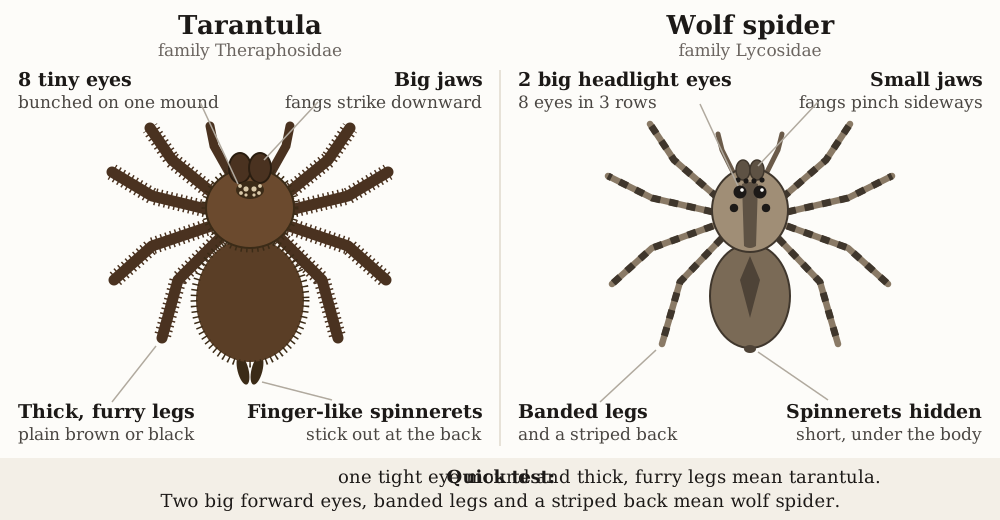
Signs you found a real tarantula
Check each clue below to narrow down what you saw.
Eight tiny eyes on one bump
The eyes sit close together on a small mound at the front of the head. No single pair stands out.
Thick, furry legs
The legs look as fuzzy as the body. They are plain brown or black, with no bands.
Big, heavy body
A US species spans about the palm of your hand, and the body alone can reach 2 inches.
Slow, careful walk
These spiders plod along. A big spider that sprints across the floor is almost always a wolf spider.
Two finger-like spinnerets
Look at the rear end. Two spinnerets stick out there like short fingers.
Fangs that point down
Seen from the side, the fangs fold under the head. Trapdoor spiders share this, so check the eyes too.
| Spider | Eyes | Body and legs | Where you meet it |
|---|---|---|---|
| Tarantula | 8 tiny eyes bunched on one bump | Very hairy, thick plain legs, up to 5 in across | Dry grassland and desert, 12 states; males roam late summer and fall |
| Wolf spider | 2 large eyes face forward, 8 in 3 rows | Striped back, banded legs, fast runner | Lawns, gardens and homes in every state |
| Trapdoor spider | Bunched like a tarantula's | Shiny, far less hair, short thick legs | Pops out of burrows after heavy rain |
| Fishing spider | 8 eyes in two even rows | Long legs, often banded, flatter body | Near ponds, streams and docks |
The trapdoor spider is the hardest one, since it is a close cousin. Both have bunched eyes and downward fangs. However, a trapdoor spider looks shiny and has far less hair, while a tarantula looks like it wears a fur coat.
Still not sure? Our wolf spider guide shows the eye pattern up close. The spider identifier also works through the other common families.
Where do tarantulas live?
They live in warm parts of every continent except Antarctica. Most species live in Central and South America. Others live in Africa, Asia and Australia, and a few reach southern Europe.
Wherever they live, most of them dig in. They use burrows in dry, open ground, often an old rodent hole lined with silk. Some tropical species live in trees instead, inside silk tubes.
Which US states have tarantulas?
Twelve states have wild tarantulas, and their range stops at the Mississippi River. That count comes from the 2016 study by Hamilton, Hendrixson and Bond, which mapped every US species.
So the popular claim that they live only in the Southwest is wrong. Missouri, Arkansas, Louisiana and Kansas all have them too.
| State | Wild tarantulas? | Notes |
|---|---|---|
| Arizona | Yes | Many species, including two found on just one mountain range each |
| California | Yes | Several species, from the southern coast to the Sierra Nevada foothills |
| Nevada | Yes | Widespread |
| Utah | Yes | Including the Grand Canyon black, on high ground |
| Colorado | Yes | Best known in the southeast grasslands around La Junta |
| New Mexico | Yes | Several species, including the Grand Canyon black |
| Texas | Yes | Common across most of the state |
| Oklahoma | Yes | Texas brown |
| Kansas | Yes | Texas brown |
| Missouri | Yes | South and central; the Missouri River seems to block them from the north |
| Arkansas | Yes | Texas brown |
| Louisiana | Yes | Texas brown, at the eastern edge of the range |
| Florida | One introduced species | Mexican redrump tarantulas found in a St. Lucie County grove in 1996 |
States with no wild tarantulas
No state east of the Mississippi has native tarantulas, and the northern states have none either. That includes Indiana, Ohio, Pennsylvania and Washington.
So if you live there, the big hairy spider in your basement is almost certainly something else. The usual suspects are wolf spiders and fishing spiders.
There is one exception worth knowing. If the spider is brightly colored, like orange, blue or striped, it may be an escaped pet. For example, one Reddit user found a Brazilian white-knee in the yard, a species with no wild US population.
Why you see tarantulas in late summer and fall
If you saw one crossing a road, it was almost certainly a male. After years in a burrow, a male matures and leaves home for good. Then he walks, sometimes for weeks, following the scent of females.
This walk is a one-way trip. Texas A&M notes that males rarely live more than two or three months after they mature. Many die from heat, cold or predators, and some get eaten by the female.
| Region | Main months | Source |
|---|---|---|
| Sonoran Desert, Arizona | July to September, with the summer rains | Arizona-Sonora Desert Museum |
| Texas | A few weeks each summer, into fall | Texas A&M field guide |
| Missouri | Late summer and fall | Missouri Dept. of Conservation |
| Southeast Colorado | Mid-September to mid-October; peak around the turn of the month | NPR, 2025 |
| Joshua Tree, California | Autumn | National Park Service |
The best time to spot one is the hour before dusk, when the heat drops. Some towns even celebrate the season. For instance, La Junta, Colorado, draws visitors every fall to watch the males cross the grasslands.
Common tarantula species in the US
The United States has 29 species, all in one genus, Aphonopelma. That number comes from the 2016 study, which merged many older names that turned out to be the same spider.
Most of them look alike. In fact, Texas A&M says even experts need a mature male and a microscope to name the species.
| Common name | Scientific name | Where it lives |
|---|---|---|
| Texas brown tarantula | Aphonopelma hentzi | Texas north to Colorado, Kansas and Missouri, and east to Arkansas and Louisiana |
| Desert blonde tarantula | Aphonopelma chalcodes | Across Arizona, south of the Colorado River |
| Grand Canyon black tarantula | Aphonopelma marxi | High ground in Arizona, New Mexico, Utah and Colorado |
| California ebony tarantula | Aphonopelma eutylenum | Southern California, west of the Mojave Desert |
| Johnny Cash tarantula | Aphonopelma johnnycashi | Plains and foothills of California's western Sierra Nevada |
The Johnny Cash tarantula earned its name in 2016. The males are solid black, and the species lives near Folsom Prison, which the singer made famous.
How many eyes do tarantulas have?
They have eight eyes, set in a tight group on a small bump at the front of the head. Still, the eyes are weak. The American Museum of Natural History says their vision is poor.
Instead, the spider “sees” with its hairs. Thousands of fine hairs on the legs and body pick up tiny vibrations. That is how it feels a cricket walking past the burrow in the dark.
Do tarantulas make webs?
They make silk, but they do not spin webs to catch prey. Instead, they use silk as a building material. A burrow gets a silk lining, which keeps the walls from falling in and gives the spider grip.
- Trip lines around the burrow entrance, which warn the spider when prey walks by
- A silk mat to lie on while it sheds its skin
- An egg sac, which the female guards in the burrow
- A small sperm web that a male builds before he goes looking for a mate
That last one often gets described wrong. The male leaves sperm on his little web, then loads it into his two front feelers. He delivers it to the female himself, and she stores it until she lays her eggs.
What do tarantulas eat?
In the wild, they eat mostly insects. For the desert blonde, the Desert Museum lists crickets, beetles, grasshoppers, cicadas and caterpillars. Big ones also take scorpions, small lizards and even mice.
Most of them hunt from ambush. One waits near the burrow mouth, feels the prey through its trip lines, then rushes out and grabs it. Next, it bites to inject venom and holds on while the venom works.
Then comes the strange part. The spider cannot swallow solid food, so it pours digestive juices onto the prey. The juices turn it to liquid, and the spider sucks it up with a pumping stomach.
What eats tarantulas?
Birds, coyotes, foxes, lizards and snakes all eat them. But the most famous enemy is a wasp, the tarantula hawk. It is one of the largest wasps in the US, with a metallic blue body and orange wings.
A female tarantula hawk stings the spider, which paralyzes it but does not kill it. She drags it into a burrow and lays a single egg on it. When the egg hatches, the young wasp eats the living spider.
New Mexico made this wasp its state insect in 1989.
Tarantulas do fight back, though. New World species rub their back legs over the abdomen and kick off a cloud of tiny barbed hairs. That is why many of them have a bald spot there.
How long do tarantulas live?
Females live a very long time for a spider. Missouri’s Department of Conservation says a female may live more than 30 years. Males live much shorter lives, because they die soon after they mature.
How long a male takes to mature depends on the species. The San Diego Zoo gives a range of 3 to 12 years. For the desert blonde, the Desert Museum puts it at 8 to 10 years.
As it grows, the spider sheds its hard outer skin, which is called molting. It lies on its back to do it, so a molting tarantula can look dead.
The empty skin it leaves behind also looks like a whole spider. In addition, it can even regrow a lost leg.
Are tarantulas dangerous?
For most people, no. A tarantula will not chase you, and it bites only when someone grabs or corners it. In fact, a threatened one usually rears up and shows its fangs first, or simply walks away.
The bite
According to MedlinePlus, the venom of US species is not considered dangerous. A bite hurts like a bee sting, and the spot may turn warm and red.
Keepers also report “dry” bites, with no venom at all, which leave just two small punctures. Pet species are a different story, though.
Some Old World species, from Africa and Asia, carry stronger venom. Keepers bitten by them report hours of intense pain and muscle cramps.
The hairs are the bigger problem
The hairs they kick off have tiny barbs. When they land on skin, they can raise itchy, swollen bumps that last for weeks. As one Reddit keeper put it, be more afraid of the hairs than the bite.
The eyes need the most care. Poison Control describes a man who let his pet tarantula walk on his face. A doctor later found about 200 hairs stuck in one eye.
So never hold one near your face. Also, wash your hands after touching one.
Tarantulas and pets
A curious dog or cat is more likely to meet the hairs than the fangs. Watch for pawing at the face, squinting, sneezing, drooling or gagging after your pet sniffs one. If any of these last, call your vet.
For milder cases, MedlinePlus advises washing the bite with soap and water. Then hold ice wrapped in a cloth on it, 10 minutes on and 10 minutes off.
To pull hairs out of skin, press duct or masking tape on the area and peel it off. Repeat until the hairs are gone.
Not sure what bit you? Our bug bite identification guide can help. The bee sting guide covers the same kind of pain in more detail.
The spiders that do matter medically in the US are different animals. See our guides to the black widow and the brown recluse.
Found a tarantula? What to do
Leave it alone if it is outside. It is almost certainly a male passing through, and it will move on by itself. It also eats insects around your home, so it does a small, useful job.
- Keep kids and pets back, and do not pick it up with bare hands.
- If it is indoors, set a large container over it and slide stiff card underneath.
- Carry it outside and let it go near shrubs or rocks, away from the door.
- Seal gaps under doors and around pipes, because that keeps the next one out.
- If it is brightly colored and your state has no wild ones, it may be a lost pet.
Also, check local rules before you keep one. In Missouri, for example, you need a permit to collect them from public land.
Not sure what you found? Snap a photo and try our bug identifier. If the animal has huge jaws and seems to have ten legs, read our camel spider page instead.
Medical disclaimer. This page is for general information only. It is not a medical diagnosis. If you have severe symptoms, trouble breathing, swelling of the face or throat, fast spreading redness, fever, severe pain, pus, or signs of infection, contact a doctor or your local emergency number.
Pest control disclaimer. Photo-based identification can help, but it is not always perfect. For dangerous spiders, large infestations, or anything you are unsure about, contact a licensed pest control professional.
Frequently asked questions
Are tarantulas harmful to humans?
Do any US states have tarantulas?
Are there tarantulas in Florida?
What is a tarantula's worst enemy?
Are tarantulas poisonous?
What happens if a tarantula kicks hairs at you?
Can you survive a tarantula bite?
Can a tarantula recognize you?
Do tarantulas keep frogs as pets?
Do all tarantulas have eight eyes?
Are tarantulas nocturnal?
How much does a tarantula weigh?
Do tarantulas have fangs?
Related guides
Wolf spider
The big, fast spider most often mistaken for a tarantula, with its telltale headlight eyes.
Spider identifier
Work out which spider you found from its eyes, markings and web.
Camel spider
Another large desert arachnid, which is not a spider and has no venom.
Brown recluse spider
One of the two US spiders whose bite truly matters, and how to spot it.
Bug bite identification
If something bit you, narrow down what it likely was.
Sources
- Hamilton, Hendrixson and Bond (2016), Taxonomic revision of the tarantula genus Aphonopelma within the United States, ZooKeys
- World Spider Catalog, family list (Theraphosidae)
- Missouri Department of Conservation, Texas brown tarantula
- Texas A&M AgriLife, Field Guide to Common Texas Insects: Tarantula
- Arizona-Sonora Desert Museum, Desert blonde tarantula fact sheet
- National Park Service, Tarantula (Joshua Tree)
- NPR via KUOW, Male tarantulas are moving and wooing their way across Colorado (2025)
- American Museum of Natural History, Ten things to know about tarantulas
- MedlinePlus, Tarantula spider bite
- Poison Control, Tarantula and scorpion bites and stings
- Florida DPI, The Mexican redrump, an exotic tarantula established in Florida
- Britannica, Tarantula
- San Diego Zoo Wildlife Alliance, Tarantula
- State Symbols USA, New Mexico state insect: tarantula hawk wasp
- Mongabay, Meet the new spider named after Johnny Cash
- The Drake Center for Veterinary Care, Are tarantulas dangerous to dogs and cats?
- Wikipedia, Dotted humming frog (summarizing Cocroft and Hambler 1989 on its partnership with Xenesthis immanis)