What are fleas?
Fleas are wingless insects of the order Siphonaptera, and they feed on blood alone. CDC counts more than 2,500 flea species worldwide and more than 300 in the United States. Only a handful of them matter to people or pets. An adult is no larger than about 1/8 inch (1 to 3 mm), and it moves by jumping. Fleas do not have wings and cannot fly, which surprises people who see one land on a sock from across the room: that was a jump.
A flea is built for life inside fur. Its body is flattened side to side, so it walks on edge between hairs instead of over them. Spines on its head and back point backward, which means a scratching pet cannot drag it out easily.
That shape is also why the bug you caught was so hard to kill. A flea’s shell takes real pressure, and readers who finally catch one keep saying the same thing: it would not squash. Roll it between two fingernails, or drop it in soapy water.
What do fleas eat?
An adult flea eats blood and nothing else. The larvae in your carpet do not bite at all. Instead, they eat flea dirt, the dried blood an adult passes as waste, plus skin flakes and other debris. Larvae also eat flea eggs, so a carpet feeds the next generation on its own.
How fleas find a host
A flea senses body heat, movement, the vibration of footsteps and the carbon dioxide in breath, CDC says. So a cocoon that has sat quiet for months can open when you walk past it. That is why people who return from a long holiday are swarmed inside the front door, and it is also why daily vacuuming helps. The noise and pressure pull them out of hiding.
How to tell a flea from everything else
Three checks settle it, and you can do all three in a minute. A flea is 1 to 3 mm long, so roughly a sesame seed. Seen from above it is a thin sliver rather than an oval, because the body is flat side to side. Finally it jumps, and the cat flea’s longest measured jump was 19 inches (48 cm).
Three checks that settle it
Check each clue below to narrow down what you saw.
It jumps
No bed bug, louse or carpet beetle jumps, so a hop of several inches is close to proof. A cat flea's longest measured jump was 19 inches (48 cm).
It is thin from above, and tall from the side
A flea is flattened side to side, so it walks on edge between hairs. A bed bug is the opposite shape: wide, flat and oval.
It is hard to squash
A flea resists a fingernail, while a bed bug or a carpet beetle crushes easily. Roll it between two nails, or drop it in soapy water.
Table 1. Fleas and the bugs people mistake for them
Flea
- Size
- 1 to 3 mm
- The one check
- Jumps, thin from above, hard to squash
- Read next
- What fleas look like
Bed bug
- Size
- 1 to 5 mm
- The one check
- Wide, flat oval. Never jumps, and hides in the bed frame
- Read next
- Bed bug look-alikes
Carpet beetle larva
- Size
- 2 to 5 mm
- The one check
- Hairy and bristly, crawls slowly, eats wool not blood
- Read next
- Carpet beetles
Springtail
- Size
- 1 to 3 mm
- The one check
- Jumps, but soft, and it springs from a forked tail. Likes damp
- Read next
- Small black bugs
Tick nymph
- Size
- About 1.5 mm
- The one check
- Eight legs, round and flat, crawls and never jumps
- Read next
- Flea vs tick
Head louse
- Size
- 2 to 3 mm
- The one check
- Pale, grips hair, cannot jump at all
- Read next
- Head lice
A full walk through colour, size and the hind legs sits on our guide to what fleas look like, with the look-alikes beside them. If what you found was flat and oval instead, start with bed bug look-alikes. Eight legs and no jump means a tick, and our flea vs tick comparison draws both to scale. Something tiny and pale in hair is more likely head lice or nits.
How far can a flea really jump?
Several ranking pages say fleas jump 7 inches high and 13 inches across. When researchers measured cat fleas in 2000, the average long jump was 7.8 inches (19.9 cm), and the 13 inches sits closer to the dog flea. Our guide to what fleas look like has the full measurements, drawn to scale.
Types of fleas
Five fleas turn up in US homes and yards, yet one of them does nearly all the biting. The cat flea, Ctenocephalides felis, is the usual flea on cats and on dogs, and it bites people too. Its cousin the dog flea is rare here. Each of the other three keeps to a particular animal or place: the human flea, the oriental rat flea and the sticktight flea.
Table 2. The fleas that matter in the US
Cat flea (Ctenocephalides felis)
- Where you meet it
- On cats, dogs and many wild mammals, everywhere in the US
- Bites people?
- Yes
- Why it matters
- Nearly every flea in a US home. Carries murine typhus, cat scratch bacteria and tapeworm
Dog flea (Ctenocephalides canis)
- Where you meet it
- Rare in the US, commoner in Europe
- Bites people?
- Yes
- Why it matters
- Looks like the cat flea. Telling the two apart needs a microscope, and the treatment is the same
Human flea (Pulex irritans)
- Where you meet it
- Nests, burrows and farms; US records mostly west of the Mississippi
- Bites people?
- Yes
- Why it matters
- Lives in the host's nest rather than on the host. Uncommon in American homes
Oriental rat flea (Xenopsylla cheopis)
- Where you meet it
- On rats, mainly in ports and cities
- Bites people?
- Yes
- Why it matters
- The global plague vector, and it also spreads murine typhus
Sticktight flea (Echidnophaga gallinacea)
- Where you meet it
- Poultry in the southern US, and pets that roam
- Bites people?
- Rarely
- Why it matters
- Clamps onto the ears and face of birds and stays there
Ground squirrel flea (Oropsylla montana)
- Where you meet it
- Wild rodents in the rural West
- Bites people?
- Yes
- Why it matters
- The flea behind most US plague cases, which is why CDC warns against rodent dens
Cat fleas and dog fleas are not the same thing
Despite the name, the cat flea is the flea on American dogs. UC IPM, Merck’s veterinary manual and Ohio State all say so, and the dog flea Ctenocephalides canis is rare in the United States. Telling the two apart needs a microscope anyway, since the difference is the shape of the head and a row of notches on the hind leg. For an owner it changes nothing: the treatment is the same.
Do other animals get fleas?
Rabbits, guinea pigs, ferrets, poultry, rats, mice, squirrels, opossums and raccoons all carry fleas. The cat flea is not fussy, and CAPC lists many mammal and bird hosts for it. Wildlife matters indoors as well as outdoors, because a raccoon in the attic or a rat under the floor brings its fleas with it.
Never treat a rabbit, a bird or any small pet with a product meant for a dog or a cat. The label names the species and the weight it is safe for, and the label is the law. Ask the vet first.
The flea life cycle
Fleas pass through four stages: egg, larva, pupa and adult. A female lays about 20 to 50 eggs a day once she has fed, UC IPM says, and the whole cycle usually takes 3 to 8 weeks. Eggs are smooth and slide off the pet within hours, so they land where the animal sleeps.
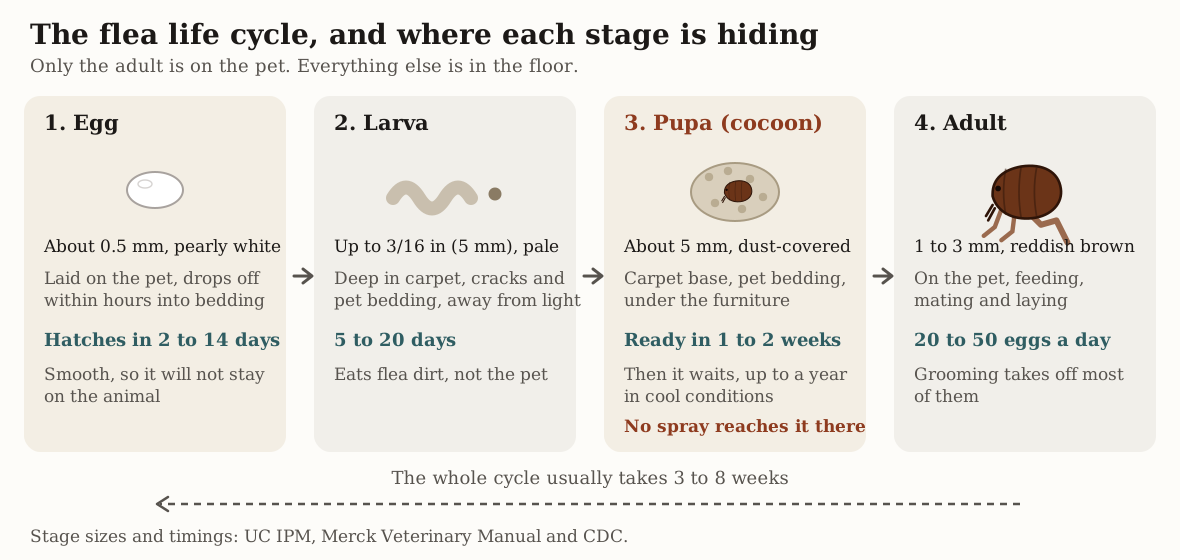
Larvae hatch within about 2 to 14 days, depending on warmth and humidity. They are pale, legless and about 3/16 inch (5 mm) at most, and they crawl away from light into carpet, floorboard cracks and pet bedding. Then each one spins a sticky cocoon that picks up dust and hair, which hides it completely.
Inside that cocoon the flea finishes growing in 1 to 2 weeks. After that it waits. A fully formed adult can stay shut in for months, and UC IPM and Merck both put the limit near a year in cool conditions. Nothing you spray reaches it there, which is the single most useful fact on this page.
Our guide to flea eggs shows what the eggs and larvae look like on bedding, and flea droppings covers the black specks that feed them.
How fast do fleas multiply?
Sources disagree here, and the gap is worth knowing. UC IPM gives 20 to 50 eggs a day, Ohio State says 15 to 20, and Texas A&M measured an average of 27. The famous “2,000 eggs” figure traces to lab cats wearing collars that stopped them grooming. On a cat that grooms normally, the real total is far lower.
Where do fleas come from?
Fleas arrive on an animal, nearly every time. Pets pick up newly emerged adults outdoors in shaded, damp spots where other animals rest, such as under a deck or a shrub. Wildlife keeps restocking those spots, and UC IPM names feral cats, opossums, squirrels and coyotes. People also carry them home on trousers and socks.
Fleas but no pets
This is the commonest question in flea forums, and the answer is almost never “nothing”. In the threads we read, the source turned out to be one of four things.
Table 3. Where fleas come from in a home with no pets
A previous tenant or owner had pets
- What it looks like
- Bites start days or weeks after moving in, with no animal in the house
- What to do
- Vacuum daily to pull fleas out of the cocoons, and tell the landlord in writing on day one
A neighbour's animal, or one you feed
- What it looks like
- Fleas near a door, a porch, a shared wall or a fed cat's spot
- What to do
- Keep the animal out of the room, then treat that room first
Wildlife inside the structure
- What it looks like
- Fleas in one room only, often a bathroom with a hard floor
- What to do
- Look in the attic, crawl space, chimney and wall voids, and have the animal removed before you treat
You carried them in
- What it looks like
- A few fleas after a visit to a home with pets, and no new ones later
- What to do
- Hot wash the clothes, shower, and watch the floor for two weeks
One pattern is worth repeating. When the trouble is concentrated in a bathroom or around a tub on a hard floor, look at what is inside the wall or under the house, not at the floor.
What attracts fleas?
Heat, movement, vibration and breath, which is the same list CDC gives for how they find a host. No smell, colour or blood type pulls a flea toward one person. White socks do not attract them either; they simply show up dark against white, which is why walking the house in white knee socks is the standard test.
Where fleas hide, and can they live in your bed?
Fleas do not nest in a mattress the way bed bugs do. Adults stay on the pet, and the eggs, larvae and cocoons gather exactly where the animal sleeps. So if the cat sleeps on your duvet, you can find eggs, flea dirt and even larvae there. Carpet, the gaps between floorboards, rugs, upholstered furniture and the pet’s own bed hold the rest.
How long do fleas live?
That depends on which flea you mean, and the published numbers look wildly different until you see why. On cats that groomed normally, adult fleas averaged 7.8 days. On lab cats that could not groom, Dryden recorded some still alive after 113 days. Off a host entirely, a newly emerged adult usually dies within 1 to 2 weeks.
Which number you need
Four situations, four very different answers. Find yours in the table, and skip the rest.
Table 4. Four flea lifespans, and why they disagree
An adult on a pet that grooms itself
- How long it lives
- About 8 days on average
- Why it differs
- Cats and dogs groom most of them off, so few reach old age
An adult on a pet that cannot groom
- How long it lives
- 30 to 40 days, and 113 days in one lab study
- Why it differs
- Nothing removes them, which is the lab figure the big egg counts come from
A newly emerged adult with no host
- How long it lives
- 1 to 2 weeks in most homes
- Why it differs
- It starves, and dry air kills it faster
A finished adult still inside its cocoon
- How long it lives
- Up to about a year in cool conditions, with 30 weeks measured at 52F (11C)
- Why it differs
- It is waiting, not feeding, and the cocoon protects it
Those four numbers answer four different questions, so an article that gives you one of them is answering somebody else’s. The cocoon figure is the one that matters when a house stands empty, and it explains why a flea problem can restart weeks after everything seemed quiet.
Do fleas die in water?
Soapy water kills them, which is why vets and extension offices tell you to dip a flea comb in it. Plain water is less certain, and no source we could open measured how long a flea survives in it, so we will not invent a number. A bath with ordinary soap does kill the adults on a pet, though it leaves nothing behind to stop the next ones.
Flea season, and do fleas die in winter?
Flea numbers climb through late spring and peak in late summer and early fall across most of the United States. Ohio State puts the worst months at July through October, while UC IPM sees the California rise in spring and early summer. Outdoors, cold does end them: every stage dies when it stays below 37F (3C) for several days, Merck says.
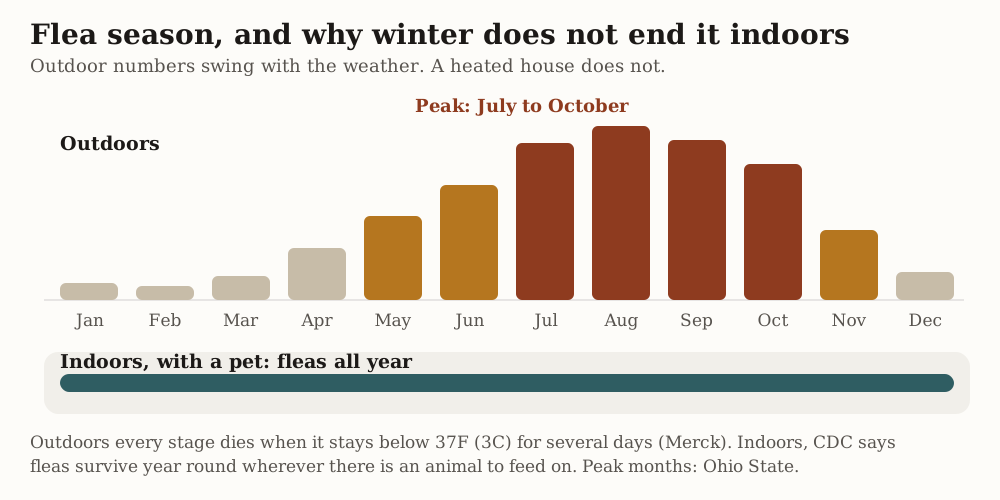
Indoors is a different story. A heated house with a pet in it carries them all year, and CDC says plainly that fleas survive year round wherever there is an animal to feed on. A hard freeze outside therefore does nothing for a living room. In the warm South, larvae also survive outdoors through the winter.
So a December flea is not a mystery, and it is not proof that your treatment failed. Keep pets on year-round prevention if your vet advises it, and keep vacuuming while the cocoons empty.
Do fleas bite people?
Yes, though fleas prefer furred animals and bite us when an animal is not available, CDC says. Bites usually land on the lower legs, feet and ankles, since that is as high as a flea jumps from the floor. UC IPM describes the mark as a small red spot with a red halo and little swelling, and the itch can last up to 5 days.
No bite pattern names a bug. Nobody can diagnose a flea bite from a photograph, and the “groups of three” line that travels around the internet has no medical source behind it. Our guide to cat flea bites covers what they look like and when a bite needs a doctor, and flea vs mosquito bite handles the commonest mix-up.
Why is only one person getting bitten?
Because reactions differ, not because a flea picks favourites. Ohio State notes that some people show no reaction at all after weeks of bites, so two people in one house can get the same number of bites and only one of them itches. Check the floor and the pet rather than trusting the skin.
Can fleas live on people?
No. Cat and dog fleas feed on people and leave, and they cannot keep a population going on a human, since we have no fur for them to hide and breed in. Showering and a change of clothes deal with any that hitched a ride. Can humans get fleas answers the hair question in full.
Are fleas dangerous?
Mostly fleas are a nuisance, yet a few illnesses are real. Murine typhus appears mainly in California, Texas and Hawaii, and symptoms start 3 to 14 days after exposure. Plague averages five US cases a year, almost all of them in the rural West. Cat scratch disease and flea tapeworm both travel through flea droppings or a swallowed flea.
Table 5. Flea-borne illness in the US: reference only, not a diagnosis
Murine typhus
- How it reaches people
- Flea droppings scratched into broken skin
- Where in the US
- Mainly California, Texas and Hawaii
- What to watch for
- Fever, headache, chills and body aches 3 to 14 days after exposure, with a rash in about half of cases
Plague
- How it reaches people
- A bite from an infected wild rodent flea, or handling an infected animal
- Where in the US
- Rural West: northern New Mexico, northern Arizona, southern Colorado, and parts of California, Oregon and Nevada
- What to watch for
- Fever with a swollen, painful lymph node 2 to 8 days after a bite. Seek medical care immediately
Cat scratch disease
- How it reaches people
- A cat's scratch carrying flea droppings into the skin
- Where in the US
- Anywhere cats and fleas live, most cases in fall and winter
- What to watch for
- A bump or blister at the scratch, then swollen, tender lymph nodes 1 to 3 weeks later
Flea tapeworm (Dipylidium)
- How it reaches people
- Swallowing an infected flea, usually a child or a pet during grooming
- Where in the US
- Anywhere fleas live
- What to watch for
- Segments like rice grains near a pet's tail or in its bed. Most people have no symptoms at all
Two points keep this in proportion. Flea-borne illness in the United States is uncommon, and plague comes from wild rodent fleas in the West rather than from the cat flea on your sofa. They also do not spread Lyme disease.
Pets carry their own risks, and those are more common than the human ones. Flea allergy dermatitis follows a single bite in a sensitive animal, and heavy infestations can make a kitten or puppy anaemic. A young animal with fleas, pale gums and no energy needs a vet the same day.
Medical disclaimer. This page is for general information only. It is not a medical diagnosis. If you have severe symptoms, trouble breathing, swelling of the face or throat, fast spreading redness, fever, severe pain, pus, or signs of infection, contact a doctor or your local emergency number.
Fleas on pets
Start at the base of the tail and the back of the neck, because that is where they gather and where a pet cannot groom well. Comb that fur over damp white paper. Black specks that smear reddish brown are flea dirt, which is dried blood, so the smear is close to proof even when you never see a flea.
Then treat every cat and dog in the home on the same day, with a product your vet chooses for that animal’s species and weight. One treated pet and one untreated pet keeps the cycle running. Spot-ons, oral products and some collars work better than shampoos, powders and dips, which UC IPM calls less effective and more hazardous.
Our guides go further for each animal: signs of fleas on dogs, signs of fleas on cats, and what kills fleas on dogs instantly for the fast-acting options and what they do not fix.
How to get rid of fleas
CDC sets out four steps: clean up, treat every pet, treat the home at the same time, then follow up. Give it weeks rather than days, and Merck puts a typical home at 6 weeks to 3 months. Start with the free work, because vacuuming does more than people expect.
Vacuum every day, especially where the pet sleeps, and get under furniture and along baseboards. When Ohio State researchers tested this in 2007, vacuuming killed 96% of adult fleas and all of the larvae and pupae it collected. Wash pet bedding in hot water weekly, and steam clean carpet if you can, since steam kills every stage.
Expect more fleas after treatment, not fewer. Cocoons survive insecticides, so adults keep emerging for about 2 weeks afterwards, and UC IPM says to keep vacuuming instead of spraying again. That wave is the treatment working, which is the opposite of what it feels like.
Products come last, and only EPA-registered ones used exactly as the label says. The indoor products that work best contain an insect growth regulator, such as methoprene or pyriproxyfen, which stops eggs and larvae developing but does not kill adults. Flea control at home runs the whole job in order. For the kitchen-cupboard tricks, home flea remedies weighs the evidence on salt, Dawn and vinegar, while food grade diatomaceous earth for fleas explains why dusting a carpet with it is the wrong move.
Bugs with “flea” in the name that are not fleas
Four common bugs carry the word flea without being one. Sand fleas on a US beach are usually mole crabs, which have no claws or biting mouthparts at all. Snow fleas are springtails. Water fleas are Daphnia, a tiny crustacean in ponds. Flea beetles are plant-eating beetles under 1/10 inch long that jump when disturbed.
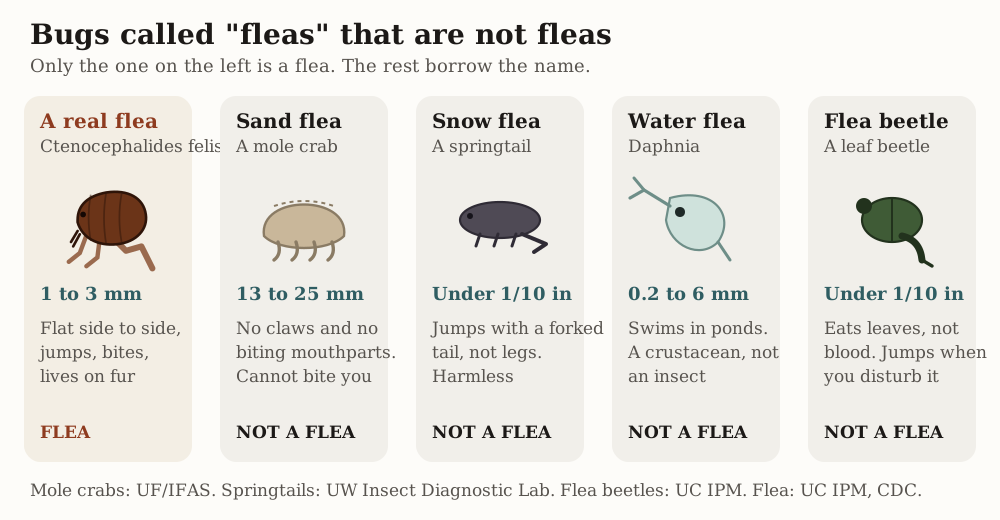
The beach is the confusing one, because something there really does bite. Biting midges, the no-see-ums, are flies 1 to 2 mm long, and they are the usual cause of itchy spots after a day on the sand. Our guides to beach fleas and beach flea bites separate the animals from the bites.
Snow fleas jump with a forked tail that snaps against the ground, not with hind legs, and they are harmless. If you are looking at tiny dark jumping specks indoors, Little black bugs in the house runs through the possibilities.
Flea myths, corrected
Myth 1
Myth: “Fleas can jump 13 inches across.”
Truth: Measured cat fleas averaged 7.8 inches, with a record of 18.9 inches. The 13-inch figure comes closer to the dog flea's average, and the dog flea is rare in the US.
Myth 2
Myth: “95% of the fleas are in your carpet and 5% on the pet.”
Truth: One dermatology reference gives that split, yet no extension source we opened repeats it. The useful version needs no number: adults live on the pet, while the eggs, larvae and cocoons that replace them sit in the carpet.
Myth 3
Myth: “Vacuuming just moves fleas into the bag, where they keep breeding.”
Truth: The Ohio State test killed 96% of the adults and every larva and pupa it picked up. Vacuuming does miss larvae deep in carpet pile, so it collects less than you hope, but what it collects dies.
Myth 4
Myth: “A flea bomb will clear the house.”
Truth: Foggers settle on open surfaces and miss the larvae at the base of carpet fibres and under furniture, which is where they live. UC IPM, UMN and Ohio State all say so, and Washington State's health department adds that foggers cause fires.
Myth 5
Myth: “Flea bites always come in threes.”
Truth: No medical or extension source gives a count. Cleveland Clinic describes a line or a cluster, and the NHS says groups below the knee.
Myth 6
Myth: “Fleas die off on their own once the pets are gone.”
Truth: Adults with no host die within 1 to 2 weeks, but the cocoons wait for months. An empty house can swarm the day someone walks back into it.
Myth 7
Myth: “Garlic, brewer's yeast or a vitamin B tablet keeps fleas off a pet.”
Truth: UC IPM, Ohio State and UF all tested the idea and found no effect. Ultrasonic devices and herbal collars do nothing either.
Pest control disclaimer. Photo-based identification can help, but it is not always perfect. For dangerous spiders, large infestations, or anything you are unsure about, contact a licensed pest control professional.
Fleas FAQ
Are fleas contagious between people?
Are fleas more active at night?
What should I do after visiting a house with fleas?
Will a dehumidifier get rid of fleas?
How do I know whether they are really gone?
Can fleas live in a litter box or on a hard floor?
Related guides
Flea bites on humans
What a bite looks like, where it lands, and when one needs a doctor.
What do fleas look like?
Size, colour and the hind legs, with the look-alikes beside them.
Flea eggs and larvae
The salt-like specks on a pet bed, and what hatches out of them.
Flea dirt
Black grit that smears red on damp paper, and what it tells you.
How to get rid of fleas
The whole job in order: pets, vacuum, the home, then the follow-up.
Home remedies for fleas
Salt, Dawn, vinegar and baking soda, each with its evidence.
Diatomaceous earth for fleas
What DE does, what the label allows, and why dusting carpet fails.
Fleas on dogs
Signs, the comb test, and treating dog and house together.
Fleas on cats
Why dog products can kill a cat, and what vets use instead.
What kills fleas on dogs instantly?
How fast each option works, and what none of them fixes.
Can humans get fleas?
Why fleas bite people but cannot live in human hair.
Sand fleas
Mole crabs, beach hoppers and the midges people blame for bites.
Sand flea bites
Itchy spots after the beach, and which animal really caused them.
Flea vs tick
Six legs and a jump, or eight legs and a crawl, drawn to scale.
Flea bites vs mosquito bites
The bumps look alike, so the room and the pet settle it.
Bugs that look like bed bugs
Fourteen look-alikes to scale, with the one check for each.
Bug bite identification
Flea bites beside mosquito, bed bug, tick and spider bites.
Sources
- CDC, About fleas: species, flea-borne diseases and how fleas find a host
- CDC, Getting rid of fleas: the four-step plan and follow-up timing
- UC IPM Pest Notes 7419, Fleas: cat flea biology, egg counts, emergence and control
- Merck Veterinary Manual, Fleas of dogs: life cycle, cold tolerance and how long control takes
- CAPC, Fleas: hosts, how long a cocoon can wait, and survival off the host
- Ohio State Extension HYG-2081, Fleas: peak months, jump figures and bite reactions
- Cadiergues, Joubert and Franc 2000, A comparison of jump performances of the dog flea and the cat flea