Why fleas keep coming back
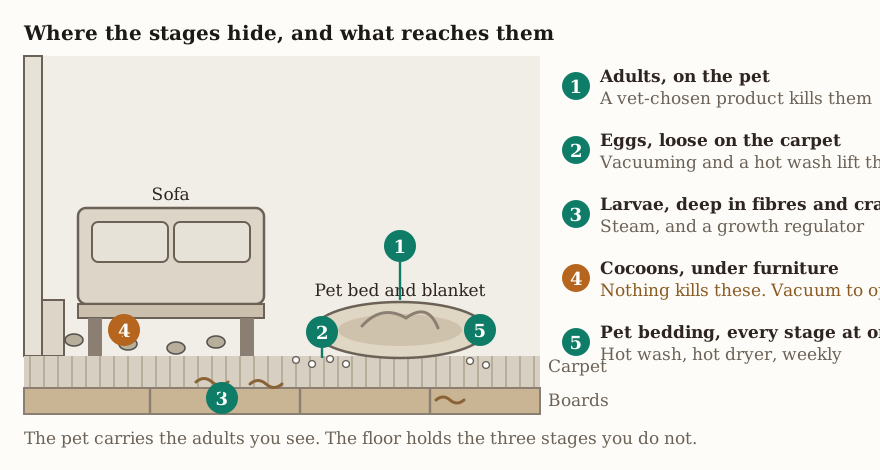
Adult fleas on the pet are the small, visible part of the problem. The eggs, larvae and cocoons sit in carpet, floor cracks and pet bedding instead, and one cocoon can hold a finished adult for up to 12 months. So new fleas keep appearing for weeks after a good treatment. That second wave is normal. It is also the key to how to get rid of fleas: the best way is to treat the pet and the house together. Even then, nothing rids a house of fleas forever, because any animal coming in can bring more.
Here is the cycle in short. A female starts laying within about a day of her first blood meal, and UC IPM counts 20 to 50 eggs a day. She lays them on the animal, yet they are not sticky, so they drop off within hours wherever your pet sleeps, sits and walks.
Those eggs hatch into tiny worm-like larvae. Larvae avoid light, so they wriggle down to the base of carpet fibers, under furniture and into floorboard cracks. They do not bite anyone. Instead they eat flea feces, the dried blood the adults leave behind.
After 5 to 20 days the larva spins a sticky silk cocoon and pulls in dust, hair and carpet fiber as camouflage. That cocoon is the reason a treatment can look like a failure. No spray gets through it, and the adult inside simply waits.
What wakes it up is you. Warmth, the pressure and vibration of footsteps, and the carbon dioxide in your breath all tell the flea that a host has arrived. Vacuuming does the same thing, which is why daily vacuuming is a weapon rather than a chore.
The 95 percent claim, and what the sources say
You will read everywhere that 95 percent of fleas live in your home and only 5 percent on the pet. The principle holds, though the number is thinner than it looks. Among the sources we opened, only DermNet gives it, as “pets carry about 5% of the total flea population”.
University entomologists make the same point without a percentage. Eggs fall off the animal within hours, and larvae and cocoons develop where the pet rests, so the home holds the bulk of any flea population. Act on the rule, then treat the exact split as an estimate nobody has pinned down.
Fleas but no pets
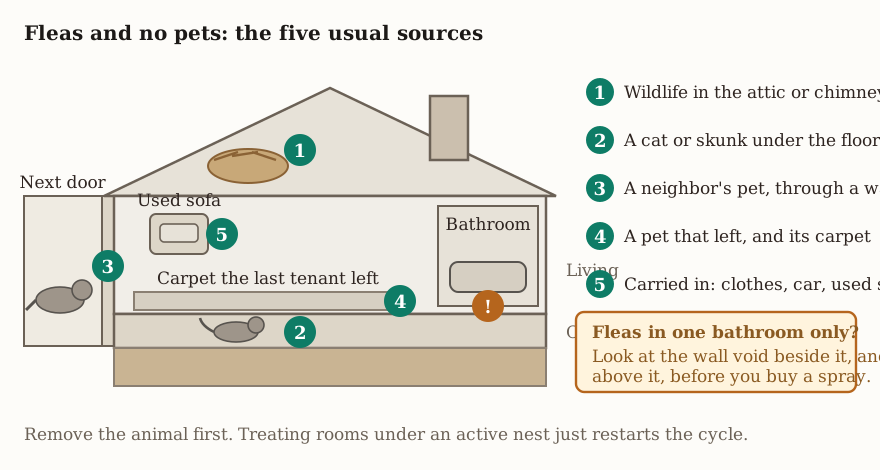
Fleas in a home with no animals still have a source, and it is usually one of four. A pet that recently left or died. The last tenant’s cat or dog. A neighbor’s animal, through a shared wall or yard. Or wildlife, which is the one people miss.
University of Kentucky entomologists list raccoons, opossums, skunks and squirrels in an attic or chimney, plus a feral cat under the floor. Remove the animal first, through a wildlife or pest professional. Otherwise you treat the rooms while a nest sits above them, and the problem restarts.
One pattern repeats in forum posts: no pets, hard floors, and fleas concentrated in a single bathroom. That points at a wall void or a crawl space beside that room, so look behind and above before you buy anything.
How to get rid of fleas, step by step
Eight steps show you how to get rid of fleas in a home, and only two of them cost money. Treat every pet on day one, strip and wash everything soft, then vacuum daily for at least 2 weeks. Reach for a spray only when fleas still turn up after a month of that.
The flea control plan in 8 steps
Treat every pet on the same day
Ask your vet for a flea product for every dog and cat in the home, whether a spot-on, an oral tablet or a collar, then give them all on the same day. One untreated animal keeps the whole cycle running. Never put a dog product on a cat, because permethrin and amitraz can kill one. Follow the label for species and weight.
Bathe and comb the itchiest animal
A bath in plain soapy water kills the adults on your pet, and CDC calls soap a gentle insecticide. Comb afterwards over a bowl of soapy water, working around the neck and the base of the tail. It brings relief today, although it leaves no protection for tomorrow.
Clear the floors
Pick up clothes, toys and anything soft from the floors, then pull storage out from under the beds and the sofa. Larvae live in that clutter, and anything on the floor blocks your vacuum. The step costs nothing, yet it decides how well every later step works.
Wash all the bedding hot
Strip the pet beds, the blankets they lie on and any human bedding they sleep on. Wash it all in hot, soapy water, then dry it on the hottest cycle the fabric allows. Heat kills eggs, larvae and adults together, so laundry is the most reliable weapon you own.
Vacuum every day, everywhere
Vacuum carpets, rugs, hard floors, upholstery and the edges of every room, plus under the furniture. Then empty the canister into a tied bag in an outside bin. Daily passes also shake cocoons open, so the fleas inside meet a treated pet instead of waiting.
Do the car and the rooms you skipped
Give the car the same treatment, along with any room you skipped. Vacuum the seats, the carpet and the cracks, then wash or hot-dry the blanket your pet travels on. Fleas ride back indoors from a car, and that is a common reason a cleared house fills up again.
Use a spray with a growth regulator, only if you need one
Still seeing fleas after 4 weeks? Choose an EPA-registered indoor product whose ingredients include methoprene or pyriproxyfen, and treat carpet, under furniture and pet resting spots. Never spray a pet with it. Follow the label on drying time and re-entry, because the label is the law.
Keep going, then judge it at 4 weeks
Keep vacuuming for 2 weeks after the last flea, and keep every pet on prevention. Walk the rooms in white socks each evening and count what jumps on. If adults still appear more than 4 weeks after a treatment, retreat the house or call a licensed professional.
The order matters more than the products do. If sanitation and pet treatment succeed, an insecticide treatment is not required at all, which is the same rule we apply to every pest. For the animal itself, our guides to fleas on a dog and fleas on a cat cover the checks, the products by class and the vet conversation.
What kills fleas at each life stage
No single method kills all four stages, and that is why half-done flea jobs fail. Soap and water kill adults on contact. A hot wash and steam kill every stage they reach. Vacuuming kills what it collects, and a growth regulator stops eggs and larvae becoming adults. Nothing kills a cocoon.
The four flea stages, where each one sits, and what reaches it
Adult, about 1/16 to 1/8 in (1.5 to 3 mm)
- Where it is
- On the pet, feeding, for most of its life
- What kills it
- A vet-chosen flea product; soapy water on contact
- What does not
- Carpet sprays, which it rarely touches
Adult, newly emerged
- Where it is
- In the carpet, waiting for a host, 1 to 2 weeks without a meal
- What kills it
- An indoor adulticide; a vacuum; a treated pet it jumps onto
- What does not
- Waiting it out: the next cocoon opens behind it
Egg, pearly white, about 0.5 mm
- Where it is
- Loose on carpet, bedding and anywhere the pet rests
- What kills it
- Hot washing; vacuuming; an insect growth regulator
- What does not
- Most adulticides, which are not made for eggs
Larva, up to about 3/16 in (5 mm)
- Where it is
- Down at the base of carpet fibers, in cracks, under furniture
- What kills it
- Steam; a growth regulator; drying out below 50% humidity
- What does not
- A fogger, which never reaches the fiber base
Cocoon, holding a finished adult
- Where it is
- Glued into carpet, under furniture, in floor gaps
- What kills it
- Nothing. Vibration, warmth and time make it open
- What does not
- Every spray, dust and bomb on the shelf
Two rows there deserve a note. Vacuuming is both better and worse than its reputation, and we give the evidence below. The cocoon row is the honest one: no product on a shelf kills a flea inside its cocoon, so the plan has to outlast them instead. If the bug you caught might have eight legs, our flea or tick comparison settles it in one look.
Getting rid of fleas in the house
How to get rid of fleas in the house comes down to four free habits, and the house is the slow half of the job. Vacuum every day, including under furniture and along the edges of rooms. Wash all the bedding hot. Steam the worst carpet if you can. Then repeat for 2 to 4 weeks, while the cocoons keep opening.
Vacuuming, and what it really does
Vacuuming does two jobs at once, and the second one matters more. First, it lifts eggs, larvae and flea dirt out of the carpet. Second, it warms and shakes the carpet, so cocoons open early and the new adults meet your treated pet.
An Ohio State study put numbers on the first job. A standard upright vacuum killed an average of 96 percent of the adult fleas it collected, plus all the larvae and pupae in those tests. So the old worry about fleas breeding happily inside the bag does not hold up.
Collection is the weaker half. Texas A&M puts carpet removal at 15 to 30 percent of larvae and 30 to 60 percent of eggs in one pass, because larvae grip the fibers hard. That gap is exactly why one deep clean fails and daily passes win.
Vacuum every day, or every other day at the least, and keep going for 10 days to 2 weeks after any treatment. Push the nozzle under beds, along baseboards, under cushions and into the spot where your pet sleeps. Emptying the canister outside costs nothing, so do it anyway.
Washing bedding, yours and the pet’s
A hot wash and a hot dryer cycle kill fleas at every stage, so laundry is the most dependable step here. Wash pet bedding weekly at least, and wash any human bedding a cat or dog sleeps on at the same time. Dry everything on the hottest setting the fabric allows.
Soft things you cannot wash go into the dryer alone for a full hot cycle, or into a sealed bag for several weeks. Rugs, throws, cushion covers and the dog’s favorite blanket all count. If a pile of clothes lives on the bedroom floor, wash that too, since larvae do well in it.
Steam, carpets and furniture
Steam cleaning kills all four stages on contact, and both EPA and university extensions list it for bad infestations. Rent or borrow a machine, then work the rooms your pet uses most. Be ready for a wave of fleas a day or two later, because the heat and moisture trigger the cocoons.
After steaming, go back to the daily vacuum. Deep carpet, the gap under a sofa cushion and the foot of the bed are the three places larvae gather, so give each one extra passes. Hard floors still need attention, since the cracks between boards hold the same stages.
Fleas in the car
A car gets treated like a room, and people forget it until the fleas return. Vacuum the seats, the carpet, the trunk and every crack between and under the seats. Then wash or hot-dry any blanket or cover your pet travels on.
Park in the sun with the windows closed when you can, because heat makes a car hostile to larvae. Do not set off a fogger inside a vehicle. An indoor product’s label does not cover a car, and a fogger in that space brings a fire risk for very little gain.
Flea sprays and insect growth regulators
If cleaning alone has not won after a month, an indoor spray is the next step rather than the first. The products that work hold two things: an adulticide, and an insect growth regulator such as methoprene or pyriproxyfen. The regulator stops eggs and larvae developing, though it kills no adults.
Read the active ingredients panel before you buy, because plenty of shelf products carry only the adulticide. In published trials, pairing an adulticide with pyriproxyfen stopped more than 99 percent of the young fleas for months. On its own, a growth regulator still works, yet it needs 4 to 6 weeks to show.
Treat where the stages actually are. Carpet, rugs, under and behind furniture, under beds and the pet’s sleeping spots all want the spray. Hard floors usually do not, although they still want vacuuming. Keep people and pets off treated surfaces until the label says they are dry.
House flea products: what each class does, and the catch
Adulticide spray for carpet
- What it hits
- Adult fleas, as they emerge and walk on the treated surface
- The catch
- No effect on eggs inside a cocoon, so one treatment is rarely enough
Insect growth regulator (methoprene, pyriproxyfen)
- What it hits
- Eggs and larvae, which never become adults
- The catch
- Kills no adults, and takes 4 to 6 weeks alone. Methoprene breaks down in sunlight
A product combining both
- What it hits
- Adults plus the next generation
- The catch
- The one worth buying. Check the active ingredients panel, not the front of the can
Carpet powders and dusts
- What it hits
- Registered borate products kill larvae in carpet
- The catch
- No effect on adults, and not for homes with crawling infants
Total release fogger, the bug bomb
- What it hits
- Adults on open surfaces only
- The catch
- Misses the carpet base and under furniture. Flammable near a pilot light
Light traps
- What it hits
- Some adults, which stick to the board
- The catch
- A monitor, not a treatment. It reaches no eggs, larvae or cocoons
A note on dusts. Registered boric acid and borate carpet products do kill larvae, which researchers have measured, but they do nothing to adults. Diatomaceous earth is a longer argument with a label rule of its own, so it has its own page on how diatomaceous earth kills fleas.
Do flea bombs and foggers work?
Mostly no, and five university or state health sources say so. A total release fogger sprays upward and settles on open surfaces, so it misses the larvae at the base of the carpet and the cocoons under your sofa. Kentucky entomologists call foggers “seldom effective” against fleas.
UC IPM, Ohio State, Minnesota, Maryland and Washington State reach the same verdict. Washington’s health department adds two hazards: foggers are flammable near a pilot light, and they cause breathing illness when people go back in too early. Follow the label exactly if you use one anyway.
The disagreement is worth showing you. DermNet lists a flea bomb among home measures, and Merck’s veterinary manual mentions fogger sprays. Neither explains how the fog is meant to reach the carpet base. Given the weight on the other side, we put a direct spray and a growth regulator first every time.
Forum veterans land in the same place. In the 490-comment thread that outranks most articles for “fleas in house”, bombs are the step people report buying first and regretting. The fog never reaches the pupae, so the wave that follows reads to them like failure.
How long it takes to get rid of fleas
Expect fleas for 2 to 4 weeks after you start, then plan on 6 weeks to 3 months for a moderate or severe infestation. Merck’s veterinary manual gives that outer range, and CDC says months. One flea on day 20 is not proof that the plan failed.
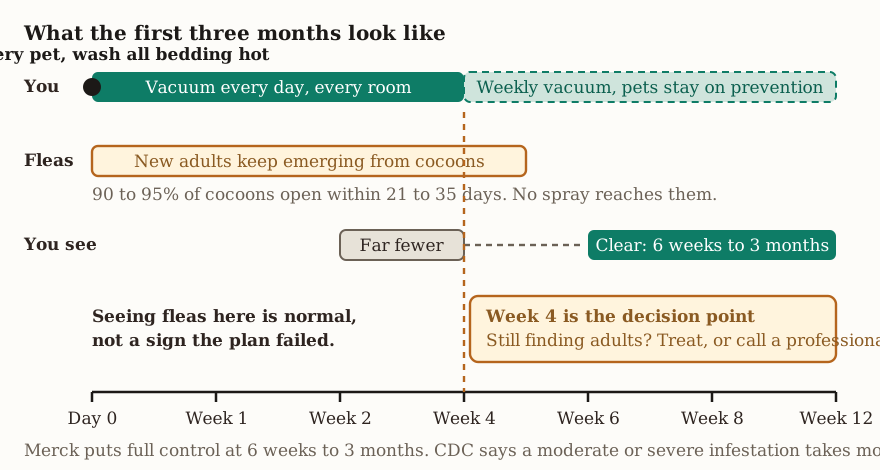
Why so long? Because you are waiting out every cocoon. In a temperate US climate, 90 to 95 percent of them open within 21 to 35 days once conditions suit, so the back half of your first month is the noisy part. Keep the pets treated and those fleas die as they emerge.
Some pest pages put a shorter number on it, and the figure we see most often is 2 to 4 weeks. That is the right window for fleas to drop off sharply, not for finishing. The honest version holds two numbers: far fewer fleas within 2 to 4 weeks, and a clear house in 6 weeks to 3 months.
Several things stretch the timeline. An untreated animal in the home, or a neighbor’s cat coming in. A room you skipped. A long gap between vacuums. Cool rooms slow the cocoons down as well, which pushes the last stragglers further out.
Measure instead of guessing. Walk each room in white knee socks for a minute every evening and count what jumps on, a check UC IPM and University of Kentucky both describe. Three fleas on Monday and one on Friday is progress, even when it does not feel like it.
Fleas in your bed
Fleas do not live on people, and they do not set up home inside a mattress. Where a cat or dog sleeps on the bed, though, eggs, flea dirt and larvae land in the bedding. So the answer is laundry and a vacuum rather than a mattress spray.
Strip the bed and wash everything hot, including the duvet cover and the pillowcases. Vacuum the mattress, the base and the floor around the bed, then empty the canister outside. Keep the pet off the bed until the house is clear, if you can manage it.
Black specks on a sheet are usually flea dirt rather than fleas. Wipe them onto damp white paper and watch for the red-brown smear that gives them away. If something bit your ankles overnight, our guide to flea bites on the ankles shows what those bites look like, and whether fleas can live on you answers the question behind it.
Fleas in the yard
Treat the shade, never the whole yard. Flea larvae die in sunny, dry turf, so most lawns hold almost none. Merck’s veterinary manual says spraying a whole yard is not worthwhile. Target the dog run, the kennel, the deck underside, the crawl space and the shaded strip where your pet lies.
Do the sock test outdoors first, so you know whether the yard is part of your problem at all. Then mow, rake up leaf litter and open the damp shade in those few spots. Wildlife reseeds a yard, so closed bins, a sealed crawl space and a fenced run beat a sprayer.
If you do treat outdoors, use an EPA-registered product labeled for fleas and for that surface, and follow the label on re-entry and on pets. A product with pyriproxyfen holds up better in sunlight than methoprene does. Yard treatment has no page of its own here yet, so this is the short version.
What does not work
Several popular fixes have no evidence behind them, and a few bring real risk. Brewer’s yeast, garlic and vitamin B1 do not stop fleas feeding. Ultrasonic devices do not repel them either, since adults and larvae cannot hear those sounds. Herbal collars fail in the same way.
Myth 1
Myth: “A flea bomb will clear the house.”
Truth: A fog settles on open surfaces, so it misses the larvae at the carpet base and the cocoons under furniture. Five university and state health sources advise against foggers for fleas, and Washington State adds a fire risk near pilot lights.
Myth 2
Myth: “Vacuuming just moves fleas into the bag, where they breed.”
Truth: An Ohio State study measured 96 percent of collected adults dead, plus every larva and pupa in those tests. Empty the canister outside anyway, because it costs nothing and settles the worry.
Myth 3
Myth: “No pet in the house means the fleas starve in a few days.”
Truth: Newly emerged adults live 1 to 2 weeks without a meal, and cocoons wait far longer. Empty homes are famous for swarming the day someone walks back in, so an empty house is not a cure.
Myth 4
Myth: “Spray the whole yard along with the house.”
Truth: Flea larvae die in sun and dry turf, so a lawn rarely holds many. Merck's veterinary manual calls whole-yard spraying not worthwhile. Treat the shaded spots where pets rest instead.
Myth 5
Myth: “Fleas live in your hair and in your mattress.”
Truth: Cat and dog fleas do not live on people, and a flea that lands in your hair leaves or dies. Shampoo will not fix a house, so keep your effort on the pets and the floors.
Myth 6
Myth: “A flea comb will clear the pet.”
Truth: A comb removes only 10 to 60 percent of the fleas on an animal, so combing is a check and a comfort rather than a cure. Use it to count progress each week.
Essential oils deserve a sharper warning. In one poison-center review of flea products exempt from EPA registration, 92 percent of 48 exposed animals had a bad reaction, and three died or were euthanized. Cats are the most vulnerable, so keep tea tree, pennyroyal and similar oils away from them.
Never use rubbing alcohol, kerosene or gasoline on an insect problem indoors. EPA warns that all three can harm your family and ignite easily. Salt, baking soda and dish soap need a longer answer, so we put the evidence for each one on our page of natural flea killers. If a dog is the one suffering tonight, what kills fleas on dogs fast covers the same ground for the animal.
When to call a professional
Call a flea exterminator, meaning a licensed pest professional, when adult fleas still appear more than 4 weeks after a proper treatment, when several rooms are affected at once, or when wildlife is nesting in the structure. A pro reaches wall voids and uses products you cannot buy over the counter.
Two more triggers are practical rather than technical. Severe asthma or allergies in the home make dust and sprays a poor do-it-yourself project. A pregnancy or a new baby changes the calculation as well, so ask the company which products they use and when the rooms are safe again.
We will not print a price. No source we trust publishes a US average for flea treatment, and quotes swing with the size of the home and the number of visits. Get two or three quotes, and ask each company how many follow-up visits the price covers.
If you rent
Tell your landlord in writing on the day you find fleas, and keep dated photos. Many leases and local housing codes make pest control the landlord’s job, especially where the problem predates your tenancy or comes from a shared space. Check your local code or a tenants’ advice line.
Landlords often reach for a fogger, because it is cheap. If yours does, ask for a treatment that includes a growth regulator instead, and ask for a follow-up visit about 2 weeks later. One fog and no follow-up is the pattern behind most “they came back” stories.
How to keep fleas gone
Knowing how to get rid of fleas is one job, and keeping them out is the easier one. Year-round prevention from a vet is the habit that ends the cycle for good. Every dog and cat in the home needs it, including an indoor cat, because people and other animals carry fleas in. Add a monthly check with a flea comb and you catch the next one early.
Keep the easy habits too. Vacuum weekly once the problem is over, wash pet bedding often, and keep wildlife out of the crawl space and the attic. If you move house, leave an infested rug or pet bed behind rather than packing it.
Check new arrivals as well. A rescue dog, a foster kitten and a second-hand sofa are the three commonest ways a cleared home fills up again. Comb an animal over white paper before it comes inside, and vacuum used furniture before it reaches a carpeted room. Still not sure what you are dealing with? Our guide to fleas covers the species and the signs, what flea eggs look like shows the specks you will find in the bedding, and the bug finder names a photo in seconds.
Pest control disclaimer. Photo-based identification can help, but it is not always perfect. For dangerous spiders, large infestations, or anything you are unsure about, contact a licensed pest control professional.
Frequently asked questions
What kills fleas instantly in the house?
Can you ever 100% get rid of fleas?
What smell do fleas hate?
Will fleas go away on their own if I leave for a while?
Can fleas drown?
Do flea traps work?
How long after a flea bomb can I go back in the house?
Do I need to treat the house if my dog or cat has fleas?
Does bug spray kill fleas?
Do fleas die in the winter?
Related guides
Fleas: the full guide
What fleas are, the species that bite in the US, and every sign in one place.
Home remedies for fleas
Salt, baking soda, vinegar and Dawn, each one with the evidence behind it.
Does diatomaceous earth kill fleas?
What DE does, what the EPA label allows, and why broadcasting it is the wrong move.
Fleas on dogs
Checking a dog, the product classes, and when the vet needs to see them.
Fleas on cats
Indoor cats included, plus the dog-product warning that saves lives.
What kills fleas on dogs instantly
The fast options for tonight, and why they need the house plan behind them.
Flea dirt
The black specks, the damp paper test, and what they prove.
What flea eggs look like
Salt-like specks in the pet bed, and how the next wave starts.
Flea bites
What bites around the ankles look like, and when to see a doctor.
What do fleas look like?
Size, shape and the jump, so you can settle it before you treat.
Sources
- CDC, Getting Rid of Fleas: the four-step plan, soap as a gentle insecticide, follow-ups 5 to 10 days apart
- US EPA, Controlling Fleas and Ticks Around Your Home: vacuuming, steam and washing bedding
- US EPA, Controlling Fleas and Ticks on Your Pet: the label rule, species and weight, adverse reactions
- UC IPM Pest Notes 7419, Fleas: life cycle, growth regulators, why foggers underperform, the sock test
- University of Kentucky Entomology ENTFACT-602, Flea Control and Prevention: premises treatment, foggers, fleas with no pets (archived copy)
- Merck Veterinary Manual, Fleas of Dogs: 6 weeks to 3 months for control, cold limits, yard advice
- Washington State Department of Health, Foggers (bug bombs): illness, fire risk and why they miss hiding pests