How to tell if your cat has fleas
Four signs point to fleas on cats: scratching and biting at the skin, overgrooming, small scabs along the back and neck, and black specks in the fur. The specks settle it. Comb them onto white paper, add a drop of water, and smear them. Flea dirt turns red-brown, because it is dried blood.
Cats hide the problem better than dogs do. A grooming cat removes 4.1 to 17.6 percent of its fleas every day, and about 41 percent over two to three weeks, so a cat can carry fleas while you never see one. That is why Merck’s vet manual says fleas may not show on a very itchy cat at all.
So trust the signs, not the headcount. Vets look for the same picture you can see at home: thinning fur, tiny crusty bumps, and flea dirt in the coat. Cornell notes that cats get bitten mostly on the back of the neck and the top of the tail head.
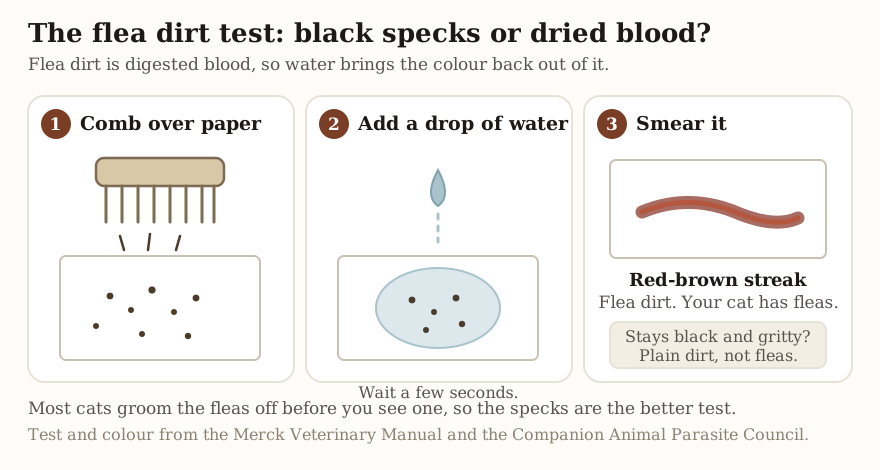
Table 1. The signs of fleas on cats, and what else explains each one
Scratching and biting at the skin
- Fleas fit when
- It centers on the neck, spine and tail base
- Could also be
- Food allergy, environmental allergy, ear mites
- The check
- Comb for flea dirt before anything else
Black specks in the fur or on the bedding
- Fleas fit when
- They smear red-brown on damp paper
- Could also be
- Plain dirt, soil, litter dust
- The check
- The wet paper test above
Small crusty bumps along the back
- Fleas fit when
- Scabs cluster from the neck to the tail head
- Could also be
- Miliary dermatitis from other allergies, ringworm
- The check
- Your vet. The bumps alone cannot name the cause
Overgrooming or bald patches
- Fleas fit when
- The thin spots sit on the back half of the cat
- Could also be
- Stress, pain, skin infection
- The check
- Comb, then ask your vet if the comb is clean
Tiny white grains in the bed
- Fleas fit when
- They roll loose and will not stick
- Could also be
- Skin flakes, litter, dried food
- The check
- What flea eggs look like
Where to comb first
Start at the back of the neck and between the shoulder blades. Then work along the spine to the base of the tail. Those two spots matter most, because a cat cannot groom either one well. Check the chin, the belly and the armpits next, where the fur is thin and the skin shows.
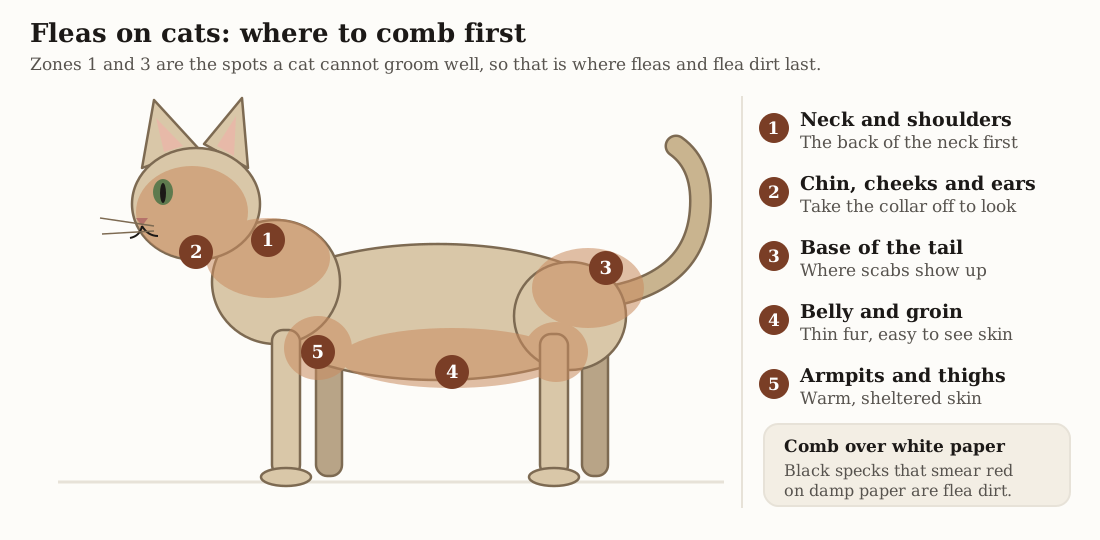
Use a fine-toothed flea comb and go slowly, with the teeth touching the skin. A comb only lifts 10 to 60 percent of the fleas on an animal, so treat it as a test rather than a cure. Dunk whatever you catch in a cup of soapy water straight away.
Signs that are not fleas
Scratching alone proves nothing. Food allergy, environmental allergy, ear mites and ringworm all make a cat itch, and flea dirt is what separates them. If the paper test stays black and gritty, you have plain dirt, so talk to your vet about the other causes.
Flea dirt without a single flea is normal, not a puzzle. The cat ate the evidence while grooming. Still treat it as fleas, because the dirt is flea feces and nothing else makes it. Our guide to flea dirt on cats and the wet paper test covers the look-alikes in detail.
What fleas look like on cats
An adult flea is up to about 1/8 inch (3 mm) long, reddish brown to nearly black, and flattened side to side, so it looks thin from above. It has no wings. It jumps instead, and it slips between hairs edge-on, which is why a flea is so hard to pin down with a fingertip.
Google’s own answer for this search says cat fleas run 1 to 3 mm, and one UK pet brand puts them at 1 to 2 mm. Those low numbers undersell the big ones. UC IPM gives “no larger than 1/8 inch”, and CDC’s lab reference puts Ctenocephalides at 3 to 4 mm. Our full size guide covers what fleas look like at every stage.
Eggs are a different thing. They are pearly white, about 0.5 mm, and they fall off the cat within hours onto bedding and carpet. So white specks that stay put in the fur are usually skin flakes or the remains of grooming, not eggs.
How indoor cats get fleas
Indoor cats get fleas because fleas do not need the cat to go outside. People carry newly hatched adults in on shoes and trouser legs. A dog brings them home. In a shared building they travel through walls and doorways, and wildlife under the floor or in the attic seeds the whole structure.
The pattern shows up constantly on Reddit, where “my indoor cat somehow got fleas” is one of the most-upvoted flea posts on r/cats. The same thread’s top answer names the real route: “I used to bring them in on my ankles.”
Two situations explain most of the rest:
- You just moved in. The last tenant’s pets left eggs and cocoons behind. A fully formed flea can wait in its cocoon for months, and your footsteps wake it up.
- A pet left, or a stray visits. Fleas that lose their host look for another one, so the bites and the sightings often start after the animal has gone.
None of this is about a dirty house. Cocoons survive a vacuum-clean home easily, and the trigger for them is warmth, carbon dioxide and vibration.
How to get rid of fleas on cats
Getting rid of fleas on cats takes three things at once. You need a flea product your vet chose for cats, the same treatment for every other pet, and the house itself. Skip any one of them and the cycle restarts. Expect 6 weeks to 3 months for a home, which is what Merck’s manual reports.
Budget first, because the free steps carry real weight. Vacuum daily, wash the bedding hot, and comb the cat. EPA calls daily vacuuming the best method for initial control, and the vibration also pulls new fleas out of their cocoons where the treatment can reach them.
Clearing fleas from your cat and your home, step by step
Treat every pet on the same day
Ask your vet which product fits each animal by species, age and weight. Prescription products beat the store shelf: VCA notes that over-the-counter products may have limited effectiveness. One untreated cat in the house keeps the whole cycle going.
Comb the cat over white paper
Work through the neck, spine and tail base with a fine-toothed flea comb. Drop every flea into soapy water. Combing gives you a count, so you can tell next week whether the numbers are falling.
Bathe only if your cat tolerates it
Soap drowns adult fleas on the day and nothing more. CDC calls soap a gentle insecticide, so plain water and a cat-labeled shampoo are enough. Skip the bath if your cat panics, because a scratched owner and a terrified cat help nobody.
Strip and wash the soft stuff
Wash cat bedding, blankets and throws in hot water, then dry them on the highest heat the fabric allows. Do the beds and sofa covers your cat sleeps on too.
Vacuum every day for two weeks
Cover carpet, rugs, under furniture and along the baseboards, and go over the spots your cat naps in twice. Empty the canister into a sealed bag and put it in an outside bin.
Keep going for three months
Give every dose on time. Fleas keep hatching for weeks, so the plan only works if nothing lapses.
The house holds most of the population, and that is the part people skip. Our guide to clearing fleas from a house covers carpets, growth regulators and why foggers underperform. Fallen flea eggs and flea dirt in the carpet are the supply line, and vacuuming is what cuts it.
Table 2. Flea product classes for cats, and what each one does
Spot-on applied to the skin
- What it does
- Kills adult fleas, and some stop eggs and larvae developing
- The catch
- Keep the cat away from a treated dog, and do not bathe either side of the dose without checking the label
Oral tablet or chew
- What it does
- Kills fleas that bite the cat, monthly or longer
- The catch
- FDA has linked the isoxazoline class to tremors and seizures in some pets, so mention any seizure history
Fast-acting oral tablet
- What it does
- Clears the adults on the cat within about half an hour
- The catch
- No lasting protection at all, so the carpet refills the cat
Collar
- What it does
- Some work well and last months
- The catch
- UC IPM rates the better collars with spot-ons and orals, but cheap ones can irritate the skin
Shampoo, powder, spray or dip
- What it does
- Kills what is on the cat at that moment
- The catch
- UC IPM calls these less effective and more hazardous than the three above
Product classes from UC IPM Pest Notes 7419, VCA Animal Hospitals and the Merck Veterinary Manual. Your vet picks the product; this page names none, because the label decides what is legal for your cat.
Why you still see fleas after treatment
New fleas after treatment are expected. A flea can feed on a treated cat for 6 to 24 hours before the product kills it, and some drops need up to 36 hours to reach full strength. Meanwhile the cocoons in your carpet keep opening for about two more weeks.
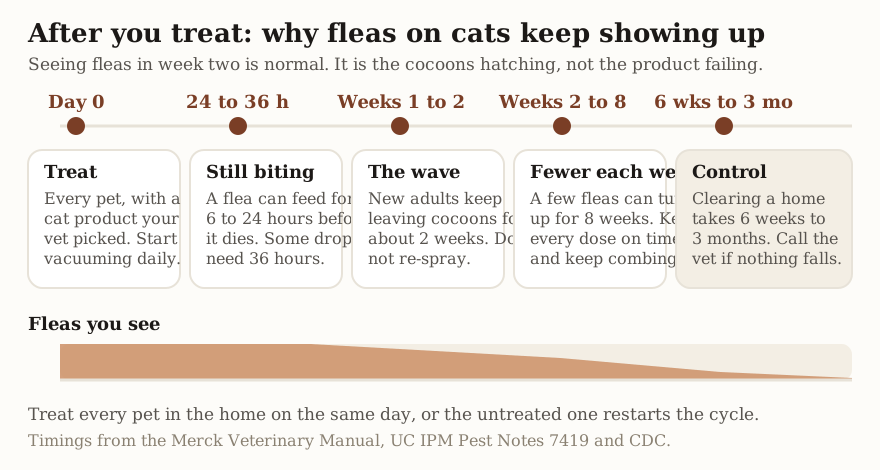
So do not re-treat early and do not switch products in week two. UC IPM advises vacuuming rather than spraying again. A few fleas can still turn up for up to 8 weeks, and VCA recommends keeping every pet on flea control for 3 to 6 months after an infestation.
Judge progress by the comb, not by the odd sighting. Falling numbers week on week mean it is working, even while you are still finding the occasional flea.
What kills fleas on cats instantly
Nothing kills fleas on a cat instantly and safely at home. The fastest honest answer is a fast-acting oral tablet from a vet, which starts killing adult fleas within about half an hour. It clears the cat and nothing else, though: it leaves no protection, so the fleas in the carpet simply climb back on.
That is why a quick kill is a first step, never the plan. Ask your vet whether a fast-acting product suits your cat, then start the monthly product and the house work the same week. The dog side of this question sits on our page about instant flea killers for dogs.
The common “instant” home tricks do not hold up:
- A soapy bath drowns the adults on the cat that day. It leaves nothing behind.
- A flea comb removes 10 to 60 percent of the adults, and misses every egg, larva and cocoon.
- Salt, baking soda and vinegar have no evidence behind them for fleas. NPIC advises avoiding home remedies, because most have not been found effective.
Never use a dog flea product on a cat
A dog flea product can kill a cat. Many dog spot-ons hold 45 to 60 percent permethrin, while cat products hold less than 0.1 percent, the American Association of Feline Practitioners says. A cat’s body breaks permethrin down far too slowly, so a dog dose causes drooling, twitching, tremors, seizures and death.
Cats also get poisoned without anyone applying anything to them. Grooming a freshly treated dog, or sleeping against one, is enough. So tell your vet you have both animals before the dog’s product is picked, and keep the cat away from a treated dog for as long as the dog’s label says. Our guide to cat ticks carries the same rule for tick products.
Amitraz, in some dog collars, must never go on a cat either. Read the label every time, even on a product you have used for years, and use it only on the species, age and weight the label names. EPA puts it plainly: the label is the law.
Flea collars, shampoos and powders
Shampoos and powders kill what is on the cat at that moment, then stop. UC IPM rates spot-ons, oral products and some collars above shampoos, powders, sprays and dips, which it calls less effective and more hazardous. Your vet picks between them for your cat.
One note on the newer oral products. FDA has flagged that the isoxazoline class has been linked to tremors and seizures in some dogs and cats, including animals with no seizure history, while still calling the drugs safe and effective. Mention any past seizure to your vet before you choose.
Essential oils and home remedies that hurt cats
Essential oils are the dangerous end of the “natural” shelf. In one review of EPA-exempt essential-oil flea products, 92 percent of 48 exposed animals had adverse effects, 77 percent of them used as labelled, and three died or were put to sleep. A separate review of 100 percent tea tree oil found 443 poisoned dogs and cats, with signs in 2 to 12 hours and young, small cats at the highest risk.
Pennyroyal oil can cause seizures and liver failure, and some cats react to registered citrus-oil products too. So keep oils off the cat, out of a diffuser near the cat, and off their bedding. Our verdict on each flea remedy goes through the evidence one by one.
Garlic, brewer’s yeast and vitamin B1 do nothing. Ultrasonic devices and herbal collars do nothing either. Diatomaceous earth is the other one to watch. It only works while it stays dry. Use an EPA-registered product into cracks and crevices only, never dusted across floors where a cat walks and grooms, as our page on diatomaceous earth for fleas on cats explains.
Fleas on kittens
Kittens need a vet first, not a product off a shelf. Every flea product carries a minimum age and a minimum weight on its label, and plenty of them exclude young kittens outright. So read the label, and when the kitten is under that line, the safe tools are a flea comb, a warm bath if the kitten copes, and a call to the vet.
Flea anemia is the reason this matters. A heavy flea burden drains enough blood to make a kitten anemic, and AAHA calls that a medical emergency. Cornell puts it plainly. A kitten carrying countless fleas does not need much of that blood loss before it turns anemic.
Keep a flea-covered kitten warm and fed while you arrange the visit. Comb it over white paper, drop the fleas in soapy water, and do not dose it with an adult cat’s product to buy time. Rescue threads on Reddit are full of owners who did exactly that and lost the animal.
What fleas do to a cat’s health
Fleas on cats cause three problems a vet sees often: flea allergy dermatitis, tapeworm and anemia. None of them is diagnosed from a photo or a web page, so this is reference only. Scabs, hair loss or a cat that will not settle all deserve a call.
- Flea allergy dermatitis. An allergy to flea saliva, not to the bite itself. Merck describes a bumpy rash over the back, neck and face, which vets call miliary dermatitis, and one bite can set it off in a sensitive cat. Most cases land in late summer.
- Tapeworm. A cat swallows an infected flea while grooming and picks up Dipylidium. Rice-like segments near the tail are the usual sign, and flea control is the prevention.
- Anemia. Blood loss from a heavy infestation, worst in kittens and old or sick cats. Pale gums, weakness and fast breathing mean a vet now.
Cats also carry Bartonella henselae, the cat scratch disease germ, and they pick it up from fleas. CDC says up to one in three healthy cats carries it, and the germ travels in flea feces. So flea control on the cat is also protection for the people in the house.
Not veterinary advice. This section is general reference for cat owners. It is not a diagnosis and gives no doses. If your cat or kitten seems unwell, call your vet.
The cat flea is the same flea your dog has
The flea on your cat is almost certainly the cat flea, Ctenocephalides felis, and it is the usual flea on American dogs too. UC IPM, Merck, CAPC and Ohio State all agree on that. The dog flea, Ctenocephalides canis, is rare in the United States.
So the name tells you nothing about which pet brought them in. It changes the plan in one way only: every furry pet in the house needs treating, not just the itchy one. Our pages on how dogs get fleas and fleas in general cover the rest of the household.
Can you catch fleas from your cat?
Cat fleas bite people, but they cannot live on you. They have no hair to hold onto and no warm pelt to shelter in, so a flea that lands on a person feeds and leaves. Bites turn up on the ankles and lower legs, which is the giveaway in a home with a cat.
You can still pick fleas up and carry them, which is how an indoor cat gets them in the first place. Petting a flea-covered cat does not infest you, though, so there is no reason to avoid the animal. Our guide to fleas on people covers hair, beds and showers, and cat flea bites on people covers what they look like.
How to keep fleas off your cat
Year-round prevention through a vet beats treating an outbreak, and it costs less. CAPC advises keeping every pet on flea control all year, because a heated home keeps fleas breeding through the winter even where the outdoor population dies off.
- Keep every pet on a product, chosen by your vet, dosed on time, all year.
- Comb your cat weekly over white paper, so you catch the first flea dirt early.
- Wash cat bedding in hot water every week or two, and vacuum the napping spots.
- Discourage wildlife. Opossums, raccoons and feral cats seed a yard, so block crawl spaces and do not leave food out.
- Treat shaded resting spots only if you treat outdoors at all. Spraying a whole sunny lawn is wasted: flea larvae die in sun and dry soil.
Fall is the season to be strict. The searches for fleas on cats peak in October in the US, which matches the indoor wave as the weather turns. If the bug you found jumped but you are not sure it was a flea, compare it with a tick before you treat.
Myths about fleas on cats, corrected
Some of the most repeated advice about fleas on cats is wrong, and two of these myths sit in Google’s own AI answer. Here is what the vet and extension sources say instead.
Myth 1
Myth: “An indoor cat cannot get fleas.”
Truth: People carry fleas in on shoes and clothing, and so do dogs, visiting strays and wildlife under the floor.
Myth 2
Myth: “No fleas on the comb means no fleas.”
Truth: A cat grooms off 4.1 to 17.6 percent of its fleas a day. That is why flea dirt is the better test.
Myth 3
Myth: “A small dose of the dog's product is fine.”
Truth: Dog spot-ons can hold 45 to 60 percent permethrin against under 0.1 percent in cat products, and cats cannot break it down.
Myth 4
Myth: “Dish soap is a flea treatment.”
Truth: Soap drowns the adults in the bath and leaves nothing behind. The carpet then repopulates the cat.
Myth 5
Myth: “Fleas die off in winter, so you can stop.”
Truth: A heated home breeds fleas all year, and CDC says fleas survive year-round wherever there is an animal to feed on.
Myth 6
Myth: “Essential oils are the safe natural choice.”
Truth: In one review, 92 percent of 48 animals exposed to natural flea products had adverse effects. Three of them died.
Myth 7
Myth: “You have to throw everything out.”
Truth: Hot washing and daily vacuuming handle bedding and carpet, and nobody needs to bin a sofa.
Myth 8
Myth: “A supermarket flea collar does the same job.”
Truth: UC IPM rates spot-ons and oral products above shampoos, powders and sprays, and VCA warns that store products may have limited effectiveness.
Pest control disclaimer. Photo-based identification can help, but it is not always perfect. For dangerous spiders, large infestations, or anything you are unsure about, contact a licensed pest control professional.
Veterinary disclaimer. This page is general information for cat owners. It is not veterinary advice, a diagnosis or a treatment plan. It names no product and gives no dose. Ask your veterinarian which flea product is right for your cat, and call them if your cat or kitten seems unwell.
Fleas on cats: FAQ
Do I have to treat my house if my cat has fleas?
Can fleas live in cat litter?
Can I touch my cat if it has fleas?
I found one flea on my cat. Does that mean an infestation?
Can I put a spot-on straight after a flea bath?
How long must I keep the cat away from the dog after treating the dog?
Can fleas kill a cat?
My cat still scratches after the fleas are gone. Why?
Related guides
Fleas
The hub: what fleas are, where they come from, and how the life cycle drives everything else.
How to get rid of fleas
Clearing the house, in order, including carpets, growth regulators and why foggers underperform.
Flea dirt
The black specks, the wet paper test, and the things people mistake for them.
What do fleas look like
Size, color and shape at every stage, drawn to scale.
Fleas on dogs
The same flea, a different pet, and the plan for a household with both.
Home remedies for fleas
Dawn, salt, vinegar and oils, each with the evidence behind it.
Can humans get fleas
Whether fleas live on people, in hair or in a bed, and what to do if you are bitten.
Flea eggs
The white grains in the bedding, and why they are the supply line.
Ticks on cats
Removal, the vet red flags, and the same warning about dog products.
Sources
- US EPA, Controlling Fleas and Ticks on Your Pet: the species, age and weight rules, and the label
- US EPA, What to Do if Your Pet Has an Adverse Reaction to a Flea or Tick Product
- FDA, Potential Adverse Events Associated with Isoxazoline Flea and Tick Products
- CDC, Getting Rid of Fleas (May 2024): the four-step plan and the follow-up window
- Merck Veterinary Manual, Fleas of Cats (cat owners, updated March 2026)
- Cornell Feline Health Center, Fleas: where cats get bitten, and kitten anemia
- UC IPM Pest Notes 7419, Fleas: product classes, vacuuming and the two-week emergence window