What are ticks?
A tick is a small parasite that lives only on blood. Ticks belong to the arachnids, along with spiders, mites and scorpions, not to the insects. An adult tick has 8 legs, no wings and no antennae, and its head and body form one flat oval. Unfed adults are about 3 to 5 mm (1/8 to 3/16 inch) long.
Hundreds of tick species live around the world, but only a few bite people. In the US, CDC maps eight that matter for human health. Illinois, for example, has at least 15 species, yet people there meet mainly five.
A tick feeds slowly. Once it bites, it can stay attached for several days while it fills with blood, and it often goes unnoticed the whole time. That long, quiet meal is what makes some ticks such good carriers of disease.
Are ticks insects or arachnids?
Ticks are arachnids. Count the legs: an adult insect has 6 legs and a pair of antennae, while an adult tick has 8 legs and no antennae. The one catch is the larva. A newly hatched tick has only 6 legs and grows its last pair after its first meal. So a tiny 6-legged “seed tick” on your ankle is still a tick, as our guide to seed ticks and tick larvae explains.
Hard ticks and soft ticks
Nearly every tick that bites people in the US is a hard tick. A hard tick has a stiff shield on its back, just behind the mouthparts, and an unfed one looks like a flat seed. A soft tick has no shield, looks more like a large raisin, and hides its mouthparts under its body.
Table 1. Hard ticks vs soft ticks
Shield on the back
- Hard ticks
- Yes, a hard plate behind the mouthparts
- Soft ticks
- No, the skin is leathery and wrinkled
Shape when unfed
- Hard ticks
- Flat, like a seed
- Soft ticks
- Plump, like a large raisin
Mouthparts
- Hard ticks
- Stick out in front, easy to see from above
- Soft ticks
- Hidden underneath the body
How long it feeds
- Hard ticks
- Days, while attached
- Soft ticks
- Usually under half an hour, often at night
Where people meet it
- Hard ticks
- Grass, brush and the edges of woods
- Soft ticks
- Rodent nests in cabins, caves, bird and bat roosts
Examples in the US
- Hard ticks
- Deer tick, lone star tick, American dog tick
- Soft ticks
- Ornithodoros ticks in western mountain cabins
Soft ticks matter to people mainly in one setting. According to CDC, most US cases of soft tick relapsing fever come from sleeping in rodent-infested cabins in the western mountains. There, the ticks come out at night, feed for minutes while people sleep, and leave.
What ticks look like, and which kind you have
Most ticks are brown, reddish-brown or black, flat and oval, with a small head part sticking out in front. Size depends on the stage: a larva is the size of a sand grain, a nymph a poppy seed, and an adult a sesame or apple seed. After feeding, a female American dog tick swells to about 1/2 inch (13 mm).
Our guide to tick colors, sizes and engorged ticks shows every stage side by side. For the species, the US tick identification chart covers every tick that bites people.
The three ticks most Americans meet
The deer tick, or blacklegged tick, is small: unfed adults are reddish-brown, about 2 to 3 mm (1/8 inch or less), with black legs. It is the tick that spreads Lyme disease in the eastern US, and its poppy-seed nymph is the stage people miss.
The lone star tick female carries a single white dot on her back. CDC calls it a very aggressive biter, and it is linked to alpha-gal syndrome, a red meat allergy.
The American dog tick, also called the wood tick, is larger: about 3/16 inch (5 mm) unfed, reddish-brown, with silver-white marks on its back. Can’t tell the first and the last apart? Our deer tick vs dog tick comparison puts them side by side.
Tiny ticks, tick eggs and ticks on pets
Dozens of tiny specks at once, usually on the ankles, are larvae that hatched from one egg mass. A female hard tick lays thousands of eggs in a single clump on the ground; people call it a “tick nest”, but there is no nest. Our guide to what tick eggs look like shows the clump. Dogs pick up ticks too, and our guide for dog owners covers checks and prevention, and our dog removal guide covers removal.
Is it a tick or something else?
Start with the legs. An adult tick has 8 legs and a body with no clear segments or waist; insects such as beetles and bed bugs have 6. Our guide to tick look-alikes covers the common mix-ups. A flat, red-brown bug in a mattress seam is a separate question, answered in tick vs bed bug. Still unsure? A clear photo in our free bug identifier will name it.
The tick life cycle
Ticks go through four stages: egg, larva, nymph and adult. Each active stage needs one blood meal before it can molt into the next, and most kinds find a new animal for every meal. CDC says the whole cycle takes up to 3 years: about 2 for the deer tick in the East, and 3 for the western blacklegged tick.
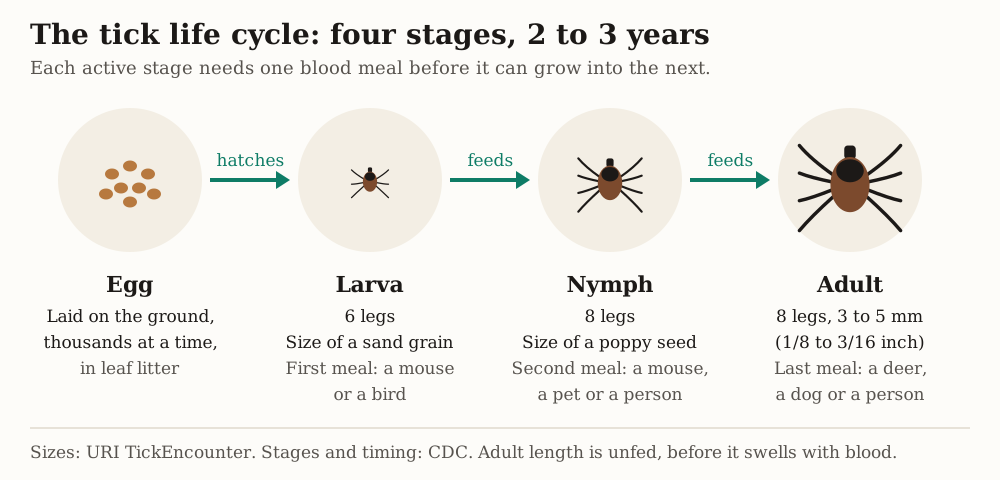
Each meal moves the tick to a bigger animal. Larvae feed mostly on mice and birds, nymphs on mice, pets and people, and adults on deer, dogs and people. This is also how a tick picks up germs: a larva or nymph feeds on an infected mouse, then passes the germ on at its next meal.
Most ticks die young. CDC notes that most never find a host for their next feeding. The brown dog tick is the exception: it feeds on dogs at every stage and can finish its whole life cycle indoors, in kennels and in homes with dogs.
How long do ticks live?
A tick’s whole life usually lasts 2 to 3 years, and most of it is spent waiting. Between meals, ticks shelter in damp leaf litter and can go months without food. In one lab study, unfed American dog tick larvae lived more than 100 days in humid air. Indoors, the air is too dry for most kinds, and they die much sooner.
Where do ticks come from?
Ticks hatch outdoors from eggs laid in leaf litter, then travel on animals. Mice, birds and deer carry them from place to place, and deer in particular help ticks move into new areas. Pets, people and gear bring them indoors. In fact, URI TickEncounter names pets that go in and out as the most common way they get into a house.
What do ticks eat?
Only blood. Ticks eat nothing else at any stage, and they feed on mammals, birds, reptiles and amphibians. They cannot molt or lay eggs without a blood meal, so a tick that finds no host simply starves. Plenty of animals eat ticks in turn, though none keeps them in check, as our guide to which animals eat ticks shows.
How ticks find you: do ticks jump, fly or fall from trees?
Ticks cannot jump or fly, and they do not drop from trees. Instead, they climb grass and low plants and wait with their front legs held out, a pose called questing. When you brush past, the tick grabs on and crawls upward. That is why a tick on your scalp almost always started at your shoe or ankle.
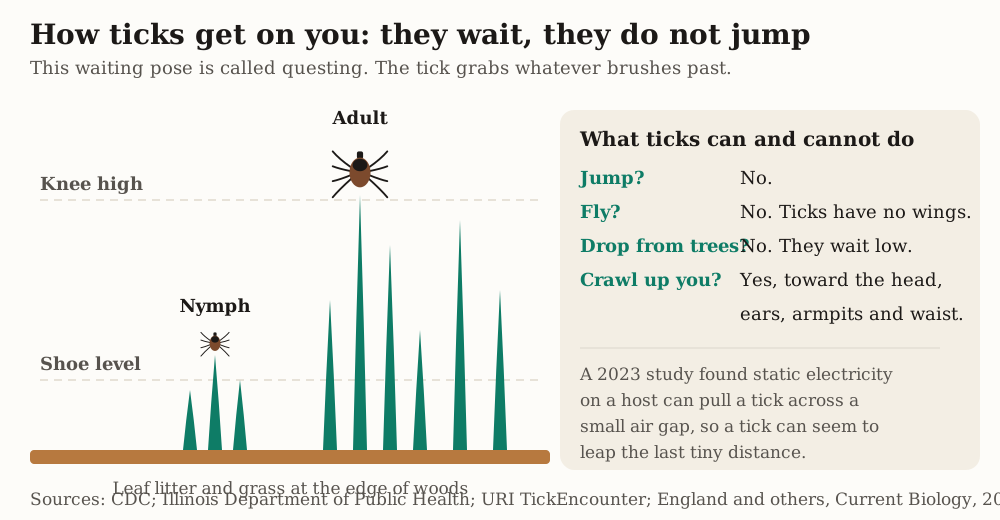
While they wait, they sense breath, body odor, heat, moisture and vibration, CDC says, and some species even react to a shadow. They also pick spots beside paths that animals use often. Some ticks attach right away, while others wander for a while, looking for thin skin around the ears or hairline.
Do ticks jump or fly?
No. Ticks have no wings, and CDC confirms they cannot jump, so every tick on you climbed aboard. A 2023 study in Current Biology found one twist, though. The static charge on a person or animal can pull a nearby tick across a small air gap, which may look like a short hop.
Do ticks fall from trees?
No. The Illinois Department of Public Health says ticks wait on the tips of grasses and shrubs, not in trees, and URI TickEncounter agrees. On the ground, nymphs tend to latch on near shoe level and adults about knee high. As a result, tucking pants into socks and treating shoes and socks help more than a hat.
Can ticks drown?
Not easily. A tick can hold a thin film of air against its breathing pores and live underwater for days. In a 2021 lab study, half of the unfed American dog tick larvae were still alive after 68 days underwater. So water alone is not a reliable way to kill a tick. Flushing still gets one out of the house, which is why CDC lists it, but tape, a sealed bag or rubbing alcohol is the sure way.
Tick season: when are ticks most active?
In most of the US, tick season runs from spring to fall, and CDC says they are most active from April to September. Deer tick nymphs, the stage behind most Lyme disease, peak from April to July. Adult deer ticks return in October and November, and they come out on any winter day that is warm enough.
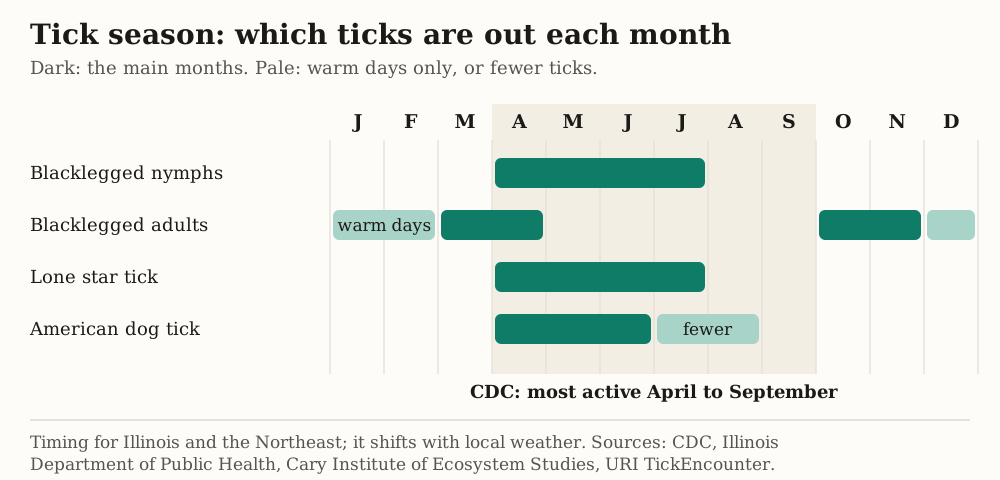
Your own season depends on the tick and the weather where you live. In Illinois, for instance, the lone star tick is most active from April through July, and adult American dog ticks from April to June. By September, adult dog ticks there are rarely seen.
Do ticks die in the winter?
No, cold rarely kills them. They crawl under leaf litter or snow and go dormant, then become active again on mild days. The Cary Institute in New York has tracked deer ticks for over 30 years. It found no link between how cold a winter was and how many nymphs came out the next spring. The National Park Service adds that winter kills ticks only after several days in a row at 10°F (minus 12°C) or colder, and ticks under leaf litter or snow seldom stay exposed that long.
So at what temperature do ticks become inactive? Sources give different answers, so treat any single number as a rough guide.
Table 2. When adult deer ticks can be out in winter, as different sources put it
CDC
- When they can be active
- Any time winter temperatures are above freezing
National Park Service
- When they can be active
- Deer ticks slow down below 35°F (2°C), so warm winter days still carry risk
Illinois Department of Public Health
- When they can be active
- Winter days when the ground is about 45°F (7°C)
URI TickEncounter
- When they can be active
- Any winter day the ground is not covered in snow or frozen
Cary Institute of Ecosystem Studies
- When they can be active
- At least several degrees above freezing; snow seems to keep them down, but that is not well studied
Our reading of all five: if the ground is bare and not frozen, check for ticks after a walk, even in January. For the full checklist, see how to avoid tick bites in every season.
Where do ticks live?
Ticks live outdoors in grassy, brushy and wooded places, especially in damp leaf litter where woods meet lawns. Many people pick them up in their own yard, CDC says. Because ticks dry out easily, short, mowed grass holds few of them, while tall grass, brush and leaf piles hold many.
Where ticks live in the US
Each region has its own mix. The deer tick dominates the Northeast and upper Midwest, the lone star tick the South and East, and the American dog tick most of the country east of the Rockies. None of the main disease-carrying US ticks lives naturally in Alaska, according to CDC. Ranges are moving, too: CDC now maps the lone star tick across the Northeast, South and Midwest. For the ticks in your state, region by region, see our guide to the types of ticks and where each one lives, or the CDC tick maps.
Can ticks live in your house?
Most can’t. A tick found indoors usually rode in on a pet, clothes or a bag, and most kinds cannot breed indoors. They do not die at once, though. In a 2026 Ohio State study, unfed lone star ticks lived about 11 days on average on home floors and Gulf Coast ticks about 18, from about 7 days on tile to 25 on vinyl. The brown dog tick is the exception. It can live and breed inside homes and kennels with dogs, hiding in cracks, under rugs and behind furniture. On Reddit’s r/ticks, one California owner found more than 20 ticks in a bedroom soon after moving into a new house with two dogs. If ticks keep turning up inside, read our guide to getting rid of ticks in the house and yard.
Where ticks hide on your body
On people, ticks crawl to warm, hidden places. CDC lists the spots to check after time outdoors: under the arms, in and around the ears, inside the belly button, behind the knees, in and around the hair, between the legs and around the waist. Check children the same way, and look at pets, coats and day packs too.
Are ticks dangerous?
Some are. They spread at least 16 diseases in the US, CDC says, from Lyme disease to Rocky Mountain spotted fever. Even so, not every tick carries germs. In the Northeast, about 1 in 4 deer tick nymphs carries Lyme bacteria, while deer ticks in most of the Southeast almost never do. Removing a tick quickly is the best protection.
Lyme disease is the most common. More than 80,000 cases are reported to CDC each year, and an estimate based on insurance claims suggests about 476,000 people are diagnosed and treated for it yearly. CDC notes that second figure may run high.
Time matters, too. For Lyme disease, CDC says a tick usually has to be attached for more than 24 hours to pass on the bacteria. However, some germs, especially viruses, move faster. Our guide to tick bite symptoms and when to worry covers what to watch for, and what a tick bite looks like shows a normal bite next to a Lyme rash.
Table 3. Tick-borne diseases in the US: reference only, not a diagnosis
Lyme disease
- Spread by
- Deer tick; western blacklegged tick
- Where in the US
- Northeast, mid-Atlantic, upper Midwest; parts of the Pacific coast
- Signs to watch for
- A rash that grows, in about 70 to 80% of cases, 3 to 30 days after the bite; fever, aches. Later: facial droop, joint pain
Anaplasmosis
- Spread by
- Deer tick; western blacklegged tick
- Where in the US
- Same areas as Lyme disease
- Signs to watch for
- Fever, chills, headache, muscle aches
Babesiosis
- Spread by
- Deer tick
- Where in the US
- Northeast and upper Midwest
- Signs to watch for
- Fever, chills, tiredness
Powassan virus
- Spread by
- Deer tick, groundhog tick, squirrel tick
- Where in the US
- Northeast and Great Lakes
- Signs to watch for
- Fever, headache, vomiting, weakness; can cause brain swelling
Ehrlichiosis
- Spread by
- Lone star tick
- Where in the US
- South, East and Midwest
- Signs to watch for
- Fever, headache, aches; sometimes a rash
Alpha-gal syndrome
- Spread by
- Lone star tick; rarely deer ticks
- Where in the US
- South, East and central states
- Signs to watch for
- Hives, vomiting or swelling, usually 2 to 6 hours after eating red meat or dairy
Rocky Mountain spotted fever
- Spread by
- American dog tick, Rocky Mountain wood tick, brown dog tick
- Where in the US
- Cases occur throughout the US
- Signs to watch for
- Fever and headache, then a rash 2 to 4 days after the fever starts. Can be deadly if not treated early
Tularemia
- Spread by
- American dog tick, lone star tick, Rocky Mountain wood tick
- Where in the US
- Where those ticks live
- Signs to watch for
- Fever; can cause a rash
Soft tick relapsing fever
- Spread by
- Soft ticks (Ornithodoros)
- Where in the US
- Western mountain cabins; caves in parts of Texas
- Signs to watch for
- Fever for about 3 days, about 7 days without, then fever again
Tick paralysis
- Spread by
- A toxin in the saliva of some attached ticks
- Where in the US
- Varies by tick species
- Signs to watch for
- Weakness that moves up the body; most people recover within 24 hours of the tick being removed
Medical disclaimer. This page is for general information only. It is not a medical diagnosis. If you have severe symptoms, trouble breathing, swelling of the face or throat, fast spreading redness, fever, severe pain, pus, or signs of infection, contact a doctor or your local emergency number.
Found a tick? What to do next
Don’t panic, and don’t wait. If the tick is attached, pull it out now with fine-tipped tweezers: grip it as close to the skin as you can and pull straight up with steady, even pressure. If it is only crawling, it has not bitten yet. Either way, keep the tick in tape or a sealed bag and note the date.
Table 4. Found a tick: what it means and where to go next
A tick crawling on skin or clothes
- What it means
- It has not bitten yet
- Do this now
- Lift it off with tape, then check your whole body. Dry your clothes on high heat for 10 minutes
- Read next
- Tick checks and repellents
A tick attached to you or your child
- What it means
- It is feeding, maybe for hours or days
- Do this now
- Pull it out with tweezers today. Don't wait to see a doctor first
- Read next
- Tick removal, step by step
A small red bump where a tick was
- What it means
- Usually a normal reaction to the bite
- Do this now
- Watch the spot for several weeks and note any rash or fever
- Read next
- Normal bite vs Lyme rash
A rash, fever or aches days to weeks after a bite
- What it means
- Possibly a tick-borne disease
- Do this now
- See a doctor and say when and where you were bitten
- Read next
- When a tick bite needs a doctor
Dozens of tiny ticks at once
- What it means
- Larvae from one egg mass
- Do this now
- Lift them off with tape, shower, and check your legs and waist
- Read next
- Seed ticks
A tick on your dog or cat
- What it means
- Common after walks. Pets carry ticks indoors
- Do this now
- Remove it, check the ears and between the toes, and ask your vet about prevention
Ticks in the house again and again
- What it means
- Possibly brown dog ticks breeding indoors
- Do this now
- Check your dog, vacuum, and get help if it continues
- Read next
- Ticks in the house
A bug you are not sure is a tick
- What it means
- Many small bugs look alike
- Do this now
- Count the legs and take a sharp photo
- Read next
- Tick look-alikes
Should you send the tick off for testing? CDC does not recommend commercial tick testing for treatment decisions. A positive result does not mean you are infected, and a negative one can give false comfort. It is more useful to know the species, because each tick carries its own set of diseases. Keep the tick in a sealed bag with the date, and show it to your doctor if you get sick.
Tick prevention and control: the short version
Prevention works in layers. Use an EPA-registered repellent on skin, treat clothes and shoes with 0.5% permethrin, and tuck pants into socks. Then shower and do a full tick check within 2 hours of coming in. Around the house, mowing and clearing brush and leaves at the woods’ edge and around stone walls are the usual advice. The evidence behind each yard step is weaker than most guides admit, and our yard guide says which ones hold up.
Our guide to tick repellents, treated clothing and tick checks covers the personal side. For the property, see tick control for the yard and house, which explains landscaping and when spraying is worth it. If you do treat a yard, use an EPA-registered product labeled for ticks and follow the label, because the label is the law. Even then, CDC says not to rely on spraying alone.
Tick myths, corrected
Most bad tick advice comes from old habits and social media. Here are six common beliefs, several of them from Reddit threads, and what the research says about each.
Myth 1
Myth: “Ticks jump or drop onto you from trees.”
Truth: They cannot jump or fly. They wait on grass and low plants, grab on as you brush past, and crawl up. A tick on your scalp most likely started at your ankle.
Myth 2
Myth: “Burn it off, or smother it with nail polish or petroleum jelly.”
Truth: CDC warns these can agitate the tick and push infected fluid into the skin. Pull the tick straight out with fine-tipped tweezers instead.
Myth 3
Myth: “A hard winter kills off the ticks.”
Truth: Ticks wait out the cold under leaf litter and snow. The Cary Institute found no link between winter cold and the number of deer tick nymphs the next spring.
Myth 4
Myth: “Flushing a tick kills it.”
Truth: Ticks can live underwater for days. Flushing gets a tick out of the house, but tape, a sealed bag or rubbing alcohol is the sure way to finish it.
Myth 5
Myth: “An opossum eats 5,000 ticks a year.”
Truth: That figure is a 2009 lab estimate of about 5,500 larval ticks a week at the late-summer peak, based on six caged opossums. When researchers checked 32 wild opossum stomachs, they found no ticks at all.
Myth 6
Myth: “Any tick can give you Lyme disease.”
Truth: In the US, only blacklegged ticks spread it. CDC says the lone star tick and the dog ticks cannot spread Lyme bacteria, though they carry other diseases.
Our guide to whether opossums really eat ticks traces the 5,000 figure back to the study.
Pest control disclaimer. Photo-based identification can help, but it is not always perfect. For dangerous spiders, large infestations, or anything you are unsure about, contact a licensed pest control professional.
Ticks FAQ
Why do ticks exist?
Do ticks die in the washing machine?
Why shouldn't you crush a tick with your fingers?
Can a baby tick carry Lyme disease?
Can you feel a tick bite you?
What kills a tick immediately?
Related guides
What does a tick look like?
Size by stage, colors, engorged ticks, and how to spot one on skin.
Types of ticks
Every US tick that bites people, with an identification chart.
Lone star tick
The tick with the white dot, where it lives, and the red meat allergy.
Deer tick (blacklegged tick)
The Lyme disease tick: its size, range and season.
American dog tick
The wood tick: the large brown tick of spring and early summer.
Deer tick vs dog tick
How to tell the two most common US ticks apart.
Seed ticks
Dozens of tiny ticks at once: what they are and what to do.
Tick eggs and “tick nests”
What a tick egg mass looks like, and why ticks build no nest.
How to remove a tick
The CDC tweezer method, stuck mouthparts, and what never to use.
What a tick bite looks like
A normal bite, day by day, next to the Lyme rash.
Tick bite symptoms
What to watch for after a bite, and when to see a doctor.
Ticks on dogs
Checks, removal and prevention for dog owners.
How to remove a tick from a dog
Gloves, the grip and the pull, a stuck head and the bump afterward.
What kills ticks on dogs instantly?
Why home remedies fail on an attached tick, and how fast vet products work.
Ticks on cats
Where ticks hide on a cat, how to take one off, and why dog products can kill cats.
Brown dog tick
The one US tick that breeds indoors, and how to clear it from a house.
Flea vs tick
Six legs and a jump, or eight legs and a crawl, drawn to scale.
What eats ticks?
Chickens, guinea fowl, lizards and ants, and why none clears a yard.
Do opossums eat ticks?
Where the 5,000 ticks claim came from, and what wild opossums really eat.
How to prevent ticks
Repellents, permethrin clothing and a proper tick check.
Getting rid of ticks in the yard and house
Landscaping, yard treatment and ticks indoors.
Bugs that look like ticks
Beetles, mites and other look-alikes, and the one check for each.
Tick vs bed bug
Eight legs or six, and where each one hides.
Bug bite identification
Tick bites compared with mosquito, flea, bed bug and spider bites.
Sources
- CDC, About ticks and tickborne disease
- CDC, Where ticks live
- CDC, Tick lifecycles
- CDC, What to do after a tick bite
- CDC, Preventing tick bites
- CDC, How Lyme disease spreads
- Ohio State University, Some ticks can survive from 1 to 3 weeks on home flooring (2026)
- CDC, About soft tick relapsing fever
- Illinois Department of Public Health, Common ticks
- National Park Service, Species spotlight: deer tick
- URI TickEncounter, Top ten things everyone should know about ticks
- Cary Institute of Ecosystem Studies, Ticks in the winter: your questions answered
- Penn State Extension, Do chickens, guinea fowl, or opossums control ticks?
- England, Lihou and Robert, Static electricity passively attracts ticks onto hosts, Current Biology (2023)
- Diyes and others, Reproductive output and larval survival of American dog ticks, Experimental and Applied Acarology (2021)