What is a dog tick?
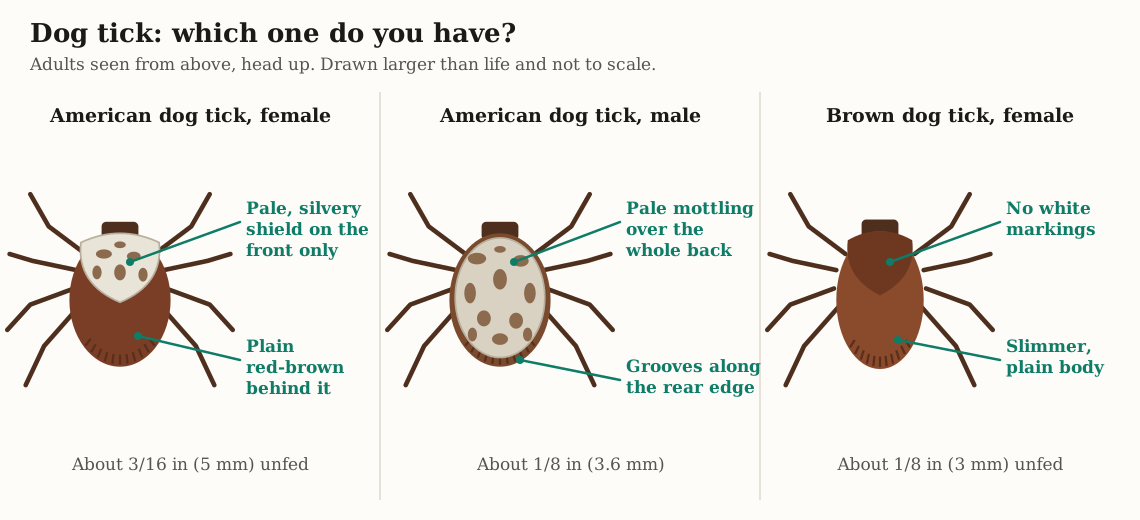
A dog tick is a hard tick named for its favorite adult host. In most of the US the name means the American dog tick, Dermacentor variabilis, which many people call the wood tick. An unfed adult is flat, oval, reddish brown and about 3/16 inch (5 mm) long, with pale silvery or cream markings on its back.
Two different ticks share the name, though. The second is the brown dog tick, a plain brown tick that can live inside homes and kennels. It gets its own section below, because it behaves so differently.
Like every tick, it is an arachnid, a relative of spiders and mites. It needs three blood meals, each from a different animal. Larvae and nymphs feed on mice, voles and chipmunks. Adults prefer medium-sized animals such as raccoons, skunks and dogs, and they bite people readily. Because larvae and nymphs rarely bite people or pets, almost every dog tick you find is an adult.
For the other kinds of ticks in the US and how they compare, see our guide to ticks.
How to identify a dog tick
To identify a dog tick, check four things: a flat, oval, reddish-brown body; short mouthparts; pale silvery or cream markings on the back; and a row of small grooves along the rear edge. An unfed female is about 3/16 inch (5 mm) long and a male about 1/8 inch (3.6 mm), according to the University of Florida.
Then decide whether it is a female or a male. The pale markings tell you, and so does the size. That matters, because the female is the one most likely to bite and to stay on for days.
Table 1. Female, male and young American dog ticks
Pale markings
- Female
- Silvery or cream shield on the front of the back only
- Male
- Pale, mottled lines over the whole back
- Nymph or larva
- None
Rest of the body
- Female
- Plain reddish brown, and it stretches as she feeds
- Male
- Covered by the shield, so it hardly swells
- Nymph or larva
- Pale yellow-brown; the nymph has a brick-red shield
Size, unfed
- Female
- About 3/16 in (5 mm)
- Male
- About 1/8 in (3.6 mm)
- Nymph or larva
- Nymph 0.9 mm, larva 0.6 mm: a pinhead
After feeding
- Female
- Grey and bean-shaped, up to 5/8 in (15 mm)
- Male
- About the same size
- Nymph or larva
- Grey to black
Legs
- Female
- 8
- Male
- 8
- Nymph or larva
- Nymph 8, larva 6
Bites people?
- Female
- Yes, the stage most likely to bite
- Male
- Briefly, for 1 to 2 days
- Nymph or larva
- Rarely
Sizes from University of Florida EENY-443, Texas A&M Tick App and Ohio State HYG-2073; behavior from the University of Rhode Island TickEncounter center and CDC.
The female American dog tick
The female has a small, pale shield right behind her head, like a silvery collar. The rest of her body is plain reddish brown. That plain back is soft and folded, so it can stretch while she feeds. A female stays attached for a week or more, then drops off to lay her eggs.
CDC says adult females are the dog ticks most likely to bite people. In the Reddit threads we read that asked “is this a dog tick?”, most were unfed females, pulled from a scalp or found crawling on a shirt.
The male American dog tick
A male’s shield covers his whole back, so he looks pale and mottled from end to end. Some people describe the pattern as stripes or suspenders. He is a little smaller than the female and hardly swells at all. After 1 to 2 days on a host, he lets go and wanders off to find a feeding female to mate with.
How big is a dog tick when it is full?
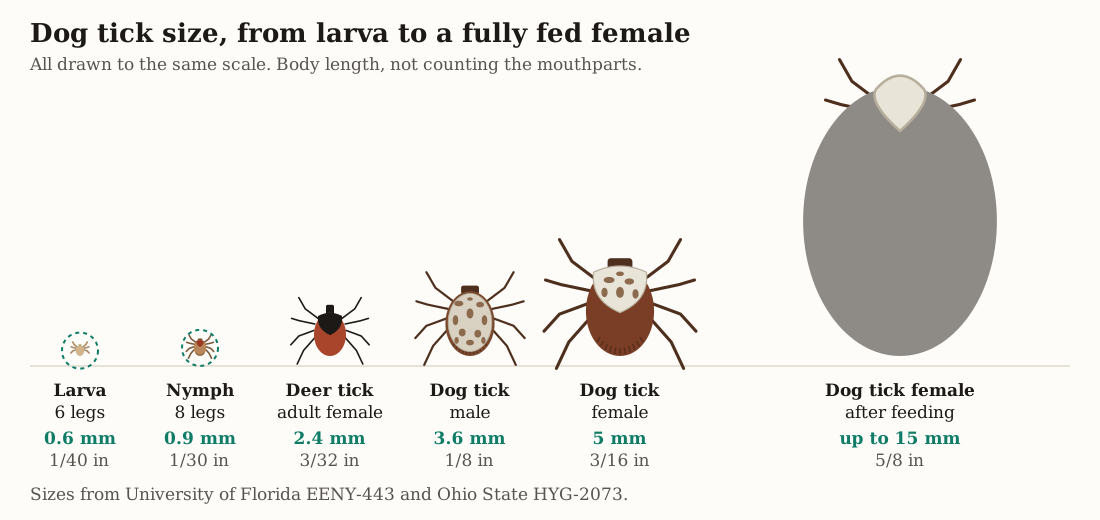
A female that has fed for several days turns grey and swells like a bean, up to about 5/8 inch (15 mm) long. The University of Florida and Penn State both give 15 mm, and Ohio State gives about 5/8 inch. Even when she is that full, her small pale shield still shows at the front.
An engorged tick on a dog is almost always a female, because males do not swell. Our guide to what ticks look like before and after feeding shows the change in other species too.
Dog tick nymphs and larvae
Young dog ticks are tiny. A larva is about 0.6 mm and has six legs; a nymph is about 0.9 mm and has eight. Neither has the pale markings. Both feed mostly on mice and voles, larvae in May and June and nymphs in July and August. They rarely bite people. So if you find a cluster of pinhead ticks on your leg, see our page on seed ticks, because those are often lone star tick larvae.
What a phone photo can and cannot show
A sharp photo from above, on white paper, is usually enough to name an adult American dog tick. The pale markings and the short mouthparts show up well. However, a photo cannot separate it from its western cousins, the Rocky Mountain wood tick and the Pacific Coast tick. For those, where you were matters more than the picture. You can upload a photo to our bug identifier by picture, then keep the tick in case a doctor or an extension office wants to see it.
Dog tick or deer tick? The look-alikes
A dog tick is larger and has pale markings. An adult deer tick, the blacklegged tick, is only about 2 to 3 mm (3/32 to 1/8 inch) long unfed, with a dark brown to black shield, an orange-red rear and dark legs, and no white at all. That one difference settles most cases. It matters, because the deer tick spreads Lyme disease and the dog tick does not.
For a side-by-side with photos, see deer tick vs dog tick, and our deer tick guide for the Lyme risk. Other ticks can be confused with a dog tick too. The table gives the one feature that separates each.
Table 2. Ticks that get mistaken for a dog tick
Silvery or cream markings on a reddish-brown back, short mouthparts
- Tick
- American dog tick
- Where in the US
- East of the Rockies, plus parts of California and the Northwest
Dark brown to black shield, orange-red rear, dark legs, no white
- Tick
- Deer (blacklegged) tick
- Where in the US
- Most of the eastern US
One white spot in the middle of the female's back
- Tick
- Lone star tick
- Where in the US
- South, East and Midwest
Plain red-brown, no white markings, slim body
- Tick
- Brown dog tick
- Where in the US
- Across the US, mostly indoors with dogs
Same look; found in the mountains at 4,000 to 10,500 ft
- Tick
- Rocky Mountain wood tick
- Where in the US
- Rocky Mountain states
Same look; found near the Pacific coast
- Tick
- Pacific Coast tick
- Where in the US
- California, southwest Oregon, south-central Washington
Similar pattern, but longer mouthparts and a paler color
- Tick
- Gulf Coast tick
- Where in the US
- Mostly the Southeast
Ranges from CDC’s tick maps and, for the Pacific Coast tick, Paddock and others (2024). Deer tick size from Ohio State; Gulf Coast tick from Texas A&M.
A tick with one bright white spot on its back is a female lone star tick, the tick linked to red meat allergy. Our lone star tick guide covers it, and types of ticks compares every common US species.
Wood tick: one tick in the East, three cousins in the West
In most of the US, a wood tick and a dog tick are the same animal: the American dog tick. In the West, “wood tick” can also mean the Rocky Mountain wood tick. Two more close relatives live near the Pacific coast. All of them belong to the genus Dermacentor, adults about 5 mm long with ornate pale markings.
Because they look so alike, the safety advice is the same for all of them. What changes is the list of diseases, and that depends on where you live.
Rocky Mountain wood tick
The Rocky Mountain wood tick, Dermacentor andersoni, lives in the Rocky Mountain states and southwestern Canada, at elevations of 4,000 to 10,500 feet, CDC says. It can spread Rocky Mountain spotted fever, Colorado tick fever and tularemia, mainly through adult ticks. It is also one of the two ticks behind most US cases of tick paralysis, covered below.
Pacific Coast tick
The Pacific Coast tick, Dermacentor occidentalis, has been recorded across most of California and in parts of southwestern Oregon, south-central Washington and northwestern Mexico. It bites people often. In California it can carry Rocky Mountain spotted fever and Pacific Coast tick fever. The California Department of Public Health says Pacific Coast tick fever often leaves a small sore, about the size of a pencil eraser, that turns into a dark scab.
The western “American dog tick” is now its own species
In 2021, Ohio State researchers found that the American dog ticks west of the Rockies are a separate species. They named it Dermacentor similis. It looks the same to the naked eye; the clearest difference is in the breathing plates on the underside. CDC now lists both species. CAPC, the veterinary parasite council, lists the same two diseases for each: Rocky Mountain spotted fever and tularemia. How well the western one spreads them is still being studied, so treat a bite the same way.
The brown dog tick: the other dog tick
The brown dog tick, Rhipicephalus sanguineus, is the only US tick that can live and breed indoors, in homes and kennels with dogs. It is plain reddish brown with no white markings, about 1/8 inch (3 mm) long unfed, and it rarely bites people, according to Ohio State.
Table 3. American dog tick vs brown dog tick
Markings
- American dog tick
- Pale silvery or cream
- Brown dog tick
- None, plain reddish brown
Unfed adult size
- American dog tick
- About 3/16 in (5 mm)
- Brown dog tick
- About 1/8 in (3 mm)
Where it lives
- American dog tick
- Outdoors, in tall grass along trails and field edges
- Brown dog tick
- Indoors with dogs, kennels, yards close to the house
Bites people
- American dog tick
- Often, mostly adult females
- Brown dog tick
- Rarely
Found in the house
- American dog tick
- A hitchhiker that soon dies
- Brown dog tick
- Can infest the house
Season
- American dog tick
- Spring to midsummer
- Brown dog tick
- All year indoors
Spreads to people
- American dog tick
- Rocky Mountain spotted fever, tularemia
- Brown dog tick
- Rocky Mountain spotted fever in the Southwest and on the Mexico border
If ticks keep turning up on the walls near your dog’s bed, they are almost certainly brown dog ticks. Our guide to identifying and clearing brown dog ticks covers the house plan.
Where American dog ticks live
American dog ticks live across most of the US east of the Rocky Mountains, and in parts of California and the Northwest. They wait in tall grass and low brush along trails, roadsides, field edges and the edges of woods, not deep in the forest. That is where people and dogs pick them up.
Texas A&M maps the eastern range from the Atlantic states south and west to the Texas Panhandle, and north to eastern Montana. Along the Pacific coast, it reaches through the western half of California into parts of Oregon and Washington. Those western ticks are the new species described above.
Dog ticks do not jump, fly or drop from trees. Instead, an adult climbs to the tip of a grass blade and waits for an animal to brush past. Once aboard, it crawls upward. On people, adults often end up on the scalp or the hairline at the back of the neck.
They do not settle indoors. The California Department of Public Health says American dog ticks do not live long in homes or suburban yards. A dog tick on the mudroom wall, or in the dryer lint trap, rode in on a pet or on clothes.
When dog ticks are out
Adult American dog ticks are out from about April to early August in most regions. In Ohio, they are most common from mid-April to mid-July. Farther south, every stage can be active through much of the year, with a rise in spring. So the risk of a bite is highest in late spring and early summer.
The young ones keep a different schedule. Larvae feed in May and June and nymphs in July and August, mostly on small mammals. That is why late-summer bites from tiny ticks are usually some other species.
Dog ticks are also patient. The University of Rhode Island says they can survive up to 2 years at any stage without finding a host. Our guide to preventing tick bites covers repellents and clothing for the season.
Dog tick bite on humans
A dog tick bite usually leaves a small red bump after the tick is removed, sometimes with mild itching. Adults often climb to the head and attach at the scalp or the hairline at the back of the neck. The bite itself is rarely the problem. What matters is whether the tick carried a germ.
Most people do not feel the bite. They find the tick later, while combing hair or giving a child a bath. A small, firm bump can last a few days. Yet a bite mark cannot tell you which tick bit you, so keep the tick. Our guide to what a tick bite looks like shows the normal reactions and the ones that need a doctor.
Found a dog tick on you: what to do
Take it off now
Grip the tick with fine-tipped tweezers as close to the skin as you can. Pull straight up with steady, even pressure. Never twist or jerk it. Do not wait for a doctor to do it, because a tick that stays on longer has more time to pass on germs.
Skip the home tricks
Nail polish, petroleum jelly and heat do not help, so leave them out. Never crush the tick with your fingers either. CDC warns these tricks can force fluid from the tick into the skin.
Clean the bite and your hands
Wash the bite and your hands with soap and water. If part of the mouth stays in and will not come out easily, leave it. CDC says the skin pushes it out as it heals.
Keep the tick
Seal it in a small bag or wrap it tightly in tape. Write down the date and where you think you picked it up. A doctor may want to know which tick it was.
Check for more
Look over the scalp, the hairline at the back of the neck, behind the ears and the waistband. Then check your dog and your children. Where there is one tick, there may be others.
Watch the next few weeks
Fever, headache, a rash, vomiting or muscle aches in the weeks after the bite need a doctor the same day. Say that a tick bit you, when, and where.
Did a little skin come off with the tick? That alone is not a problem, so just clean the spot well. If the mouthparts broke off, CDC says to remove them with tweezers if that is easy, and otherwise to leave them alone. Our step-by-step tick removal guide covers stuck heads and ticks in hard places. For what to watch in the weeks after, see tick bite symptoms.
Are dog ticks dangerous? The diseases they carry
Most dog tick bites do no harm. The tick can pass on Rocky Mountain spotted fever and tularemia, and it can cause tick paralysis. Even so, Ohio State says fewer than 2 in 100 of these ticks carry the spotted fever germ. It does not spread Lyme disease.
Table 4. What the American dog tick and its cousins can cause
Rocky Mountain spotted fever
- What to watch for
- Fever and headache 3 to 12 days after a bite, then often a rash on the wrists and ankles
- Ticks that spread it
- American dog tick, Rocky Mountain wood tick, brown dog tick (Southwest)
Tularemia
- What to watch for
- Fever, a sore where the tick fed, swollen glands in the armpit or groin
- Ticks that spread it
- American dog tick, Rocky Mountain wood tick, lone star tick
Tick paralysis
- What to watch for
- Weakness that climbs from the legs, after 4 to 7 days of feeding
- Ticks that spread it
- Rocky Mountain wood tick, American dog tick
Pacific Coast tick fever
- What to watch for
- Fever and a dark scab at the bite
- Ticks that spread it
- Pacific Coast tick
Lyme disease
- What to watch for
- Not spread by any tick on this page
- Ticks that spread it
- Deer (blacklegged) ticks
From CDC (Rocky Mountain spotted fever, tularemia, where ticks live, Lyme disease), CDC’s MMWR (tick paralysis, 2006), Ohio State HYG-2073 and the California Department of Public Health.
Rocky Mountain spotted fever
Rocky Mountain spotted fever is a bacterial infection. The most common signs are fever, headache and a rash, CDC says. The rash often appears 2 to 4 days after the fever starts, so it can come late. Despite the name, most cases happen in the Southeast and the south-central states, not the Rockies.
Speed matters most. CDC says the disease can be deadly if it is not treated early with the antibiotic doxycycline, which is approved for adults and children of all ages. Blood tests can take weeks, so a doctor who suspects it should start treatment before the results come back. Severe cases can leave lasting damage, such as hearing loss or the loss of fingers or toes.
How long does a dog tick have to be attached?
Nobody can give you a safe number. On forums, people often say a tick that was on for under 24 hours cannot make you sick. That rule comes from Lyme disease: CDC says a tick must usually be attached for more than 24 hours to pass on Lyme bacteria. It does not fit Rocky Mountain spotted fever. The California Department of Public Health says an infected tick needs at least 4 to 6 hours, and CAPC says spotted fever germs can pass within 3 to 6 hours. Ohio State, on the other hand, says at least a day.
The sources disagree, and the clock is hard to know anyway. So take the tick off as soon as you see it, and watch for a fever whatever its size.
Tularemia
Tularemia is a rarer bacterial disease that people also get from deer flies and from handling sick rabbits and rodents. After a tick bite, the usual form is a skin sore where the tick fed, with swollen glands in the armpit or groin. CDC says every form brings a fever, as high as 104°F (40°C). Most infections can be treated with antibiotics.
Tick paralysis
Tick paralysis is caused by a toxin in the saliva of a feeding tick. In the US, the Rocky Mountain wood tick and the American dog tick cause most cases, says a CDC report. Weakness usually starts after 4 to 7 days of feeding. Then it climbs from the legs upward over hours or days, without pain.
The cure is finding the tick. Once it is removed, the weakness usually clears within 24 hours. If the tick is missed, the paralysis can reach the breathing muscles, and the same report puts the death rate at about 10%. Most cases happen from April to June. Children are most often affected, and the tick is usually on the head or neck, hidden in the hair.
Do dog ticks carry Lyme disease?
No. CDC says the American dog tick, the Rocky Mountain wood tick and the brown dog tick cannot pass on the bacteria that cause Lyme disease. In the US, Lyme disease comes from deer ticks. Still, see a doctor for a fever or rash after any tick bite. You may have been bitten by a second tick you never saw.
Medical disclaimer. This page is for general information only. It is not a medical diagnosis. If you have severe symptoms, trouble breathing, swelling of the face or throat, fast spreading redness, fever, severe pain, pus, or signs of infection, contact a doctor or your local emergency number.
Dog ticks on your dog
Dogs are this tick’s favorite adult host, which is how it got its name. A dog can get Rocky Mountain spotted fever from it, and the tick’s saliva can cause tick paralysis in dogs as well as people. Removing the tick quickly usually brings a quick recovery, Ohio State says. Watch your dog for changes in behavior or appetite after a bite, though: CDC says signs of a tick-borne illness in a pet may not show for 7 to 21 days or longer.
Run your hands over your dog after every walk in tall grass, and ask your vet about a tick-control product. Home remedies will not kill a tick that has bitten: our page on what kills ticks on a dog, and how fast explains why. Our guide to ticks on dogs covers where to look and the warning signs to take to the vet, and our dog tick removal guide shows how to take a tick off a dog.
How to avoid dog tick bites
The cheapest protection costs nothing: stay in the middle of mowed paths, tuck pants into socks, and check the scalp and hairline after time in tall grass. Light-colored clothes make a crawling tick easier to spot. Also, check your dog before it comes inside.
Repellents add to that. Use an EPA-registered repellent and follow the label. Ohio State notes that permethrin goes on clothing only, never on skin. Around the house, keeping grass short and brush cut back makes the edges of the yard less friendly to ticks. Our tick prevention guide covers repellents and clothing in detail.
Dog tick myths, corrected
Several common beliefs about this tick are wrong, and a few appear on pages that rank well, including Google’s AI answer. Here is what the public health and university sources say instead.
Myth 1
Myth: “A dog tick can give you Lyme disease.”
Truth: CDC says this tick and its close cousins cannot pass on Lyme bacteria. Deer ticks do.
Myth 2
Myth: “If it was on you for under 24 hours, you are safe.”
Truth: That rule does not fit Rocky Mountain spotted fever. CAPC and the California Department of Public Health both say a few hours can be enough. Watch for a fever either way.
Myth 3
Myth: “American dog ticks spread canine babesiosis.”
Truth: Some pages and Google's AI answer say so. CAPC, the veterinary parasite council, names the brown dog tick as the most common US carrier.
Myth 4
Myth: “Send the tick to a lab to see if you are infected.”
Truth: CDC advises against it. A positive tick does not mean you are infected, a negative one can give false comfort, and you should not wait for the result to see a doctor.
Myth 5
Myth: “American dog ticks feed on the same animal all their lives.”
Truth: Larvae and nymphs feed on mice and voles. Adults move up to raccoons, dogs and people (University of Rhode Island, Texas A&M). The brown dog tick is the exception: CDC says it prefers the same host at every stage.
Myth 6
Myth: “Dog ticks jump on you or fall from trees.”
Truth: They climb grass and wait for you to brush past, then crawl upward. That is why they turn up in the hair.
Myth 7
Myth: “A dog tick in the house means an infestation.”
Truth: American dog ticks do not live long indoors. A house infestation points to the brown dog tick.
Still not sure what you found? Compare it with the photos in our guide to tick identification by color and size, or upload a photo to the bug identifier.
Pest control disclaimer. Photo-based identification can help, but it is not always perfect. For dangerous spiders, large infestations, or anything you are unsure about, contact a licensed pest control professional.
Dog tick FAQ
How long does a dog tick stay attached?
How long can a dog tick live without a host?
Do dog ticks lay eggs in your house?
Can I catch Rocky Mountain spotted fever from my dog?
Related guides
Ticks
The ticks that bite people in the US, where they live, and what each can spread.
Deer tick
The small black-shielded tick that spreads Lyme disease, and how to spot it.
How to remove a tick
The CDC method step by step, including a stuck head and a tick in the hair.
Deer tick vs dog tick
Side-by-side photos and the one check that tells them apart.
Ticks on dogs
Where ticks hide on a dog, how to take them off, and when to call the vet.
Lone star tick
The tick with the white spot, and its link to red meat allergy.
Types of ticks
Every common US tick compared by color, size and range.
Tick bite
Symptoms after a bite and when to worry.
Sources
- CDC, Where Ticks Live (July 30, 2025)
- CDC, About Rocky Mountain Spotted Fever
- CDC, What to Do After a Tick Bite
- CDC, How Lyme Disease Spreads
- CDC, Signs and Symptoms of Tularemia
- CDC, MMWR 55(34), Cluster of Tick Paralysis Cases, Colorado, 2006
- University of Rhode Island TickEncounter Resource Center, American Dog Tick
- Chan and Kaufman, American Dog Tick, Dermacentor variabilis, University of Florida EENY-443
- Ohio State University Extension, Ticks and Tick-Borne Diseases, HYG-2073
- Texas A&M AgriLife, The Tick App: American dog tick
- Companion Animal Parasite Council, Ticks guideline (March 30, 2023) and Babesia guideline
- CDC, Preventing Ticks on Pets (May 15, 2024)
- California Department of Public Health, Spotted Fever Group Rickettsia in California (fact sheet)
- Lado, Glon and Klompen (2021), Integrative taxonomy of Dermacentor variabilis with description of a new species, Dermacentor similis, Journal of Medical Entomology 58(6)
- Paddock and others (2024), Rickettsia species identified in adult, host-seeking Dermacentor occidentalis from Baja California, Oregon and Washington, Journal of Medical Entomology