What does a tick bite look like?
So what does a tick bite look like? Most of the time, it is a small red bump or a flat red dot, about the size of a mosquito bite. There may be a tiny dark speck in the middle, where the mouthparts went in. CDC says this mark appears right away and usually fades within 1 to 2 days. It is the skin reacting to the bite, not a sign of Lyme disease. In some people the spot also swells, itches, blisters or bruises, NHS inform notes.
Often the first thing you see is the tick, not the bite. An attached tick can pass for a new freckle, a scab or a small mole. A 2017 dermatology review by Joseph Kallini and Amor Khachemoune collected cases where attached ticks were mistaken for moles, and even for melanoma. On Reddit, one woman covered what she took for a scabbing mole with a bandage for a week. Then her husband looked closer and found a tick.
A tick bite rarely hurts at the time, so many bites go unnoticed. That has a real cost. In US studies of people with a Lyme rash, only about 25% remembered the tick bite behind it, according to a 2015 review by Robert Nadelman of New York Medical College. CDC says the nymph, about the size of a poppy seed, is the riskiest stage because it is so hard to see.
So what you can see has limits. A bite mark looks much like a mosquito, flea or spider bite. The only proof that a tick bit you is the tick itself, so keep it if you find it. Our guide to what a tick looks like shows each kind at real size, swollen and flat, and the ticks guide covers every other tick question.
Where on the body ticks bite
Ticks crawl until they find a warm, hidden spot. In a study of 79 adults with a Lyme rash, the most common places were the thigh (18%), the back (15%), the shoulder (14%), the calf (10%) and the groin (8%). In children, ticks often bite along the hairline and the scalp, where the hair hides them.
CDC’s tick check adds the armpits, in and around the ears, the belly button, the back of the knees, between the legs and around the waist. A bump in one of those spots after time outdoors deserves a second look.
Tick bite day by day: day 1, day 4 and after a week
On day 1, a normal tick bite is a small red bump or dot, and it may itch. By day 2 or 3 it should be fading, and after a week it is usually gone or a faint mark. A Lyme rash keeps a different clock. CDC says it starts 3 to 30 days after the bite, about 7 days on average, and then grows.
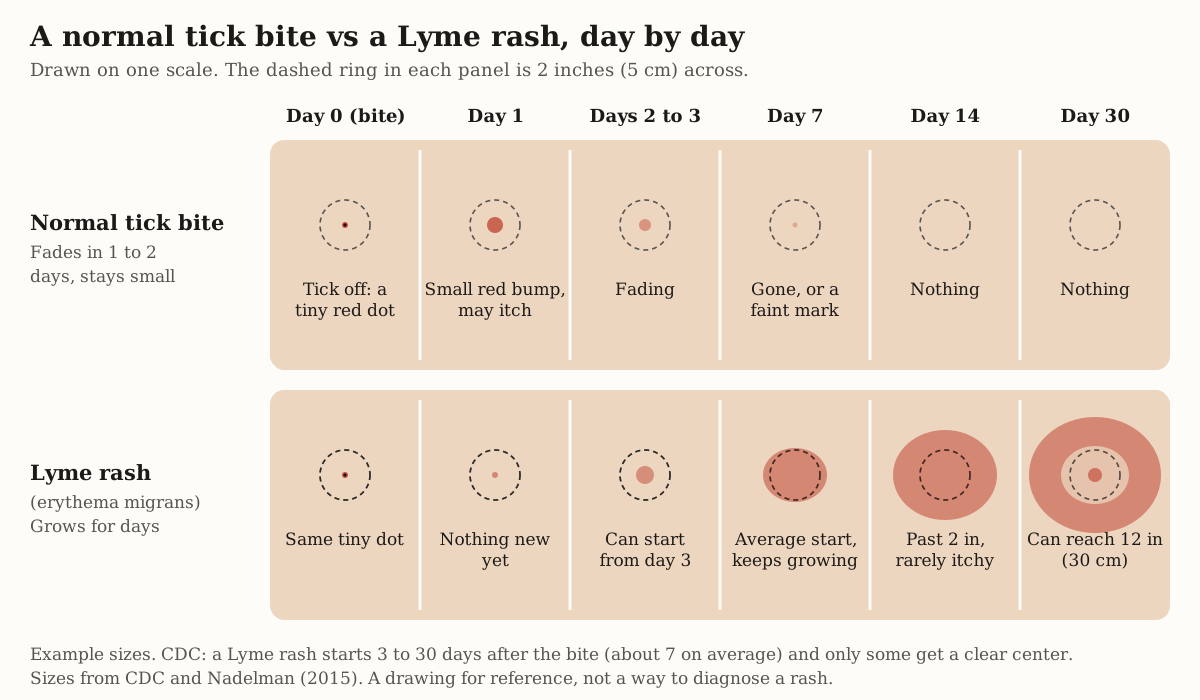
Tick bite timeline: what is normal and what needs a doctor
While the tick is on (day 0)
- A normal tick bite
- The tick itself, flat or swollen, with a little redness around it. Usually no pain.
- Signs that need a doctor
- Trouble breathing or a swelling face or throat: call 911.
Day 1
- A normal tick bite
- A small red bump or dot, like a mosquito bite. It may itch. A dark speck can mark where the mouthparts were.
- Signs that need a doctor
- Usually none. CDC puts the start of a Lyme rash at day 3 or later.
Days 2 to 3
- A normal tick bite
- The bump shrinks and fades. CDC says this redness usually clears in 1 to 2 days.
- Signs that need a doctor
- Redness that spreads, hot skin, pus or red streaks can mean a skin infection.
Days 4 to 7
- A normal tick bite
- Gone, or a small scab or faint mark.
- Signs that need a doctor
- A new red or dark patch growing around the bite. Day 7 is the average start of a Lyme rash.
Weeks 1 to 4
- A normal tick bite
- Nothing new.
- Signs that need a doctor
- A patch past 2 inches (5 cm), new rings elsewhere, fever, chills, aches, or small spots on the wrists and ankles.
Months later
- A normal tick bite
- In some people, a firm, itchy lump at the bite.
- Signs that need a doctor
- A lump that grows, breaks open or changes color.
Timing from CDC (Lyme disease, STARI and Rocky Mountain spotted fever pages) and Nadelman (2015). Every bite is a little different.
What a tick bite looks like after 1 day
What does a tick bite look like after 1 day? Usually a small pink or red bump, flat or a little raised, about as big as a mosquito bite. It may itch, and there may be a dark dot in the center. CDC says this early redness is common and is not a sign of Lyme. A Lyme rash starts 3 to 30 days after the bite.
What a tick bite looks like on day 4
By day 4, most tick bites are fading or gone. A small scab is normal. What is not normal is a patch that is bigger today than yesterday. That is the moment to draw around it with a pen and photograph it, as the steps further down explain.
What a tick bite looks like after a week
What does a tick bite look like after a week? Usually like nothing at all, or a faint mark where it healed. A red patch that appeared after day 3 and keeps spreading is the warning sign. Day 7 is the average start of a Lyme rash, so the end of the first week is a good time to look closely, in good light.
Why a big red patch in the first 2 days is usually not Lyme
Some people react strongly to tick saliva. Nadelman’s review explains that a red patch present while the tick is still on, or within 48 hours of taking it off, is most likely a reaction to the bite rather than an infection. These reactions are usually under 2 inches (5 cm), often itch, and fade within 24 to 48 hours.
Some can be bigger, though. Nadelman shows one larger than 5 cm that appeared within hours and was gone in about 2 days. A Reddit poster asked about the same pattern: a rash about 4 cm wide 2 days after a first tick bite, “only itchy.” The test is what happens next: a bite reaction fades, while a Lyme rash keeps growing.
Normal tick bite vs Lyme rash: how to tell them apart
Timing, size and change tell them apart. A normal tick bite reaction appears within hours, usually stays under 2 inches (5 cm), often itches, and fades in 1 to 2 days. A Lyme rash, called erythema migrans, appears 3 to 30 days later, grows past 2 inches over several days, may feel warm, and rarely itches.
Normal tick bite vs Lyme rash (erythema migrans)
When it appears
- Normal bite or bite reaction
- Within hours, while the tick is on or within 2 days of removal
- Lyme rash
- 3 to 30 days after the bite, about 7 days on average
Size
- Normal bite or bite reaction
- Small, usually under 2 inches (5 cm)
- Lyme rash
- 2 inches (5 cm) or more; often 4 to 6 inches (10 to 16 cm) when people see a doctor; up to 12 inches (30 cm) or more
Over the next days
- Normal bite or bite reaction
- Shrinks and fades in 1 to 2 days
- Lyme rash
- Keeps growing for days; untreated, it lasts weeks
Itch and pain
- Normal bite or bite reaction
- Often itchy
- Lyme rash
- Rarely itchy or painful; may feel warm to the touch
Shape
- Normal bite or bite reaction
- A bump or a small round patch
- Lyme rash
- Round or oval; a solid patch more often than a bull's-eye
Feeling unwell
- Normal bite or bite reaction
- No
- Lyme rash
- Often fever, chills, headache, tiredness or aches
From CDC’s Lyme disease signs and symptoms page and Nadelman (2015), table 4.
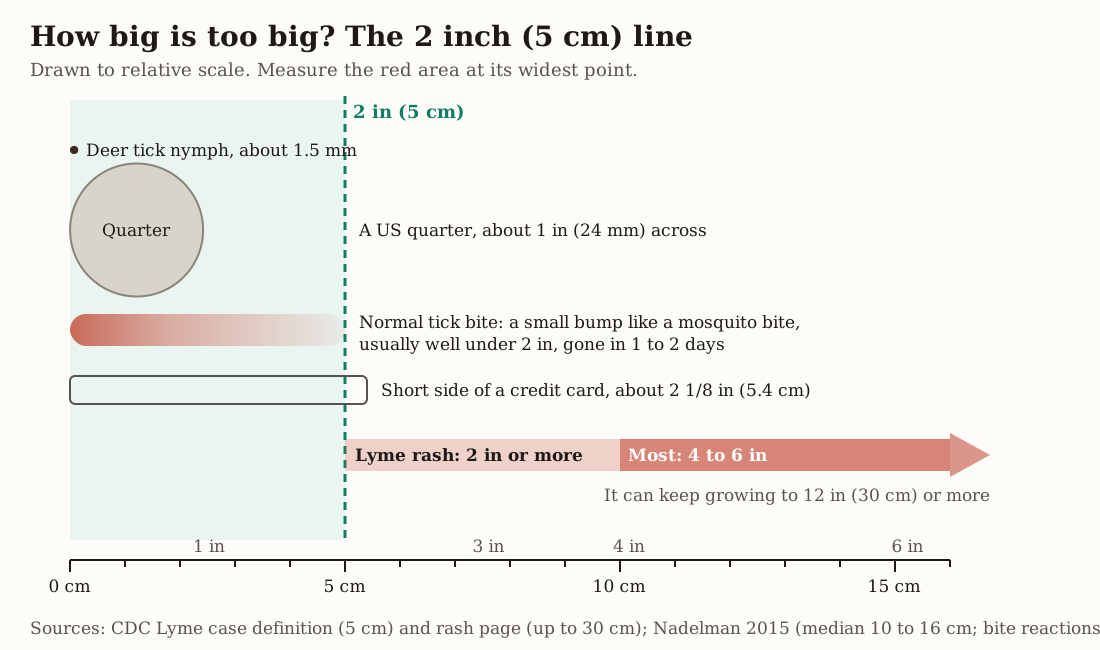
Measure it at the widest point. The 2 inch (5 cm) line comes from CDC’s case definition of the Lyme rash, which counts a single rash of 5 cm or more. Without a ruler, the short side of a credit card is about 2 1/8 inches (5.4 cm). A rash a little smaller than that can still be Lyme if it keeps growing, so the trend matters more than one measurement.
A pen helps more than a ruler. Nadelman describes doctors tracing the edge of a doubtful rash in ink and checking it 1 to 2 days later: a bite reaction fades, while a Lyme rash grows past the line. You can do the same at home and photograph it each day. If the patch is already past 2 inches days after the bite, or you feel unwell, see a doctor now instead of waiting.
Does a bullseye rash after a tick bite always mean Lyme?
No. A ring after a tick bite is a reason to see a doctor, but it is not proof of Lyme disease. Lone star ticks can cause STARI, a rash CDC calls very similar to the Lyme rash. A strong bite reaction in the first 2 days can also form a ring. Ringworm, a fungus, makes rings too.
STARI matters most in the South, where lone star ticks are common and Lyme disease is rare. CDC says the STARI rash usually appears within 7 days and grows to 3 to 12 inches (8 to 30 cm). Lone star ticks do not spread Lyme bacteria. Our lone star tick guide shows that tick and the white spot on the female.
Most Lyme rashes are not a bull’s-eye
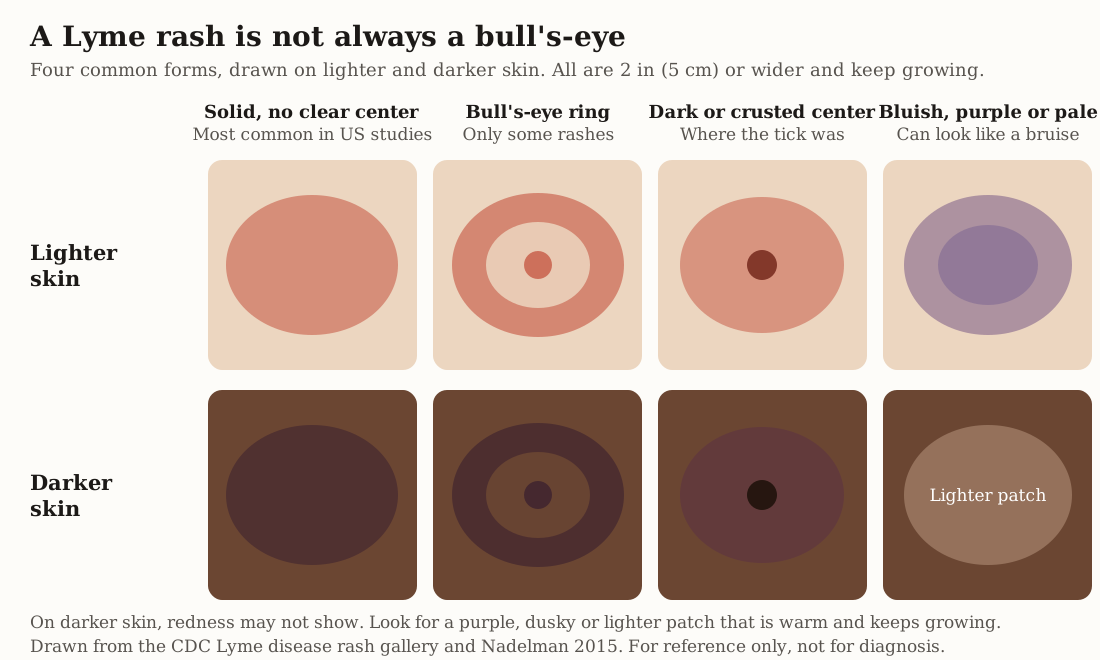
The classic target rash is the exception in the US. In two large studies in the Northeast, only 37% and 9% of Lyme rashes had a clear center, Nadelman reports. Most are an evenly red or pink oval. Some have a blister or a crust in the middle, and some on the legs turn bluish. CDC’s gallery of Lyme disease rashes shows real examples next to rashes that are not Lyme.
Can you have Lyme disease without a rash, or without seeing a tick?
Yes to both. CDC says the rash appears in about 70 to 80 percent of infected people, so some never get one. They may only feel feverish, tired and achy. And with only about 1 in 4 people remembering the bite, a growing rash is worth showing a doctor even if you never saw a tick. A Reddit commenter put it simply: “Doesn’t matter that you never saw a tick, most people don’t.”
What a tick bite and Lyme rash look like on darker skin
What does a tick bite look like on darker skin? On brown or black skin, redness is harder to see, so the bump may be one you feel more than see. A Lyme rash can look purple, bluish, bruise-like or paler than the skin around it, as the photos in CDC’s rash gallery show. Even so, a patch that keeps growing is still the key sign.
Missed rashes have a cost. A 2025 study in CDC’s journal Emerging Infectious Diseases looked at Lyme diagnoses in Medicaid and Medicare claims from 2016 to 2021. Black children on Medicaid were 2.35 times as likely as White children to have Lyme disease that had already spread when it was diagnosed. The authors name rashes that are hard to see on darker skin as one likely reason.
These checks make a rash easier to spot on any skin tone:
- Look in daylight or bright white light, not under a warm lamp.
- Compare sides. Look at the same spot on the other arm or leg.
- Feel the skin. CDC says a Lyme rash may feel warm to the touch.
- Mark the edge with a pen and see whether it grows past the line.
- Tell the doctor that the rash is hard to see on your skin, and show your dated photos.
Other rashes that can follow a tick bite
A growing ring is not the only rash ticks cause. Lone star ticks can cause STARI, a ring much like the Lyme rash. Rocky Mountain spotted fever causes small, flat pink spots on the wrists, forearms and ankles, 2 to 4 days after a fever starts. Some infections leave a dark scab or an open sore where the tick fed.
Rashes after a tick bite and what each looks like
Lyme disease rash (erythema migrans)
- What it looks like
- A red, dark or purple patch that grows past 2 in (5 cm); sometimes a bull's-eye
- When it shows up
- 3 to 30 days after the bite
- Tick usually behind it
- Blacklegged (deer) tick
STARI
- What it looks like
- A red, growing ring, 3 to 12 in (8 to 30 cm), sometimes a bull's-eye
- When it shows up
- Usually within 7 days
- Tick usually behind it
- Lone star tick, mostly in the South
Rocky Mountain spotted fever
- What it looks like
- Small, flat, pink spots on the wrists, forearms and ankles that spread to the body, sometimes the palms and soles; later, tiny red-purple dots
- When it shows up
- 2 to 4 days after the fever starts; the illness begins 3 to 12 days after the bite
- Tick usually behind it
- American dog tick, Rocky Mountain wood tick, brown dog tick
Other spotted fevers
- What it looks like
- A dark, dead-looking scab at the bite (an eschar), with fever and sometimes a rash
- When it shows up
- Days after the bite
- Tick usually behind it
- Gulf Coast tick and others
Tularemia
- What it looks like
- An open sore at the bite, with swollen glands in the armpit or groin
- When it shows up
- With a fever that can reach 104 F (40 C)
- Tick usually behind it
- Dog ticks, wood ticks and lone star ticks
Ehrlichiosis
- What it looks like
- Red splotches or pinpoint dots; up to 1 in 3 people, more often children
- When it shows up
- About 5 days after the fever starts
- Tick usually behind it
- Lone star tick
Alpha-gal syndrome
- What it looks like
- Hives or an itchy rash, a reaction to food rather than to the bite
- When it shows up
- 2 to 6 hours after eating red meat or dairy, starting weeks to months after the bite
- Tick usually behind it
- Lone star tick
From CDC pages on each illness (2024 to 2026), and Kallini and Khachemoune (2017) for which tick spreads what.
These rashes come with feeling sick, and the fever often comes first. CDC says fewer than half of people with Rocky Mountain spotted fever have the rash in the first 3 days. So a fever after a tick bite needs a doctor even with no spots at all. Each illness, its symptoms and when it starts are covered in our guide to tick bite symptoms, and the ticks themselves on the dog tick and deer tick pages.
A hard lump, an itch or a bruise after a tick bite
A small, firm bump that itches for weeks or months is a common reaction to tick saliva. It does not mean the tick is still inside. Harvard Health lists hardened bumps and nodules called granulomas among the skin reactions to tick bites. Most fade on their own. See a doctor for a lump that grows, bleeds or changes color.
Tick bite granuloma: the hard lump that lasts
A tick bite granuloma is a firm, red or skin-colored lump at the bite, often itchy, that lingers long after the tick is gone. Keisuke Hirota of Tottori University wrote in 2015 that the reaction can last several months to several years. It is the immune system reacting to tick saliva, and it can form even when no tick parts are left in the skin. Harvard Health says that, rarely, one grows large enough to be removed.
The fear behind it is usually worse than the lump. One Reddit user with a six-month-old lone star tick bump wrote that they knew “intellectually that it’s not filled with baby ticks.” It is not. It is your skin, not something living in it. Show a doctor or a dermatologist if it bothers you or keeps changing.
Is an itchy tick bite normal?
Yes. In the first days, itching fits a normal bite reaction, which often itches, Nadelman notes. A Lyme rash is the opposite: CDC says it is rarely itchy or painful. So an itchy bump is not a Lyme sign, and a rash that does not itch is not a safe sign either. How long the itch lasts, and what helps, is covered in our tick bite guide.
A bruise around a tick bite
An ordinary bruise changes color from purple to green and yellow, and it shrinks. A bruise-like patch that shows up days after a bite and keeps spreading is different. Nadelman notes that Lyme rashes on the legs can turn bluish, and on darker skin the rash often looks dusky or purple. Treat a growing bruise after a tick bite like a growing rash.
A black dot or scab in the middle
A tiny dark dot after you pull a tick off is often a bit of mouthpart or a small scab. CDC says you can lift leftover mouthparts with tweezers, and should leave them if they do not come out easily. The skin pushes them out as it heals. A large, dark, dead-looking scab with a fever is different, and it needs a doctor.
Tick bite or something else? Spider bites, mosquito bites and ringworm
Many bites and rashes look like a tick bite, and the mark alone rarely settles what bit you. A tick that is still attached, or found nearby the same day, is the only real proof. These clues help you decide what to check next, not what you have.
Clues that point to a tick bite or to something else
A tick attached, or found nearby the same day
- More likely
- Tick bite
- What to know
- Keep the tick in a sealed bag or tape and write down the date
An itchy bump within minutes, after time outdoors at dusk
- More likely
- Mosquito bite
- What to know
- Several bites at once, itch starts fast, gone in a few days
Itchy bites in lines or clusters, found in the morning
- More likely
- Bed bugs
- What to know
- Check mattress seams for small brown bugs and dark spots
Many tiny itchy bumps around the ankles, waist or sock line after walking in grass
- More likely
- Chiggers or seed ticks
- What to know
- Seed ticks are tick larvae that can climb on in groups
A ring with a raised, scaly, itchy edge that grows slowly
- More likely
- Ringworm, a fungal infection
- What to know
- CDC lists ringworm among rashes that are not a Lyme rash
A painful sore with a dark or blistered center
- More likely
- A spider bite or a skin infection
- What to know
- Most suspected spider bites turn out to be something else
Spider bite bullseye rash vs a tick bite
A brown recluse bite can form a bull’s-eye: a dark center, a pale ring and a red edge. Still, that pattern appears in only a minority of bites, and the spider lives only in parts of the South and Midwest. Our brown recluse guide maps where it lives and how a bite develops.
The mix-up runs the other way too. Rick Vetter, a spider researcher at UC Riverside, lists Lyme disease among the conditions doctors have mistaken for recluse bites, and cites published cases. A painless, warm ring that keeps growing for days fits a Lyme rash better than a spider bite. Mention any time outdoors to the doctor.
A bullseye rash that is not Lyme
CDC shows six rashes that can look like a Lyme rash but are not: a big allergic reaction to an insect bite, a rash from a medicine, ringworm, pityriasis rosea, granuloma annulare and hives. STARI adds a seventh. A doctor sorts them out by when the rash started, how it changed and whether you were bitten.
For a tick next to a bed bug, see tick vs bed bug. To compare 20 kinds of bites at once, try the bug bite identification chart, and for clusters of tiny ticks, the seed ticks guide.
Tick bite pictures: why this page uses drawings
Search for what does a tick bite look like, and most results are photos of skin. This page shows drawings instead, on purpose. A photo of someone else’s bite invites a match that a bite cannot support, and rashes vary a lot from person to person. The pictures that help you are your own: the tick, and a dated photo of your bite each day for 30 days.
A photo of the tick can be identified. A photo of the bite cannot. Tape the tick to a white card, photograph it from above, and try our bug identifier by picture. Knowing the kind of tick tells you which illnesses to watch for.
How to track a tick bite, step by step
Keep the tick
Seal it in a small bag or wrap it tightly in tape. Write down the date and where you think you picked it up. The tick is the only proof that a tick bit you.
Photograph the bite on day 1
Put a coin or a ruler next to it for scale. Use daylight or the same lamp each time, so the color looks the same from day to day.
Draw around any redness
Trace the edge of a red, dark or purple patch with a pen. Doctors use the same trick to see whether a rash grows or fades over 1 to 2 days.
Look again every day for 30 days
Check the spot and take a new photo at about the same time each day. CDC says a Lyme rash can start up to 30 days after the bite.
Measure anything that spreads
A patch past 2 inches (5 cm), or one that grows past your pen line, needs a doctor. So does a fever, with or without a rash.
Bring the photos and the tick to the doctor
Say when and where the bite happened. If your skin is darker and the rash is hard to see, say so, and show the photos in order.
Tick bite myths, corrected
At least 6 common beliefs about how a tick bite looks are wrong. Several appear on pages that rank well, and others come up again and again on Reddit. Here is what each gets wrong, and the source that says so.
Myth 1
Myth: “A Lyme rash is always a bull's-eye.”
Truth: Only 37% and 9% of Lyme rashes had a clear center in two large US studies, Nadelman reports. Most are an evenly colored oval.
Myth 2
Myth: “A red bump on day 1 means Lyme disease.”
Truth: CDC says a small bump or redness in the first 1 to 2 days is common and is not a sign of Lyme. The Lyme rash starts 3 to 30 days after the bite.
Myth 3
Myth: “No rash means no Lyme disease.”
Truth: CDC says the rash appears in about 70 to 80 percent of infected people. A fever and aches without a rash still need a doctor.
Myth 4
Myth: “You would know if a tick bit you.”
Truth: Only about 25% of US patients with a Lyme rash remembered the bite, according to Nadelman's review.
Myth 5
Myth: “A bull's-eye always means Lyme disease.”
Truth: STARI from lone star ticks, strong bite reactions and ringworm can all form rings. Any growing ring after a tick bite still needs a doctor.
Myth 6
Myth: “A lump months later means the head is still in.”
Truth: A lasting lump is usually a granuloma, the skin reacting to tick saliva. Hirota (2015) notes it can form with no tick parts left.
Medical disclaimer. This page is for general information only. It is not a medical diagnosis. If you have severe symptoms, trouble breathing, swelling of the face or throat, fast spreading redness, fever, severe pain, pus, or signs of infection, contact a doctor or your local emergency number.
Tick bite appearance FAQ
Does a tick bite look like a pimple?
How long does a tick bite mark last?
What does an infected tick bite look like?
What does a deer tick bite look like?
What does a tick bite look like on the scalp?
What do seed tick bites look like?
Related guides
Tick bite
Symptoms by disease, when to worry, and when to see a doctor.
How to remove a tick
The CDC tweezer steps, and what to do if part of it stays in.
What a tick looks like
Every stage at real size, flat and swollen.
Deer tick
The tick behind Lyme disease, and when each stage is out.
Lone star tick
The white-spotted tick behind STARI and the meat allergy.
Bug bite identification
A chart of 20 bites by look, place and timing.
Sources
- CDC, Signs and Symptoms of Untreated Lyme Disease (May 15, 2024)
- CDC, Lyme Disease Rashes (May 15, 2024)
- CDC, Lyme Disease (Borrelia burgdorferi) 2022 Case Definition
- CDC, How Lyme Disease Spreads (September 24, 2024)
- CDC, What to Do After a Tick Bite (June 9, 2026)
- CDC, About Southern Tick-Associated Rash Illness (March 24, 2026)
- CDC, Clinical Signs and Symptoms of Rocky Mountain Spotted Fever (May 15, 2024)
- NHS inform (Public Health Scotland), Tick bites (updated September 15, 2026)
- CDC, Symptoms of Alpha-gal Syndrome
- Nadelman RB, Erythema Migrans, Infectious Disease Clinics of North America 29(2):211-239 (2015)
- Gould LH and others, Differences in Lyme Disease Diagnosis among Medicaid and Medicare Beneficiaries, United States, 2016-2021, Emerging Infectious Diseases 31(9), September 2025
- Harvard Health Publishing, Tick bites A to Z (reviewed March 17, 2026)
- Hirota K and others, Tick Bite Granuloma: Recommendations for Surgical Treatment, Yonago Acta Medica 58(1):51-52 (2015)
- Kallini JR and Khachemoune A, Ticks and Tick Bites Presenting as Funny Moles, Journal of Clinical and Aesthetic Dermatology 10(3):46-50 (2017)
- Vetter R, UC Riverside, Causes of Necrotic Wounds Other Than Brown Recluse Spider Bites