Tick vs bed bug: the one-look answer
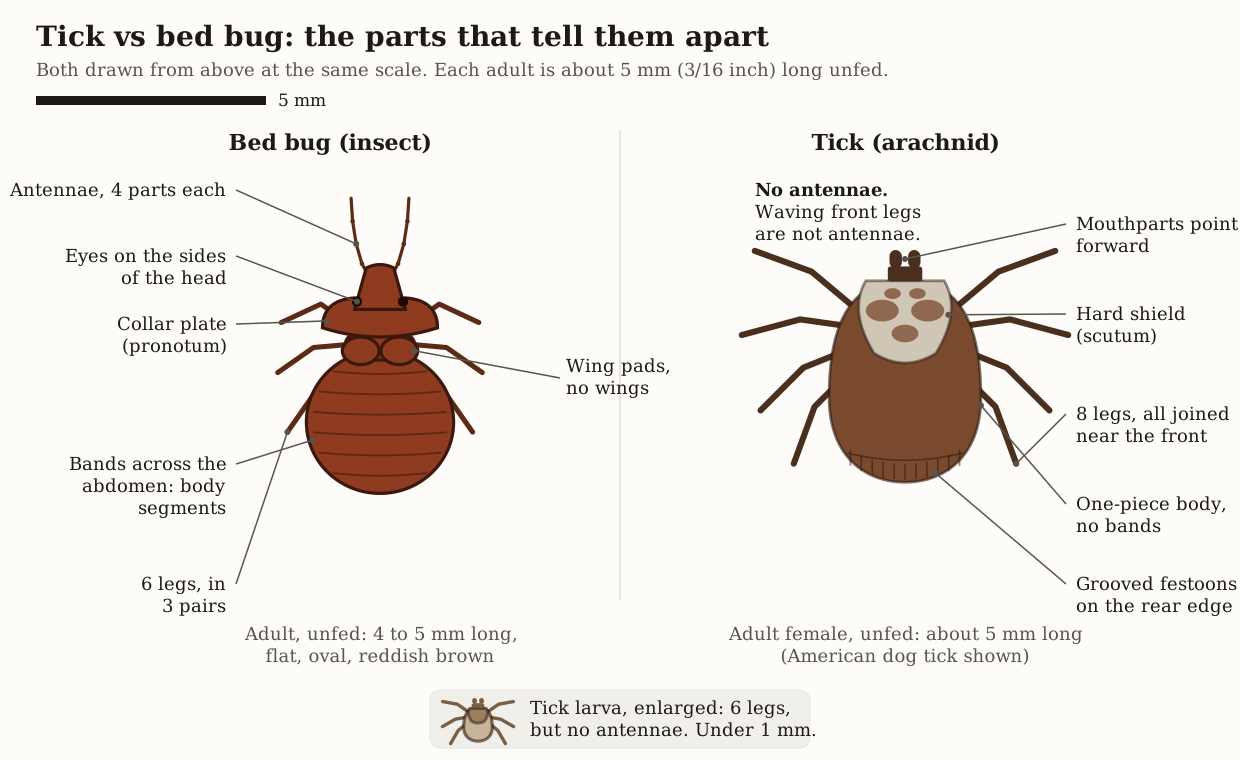
To settle tick vs bed bug, count the legs and look for antennae. Bed bugs have 6 legs and two thin antennae that stick out in front of the head. An adult tick has 8 legs and no antennae at all. So if you can see antennae, it is not a tick, whatever its size or color.
Two more checks back that up. A bed bug’s rear half has thin bands across it, so under a zoom it looks striped. A tick’s body, by contrast, is one smooth piece with no bands. Most ticks people find also carry a hard shield, called the scutum, just behind the mouthparts. Bed bugs have no such shield, only a wide collar plate behind the head.
Bed bug compared with an adult tick
Legs
- Bed bug
- 6, in three pairs
- Tick
- 8 on nymphs and adults; 6 on larvae under 1 mm
Antennae
- Bed bug
- Two, each in four parts
- Tick
- None. Waving front legs are not antennae
Body
- Bed bug
- Head, collar plate and a banded rear half
- Tick
- Mouthparts plus one smooth body with no bands
Mouthparts
- Bed bug
- A beak folded under the head, hard to see from above
- Tick
- Point forward, easy to see from above
Hard shield on the back
- Bed bug
- No
- Tick
- Yes on the common ticks: small on females, full length on males
Stuck in your skin?
- Bed bug
- Never. It feeds for minutes and leaves
- Tick
- Yes, for days, with its mouthparts in the skin
Where you find it
- Bed bug
- Mattress seams, bed frames and couches, within about 6 feet (2 m) of where people sleep
- Tick
- On people and pets after time outdoors; brown dog ticks near where dogs rest
After a meal
- Bed bug
- Longer, swollen and darker red, up to about 7 mm
- Tick
- Round, gray and much bigger, up to 5/8 in (16 mm)
What it is
- Bed bug
- An insect, a true bug
- Tick
- An arachnid, like spiders and mites
Six legs but no antennae? It may be a tick larva
Tick larvae, often called seed ticks, are the one catch. They hatch with only 6 legs and get the fourth pair when they molt. They are also tiny, under 1 mm, and they often turn up by the dozen. Even so, a larva has no antennae, and that settles it.
A bed bug nymph has antennae from the day it hatches. So when you count six legs, let the antennae decide. Our page on seed ticks and how to get a cluster off covers the larvae in detail.
Cannot count the legs? Try this
Legs are hard to count on a moving bug, and a dead one often tucks them under. So catch it whole first: press clear tape over it or drop it into a sealed bag. Then set it on white paper in daylight and zoom in with your phone. Look at the front end, because that is where the antennae and the mouthparts show.
On Reddit, the people who settle these threads go straight to the legs and the antennae. “Tick = 8 legs. Bedbugs are insects with 6 legs,” one r/whatsthisbug reply put it. Another commenter warned that ticks have different leg numbers at different ages. Both are right, which is why the antennae check matters too. If it is still not clear, a sharp photo in our free bug identifier gives a quick first answer.
Bed bug vs tick size, side by side
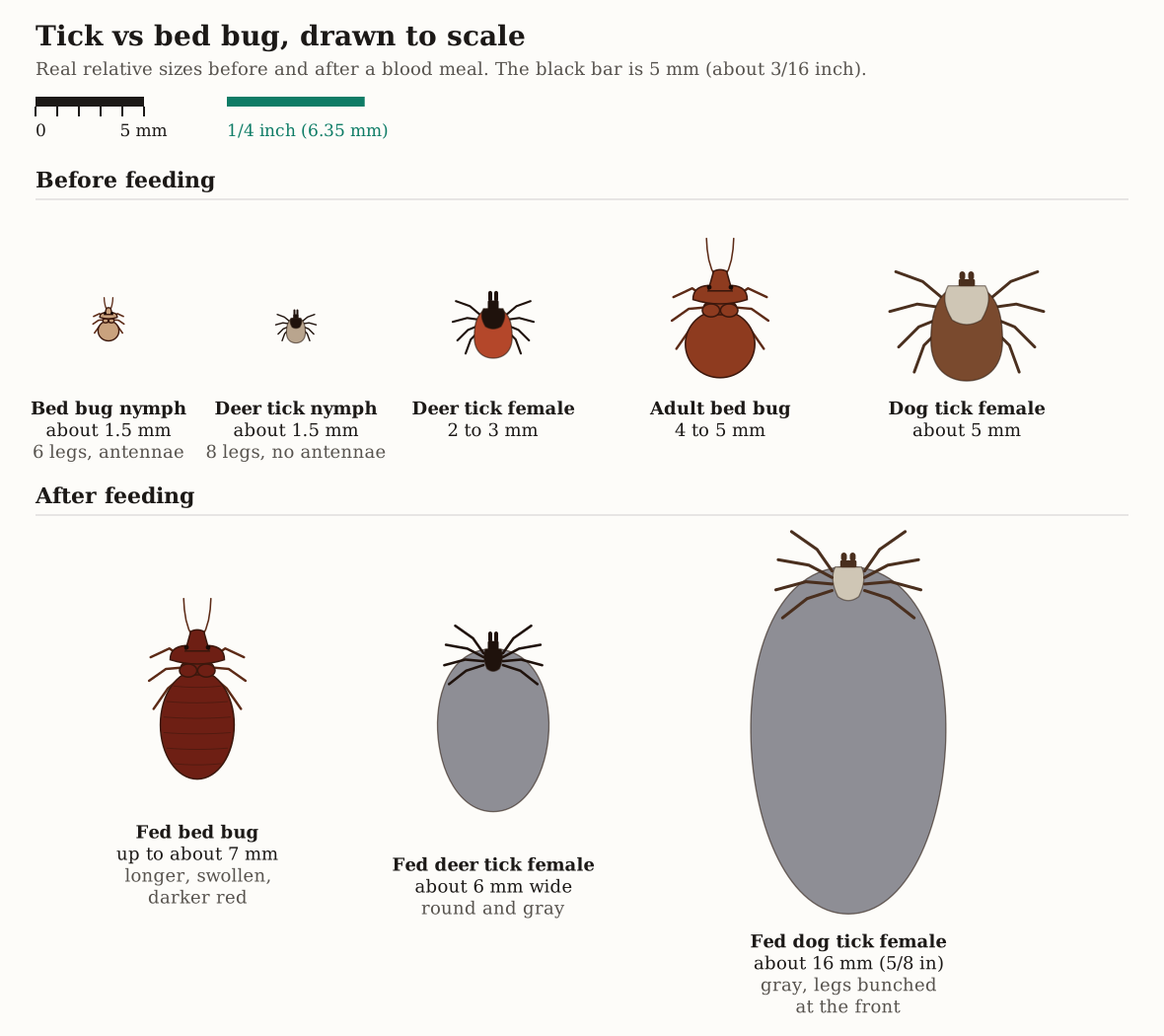
An adult bed bug is 4 to 5 mm long, about 3/16 inch, the size and shape of an apple seed. Deer ticks are smaller, at 2 to 3 mm as adults, like a sesame seed. An adult dog tick, however, is about 5 mm, the same length as a bed bug. So in a tick vs bed bug check, size alone will not tell you which one you have.
Tick and bed bug sizes, before and after feeding
A pale speck with antennae
- Bug and stage
- Bed bug nymph, first stage
- Unfed
- About 1.5 mm
- Fed
- Turns red inside, a little longer
A pale speck with 8 legs and no antennae
- Bug and stage
- Deer tick nymph
- Unfed
- About 1.5 mm (1/16 in)
- Fed
- Swells, but stays small
A speck under 1 mm with 6 legs and no antennae
- Bug and stage
- Tick larva (seed tick)
- Unfed
- Under 1 mm
- Fed
- Slightly larger and rounder
Flat, oval, reddish brown, banded
- Bug and stage
- Adult bed bug
- Unfed
- 4 to 5 mm (about 3/16 in)
- Fed
- Up to about 7 mm (1/4 in), dark red
Orange-red body, black shield and legs
- Bug and stage
- Adult female deer tick
- Unfed
- 2 to 3 mm
- Fed
- About 1/4 in (6 mm) wide, gray
Brown with pale, silvery marks on the shield
- Bug and stage
- Adult American dog tick
- Unfed
- About 3/16 in (5 mm)
- Fed
- About 5/8 in (16 mm), mostly gray
Plain reddish brown, no marks, indoors with a dog
- Bug and stage
- Adult brown dog tick
- Unfed
- About 1/8 in (3 mm)
- Fed
- About 1/2 in (13 mm), bluish gray
Bed bug sizes as in our bed bug identification guide. Tick sizes from Ohio State University fact sheets HYG-2073 and ENT-0096.
Published bed bug sizes vary a little. EPA gives 5 to 7 mm (3/16 to 1/4 inch), while UC IPM says about 1/5 inch. CDC’s range of 1 to 7 mm covers every stage, from the smallest nymph to a fed adult. Most of the gap is fed versus unfed. An unfed adult sits at the low end, and one that just fed sits at the top.
Tick nymph or bed bug nymph?
This is the hardest pair. A first-stage bed bug nymph and a deer tick nymph are both about 1.5 mm, pale and nearly see-through. At that size, the leg count is your best check: 6 legs plus antennae means a bed bug nymph, and 8 legs means a tick nymph.
Place helps as well. Bed bug nymphs live where the adults live, in seams and cracks, along with shed skins and dark spots. Tick nymphs ride in on you or a pet, mostly from spring through summer. Our guide to what a tick looks like at every stage shows the nymph next to a poppy seed.
What a fed bed bug and a fed tick look like
Both swell after a meal, but not in the same way. A bed bug feeds for about 3 to 10 minutes and then looks longer, plumper and darker red, up to about 7 mm. Ticks feed for days and keep growing. By the end, a female is gray and round, up to 5/8 inch (16 mm), while her small shield stays the same size.
Color is a good clue here. A fed bed bug turns dark red or mahogany, and you can sometimes see the blood inside a young nymph. A fed hard tick, on the other hand, turns gray, bluish gray or tan, not red. One r/whatsthisbug commenter made the same point: ticks are not red, even when fed.
Does a bed bug stay flat after it feeds?
No. Google’s AI Overview for this search says bed bugs stay “relatively flat” after feeding, and it cites a pest company page. That is wrong. EPA describes a recently fed bed bug as balloon-like, longer and reddish brown. In addition, UC IPM notes that a bed bug can take up to six times its own weight in blood in one meal.
What is true is that a tick swells far more. A female dog tick grows from about 3/16 inch to 5/8 inch, more than three times as long, while a bed bug grows from about 5 mm to 7 mm. So next to an engorged tick, a fed bed bug looks modest. On its own, though, it looks plump, not flat.
That myth causes real tick vs bed bug mix-ups. In one large r/whatisit thread, a few commenters argued that a plump bug must be a tick, because bed bugs are supposed to be small and flat. It had six legs and antennae, so it was a fed bed bug.
Where you found it: in the bed, on your skin or on the dog
In the tick vs bed bug question, where the bug was is the next best clue. Bed bugs live indoors and hide in mattress seams, bed frames and furniture, usually within about 6 feet (2 m) of where people sleep, and they come out at night. Ticks live outdoors in grass, brush and leaf litter. They come inside on people and pets.
So a bug crawling on your clothes after a walk or a hike is more likely a tick. A bug in a mattress seam with dark spots and shed skins nearby points to bed bugs. Neither clue is proof on its own, though. A bed bug can ride home on clothes from a hotel, a couch or even a dry cleaner, as several Reddit posters found. Likewise, a tick can drop off a pet and turn up on a pillow.
The tick that lives indoors: the brown dog tick
One tick breaks the outdoor rule. The brown dog tick is the only tick that can settle in and breed inside homes with dogs and in kennels, Ohio State Extension notes. It is plain reddish brown, about 1/8 inch (3 mm) long, with no markings. After a meal, it drops off the dog and hides nearby in cracks along baseboards, window frames and door frames.
That is why it can look like a bed bug problem, since both hide in cracks near a sleeping spot. Brown dog ticks, however, gather where the dog rests, and they rarely bite people. Found them on walls or curtains in a home with a dog? Our guide to the tick that breeds indoors covers the brown dog tick, and our guide to checking a dog for ticks covers the dog.
Found a tick in your bed?
A single tick in bed usually fell off a person or a pet. It does not mean ticks live in your mattress, because most ticks need the damp of grass and leaf litter and do not breed indoors. Check yourself, your children and your pets for attached ticks, then wash the bedding.
A stray tick can still live for a while before it dries out. In a 2026 Ohio State study, unfed lone star ticks lasted about 11 days on house floors on average, and Gulf Coast ticks about 18 days. So after time outdoors, dry your clothes on high heat and brush or lint-roll the dog. If ticks keep turning up in a home with a dog, think brown dog tick, and see our guide to getting rid of ticks in the house.
Ticks that act like bed bugs: soft ticks
Some ticks really do behave like bed bugs. Soft ticks have no hard shield and a wrinkled, leathery body, and they live in rodent nests. According to CDC, people in the US meet them most often by staying overnight in rodent-infested cabins. The ticks come out at night, bite for usually less than half an hour, and leave. Because the bite is painless, most people never know it happened.
Unlike bed bugs, soft ticks have 8 legs and no antennae, so the same check works. They also matter more, since some carry tick-borne relapsing fever. If you get a fever after a night in a rustic cabin, tell your doctor where you slept.
How they feed: days attached vs minutes and gone
The way they feed is the clearest tick vs bed bug difference of all. A tick pushes its mouthparts into the skin and stays for days: deer ticks usually feed for 3 to 5 days, and a female dog tick for 7 to 11. A bed bug, by contrast, feeds for about 3 to 10 minutes while you sleep. Then it walks back to its hiding place.
That gives you a simple rule. A bug attached to your skin, with its head buried and its body sticking out, is a tick. Bed bugs never stay on a person, so you will not find one hanging from your arm in the morning. Instead, you may find a bug in the sheets, a few small blood spots, or nothing at all.
Both bites are usually painless at the time. Bed bugs inject a natural numbing agent as they feed, so sleepers rarely wake. A tick bite often goes unnoticed too, which is why a full tick check after time outdoors matters.
Which is worse, a tick or a bed bug?
For your health, a tick is worse. Some ticks can pass on Lyme disease, Rocky Mountain spotted fever and other infections while they feed, and the risk grows the longer one stays attached. Bed bugs are not known to spread any disease to people, CDC says. For your home and your sleep, though, bed bugs are the harder problem.
With ticks, time matters. CDC says that in most cases a tick must be attached for more than 24 hours to pass on the germ that causes Lyme disease. So finding and removing a tick quickly is the best protection. The blacklegged deer tick carries Lyme disease, while the American dog tick is a main carrier of Rocky Mountain spotted fever.
Bed bugs cost you in other ways. The bites itch, and scratching can lead to a skin infection. Lost sleep and worry are common, and an infestation can take weeks and several visits to clear. A few people have a serious allergic reaction to the bites, though that is rare.
Why the bites cannot tell you which bug it was
A bite mark cannot settle tick vs bed bug for you. Both leave small red bumps, people react differently, and some show no reaction at all. CDC notes that bed bug bites look like mosquito or flea bites and can be scattered or in a line. So look for the bug, not a bite pattern.
The one exception is a tick that is still attached, because then you can see it. Several pages that rank for this search say bed bug bites come in lines and tick bites come with a bullseye. Neither rule holds up. Bed bug bites often scatter, and other bugs make rows. Most tick bites never form a bullseye rash, and even the Lyme rash, when it does appear, starts 3 to 30 days after the bite.
For what each bite looks like and how it changes, see our guides to bed bug bites and to what a tick bite looks like day by day.
Tick or bed bug? What to do next
Whatever the answer to tick vs bed bug turns out to be, start with what costs nothing. Check whether the bug is attached, catch it whole and count the legs. A tick comes off with fine-tipped tweezers, and then you watch the bite for a few weeks. A bed bug calls for a careful check of the bed and two weeks of monitoring before anyone sprays.
When you cannot tell a tick from a bed bug, step by step
Check whether it is attached
If the bug is fixed in your skin with its body sticking out, it is a tick. Remove it now, and identify it afterward.
Remove an attached tick
Grip it close to the skin with fine-tipped tweezers and pull straight out with steady, even pressure. Do not twist or jerk it, and skip nail polish, petroleum jelly and heat.
Catch a loose bug whole
Press clear tape over it, or seal it in a zip bag or a pill bottle. Do not crush it, because a squashed bug loses the legs and antennae you need to see.
Count the legs and look for antennae
Use daylight, white paper and your phone's zoom. Six legs with antennae means a bed bug. Eight legs with no antennae means a tick, and six legs with no antennae means a tick larva.
Write down where it was
Note the room, the spot and the date. A mattress seam points to bed bugs. Your skin, your clothes after a walk, or the dog points to a tick.
If it is a tick, watch the bite
Wash the bite and your hands with soap and water. Keep the tick sealed in a bag or taped to a card, and check your family and pets for more. See a doctor if a rash or fever starts in the next few weeks.
If it is a bed bug, check the bed
Do not strip the bed or spray. Inspect mattress seams, the box spring and the bed frame with a flashlight, and set 8 or more interceptor cups. If you rent, tell your landlord in writing.
What you found, what it likely is, and what to do
A bug attached to your skin
- What it likely is
- A tick
- What to do
- Remove it now with fine-tipped tweezers; watch for a rash or fever
A bug crawling on you after time outdoors
- What it likely is
- Usually a tick that has not fed yet
- What to do
- Tape it, seal it, and check your body and clothes
Bugs in a mattress seam with dark spots or shed skins
- What it likely is
- Bed bugs
- What to do
- Check the bed and nearby furniture, set interceptors, then call a licensed professional
One bug on your clothes after a hotel, a couch or a trip
- What it likely is
- Possibly a hitchhiking bed bug
- What to do
- Seal it in a bag, dry your clothes on high heat, and watch for more
Small reddish-brown ticks on walls or curtains in a home with a dog
- What it likely is
- Brown dog ticks
- What to do
- Ask your vet about the dog, then treat the home
Dozens of specks with 6 legs and no antennae
- What it likely is
- Tick larvae (seed ticks)
- What to do
- Lift them off with tape, shower, and dry your clothes on high heat
Bites but no bug
- What it likely is
- Cannot tell from the bites
- What to do
- Look for the bug and set interceptors for two weeks
If it is a tick
The safe way to remove a tick is the same for every kind: fine-tipped tweezers, close to the skin, and a steady pull. CDC warns that nail polish, petroleum jelly and heat can irritate the tick and push infected fluid into the skin. If the mouthparts stay behind, take them out with clean tweezers if you can. Otherwise, leave them to come out as the skin heals.
Our step-by-step guide on removing a tick safely covers each case. Our tick bite guide explains which symptoms matter and when to call a doctor.
If it is a bed bug
One bed bug is not always an infestation, but it is a reason to look. Seal the bug in a bag rather than stripping the bed, because disturbing the room scatters them. Next, inspect the seams, the box spring and the bed frame with a flashlight, and set interceptor cups under the bed legs for two weeks. Our guide to checking a bed for bed bugs shows each step, and our complete bed bug guide explains treatment and cost.
Heat is the do-it-yourself tool that works on fabric. Wash bedding and clothes hot, then tumble dry on high for at least 30 minutes. A mattress, furniture or walls usually need a licensed professional. Pesticides come last. If you do use one, choose an EPA-registered product labeled for bed bugs and for that place, and follow the label exactly. The label is the law.
Fleas, lice and other bugs mistaken for a tick or a bed bug
Five other small bugs get mixed up with both: fleas, head lice, bat bugs, spider beetles and carpet beetles. The same leg check still helps, since all five are insects with 6 legs, like a bed bug. After that, one habit or one place usually gives each away, as the table shows.
Other bugs people mistake for a tick or a bed bug
Jumps when you reach for it; flat from side to side; 1.5 to 3 mm
- What it is
- Cat or dog flea
- Where you find it
- On pets, pet beds and carpets
Holds onto hair; 2 to 3 mm; 6 legs
- What it is
- Head louse
- Where you find it
- On the head, not in the bed
Looks almost exactly like a bed bug; longer hairs behind the head under a lens
- What it is
- Bat bug
- Where you find it
- Homes with bats in the attic or walls
Round, shiny, humped body; long legs and long antennae
- What it is
- Spider beetle
- Where you find it
- Pantries, stored food and old buildings
Small, round and mottled; or a bristly, striped larva
- What it is
- Carpet beetle
- Where you find it
- Windowsills, closets, rugs and wool
Fleas are what people usually mean by “flea, tick or bed bug”. A flea jumps, while ticks and bed bugs only crawl, and that one habit usually settles it. Our guide to telling a flea from a tick draws both to scale. For lice, see our head lice guide. For the beetles that turn up on sills and rugs, see our carpet beetle guide.
Spider beetles fool a lot of people. In one r/whatsthisbug thread, a bug found on a rug in an apartment with two cats turned out to be one. Commenters said spider beetles are very often mistaken for ticks or bed bugs. Our round-up of bugs that are often mistaken for ticks covers spider beetles, weevils, mites and the rest, with the one feature that gives each away.
For everything else about ticks, from where they live to when they are most active, start at our complete guide to ticks.
Pest control disclaimer. Photo-based identification can help, but it is not always perfect. For dangerous spiders, large infestations, or anything you are unsure about, contact a licensed pest control professional.
Tick vs bed bug FAQ
Is there such a thing as a bed tick?
What are three signs you might have bed bugs?
Do ticks lay eggs in your bed?
What kills bed bugs for sure?
Can bed bugs live on a dog the way ticks do?
Related guides
Ticks
The full guide: what ticks are, where they live, the diseases they carry and how to stay safe.
What does a tick look like?
Every stage, size and color, unfed and engorged, with the parts that make a tick a tick.
Bed bugs
Where they come from, how they spread, and how treatment and its cost work.
Bugs that look like ticks
Spider beetles, weevils, bed bugs and mites, with the feature that separates each.
Flea vs tick
The other pet-and-house mix-up: a jumper with six legs or a crawler with eight.
Brown dog tick
The tick that hides in cracks near where a dog sleeps.
What bed bugs look like
Eggs, nymphs and adults at true size, and the look-alikes people confuse with them.
How to remove a tick
The tweezer method step by step, and what to do if part of it stays in.
Checking for bed bugs
Where to look on a mattress, which tools help, and how many interceptors you need.
Seed ticks
Six-legged larvae and poppy-seed nymphs, and what to do about a cluster.
Sources
- US EPA, Bed bugs: appearance and life cycle
- US EPA, Do-it-yourself bed bug control
- CDC, About bed bugs
- UC IPM Pest Notes 7454, Bed bugs
- American Academy of Dermatology, Bedbugs: signs and symptoms
- CDC, What to do after a tick bite
- CDC, How Lyme disease spreads
- CDC, About soft tick relapsing fever
- Ohio State University Extension, HYG-2073, Ticks and their control
- Ohio State CFAES, ENT-0096, Blacklegged (deer) tick
- Minnesota Department of Health, Ticks
- Ohio State College of Veterinary Medicine, Some ticks can survive from 1 to 3 weeks on home flooring (2026)
- University of Rhode Island TickEncounter, Tick look-alikes