Half the results for this search are about pulling a tick off your skin. This page is about the place: how to get rid of ticks in your yard and your house, and the products and services that go with it. For a tick on your dog, start with our guide to checking and treating ticks on dogs. For the products that kill ticks on a dog and how fast they work, see killing ticks on dogs.
This page covers the place: the yard, the house, what kills ticks, sprays and professionals. Protecting yourself is in our guide to preventing tick bites: repellent on skin, permethrin on clothes, tick checks, a shower and the dryer after time outdoors.
How to get rid of ticks, step by step
How to get rid of ticks comes down to 8 steps, and most of the first 6 cost little or nothing. Find out where your ticks come from, cut back their habitat at the woods edge and the stone walls, and keep mice and deer out. Then clean up indoors if ticks came inside. Spraying is step 7, and only if ticks persist.
The tick control plan in 8 steps
Work out where the ticks come from
After yard work, ticks on you point to the woods edge, a stone wall or long grass. After a walk, ticks on the dog point to the walk. Ticks climbing the walls near a dog bed, week after week, point to the brown dog tick. That needs a different plan.
Mow, rake and let the sun in
Keep the lawn mown, rake leaves out of the places you use, and trim low branches and shrubs so sunlight reaches the ground. Ticks need damp shade, and open sunny lawn holds few of them.
Clear the woods edge and stone walls
Cut brush and tall weeds where the lawn meets the woods. Clear leaves and plants away from stone walls. These two spots hold the most ticks in a yard. Remove thickets of Japanese barberry if you have them.
Move where you play and sit
Put play sets, sandboxes, patios and chairs in open, sunny ground, away from the woods edge, stone walls and leaf piles.
Keep mice and deer out
Stack firewood neatly in a dry, sunny spot away from the house. Keep trash cans closed and bird feeders away from the house. A deer fence 8 feet (2.4 m) tall keeps deer, and the adult ticks they carry, out of the yard.
Clean up indoors if ticks came in
Vacuum where you found them, and wash pet bedding hot and dry it on high heat. Ask your vet about a tick product for every dog in the home. One tick indoors needs no spray.
Spray only if ticks keep turning up
If ticks still turn up where you spend time, use an EPA-registered product labeled for ticks. Treat the woods edge and stone walls in May or early June. Follow the label exactly, and keep children and pets off until it allows.
Call a professional when the job is too big
Call a licensed pest professional for brown dog ticks breeding indoors, or for a large or wooded property. A pro also makes sense if you want a yard spray but not the job of handling it.
The order matters. CDPH and Harvard Medical School both put landscaping before any pesticide. Our rule is the same as for every pest: if exclusion and sanitation are successful, insecticide treatments are not required. Not sure which tick you have? Our tick identification chart sorts out the common US species.
Where ticks live in your yard
Most ticks in a yard live where the lawn meets the woods. In a 2024 study of 42 Connecticut yards, deer tick nymphs were densest in the first 3 feet (1 m) of woods past the lawn edge. Ground next to stone walls held nearly 3 times as many nymphs as ground without one. Open, sunny lawn held few.
Older Connecticut sampling tells the same story. The Connecticut Agricultural Experiment Station’s Tick Management Handbook found 67% of deer ticks in woods, 22% in the brushy edge, 9% in ornamental plantings and only 2% on lawns. Even on the lawn, 82% sat within 3 yards (2.7 m) of its edge.
The reason is water. A tick dies if it dries out. So it waits where the air stays damp: in leaf litter, brush, tall grass and the shade of a wall. From there it climbs a stem and holds out its front legs until a person or a pet brushes past. Ticks cannot jump or fly, so they rarely cross a dry, open lawn on their own.
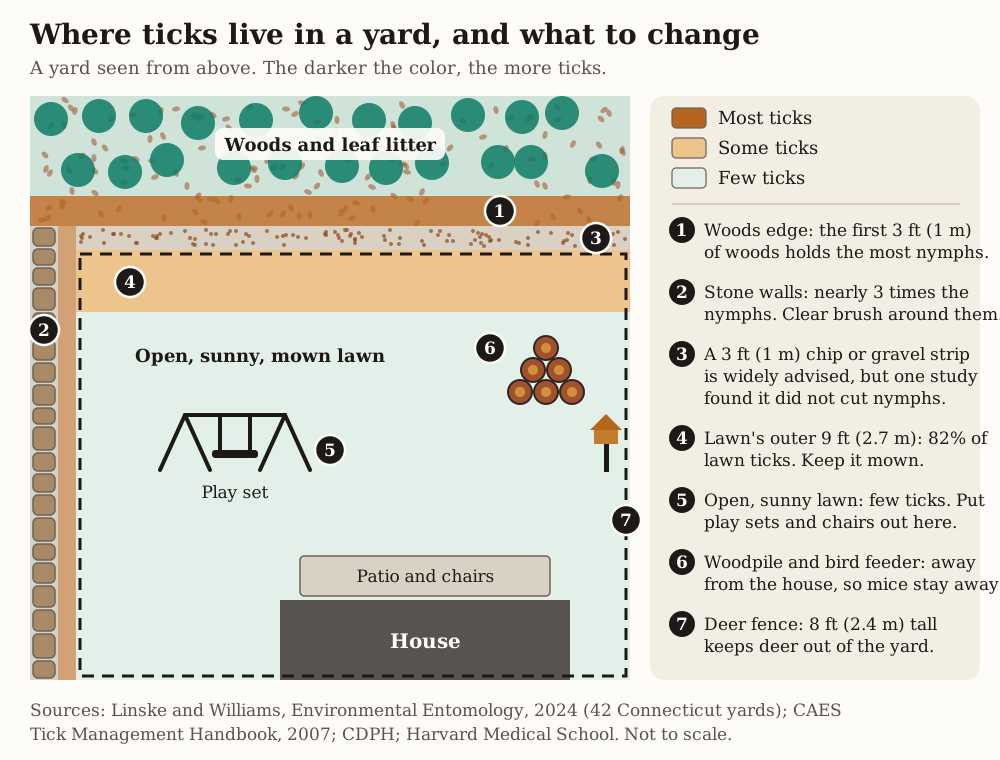
Animals bring the ticks in. Mice, chipmunks and birds feed young ticks. Adult female deer ticks feed on deer, then drop off in yards to lay their eggs, Harvard Medical School explains. So a yard that backs onto woods with deer and mice will always have some ticks along its edge.
The same Connecticut study, by researchers at the Connecticut Agricultural Experiment Station, found no link between woodpiles or bird feeders and the number of nymphs. Moving them is still worth it, because they feed and shelter mice. Even so, the woods edge and the walls come first. For which tick you are likely to meet, see our deer tick guide and the lone star tick, the fast, aggressive tick of the South and East.
How to get rid of ticks in the yard without spraying
The free part of tick control is the yard work on CDC’s list. Mow, clear brush and leaves at the woods edge and the stone walls, let in sunlight, and move where you sit and play. None of it takes a yard to zero ticks. Still, it shrinks the area where ticks can live, and it costs nothing but time.
Yard fixes compared: what each costs and how strong the evidence is
Clear brush and plants along the woods edge
- Cost
- Free
- What the evidence says
- The first 3 ft (1 m) of woods holds the most nymphs (Connecticut, 2024)
Clear leaves and plants around stone walls
- Cost
- Free
- What the evidence says
- Walls had nearly 3 times the nymphs of other spots in the same study
Mow the lawn, especially next to the woods
- Cost
- Free
- What the evidence says
- Ticks are rare on open, sunny, mown lawn (CDPH), but short lawn beside the woods still had nymphs
Prune trees and shrubs to let in sun
- Cost
- Free to low
- What the evidence says
- Ticks need shade and damp to survive
Move play sets, patios and chairs into the sun
- Cost
- Free
- What the evidence says
- Keeps your time away from the edge, where the ticks are
Rake leaf litter
- Cost
- Free
- What the evidence says
- Mixed: CAES and Harvard report fewer nymphs on some properties, but the 2024 study found no clear drop where leaves were removed
Remove Japanese barberry thickets
- Cost
- Your labor
- What the evidence says
- Fewer adult ticks and, by the second year, fewer ticks carrying Lyme bacteria (Connecticut, 2009)
3 ft (1 m) strip of wood chips or gravel
- Cost
- Low
- What the evidence says
- On CDC's and CDPH's lists, yet Harvard calls the evidence weak, CAES says results vary widely, and the 2024 study found no drop in nymphs
Move woodpiles, close trash, move bird feeders
- Cost
- Free
- What the evidence says
- Gives mice less food and cover; no direct link to nymph numbers in the 2024 study
Deer fence 8 ft (2.4 m) tall
- Cost
- High
- What the evidence says
- Keeps out deer, which carry adult ticks into yards (CDPH)
Our reading: clear the edge and the walls first, because that is where the ticks are. Then do the cheap things that keep your own time away from them. A chip or gravel strip is a fine path or border, but do not count on it as a tick barrier.
Keeping mice and deer out of the yard
Deer carry adult ticks, and mice feed the young ones. To keep deer out, CDPH suggests fences 8 feet (2.4 m) tall. For mice, it suggests closed trash cans away from the house, neat woodpiles away from the walls, and bird feeders that are not overfilled. Seal holes in stone walls and sheds where mice nest.
A full deer fence is a big job, and it only makes sense on a property where deer are a daily sight. On a small lot, clearing the edge and moving your play and seating areas does more for the money.
Do chickens or guinea fowl get rid of ticks?
Not enough to count on. Penn State Extension and the CAES handbook agree: chickens and guinea fowl eat some ticks, but in studies neither lowered the nymphs that bite people most. Beneficial nematodes fail too, because they cannot take the cold. Opossums do no better: the famous 5,000 ticks figure was a lab estimate, and wild opossum stomachs held no ticks. Our guide to what eats ticks ranks every claimed predator by the evidence.
How to get rid of ticks in the house
One tick in the house is usually a hitchhiker that rode in on a person, a pet or a coat. It does not breed indoors, and it dries out and dies within about 1 to 3 weeks. Remove it, check everyone, and vacuum. The exception is the brown dog tick, which can infest a home with dogs and take months to clear.
- If it is attached to someone, pull it off now with tweezers. Our tick removal steps show the grip.
- If it is crawling, pick it up with tape or a tissue and seal it in tape or a bag. Do not crush it with your fingers.
- Check people and pets. A tick that came in on one coat may not have come alone.
- Vacuum the floor, rugs and furniture where you found it, and around pet beds.
- Wash pet bedding hot and dry it on high heat. Heat in a dryer kills ticks. Put outdoor clothes through the dryer too.
- Do not spray the house for one tick. It will not help, and any indoor product must list ticks and indoor use on its label. Never use a yard product indoors.
Not sure it is a tick at all? If you cannot tell it from a bed bug or a beetle, our tick identification guide shows the eight legs and the shape.
How long can ticks live in a house?
Longer than most people expect: at least a week, and up to about 3 weeks. An Ohio State University study published in 2026 put unfed adult ticks on five kinds of household floor. Lone star ticks lived about 11 days on average, and Gulf Coast ticks about 18 days. The ticks most likely died from drying out.
How long unfed adult ticks lived on household floors (Ohio State, 2026)
Lone star tick
- Average survival
- About 11 days
- Range by floor type
- About 7 days on tile to almost 15 days on long-pile carpet
Gulf Coast tick
- Average survival
- About 18 days
- Range by floor type
- 10 days on long-pile carpet to 25 days on vinyl
Deer tick and brown dog tick
- Average survival
- Not tested
- Range by floor type
- Brown dog ticks are the exception: they can breed indoors
So a tick you find a week after a hike may well be from that hike. The study tested only two species, and homes differ in humidity, so treat the numbers as a guide. Either way, the practical answer is the same: a hitchhiking tick that finds no host will die, but it can bite someone first.
Brown dog ticks: the one tick that infests homes
The brown dog tick (Rhipicephalus sanguineus) is the one tick that breeds indoors in homes with dogs. Clearing it means treating every dog through your vet and the house at the same time, often with a licensed pro, over several months, CAPC says. Our brown dog tick house plan covers it step by step.
What kills ticks, and what does not
Ticks are tough. A hot clothes dryer kills them, and so do pesticides labeled for ticks. Most home remedies fail in a yard: dish soap and vinegar only touch the ticks you soak, and ticks can survive underwater for 2 to 3 days. Here is how the common methods compare.
What kills ticks: home remedies and products compared
Hot clothes dryer
- Does it kill ticks?
- Yes
- The catch
- For clothes and pet bedding, not the yard
Rubbing alcohol
- Does it kill ticks?
- Yes, a tick dropped into it
- The catch
- Fine for a tick you removed. Never spray it around the house: EPA warns it can catch fire
Dish soap or vinegar
- Does it kill ticks?
- Not shown for vinegar; soap only in lab tests
- The catch
- No effect on the ticks hidden in leaf litter. Never use either on an attached tick
Drowning or flushing
- Does it kill ticks?
- Slowly, if at all
- The catch
- Brown dog ticks survived 2 to 3 days underwater in a 2012 study
Bleach or disinfectant spray
- Does it kill ticks?
- Not a tick product
- The catch
- Made for germs. Use a vacuum and tape instead
Diatomaceous earth
- Does it kill ticks?
- Slowly, while it stays dry
- The catch
- Only a registered product, only where its label allows; useless once wet
Cedar oil and other unregistered sprays
- Does it kill ticks?
- Varies widely
- The catch
- Not EPA-registered; some cedarwood products killed almost no ticks in field tests
Pyrethroid yard spray, such as bifenthrin
- Does it kill ticks?
- Yes, for 6 weeks or more
- The catch
- Use only as labeled; toxic to fish and bees; fewer ticks did not mean fewer bites in a large trial
Chickens and guinea fowl
- Does it kill ticks?
- A few ticks
- The catch
- Not enough to lower tick numbers (Penn State; CAES)
Beneficial nematodes
- Does it kill ticks?
- Not in practice
- The catch
- Too sensitive to the cold autumn weather when ticks are active (CAES)
Rubbing alcohol needs a word of its own. Mayo Clinic Health System lists it as one way to kill a tick you have already removed, and that is safe. Pouring or spraying it on a lawn, a rug or a pet is not. EPA warns that rubbing alcohol can easily catch fire. It also does nothing to make an attached tick let go, so never put it on a tick that is still biting.
Does diatomaceous earth kill ticks?
Yes, slowly, as long as it stays dry. Diatomaceous earth is a fine powder made from fossil algae. The National Pesticide Information Center says it soaks up the oils and fats in an insect’s or tick’s outer shell. It works only while dry and undisturbed. Over 150 products are registered, and some list ticks.
That makes it a poor yard treatment. Dew and rain stop it working, and spreading bags of it across a lawn, as some forum posts suggest, also kills the insects you want. Breathing the dust irritates the nose and lungs. Use only a product registered as a pesticide, put it into cracks and crevices or wherever its label allows, and never broadcast it.
Can ticks drown?
Not quickly. In a 2012 study, every engorged brown dog tick survived 48 hours underwater, and some lasted 72 hours. That is why dunking a tick in water, or flushing it, is a slow and unreliable way to kill it. It is also why heavy rain does not clear a yard of ticks.
Tick control for the yard: sprays, granules and the label
A tick spray for the yard can cut tick numbers sharply for 6 weeks or more, but it has limits. In a trial in 2,727 homes, yards sprayed once with bifenthrin had 63% fewer ticks. Yet the families reported no fewer run-ins with ticks and no fewer tick-borne illnesses than families whose yards got water.
That trial, led by CDC scientists and published in 2016, is the best test of yard spraying so far. A second large trial in New York, the Tick Project, found the same pattern in 2022: fewer ticks, but no drop in human illness. One possible reason, the Tick Project team suggests, is that the treatments did not push tick numbers low enough to lower disease.
So a yard spray is optional. If the free fixes keep ticks down where you spend time, you do not need one. If ticks still turn up after the yard work is done, a spray can make sense, as long as you keep doing tick checks.
How to use a tick spray for the yard safely
- Pick a product labeled for ticks. Yard products for ticks usually contain a pyrethroid, such as bifenthrin or permethrin, or carbaryl. Harvard Medical School warns that some only kill dog ticks, so check that the label lists the ticks you have. It must also be registered in your state.
- Treat where the ticks are, not the whole lawn: the woods edge, the shady borders and the ground around stone walls, plus a few yards into the woods. The CAES handbook and the 2024 Connecticut researchers both favor targeted treatment over broadcast spraying. A small hand-pump sprayer rarely covers enough, and a lawn spreader cannot reach the woods edge, CAES adds.
- Time it. Harvard and the CAES handbook both name May or early June, when nymphs are out. CAES says one spray then gives 85 to 90% control or better. A fall treatment in October targets adults if needed.
- Keep people and pets off until the spray has dried, usually 12 to 24 hours, or longer if the label says so. CAES singles out cats. Do not spray plants you will eat unless the label allows it.
- Protect water and bees. Permethrin is highly toxic to fish and to bees, the National Pesticide Information Center says. Keep sprays at least 25 feet (8 m) from ponds, streams and wetlands, as CAES advises, and off plants in flower and windy days.
- Only your own yard. CDPH says never to apply pesticide to someone else’s yard.
Natural tick sprays: cedar oil and other minimum-risk products
Many “natural” tick sprays, including most cedar oil products, are minimum-risk pesticides. EPA exempts these from registration because their ingredients pose little or no risk, so nobody checks that they work. A 2024 review in CDC’s journal Emerging Infectious Diseases found they vary hugely.
In standard field tests, two cedarwood oil products knocked down only 5 to 6% of ticks, and almost none two weeks later. Some rosemary and peppermint oil products did as well as a pyrethroid when a firm sprayed them at high pressure. Others with the same oils did almost nothing. Even the good ones tend to fade within 1 to 3 weeks, so they need repeat sprays.
Is it worth spraying your yard for ticks?
It depends what you want from it. If you want fewer ticks on the lawn edge, a registered product used as labeled will deliver that for weeks. If you want to stop tick bites or Lyme disease, the two biggest trials found that yard treatment alone did not do it. The Tick Project did see fewer tick-borne illnesses in pets. Do the yard work first, and keep checking for ticks either way.
Tick tubes and bait boxes: do they work?
Tick tubes are cardboard tubes of permethrin-treated cotton. Mice carry the cotton home as nest material, and the ticks feeding on them die. The results are mixed: some studies found fewer ticks and others found little change, Harvard Medical School notes. Bait boxes did better in a 2022 trial, cutting nymphs in the woods by about half.
Tick tubes help only where white-footed mice are common. Bait boxes work on the same idea: a mouse walks through the box to reach food and gets a dab of fipronil, a tick killer. In the Tick Project, bait boxes cut nymphs in the woods by 53% and halved the ticks on mice. Human illness still did not drop, but the number of pets with tick-borne disease fell by about half.
Forum posts often suggest making your own tubes from cotton balls soaked in a permethrin concentrate. We do not give a recipe. A homemade mix has no tested strength, it is not used as any label directs, and concentrated permethrin is dangerous to cats and to fish. If you want tubes, buy a registered product and place it as its label says.
Tick control services: when to call a professional
Call a licensed pest professional when brown dog ticks are breeding indoors or the property is large or wooded. A pro also makes sense when you want a yard treatment but would rather not handle pesticides. A good service starts by looking at the woods edge and the walls, not by spraying the whole lawn. For most yards, Harvard Medical School names 2 key treatment times a year: late spring and fall.
CDPH calls the approach integrated tick management: advice on the yard, rodent control and, where needed, a pesticide. Before you sign, ask:
- Are you licensed to apply pesticides for ticks in this state? CAES suggests asking for the license number.
- Which product, by name, and is it EPA-registered and labeled for ticks?
- Where will you spray, and why there? The answer should mention the edge and the walls.
- How many visits, and why? More than 2 a year needs a reason, such as a product that breaks down fast.
- When can children and pets go back out, and how do you protect bees, ponds and streams?
- For a “natural” plan, what evidence shows that this product kills ticks?
- For brown dog ticks, will you treat the cracks, crevices and walls, and how many follow-up visits are included?
How much does tick control cost?
No university or government source we read publishes prices, so we do not quote one. The price depends on the size of the yard, the product and the number of visits. Get two or three written quotes, and compare what each visit treats rather than the headline price. Then compare that with the free fixes in the table above, which do much of the same work.
Protecting yourself while the yard improves
Knowing how to get rid of ticks in the yard lowers the odds of a bite, but it does not remove them. So keep doing the personal part. Use an EPA-registered repellent on skin and permethrin-treated clothing for yard work, check for ticks after every session outdoors, and put outdoor clothes in a hot dryer.
Our tick prevention guide covers each of those steps in full. For dogs, CAPC recommends a tick product all year round, which also keeps dogs from carrying ticks into the house. If you are bitten, our tick bite guide explains what to watch for. Everything about ticks, from species to season, is on our ticks hub.
Pest control disclaimer. Photo-based identification can help, but it is not always perfect. For dangerous spiders, large infestations, or anything you are unsure about, contact a licensed pest control professional.
Getting rid of ticks: FAQ
Will ticks eventually go away on their own?
Why is my yard suddenly full of ticks?
Can ticks live in your bed?
Can I use Lysol or bleach to kill ticks in the house?
Does cold weather kill ticks?
What smell do ticks hate the most?
Related guides
Ticks
The hub: what ticks are, where they live, the season, and every tick guide on the site.
Preventing tick bites
Repellents, permethrin for clothes, tick checks and the dryer: the personal side of tick control.
Removing an attached tick
The tweezer method, what to do if the head stays in, and what never to put on a tick.
Ticks on dogs
Where to check your dog, a tick or a skin tag, and when to call the vet.
How to remove a tick from a dog
Gloves, the grip and the pull, a stuck head and the bump afterward.
Deer tick
The blacklegged tick of the woods edge, its life stages to scale, and the Lyme risk.
Lone star tick
The fast, aggressive tick of the South and East, and the meat allergy it can cause.
Sources
- Linske MA, Williams SC. Landscaping and vegetation management to suppress host-seeking Ixodes scapularis nymphs on residential properties in Connecticut. Environmental Entomology (2024)
- Hinckley AF and others. Effectiveness of Residential Acaricides to Prevent Lyme and Other Tick-borne Diseases in Humans. Journal of Infectious Diseases (2016)
- Keesing F and others. Effects of Tick-Control Interventions on Tick Abundance, Human Encounters with Ticks, and Incidence of Tickborne Diseases in Residential Neighborhoods, New York. Emerging Infectious Diseases (2022)
- Eisen L. Efficacy of Unregulated Minimum Risk Products to Kill and Repel Ticks. Emerging Infectious Diseases (January 2024)
- Harvard Medical School, Lyme and Tick-Borne Diseases: Protecting Your Yard
- California Department of Public Health, Controlling Ticks Around Your Home (PDF)
- Companion Animal Parasite Council, Ticks guidelines (brown dog tick and home infestations)
- The Ohio State University, Some ticks can survive from 1 to 3 weeks on home flooring (2026)
- Penn State Extension, Do Chickens, Guinea Fowl, or Opossums Control Ticks? (updated 2024)
- Giannelli A, Dantas-Torres F, Otranto D. Underwater survival of Rhipicephalus sanguineus. Experimental and Applied Acarology (2012)
- National Pesticide Information Center, Diatomaceous Earth General Fact Sheet
- National Pesticide Information Center, Permethrin General Fact Sheet
- US EPA, Introduction to Pesticide Labels
- CDC, Preventing Tick Bites (create a tick-safe zone in your yard)
- Stafford KC III. Tick Management Handbook, revised edition. Connecticut Agricultural Experiment Station, Bulletin 1010 (2007)