Part 1 of 6
Start here
What eats ticks? The short list, and the catch
Birds, small mammals, ants, spiders, beetles, mites, a wasp and a soil fungus all kill ticks. But most are generalists that eat a tick only when they happen to find one. In the studies we read, not one of them reliably lowered tick numbers in a yard. That is the honest answer to what eats ticks: plenty, but not enough.
The reason is simple. Ticks spend most of their lives hidden in leaf litter, and a tick eater often doubles as a tick host. Guinea fowl eat adult ticks, for example, but young ticks also feed on them. The Connecticut Agricultural Experiment Station (CAES) wrote the standard tick handbook. It puts it plainly: ticks have few natural enemies, and most predators “probably have little impact on ticks.”
What eats ticks, and whether it lowers ticks in a yard
Eats ticks among cattle
- Animal or agent
- Chickens
- What the evidence says
- Up to 331 ticks per bird in Africa; never tested in a North American yard
- Lowers ticks in a yard?
- Not shown
Eats adults, feeds nymphs
- Animal or agent
- Guinea fowl
- What the evidence says
- Fewer adult ticks in two studies; no drop in nymphs; nymphs fed on the birds
- Lowers ticks in a yard?
- No
Kills ticks while preening
- Animal or agent
- Wild turkeys
- What the evidence says
- Killed about 92% of nymphs put on them; foraging did not cut adult ticks
- Lowers ticks in a yard?
- No
Kills some, carries others
- Animal or agent
- Songbirds
- What the evidence says
- Catbirds let about 27% of larvae feed; migrating birds spread deer ticks north
- Lowers ticks in a yard?
- No
Kills ticks while grooming
- Animal or agent
- Opossums
- What the evidence says
- Killed 96.5% in a lab; 0 ticks in 32 wild stomachs
- Lowers ticks in a yard?
- No
Feeds young ticks
- Animal or agent
- White-footed mice
- What the evidence says
- About half of larvae feed; the main Lyme reservoir
- Lowers ticks in a yard?
- Adds ticks
Feeds young ticks
- Animal or agent
- Shrews and chipmunks
- What the evidence says
- Hosts that raise the number of infected nymphs
- Lowers ticks in a yard?
- Adds ticks
Kills ticks while grooming
- Animal or agent
- Gray squirrels
- What the evidence says
- Only about 17% of larvae fed in a lab
- Lowers ticks in a yard?
- Not shown
Feeds ticks, kills Lyme bacteria
- Animal or agent
- Western fence lizard
- What the evidence says
- A host, not a predator; fewer ticks when lizards were removed
- Lowers ticks in a yard?
- No
Linked to fewer ticks nearby
- Animal or agent
- Fire ants
- What the evidence says
- Fewer ticks where they live, yet they ignore live ticks in tests
- Lowers ticks in a yard?
- Not advised
Eats a few in leaf litter
- Animal or agent
- Spiders, rove beetles, mites
- What the evidence says
- 7 of 252 litter arthropods ate labeled nymphs in a lab
- Lowers ticks in a yard?
- No
Lays eggs inside ticks
- Animal or agent
- Ixodiphagus wasp
- What the evidence says
- Lasts only where deer and ticks are superabundant
- Lowers ticks in a yard?
- No
Infects engorged ticks in a lab
- Animal or agent
- Nematodes
- What the evidence says
- Too sensitive to the cold autumn weather when ticks are out
- Lowers ticks in a yard?
- No
Infects and kills ticks
- Animal or agent
- Metarhizium fungus
- What the evidence says
- Fewer nymphs in a 2002 trial; no effect in a 2017 to 2020 trial
- Lowers ticks in a yard?
- Mixed
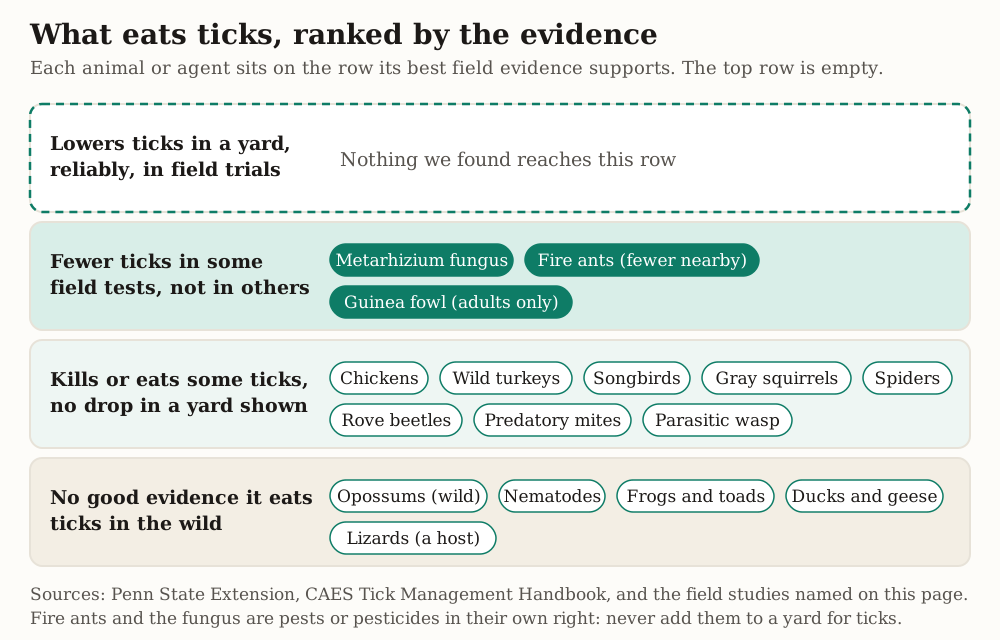
Our reading: treat any animal as a bonus, not a plan. If ticks worry you, the yard work and personal habits in our guide to getting rid of ticks in the yard do more than a flock ever will. Each animal on the list is covered below, with the study behind its row.
Part 2 of 6
Birds
Do chickens eat ticks?
Yes, chickens eat ticks they find while scratching for food. Still, no study has tested chickens as tick control in North America, Penn State Extension notes. The only counts come from Africa, where hens picked 3 to 331 ticks each, about 81 on average, off and around tick-covered cattle in 30 to 60 minutes.
That Kenyan study, published in 1991, and a South African one in 1997 (28.8 ticks per bird on average, over 3 hours) worked with cattle ticks. Those ticks clump on cattle, so they are easy to find. Backyard ticks are different. They sit scattered in leaf litter and at the woods edge, and the young ones are the size of a poppy seed. So the African numbers say little about a backyard flock in Connecticut or Missouri.
Keepers disagree on Reddit. In r/chickens, the thread “Are chickens an effective tick-removal method?” ranks for this search, and its top answer says a couple of chickens won’t make a huge difference. Others report fewer ticks once their hens ranged freely. One keeper with about 100 birds and 10 years of experience wrote that their hens refuse black-legged and dog ticks, even when handed one.
How many ticks does a chicken eat in a day?
Nobody has measured it for a backyard. The “80 ticks a day” figure that circles online seems to come from the Kenyan average of 81, which was ticks per bird after up to an hour among infested cattle. It is not a daily count, and it is not a yard. Free-range birds also face hawks, foxes and roads, and that cost is real, as many keepers on Reddit note.
Do guinea fowl eat ticks?
Guinea fowl eat ticks, and they range wider than chickens. But three North American studies, reviewed by Penn State Extension, found the catch. All three saw the birds eat adult ticks, and two found fewer adults. Yet the two that also counted nymphs, the small stage behind most Lyme cases, found no drop in nymphs at all.
Worse, guinea fowl feed ticks too. A 2024 study in Virginia, “Release the hens”, found fed lone star tick nymphs on coop floors, and tests showed some had fed on the birds. The authors found no evidence that guinea fowl control lone star ticks or the germs they carry. As a result, a flock can eat adults while it raises the next crop of nymphs.
Owners on r/homestead love their guineas for snakes and as a noisy alarm. Many also say they are loud, roost in trees, wander into roads and die young. If you want them, want them for those reasons, not for ticks.
Do turkeys eat ticks?
Wild turkeys kill ticks that climb onto them, but they do not clear ticks from the woods. In a 1999 New York study, 5 captive turkeys preened off and apparently ate 152 of 165 nymphs placed on them, about 92%. None of 550 larvae managed to feed. Turkeys, it seems, are poor hosts for young deer ticks.
The field test told a different story. Researchers released 250 adult ticks into forest pens, some open to turkeys and some fenced off. They got back 89.5% of the ticks where turkeys foraged and 92.2% where they did not, a difference too small to matter. CAES draws the same conclusion: turkey foraging does not reduce adult ticks.
Do birds eat ticks? Songbirds, ducks and geese
Birds are the first answer most people get to what eats ticks, but birds also carry them. In a 2009 lab study, gray catbirds and veeries let only about 27% of the larvae placed on them feed, and most of the rest vanished, probably eaten during preening. Yet across eastern Canada, migrating songbirds are thought to carry 50 to 175 million deer ticks north each spring.
So birds work in both directions. Woodpeckers, robins and wrens may take a tick while hunting insects, but we found no study that measured it. For ducks and geese, we found no study at all, so any claim about them is a guess.
You may have read about the oxpecker, an African bird studied for eating ticks off livestock. No North American bird does that job. A bird feeder can even work against you, since spilled seed feeds the mice that feed young ticks.
Part 3 of 6
Mammals
Do opossums eat ticks?
Wild opossums eat few or no ticks. The famous “5,000 ticks a season” claim traces to a 2009 lab study of 6 captive opossums. They groomed off and apparently ate 96.5% of the larvae put on them, and the authors worked out that each must meet more than 5,500 larvae a week at the late-summer peak.
Then a 2021 Illinois study checked the stomachs of 32 wild opossums and found no ticks or tick parts. Twenty-three earlier diet studies had found none either. Opossums are still worth having around, but they are not tick control. Our page on whether opossums really eat ticks covers the myth and the studies in full.
Do mice, shrews and squirrels eat ticks?
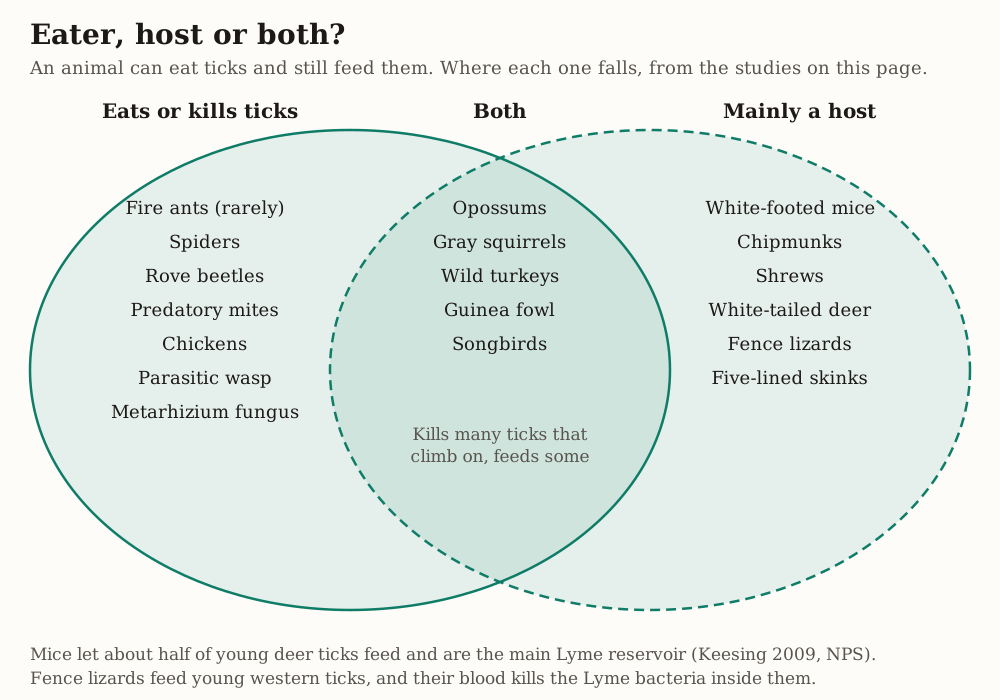
Mice and shrews turn up in lists of what eats ticks, yet they mostly feed ticks rather than eat them. In the 2009 lab study, about half the young deer ticks put on white-footed mice fed to the full, while only about 17% managed on gray squirrels. That is why mice matter so much: the National Park Service calls them perhaps the leading reservoir of Lyme bacteria.
Shrews and chipmunks belong on the host side too. A 2016 study of forest hosts in New York found that white-footed mice, chipmunks and two kinds of shrew all raised the number of infected nymphs. Shrews do eat ticks sometimes: in a Kenyan grass plot, they were among six groups seen eating fed female ticks. But in North America their bigger role is as a meal for young ticks.
Squirrels, by contrast, kill most of the ticks that try to feed on them. Still, squirrels carry ticks, and no one has shown that squirrels lower ticks in a yard.
Raccoons, skunks, armadillos and bats
People ask about all four, and the evidence is thin. Raccoons are minor tick hosts that dilute Lyme risk a little, the same 2016 study found. For skunks, armadillos and bats, we found no study showing they eat ticks in any number. All four eat insects or grubs, so a stray tick is possible, but nothing more is known.
Foxes and other mouse hunters
The animals that may help most never touch a tick. Foxes and martens eat mice and voles, and a 2017 study across 20 Dutch forest plots found fewer young ticks on mice where those predators were more active. It also found fewer infected nymphs. Snakes, hawks and owls hunt mice too, though we found no study that measured their effect on ticks.
Part 4 of 6
Reptiles and amphibians
Do lizards eat ticks? The western fence lizard mix-up
Lizards appear in almost every answer to what eats ticks, but they are better known as tick hosts. Google’s AI Overview says western fence lizards eat ticks and can neutralize Lyme disease. That mixes up two different things. Young western blacklegged ticks feed on the lizard, and a protein in the lizard’s blood kills the Lyme bacteria inside the tick.
The lab proof is striking. In 1998, Lane and Quistad let infected nymphs feed on fence lizards, and none of the 62 adult ticks that came out of them still carried Lyme bacteria. Yet when the same kind of nymphs fed on rabbits, 11 of 20 kept their infection. The National Park Service calls this blood protein a major reason Lyme is less common in the West.
The lizard does not lower tick numbers, though. In a 2011 field experiment in the far West, removing lizards left most young ticks with no meal, so there were fewer nymphs the next year. In the Southeast, deer ticks favor five-lined skinks, lizards that pass on Lyme poorly. Our deer tick guide explains why that keeps Lyme rare there.
Frogs, toads and snakes
Frogs and toads snap up small crawling prey, so a stray tick is possible. Even so, we found no study that counted ticks in their diet. Snakes do not eat ticks; their link to ticks is the mice they eat. Several popular pages list frogs and toads as tick predators, but none of them cites a study.
Part 5 of 6
Bugs, fungi and other biological control
What bugs eat ticks? Ants, spiders and beetles
Ants, spiders, rove beetles and predatory mites all eat some ticks. But in the best test so far, only a sliver of them did. When researchers asked what eats ticks in forest leaf litter, only 7 of 252 arthropod samples showed they had eaten labeled nymphs. Most hunters there left the ticks alone.
That 2024 study, from Russian and Czech labs and reported by Entomology Today, used European castor bean ticks. It put 10 or 11 nymphs, marked with a heavy form of nitrogen, into each of 60 small pots of forest litter for 8 days. The ones that ate ticks were two spiders, a rove beetle and two predatory mites. Centipedes are better known for eating fed larvae.
Fire ants and ticks
Fire ants live alongside fewer ticks, but they may not be eating them. A 2016 Texas study found three times as many ticks on small mammals where fire ants were suppressed. Then a 2019 USDA study, reported by Entomology Today, offered lone star ticks to fire ants and six other ant species. The ants ignored live ticks at every stage.
They only attacked a fed female tick after researchers punctured it. The lead researcher thinks fire ants cut ticks by driving off the small animals that young ticks feed on. Either way, never encourage fire ants for ticks. Their stings hurt and can be dangerous, as our fire ant sting guide explains. Carpenter ants, often listed too, have no tick study behind them that we could find.
The tick wasp
One tiny wasp, Ixodiphagus hookeri, lays its eggs inside deer ticks, and the young wasps eat the tick from within. It sounds ideal. However, CAES found it only on a few isolated New England tracts with superabundant deer and ticks, and it disappears at the tick numbers found in most places.
Fungi and nematodes: biological tick control
Beneficial nematodes do not work against ticks in practice, and a tick-killing fungus works only sometimes. The fungus, Metarhizium, cut nymphs by 56% on lawns and 85% in woods in a 2002 Connecticut trial. But in a larger 2017 to 2020 New York trial, it made no difference to tick numbers.
Nematodes are tiny worms sold for lawn grubs. Fed female ticks can catch them in the lab, but CAES says they are too sensitive to the cold autumn weather when ticks are active. A study in the Caribbean tried 15 nematode strains on fed young ticks, and none of them took.
The fungus is a different case. Metarhizium is a natural soil fungus whose spores attach to a tick, grow through its skin and kill it. CAES calls it nonpathogenic to mammals. A 2017 study also found it did not reduce other ground-dwelling bugs in yards.
The trouble is how it does in yards. In the Tick Project, a masked trial across 24 neighborhoods in Dutchess County, New York, the fungus spray did not lower ticks compared with a water spray. The authors suspect the spray breaks down too quickly to keep working.
Part 6 of 6
What to do instead
What actually lowers ticks in a yard
Whatever eats ticks near you, habitat work at the yard’s edge, fewer mice and your own habits lower tick bites more than any predator. CAES found 82% of lawn ticks within 3 yards (2.7 m) of the lawn’s edge with woods or brush. Clearing that strip and keeping your time away from it costs nothing.
If you still want birds, keep them for eggs and enjoyment, and treat any ticks they catch as a bonus. Our tick prevention guide covers repellents, permethrin and tick checks in full.
Five steps that beat any predator
Clear the edge of the yard
Most ticks in a yard sit where the lawn meets woods, brush or a stone wall. Cut back brush, clear leaves along that edge and move play sets, chairs and patios into the sun.
Make the yard less friendly to mice
Keep trash closed, stack woodpiles away from the house, and do not overfill bird feeders. Mice feed young ticks and carry the Lyme bacteria they pick up.
Protect your body, not just the yard
Use an EPA-registered repellent on skin and wear permethrin-treated clothing for time in brush or woods. Tuck pants into socks on trails.
Check for ticks every day in season
Check yourself, children and pets after time outdoors, and shower within two hours. Put outdoor clothes in a hot dryer before washing them.
Remove an attached tick at once
Grip it close to the skin with fine-tipped tweezers and pull straight up with steady pressure. Skip heat, nail polish and petroleum jelly.
If a tick has already bitten, see our steps for removing a tick safely. To learn which tick it was, start with our guide to the common US ticks, and for everything else, our complete guide to ticks.
Mistakes in other what-eats-ticks guides
Several pages that rank for what eats ticks repeat claims the studies do not support. Here are four, with the source of each. They matter because each one can lead a reader to skip the steps that do lower tick bites.
Claim 1
Claim: Opossums are among the most effective natural tick predators and eat thousands of ticks in a season (Terminix).
What the studies show: That figure came from 6 captive opossums in a 2009 lab study. A 2021 study found no ticks in the stomachs of 32 wild opossums, and 23 earlier diet studies found none either.
Claim 2
Claim: Chickens and ducks can significantly reduce the risk of picking up a tick, and wild turkeys reduce ticks substantially (Huron River Watershed Council).
What the studies show: Penn State Extension says no study has tested chickens as tick control in North America. Turkey foraging did not change how many adult ticks survived in a 1999 field test.
Claim 3
Claim: Western fence lizards eat ticks and can neutralize Lyme disease (Google's AI Overview for this search).
What the studies show: The lizard is a host, not a predator. Young ticks feed on it, and its blood kills the Lyme bacteria inside them, the National Park Service explains.
Claim 4
Claim: Fire ants and carpenter ants feed on ticks and help reduce them (Terminix).
What the studies show: In a 2019 USDA test, fire ants and six other ant species ignored live ticks at every stage. Fewer ticks near fire ants is probably due to fewer small animal hosts.
Pest control disclaimer. Photo-based identification can help, but it is not always perfect. For dangerous spiders, large infestations, or anything you are unsure about, contact a licensed pest control professional.
What eats ticks: FAQ
What is a tick's natural enemy?
Which animal kills the most ticks?
What instantly kills ticks?
Can the earth survive without ticks?
Do chickens or guinea fowl get ticks themselves?
Should I feed opossums or put out bird feeders to fight ticks?
Related guides
Ticks
The full guide: what ticks are, where they live and how to stay safe.
Do opossums eat ticks?
Where the 5,000-ticks claim came from, and what wild opossums really eat.
How to get rid of ticks
Yard and house fixes, ranked by the evidence, cheapest first.
Preventing tick bites
Repellents, permethrin clothing and the after-walk routine.
Deer tick
The Lyme tick: size at each stage, season and range.
Lone star tick
The fast tick of the South and East, and the meat allergy it can cause.
Fire ants
Mounds, stings and the two-step bait method.
How to remove a tick
The tweezer grip, what to do with the tick, and what to skip.
Sources
- Penn State Extension, Do Chickens, Guinea Fowl, or Opossums Control Ticks? (updated May 3, 2024)
- Stafford KC III. Tick Management Handbook, revised edition. Connecticut Agricultural Experiment Station, Bulletin 1010 (2007), Biological Control of Ticks
- National Park Service, Species Spotlight: Deer Tick (updated January 15, 2025)
- Hassan SM and others. Predation on livestock ticks by chickens. Veterinary Parasitology (1991)
- White AL and others. Release the hens: a study on the complexities of guinea fowl as tick control. Journal of Medical Entomology (2024)
- Ostfeld RS, Lewis DN. Experimental studies of interactions between wild turkeys and black-legged ticks. Journal of Vector Ecology (1999)
- Keesing F and others. Hosts as ecological traps for the vector of Lyme disease. Proceedings of the Royal Society B (2009)
- Hennessy C, Hild K. Are Virginia opossums really ecological traps for ticks? Ticks and Tick-borne Diseases (2021)
- Lane RS, Quistad GB. Borreliacidal factor in the blood of the western fence lizard. Journal of Parasitology (1998)
- Swei A and others. Impact of the experimental removal of lizards on Lyme disease risk. Proceedings of the Royal Society B (2011)
- Entomology Today, What Eats Ticks? Study Puts an Old Technique to New Use (January 23, 2024)
- Entomology Today, How Ticks Hide in Plain Sight From Predatory Fire Ants (October 2, 2019)
- Keesing F and others. Effects of tick-control interventions on tick abundance, human encounters with ticks, and incidence of tickborne diseases. Emerging Infectious Diseases (2022)
- Stafford KC III, Allan SA. Field applications of entomopathogenic fungi for the control of Ixodes scapularis. Journal of Medical Entomology (2010)
- US EPA, Pesticide Product and Label System, Metarhizium brunneum strain F52 tick products (64137-32 and 64137-33)