Part 1 of 4
Start here
How many types of ticks are there?
Scientists have described more than 900 kinds of ticks, UC IPM says, and about 80% of them are hard ticks. Only a small share bite people. In the lower 48 states, the CDC maps eight types of ticks that spread disease to humans. Five of those make up most of the ticks people find on themselves and their pets.
Each state has its own short list, too. California has 48 kinds of ticks, but only 6 attach to people with any regularity, according to UC IPM. Minnesota has about a dozen, and Tennessee at least 15. On iNaturalist, naturalists have photographed 38 tick species in the US with an expert-confirmed name (read October 23, 2026).
Hard ticks vs soft ticks
All ticks belong to two main families. Hard ticks (Ixodidae) have a flat shield on the back and feed for days. Soft ticks (Argasidae) have no shield, look leathery, and feed for less than an hour, usually at night. In practice, nearly every tick you find on a person, a dog or a deer is a hard tick.
Hard ticks vs soft ticks
Shield on the back
- Hard ticks (Ixodidae)
- Yes, a flat plate behind the head
- Soft ticks (Argasidae)
- No, the whole body is soft and wrinkled
Mouthparts from above
- Hard ticks (Ixodidae)
- Visible at the front
- Soft ticks (Argasidae)
- Hidden under the body
How long a bite lasts
- Hard ticks (Ixodidae)
- Days; the tick stays attached
- Soft ticks (Argasidae)
- Usually under 30 minutes
Where you meet them
- Hard ticks (Ixodidae)
- Grass, brush, woods and leaf litter
- Soft ticks (Argasidae)
- Rodent nests, cabins, caves, bat roosts, coops
Number of kinds
- Hard ticks (Ixodidae)
- About 80% of the 900-plus known
- Soft ticks (Argasidae)
- About 20%
US examples
- Hard ticks (Ixodidae)
- Deer, lone star, dog, Gulf Coast, brown dog ticks
- Soft ticks (Argasidae)
- Relapsing fever ticks, bat ticks, fowl ticks
What are the three types of ticks?
The question has two common answers. First, the three ticks behind most tick-borne illness in the US are the blacklegged tick, the American dog tick and the lone star tick. Minnesota’s health department and the PA Tick Research Lab both name those three.
Second, “three types” sometimes means the three life stages that bite: larva, nymph and adult. Larvae have 6 legs and are barely bigger than a printed period. Nymphs have 8 legs and are about the size of a poppy seed. Our guide to what a tick looks like at each stage shows all three to scale.
Tick identification chart: the one mark that names each tick
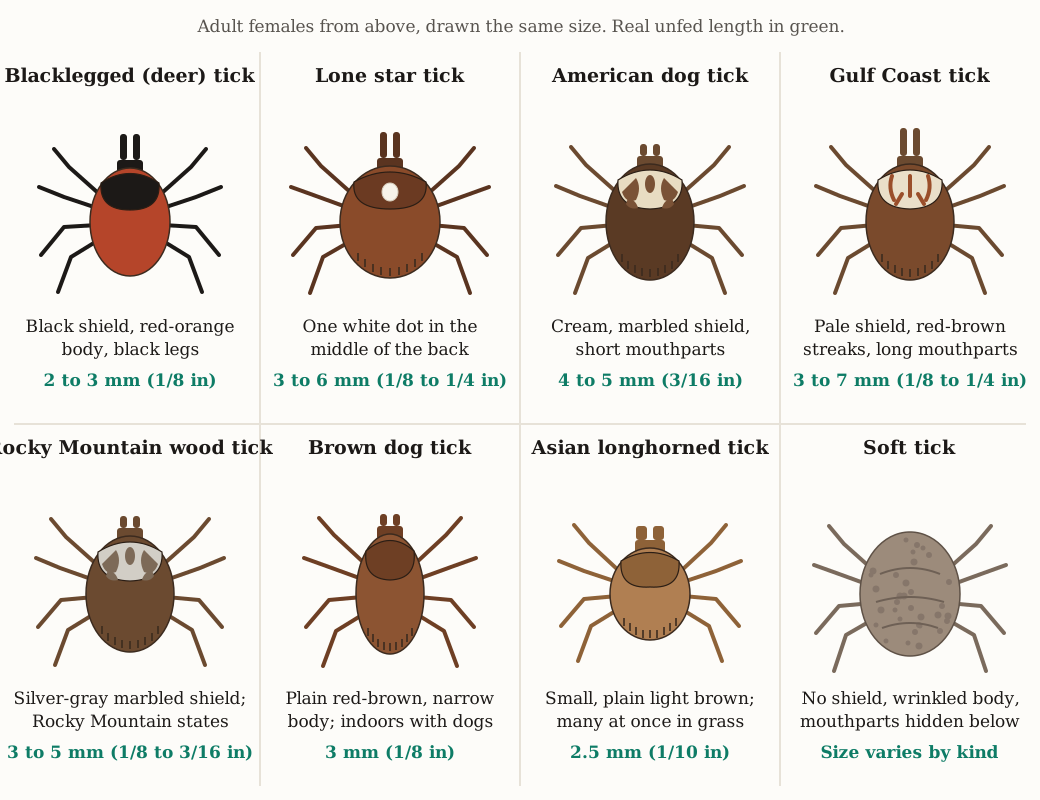
Most types of ticks in the US can be named by one mark on the shield behind the head of an adult female. Check for a white dot, a black shield on an orange body, or cream or silver marbling. Then use size, the length of the mouthparts, and where you live to settle it. The chart below puts that mark first.
Tick identification chart, unfed adult females
Black shield on a red-orange body; black legs; long mouthparts
- Tick
- Blacklegged (deer) tick
- Size
- 2 to 3 mm (about 1/8 in)
- Where in the US
- East, South and upper Midwest
- Main disease risk
- Lyme disease, anaplasmosis, babesiosis
Same look as the deer tick, but on the West Coast
- Tick
- Western blacklegged tick
- Size
- About 1/8 in (3 mm)
- Where in the US
- Pacific Coast, mainly northern California
- Main disease risk
- Lyme disease, anaplasmosis
One white or silver dot in the middle of the back
- Tick
- Lone star tick
- Size
- 1/8 to 1/4 in (3 to 6 mm)
- Where in the US
- South, East and Midwest, spreading north
- Main disease risk
- Ehrlichiosis, alpha-gal syndrome
Cream, marbled shield; short mouthparts
- Tick
- American dog tick (wood tick)
- Size
- About 3/16 in (4 to 5 mm)
- Where in the US
- East of the Rockies and the Pacific Coast
- Main disease risk
- Rocky Mountain spotted fever, tularemia
Pale shield with reddish-brown streaks; long mouthparts
- Tick
- Gulf Coast tick
- Size
- 1/8 to 1/4 in (3 to 7 mm)
- Where in the US
- Gulf and southern Atlantic coasts, Plains
- Main disease risk
- Rickettsia parkeri spotted fever
Silver-gray marbled shield; high ground in the West
- Tick
- Rocky Mountain wood tick
- Size
- 1/8 to 3/16 in (3 to 5 mm)
- Where in the US
- Rocky Mountain states, 4,000 to 10,500 ft
- Main disease risk
- Colorado tick fever, spotted fever
Plain reddish brown, no marks; narrow body; indoors
- Tick
- Brown dog tick
- Size
- About 1/8 in (3 mm)
- Where in the US
- Every state, in homes and kennels with dogs
- Main disease risk
- Spotted fever in the Southwest
Small, plain light brown; dozens or hundreds at once
- Tick
- Asian longhorned tick
- Size
- About 1/10 in (2.5 mm)
- Where in the US
- East, from New York to Georgia and Missouri
- Main disease risk
- No proven human disease in the US yet
No shield; wrinkled, raisin-like body
- Tick
- Soft tick
- Size
- Varies by kind
- Where in the US
- Western mountain cabins, caves, bat roosts
- Main disease risk
- Soft tick relapsing fever
Sizes from Texas A&M AgriLife, UC IPM, Oak Ridge National Laboratory, Penn State Extension and the University of Alberta museums. Ranges and diseases from the CDC. Males and engorged females look different.
How to identify a tick in five checks
To identify a tick, work from the body plan down to the details. First confirm it is a tick, then find the shield, read its marks, and check the mouthparts and legs. Finally, add your location. Tick experts on Reddit ask for the location before anything else, because it rules out most of the look-alikes.
Identify a tick, step by step
Count the legs
Ticks have 8 legs, no antennae and no wings. The only exception is the tiny larva, which has 6 legs. A bug with 6 legs and antennae is an insect, not a tick.
Look for a shield
Hard ticks have a flat shield (the scutum) behind the head. Soft ticks have none and look like a wrinkled raisin. Almost every tick found on people or pets in the US is a hard tick.
Check the shield's color and marks
Note any white dot, cream or silver marbling, or a plain black or brown shield. On females the shield covers only the front of the back, which makes it easy to see.
Check the mouthparts and legs
Long, thin mouthparts point to a deer, lone star or Gulf Coast tick. Short ones point to a dog, wood or brown dog tick. Black legs on an orange body mean a blacklegged tick.
Add where and when you found it
Note your state, the habitat and the month. Many ticks look alike, and location rules out most of them. Then match your notes to the chart on this page.
Deer tick or dog tick?
These are the two types of ticks people mix up most, and the shield settles it. A female deer tick has a solid black shield on a red-orange body and is about half the size of a dog tick. A female dog tick has a cream, marbled shield on a dark brown body. Our side-by-side guide to telling a deer tick from a dog tick covers males, nymphs and fed ticks of both.
What a photo can and cannot tell you
A sharp photo of the top of an unfed adult is enough to name most types of ticks. Nymphs are harder, because their marks are faint, and larvae need a microscope. So when you photograph a tick, put it on white paper, shoot the top in daylight, and note the state where you found it.
Fed ticks are the hardest case. An engorged female swells into a gray bean, and the body color disappears. Look at the small shield behind the head instead, because the marks stay there. Even then, people misread fed ticks: in one 2025 r/ticks thread, a doctor called a tick a female deer tick, while the volunteers identified the same photo as a lone star nymph.
One rule has no exceptions: a photo of a bite cannot tell you which tick bit you. Save the tick itself in a sealed bag or taped to a card. You can also try our free photo bug identifier on the tick.
Part 2 of 4
The ticks, one by one
The five types of ticks that bite people most
Five hard ticks are behind most tick bites in the US: the blacklegged, lone star, American dog, western blacklegged and Gulf Coast ticks. The first three alone make up 80% of the 59,349 expert-confirmed US tick sightings on iNaturalist. Meanwhile, the other two lead in their own regions.
Blacklegged tick (deer tick)
The blacklegged tick is small and dark, and the female is the easiest tick to recognize: a black shield on a red-orange body, with black legs. It is the tick most linked to Lyme disease. Adults stay active on any winter day above freezing, so it is the tick you may find in November or even January.
- Scientific name
- Ixodes scapularis
- Size, unfed adult female
- 2 to 3 mm (about 1/8 in); a nymph is about 1.5 mm, the size of a poppy seed
- The mark to look for
- Black shield on a red-orange body, black legs, no white marks
- Where it lives
- The eastern US, from New England and the upper Midwest south to Florida and Texas
- When it bites
- Nymphs in late spring and summer; adults in fall, early spring and warm winter days
- Main disease risk
- Lyme disease, anaplasmosis, babesiosis, Powassan virus
One popular summary gets this tick backward. Google’s AI Overview for this topic says the female has “a dark body with a reddish-orange cap near the head”. It is the other way around: the dark shield sits near the head, and the red-orange body is behind it.
Lone star tick
The lone star tick is a round, reddish-brown tick, and the female carries a single white or silver dot in the middle of her back. The CDC calls it a very aggressive biter. All three stages bite people, and the nymphs and adult females bite most often.
- Scientific name
- Amblyomma americanum
- Size, unfed adult female
- 1/8 to 1/4 in (3 to 6 mm), depending on the source
- The mark to look for
- One white dot on the female's back; the male has faint white marks on the rear edge instead
- Where it lives
- The South, East and Midwest, now north to coastal Maine
- When it bites
- March to August, with a peak in May and June
- Main disease risk
- Ehrlichiosis, Heartland and Bourbon viruses, tularemia; linked to alpha-gal syndrome (red meat allergy)
Sources disagree on its size. Oak Ridge National Laboratory and the PA Tick Research Lab put adults at about 1/8 inch (3 mm), while Texas A&M gives unfed females 4 to 6 mm. Either way, it is larger than a deer tick and about the size of a dog tick.
American dog tick (wood tick)
The American dog tick is the largest common US tick, at about 3/16 inch (4 to 5 mm) before it feeds. The female has a cream or silver marbled shield on a dark brown body, and the male is marbled all over. In the North people call it the wood tick. A fed female can swell to about 1/2 inch, the size of a small grape.
- Scientific name
- Dermacentor variabilis
- Size, unfed adult female
- About 3/16 in (4 to 5 mm); up to 1/2 in (15 mm) when fed
- The mark to look for
- Cream or silver marbled shield, short mouthparts
- Where it lives
- East of the Rocky Mountains, plus parts of the Pacific Coast
- When it bites
- April to July; adult females bite most in spring and early summer
- Main disease risk
- Rocky Mountain spotted fever, tularemia; it does not spread Lyme disease
It is also the tick people photograph most. On iNaturalist, it accounts for 39% of confirmed US tick sightings, and more than half of those in New England and the Great Lakes states. For dogs that come home with ticks, see our guide to finding and removing ticks on dogs.
Western blacklegged tick
The western blacklegged tick is the West Coast twin of the deer tick, with the same black shield, red-orange body and black legs. It is the main Lyme carrier in California, Oregon and Washington. Unlike most ticks, it is active mainly from late fall through spring.
- Scientific name
- Ixodes pacificus
- Size, unfed adult female
- About 1/8 in (3 mm); a nymph is about 1/25 in (1 mm)
- The mark to look for
- Black shield on a red-orange body, black legs; only on the Pacific side of the country
- Where it lives
- The Pacific Coast, mainly northern California; also parts of Oregon, Washington, Nevada, Utah and Arizona
- When it bites
- Adults from November to April; nymphs in spring and early summer
- Main disease risk
- Lyme disease, anaplasmosis, hard tick relapsing fever
It is the most widespread tick in California, found in 56 of the state’s 58 counties, says UC IPM. LymeDisease.org gives 55. It bites people more often than any other California tick, yet fewer carry Lyme bacteria. One reason is its nymphs feed mostly on lizards: the western fence lizard has a blood protein that kills Lyme bacteria, the National Park Service notes.
Gulf Coast tick
The Gulf Coast tick looks like a dog tick at first glance, with a pale, ornate shield. Its mouthparts are longer and narrower, though, and the shield has reddish-brown streaks. It is a late-summer tick, so a marbled tick in July or August in the South is more likely this one than a dog tick.
- Scientific name
- Amblyomma maculatum
- Size, unfed adult female
- 1/8 to 1/4 in (3 to 7 mm); up to 3/4 in (18 mm) when fed
- The mark to look for
- Pale shield with reddish-brown streaks, long mouthparts
- Where it lives
- About 100 to 150 miles inland along the Gulf and southern Atlantic coasts, from Texas to South Carolina; also Oklahoma, Kansas and Arkansas
- When it bites
- June to September, with the peak in July and August
- Main disease risk
- Rickettsia parkeri rickettsiosis, a form of spotted fever
It is common where it lives. In Texas, Louisiana and Mississippi, it is the most photographed tick on iNaturalist, ahead of the lone star tick. Texas A&M notes that recent studies found more than 20% of Gulf Coast ticks carry Rickettsia parkeri, and that the tick is spreading north and inland.
Other hard ticks in the US
Beyond the big five, five more types of ticks matter in parts of the US. The Rocky Mountain wood tick lives at high elevation in the West. Along the West Coast live the Pacific Coast and western dog ticks. The brown dog tick lives indoors with dogs, and the Asian longhorned tick is a newcomer in the East.
Rocky Mountain wood tick
The Rocky Mountain wood tick looks almost the same as the American dog tick, with a silver-gray marbled shield. Range is the easiest way to tell them apart: the CDC places it in the Rocky Mountain states and southwestern Canada at 4,000 to 10,500 feet (1,200 to 3,200 m). It is most active from March to June.
- Scientific name
- Dermacentor andersoni
- Size, unfed adult female
- 1/8 to 3/16 in (3 to 5 mm); up to 5/8 in (16 mm) when fed
- The mark to look for
- Silver-gray marbled shield; found in mountains and foothills
- Where it lives
- Montana, Wyoming, Idaho, Colorado, Utah and neighboring states, at elevation
- When it bites
- March to June, with the peak in May
- Main disease risk
- Colorado tick fever, Rocky Mountain spotted fever, tularemia; can cause tick paralysis
Pacific Coast tick and western dog tick
On the West Coast, two marbled ticks replace the American dog tick. The Pacific Coast tick (Dermacentor occidentalis) is the tick photographed most in California, at 49% of confirmed sightings there. UC IPM says it alone spreads Rickettsia philipii, which leaves a painful scab at the bite.
The western dog tick (Dermacentor similis) was only recently described as a separate species. Before that, the dog ticks west of the Rockies were counted as American dog ticks. The CDC now lists it beside the American dog tick and says more research is needed on what it spreads.
Brown dog tick
The brown dog tick is the one type of tick that can live and breed indoors. It is plain reddish brown with no markings and a narrow body, about 1/8 inch (3 mm) long. Dogs are its main host at every stage, and it often turns up crawling up walls and curtains in homes and kennels.
- Scientific name
- Rhipicephalus sanguineus
- Size, unfed adult female
- About 1/8 in (3 mm); a fed female grows to about 1/2 in
- The mark to look for
- No marks at all; uniform reddish brown and narrow
- Where it lives
- Worldwide; in most of the US inside homes and kennels, and outdoors in warm southern areas
- When it bites
- All year indoors
- Main disease risk
- Rocky Mountain spotted fever in the southwestern US and along the Mexico border; serious dog diseases
A female can lay up to 4,000 eggs indoors, Texas A&M says, so one tick on a dog can turn into a house problem. Our brown dog tick guide covers how to clear it.
Asian longhorned tick
The Asian longhorned tick is a small, plain light-brown tick from East Asia, first found in the US in 2017 in New Jersey. US populations are all female. Each female lays eggs without mating, so one tick can start a colony. The CDC says thousands may be found at once in grass or on one animal.
- Scientific name
- Haemaphysalis longicornis
- Size, unfed adult female
- About 1/10 in (2.5 mm); the size of a pea when fed
- The mark to look for
- No marks; small and light brown, often found in large numbers
- Where it lives
- The East, from New York south to Georgia and west to Missouri; CDC listed 20 states by April 2024
- When it bites
- March to November, with most sightings in June and July
- Main disease risk
- No human disease proven in the US yet; it is not a Lyme carrier. A serious livestock pest
It bites people less often than native ticks, the CDC says. It also cannot spread Lyme bacteria, according to USDA APHIS. Its threat so far is to cattle, sheep and other animals. If you think you found one, seal it in a bag and send it to your state extension office or vet, because it is still being mapped.
Soft ticks: relapsing fever, bat and bird ticks
Soft ticks are the rarer types of ticks for most Americans. They have no shield, a wrinkled body, and mouthparts hidden underneath. Instead of waiting in grass, they live in the nests of their hosts and bite for less than 30 minutes, usually at night. Most people never notice the bite.
Relapsing fever ticks
Soft ticks of the genus Ornithodoros spread soft tick relapsing fever. In the US, the CDC says, most people are infected while sleeping in rodent-infested cabins in western mountains. The ticks hide in the walls and come out at night, even in winter, when a fire warms the cabin.
A second kind lives in caves, mostly in Texas. The illness brings fever, headache and muscle aches 4 to 21 days after the bite. Usually, the fever lasts about 3 days, fades for about a week, and then returns, which gives the disease its name.
Bat ticks
The bat tick (Carios kelleyi) lives with bats in attics, barns and church belfries. Rutgers researchers note it has been found in 29 of the 48 lower states. It usually stays with the bats. However, once the bats leave or are removed, hungry ticks wander and sometimes bite people.
Iowa State Extension says the fix starts with sealing the bats out, and the ticks can survive months or even years without a meal. For that reason, it may also take a crack-and-crevice treatment in the roost area, following the product label.
Bird, poultry and ear ticks
The fowl tick (Argas persicus), called the “blue bug”, lives in the cracks of chicken coops. It feeds on birds at night and hides by day. Oklahoma State Extension calls it a serious poultry pest that can kill chicks through blood loss. Its relatives live in pigeon, swallow and seabird nests.
One more soft tick turns up on dogs, horses and cattle: the spinose ear tick (Otobius megnini). It lives deep in the ear canal, mostly in dry country west of the Mississippi. Only the larvae and nymphs feed, according to the Companion Animal Parasite Council, and the adults do not feed at all.
Part 3 of 4
Risk, region and season
Which types of ticks carry Lyme disease and other illnesses?
In the US, only two ticks spread Lyme disease to people: the blacklegged (deer) tick in the East and Midwest, and the western blacklegged tick on the Pacific Coast. The lone star tick and the American dog tick do not. Other types of ticks carry different diseases, so the type matters if you get sick.
Which ticks carry Lyme disease?
Only Ixodes ticks, the blacklegged and western blacklegged ticks, carry Lyme bacteria to people in the US. Even then, most of them are not infected. Our deer tick guide covers how long a tick must feed before it can pass on Lyme bacteria, and what the numbers mean for you.
Infection rates vary a lot by place. The Minnesota Department of Health says about 1 in 3 adult blacklegged ticks there carry Lyme bacteria, and 1 in 5 nymphs. In northern California, by contrast, UC IPM puts it at 1% to 2% of adult western blacklegged ticks and 2% to 15% of nymphs.
Which ticks should you worry about?
The most dangerous tick is the one carrying a germ that is common where you live. Rocky Mountain spotted fever, spread by dog ticks, wood ticks and brown dog ticks, can be deadly if not treated early, the CDC warns. Powassan virus, from deer ticks and groundhog ticks, is rare but can cause swelling of the brain.
What each type of tick can spread to people in the US
Blacklegged (deer) tick
- Diseases
- Lyme disease, anaplasmosis, babesiosis, Borrelia miyamotoi, ehrlichiosis (E. muris), Powassan virus
- Lyme?
- Yes
Western blacklegged tick
- Diseases
- Lyme disease, anaplasmosis, Borrelia miyamotoi
- Lyme?
- Yes
Lone star tick
- Diseases
- Ehrlichiosis, Heartland virus, Bourbon virus, tularemia, STARI rash; linked to alpha-gal syndrome
- Lyme?
- No
American dog tick
- Diseases
- Rocky Mountain spotted fever, tularemia
- Lyme?
- No
Rocky Mountain wood tick
- Diseases
- Rocky Mountain spotted fever, Colorado tick fever, tularemia
- Lyme?
- No
Brown dog tick
- Diseases
- Rocky Mountain spotted fever (Southwest and Mexico border)
- Lyme?
- No
Gulf Coast tick
- Diseases
- Rickettsia parkeri rickettsiosis
- Lyme?
- No
Pacific Coast tick
- Diseases
- Pacific Coast tick fever (Rickettsia philipii)
- Lyme?
- No
Groundhog tick
- Diseases
- Powassan virus
- Lyme?
- No
Asian longhorned tick
- Diseases
- None proven in people in the US so far
- Lyme?
- No
Soft ticks (Ornithodoros)
- Diseases
- Soft tick relapsing fever
- Lyme?
- No
Diseases from the CDC, except Pacific Coast tick fever, from UC IPM. A tick that can carry a disease is not always infected.
A few ticks cause harm without any germ. The saliva of some ticks, most often dog and wood ticks (Dermacentor), can cause tick paralysis, a weakness that climbs up the body. The CDC says people usually start to move normally within 24 hours of removing the tick.
Medical disclaimer. This page is for general information only. It is not a medical diagnosis. If you have severe symptoms, trouble breathing, swelling of the face or throat, fast spreading redness, fever, severe pain, pus, or signs of infection, contact a doctor or your local emergency number.
Which ticks live in my state?
The types of ticks you meet depend on your region. In New England and the Great Lakes states, the American dog tick and the deer tick make up nearly all sightings. From Virginia to Texas, the lone star tick leads. On the West Coast, the Pacific Coast tick and the western blacklegged tick lead.
We read all 59,349 research-grade US tick sightings on iNaturalist on October 23, 2026, and grouped them by region. The CDC’s range maps, Texas A&M and UC IPM fill in the ticks that people rarely photograph.
Ticks by US region (iNaturalist research-grade sightings, read October 23, 2026, plus CDC range maps)
New England (ME, NH, VT, MA, RI, CT)
- Most reported ticks
- American dog tick (58%), blacklegged tick (38%)
- Also there
- Lone star tick (spreading north), Asian longhorned tick
- Lyme carrier?
- Yes, blacklegged tick
New York, New Jersey, Pennsylvania
- Most reported ticks
- American dog tick (40%), blacklegged tick (37%), lone star tick (20%)
- Also there
- Asian longhorned tick (2%), groundhog tick
- Lyme carrier?
- Yes, blacklegged tick
Mid-Atlantic (DE, MD, DC, VA, WV)
- Most reported ticks
- Lone star tick (37%), American dog tick (32%), blacklegged tick (28%)
- Also there
- Gulf Coast tick, Asian longhorned tick
- Lyme carrier?
- Yes, blacklegged tick
Southeast (NC, SC, GA, FL, AL, MS, TN, KY)
- Most reported ticks
- Lone star tick (43%), American dog tick (26%), Gulf Coast tick (20%)
- Also there
- Blacklegged tick, brown dog tick, gopher tortoise tick
- Lyme carrier?
- Blacklegged tick present; Lyme is less common than in the North
South Central (TX, OK, AR, LA, MO, KS)
- Most reported ticks
- Lone star tick (45%), Gulf Coast tick (25%), American dog tick (20%)
- Also there
- Blacklegged tick, brown dog tick
- Lyme carrier?
- Blacklegged tick present; Lyme is uncommon
Great Lakes (OH, IN, IL, MI, WI, MN)
- Most reported ticks
- American dog tick (66%), blacklegged tick (24%)
- Also there
- Lone star tick (9%, rising in the south of the region)
- Lyme carrier?
- Yes, blacklegged tick
Plains (IA, NE, ND, SD)
- Most reported ticks
- American dog tick (70%), lone star tick (24%)
- Also there
- Blacklegged tick, mostly in the east
- Lyme carrier?
- Some, mostly in the east
Mountain West (MT, WY, ID, CO, UT, NV, AZ, NM)
- Most reported ticks
- Rocky Mountain wood tick (41%), American dog tick (30%)
- Also there
- Brown dog tick, soft ticks in cabins
- Lyme carrier?
- Rare; western blacklegged tick in parts of UT, NV and AZ
Pacific (CA, OR, WA)
- Most reported ticks
- Pacific Coast tick (46%), western blacklegged tick (30%), American dog tick (14%)
- Also there
- Western dog tick (8%), soft ticks in mountain cabins
- Lyme carrier?
- Yes, western blacklegged tick
Alaska and Hawaii
- Most reported ticks
- Very few records
- Also there
- Brown dog tick in Hawaii; no native human-biting ticks in Alaska
- Lyme carrier?
- No
Percentages are each tick’s share of research-grade iNaturalist tick sightings in that region. They show what people photograph, mostly outdoors, not how often each tick bites. Brown dog ticks live indoors and are photographed far less often than they are found.
Are there ticks in Florida and Texas?
Yes, and plenty of them, all year in places. In Florida, the lone star tick is 54% of iNaturalist sightings, followed by the Gulf Coast tick (21%) and the blacklegged tick (12%). In Texas, the Gulf Coast tick leads at 47%, then the American dog tick and the lone star tick. The brown dog tick is common in both states, in homes with dogs.
Are there ticks in Colorado and Utah?
Yes. The Rocky Mountain wood tick is the main tick of the high country, at 67% to 74% of sightings in Montana, Wyoming and Utah. In Colorado, the American dog tick is common on the eastern plains, while the wood tick takes over in the foothills and mountains. Both are marbled and hard to tell apart, so the place is the best clue. Ticks there are most active from March to June.
Are there ticks in California, Oregon and Washington?
Yes, and they are common along the West Coast, mostly in grass, brush and oak woodland. California has the Pacific Coast tick, the western blacklegged tick and the western dog tick. In Washington, the Rocky Mountain wood tick makes up about 1 in 5 sightings as well. Most West Coast tick sightings come between January and May, earlier than in the East.
Ticks in Michigan, Pennsylvania and the North
In Michigan, the American dog tick is 72% of sightings and the blacklegged tick 26%. Pennsylvania and New York are nearly an even split between the two, with the lone star tick and the Asian longhorned tick now turning up as well. In fact, Pennsylvania is one of the few states where the deer tick is the most photographed tick. About 15 kinds of ticks live in the Northeast, the National Park Service says, but most feed only on bats, rabbits, moose or birds.
Does Hawaii have ticks? Does Alaska?
Hawaii has the brown dog tick, the CDC notes, plus seabird ticks on its coasts, but none of the mainland ticks that spread disease. Alaska has no established populations of the human-biting ticks on the CDC’s maps. Ticks in Alaska mostly live on wild animals, and a few arrive on pets or travelers. Still, brown dog ticks can infest a home with dogs even in Alaska, the Companion Animal Parasite Council notes.
Which states have the worst ticks?
It depends on what “worst” means. For Lyme disease, Mayo Clinic points to the Northeast, Minnesota, Wisconsin and the areas around Lake Michigan, where deer ticks are common. In 2015, 95% of confirmed Lyme cases came from the Northeast, Wisconsin and Minnesota, says the National Park Service. If you mean sheer numbers of aggressive biters, the lone star belt from Virginia to Missouri and Texas is hard to beat. Rocky Mountain spotted fever, by contrast, occurs across the whole country, the CDC says.
When each type of tick is active
Most types of ticks peak in May and June, when 45% of US tick sightings happen. Three break the pattern. The Gulf Coast tick peaks in July and August, and the blacklegged tick has a second peak in October and November. Out West, the western blacklegged tick is active mostly from November to April.
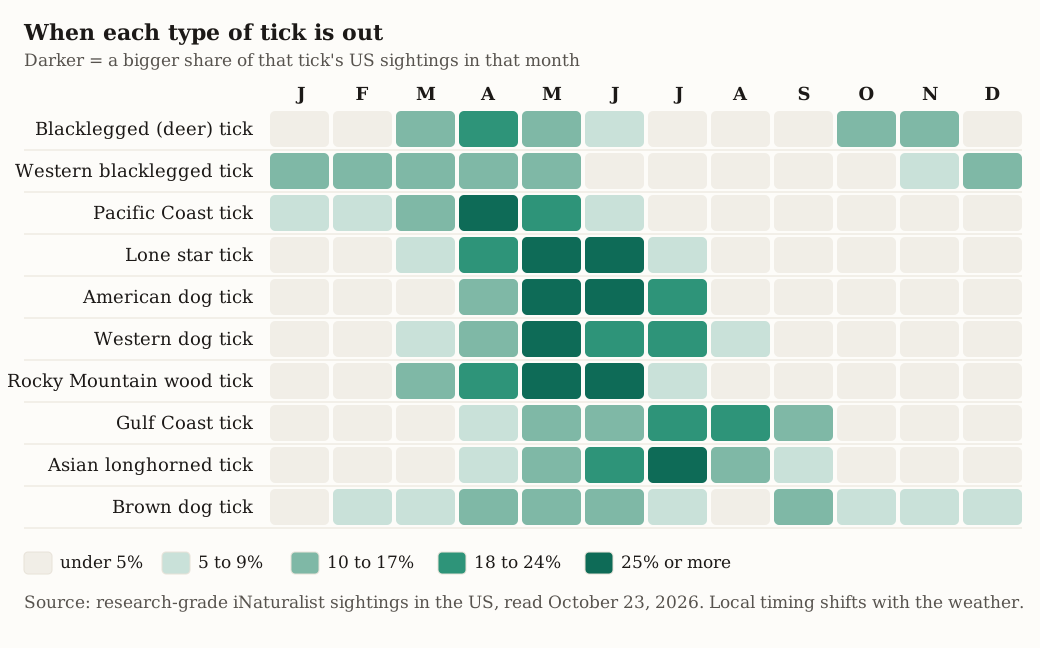
The calendar is built from the month of each confirmed sighting, so read it as a rough guide. Local weather shifts it by weeks. Adult deer ticks look for a host on any winter day above freezing, the CDC says, and a warm spell in January can bring them out.
The season also changes which tick you are likely to have. A small dark tick in November in the North is almost always a deer tick. A marbled tick in August on the Gulf Coast is more likely a Gulf Coast tick than a dog tick. Finally, a flood of tiny ticks in late summer is usually a hatch of seed ticks, the larvae.
Three mix-ups in popular tick guides
Myth 1
Myth: “The female deer tick has a red-orange cap near the head.”
Truth: Reversed. The shield near the head is black, and the red-orange part is the body behind it. Google's AI Overview for this topic says it backward.
Myth 2
Myth: “The lone star tick is rarely seen in Tennessee.”
Truth: Oak Ridge National Laboratory's tick guide still says so. Today it is the most reported tick in Tennessee, at 45% of iNaturalist sightings, and the CDC maps the whole state inside its range.
Myth 3
Myth: “The deer tick spreads Borrelia hermsii relapsing fever.”
Truth: LymeDisease.org lists it that way. The CDC says Borrelia hermsii comes from the soft tick Ornithodoros hermsi in western cabins. The deer tick spreads a different relapsing fever germ, Borrelia miyamotoi.
Part 4 of 4
What to do
Found a tick? What to do next
If a tick of any type is attached, remove it first and identify it after. Grip it close to the skin with fine-tipped tweezers and pull straight out with steady pressure. Then save it in a sealed bag or tape. The type of tick matters later, if a rash or fever starts.
The CDC’s removal steps are short. Don’t twist or jerk the tick, and don’t use nail polish, petroleum jelly or heat. Clean the bite and your hands afterward. Our step-by-step guide to removing a tick safely covers a tick with its head stuck in the skin.
What to read next, by the type of tick you found
A small tick with a black shield and black legs
A tick with a white dot on its back
A larger tick with a cream, marbled shield
- Read next
- The American dog tick, or wood tick
Ticks on your dog, or ticks in the house
- Read next
- Ticks on dogs: checks and prevention
Dozens of tiny ticks at once
- Read next
- Seed ticks and tick larvae
A cluster of tiny amber beads
- Read next
- Tick eggs and the tick nest myth
Something that may not be a tick at all
- Read next
- Bugs that look like ticks
A small flat bug in your bed
- Read next
- Tick vs bed bug
After that, prevention is the same for all types of ticks. Repellent on skin, permethrin-treated clothes and a full tick check after time outdoors do most of the work. Our guide on how to prevent tick bites covers each step, and our page on getting rid of ticks in the yard and house covers the rest. For an overview of tick biology, start at our guide to ticks.
The brown dog tick is the one type that needs work indoors: treat the dog through your vet and the house at the same time, as our guide to clearing brown dog ticks explains.
Pest control disclaimer. Photo-based identification can help, but it is not always perfect. For dangerous spiders, large infestations, or anything you are unsure about, contact a licensed pest control professional.
Types of ticks FAQ
What is the most common tick in the US?
Can ticks live in your house?
Do ticks prefer certain blood types?
Do all ticks carry disease?
What are seed ticks?
Related guides
Ticks
The tick hub: what ticks are, how they find you, and every tick guide on this site.
Deer tick vs dog tick
The two most common US ticks side by side, at every life stage.
What does a tick look like?
Size, color and shape at each stage, from a speck to an engorged female.
Lone star tick
The tick with the white dot, and why it can cause a red meat allergy.
How to remove a tick
The CDC tweezer method, step by step, and what not to do.
Bugs that look like ticks
Spider beetles, bed bugs, mites and other tick look-alikes.
Seed ticks
Tiny ticks by the hundred in late summer: what they are and what to do.
Ticks on dogs
Where ticks hide on a dog, and how to remove and prevent them.
Sources
- CDC, Where Ticks Live (July 30, 2025)
- CDC, About Ticks and Tickborne Disease
- CDC, What to Do After a Tick Bite
- CDC, About Rocky Mountain Spotted Fever
- CDC, About Soft Tick Relapsing Fever (STRF)
- UC IPM, Ticks and Lyme Disease in California
- Texas A&M AgriLife Extension, Tick identification (species pages)
- USDA APHIS, Asian Longhorned Ticks (May 27, 2026)
- Penn State Extension, Asian Longhorned Tick, Haemaphysalis longicornis
- Minnesota Department of Health, Ticks
- Oak Ridge National Laboratory, Tick Identification and Prevention (2018)
- National Park Service, Species Spotlight: Deer Tick (January 15, 2025)
- Iowa State University Extension, Bat Tick
- Zakovska A, et al. Pilot study of Ixodes ricinus ticks preference for human ABO blood groups. Ann Agric Environ Med, 2018
- iNaturalist, research-grade tick (Ixodida) observations in the United States (read October 23, 2026)