Deer tick vs dog tick: the five checks
Deer tick vs dog tick takes five checks, and the first one usually settles it. Look for white. A dog tick has pale, silvery marks on its back, and a deer tick has none. Then check the legs, the mouthparts, the back edge and the size. An unfed deer tick female is 2 to 3 mm; a dog tick female is about 5 mm.
These are two of the ticks people find most often in the eastern US, so they are the usual pair to sort out. A deer tick is Ixodes scapularis, and a dog tick is Dermacentor variabilis. They are not close relatives, which is why they look so different under a magnifying glass.
Table 1. Deer tick vs dog tick at a glance
Shield behind the head
- Deer tick (blacklegged tick)
- Plain black or dark brown, no pale marks
- Dog tick (American dog tick)
- Pale silvery or cream, with brown flecks
Legs
- Deer tick (blacklegged tick)
- Black
- Dog tick (American dog tick)
- Brown, like the body
Mouthparts, seen from above
- Deer tick (blacklegged tick)
- Long and thin
- Dog tick (American dog tick)
- Short and broad
Rear edge of the body
- Deer tick (blacklegged tick)
- Smooth
- Dog tick (American dog tick)
- A row of small grooves (festoons)
Body of an unfed female
- Deer tick (blacklegged tick)
- Red-orange behind the shield
- Dog tick (American dog tick)
- Reddish brown
Size of an unfed female
- Deer tick (blacklegged tick)
- 2 to 3 mm (about 1/8 in), a sesame seed
- Dog tick (American dog tick)
- About 5 mm (3/16 in), twice as long
Size of a fully fed female
- Deer tick (blacklegged tick)
- About 6 mm (1/4 in) wide
- Dog tick (American dog tick)
- Up to 15 mm (5/8 in) long
Male
- Deer tick (blacklegged tick)
- All dark brown
- Dog tick (American dog tick)
- Mottled pale over the whole back
Spreads Lyme disease?
- Deer tick (blacklegged tick)
- Yes
- Dog tick (American dog tick)
- No
Sizes from Ohio State ENT-0096 (deer tick) and University of Florida EENY-443 (dog tick). Features from the University of Rhode Island TickEncounter center and Penn State Extension.
1. The shield
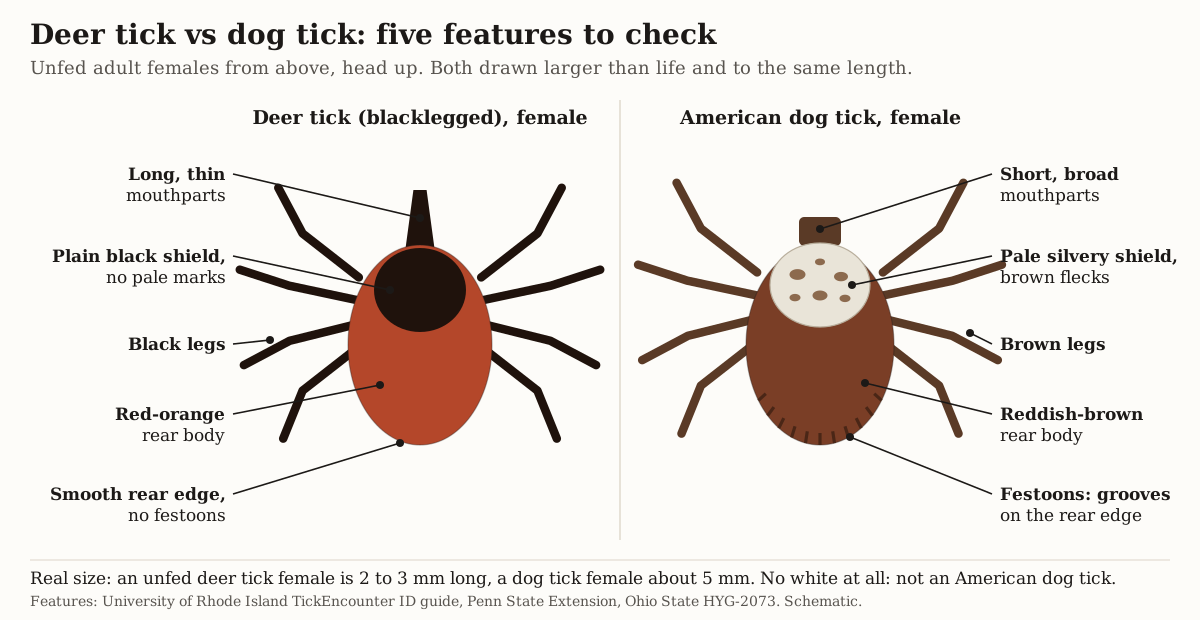
Every hard tick has a hard shield, the scutum, right behind its mouthparts. On a deer tick it is plain black or dark chocolate brown. On an American dog tick it is pale and silvery, with brown flecks. So any white or cream on the back rules out a deer tick. In the Reddit threads we read that asked “deer or dog?”, experts usually settled it with this one look.
2. The legs
The deer tick’s other name, blacklegged tick, gives the second check away. Its legs are black, and they stand out against a red-orange body. A dog tick’s legs are brown, about the same color as the rest of it. Leg color helps most when the back is hard to see, for example on a tick that has fed.
3. The mouthparts
From above, a deer tick’s mouthparts look long and thin, like a little beak. A dog tick’s are short and broad. The University of Rhode Island TickEncounter center notes that mouthpart length also changes how hard a tick is to pull out. However, they often break off during removal, so a missing beak tells you nothing.
4. The back edge
Look at the rear edge of the body. A dog tick has a row of small grooves there, called festoons, a bit like the rippled edge of a pie crust. A deer tick has none: Ixodes ticks are the only common ticks without festoons, URI says. You may need a magnifier to see them.
5. The size
An unfed dog tick is about twice as long as a deer tick. Size alone can mislead, though. A partly fed deer tick can be as long as a hungry dog tick, so treat size as the last check, not the first.
Deer tick vs dog tick size
The deer tick vs dog tick size gap is easy to see. An unfed adult deer tick is 2 to 3 mm (about 1/8 inch), and an unfed adult dog tick is about 5 mm (3/16 inch). After feeding, a deer tick female swells to about 6 mm (1/4 inch) wide, while a dog tick female can reach 15 mm (5/8 inch) long.
The drawing below puts all four at true relative size. It shows something that photos online rarely do: a full dog tick dwarfs a full deer tick. Ohio State compares a fed deer tick to the eraser on a No. 2 pencil. A fed dog tick is closer to the size of a pinto bean.
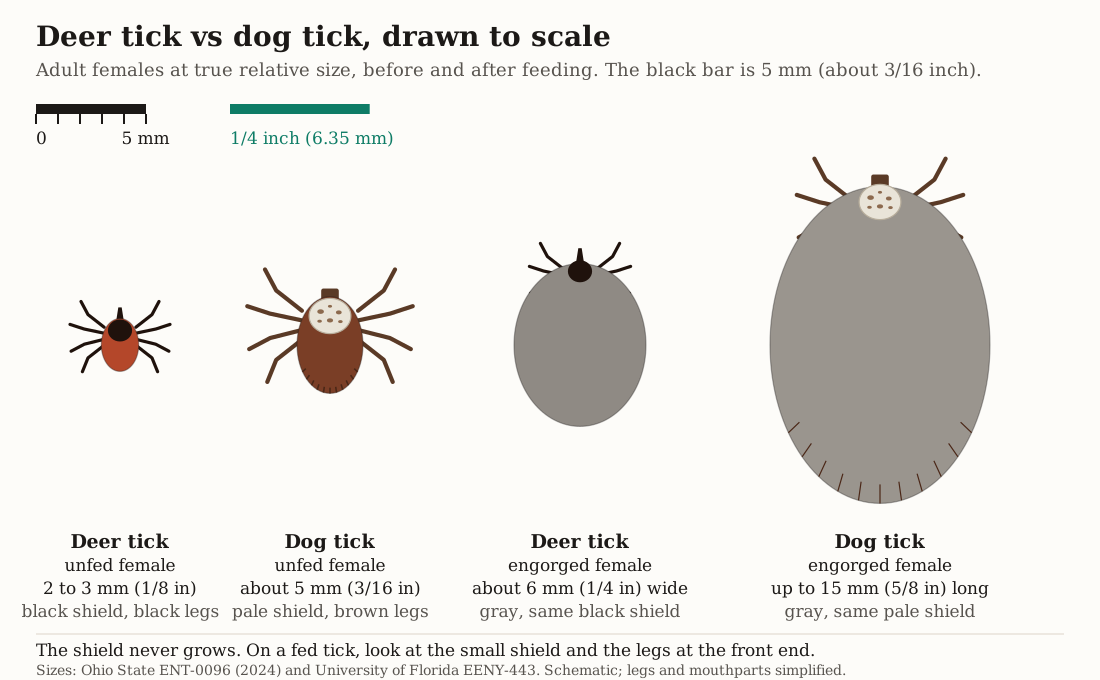
Sources give slightly different adult sizes. Ohio State’s deer tick fact sheet says 2 to 3 mm for both sexes, while its general tick sheet puts an unfed female at about 3/32 inch (2.4 mm). For the dog tick, the University of Florida gives 5 mm for an unfed female and 3.6 mm for a male. Either way, the gap between the two is plain to see.
Engorged deer tick vs engorged dog tick
An engorged deer tick and an engorged dog tick both turn gray and swell like a bean, so color stops helping. Three things still separate them: the shield, which never grows; the legs, which keep their color; and the size. A fed deer tick stops at about 6 mm (1/4 inch) wide, while a dog tick can reach 15 mm (5/8 inch).
The shield is the key. The URI tick growth charts show that it stays the same size however big the tick gets. On a full deer tick, look for a tiny black spot at the front end with black legs around it. On a full dog tick, the small pale shield still shows at the front, and Penn State Extension says its pattern can still be used to identify the tick.
The festoons are less helpful on a full tick. As the body stretches, the grooves can flatten out and become hard to see. In the same way, a mouthpart left in the skin can leave a fed tick looking blunt. So check the shield and the legs first.
Size gives one more clue. A fed tick much bigger than a pencil eraser is not a deer tick. It is most likely a dog tick, or a lone star tick in the South and East. A small, partly swollen tick could be either, so use the shield.
How long was an engorged tick attached?
A fully gray, swollen tick has been feeding for days, not hours. Minnesota health officials say deer ticks usually feed for 3 to 5 days, and URI says a dog tick female takes a week or more to fill up. Still, nobody can read the exact hours from a photo. Keep the tick, note how swollen it was, and tell your doctor. Only females swell, so any engorged tick is a female.
Male ticks and nymphs: deer or dog?
Males and young ticks follow the same rules, with two twists. A male deer tick is dark brown all over. The male dog tick, by contrast, is mottled pale over his whole back. A deer tick nymph is a poppy-seed speck about 1.5 mm (1/16 inch) long, and dog tick nymphs rarely bite people at all.
That last point is useful. URI says American dog tick nymphs and larvae rarely attach to people or pets. They feed on mice and voles instead. So a tiny, eight-legged tick on your skin in late spring is far more likely a deer tick nymph, or a lone star nymph in the South, than a young dog tick.
A cluster of pinhead ticks with six legs is a different story. Those are larvae, often called seed ticks, and our guide to seed ticks and baby ticks covers them.
Which is worse, a deer tick or a dog tick?
For most people in the eastern US, the deer tick is the bigger worry. It spreads Lyme disease, anaplasmosis, babesiosis and Powassan virus, and in Minnesota about 1 in 3 adults carry Lyme bacteria. The dog tick does not spread Lyme. Fewer than 2 in 100 carry Rocky Mountain spotted fever, but that disease can kill if treated late.
Table 2. What each tick can do
Main diseases
- Deer tick
- Lyme disease, anaplasmosis, babesiosis, Powassan virus
- Dog tick
- Rocky Mountain spotted fever, tularemia, tick paralysis
How many carry the main germ
- Deer tick
- About 1 in 3 adults and 1 in 5 nymphs carry Lyme bacteria (Minnesota)
- Dog tick
- Fewer than 2 in 100 carry spotted fever (Ohio State)
Time attached before it can infect you
- Deer tick
- Lyme: more than 24 hours in most cases; anaplasmosis may take less
- Dog tick
- Spotted fever: at least 4 to 6 hours (California) or at least a day (Ohio State)
When symptoms usually start
- Deer tick
- Lyme rash 3 to 30 days after the bite
- Dog tick
- Spotted fever 3 to 12 days after the bite
Who it bites
- Deer tick
- Nymphs and adult females
- Dog tick
- Mostly adult females
From CDC (Lyme disease, Rocky Mountain spotted fever), the Minnesota Department of Health, Ohio State HYG-2073 and the California Department of Public Health.
The timing row is the one people get wrong. On forums, a tick that was on for under a day is often called safe. That rule comes from Lyme disease: CDC says a tick must usually be attached for more than 24 hours to pass it on. It does not fit the dog tick. The California Department of Public Health says spotted fever needs only 4 to 6 hours, although Ohio State says at least a day.
So the honest answer to “which is worse” is this. A deer tick is more likely to make you sick. A dog tick is less likely to, but it can do it faster, and the illness can be severe. Either way, take it off now. For the full picture of each, see our deer tick guide and our American dog tick guide.
Medical disclaimer. This page is for general information only. It is not a medical diagnosis. If you have severe symptoms, trouble breathing, swelling of the face or throat, fast spreading redness, fever, severe pain, pus, or signs of infection, contact a doctor or your local emergency number.
Found a deer tick or a dog tick on you: what to do now
The removal is the same for both ticks: fine-tipped tweezers, close to the skin, one steady pull straight up. What changes is what comes next. After a deer tick in a Lyme area, call your doctor soon. After a dog tick, watch for a fever over the next 2 weeks.
Four steps after you know which tick it is
Take it off now, the same way for both
Grip the tick close to the skin with fine-tipped tweezers and pull straight up with steady pressure. Do not twist it, crush it, or use nail polish, petroleum jelly or heat. Then wash the bite and your hands with soap and water.
Keep the tick and note the day
Seal it in a small bag or wrap it in tape. Write down the date and where you think you picked it up. A doctor may want to see which tick it was, so do not throw it away.
A deer tick in a Lyme area? Call your doctor soon
CDC says an antibiotic given after a tick bite may lower the risk of Lyme disease in certain cases. Ask your doctor whether it is right for you, and say how swollen the tick was.
Watch the next few weeks
After a dog tick, a fever, headache or rash in the next 2 weeks needs a doctor the same day. After a deer tick, watch for a growing rash or a fever for about a month. Tell the doctor about the bite.
Our guide on how to remove a tick shows the grip and what to do if the head stays in. For what a normal bite looks like over the next days, see what a tick bite looks like. Our tick bite guide covers when to worry.
Some sites tell you to send the tick to a lab. CDC advises against it. A positive tick does not mean you were infected, and a negative one can give false comfort. Keep the tick so a doctor can see which kind it was.
Where and when you meet each one
Place and season are strong clues. Deer ticks live in shady woods, and their adults are out in October and November and again in early spring. Dog ticks wait in tall grass along trails, and their adults are out from about April to early August. So a tick on you in October is most likely a deer tick.
Table 3. Where and when each tick is out
Habitat
- Deer tick
- Leaf litter in shady woods, trails and the brushy edge of yards
- Dog tick
- Tall grass and low brush along trails, roads and field edges
US range
- Deer tick
- Eastern US; most infected ticks in the Northeast, Mid-Atlantic and upper Midwest
- Dog tick
- East of the Rocky Mountains, plus parts of the Pacific coast
Adults out
- Deer tick
- October to November and again in spring; any winter day above freezing
- Dog tick
- About April to early August; most common mid-April to mid-July in Ohio
Nymphs out
- Deer tick
- April through July, peaking in June
- Dog tick
- July and August, on mice; they rarely bite people
Where it ends up on you
- Deer tick
- Anywhere; it attaches soon after reaching bare skin
- Dog tick
- Often the scalp and the hairline at the back of the neck
From CDC, the University of Rhode Island TickEncounter center, the Minnesota Department of Health and Ohio State HYG-2073.
Use the calendar as a deer tick vs dog tick tiebreaker. A tick crawling on your jacket after a mild November walk is almost certainly a deer tick, because dog tick adults are gone by late summer. The National Park Service says dog ticks and lone star ticks are mostly inactive in fall and winter, while deer ticks only slow down below about 35°F (2°C). In May and June both are out, so go back to the shield. Also, a tick found in a child’s hair after playing in a grassy field fits the dog tick, which tends to climb to the head.
Neither tick lives long indoors. A deer tick or a dog tick on the kitchen floor rode in on a person or a pet. Our guide to ticks covers the other species in the US, and how to prevent tick bites covers repellents and tick checks.
Deer tick vs wood tick
A wood tick is the same animal as the dog tick in most of the US: the American dog tick. Minnesota health officials, for example, list “wood tick” as its everyday name. So deer tick vs wood tick uses the same five checks. The wood tick is bigger, with a pale shield and brown legs.
In the Rocky Mountain states, “wood tick” can also mean the Rocky Mountain wood tick, Dermacentor andersoni. It looks almost the same as the American dog tick, pale markings and all. CDC says it can spread Colorado tick fever, Rocky Mountain spotted fever and tularemia, but not Lyme disease. Deer ticks do not normally live there.
Deer tick vs lone star tick, brown dog tick and “regular” ticks
Two other ticks get mixed up with deer ticks. The lone star tick female has one white spot on her back. The brown dog tick is plain reddish brown with no markings and brown legs. Neither one spreads Lyme disease, CDC says. And there is no “regular tick”: most people who say that mean the American dog tick.
Table 4. Other ticks people compare with a deer tick
Black shield, black legs, red-orange rear, no white
- Tick
- Deer tick
- Spreads Lyme?
- Yes
One white spot on the female's back; long mouthparts
- Tick
- Lone star tick
- Spreads Lyme?
- No
Plain reddish brown, no markings, brown legs, short mouthparts
- Tick
- Brown dog tick
- Spreads Lyme?
- No
Pale silvery shield, brown legs, short mouthparts
- Tick
- American dog tick (wood tick)
- Spreads Lyme?
- No
Lone star tick vs deer tick
The lone star tick has long mouthparts like a deer tick, which can confuse people. But the adult female has a single white or silvery spot in the middle of her back, and the body is reddish brown, not red-orange. It also has festoons. CDC calls it a very aggressive biter. It can spread ehrlichiosis, and growing evidence links its bite to the red meat allergy called alpha-gal syndrome. Our lone star tick guide covers it.
Brown dog tick vs deer tick
The brown dog tick is about the same size as a deer tick, around 1/8 inch (3 mm) unfed. However, it is plain reddish brown from end to end, with brown legs and short mouthparts. It lives with dogs, often indoors and in kennels, and rarely bites people. In the Southwest and along the Mexico border, it can spread Rocky Mountain spotted fever. A tick on a dog that seldom goes outside is more likely this one. Our guide to ticks on dogs covers what to do.
Deer tick vs a “regular” tick
When people ask how a deer tick differs from a regular tick, they usually mean the bigger brown tick they have pulled off a dog for years. That is the American dog tick, so the five checks above apply. For every common US tick side by side, see types of ticks, and for the body parts named here, see what a tick looks like up close.
Deer tick vs dog tick myths, corrected
Several pages that rank for deer tick vs dog tick get basic facts wrong. A few of the errors could change what a reader does next, so here they are, with what university and health agency sources say instead.
Myth 1
Myth: “Deer ticks and dog ticks are the same species.”
Truth: Healthline's comparison chart says so. They are not even in the same genus: the deer tick is Ixodes scapularis and the dog tick is Dermacentor variabilis.
Myth 2
Myth: “Dog ticks can live their whole lives indoors.”
Truth: That describes the brown dog tick. The California Department of Public Health says the American dog tick does not live long in homes.
Myth 3
Myth: “A male dog tick is dark brown or black.”
Truth: Fox Pest Control says so. In fact, the male American dog tick is mottled pale over his whole back (University of Florida, URI). The all-dark male is the deer tick.
Myth 4
Myth: “Deer tick larvae are the size of a poppy seed.”
Truth: American Pest says so, but the poppy seed is the nymph, about 1.5 mm. Larvae are under 1 mm (Ohio State).
Myth 5
Myth: “You cannot tell engorged ticks apart.”
Truth: The shield never changes size (URI), and the legs keep their color. A photo of a fed tick can still be hard to read, so keep the tick.
Myth 6
Myth: “A dog tick bite is harmless because it cannot give you Lyme.”
Truth: It cannot give you Lyme, but it can carry Rocky Mountain spotted fever, which can pass in as little as 4 to 6 hours (California Department of Public Health).
Myth 7
Myth: “Send the tick to a lab to find out if you need treatment.”
Truth: CDC does not recommend tick testing, and its results should not guide treatment. See a doctor for symptoms instead.
Still not sure which tick you have? Take a sharp photo from above on white paper and try our bug identifier by picture. Then keep the tick in case a doctor wants to see it.
Pest control disclaimer. Photo-based identification can help, but it is not always perfect. For dangerous spiders, large infestations, or anything you are unsure about, contact a licensed pest control professional.
Deer tick vs dog tick FAQ
What color tick carries Lyme disease?
Which is more common, a deer tick or a dog tick?
Can my dog get Lyme disease from a dog tick?
Can a phone app tell a deer tick from a dog tick?
Related guides
Ticks
The ticks that bite people in the US, where they live, and what each one can spread.
Deer tick
Every stage at true size, its season, and how often it carries Lyme.
American dog tick
The wood tick: female and male markings, bites and spotted fever.
How to remove a tick
The CDC method step by step, and what to do if the head stays in.
Lone star tick
The tick with one white spot, and its link to red meat allergy.
What a tick bite looks like
A normal bite day by day, and how a Lyme rash differs.
Types of ticks
Every common US tick compared, with a picture chart.
Ticks on dogs
Where ticks hide on a dog, and when to call the vet.
Sources
- CDC, How Lyme Disease Spreads (September 24, 2024)
- CDC, What to Do After a Tick Bite
- CDC, Where Ticks Live (July 30, 2025)
- CDC, Preventing Lyme Disease: post-exposure antibiotics
- CDC, About Rocky Mountain Spotted Fever
- Ohio State University Extension, Blacklegged (deer) tick, Ixodes scapularis, ENT-0096 (2024)
- Ohio State University Extension, Ticks and Tick-Borne Diseases, HYG-2073
- Chan and Kaufman, American Dog Tick, Dermacentor variabilis, University of Florida EENY-443
- University of Rhode Island TickEncounter, Tick ID guide: scutum, mouthparts and festoons
- University of Rhode Island TickEncounter, Tick Growth Comparison Charts
- University of Rhode Island TickEncounter, American Dog Tick
- Penn State Extension, Know Your Vector: American Dog Ticks
- Minnesota Department of Health, Ticks
- National Park Service, Species Spotlight: Deer Tick (updated January 15, 2025)
- California Department of Public Health, Spotted Fever Group Rickettsia in California (fact sheet)