What are seed ticks?
Seed ticks are tick larvae, the six-legged stage that hatches from the egg. Each one is about 0.5 to 1 mm (1/50 to 1/25 inch) long. A cluster on a pant leg looks like a sprinkle of seeds, which is where the name comes from. In the South, East and Midwest, late summer swarms are usually lone star tick larvae.
A seed tick is not its own species. Every hard tick starts life this way, so there are deer tick larvae, dog tick larvae and lone star tick larvae. Like all ticks, they are arachnids, related to mites and spiders, not insects. CDC lists four life stages: egg, six-legged larva, eight-legged nymph and adult.
Here is the mix-up this page corrects. Many posts call nymphs “seed ticks”, including a Facebook post on the first page of Google for this search. A nymph is the next stage up: it has eight legs and is about the size of a poppy seed. The difference matters, because nymphs are the stage that spreads most Lyme disease, and seed ticks are not.
Our guide to ticks covers the whole group. This page is about the tiny ones: what they look like, how risky they are, and how to get them off you.
What do seed ticks look like?
Seed ticks look like moving specks of pepper: round, flat and light brown to reddish, about 0.5 to 1 mm (1/50 to 1/25 inch) long, with six legs. Deer tick larvae are paler, almost see-through. After a meal, a larva swells and turns gray. You usually see a group, not one.
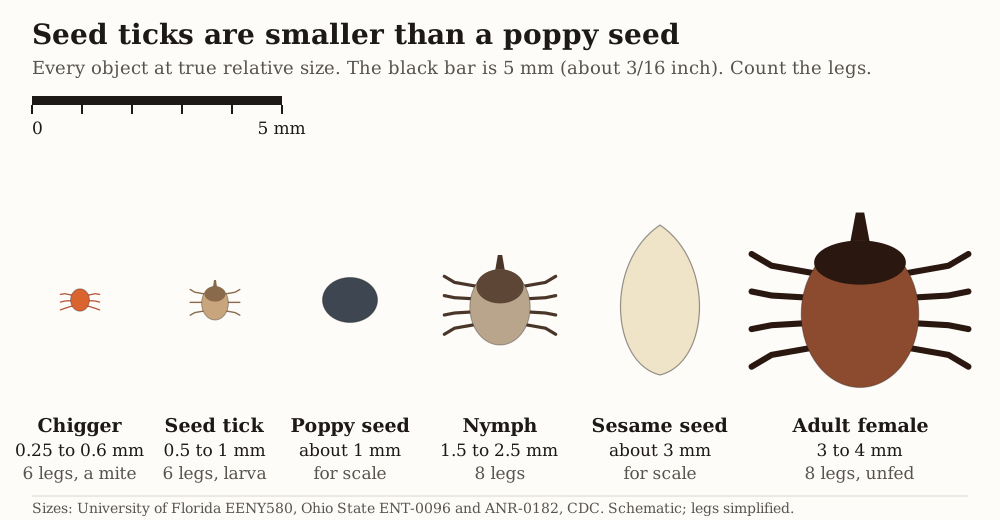
Table 1. Baby tick stages, and how to tell them apart
6
- Stage
- Larva (seed tick)
- Size before feeding
- 0.5–1 mm (1/50–1/25 in)
- About the size of
- A speck of pepper, smaller than a poppy seed
- How many at once
- Dozens to hundreds
8
- Stage
- Nymph
- Size before feeding
- 1.5–2.5 mm (1/16–1/10 in)
- About the size of
- A poppy seed
- How many at once
- One or a few
8
- Stage
- Unfed adult
- Size before feeding
- 2–4 mm (1/12–1/6 in)
- About the size of
- A sesame seed
- How many at once
- One or a few
Lone star tick sizes from the University of Florida; deer tick sizes from Ohio State. Inch figures are rounded.
How big are seed ticks?
Sources give slightly different numbers, so here they are. The University of Florida puts lone star tick larvae at 0.5 to 1 mm. Ohio State says deer tick larvae are under 1 mm, and a 1987 journal note gave 0.6 mm. Medical News Today, quoting the World Health Organization, gives 0.5 to 1.5 mm.
Google’s AI answer and Terminix give 0.02 to 0.06 inch, which is the same 0.5 to 1.5 mm. The top of that range overlaps with nymphs, though. So if a tiny tick is 1.5 mm or more and has eight legs, it is a nymph, not a seed tick.
Are baby ticks red?
Some look reddish brown, and a fed one turns gray. A bright red speck, on the other hand, is more often a mite. Chiggers are yellow to reddish and too small to see well, and clover mites are bright red and crawl on sunny walls. Our guide to tiny red bugs sorts them out.
What seed ticks look like on skin
A seed tick that has bitten looks like a new freckle or a fleck of dirt that will not brush off. One Reddit user in Kentucky wrote that their freckles made the ticks hard to spot. Run a fingernail over the spot: a tick feels like a tiny raised bump and does not smear. Then look closely with a phone camera zoomed in.
Seed tick or nymph? What a nymph tick is
A nymph tick is the stage after the seed tick. It has eight legs, measures about 1.5 to 2.5 mm (1/16 to 1/10 inch), the size of a poppy seed, and usually turns up one or two at a time. CDC says nymphs pose a particularly high risk for Lyme disease, because they are common and easy to miss.
The reason is the life cycle. A larva can pick up Lyme bacteria from its first meal, usually a mouse. It keeps the bacteria when it molts. Then, as a nymph, it can pass them to the next animal it bites, which may be you. Researchers studying deer ticks put it plainly: nymphs are mainly responsible for passing germs to people.
To tell a seed tick from a nymph, check four things:
- Legs. Six means a larva. Eight means a nymph or an adult. Zoom in with a phone camera on white paper.
- Numbers. Dozens at once are larvae from one egg mass. A single tiny tick is more often a nymph.
- Size. Smaller than a poppy seed points to a larva. About poppy seed size points to a nymph.
- Month. Larvae peak in late summer. Deer tick nymphs peak in June.
What do you do if you find a nymph tick? Remove it now with fine-tipped tweezers, then watch the spot for a month. CDC says a tick usually must be attached for more than 24 hours to spread Lyme bacteria, so quick removal helps. The Lyme rash, if it comes, appears 3 to 30 days after the bite. Our deer tick guide covers nymph season and Lyme risk in depth.
Why seed ticks come by the hundreds
Seed ticks come in crowds because a female lays all her eggs in one mass, and the larvae hatch together. The University of Florida puts a lone star tick clutch at about 5,000 eggs. Several thousand larvae can wait in one small patch, so one step can pick up dozens or even hundreds.
The count varies by source and species. The University of Rhode Island says a lone star female lays 2,500 to 3,000 eggs and a deer tick female 1,500 to 2,000. Pennsylvania DEP gives 3,000 to 8,000 for the lone star tick. Either way, that is far more than you could pick off one at a time. That is why tape works better than tweezers for a swarm.
After hatching, the larvae climb to the tips of grass and low leaves and wait for a host to brush past. People call that spot a “seed tick nest”, but there is no nest. It is simply where an egg mass hatched. Our guide to tick eggs and so-called tick nests shows what the egg mass looks like before it hatches.
Reddit is full of the same story. A hiker in Kentucky felt “stuff crawling” minutes after setting up camp. Another person stopped for two minutes on a woods walk and looked down to find their legs covered. Standing still near a hatch is what does it.
When are seed ticks out?
Seed ticks are a late summer problem. Lone star tick larvae peak from July to September in University of Florida field data from Georgia and Missouri, and deer tick larvae peak in August. As a result, searches for seed ticks peak in August, about 15 times higher than in January, while searches for nymphs peak in June.
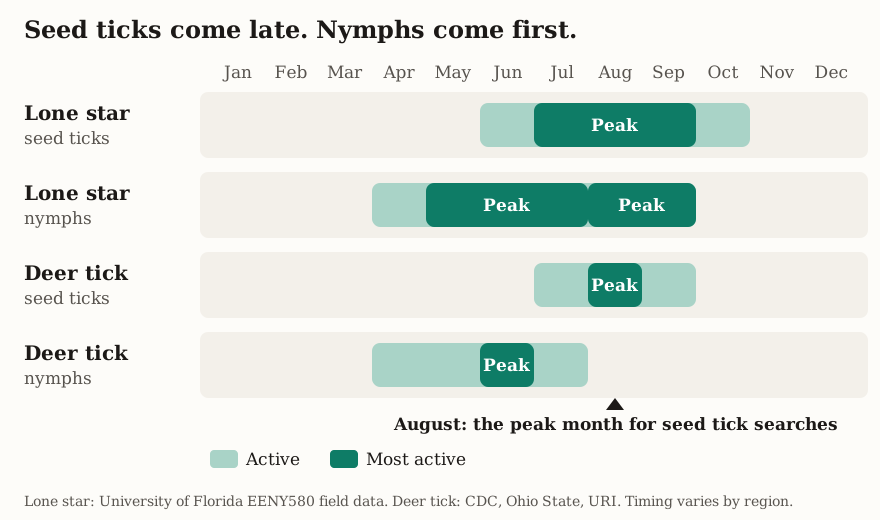
Timing shifts with the weather and the region. Texas A&M gives June to August as the usual larval peak for lone star ticks. In Florida, some stage of the lone star tick can be active in nearly every month. Still, the big swarms come after the nymph season, when the year’s eggs hatch.
Which tick are they? Usually the lone star tick, which bites people more than most and lives across the South, the East and the Midwest. Our lone star tick guide covers its range. American dog tick larvae feed mostly on small mammals, and deer tick larvae are so pale and small that most people never notice them.
Are seed ticks dangerous? Do they carry disease?
Seed ticks are mostly a nuisance, not a disease threat. They hatch without having fed, so most carry no germs. CDC says female ticks infected with Lyme bacteria do not pass the infection to their offspring. One germ that does pass through the egg turned up in just 0.4% of deer tick larvae in a New York study.
Several pages say the opposite. Google’s AI answer for this search says seed ticks can still transmit Lyme disease. Terminix lists Lyme disease too, and a 1987 note in American Family Physician, still on Google’s first page through PubMed, says the same. CDC’s current page does not support it.
The research shows a mixed picture by germ, and Table 2 sums it up. In short, a few germs can pass from the mother tick into the egg, but the common serious ones mostly do not. The bigger problem is that dozens of bites at once can itch for days.
Table 2. Which germs can a seed tick be born with?
Borrelia burgdorferi (Lyme disease)
- Passed through the egg?
- No, CDC says
- What it means for a seed tick bite
- Very unlikely in the US. A larva usually picks the germ up from a mouse and spreads it later as a nymph. A 2016 Dutch lab study found a few wild larvae of a European tick passed a related Lyme germ to mice
Borrelia miyamotoi (hard tick relapsing fever)
- Passed through the egg?
- Yes, in deer ticks
- What it means for a seed tick bite
- Possible but uncommon: 0.4% of deer tick larvae carried it in a New York study
Ehrlichia chaffeensis (ehrlichiosis)
- Passed through the egg?
- No, in a lab test with lone star ticks
- What it means for a seed tick bite
- Larvae from infected mothers tested clean
Rickettsia rickettsii (Rocky Mountain spotted fever)
- Passed through the egg?
- Sometimes. A 2017 lab test with American dog ticks found none, while Rocky Mountain wood ticks passed it to some offspring and most infected ticks died
- What it means for a seed tick bite
- Risk from larvae looks low, but evidence is thin
Rickettsia amblyommii, a spotted fever group germ
- Passed through the egg?
- Yes, in lone star ticks
- What it means for a seed tick bite
- Common in lone star larvae; whether it makes people sick is unknown
From CDC (Lyme), Han and others 2019 and Keesing and others 2021 (B. miyamotoi), Long and others 2003 (Ehrlichia), Harris and others 2017 (R. rickettsii) and Stromdahl and others 2008 (R. amblyommii). Reference only, not a diagnosis.
The University of Rhode Island sums up lone star larvae this way: they do not carry disease-causing germs, but they still inject saliva that can cause allergic reactions. So a seed tick bite is a reason to watch, not to panic.
Can seed ticks cause alpha-gal syndrome?
Nobody knows for sure. Alpha-gal syndrome is an allergy to red meat that can follow a tick bite. CDC links it mostly to the lone star tick, and says the tick passes alpha-gal in its saliva, not as a germ. CDC does not say which life stage, and we found no study that tested larval bites alone.
So the honest answer is that it cannot be ruled out. Our lone star tick page explains the allergy. If you get hives, belly pain or trouble breathing a few hours after eating red meat, see a doctor, and call 911 for breathing trouble.
Why seed tick bites itch so much
It is the number of bites. A University of Virginia dermatology team described two summer cases in 2019 where larval ticks caused a spread of itchy red bumps and pimple-like spots. They warned doctors to think of seed ticks, because the cause is easy to miss without a close look.
Scratching is the main risk that follows. Broken skin can get infected, so keep nails short and the bites clean. A pharmacist can suggest something for the itch.
Seed tick bites: what they look like
Seed tick bites usually show up as clusters of small, itchy red bumps, often on the legs and around the waist, where dozens of larvae fed at the same time. Some turn into pimple-like bumps. A bite cannot prove what bit you: finding the tiny tick still attached is what confirms it.
Chigger bites, bed bug bites and flea bites can all look like this. That is why this site never names the bug from a photo of a bite. Our guide to what a tick bite looks like shows a normal reaction and the signs that are not normal.
Will seed ticks fall off on their own? Yes, after they feed, but do not wait. The University of Florida gives 1 to 3 days of feeding in one place and 4 to 9 days in another. Pennsylvania DEP says 3 to 7 days, and Terminix about 3. A tick that stays on longer has more time to pass on anything it carries.
Are they under your skin? No. Ticks do not burrow. A larva cuts in with its mouthparts and glues itself in place, so only the tiny mouthparts go in. If a bump has a dark dot in the middle, that may be the tick itself, or a piece of its mouth.
How to get rid of seed ticks on skin and clothes
To get rid of seed ticks, act in this order: tape or a lint roller for the ones still crawling, a hot dryer for your clothes, a shower within two hours, then fine-tipped tweezers for any that are attached. Many will not have bitten yet, so the first 30 minutes matter most.
Getting seed ticks off: step by step
Tape them off before you go inside
Wrap duct tape or packing tape around your hand, sticky side out, and press it on your pant legs, socks, shoes and skin. Then peel it away and fold it shut. The University of Rhode Island says sticky tape is a good way to get larvae off before they attach. A lint roller does the same job on clothes.
Strip at the door and put clothes in a hot dryer
Put dry clothes straight into the dryer on high heat. CDC says 10 minutes kills ticks on dry clothing; the University of Rhode Island suggests 15 minutes, because lone star ticks are harder to dry out. If the clothes must be washed first, use hot water, then dry them. Cold and medium water will not kill ticks.
Shower within two hours
Scrub with soap and a washcloth. CDC says a shower within two hours of coming inside lowers the risk of Lyme disease and washes off ticks that have not attached. Use the shower to check your scalp, hairline, ears, armpits, waist, groin and the backs of your knees.
Pull attached ones with fine-tipped tweezers
Grip each tick as close to the skin as you can and pull straight out with steady pressure. Do not twist or jerk. Do not use petroleum jelly, nail polish or heat, which CDC warns can agitate the tick. If a tiny mouthpart stays in and will not lift out easily, leave it to heal.
Clean the bites and your hands
Wash the bites and your hands with soap and water, or use hand sanitizer. Seal the ticks in tape or a bag. Do not crush them with your fingers.
Check the kids and pets, then write down the date
Check children and dogs the same way. Note the date and the place, and watch the bites for about a month. See a doctor for a fever or a rash that keeps growing.
The tweezer steps follow CDC’s advice after a tick bite, and the dryer and shower steps follow CDC’s tick prevention page. Our tick removal guide shows the grip close up.
What kills seed ticks instantly?
On clothes, a hot dryer. On skin, nothing you should put on your body works better than tape and tweezers. A Reddit reply says permethrin spray is safe to use on skin. That is wrong: CDC and EPA describe permethrin as a treatment for clothing and gear, and they point people to skin repellents such as DEET or picaridin instead.
The same goes for lice shampoo as a body wash, an idea that goes back to that 1987 journal note. Ask a doctor before you put any pesticide on your skin. And keep petroleum jelly, nail polish and heat off attached ticks: CDC says they can agitate the tick.
Are seed ticks hard to get rid of?
On you, not if you move fast. Most of the work is done by the tape and the shower. The hard part is the ones that have already attached, since each needs tweezers, a good light and patience. Ask someone to check your back and scalp. If there are too many to reach, an urgent care clinic can help remove them.
Seed ticks vs chiggers
Seed ticks and chiggers are both six-legged larvae that bite in summer grass, but chiggers are mites, 0.25 to 0.6 mm, and usually too small to see. Seed ticks are big enough to see crawling and stay attached. Ohio State says chiggers do not burrow and do not drink blood.
Table 3. Seed ticks vs chiggers
Can you see it?
- Seed tick
- Yes, as a moving speck, 0.5–1 mm
- Chigger
- Rarely; 0.25–0.6 mm and usually unseen
What it is
- Seed tick
- The larva of a tick
- Chigger
- The larva of a mite (family Trombiculidae)
Color
- Seed tick
- Light brown to reddish; gray once fed
- Chigger
- Yellow to reddish
How it feeds
- Seed tick
- Glues on and drinks blood for days
- Chigger
- Dissolves skin cells through a feeding tube; no blood
Does it stay on?
- Seed tick
- Yes, until it is full or pulled off
- Chigger
- Usually knocked off by moving, scratching or a shower
Where bites cluster
- Seed tick
- Legs and waist, wherever they climbed
- Chigger
- Under tight clothes: sock lines, waistbands, bra straps, armpits
Disease risk in the US
- Seed tick
- Low; see Table 2
- Chigger
- Not known to spread disease to people in the US
Chigger facts from Ohio State Extension fact sheet ANR-0182 (2025).
You cannot tell the two apart from the bites alone. Both itch badly, and Ohio State says chigger itch can last 2 weeks or more. What settles it is finding a tick: if you can see a tiny bug attached and it has to be pulled off, it was a seed tick.
Are chiggers ticks? No, but they are cousins. Both are arachnids, and both have six legs only as larvae. On disease, scrub typhus, the best-known illness spread by chiggers, is mainly found in Asia and the Pacific. A 2022 review notes that US chiggers are poorly studied, so “not known” is the right wording, not “proven harmless”.
To check a yard for chiggers, Ohio State suggests laying black paper or cardboard in the grass for 10 minutes, then looking for tiny yellow-red dots on it. Our tiny red bugs guide covers chiggers in depth.
Seed ticks in the house
Seed ticks in the house almost always came in on clothes, shoes or a dog. Most ticks need damp air, about 50 to 80% humidity or more depending on the species, and dry out indoors, University of Rhode Island tick experts say. The brown dog tick is the exception. A swarm inside means hitchhikers, not a nest.
That does not mean they die at once. In a 2026 Ohio State study, unfed adult lone star ticks lived about 11 days on average on home floors, and close to 15 days on long-pile carpet. Larvae were not tested, but expect stragglers for a week or two.
Here is what to do:
- Vacuum the floor, rugs and furniture where the person or dog sat, then seal and toss the bag or empty the canister outside.
- Dry the bedding on high heat, as with clothes. Wash it in hot water first if it needs washing.
- Lint roll couch cushions and the dog’s bed. One Reddit user did this after a dog walk and found no more for days.
- Check the dog again over the next few days.
If you keep finding ticks of every size indoors for weeks, think brown dog tick. Unlike the others, it feeds on dogs at every stage and can breed inside a home. That needs your vet and often a pest professional. Our guide to getting rid of ticks in the house and yard covers it.
Seed ticks on dogs
Dogs walk straight through seed tick clusters, so they often come home with dozens on the legs and belly. Texas A&M lists dogs among the hosts of young American dog ticks, and lone star larvae feed on many mammals. Check the legs, belly, between the toes, the ears and under the collar.
Pull attached ones with tweezers, as on people. Ask your vet which tick product suits your dog, and never use a dog product on a cat without checking. Our ticks on dogs guide covers checks, removal and prevention.
How to avoid seed ticks
To avoid seed ticks, keep moving and keep covered in late summer. Walk in the center of trails, do not stand or sit still at wooded edges, and tuck your pants into your socks. Treat clothes and shoes with 0.5% permethrin, and use an EPA-registered repellent on skin, as CDC advises.
- Wear light colors. A cluster of brown specks shows up on khaki much faster than on jeans.
- Carry tape. A roll of duct tape in the car or pack lets you deal with a swarm on the spot.
- Check at every stop. Look at your shoes and socks whenever you pause, before the larvae climb higher.
- Pick the repellent by the label. CDC lists DEET, picaridin, IR3535, oil of lemon eucalyptus, PMD and 2-undecanone. Look for an EPA registration number.
Our guide to preventing tick bites covers repellents and clothing in full.
Seed tick myths, corrected
At least 7 common claims about seed ticks are wrong. Some come from pest control and health sites that rank on Google, one from Google’s own AI answer, and one from a popular Reddit reply. Here is what each gets wrong.
Myth 1
Myth: “Seed ticks are tick nymphs.”
Truth: Seed ticks are larvae, with six legs. Nymphs are the next stage, with eight legs, and are about poppy seed size.
Myth 2
Myth: “Seed ticks can give you Lyme disease.”
Truth: Google's AI Overview, Terminix and a 1987 journal note say so. CDC says infected females do not pass Lyme bacteria to their offspring.
Myth 3
Myth: “Seed ticks can barely bite human skin.”
Truth: TickSafety says so. They bite people readily. Dr. Daniel Cameron, summing up a 2016 Dutch study, cites about 30,000 larval tick bites a year in the Netherlands, out of about 1.1 million tick bites.
Myth 4
Myth: “Seed ticks are tiny insects.”
Truth: Terminix calls them insects. Ticks are arachnids, like mites and spiders. Only the larva has six legs.
Myth 5
Myth: “Seed ticks live in nests.”
Truth: There is no nest. A female lays one egg mass on the ground, and the larvae hatch and wait nearby.
Myth 6
Myth: “Permethrin spray is safe to put on your skin.”
Truth: CDC and EPA describe permethrin for clothing and gear. On skin, use a repellent registered for skin, such as DEET or picaridin.
Myth 7
Myth: “Ticks burrow under your skin.”
Truth: A Healthline article says nymphs burrow into skin. Ticks attach with their mouthparts and a glue-like cement; the body stays outside.
When to call someone
Most seed tick encounters need only tape, a shower and a few weeks of watching. Get help in 4 cases: a fever or a growing rash after the bites, signs of a skin infection, an allergic reaction, or ticks that keep turning up inside. Here is who to call.
- 911 for trouble breathing, a swelling face, lips or throat, or fainting.
- Your doctor for a fever, a rash that keeps growing, or bites that look infected. Say when and where it happened.
- Urgent care if dozens are attached where you cannot reach them.
- An allergist for hives, belly pain or other reactions a few hours after eating red meat.
- Your vet for a dog covered in ticks, or ticks that keep coming back on a pet.
- Poison Control, 1-800-222-1222, if someone swallows a pesticide or gets it on the skin or in the eyes.
- A licensed pest professional if ticks of every size keep turning up in the house.
Not sure what you found? Put it on white paper and try the bug identifier by picture. For bigger ticks, our tick identification guide and chart of US tick types help.
Medical disclaimer. This page is for general information only. It is not a medical diagnosis. If you have severe symptoms, trouble breathing, swelling of the face or throat, fast spreading redness, fever, severe pain, pus, or signs of infection, contact a doctor or your local emergency number.
Pest control disclaimer. Photo-based identification can help, but it is not always perfect. For dangerous spiders, large infestations, or anything you are unsure about, contact a licensed pest control professional.
Seed ticks FAQ
Can you see seed ticks with the naked eye?
How long do seed ticks live without a host?
Do baby ticks grow into big ticks?
What do seed tick eggs look like?
Can seed ticks get in your hair?
Related guides
Ticks
The hub: every tick guide on the site, by species and by problem.
What a tick looks like
Colors, sizes and engorged ticks, stage by stage.
Tick eggs
What an egg mass looks like, and why there is no tick nest.
Lone star tick
The tick behind most late summer seed tick swarms.
Deer tick
The blacklegged tick whose nymphs spread Lyme disease.
How to remove a tick
Step by step: the tweezer method, and what to do about a stuck head.
Tiny red bugs
Chiggers, clover mites and the other red specks.
Ticks on dogs
Checks, removal and prevention for pets.
Sources
- CDC, How Lyme Disease Spreads
- CDC, Tick Lifecycles (October 11, 2024)
- CDC, What to Do After a Tick Bite
- CDC, About Alpha-gal Syndrome
- Holderman CJ and Kaufman PE, Lone Star Tick, University of Florida EDIS EENY580 (archived copy)
- Ohio State University Extension, Blacklegged (Deer) Tick, ENT-0096 (2024)
- Ohio State University Extension, Chiggers, ANR-0182 (June 13, 2025)
- University of Rhode Island TickEncounter, Lone Star Tick
- University of Rhode Island TickEncounter, What's the difference between inside ticks and ticks inside?
- Han S and others, Vertical transmission rates of Borrelia miyamotoi in Ixodes scapularis, Ticks and Tick-borne Diseases (2019)
- Keesing F and others, Spatial and temporal patterns of Borrelia miyamotoi in blacklegged ticks in New York, Parasites & Vectors (2021)
- Long SW and others, Evaluation of transovarial transmission of Ehrlichia chaffeensis in Amblyomma americanum, Journal of Medical Entomology (2003)
- Niebylski ML and others, Lethal effect of Rickettsia rickettsii on its tick vector (Dermacentor andersoni), Applied and Environmental Microbiology (1999)
- Lee J and others, Larval tick infestation causing an eruption of pruritic papules and pustules, Cutis (2019)
- Chen K, Roe RM and Ponnusamy L, Biology, Systematics, Microbiome, Pathogen Transmission and Control of Chiggers, with Emphasis on the United States (2022)