What is a deer tick?
A deer tick is the blacklegged tick, Ixodes scapularis, a hard tick of the eastern United States. Three features mark it: black legs, a plain dark shield with no pale markings, and long, thin mouthparts. Before it feeds, an adult is only 2 to 3 mm (about 1/8 inch) long.
“Deer tick” is a nickname. The adults feed mostly on white-tailed deer, which keeps their numbers up. The young stages feed on mice, chipmunks, shrews and birds instead. That matters, because the Lyme bacteria come from those small animals. CDC says deer are not infected and do not infect ticks.
The two names come from an old mix-up. In 1979, scientists named the northern tick Ixodes dammini, the deer tick. Then a 1993 study by James Oliver and colleagues bred the northern and southern ticks together and found they were one species. So the older name, Ixodes scapularis, won, and both common names stuck.
Like all ticks, it is an arachnid, a relative of spiders and mites, not an insect. Larvae have 6 legs, while nymphs and adults have 8. It has no eyes and no wings, and it cannot jump. Each stage feeds once, then drops off to molt. CDC’s life cycle page says the whole cycle generally takes 2 years, while its Lyme page says 2 to 3. Our guide to ticks covers the basics for every kind.
How to identify a deer tick at each stage
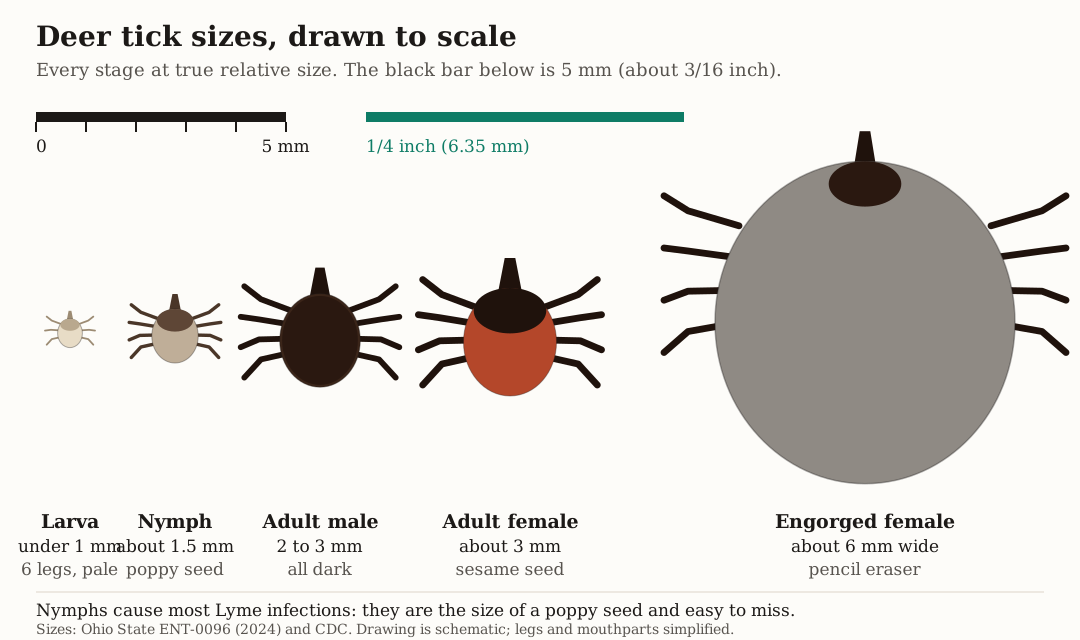
A deer tick looks different at each of its 4 life stages, so check 3 things: the color of the body, the shield on its back and the legs. An unfed adult female is red-orange with a black shield and black legs. The male is solid dark brown. The nymph is a see-through gray-brown speck about 1.5 mm (1/16 inch) long.
Table 1. Deer tick stages at a glance
Larva
- Size
- Under 1 mm (1/25 inch)
- What it looks like
- Pale and nearly see-through, with 6 legs
- Bites people?
- Sometimes. It cannot pass on Lyme
Nymph
- Size
- About 1.5 mm (1/16 inch), a poppy seed
- What it looks like
- Gray to brown and see-through, with a small dark shield and 8 legs
- Bites people?
- Yes. It causes most Lyme cases
Adult male
- Size
- 2 to 3 mm (about 1/8 inch)
- What it looks like
- Solid dark brown; the shield covers the whole back
- Bites people?
- Rarely, and not a disease risk
Adult female
- Size
- 2 to 3 mm unfed, a sesame seed
- What it looks like
- Red-orange body behind a black shield, black legs
- Bites people?
- Yes, mostly in fall and spring
Engorged female
- Size
- Up to about 6 mm (1/4 inch) wide
- What it looks like
- Swollen and gray, with the small dark shield still at the front
- Bites people?
- Yes, after days of feeding
Sizes from Ohio State University Extension (ENT-0096, 2024) and CDC. Bite notes from CDC and the University of Rhode Island.
Adult female deer tick
The adult female is the easiest stage to name. Her rear body is red-orange, and a black shield sits just behind her head, so she looks like a red seed with a black cap. The University of Rhode Island calls this the feature that sets her apart from other ticks. Her legs and mouthparts are black too.
As she feeds, only the red part stretches. The shield stays the same small size, which is why a fed female looks like a gray bean with a dark spot at one end.
Adult male deer tick
The male is slightly smaller and dark brown all over, because his shield covers his whole back. He does not swell with blood. Rhode Island researchers say males are not involved in passing on infections, and they are often found mating with a female, even off a host.
Deer tick nymph
The nymph is the stage to worry about. It is about the size of a poppy seed, gray to brown and slightly see-through, with 8 legs and a small dark shield. On skin it looks like a freckle or a speck of dirt that does not brush off. CDC says nymphs are a high risk because they are common and so hard to see.
Sources differ a little on its size. Ohio State gives 1.5 mm, while the University of Wisconsin tick lab gives 2 mm (1/10 inch). Either way, it is smaller than a pinhead. Many people call nymphs “baby deer ticks” or seed ticks, but true seed ticks are larvae, the six-legged stage that often turns up in clusters.
Deer tick larva
Larvae are under 1 mm, pale and six-legged, and most people never notice one. They hatch in summer and feed on mice and birds. CDC says larvae do bite people, but they hatch free of Lyme bacteria, so a larva is very unlikely to give you Lyme disease.
Deer tick or dog tick?
Look at the shield and the size. A deer tick is much smaller than an American dog tick, and its shield is plain and dark, with no pale markings. Our side-by-side deer tick vs dog tick comparison has the full checklist. For a tick with one white dot on its back, see the lone star tick, and for every common kind, see types of ticks.
How big is a deer tick?
Deer ticks are tiny. An unfed adult is 2 to 3 mm, about 1/8 inch or the size of a sesame seed. A nymph is about 1.5 mm (1/16 inch), the size of a poppy seed, and a larva is under 1 mm. A fully fed female swells to about 6 mm (1/4 inch) across.
Published adult sizes vary a little. Ohio State, citing CDC, puts unfed adults of both sexes at 2 to 3 mm. Wikipedia gives females as 3 to 4 mm and males as 2 to 3 mm. Part of the gap is whether the mouthparts are counted, so think “sesame seed” for any adult.
For scale, a dime is about 18 mm across. Six or seven unfed adult deer ticks would fit across it end to end.
Engorged deer tick
An engorged deer tick is a female that has fed for days. She grows to about 6 mm wide and turns gray. Ohio State compares her to the eraser on a No. 2 pencil. The small dark shield and black legs at the front still identify her. Minnesota health officials say blacklegged ticks usually feed for 3 to 5 days.
A swollen tick has been attached longer than a flat one. Still, you cannot tell the hours by eye with any certainty. On tick forums, even experienced commenters say a few hours and 2 days are hard to tell apart in a photo. Note how swollen it was, keep the tick, and tell your doctor.
An engorged tick on a dog looks the same: a gray, grape-like lump near the ears, neck or paws. For a dog, follow our guide to removing a tick from your dog, which adds gloves and a helper; our guide to ticks on dogs covers the rest.
Which ticks carry Lyme disease?
In the US, only two ticks spread Lyme disease to people: the blacklegged (deer) tick in the East and Midwest, and the western blacklegged tick on the Pacific coast. CDC says lone star ticks, American dog ticks, Rocky Mountain wood ticks and brown dog ticks cannot transmit Lyme bacteria.
So if you need a picture of the ticks that carry Lyme disease, the stage drawing above is it. The nymph and the adult female are the two that matter. Those other ticks do spread other germs, though, so a bite from any tick is worth watching.
Do all deer ticks carry Lyme disease?
No. CDC says the share of ticks infected ranges from none to over 50%, depending on the place and the life stage. Adults are infected more often than nymphs, because they have fed twice. Even so, nymphs cause more illness, because people miss them.
Table 2. How often blacklegged ticks carry Lyme bacteria, by place
Minnesota, adults
- Share infected
- About 1 in 3
- Source
- Minnesota Department of Health, on average
Minnesota, nymphs
- Share infected
- About 1 in 5; 25% of 1,240 nymphs in a 2015 survey
- Source
- Minnesota Department of Health; Johnson and others, 2018
Wisconsin, nymphs
- Share infected
- 11% to 30%, about 15% to 20% on average
- Source
- University of Wisconsin, 2016 to 2017
California, western blacklegged nymphs
- Share infected
- 3.2% statewide
- Source
- Padgett and others, 2014
California, western blacklegged adults
- Share infected
- 0.6% statewide
- Source
- Padgett and others, 2014
Most of the Southeast
- Share infected
- Almost never infected
- Source
- CDC
Shares vary a lot from one county or trail to the next. A 2023 CDC review of national tick testing found the widest swings below the state level.
The Southeast is the odd case. Deer ticks live there, yet Lyme disease is rare. A 2015 study by Isis Arsnoe and colleagues found one reason: southern nymphs rarely climb out of the leaf litter, so they seldom meet a person. The National Park Service adds another: in the South, deer ticks often feed on five-lined skinks, lizards that pass on Lyme bacteria poorly.
Forums tell a scarier story than the data. On Reddit, “it’s 50/50” is a common answer to “what are the chances it’s Lyme?” That is true for adults in a few hot spots, not for most bites. In the CDC view, the odds also depend on how long the tick fed, which you can control.
Diseases deer ticks carry
Deer ticks carry at least 6 germs that make people sick. CDC lists Lyme disease, anaplasmosis, babesiosis, Powassan virus disease, hard tick relapsing fever from Borrelia miyamotoi, and a rare ehrlichiosis. Lyme is by far the most common: more than 80,000 cases are reported to CDC each year.
Table 3. Germs spread by deer ticks
Lyme disease
- Germ
- Borrelia burgdorferi (rarely B. mayonii)
- When symptoms start
- 3 to 30 days
- Good to know
- An expanding rash in about 70% to 80% of cases; about 476,000 people are treated each year
Anaplasmosis
- Germ
- Anaplasma phagocytophilum
- When symptoms start
- 1 to 2 weeks
- Good to know
- Fever, severe headache, chills, muscle aches; often no rash
Babesiosis
- Germ
- Babesia microti, a parasite of red blood cells
- When symptoms start
- Varies
- Good to know
- Many people have no symptoms; more serious without a spleen, with a weak immune system, or over 50
Powassan virus disease
- Germ
- Powassan virus
- When symptoms start
- 1 week to 1 month
- Good to know
- Uncommon but rising; about 1 in 10 people with severe illness die; no medicine treats it
Hard tick relapsing fever
- Germ
- Borrelia miyamotoi
- When symptoms start
- Varies
- Good to know
- Bouts of fever that come back; larvae can carry it
Ehrlichiosis
- Germ
- Ehrlichia muris eauclairensis
- When symptoms start
- Varies
- Good to know
- Found mainly in the upper Midwest
From CDC disease pages (2024 to 2026) and the Minnesota study by Johnson and others (2018).
One tick can carry more than one germ. In that Minnesota survey, 7.3% of nymphs carried two or more. Because the symptoms overlap, a doctor may order blood tests to sort them out. The CDC page on signs and symptoms of Lyme disease describes each stage of the illness.
Deer tick bite: what to do and how long it takes to spread Lyme
A deer tick bite does not hurt, so most people find the tick, not the bite. CDC says that in most cases the tick must be attached for more than 24 hours to pass on Lyme disease. Taking it off within a day greatly lowers the risk, so remove it the moment you find it.
Sources word the timing differently. CDC now says “more than 24 hours”, while the Minnesota Department of Health says 24 to 48 hours. Minnesota adds that anaplasmosis may take less time. So the 24-hour figure is not a safe window for every germ the tick carries.
If a deer tick is attached: step by step
Take it off now
Do not wait to see a doctor first. Grip the tick as close to the skin as you can with clean, fine-tipped tweezers. Pull straight out with steady, even pressure. Do not twist or jerk it.
Skip the home remedies
Do not use nail polish, petroleum jelly, heat or anything else to make the tick let go. CDC says these can make it push infected fluid into the skin. Do not crush the tick with your fingers.
Leave small bits alone
If the mouthparts break off, try once with the tweezers. If they do not come out easily, leave them. The skin pushes them out as it heals.
Clean up and keep the tick
Wash the bite and your hands with soap and water. Seal the tick in a small bag or wrap it in tape, and write down the date and where you think you picked it up.
Check for more ticks
One tick often means another. Check the scalp, ears, armpits, waist, groin and behind the knees, and check children and pets too.
Ask about antibiotics after the bite
In places where Lyme disease is common, CDC says an antibiotic given after a tick bite may lower the risk of Lyme disease in certain cases. Call your doctor soon and ask whether it is right for you.
Watch the next few weeks
See a doctor if a rash or fever starts within several weeks. Tell them when and where the bite happened, and show them the tick.
Our step-by-step guide on how to remove a tick shows the grip, and what to do when the head stays in. For what a normal bite looks like over the next days, and how a Lyme rash differs, see what a tick bite looks like.
Should you test the tick?
CDC does not recommend it, even though some labs sell tick tests. Their results are not used for treatment decisions. A positive tick does not mean you were infected, and a negative one can give false comfort. You would also likely feel sick before the result came back. Keep the tick so a doctor can see what bit you.
For when to worry and what a doctor will do next, our tick bite guide walks through each symptom. CDC’s page on what to do after a tick bite is the source for the steps above.
Deer tick season: when each stage is out
Deer tick season is longer than most people think. Nymphs are out from April through July and peak in June. Adults peak in April and again in October and November. CDC adds that adults may hunt for a host on any winter day above freezing, so there is no fully safe month.
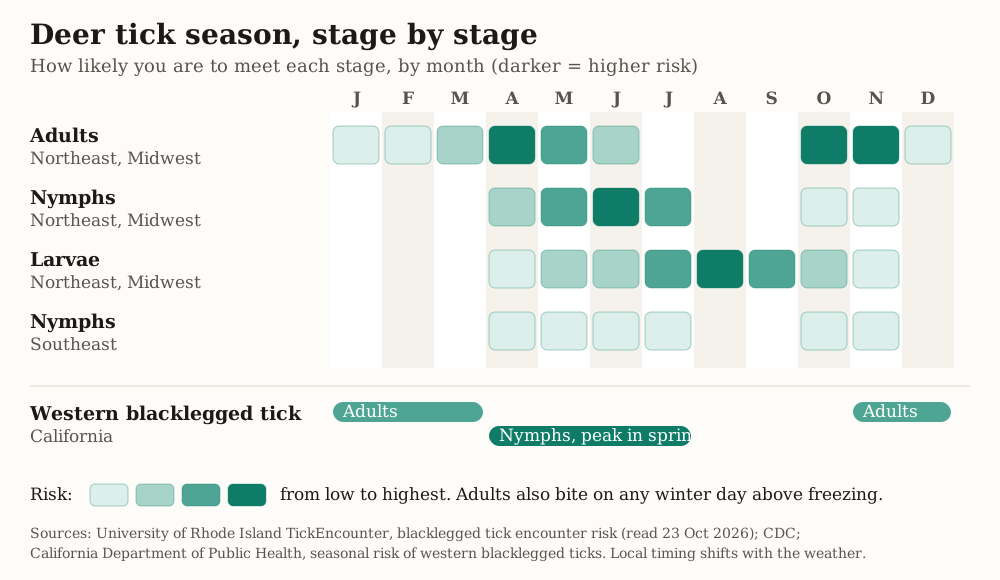
Each stage has its own risk. Late spring and early summer bring nymphs, which cause most Lyme cases because people are outside in shorts. In the fall, hunters and leaf rakers meet the adults, which are easier to spot. Larvae peak in August, but they rarely matter for Lyme.
Cold slows deer ticks down, but it rarely kills them. The National Park Service says they slow down below about 35°F (2°C), so Lyme risk in the Northeast is lowest from late December to late March. To kill them, it must stay at 10°F (−12°C) or colder for several days in a row. Most ticks ride out the cold under leaf litter and snow. In one study the Park Service describes, nearly 80% of ticks carrying Lyme bacteria survived the winter, against 50% of uninfected ones.
The calendar above uses the University of Rhode Island TickEncounter risk scale for the Northeast, Mid-Atlantic and Midwest. Farther north, the season starts later. In Minnesota, adults come out right after the snow melts and peak in May, and nymphs peak from late May through June. Ohio has reported Lyme disease cases in all 12 months.
Where do deer ticks live?
Deer ticks live across the eastern United States, CDC says. Infected ticks are most common in the Northeast, the Mid-Atlantic and the upper Midwest, with smaller pockets on the Pacific coast. The South has deer ticks too, but they are almost never infected there.
The range keeps growing. Ohio State notes that Ohio found its first established population in 2010. By 2023, 61 Ohio counties had one. CDC keeps a county map of where blacklegged ticks are established, updated in 2026.
In the woods and the yard
Deer ticks need shade and damp air. They live in leaf litter in leafy woods, along trails, and in the brushy edge where a yard meets the trees. Minnesota health officials say they are rarely found in open yards, though shaded lawn near woods can hold them.
They do not jump, fly or drop from trees. Instead, they climb low plants, about 0 to 3 feet (0 to 1 m) up, and grab whatever brushes past. Then they crawl upward to find a spot to bite. That is why a tick check should start at the legs and work up.
A deer tick found indoors, say near the kitchen sink, almost always rode in on a person or a pet. To cut ticks around the house, CDC suggests clearing leaf litter and tall grass at the lawn edge. It also suggests a 3-foot (1 m) strip of wood chips or gravel between lawn and woods. Our guide on getting rid of ticks in the yard covers the rest, and how to prevent tick bites covers repellents and clothing.
Western blacklegged tick (Ixodes pacificus)
The western blacklegged tick, Ixodes pacificus, is the deer tick’s West Coast cousin. It lives along the Pacific coast, mostly in northern California, and looks almost the same. CDC says it spreads Lyme disease, anaplasmosis and Borrelia miyamotoi, but it is infected far less often than eastern deer ticks.
It is a separate species. In the 1993 study that merged the eastern ticks, crosses with the western tick produced only sterile young. CDC says its life cycle generally takes 3 years. Its season also runs the other way. The California Department of Public Health says adults come out in the fall, around Halloween, and bite through winter and early spring. Nymphs follow in spring and early summer.
The risk is lower but real. Across 13 years of California samples, Kerry Padgett and colleagues found Lyme bacteria in 3.2% of nymphs and 0.6% of adults. Risk was highest on the north and central coast and in the Sierra Nevada foothills, and lowest in southern California. Lizards are part of the reason. Young western ticks often feed on western fence lizards, and the National Park Service says these lizards have a blood protein that kills the Lyme bacteria. That makes the lizard a tick host, not a tick eater, a mix-up our page on what animals eat ticks corrects.
Deer tick myths, corrected
Several beliefs about deer ticks are wrong, and a few appear on pages that rank well for this search. The worst ones make people wait to remove a tick or to see a doctor. Here are 8, with what the health agencies and research say instead.
Myth 1
Myth: “Ticks jump or drop on you from trees.”
Truth: They climb low plants, up to about 3 feet, and grab on as you pass (Ohio State, Minnesota Department of Health).
Myth 2
Myth: “Deer give you Lyme disease.”
Truth: Deer are not infected. Young ticks pick up the bacteria from mice and other small animals (CDC).
Myth 3
Myth: “A tick must be on you for 72 hours to pass on Lyme.”
Truth: CDC says more than 24 hours in most cases, and other germs may pass sooner. Remove every tick right away.
Myth 4
Myth: “Every deer tick carries Lyme, or it is 50/50.”
Truth: CDC says anywhere from none to over 50%, by place and stage. Most of the Southeast is near zero.
Myth 5
Myth: “Testing the tick tells you whether you need treatment.”
Truth: CDC does not recommend tick testing, and its results should not guide treatment.
Myth 6
Myth: “Ticks die off in winter.”
Truth: Adults can be out on any winter day above freezing (CDC). So a mild January walk still calls for a tick check.
Myth 7
Myth: “Deer ticks live in all 48 states and Alaska.”
Truth: The PA Tick Research Lab says so, but CDC maps the deer tick across the eastern US only. The West Coast has a different species.
Myth 8
Myth: “A Lyme rash always looks like a bull's-eye.”
Truth: CDC says it does not always look like a classic bull's-eye. Any rash that keeps growing needs a doctor.
Still not sure what you found? Take a sharp photo of the tick on white paper, then try our bug identifier by picture, or compare it with what other ticks look like.
Medical disclaimer. This page is for general information only. It is not a medical diagnosis. If you have severe symptoms, trouble breathing, swelling of the face or throat, fast spreading redness, fever, severe pain, pus, or signs of infection, contact a doctor or your local emergency number.
Pest control disclaimer. Photo-based identification can help, but it is not always perfect. For dangerous spiders, large infestations, or anything you are unsure about, contact a licensed pest control professional.
Deer tick FAQ
Do male deer ticks bite?
Can a deer tick larva give you Lyme disease?
Do deer ticks cause the red meat allergy?
Can my dog get Lyme disease from a deer tick?
Related guides
Ticks
The ticks of the US, how to tell them apart, and what each one means for you.
Deer tick vs dog tick
Size, shield and season: the checks that separate the two most common ticks.
How to remove a tick
The CDC method, step by step, and what to do if the head stays in.
What a tick bite looks like
A normal bite day by day, and how a Lyme rash differs.
Tick bite
When to worry after a bite, and when to see a doctor.
Lone star tick
The tick with a white dot, and the meat allergy it can cause.
Seed ticks
Clusters of tiny six-legged larvae, and how to get them off.
Types of ticks
Every common US tick, with a picture chart and where each one lives.
Sources
- CDC, How Lyme Disease Spreads (September 24, 2024)
- CDC, What to Do After a Tick Bite (June 9, 2026)
- CDC, Signs and Symptoms of Untreated Lyme Disease (May 15, 2024)
- CDC, Where Ticks Live (July 30, 2025)
- National Park Service, Species Spotlight: Deer Tick (updated January 15, 2025)
- CDC, Preventing Lyme Disease: post-exposure antibiotics
- CDC, About Powassan Virus (June 23, 2026)
- Ohio State University Extension, Blacklegged (deer) tick, Ixodes scapularis, ENT-0096 (2024)
- University of Rhode Island TickEncounter, Blacklegged (Deer) Tick
- Minnesota Department of Health, Ticks
- University of Wisconsin-Madison, Blacklegged or deer tick (Ixodes scapularis)
- California Department of Public Health, Seasonal risk of western blacklegged ticks (PDF)
- Johnson TL and others (2018), Prevalence and distribution of seven human pathogens in host-seeking Ixodes scapularis nymphs in Minnesota, Ticks and Tick-borne Diseases
- Padgett K and others (2014), Large scale spatial risk and comparative prevalence of Borrelia miyamotoi and Borrelia burgdorferi in Ixodes pacificus, PLoS ONE
- Arsnoe IM and others (2015), Different populations of blacklegged tick nymphs exhibit differences in questing behavior, PLoS ONE