How to remove a tick, step by step
You need 4 things: tweezers, good light, soap and a small bag. Grip the tick right at the skin, pull straight up with even pressure, then clean the bite and your hands. The whole job takes about a minute. Do it as soon as you find the tick, not after a doctor visit.
Knowing how to remove a tick quickly matters, because risk builds with time. CDC says a tick usually has to stay attached for more than 24 hours to pass on Lyme disease. Taking it off within 24 hours greatly lowers your chances. Other germs can move faster, though. Mayo Clinic notes that some infections can pass in a few hours or even minutes.
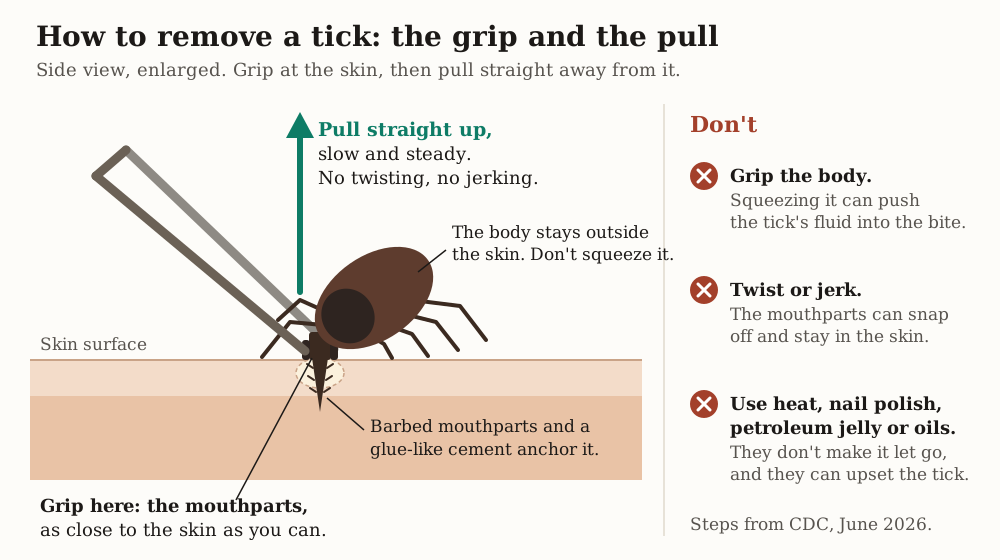
The CDC tweezer method in 7 steps
Get fine-tipped tweezers, and don't wait
Pointed tweezers grip a small tick best. If you don't have them, CDC says regular tweezers or your fingers will do. Good light and a phone camera on zoom help with a small tick. Don't wait to see a doctor first: CDC says the delay can raise your risk of infection.
Grip the tick right at the skin
Close the tips around the tick's mouthparts, where they go into the skin. Keep them off the swollen body. A low grip stops you from squeezing the body, which can push the tick's fluid into the bite.
Pull straight up, slow and steady
Pull away from the skin with steady, even pressure until the tick lets go. Don't twist or jerk it, because that can snap off the mouthparts. If it holds on, keep the pressure even for a few more seconds. Sometimes it takes 2 or 3 gentle tries.
Check what came out
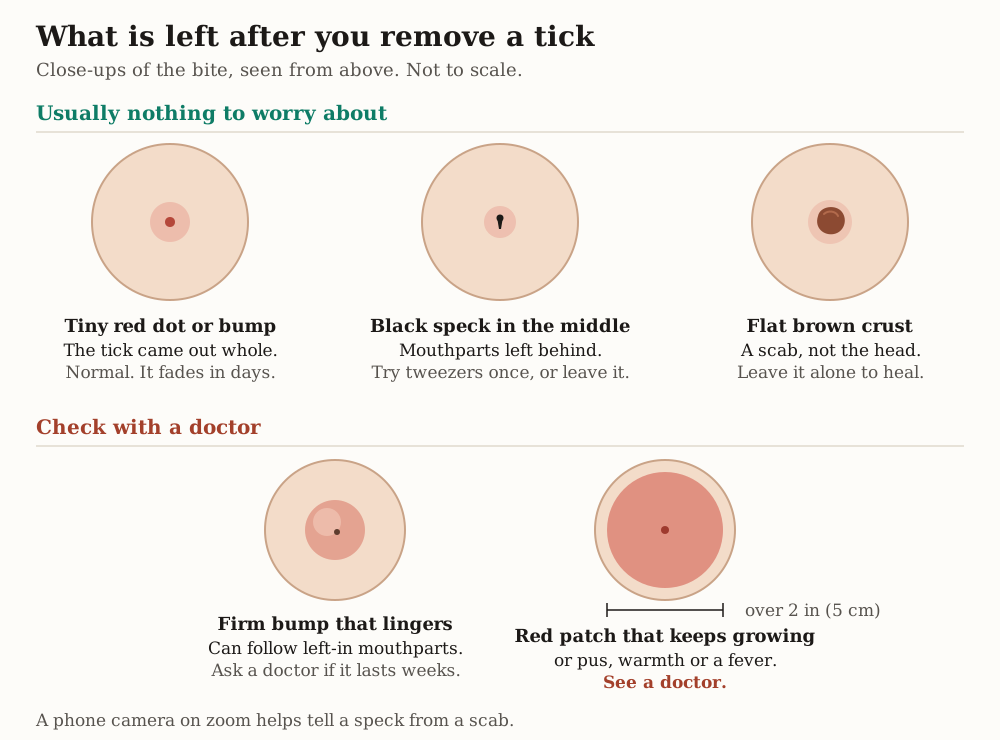
Look at the front of the tick for its mouthparts, then look at the bite. If a tiny black speck stays in the skin, try once to lift it out with clean tweezers. If it doesn't come out easily, leave it. Your skin pushes it out as the bite heals.
Seal the tick, and don't crush it
Put the tick in a sealed bag or small container, or wrap it tightly in tape. Never crush it between your fingers. Write down the date and where you think you picked it up.
Clean the bite and your hands
Wash both with soap and water. Once the tick is out, CDC also lists rubbing alcohol or hand sanitizer for this step.
Check for more ticks, then watch the bite
One tick often means more. Check the hair, ears, armpits, belly button, waist, groin and the backs of the knees. After that, watch the bite and your health for the next 30 days.
That is how to remove a tick the way CDC, Johns Hopkins and the pediatricians at Children’s Hospital of Philadelphia (CHOP) all teach it. So is it okay to just pull a tick out? Yes, as long as you pull slowly and straight from the base. Want to know which tick it was? Our guide to ticks covers the common US kinds and what each one can carry.
What not to put on a tick, and why it doesn’t work
Never put nail polish, petroleum jelly, rubbing alcohol, oils or heat on a tick that is still attached. CDC warns that these may agitate the tick and force infected fluid from it into the skin. They also don’t work. In a 1985 study, 4 popular tricks all failed to make attached ticks let go.
That study, by G. R. Needham in the journal Pediatrics, tested petroleum jelly, fingernail polish, 70% rubbing alcohol and a hot kitchen match on American dog ticks. None of them made a tick detach. It made no difference whether the tick had fed for half a day or for 3 to 4 days. Forceps or protected fingers, on the other hand, removed all 29 ticks pulled that way, mouthparts and all.
Home tricks for getting a tick out, and what actually happens
Nail polish or petroleum jelly
- Does the tick let go?
- No, in the 1985 test
- The problem
- The tick keeps feeding while you wait, and the coating makes it slippery to grip
Rubbing alcohol on the tick
- Does the tick let go?
- No, in the 1985 test
- The problem
- Use alcohol only on the skin after the tick is out, or to kill the tick in a jar
A hot match, lighter or heated needle
- Does the tick let go?
- No, in the 1985 test
- The problem
- You can burn your skin, and heat can make the tick release more saliva
Essential oils, dish soap or toothpaste
- Does the tick let go?
- No good evidence that it does
- The problem
- Northwestern Medicine calls toothpaste not effective, and CDC warns against other substances
Twisting it out
- Does the tick let go?
- Sometimes, but at a cost
- The problem
- CDC says twisting can break off the mouthparts and leave them in the skin
Squeezing the body with your fingers
- Does the tick let go?
- Not reliably
- The problem
- Johns Hopkins says squeezing may force infected fluid into the skin
From Needham (1985), CDC (2026), Johns Hopkins Lyme Disease Research Center, Northwestern Medicine (2025) and CHOP (2025).
So what can draw a tick out? Nothing you put on it. A tick anchors itself with barbed mouthparts and a glue-like cement, so it cannot simply back out. Will rubbing alcohol make a tick back out? No, the Needham test shows that too. A slow, straight pull is the only thing that works.
Tick head stuck in skin: what to do
What stays in the skin is not really the head. It is the mouthparts, a speck smaller than a poppy seed. CDC says to lift it out with clean tweezers if you can, and to leave it alone if you can’t. Your skin pushes it out as it heals, and Johns Hopkins says left-in mouthparts do not pass on Lyme disease.
Ticks don’t have a separate head the way an ant does. What people call the head is the capitulum: the mouthparts and the small plate they sit on. The germs a tick carries live in its body. So once the body is off, the risk from that bite stops growing. The University of Rhode Island’s TickEncounter puts it plainly: disease cannot pass without the tick’s body.
How to tell if the tick head is still in your skin
First, look at the tick you pulled out. A tiny dark point at its front end means the mouthparts came out with it. Next, look at the bite with your phone camera on zoom. A hard black speck in the center that won’t wipe off is probably mouthparts left behind. By contrast, a flat brown crust is a scab. A small red dot or bump is just the skin reacting to the bite.
Should you dig it out?
No. Try once with clean tweezers, then stop. Don’t dig with a needle or squeeze the skin around the bite. CHOP pediatricians compare left-in mouthparts to a tiny splinter that the skin pushes out by itself. They add that soaking the spot in warm water can help.
Digging breaks the skin and gives bacteria a way in. One person on Reddit squeezed the skin hard to be sure the head was out. Two days later, they posted to ask why the bite looked worse. That pattern is common.
A small, firm bump can stay for weeks after bits are left behind. A 2018 dermatology review describes these bumps as a reaction to the leftover fragments that can last for months. Ask a doctor if the bump bothers you or doesn’t fade. Go sooner if the spot gets more painful, red and warm, or leaks pus. Mayo Clinic lists those as signs of infection.
Is the tick fully embedded, or under your skin?
A tick almost never burrows under your skin, even when it looks “fully embedded.” In fact, only its barbed mouthparts go in, and a glue-like cement holds them there. The body stays outside, sometimes sunk into a pore or a skin fold. So the same tweezer grip works on a deeply attached tick.
Deep embedding does happen, but rarely. A 2026 case report described an 83-year-old woman in Switzerland whose tick had fed for about 5 days. More than half of its body had sunk into her lower leg. The tick tore during removal, and a doctor needed minor surgery to clear the rest. The authors call this kind of embedding uncommon in people.
Can’t see where the mouthparts meet the skin? Did the tick break apart? Then stop and see a doctor or urgent care. The American Academy of Pediatrics and Mayo Clinic both say to call when you can’t remove the tick completely.
How long can a tick stay attached?
Several days. The American Academy of Pediatrics says ticks drop off after feeding for 3 to 6 days. By then they have swollen to 2 or 3 times their size. A round, gray, swollen tick has probably fed for a day or more. Where Lyme disease is common, that is worth a call to your doctor, as the last section explains.
How to remove a tick without tweezers
Use your fingers. That is how to remove a tick without tweezers, CDC says: grasp it as close to the skin as you can and pull it straight out. Take care not to squeeze the body. Cover your fingers with a tissue, a plastic bag or a glove if you have one. Afterwards, wash your hands and the bite with soap and water.
Some clinics still say never to use fingers. Cheshire Medical Center in New Hampshire, for one, warns that fingers tend to squeeze the body. CDC’s June 2026 page allows them when nothing else is at hand. Either way, the rule is the same: grip low, and never squeeze.
Don’t reach for a match, dish soap or an essential oil instead. None of them gets a tick out faster than fingers. In fact, the folk methods in the table above did not work at all in testing. If you have regular household tweezers, use them. They grip less precisely than pointed ones, but CDC lists them as the next best tool.
Tick removal tools, such as small notched hooks and cards, are sold widely. CDC says plain tweezers work very well, so you don’t need one. Still, a 1998 lab study found three commercial tools worked for both adults and nymphs. If a tool’s instructions tell you to twist, pull straight instead, as CDC advises.
A tick nymph can be too small to grip, about the size of a poppy seed. For these, the American Academy of Pediatrics suggests scraping the tick off with the edge of a credit card. CDC’s steps don’t include scraping, so try tweezers or fingers first.
What to do with the tick after you remove it
A tick you pull out is usually still alive, so don’t just drop it on the floor. CDC lists 4 ways to get rid of it. Seal it in a bag or container, wrap it tightly in tape, flush it, or drop it in rubbing alcohol. Never crush it between your fingers.
Can you flush a tick down the toilet?
CDC says yes, but not every health department agrees. The New Jersey Department of Health tells people not to flush ticks, because they can survive in water. Both agree on a sealed bag, a sealed container or tape. Those are the safest picks, and they let you keep the tick too.
Should you keep the tick?
Yes, for a few weeks if you can. A photo of the tick helps you and your doctor tell what kind it was, Mayo Clinic says, and so which diseases to watch for. Your doctor may also want to see the tick itself if you get sick. Tape it to a card or seal it in a bag, and write down the date and the place.
Take a sharp photo of the tick from above, on white paper, next to a ruler or a coin. Then compare it with our pages on the deer tick and the lone star tick, or upload it to our bug identifier by picture. Photograph the tick, never the bite. A bite cannot show which tick made it.
Should you get the tick tested?
Usually not. CDC does not recommend testing a tick, and says the results should not guide treatment. Labs that test ticks don’t have to meet the quality rules of clinical labs. Watch your own health instead, and see a doctor if a rash or fever starts.
CDC gives 4 reasons a tick test rarely helps:
- Quality. Tick-testing labs don’t follow the strict quality control of the labs that test people.
- A positive tick is not a positive person. Germs in the tick don’t mean they got into you.
- A negative tick can fool you. Another tick may have bitten you without your knowing.
- Timing. If you are infected, symptoms usually start before the result comes back.
Some groups disagree. The University of Rhode Island’s TickEncounter suggests sending the tick to a lab. Likewise, the Bay Area Lyme Foundation’s flyer tells people to save it for testing. Johns Hopkins takes the middle line: a tick test may be useful for information only, but it should not decide whether you need antibiotics.
This matters most when a doctor has already offered treatment. On Reddit, a parent asked whether to wait for the tick test before starting the antibiotic a doctor had suggested. CDC’s answer is clear: don’t wait for a tick test before starting treatment. Knowing the kind of tick, the date and the place helps your doctor far more.
Removing a tick from a child
Knowing how to remove a tick from a child is the same skill: fine-tipped tweezers at the skin and one slow, straight pull. CHOP pediatricians say it is safe and simple to do at home. So there is no need to see the pediatrician first. Pressing the skin down on each side of the tick lessens the pinch your child feels.
- Get a helper. One adult holds the child on a lap while the other works. A show on a phone helps a small child keep still.
- Stay calm. The CHOP doctors suggest a deep breath, and treating the tick like a speck of lint.
- Check the whole child. Look through the hair, behind the ears, at the waistband, in the armpits and in the groin.
- Teach older kids to tell an adult rather than pull a tick off alone. A Bay Area Lyme Foundation sign for kids says the same.
The American Academy of Pediatrics says to call the pediatrician if you can’t get the tick out or the bite looks infected. Also call if a fever or rash starts in the next 4 weeks. If your child looks or acts very sick, call right away. To stop the next bite, our guide to preventing tick bites covers repellents and tick checks for the whole family. If ticks keep turning up at home, our yard and house tick control guide shows where they hide.
Ticks in the hair, ear, belly button or groin
The method stays the same wherever the tick is, but the setup changes. Ticks favor warm, hidden skin, such as the scalp, behind the ears, the armpits, the belly button and the groin. Part the hair or stretch the skin flat to see where the mouthparts go in. Then grip and pull as usual.
- Scalp and hair. Part the hair with a comb and clip it back. CDC’s own photos show how well a tick hides in hair, so ask someone else to look.
- Ear canal or eyelid. Don’t push tweezers into the ear canal or work close to the eye. See a doctor or urgent care instead.
- Belly button, groin or genitals. Use the same grip and pull. A hand mirror helps, and a clinic can do it if you can’t see the tick well.
- Many tiny ticks at once. A cluster of pinhead-sized ticks is usually a batch of larvae. Our page on seed ticks shows how to get dozens off quickly.
- On a dog or cat. The grip is the same, but pets need their own care. See our guides to taking a tick off a dog and ticks on cats, and why home remedies will not kill a tick on a dog.
After you remove a tick: what to watch for
Most tick bites cause no illness. For the next 30 days, though, keep an eye on the bite and on how you feel. A small red bump that shows up right away and fades in a few days is normal. But a red patch that keeps growing, or a fever, chills or aches in the weeks after, needs a doctor.
In places where Lyme disease is common, CDC says one dose of an antibiotic after a tick bite may lower the risk in certain cases. So ask your doctor soon whether an antibiotic after the bite is right for you. That goes double if the tick was swollen or had been on for more than a day.
Our tick bite guide covers each symptom, and when to go to the ER. To compare a normal bite with a Lyme rash, see what a tick bite looks like from day 1.
Medical disclaimer. This page is for general information only. It is not a medical diagnosis. If you have severe symptoms, trouble breathing, swelling of the face or throat, fast spreading redness, fever, severe pain, pus, or signs of infection, contact a doctor or your local emergency number.
Tick removal FAQ
Should I go to the doctor to have a tick removed?
I pulled the tick off with my fingers. Is that bad?
Can a tick crawling on me make me sick?
Will a tick fall off on its own?
Does my child need a tetanus shot after a tick bite?
Related guides
Tick bite
Symptoms to watch, when to worry, and when a bite needs a doctor.
What a tick bite looks like
A normal bite day by day, and how a Lyme rash differs.
Ticks on dogs
Where to check your dog, how to take ticks off, and prevention.
How to remove a tick from a dog
The same grip, plus gloves, a helper and the vet signs to watch.
Ticks on cats
A towel wrap, the tweezers, and the products that are safe for cats.
Seed ticks
Dozens of tiny larvae at once, and how to get them all off.
Deer tick
The tick behind Lyme disease, at its real size, stage by stage.
How to prevent ticks
Repellents, clothing and tick checks that stop the next bite.
All about ticks
Every common US tick, where it lives, and what it can carry.
Sources
- CDC, What to Do After a Tick Bite (June 9, 2026)
- CDC, How Lyme Disease Spreads (September 24, 2024)
- CDC, Signs and Symptoms of Untreated Lyme Disease
- NHS inform (Public Health Scotland), Tick bites (updated September 15, 2026)
- Mayo Clinic, Tick bites: First aid (March 15, 2024)
- Johns Hopkins Lyme Disease Research Center, What to Do After a Tick Bite
- American Academy of Pediatrics, HealthyChildren.org, Tick Bite symptom guide (Barton Schmitt)
- Children's Hospital of Philadelphia, Removing Ticks: The Dos and Don'ts (April 29, 2025)
- Northwestern Medicine, How to Remove a Tick Safely (May 2025)
- New Jersey Department of Health, Lyme Disease Frequently Asked Questions (2024, PDF)
- University of Rhode Island TickEncounter, Remove ticks safely
- Bay Area Lyme Foundation, If You've Been Bitten (flyer, PDF)
- Needham GR, Evaluation of five popular methods for tick removal, Pediatrics 75(6):997-1002 (1985)
- Haddad V Jr and others, Skin manifestations of tick bites in humans, Anais Brasileiros de Dermatologia 93(2):251-255 (2018)
- Wang B, Papdi N, Deep Subcutaneous Tick Embedding Following Prolonged Attachment: A Case Report, Cureus 18(1):e102067 (2026)