Found a tick on your cat? Should you be worried?
Usually not. Ticks on cats are less common than on dogs, and most cats with one tick stay healthy. Still, take the tick off the same day, because the risk of a germ passing grows the longer it feeds. Then watch your cat for 3 weeks, since CDC says signs of tickborne disease in pets can take 7 to 21 days to show.
Here is the short version. First, put on gloves and take the tick off with tweezers, as shown below. Next, wash the spot and your hands. Keep the tick in a sealed, dated bag for a few weeks. Finally, check the rest of the cat, because one tick can mean more.
A thread on Reddit’s r/whatsthisbug, “Is this a tick in my cats fur? Please help I’m freaking out,” ranks on Google for this exact search. The top reply, from a vet tech, said it well: it is a tick, and it is not an emergency. The owner’s own emergency vet said the same on the phone.
One thing changes that answer. In the South, the Southeast and the mid-Atlantic, lone star ticks can give cats cytauxzoonosis, a fast and often fatal disease. So a cat that turns sick in the weeks after a tick needs a vet that day. The red flags are in a box further down.
What does a tick look like on a cat?
Unfed ticks on cats are flat, oval, brown or reddish bugs from about 1 mm (a poppy seed) to 1/8 inch (3 mm) long. After a few days of feeding, each one swells into a gray, tan or greenish-gray bean up to about 1/2 inch (12 mm) long. In both cases the legs sit where the tick meets the skin.
You usually feel a tick before you see it. It shows up as a small, hard bump while you stroke your cat. Part the fur and look closely. A tick is attached at one small point at its front end, and its body sticks up and away from the skin.
Merck’s vet manual gives a useful rule of thumb. A tick that has been on a cat for an hour to a few days looks flat, and one that has fed for days looks round. A fed tick can look pale gray or almost white, which is why people search for a “white tick” on their cat. Young ticks are the size of a poppy seed and easy to miss. For sizes at every stage, see our guide to what ticks look like from larva to engorged.
Tick, scab, skin tag or nipple? How to tell
The quickest test is legs. A tick has 8 short legs (6 on a tiny larva) bunched where it meets the skin, and a hard body that sticks up. A scab is a flat, dry crust in the skin. Skin tags are the color of the skin and sit on a stalk, and nipples are smooth bumps in two rows on the belly, on males and females.
The Reddit thread above shows how often this goes wrong. Replies to one photo guessed a tick, a wart, a cyst, a fatty lump and a nipple. So if you see no legs, do not pull. Pulling a scab or a growth hurts and can bleed. Show it to your vet instead.
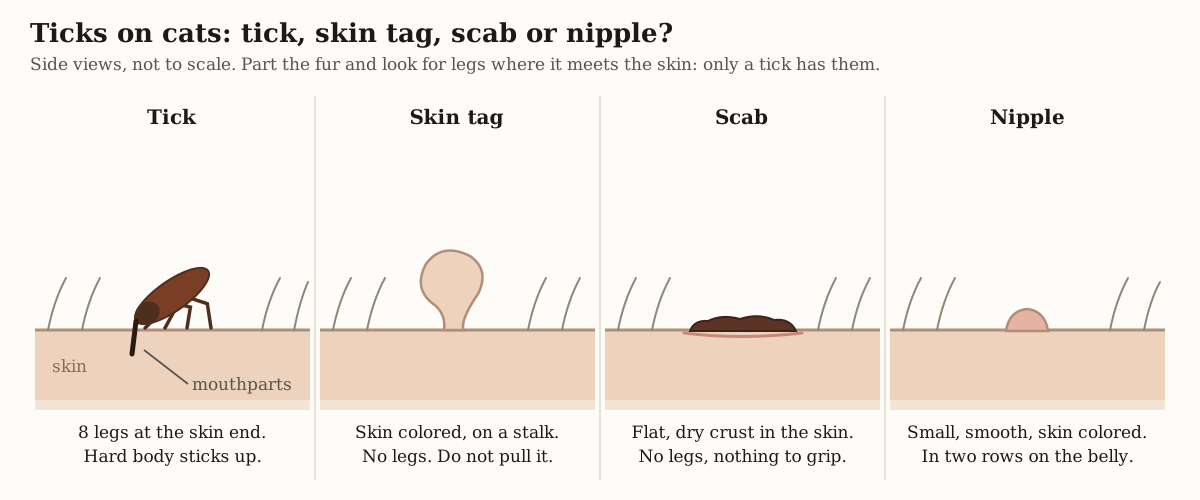
Table 1. Tick, scab, skin tag or nipple on a cat
Legs where it meets the skin
- Tick
- Yes, 8 (6 on a larva)
- Scab
- None
- Skin tag or growth
- None
- Nipple
- None
Shape
- Tick
- Oval body sticking up; swells as it feeds
- Scab
- Flat, rough crust
- Skin tag or growth
- Round, on a stalk or a broad base
- Nipple
- Small smooth dome
Color
- Tick
- Brown or red-brown; gray or tan when fed
- Scab
- Dark red, brown or black
- Skin tag or growth
- Same as the skin, or darker
- Nipple
- Pink or skin colored
Where on the cat
- Tick
- Head, ears, neck and feet most often
- Scab
- Anywhere, often where the cat scratches
- Skin tag or growth
- Anywhere
- Nipple
- Two rows along the belly
Changes over days
- Tick
- Swells, then drops off
- Scab
- Flakes off as the skin heals
- Skin tag or growth
- Stays the same or grows slowly
- Nipple
- Stays the same
Which ticks bite cats in the US?
Three species account for most ticks on cats in the US, a 2024 review in Today’s Veterinary Practice says: the deer (blacklegged) tick, the lone star tick and the American dog tick. The brown dog tick is common on dogs but is rarely found on cats. You do not need to name the tick to remove it, but the species tells your vet what to look for, so keep it.
Table 2. The ticks most often found on US cats
One white dot on the female's back
- Tick
- Lone star tick
- Matters for cats because
- Main carrier of cytauxzoonosis; tularemia
Red-brown with pale silvery marks
- Tick
- American dog tick (wood tick)
- Matters for cats because
- Tularemia; cytauxzoonosis less often
- More
- Dog tick guide
Small, black shield, orange-red rear, dark legs
- Tick
- Deer (blacklegged) tick
- Matters for cats because
- Anaplasmosis; Lyme infection, rarely illness
- More
- Deer tick guide
Plain red-brown, slim, no markings
- Tick
- Brown dog tick
- Matters for cats because
- Rarely bites cats; infests homes with dogs
Species from Today’s Veterinary Practice (2024) and VCA Animal Hospitals; vectors from CAPC and the Merck Veterinary Manual.
Dead tick on your cat
Dead or dried-up ticks on cats usually mean the cat’s tick product is working. Many vet products kill a tick after it starts to feed, so you may still find a dead one attached. Remove it the same way as a live one, with tweezers at the skin, and wash the spot.
Where ticks hide on cats
Ticks on cats tend to attach around the head, neck, ears and feet, Blue Cross says. Check seven places: the head and face, in and around the ears, the chin and neck, under the front legs, between the toes, the belly and groin, and the base of the tail. Check every day in tick season if your cat goes outside.
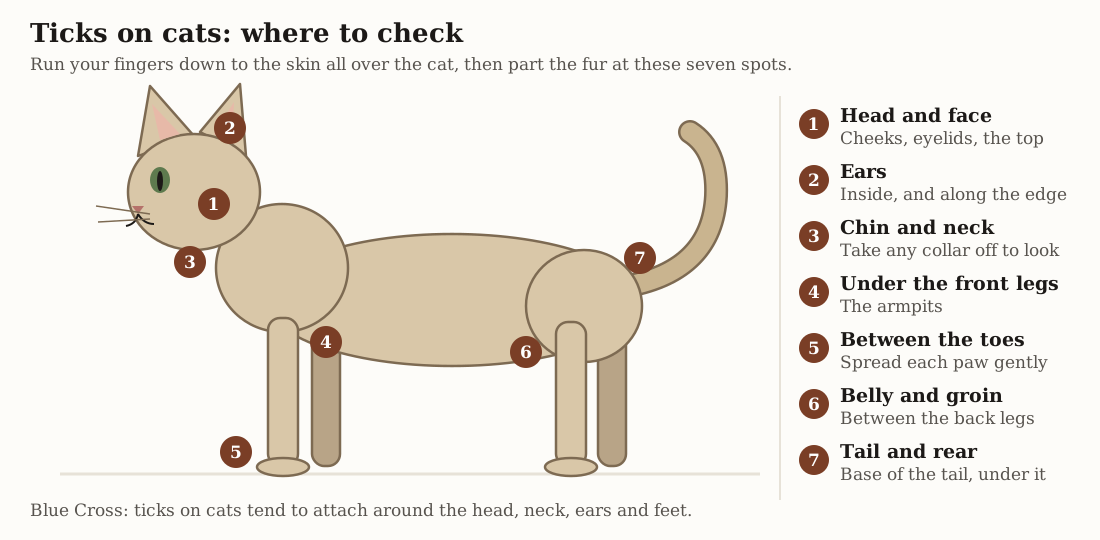
Use your hands first. Stroke your cat slowly from nose to tail, pressing gently enough to feel the skin under the fur. When you feel a bump, part the fur and look. A fine-toothed flea comb helps on long or dark coats, and it lifts off ticks that have not bitten yet.
Pay extra attention to the head and ears. These are spots a cat struggles to groom, which may be why ticks last there. Some cats scratch at a tick or shake their head. However, many cats show no sign at all, so do not wait for one.
Can indoor cats get ticks?
Yes, though ticks on cats that never go outside are less common. In two large US surveys of ticks taken off pets, 3.4% to 4.2% of the ticks from cats came from cats that lived strictly indoors, Today’s Veterinary Practice reports. Free-roaming cats are at far higher risk: one survey in the central US found ticks on 18.7% of them.
Ticks get indoors on people and dogs. CDC notes that pets carry ticks into the home, and a tick that drops off your dog or your jeans can crawl to the cat later. A 2026 Ohio State study found unfed lone star ticks lived about 11 days on home floors, and Gulf Coast ticks about 18.
So check your dog before it comes in, and check yourself after a walk. If your indoor cat goes onto a patio, a catio or a harness walk near grass, treat it as an outdoor cat in tick season. Ask your vet whether a tick product makes sense for your cat and your area.
How to remove a tick from a cat
To remove a tick from a cat, put on gloves, part the fur, grip the tick with fine-tipped tweezers right at the skin, and pull straight out with slow, steady pressure. Do not twist, squeeze or burn it. It takes a minute or two, and it is the same method CDC gives for people. A towel wrap helps with a cat that fights.
Taking a tick off your cat, step by step
Get ready, and wrap the cat if it fights
Put on disposable gloves. Set out fine-tipped tweezers or a tick tool, a small jar of rubbing alcohol or a zip bag, and a few treats. A helper makes this far easier. If your cat squirms or swats, wrap it in a towel first, as shown below.
Part the fur and check for legs
Part the fur until you can see where the bump meets the skin. A tick has tiny legs bunched at that end. If you see no legs, stop. It may be a scab, a skin tag or a nipple, and pulling it will hurt your cat.
Grip the tick at the skin
Grasp the tick with the tweezers as close to the skin as you can, at its mouthparts. Do not squeeze the round body. A tick tool made for pets also works if you use it the way its instructions say.
Pull straight out, slowly
Pull straight away from the skin with steady, even pressure. Do not twist or jerk. It can take a minute or two of slow, constant pulling before the tick lets go, so keep the pressure on and stay calm.
Kill it or keep it
Drop the tick in rubbing alcohol, seal it in a small bag or jar, or wrap it tightly in tape. Do not crush it with your fingers. Write the date on it in case your vet wants to see it later.
Clean up, then check for more
Wash the spot on your cat with mild soap and water, then take off the gloves and wash your hands. Check the rest of the cat and its bed. After that, watch your cat for 3 weeks.
If your cat fights: the towel wrap
A snug towel wrap keeps a cat still and its claws tucked away. Lay a large bath towel flat and set your cat in the middle. Fold one side over its body, then the other, and tuck the towel snugly around the neck like a scarf. Leave the head out for a tick on the head or ears, or free one leg for a tick on a paw.
Then let a helper hold the wrapped cat on a table or a lap while you work. Talk softly and offer treats. If your cat panics, growls or struggles hard, stop. A frightened cat can bite, and a pull on a moving tick is how mouthparts break off. A tick does not need to come off in the next ten minutes, but it should come off today, so call your vet.
Tick head stuck in your cat’s skin
If the mouthparts break off, try once to lift them out with tweezers. If they do not come out easily, leave them alone. CDC says the skin pushes them out as it heals, and PetMD compares it to a splinter: digging at it delays healing and invites infection.
Look at the tick you pulled. If its mouthparts are on it, a dark speck left in the skin is likely dried blood, not tick. Watch the spot instead. Some redness and a small scab are normal, but a spot that swells or oozes needs your vet.
Do you need to take your cat to the vet for a tick?
Not for one tick you removed cleanly from a cat that is acting normally. Ask your vet to do it if the tick is on an eyelid or deep in the ear, if your cat will not hold still even in a towel, or if there are many ticks. Merck says a cat that is covered in ticks needs a vet, because heavy infestations can cause blood loss and paralysis.
For a tick on a person, use our step-by-step tick removal guide, which follows the same CDC method. Our guide to checking and treating your dog for ticks covers the dog in the house.
What kills ticks on cats? Never a dog product
Nothing safely kills a tick that is already attached to your cat in seconds. The fastest safe fix is tweezers, which take about a minute. To kill ticks on cats before they bite, or soon after, you need a tick product made and labeled for cats and chosen with a vet. CDC says not to use any tick product on a cat without asking your vet first.
This matters more for cats than for dogs. Cats are extremely sensitive to many insecticides, Cornell’s Feline Health Center says, including some all-natural products and products sold for dogs. The worst offender is permethrin.
Is permethrin safe for cats?
No. Merck’s vet manual says permethrin can be highly toxic to cats, causing muscle twitching and seizures. The National Pesticide Information Center explains why: it takes a cat’s body a long time to break it down. Cats exposed by accident to dog products with 45% to 65% permethrin may act anxious, walk unsteadily, shake and seize, and they may die.
Dog products on cats are a major share of the cat poisonings reported to the ASPCA’s poison center, the AAFP says. The ASPCA’s own advice is short: read the label, and do not use a product on a cat unless the label clearly says it is for cats.
Can my dog’s tick treatment hurt my cat?
Yes, if it contains permethrin or another pyrethroid and the cat touches the dog while it is fresh. The AAFP names grooming a recently treated dog as one of the two common ways cats are poisoned. So in a home with a dog and a cat, tell your vet about both before you pick the dog’s product.
The same care applies to your own gear. If you spray permethrin on hiking clothes, do it outdoors and keep the cat away until the clothes are dry, as our tick prevention guide explains. The same goes for yard and house sprays. The AAFP warns that environmental pyrethrin products must be used with care where cats live.
Other products that are risky for cats
Merck’s vet manual says amitraz, the ingredient in some dog tick collars, should never be used on cats in any form. It also says DEET, the human bug repellent, has caused weakness, paralysis and seizures in pets and should not be given to dogs or cats. Ask your vet before you try any essential oil spray, because Cornell warns that some all-natural products are risky for cats too.
Tick bite on a cat: the bump afterward
After you remove a tick, a small red bump or scab at the bite is normal for a few days, PetMD says. Merck’s vet manual adds that a bite that turns red or swollen needs a prompt vet visit. Call your vet if the bump grows, turns hot, oozes pus, or keeps bothering your cat.
A tick bite on a cat is easy to lose track of in the fur. So note where it was, or take a photo the first day, and compare it a few days later. A spot that is shrinking and drying is healing. Cats lick and scratch at sore spots, so a bite that stays wet and open is worth a vet check.
A photo of a bite cannot tell you which tick it was, or whether it passed on a germ. That is why keeping the tick helps. The signs that matter are in the cat, not the bite, and they come later.
Tick diseases in cats, and the signs that need a vet
The signs of tickborne disease in cats are fever, low energy, a poor appetite and hiding, usually 1 to 3 weeks after the bite. Cornell says to call your vet for weakness, tiredness or less appetite in the days or weeks after a tick. In lone star tick country, a fast-rising fever is an emergency.
Table 3. Tick diseases of US cats and the signs to tell your vet about
Cytauxzoonosis (bobcat fever)
- Main ticks
- Lone star tick; American dog tick less often
- Where in the US
- Southeast, south-central and mid-Atlantic; also reported in the upper Midwest
- Signs to watch for
- High fever, not eating, hiding, fast breathing, yellow gums; often fatal within a week
Tularemia (rabbit fever)
- Main ticks
- American dog tick, lone star tick; also from hunting rabbits and rodents
- Where in the US
- Most often the south-central US and the Midwest
- Signs to watch for
- Sudden high fever, swollen glands, low energy, poor appetite, mouth sores
Anaplasmosis
- Main ticks
- Deer (blacklegged) tick
- Where in the US
- Northeast, mid-Atlantic, upper Midwest, West Coast
- Signs to watch for
- Fever, tiredness, poor appetite
Lyme disease
- Main ticks
- Deer (blacklegged) tick
- Where in the US
- Northeast, mid-Atlantic, upper Midwest, West Coast
- Signs to watch for
- Infection is common there, but illness is rarely if ever documented in cats
Tick paralysis
- Main ticks
- Several ticks; in cats mainly the Australian paralysis tick
- Where in the US
- Rare in US cats
- Signs to watch for
- Wobbly back legs, weakness that spreads, breathing trouble
From CAPC (cytauxzoonosis), the Merck Veterinary Manual (cytauxzoonosis, tularemia, tick paralysis), Today’s Veterinary Practice (2024) and Cornell’s Feline Health Center (Lyme disease).
Cytauxzoonosis: the tick disease that matters most for cats
Cytauxzoonosis is caused by a blood parasite, Cytauxzoon felis, that lives in bobcats and spreads to cats through tick bites, mostly from the lone star tick. Merck’s vet manual says signs usually start about 10 days after the bite (5 to 14 days), with a fever as high as 106°F (41°C).
It strikes mostly from March or April to September, when lone star ticks are active, CAPC and Merck say. Cats near woods and wild land, where bobcats and ticks live side by side, are at highest risk. It affects only the cat family. Dogs do not get it, and CAPC says it is not known to infect people.
The odds are poor, and the sources give different numbers. CAPC reports about 60% survival when treatment starts promptly, and Merck cites 64% in one large case series. Today’s Veterinary Practice puts the death rate at 40% to 100% for cats that reach a vet already sick. All three agree that early, intensive vet care is the best chance.
There is no vaccine. CAPC advises keeping cats indoors where possible, year-round tick control, and daily checks. In studies, two cat tick products, a collar and a spot-on, stopped lone star ticks from passing the parasite, Merck says, though some cats on spot-ons alone have still caught it. Our lone star tick guide shows where this tick lives.
Can cats get Lyme disease?
Cats can be infected with the Lyme germ, but they rarely, if ever, get sick from it. Cornell’s Feline Health Center says there is no well-documented case of a cat showing signs of Lyme disease, even among infected cats. VCA says clinical Lyme has not been seen in cats outside a lab.
Google’s AI answer for this search lists Lyme disease among the main tick risks for cats. That overstates it. Many cats in Lyme areas do carry antibodies: 13.9% of cat blood samples sent from the Northeast for tick-disease testing in one survey, says Today’s Veterinary Practice. But antibodies show a past infection, not an illness.
The same review says anaplasmosis, spread by the same deer tick, seems more likely than Lyme to make a cat sick. In the rare cats with both signs and Lyme antibodies, vets have reported fever, poor appetite, tiredness and limping. Unlike dogs, cats have no Lyme vaccine, Cornell notes. See our deer tick guide for the tick itself.
Tularemia, and a correction on hemobartonellosis
Tularemia is a bacterial disease that cats catch from ticks and, more often, from the rabbits and rodents they hunt. Merck’s vet manual says cats are at higher risk than most pets, and a very sick cat can collapse within hours or days. Early antibiotic treatment from a vet should prevent death, Merck adds.
Google’s AI answer and Cornell’s tick list also name hemobartonellosis, or feline infectious anemia. However, Merck’s vet manual, updated in March 2026, says its germ is thought to spread by fleas and other bloodsucking insects, by bite wounds, and from mother to kittens. It does not mention ticks. Flea control is what prevents it.
Tick paralysis in cats
Tick paralysis is caused by a toxin in the saliva of some feeding ticks. It is a serious problem for cats in Australia. In North America, Merck’s vet manual names the Rocky Mountain wood tick and the American dog tick as the usual causes, in dogs, livestock and people, not cats.
So it seems to be rare in US cats. Still, a cat that turns wobbly or weak with a tick on it needs a vet now, and every tick needs to come off. Our guide to tick paralysis and other signs in dogs covers the dog side.
How long does a tick have to be on a cat to make it sick?
It depends on the germ, so there is no safe number. Merck says cytauxzoonosis has passed to cats as soon as 36 to 48 hours after ticks got on them. PetMD says some diseases can pass in as little as 24 hours, and CAPC gives 3 to 6 hours for some others. Cornell gives 36 to 48 hours for Lyme. So remove ticks as soon as you find them, and check daily.
Can ticks kill cats?
Rarely, but yes. In the US the main killer is cytauxzoonosis. Tularemia can also be fatal, and Merck says heavy infestations can cause severe blood loss and paralysis. A single tick found and removed within a day is very unlikely to do any of these.
Not veterinary advice. This section is general reference for cat owners. It is not a diagnosis and gives no treatment. If your cat seems unwell after a tick bite, call your vet.
Can ticks on cats spread to people?
Ticks on cats can bite you if they crawl off the cat, but your cat cannot give you Lyme disease directly. CDC says there is no evidence that dogs or cats pass it to their owners. However, cats do carry ticks into the house. That is the real risk, and it is why you check yourself after you check the cat.
Wear gloves when you handle ticks. Merck says some tick germs, such as the one behind Rocky Mountain spotted fever, can pass through breaks in the skin. Tularemia is the one to know about with cats: Merck says a cat that recently caught an infected animal has, rarely, passed it to a person through a bite.
If you find a tick on yourself, use our guide to removing a tick from a person, and see tick bite symptoms for when to call a doctor.
How to prevent ticks on cats
Preventing ticks on cats takes three things: less time in tick habitat, a daily check in tick season, and a tick product labeled for cats, chosen with your vet. Cornell names keeping cats indoors and using only cat-approved products as the two best steps. The first two cost nothing.
- Keep your cat indoors, or let it out on a harness or in a catio away from tall grass and the edge of woods.
- Check daily after time outdoors, using the seven spots above. Remove any tick right away.
- Use a cat tick product if your vet advises one. CAPC advises year-round tick control for cats in cytauxzoonosis areas.
- Pick the dog’s product with the cat in mind. Tell your vet you have both, so the dog’s product is safe to live with.
- Keep grass short and clear brush and leaf litter near the house, as Merck advises.
- Control fleas too. Fleas spread their own cat diseases, including feline infectious anemia.
Spring and fall are the busy seasons, and searches for ticks on cats peak in May and again in October. Some ticks are active on winter days when the ground is above 32°F (0°C), VCA says. Our guide to getting rid of ticks in the yard and house covers the yard, and the tick guide covers every US species.
Is there a tick vaccine for cats?
No. Cornell notes there is no Lyme vaccine for cats, unlike dogs, and CAPC says no vaccine prevents cytauxzoonosis. That leaves the indoor life, daily checks and a cat-labeled tick product as the whole of prevention.
Myths about ticks on cats, corrected
Some of the most shared advice about ticks on cats is wrong, and two of these myths sit in Google’s own AI answer. Here is what the vet and public health sources say instead.
Myth 1
Myth: “Cats don't get ticks, because they groom them off.”
Truth: Grooming removes many, but ticks on the head, ears and neck are out of reach. One central US survey found ticks on 18.7% of free-roaming cats (Today's Veterinary Practice).
Myth 2
Myth: “Indoor cats never get ticks.”
Truth: In two US surveys, 3.4% to 4.2% of ticks taken off cats came from strictly indoor cats. People and dogs carry ticks in.
Myth 3
Myth: “Lyme disease is the big tick risk for cats.”
Truth: Cornell knows of no well-documented case of a cat sick with Lyme. In the South, the danger is cytauxzoonosis.
Myth 4
Myth: “A small dose of the dog's flea and tick product is fine for the cat.”
Truth: Dog spot-ons can hold 45% to 60% permethrin, and cats cannot break it down (AAFP). Never use a dog product on a cat.
Myth 5
Myth: “Put alcohol, petroleum jelly or a hot match on the tick so it backs out.”
Truth: CDC says these can force infected fluid into the skin. Tweezers are faster and safer.
Myth 6
Myth: “Twist the tick to unscrew it.”
Truth: CDC says not to twist or jerk with tweezers, which can snap off the mouthparts. Blue Cross in the UK advises twisting tools; use any tool exactly as its instructions say.
Myth 7
Myth: “If the head stays in, rush to the vet.”
Truth: CDC says the skin pushes leftover mouthparts out as it heals. Watch the spot, and call the vet only if it swells or oozes.
Myth 8
Myth: “Hemobartonellosis is a tick disease.”
Truth: Merck says its germ is thought to spread by fleas, bites and from mother to kittens. Flea control prevents it.
Myth 9
Myth: “A natural or essential oil spray is the safe choice for cats.”
Truth: Cornell warns that cats are sensitive to some all-natural products too. Ask your vet before using any of them.
Still unsure what you found? Compare it with our guide to bugs that look like ticks, or see how a flea differs from a tick if the bug was tiny and jumped.
Pest control disclaimer. Photo-based identification can help, but it is not always perfect. For dangerous spiders, large infestations, or anything you are unsure about, contact a licensed pest control professional.
Veterinary disclaimer. This page is general information for cat owners. It is not veterinary advice, a diagnosis or a treatment plan. Ask your veterinarian which tick products are right for your cat, and call them if your pet seems unwell after a tick bite.
Ticks on cats: FAQ
How long does a tick stay on a cat?
Can a cat survive a tick without treatment?
Why do I only ever find one or two ticks on my cat?
Should I get the tick tested?
Can I use a flea comb to get ticks off my cat?
Related guides
Ticks
The ticks that bite people and pets in the US, where they live, and what each can spread.
Lone star tick
The tick with the white dot, the main carrier of cytauxzoonosis in cats.
Ticks on dogs
Checks, removal and warning signs for the dog in the house.
How to remove a tick
The CDC method for a tick on a person, including a stuck head.
Deer tick
The small black-shielded tick behind Lyme disease and anaplasmosis.
American dog tick
The red-brown wood tick with pale marks, female and male.
Preventing ticks
Repellents, permethrin clothing and keeping cats safe around it.
What a tick looks like
Sizes and colors from larva to engorged adult, with a size scale.
Sources
- CDC, Preventing Ticks on Pets (May 2024)
- CDC, What to Do After a Tick Bite (June 2026)
- CDC, How Lyme Disease Spreads
- Cornell Feline Health Center, Ticks and Your Cat: FAQs
- Cornell Feline Health Center, Lyme Disease: A Potential, But Unlikely, Problem for Cats
- Merck Veterinary Manual, Ticks of Cats (cat owners)
- Merck Veterinary Manual, Diseases Caused by Blood Parasites in Cats (cat owners, March 2026)
- Merck Veterinary Manual, Cytauxzoonosis in Cats
- Merck Veterinary Manual, Tularemia in Cats (cat owners)
- Merck Veterinary Manual, Ectoparasiticides Used in Small Animals
- Companion Animal Parasite Council, Cytauxzoonosis (October 3, 2025)
- Smith and Starkey, Ticks and Tick-Transmitted Diseases in Cats, Today's Veterinary Practice (November/December 2024)
- American Association of Feline Practitioners, Permethrin Poisoning and Cats
- National Pesticide Information Center, Permethrin General Fact Sheet
- ASPCA, Feline Toxins to Steer Clear of This Kitten Season (permethrin)