What is a brown dog tick?
The brown dog tick is a hard tick that feeds on dogs at every stage of its life. Its scientific name is Rhipicephalus sanguineus, and some vets call it the kennel tick. It is plain reddish brown, narrow and about 1/8 inch (3 mm) long. Unlike every other US tick, it can complete its whole life cycle indoors.
It is found worldwide and is thought to be the most widespread tick on earth. Even so, it is a creature of homes and kennels, not woods. It needs dogs: in the US, they are its main host at every stage and the reason a large population can build up in a house.
Most ticks you meet ride in from tall grass and do not settle indoors. This one does, which is why it gets its own guide. For the other kinds of ticks and how they compare, start at our guide to ticks.
One name, a group of species
Scientists now treat the brown dog tick as a small group of near-identical species, often written R. sanguineus sensu lato, meaning “in the broad sense.” Over the past decade, researchers recognized two lines: a “temperate” one and a “tropical” one. In 2021, Australian researchers gave the tropical line its own name, Rhipicephalus linnaei.
You cannot tell them apart by eye, and the advice on this page is the same for all of them. You may simply see either name on a vet report or in a study.
How to identify a brown dog tick
To identify a brown dog tick, check four things: a plain reddish-brown body with no white or silver markings, a narrow teardrop shape, short mouthparts, and a six-sided base behind them. An unfed adult is 2.3 to 3.2 mm long, about 1/8 inch, the University of Florida says. If it has white on its back, it is a different tick.
Table 1. Brown dog tick sizes at each stage
Legs
- Larva
- 6
- Nymph
- 8
- Adult female
- 8
- Adult male
- 8
Size, unfed
- Larva
- About 0.5 mm, a speck
- Nymph
- 1.1 to 1.3 mm, a poppy seed
- Adult female
- 2.3 to 3.2 mm (about 1/8 in)
- Adult male
- 2.3 to 3.2 mm (about 1/8 in)
Size after feeding
- Larva
- Swells several times over
- Nymph
- Swells several times over
- Adult female
- Up to about 1/2 in (12 mm), bluish gray
- Adult male
- Hardly changes
Shield on the back
- Larva
- Small, at the front
- Nymph
- Small, at the front
- Adult female
- Small and dark, at the front
- Adult male
- Covers the whole back
Markings
- Larva
- None
- Nymph
- None
- Adult female
- None
- Adult male
- None, but tiny pits on the shield
Sizes from the University of Florida (EENY-221), Ohio State University and PestWorld.
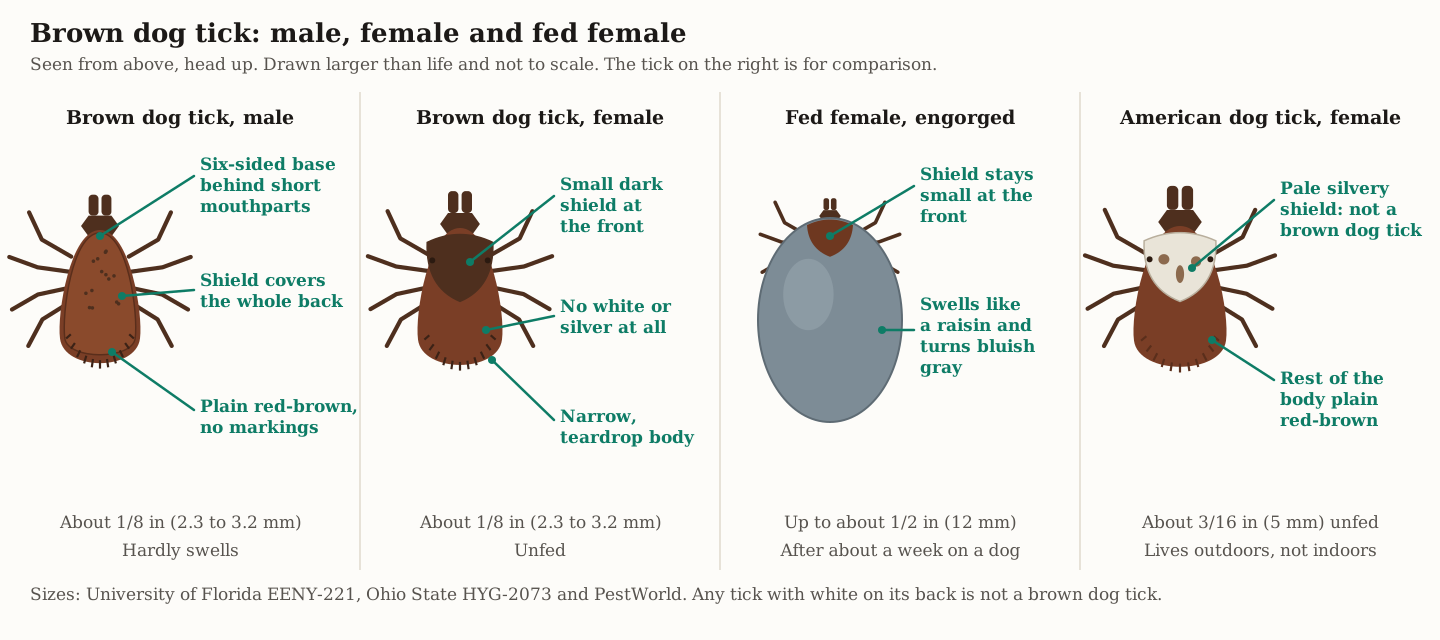
The six-sided head
Look at the front of the tick with a hand lens or a phone zoom. Behind the short mouthparts sits a flat base with six sides. Vets call it the hexagonal basis capituli, and one parasitology course compares it to a Darth Vader helmet. In the US, it is close to a signature for this tick.
In Florida, the University of Florida notes, the only other tick ever found with this shape is the cattle fever tick. It was eradicated from the US in 1943 and does not feed on dogs. So on a dog, a six-sided head is a strong sign.
Female vs male brown dog tick
The female has a small, dark shield just behind her head, and the rest of her back is softer and can stretch. The male’s shield covers his whole back, so he stays flat after feeding. PestWorld notes tiny pits scattered over the male’s back. Otherwise the two look alike, and a magnifier helps.
Their habits differ more than their looks. A female feeds for about a week, then drops off to lay eggs. A male feeds briefly, then wanders over the dog, and even onto other dogs in the house, to find females.
What an engorged brown dog tick looks like
An engorged female is gray-blue or olive, swollen and smooth, and up to about 1/2 inch (12 to 13 mm) long. The University of Florida compares her to a raisin. Her small dark shield and legs still show at the front. That is the stage most owners notice, often on an ear or between the toes.
Do not leave her there. Once she drops off, she can lay thousands of eggs in a crack nearby. Our guide to what ticks look like before and after feeding shows how much other kinds of ticks swell too.
Big ticks and tiny ones: several stages at once
Many owners think they have two or three kinds of ticks, the University of Florida says. In fact, they are seeing every stage of one: specks that are larvae, poppy-seed nymphs, adults and swollen females. Ticks of every size in one house is itself a clue that brown dog ticks are breeding there.
A sharp photo from above on white paper is usually enough to rule out the marked ticks. The six-sided head needs magnification, though. You can upload a photo to our bug identifier by picture, then keep the tick on tape in case your vet wants to see it.
Brown dog tick vs American dog tick
The quickest check is the back. An American dog tick has pale silvery or cream markings, while a brown dog tick has none at all. The American dog tick is also wider and larger, about 3/16 inch (5 mm) unfed, and it lives outdoors in tall grass. A tick that breeds in the house is the brown dog tick.
Table 2. American dog tick vs brown dog tick
Markings on the back
- Brown dog tick
- None, plain reddish brown
- American dog tick
- Pale silvery or cream
Body shape
- Brown dog tick
- Narrow teardrop
- American dog tick
- Broad oval
Unfed adult size
- Brown dog tick
- About 1/8 in (2.3 to 3.2 mm)
- American dog tick
- About 3/16 in (5 mm)
Engorged female
- Brown dog tick
- About 1/2 in (12 mm), bluish gray
- American dog tick
- Up to 5/8 in (15 mm), gray
Base of the mouthparts
- Brown dog tick
- Six-sided
- American dog tick
- Not six-sided
Where it lives
- Brown dog tick
- Homes, kennels, yards close to the house
- American dog tick
- Tall grass along trails and field edges
Hosts
- Brown dog tick
- Dogs at every stage
- American dog tick
- Mice when young, then raccoons, dogs and people
Bites people
- Brown dog tick
- Rarely
- American dog tick
- Often, mostly adult females
Season
- Brown dog tick
- All year indoors
- American dog tick
- Spring to midsummer
The two share a name, so they get mixed up often. Our American dog tick guide covers the marked one, and our page on every common type of tick compares the rest. A plain brown tick picked up outdoors is often a young tick of another kind. Ohio State notes that the nymphs and larvae of most ticks are plain tan or brown.
Other bugs that get mistaken for brown dog ticks
Indoors, people mistake bed bugs, spider beetles and booklice for brown dog ticks, vets writing in Today’s Veterinary Practice warn. So confirm the bug before you treat anything. A tick has 8 legs (6 as a larva) and no antennae, while a bed bug has 6 legs and two antennae.
See tick vs bed bug for that comparison, and our guide to bugs that look like ticks for the beetles and mites.
Where brown dog ticks live
Brown dog ticks live worldwide and in every part of the US, most commonly in warm southern states. They live wherever dogs live: homes, kennels, shelters, groomers and yards close to the house. Unlike other US ticks, they are not found in woods or wild grassland. In cold places they survive only indoors.
The University of Rhode Island says they are met more often across the southern tier of states. CAPC, the veterinary parasite council, says they infest homes and kennels anywhere there are dogs, including Canada and Alaska. Even there, it is the dogs that carry them in.
Outdoors, they stay close to the dog. Ohio State lists grassy and bushy spots next to homes and kennels, the areas where a dog rests, and the ground under doghouses. In warm months, ticks from the yard can crawl up the foundation and in through gaps around windows and doors.
Dogs pick them up where many dogs meet: boarding kennels, day cares, grooming shops, shelters, vet clinics, dog parks and other infested homes. On Reddit’s r/ticks, one owner traced an infestation to a new dog park, and another renter found the ticks after moving into an apartment where the last tenant kept two dogs.
Brown dog ticks in the house
Brown dog ticks are the only US ticks that live and breed indoors. A fed female drops off the dog, crawls into a crack and lays about 4,000 eggs. In warm conditions the next generation is ready in about 2 months, so a few ticks can become hundreds. The first sign is usually ticks climbing the walls.
How an infestation starts
It starts with a few ticks on one dog. The dog brings them home from a kennel, a groomer or a dog park, and nobody notices because they are small and few. Then the first females finish feeding, drop off and hide. Weeks later, their larvae hatch and climb back onto the same dog.
The ticks drop off after every meal, so most of the population is not on the dog at all. Today’s Veterinary Practice puts it at 90 to 95% of a brown dog tick’s life spent off the host, in the house. That is why treating only the dog, or only the house, fails.
Signs of brown dog ticks in your house
- Ticks climbing walls or curtains, often near the dog’s bed or crate, and sometimes on the ceiling.
- Several sizes at once, from specks to swollen females.
- New ticks on a dog that rarely goes outside, or fresh ones every few days on a dog you just checked.
- Swollen gray ticks in the dog’s ears or between its toes.
- Dead ticks in the vacuum, the dryer lint trap or along the baseboards.
- A clump of tiny brown eggs in a crack, on a ledge or on top of a crate.
One tick on the floor after a hike is not an infestation. Ticks from outdoors do not breed indoors, and our guide to getting rid of ticks in the house and yard covers those hitchhikers. Several ticks indoors, week after week, in a home with a dog, is the brown dog tick pattern.
Where brown dog ticks hide indoors
After feeding, ticks hide in tight, dry gaps to molt or lay eggs. Many crawl upward first, so eggs and ticks turn up high on walls as well as along the floor. Ohio State names cracks in floors and walls, baseboards, window and door frames, wall molding and hangings, and the edges of carpet.
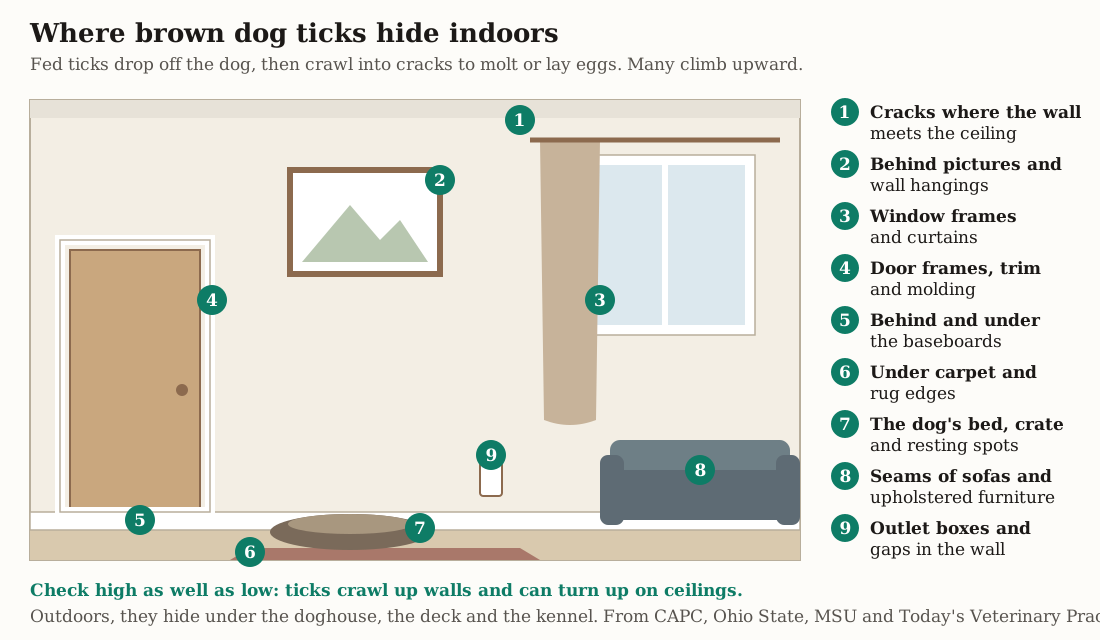
Michigan State University adds furniture, curtains and electrical outlet boxes, and CAPC says the ticks can reach false ceilings. On Reddit, owners who cleared an infestation report ticks living under wall-to-wall carpet, in a fabric headboard and in area rugs. Several removed the carpet and caulked every gap behind the trim.
The brown dog tick life cycle indoors
A brown dog tick goes from egg to egg-laying female in just over 2 months when it is warm and a dog is close, the University of Florida says. Ohio State gives about 60 days. With fewer dogs or cooler rooms, it often takes 4 to 5 months. Each stage takes one meal, drops off and hides.
Table 3. One brown dog tick generation, stage by stage
Egg
- Time on the dog
- None
- Time hidden in the house
- Hatches in 6 to 23 days; up to 60 days when cool
- Can survive without a meal
- Not applicable
Larva, 6 legs
- Time on the dog
- Feeds 5 to 15 days
- Time hidden in the house
- 1 to 2 weeks to molt
- Can survive without a meal
- About 8 months
Nymph, 8 legs
- Time on the dog
- Feeds 3 to 13 days
- Time hidden in the house
- About 2 weeks to molt
- Can survive without a meal
- About 3 to 9 months
Adult female
- Time on the dog
- Feeds and mates for about a week
- Time hidden in the house
- Lays eggs for 15 to 18 days, then dies
- Can survive without a meal
- 18 months or more
Adult male
- Time on the dog
- Feeds in short bouts and moves between dogs
- Time hidden in the house
- Stays mostly on the dogs
- Can survive without a meal
- 18 months or more
Feeding, molting and egg times from the University of Florida (EENY-221); slow egg hatch from Michigan State University; survival from Texas A&M, WCVM and Michigan State. Warmth speeds every stage.
On average, there are about two generations a year, and up to four in tropical places such as Brazil. Indoors, they lay eggs in any month. Our guides to tick eggs and seed ticks show what the eggs and larvae look like.
How many eggs does a brown dog tick lay?
Usually a few thousand, in one batch. The University of Florida gives about 4,000 on average and more than 7,000 from a large, fully fed female. Other sources give lower ranges, as the table shows. The count depends on how big the female is and how much blood she took.
Table 4. Brown dog tick eggs per female: what sources say
1,000 to 3,000
- Source
- PestWorld; Michigan State University
1,500 to 4,000 on average
- Source
- Dantas-Torres, 2010 review in Parasites & Vectors
Up to 4,000
- Source
- University of Rhode Island; Texas A&M
4,000 on average, over 7,000 at most
- Source
- University of Florida (EENY-221)
Up to 7,000
- Source
- Today's Veterinary Practice
Whichever figure is right for your area, one missed female is enough to restart an infestation. She dies after laying, but her eggs hatch in 1 to 3 weeks in a warm house.
Why brown dog ticks take months to clear
Three things make this tick slow to beat. First, it lives long without food: Texas A&M and the University of Rhode Island both say adults can survive 18 months or more unfed. The University of Florida gives a shorter figure, 3 to 5 months per stage, but either way the ticks outlast a quick fix.
Second, it hides. Ticks that are digesting, molting or laying eggs stay out of sight for weeks. The University of Florida warns this makes an infestation seem to vanish and then come back.
Third, some populations resist common chemicals. Brown dog ticks that resist permethrin have been found in Florida, Texas and California. That is one reason to let your vet choose the dog’s product. CAPC warns that an established home infestation may take several months to bring under control.
How to get rid of brown dog ticks in your house
To get rid of brown dog ticks, treat every dog with a tick product from your vet and clean the house in the same week. Vacuum, wash bedding hot and seal cracks, which cost little. If ticks still appear, a product labeled for indoor tick use or a licensed pest professional treats the cracks. Expect it to take months.
8 steps to clear brown dog ticks
Make sure it is a tick
Count the legs: adults and nymphs have 8, larvae have 6, and there are no antennae. Stick one on clear tape and keep it. Bed bugs, spider beetles and booklice get mistaken for brown dog ticks, and each needs a different plan. Your vet or county extension office can confirm it.
Treat every dog in the home this week
Ask your vet for a tick product for each dog, even the one that never goes outside, and give it on the schedule the label sets. The dogs are the ticks' only real food, so this step starves the infestation. Do not use a dog product on a cat.
Take off any attached ticks
Check the ears, between the toes, the neck and the belly. Grip each tick close to the skin with fine-tipped tweezers and pull straight up with steady pressure. Seal the ticks in tape. Do not crush them with your fingers.
Vacuum, then seal the bag
Vacuum baseboards, the gaps between floorboards, closets, carpets, rug edges, curtains, upholstery and every spot where the dog rests. Brown dog ticks survive the vacuum, so seal the bag or the canister contents in a plastic bag and put it in the outdoor trash.
Wash and dry the bedding hot
Wash dog beds, blankets and any bedding the dog sleeps on in hot water, then dry it on high heat. Steam works on things you cannot wash, such as a couch.
Seal the cracks
Caulk gaps along baseboards, window and door frames and wall trim, near where the dog sleeps first. Fewer cracks means fewer places for females to lay eggs and for young ticks to molt.
Treat hiding spots, or call a professional
If ticks keep coming after the dogs are treated and the house is cleaned, the cracks need a product labeled for ticks indoors. A licensed pest professional who knows brown dog ticks is the safer choice. Outdoors, the spots that matter are under the doghouse, the deck and the kennel.
Keep going for months
Keep every dog on its tick product all year, check them daily, and keep vacuuming. Adults can live 18 months without a meal, so ticks can keep turning up long after the house looks clear.
Steps 1, 3, 4, 5 and 6 cost little or nothing. Done well, together with treating the dogs, they may be enough for a small, early infestation. If cleaning and treating the dogs work, a house spray is not needed. For a dog that hates tweezers, our guide to removing a tick from a dog shows how to hold it still.
Do you need an exterminator for brown dog ticks?
For an established infestation, usually yes. The CAPC ticks guideline says a licensed exterminator is needed to clear brown dog ticks from a building, on top of treating the pets. Today’s Veterinary Practice agrees, because the products are toxic and repeat visits are likely.
Ask whether the company has treated brown dog ticks before. A good plan treats cracks, baseboards and the areas around the dog’s bed, then comes back for follow-up visits. If you found only one or two ticks and the dogs are now treated, you can try cleaning alone first and watch for a few weeks.
What kills brown dog ticks in the house?
Heat kills them: a hot wash and a high-heat dryer cycle, or steam on furniture. Vacuuming removes them but does not reliably kill them, so seal what you collect. Spraying rubbing alcohol on the dog’s bed, as one Reddit owner tried, only kills the few ticks it soaks. That owner’s count kept rising.
For the cracks, CAPC names pyrethroid insecticides such as cyfluthrin and permethrin, applied as the label allows. Because some brown dog ticks now resist permethrin, a professional may rotate products. On the dog, the tick product your vet prescribes does the killing, as ticks bite and die. Our page on how to get rid of ticks compares home and yard methods for other ticks.
Is the brown dog tick dangerous? The diseases it spreads
For dogs, yes. The brown dog tick spreads canine ehrlichiosis, canine babesiosis and other infections, some of them fatal, and hundreds of ticks can drain a dog’s blood. For people the risk is low, because it rarely bites them. The exception is Arizona and the Mexico border, where it spreads Rocky Mountain spotted fever.
Table 5. What the brown dog tick can spread
Canine ehrlichiosis (Ehrlichia canis)
- Who gets it
- Dogs
- Notes
- Fever, lameness, depression, weight loss and poor appetite
Canine babesiosis (Babesia vogeli, B. gibsoni)
- Who gets it
- Dogs
- Notes
- Fever, poor appetite and anemia
Canine anaplasmosis (Anaplasma platys)
- Who gets it
- Dogs
- Notes
- Infects the cells that help blood clot
Hepatozoonosis (Hepatozoon canis)
- Who gets it
- Dogs
- Notes
- Usually mild
Rocky Mountain spotted fever (Rickettsia rickettsii)
- Who gets it
- Dogs and people
- Notes
- In people, mainly Arizona and northern Mexico. Can be deadly if treated late
Lyme disease
- Who gets it
- Not spread by this tick
- Notes
- Deer (blacklegged) ticks spread it
Diseases from the CAPC ticks guideline and CDC; signs in dogs from the University of Florida; anaplasmosis and hepatozoonosis notes from PetMD. Abroad, the same tick spreads Mediterranean spotted fever.
In dogs
A few ticks rarely make a dog look sick. The danger is the germs they carry, and the sheer number in a bad infestation. Vets writing in Today’s Veterinary Practice describe dogs carrying hundreds or thousands of ticks, with anemia severe enough to need a blood transfusion.
Signs of a tick-borne illness may not appear for 7 to 21 days or longer after a bite, CDC says. So if you find an infestation, ask your vet whether every dog in the home should be tested. Our guide to ticks on dogs lists the warning signs to report.
Rocky Mountain spotted fever in Arizona and Mexico
In most of the US, Rocky Mountain spotted fever comes from American dog ticks and Rocky Mountain wood ticks. In Arizona and northern Mexico, the CDC says the brown dog tick spreads it, around homes and in every month of the year. Cases there are unusually common and unusually deadly, especially in children.
This link was first shown in a 2005 report. A CDC team traced 16 cases in eastern Arizona to brown dog ticks on dogs and in yards. Thirteen patients were children 12 or younger, and 2 died. Only 4 remembered a tick bite, which is why a fever in a home with a tick problem needs a doctor even when nobody saw a tick.
Between 2003 and 2012, Arizona recorded more than 250 cases and 19 deaths. A community program then put tick collars on about 1,000 dogs and treated yards monthly. After five months, fewer than 1% of its dogs had ticks, against 64% in nearby communities. Over the next two years, human cases there fell by 43%.
Does the brown dog tick carry Lyme disease?
No. CDC says the brown dog tick cannot pass on the bacteria that cause Lyme disease. In the US, Lyme disease comes from deer ticks, also called blacklegged ticks. Our deer tick guide covers that risk.
Can brown dog ticks cause tick paralysis?
Rarely, and in dogs. Google’s AI answer and some pages say brown dog ticks do not cause tick paralysis. The Merck Veterinary Manual disagrees: it lists R. sanguineus among the North American ticks that may cause paralysis in animals.
The main US causes are the American dog tick and the Rocky Mountain wood tick. Human cases on record come from other kinds of ticks. So for people the risk is very low. For a dog, weakness that starts in the back legs and climbs is a reason to search it for ticks and call the vet.
Medical disclaimer. This page is for general information only. It is not a medical diagnosis. If you have severe symptoms, trouble breathing, swelling of the face or throat, fast spreading redness, fever, severe pain, pus, or signs of infection, contact a doctor or your local emergency number.
Do brown dog ticks bite humans?
Rarely. Brown dog ticks prefer dogs at every stage, and people in an infested home are often spared. Bites on people become more likely when the ticks are very numerous, or when the dogs are gone and the ticks are hungry. Larvae and nymphs end up on people more often than adults, the University of Florida says.
On Reddit, owners who cleared infestations describe ticks that behaved “bed bug like” but never bit them. Others found one crawling on a shirt or a leg. If one is attached to you, take it off now with fine-tipped tweezers, pulling straight up with steady pressure. Then wash the bite and your hands, and keep the tick sealed in tape.
A bite mark cannot show which tick bit you, so keep the tick and note the date. Our tick removal guide covers a stuck head, and our guide to tick bite symptoms covers what to watch for in the weeks after.
Brown dog ticks on dogs
On a dog, adult brown dog ticks usually attach to the ears and between the toes. Larvae and nymphs tend to attach along the back, legs, chest and belly, where they are harder to see. Check all of these daily during an infestation. A swollen gray tick in an ear is a female about to drop off and lay eggs.
Take every tick off as soon as you find it. CAPC says the germs behind ehrlichiosis and spotted fever can pass within 3 to 6 hours of attachment, so do not wait for a product to work. Even the fastest tick products take hours. Keep the first tick you find on tape for your vet.
Prevention matters most here. CAPC advises a tick product all year, every year, for every dog, because brown dog ticks can set up indoors in any month. Check dogs after a kennel stay, a groomer, day care or a dog park, and check any new dog before it comes inside. Ask your vet which product suits your dog, and which ones work against this tick where you live.
Brown dog tick myths, corrected
Some of what ranks for this tick is wrong or out of date, including Google’s AI answer. Here is what the veterinary and public health sources say instead.
Myth 1
Myth: “Brown dog ticks do not cause tick paralysis.”
Truth: The Merck Veterinary Manual lists them among the North American ticks that may cause it in animals. It is rare, and the main US causes are Dermacentor ticks.
Myth 2
Myth: “Brown dog ticks live in grassy and wooded areas.”
Truth: In North America they are found in and around homes and kennels, not in woods or wild areas, according to Texas A&M and Today's Veterinary Practice.
Myth 3
Myth: “Unfed brown dog ticks die within about 5 to 8 months.”
Truth: Some pages say so. Texas A&M, the University of Rhode Island and Michigan State all say adults can survive 18 months without a meal.
Myth 4
Myth: “A tick product on the dog stops the tick before it can pass on any disease.”
Truth: CAPC says the germs of ehrlichiosis and spotted fever can pass within 3 to 6 hours of attachment. Products help a great deal, but daily checks still matter.
Myth 5
Myth: “Send the tick to a lab to find out if you are infected.”
Truth: CDC advises against relying on tick testing: a positive tick does not mean you are infected, and a negative one can give false comfort. See a doctor for symptoms.
Myth 6
Myth: “Brown dog ticks only live in the South.”
Truth: They are most common in warm states, but CAPC says they infest homes with dogs everywhere, including Canada and Alaska.
Myth 7
Myth: “Ticks in the house mean the yard is full of ticks.”
Truth: Outdoor ticks do not breed indoors. Several ticks indoors week after week, in a home with a dog, points to brown dog ticks breeding inside.
Still not sure what you found? Compare it with the photos in our guide to tick identification by color and size, or upload a photo to the bug identifier.
Pest control disclaimer. Photo-based identification can help, but it is not always perfect. For dangerous spiders, large infestations, or anything you are unsure about, contact a licensed pest control professional.
Veterinary disclaimer. This page is general information for dog owners. It is not veterinary advice, a diagnosis or a treatment plan. Ask your veterinarian which tick products are right for your dogs, and call them if a pet seems unwell after a tick bite.
Brown dog tick FAQ
Can you have brown dog ticks without a dog?
Can brown dog ticks live on cats?
Do brown dog ticks die in the winter?
Can brown dog ticks live in your bed?
Does having brown dog ticks mean my house is dirty?
Related guides
Ticks
The ticks that bite people in the US, where they live, and what each can spread.
American dog tick
The marked dog tick that lives outdoors, and how to tell it apart.
How to get rid of ticks
Yard fixes, hitchhikers in the house, and when to hire a pro.
Ticks on dogs
Where ticks hide on a dog, how to take them off, and when to call the vet.
Removing a tick from a dog
The tweezer method step by step, with a squirming dog.
Tick eggs
What an egg mass looks like, and what to do if you find one indoors.
Types of ticks
Every common US tick compared by color, size and range.
Bugs that look like ticks
Spider beetles, bed bugs, mites and other look-alikes found indoors.
Sources
- Tian Y, Lord CC and Kaufman PE, Brown Dog Tick, Rhipicephalus sanguineus, University of Florida EENY-221 (December 2018, archived copy)
- Companion Animal Parasite Council, Ticks guideline (updated March 30, 2023)
- Myers S and Little S, Top Tips for Managing Home and Kennel Infestations With Brown Dog Ticks, Today's Veterinary Practice (March/April 2024)
- CDC, Rocky Mountain Spotted Fever: Clinical Overview of Transmission and Epidemiology (May 15, 2024)
- CDC, About Rocky Mountain Spotted Fever
- CDC, What to Do After a Tick Bite (June 9, 2026)
- CDC, Preventing Ticks on Pets (May 15, 2024)
- CDC, How Lyme Disease Spreads (September 24, 2024)
- Ohio State University Extension, Ticks and Tick-Borne Diseases, HYG-2073
- Texas A&M AgriLife, The Tick App: Brown dog tick
- University of Rhode Island TickEncounter Resource Center, Brown Dog Tick
- Cope RB, Tick Paralysis in Animals, Merck Veterinary Manual (October 2023)
- Demma LJ and others, Rocky Mountain spotted fever from an unexpected tick vector in Arizona, New England Journal of Medicine 353 (2005)
- Drexler N and others, Community-Based Control of the Brown Dog Tick in a Region with High Rates of Rocky Mountain Spotted Fever, 2012-2013, PLOS ONE (2014)
- Šlapeta J, Chandra S and Halliday B, The "tropical lineage" of the brown dog tick identified as Rhipicephalus linnaei, International Journal for Parasitology (2021)