What kills ticks on dogs instantly? Nothing safe, so take it off
No product or home remedy kills a tick that is already attached to your dog instantly and safely. The fastest safe fix is a pair of fine-tipped tweezers, which gets the tick off in 1 to 2 minutes. Once it is off, killing it is easy: drop it in rubbing alcohol, seal it in a bag, or wrap it in tape.
Why can’t anything kill it on the spot? A feeding tick cuts into the skin and glues its mouthparts in place. Its body sits outside, but its head end is anchored. As a result, a liquid dabbed on top does not reach the anchor, and anything strong enough to kill the tick fast would also hurt the skin around it.
Speed matters more than killing, too. The Companion Animal Parasite Council (CAPC), a veterinary group, says the germs behind ehrlichiosis and Rocky Mountain spotted fever can pass to a dog within 3 to 6 hours of attachment. Lyme bacteria take 24 to 48 hours. So every minute spent trying a kitchen remedy is a minute the tick keeps feeding.
The short version: off first, then kill it
- Put on gloves and part the fur until you can see where the tick meets the skin.
- Grip the tick with fine-tipped tweezers as close to the skin as you can.
- Pull straight out with slow, steady pressure. Do not twist, squeeze or burn it.
- Drop it in a small jar of rubbing alcohol with a lid, or seal it in a bag or tape. Write the date on it.
Then wash the bite and your hands with soap and water, and check the rest of the dog. That is the real answer to what kills ticks on dogs instantly: your hands and a pair of tweezers, then a jar of alcohol. Our step-by-step guide to removing a tick from a dog covers a nervous dog, a tick near the eye and a head that stays in. Do not crush a tick with your fingers. CDC also lists flushing it, but a sealed tick is one you can show your vet later.
Home remedies for ticks on dogs: what the evidence says
No home remedy has been shown to kill a tick attached to a dog. In a 1985 test published in Pediatrics, petroleum jelly, nail polish, 70% rubbing alcohol and a hot match all failed to make attached American dog ticks let go. For vinegar, dish soap and bleach, we found no study at all, and CDC warns against putting anything on an attached tick.
That CDC warning has a reason behind it. Substances on an attached tick can agitate it and force infected fluid into the skin, CDC says. In other words, a remedy that fails is not harmless. It costs time, and it may raise the risk it was meant to lower.
Table 1. Home remedies for ticks on dogs, and what the evidence shows
White or apple cider vinegar, to make the tick let go
- What really happens
- No study tests it. The tick is glued in and stays put. Vinegar can sting broken skin.
- Verdict
- Does not work
- Evidence
- No study found; CDC warns against any substance
Dawn or other dish soap, to drown or smother it
- What really happens
- A bath can rinse off loose, crawling ticks. It does not loosen a glued-in tick, and it can wash a spot-on away.
- Verdict
- Only for loose ticks
- Evidence
- No study on attached ticks; Merck on bathing
Rubbing alcohol on the attached tick, to make it back out
- What really happens
- It did not make ticks detach in the 1985 test. Rubbing alcohol can also poison a pet through the skin.
- Verdict
- Does not work
- Evidence
- Needham 1985; Merck Veterinary Manual
Rubbing alcohol after removal, to kill the tick
- What really happens
- It works. Drop the tick in a small jar and close the lid.
- Verdict
- Use it this way
- Evidence
- CDC
Essential oils such as tea tree, peppermint, eucalyptus or pennyroyal
- What really happens
- No study shows an oil kills an attached tick on a dog. Strong tea tree oil and pennyroyal poison dogs through the skin.
- Verdict
- Unsafe
- Evidence
- Pet Poison Helpline
Bleach, to kill the tick on contact
- What really happens
- No study, and no reason to try. Strong bleach can burn skin and eyes, and your dog will lick it.
- Verdict
- Never
- Evidence
- Merck Veterinary Manual
Petroleum jelly or nail polish, to smother it
- What really happens
- Neither made attached ticks let go in the 1985 test.
- Verdict
- Does not work
- Evidence
- Needham 1985; CDC
A hot match, to make it back out
- What really happens
- It failed in the 1985 test, and it can burn your dog.
- Verdict
- Never
- Evidence
- Needham 1985; Merck Veterinary Manual
Vinegar on ticks on dogs
Vinegar is the most repeated tip, and it has the least behind it. We searched the research for vinegar on attached ticks and found nothing. The pages that recommend it cite other pages, not tests. A cemented tick does not release because the skin around it turns sour.
A vinegar and water spray on the coat is a separate claim, about keeping ticks away. There is no good evidence for that either, and no vet source we read recommends it. Meanwhile, the dog walks into tick country with no real protection.
Will Dawn dish soap kill ticks on dogs?
Not the ones that matter. A soapy bath can rinse off ticks that are still crawling in the fur, and it may kill some of them slowly. However, a tick that has bitten keeps its mouthparts glued in through the bath. Dish soap also strips oil from the coat.
There is a hidden cost as well. Spot-on tick products spread through the skin oils, and the Merck Veterinary Manual says bathing and swimming can shorten how long some of them last. In one Reddit thread we read, a foster dog got several dish soap baths for ticks. The owners later learned it had been given a spot-on, and the baths had likely washed it off.
Rubbing alcohol: only after the tick is off
Rubbing alcohol is good for one job: killing a tick you have already removed. Dabbed on a tick that is still attached, it did not make American dog ticks let go in the 1985 test. Do not pour it on your dog either. Merck says isopropyl alcohol, the kind in rubbing alcohol, is twice as toxic as drinking alcohol and can be absorbed through the skin.
Essential oils and ticks on dogs
No study shows that an essential oil kills a tick attached to a dog. Some oils may repel ticks for a while, but repelling is not killing, and the oils carry their own risk. Pet Poison Helpline says concentrated tea tree oil poisons dogs through the skin or the mouth, causing wobbliness, paralysis of the back legs and vomiting. Pennyroyal can cause liver failure.
Natural pet sprays often carry no EPA registration number. Those sold under EPA’s minimum risk exemption are not reviewed by EPA, which says it does not review those products or their labels. So nobody has checked that they work.
Bleach, Vaseline and matches
Never use bleach on a dog. The Merck Veterinary Manual says strong bleach can irritate or burn the skin and eyes, and a dog will lick it off. Petroleum jelly and a hot match both failed in the 1985 test. Heat can also burn your dog, and Merck tells owners to avoid hot matches.
Claims on ranking pages, corrected
A few pages that rank for this search give advice that is wrong or untested. Here is what the vet and public health sources say instead.
Myth 1
Myth: “A drop or two of neem oil makes an attached tick detach fast (MedicineNet).”
Truth: We found no study showing it. CDC says to put nothing on an attached tick and to use tweezers.
Myth 2
Myth: “Soak your dog in dish soap for 15 to 30 minutes to kill ticks (MedicineNet).”
Truth: No study supports it, and a glued-in tick keeps feeding. The soak can also wash off a spot-on preventive.
Myth 3
Myth: “Rub vinegar on the tick until it lets go, then add vinegar to the water bowl (a 2011 Vinegar Institute post).”
Truth: Neither claim has been tested. The tip came from a pet blog, not a study. Use tweezers, then a vet-approved preventive.
What kills ticks on dogs fast: vet tick products and how quickly they work
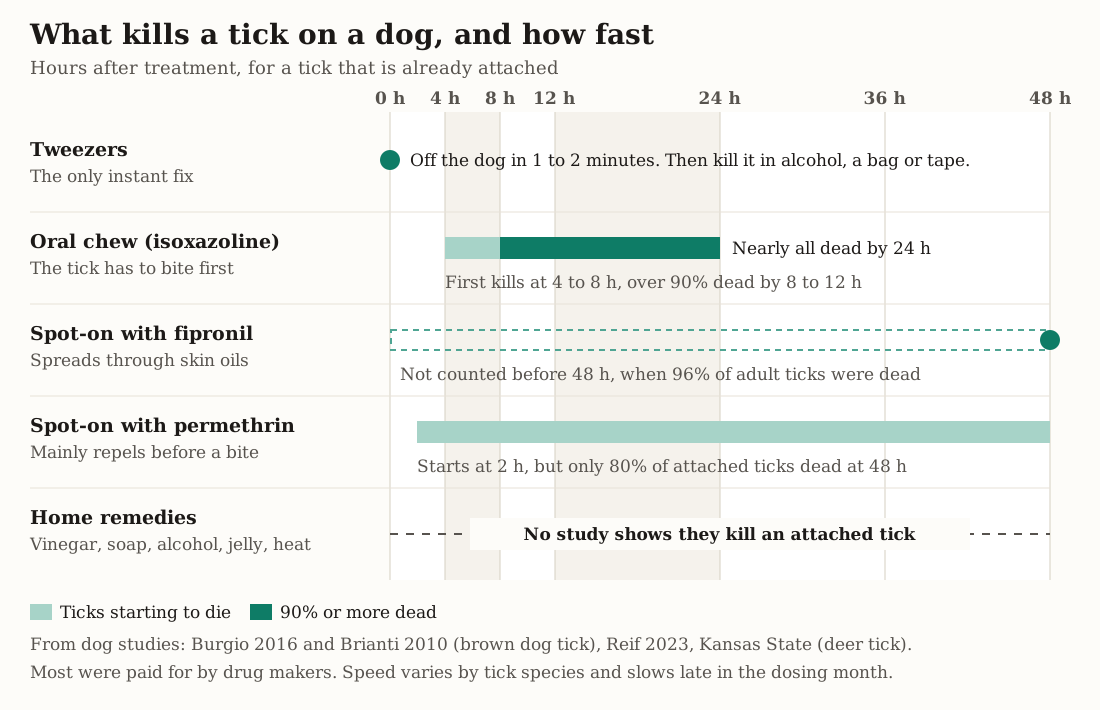
The fastest tick killers for dogs are the isoxazoline chews vets prescribe. In dog studies, they started killing attached ticks 4 to 8 hours after the dose, killed over 90% by 8 to 12 hours, and killed nearly all by 24 hours. Spot-ons were slower, taking up to 48 hours. None of them is instant.
So if you asked what kills ticks on dogs instantly because you want the next tick dead fast, these are the products to ask your vet about. They work on ticks that bite later, which is the job a home remedy cannot do.
Oral chews (isoxazolines): the fastest
The isoxazolines are the main tick drugs for dogs today, the Merck Veterinary Manual says. They come as chews, and one also comes as an injection your vet gives. The chew works through the dog’s blood, so a tick has to bite before it dies. That is why you may still find a dead tick attached to a dog on a chew.
The speed figures come from lab studies on dogs. In a 2016 trial with brown dog ticks, three chews killed over 90% of attached ticks within 8 hours. In a 2023 Kansas State University study with deer ticks, two chews controlled 93% to 99.7% of an existing infestation within 12 hours, and 99.5% to 100% within 24 hours.
Speed also drops late in the dosing month. In the Kansas State study, one chew killed none of a new batch of ticks within 8 hours, three to four weeks after the dose, while the other killed most of them. Both studies were paid for or run by drug makers, so treat the exact numbers with care.
Most chews last 1 month, and some last up to 12 weeks. In 2025, the FDA approved the first long-acting injection from the same class, which protects a dog for 8 to 12 months. Only a vet can give it.
Spot-ons and collars: slower, but some repel
Spot-ons are liquids you put on the skin, and collars release their chemical slowly over months. Both spread through the skin oils and coat, so some can kill or repel a tick before it bites. On ticks that are already attached, though, the studies we found show them working more slowly than the chews.
In a 2010 University of Messina trial on brown dog ticks, a fipronil spot-on had killed about 96% of adult ticks when they were counted at 48 hours. In the 2016 trial, a spot-on that pairs permethrin with imidacloprid began killing at 2 hours but had killed only 80% of attached ticks by 48 hours. Its strength is repelling ticks before they bite.
For collars, we found no independent speed figure we trust, so read the label for when protection starts. The Merck manual notes that the only amitraz product left on the market is a tick collar for dogs, and amitraz must never be used on a cat.
Table 2. Vet tick products for dogs by class
Oral chew (isoxazoline)
- How it reaches the tick
- Through the blood, so the tick must bite
- Starts killing an attached tick
- 4 to 8 hours; most dead by 8 to 12 hours
- Watch out for
- Prescription; FDA warning on tremors and seizures
Long-acting injection (isoxazoline)
- How it reaches the tick
- Through the blood
- Starts killing an attached tick
- No separate speed figure found
- Watch out for
- Vet-given; lasts 8 to 12 months
Spot-on with fipronil
- How it reaches the tick
- Skin oils and coat
- Starts killing an attached tick
- About 96% dead at 48 hours in one trial
- Watch out for
- Bathing rules on the label
Spot-on with permethrin
- How it reaches the tick
- Skin oils and coat; repels
- Starts killing an attached tick
- 80% of attached ticks dead at 48 hours in one trial
- Watch out for
- Highly toxic to cats
Tick collar
- How it reaches the tick
- Released slowly into the coat
- Starts killing an attached tick
- No independent figure found; see the label
- Watch out for
- Amitraz collars must never touch a cat
Pyrethrin spray or shampoo
- How it reaches the tick
- On contact with the coat
- Starts killing an attached tick
- Fast, but the effect is brief
- Watch out for
- Little or no lasting protection
The FDA warning on isoxazolines
The FDA has warned that isoxazoline products have been linked to muscle tremors, wobbliness (ataxia) and seizures in some dogs and cats. Seizures have happened even in pets with no history of them. Most pets have no such reaction, and the FDA still considers these products safe and effective.
So tell your vet if your dog has ever had a seizure, or takes other medicine. If your dog acts strangely after a dose, call your vet first. The FDA asks owners and vets to report reactions to the maker or to the agency.
Tick products for dogs: the label rule, and cats
Every tick product is safe only when used exactly as its label says. The FDA notes that some pet tick products are regulated by the FDA and some by the EPA. Either way, the label sets the species, the weight range and how often to use it. Never double a dose to make it work faster.
Read it for ticks, too. The Merck Veterinary Manual warns that fleas and ticks are not always controlled by the same ingredient, so a flea product may do nothing for ticks. It also says labels should be read for age and species limits. EPA’s review of pet spot-on incidents found that small dogs were hurt more often by some products, which is why the weight band matters.
Tick shampoos, dips and sprays: when vets use them
A tick shampoo or pyrethrin spray kills crawling ticks on contact, but the effect is brief, and it may not reach a tick that is already glued in. The Merck Veterinary Manual says newer chews and spot-ons have made many shampoos, rinses and dips essentially obsolete. Today they are mostly a tool for a vet facing a heavy infestation.
Natural pyrethrum, from chrysanthemum flowers, acts fast but briefly, Merck says, and ticks that are only stunned can recover. Permethrin can even make ticks leave the dog before they die. That is useful for repelling, but it is not a quick way to kill.
For a dog with hundreds or thousands of ticks, CAPC says a fast-acting pyrethrin or pyrethroid spray, followed by picking off the few left, can work better than picking alone. That is a call for your vet to make. The old amitraz dip is no longer made, Merck notes, and older organophosphate dips have a low margin of safety.
If you use a tick shampoo at home, pick one labeled for dogs and ticks, and follow the contact time on the label. Then check how long to wait before or after a bath if your dog also wears a spot-on.
Dog covered in ticks? See a vet the same day
A dog with dozens of ticks needs a vet the same day. The Merck Veterinary Manual says heavy infestations can damage the skin and cause anemia and paralysis, and that a clinic stay is likely. Your vet can remove them safely, give a fast-acting tick product and test for tick diseases later.
While you wait, wear gloves and take off the largest ticks with tweezers, dropping each one into a jar of rubbing alcohol. Keep other pets away from the dog. Then check yourself and your family, because ticks crawl off dogs onto people.
A cloud of pinhead-size ticks is usually larvae that hatched from one egg clump. Sticky tape or a lint roller can lift the loose ones off the coat, but it will not pull out the ones that have bitten. Our guide to seed ticks shows what they look like.
Ticks keep coming back inside the house
If ticks keep turning up on a dog that rarely goes out, or on walls and floors, suspect the brown dog tick. CAPC says it lives in homes and kennels and can be active all year. Unlike other US ticks, it can breed indoors. See our brown dog tick guide to confirm it.
Clearing it takes two jobs at once. Every dog in the home stays on a tick product, and the house is treated too. CAPC warns that an established infestation can take several months to bring under control and needs a licensed exterminator. Our guide to getting rid of ticks in the house and yard covers that side.
How to get rid of ticks on dogs for good
The way to get rid of ticks on dogs for good is a tick preventive all year, plus a check after every walk. CAPC advises year-round tick control for every dog, because tick seasons vary and brown dog ticks can infest homes in any month. Starting a product only once ticks appear lets them feed first.
- Ask your vet which tick product fits your dog, your area and the other pets at home.
- Check after every walk through grass, brush or woods, and remove any tick right away.
- Keep the yard tidy: short grass, and no brush or leaf piles where the dog plays.
- Stay on schedule. A late dose leaves a gap, and one study found slower kills late in the month.
CDC says signs of tick disease in pets can take 7 to 21 days or longer to show. Lyme disease is the only tick disease dogs can be vaccinated against. Our guide to ticks on dogs shows the seven places to check and the signs that need a vet. For people on the same walk, see how to prevent ticks, or start at our tick guide.
Pest control disclaimer. Photo-based identification can help, but it is not always perfect. For dangerous spiders, large infestations, or anything you are unsure about, contact a licensed pest control professional.
Veterinary disclaimer. This page is general information for dog owners. It is not veterinary advice, a diagnosis or a treatment plan, and it names product classes, not brands. Ask your veterinarian which tick product is right for your dog, and call them if your pet seems unwell after a tick bite.
Killing ticks on dogs: FAQ
Will a dead tick fall off my dog on its own?
What can I give my dog to kill ticks?
Can I use my own bug spray on my dog?
What kills fleas and ticks on dogs instantly?
Is a tick spray for the yard safe for my dog?
Can a tick kill a dog?
Related guides
Ticks on dogs
Where ticks hide on a dog, a tick or a skin tag, and the signs that need a vet.
How to remove a tick from a dog
Every step with tweezers or a tick tool, including a head that stays in.
Brown dog tick
The one US tick that breeds indoors, and how to clear a home of it.
Ticks on cats
Safe removal for cats, and why dog tick products can poison them.
Getting rid of ticks
Clearing ticks from the yard and house, and when to call a professional.
Seed ticks
Hundreds of tiny ticks at once: what they are and how to get them off.
All about ticks
The ticks that bite people and pets in the US, and what each can spread.
Sources
- CDC, What to Do After a Tick Bite (June 9, 2026)
- CDC, Preventing Ticks on Pets (May 2024)
- Needham (1985), Evaluation of five popular methods for tick removal, Pediatrics
- Merck Veterinary Manual, Ticks of Dogs (dog owners, updated Sept 2024)
- Merck Veterinary Manual, Ectoparasiticides Used in Small Animals
- Merck Veterinary Manual, Household Hazards (alcohols, bleach, soaps)
- US FDA, Fact Sheet about Potential Adverse Events Associated with Isoxazoline Flea and Tick Products
- US FDA, FDA approves first long-acting flea and tick treatment for dogs (July 10, 2025)
- Reif and others (2023), speed of deer tick kill on dogs, Kansas State University, Parasites & Vectors
- Burgio and others (2016), immediate efficacy against attached brown dog ticks, Parasites & Vectors
- Brianti and others (2010), fipronil spot-on against brown dog ticks, Veterinary Parasitology
- Companion Animal Parasite Council, Ticks guideline (March 30, 2023)
- Pet Poison Helpline, Essential Oils and Dogs
- ASPCA Animal Poison Control Center
- US EPA, Minimum Risk Pesticide Definition and Product Confirmation