How to prevent ticks: the 5 layers that work
How to prevent ticks comes down to 5 layers: avoid tick habitat, treat your clothes, put repellent on your skin, cover up, and check yourself after. CDC and the EPA list all five. No single layer is perfect, so use as many as the day calls for. A short dog walk needs fewer than a day of clearing brush.
- Avoid where ticks wait. Walk in the center of trails, away from tall grass, brush and leaf litter.
- Treat clothes and gear. Use a product with 0.5% permethrin on boots, clothes and camping gear, or buy them pretreated.
- Use a skin repellent. Pick one registered with the EPA for ticks, and follow the label.
- Cover up. Wear long sleeves and long pants, with the pants tucked into your socks.
- Check, dry and shower. Dry your clothes on high heat, shower within 2 hours, and look over your whole body.
Ticks are most active from April to September, CDC says, but bites happen in every month. Many people also pick up ticks in their own yard, not only on hikes. So knowing how to prevent ticks matters for gardening, mowing and walking the dog, too. If you want to know which ticks live near you, our guide to US ticks covers each kind and where it is found.
What repels ticks? The repellents that work, compared
Six active ingredients in EPA-registered skin repellents work against ticks: DEET, picaridin, IR3535, oil of lemon eucalyptus (OLE), PMD and 2-undecanone. CDC recommends all six. On clothes, 0.5% permethrin is the one that kills ticks on contact. The real differences are where each one goes, how long it lasts and who can use it.
A registration means the maker gave the EPA data showing the product works on the pests listed on the label. That is why CDC tells you to look for an EPA registration number (EPA Reg. No.) on the bottle. When used as directed, CDC says, these repellents are proven safe and effective, even for pregnant and breastfeeding women.
Table 1. Tick repellents for people, by where they go
Skin: DEET
- How long it lasts
- Hours, as stated on the label. Higher strength lasts longer, up to about 50%
- EPA status
- Registered (more than 500 products)
- Age limits
- None, the EPA says. Adults apply it for children
Skin: picaridin
- How long it lasts
- Hours, as stated on the label
- EPA status
- Registered (about 40 products)
- Age limits
- None, CDC says
Skin: IR3535
- How long it lasts
- Hours, as stated on the label
- EPA status
- Registered (about 45 products)
- Age limits
- None, CDC says
Skin: oil of lemon eucalyptus (OLE) or PMD
- How long it lasts
- Hours, as stated on the label
- EPA status
- Registered (6 products each). Not the same as pure lemon eucalyptus oil
- Age limits
- Not under 3 years old, CDC says. A few OLE-only labels allow it: read the label
Skin: 2-undecanone
- How long it lasts
- Hours, as stated on the label
- EPA status
- Registered (1 product)
- Age limits
- None, CDC says
Clothes and gear only: 0.5% permethrin
- How long it lasts
- Through several washes if you spray it on. Factory-treated clothes last longer: the tag gives the count
- EPA status
- Registered for clothing and gear. Never for skin
- Age limits
- Treated clothing is considered safe for toddlers, the EPA says
Skin: citronella, peppermint, cedar, geranium and other essential oils
- How long it lasts
- Under 2 hours in skin tests, often under 1 hour
- EPA status
- Most are not registered. The EPA has not checked whether they work
- Age limits
- Varies. Some cause skin irritation
Wristbands, sound devices, vitamin B, garlic pills
- How long it lasts
- None
- EPA status
- Not registered as tick repellents
- Age limits
- CDC calls them ineffective
From the EPA’s repellent pages, CDC’s Preventing Tick Bites and Yellow Book, and Eisen (2024). Product counts are the EPA’s.
DEET vs picaridin vs permethrin
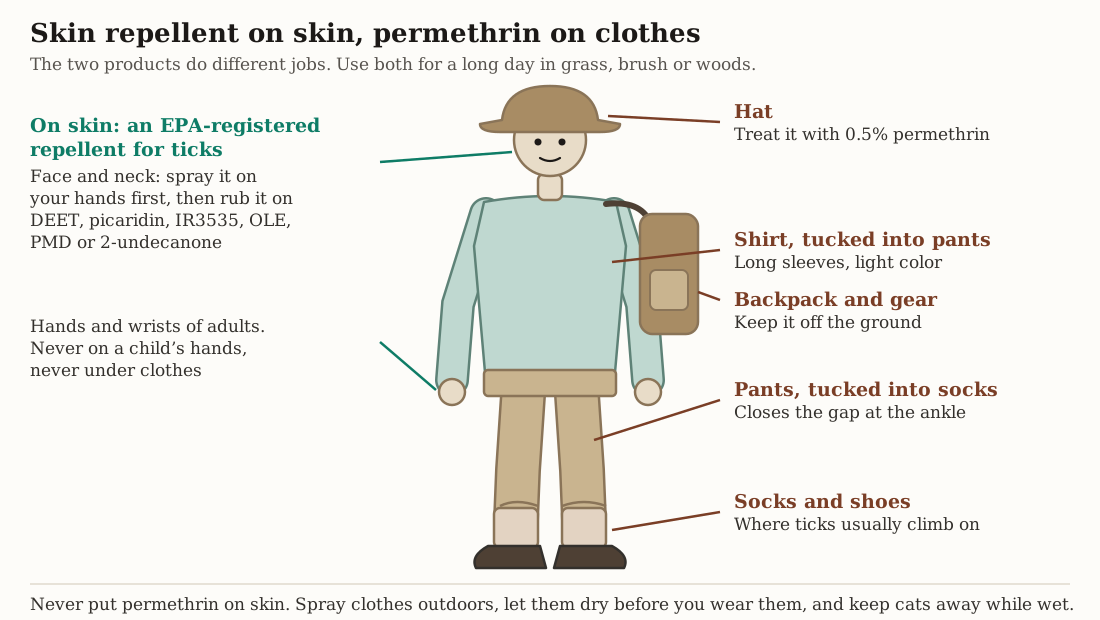
DEET and picaridin do the same job: they go on your skin and keep ticks from biting. Permethrin is different. It goes on clothing, where it repels and kills ticks that crawl on the fabric. So the real choice is not one or the other. For a long day in tick country, use permethrin on your clothes and DEET or picaridin on bare skin.
Between DEET and picaridin, pick by the protection time on the label and how it feels on your skin. CDC and the EPA treat both as effective tick repellents. CDC’s Yellow Book adds a rule of thumb: a product with less than 10% active ingredient may protect for only 1 to 2 hours. Above about 50%, DEET does not last much longer.
How to read a tick repellent label
Before you buy a tick spray for humans, turn the bottle over. You are looking for three things. Brand names change, so these are what count.
- An EPA Reg. No. No number means the EPA has not reviewed the product for ticks.
- The word “ticks.” Some repellents are tested only on mosquitoes.
- A protection time. Some labels carry an EPA graphic with the hours for ticks and mosquitoes. Match it to how long you will be out.
The EPA also runs a free online search tool. You can filter it by ticks, by active ingredient and by how many hours you need.
How to put on repellent
Apply it to bare skin only, never under clothes, and never over cuts or irritated skin. For your face, spray your hands first and rub it on, keeping it away from the eyes and mouth. If you wear sunscreen, CDC says to put it on first and the repellent second. Skip products that combine the two, because sunscreen needs reapplying more often than repellent does.
Use enough to cover the skin, but more does not help. Reapply only as often as the label allows. When you get home, wash the repellent off with soap and water, the EPA advises.
Natural tick repellents and essential oils: what the evidence says
Most natural tick repellents work for less than an hour. In a 2024 review, a CDC scientist found that 19 natural oil ingredients all lost full protection within 2 hours on human skin. DEET protected for the whole 6-hour test. The one plant-based repellent with EPA backing is registered oil of lemon eucalyptus.
The review, by Lars Eisen in the CDC journal Emerging Infectious Diseases, summed up the skin tests on blacklegged ticks. Rosemary, soybean and castor oil protected for less than 10 minutes. Peppermint, lemongrass, citronella, cedarwood, geranium, garlic and thyme oil lasted 10 minutes to 1 hour. Even the best, cinnamon, clove and geraniol, lasted 1 to 2 hours.
The rules explain why. Under federal law, products made only from a list of low-risk ingredients do not need EPA registration. These include citronella, cedar, geranium, peppermint and soybean oil. The EPA judged them safe at the strengths sold. However, it says these products have not been evaluated for effectiveness.
What smell do ticks hate the most?
No smell keeps ticks off you for a whole afternoon. A few oils, such as clove, cinnamon and geraniol, repel ticks for an hour or two in tests. Lavender, tea tree oil and vinegar have little or no testing on ticks at all. Treat any homemade tick repellent as a short-term extra, never the main layer.
Pure lemon eucalyptus essential oil is a common trap. It is not the same as registered OLE. CDC does not recommend the pure oil, because it has not been through testing for safety or effectiveness. The American Academy of Pediatrics says natural repellents may be fine where there is no serious disease risk. Where Lyme disease is common, it says to use DEET, picaridin or another approved product.
Plants work no better. No garden plant protects a person standing next to it. Making your yard less friendly to ticks is a different job, covered in the box further down.
Myth 1
Myth: “A flea and tick collar around your ankle keeps ticks off.”
Truth: A pet collar is a pesticide labeled for an animal, not for a person. Using a pesticide in a way its label does not allow is illegal, and the label is the law. Use a product registered for people instead.
Myth 2
Myth: “Sound devices and repellent wristbands keep ticks away.”
Truth: CDC's Yellow Book calls sound-emitting devices and repellent-soaked wristbands ineffective. Ticks find you by breath, heat and smell, not by sound.
Myth 3
Myth: “Taking garlic or vitamin B makes you taste bad to ticks.”
Truth: CDC lists both as ineffective. Nothing you swallow repels ticks.
Myth 4
Myth: “A sock of sulfur or a rub of menthol on your ankles works like DEET.”
Truth: Hikers and surveyors swear by both on Reddit. Still, no published test we found shows either one protects like DEET or picaridin, so treat them as extras at best.
Permethrin-treated clothing: how to use it and how long it lasts
Permethrin at 0.5% goes on clothes, shoes and gear, never on skin. It repels and kills ticks that crawl onto the fabric. Sprayed on at home, it lasts through several washes, CDC says. Factory-treated clothing lasts longer, but field trials show its protection fades over 1 to 2 years of wear.
The evidence for it is strong. In a 2011 lab test with deer tick nymphs, volunteers in treated summer clothes got 3.4 times fewer bites. Treated sneakers and socks did the most: their wearers were 73.6 times less likely to be bitten than people in untreated footwear. That fits how ticks climb on, from the ground up.
Field trials on outdoor workers agree. In North Carolina, factory-treated uniforms cut work-related tick bites by 82% in the first year, a 2014 trial found. In the second year, though, the benefit was smaller and no longer clear. Likewise, a 2020 trial in Rhode Island and Massachusetts found 65% fewer bites in year one and 50% in year two.
How long does permethrin last on clothes?
For a spray-on treatment, the label gives the number of washes or weeks. Retreat when you reach it. For factory-treated clothes, the hang-tag is the label, and the EPA says you must follow it. One finding is worth knowing: in a 2022 study, a third of foresters’ treated pants had no measurable permethrin left after a year of wear. Plan to retreat or replace work clothes you wear every day.
Is permethrin clothing safe?
For people, yes, when used as labeled. The EPA tested many scenarios, including toddlers mouthing treated clothes and soldiers wearing treated uniforms daily. All showed treated clothing is unlikely to pose a significant hazard. Less than 1% of permethrin on skin is taken into the body, the National Pesticide Information Center says.
A few rules keep it that way. Spray outdoors, and let clothes dry before you wear them. CDC’s Yellow Book suggests treating them 24 to 48 hours ahead. Wash treated clothes separately, as the EPA label requires, and never treat underwear. Keep spray away from ponds and streams, since permethrin is highly toxic to fish.
What to wear to keep ticks off
Clothing is the cheapest part of how to prevent ticks. Wear long sleeves, long pants, tall socks and closed shoes, and tuck your shirt into your pants and your pants into your socks. The EPA advises this. It keeps ticks on the outside of your clothes, where you can see them and where permethrin works. Light colors make dark ticks easier to spot.
Light colors come with a catch, though. In a 2005 Swedish study, walkers wearing light clothes picked up about 21 more ticks each over the study than in dark clothes. The authors could not say why. Light colors still help you see and remove ticks before they reach skin, so most health agencies recommend them.
- Leggings or tights. Snug fabric under loose pants helps, but tucking matters more. Ticks crawl up and through any gap.
- Long hair. Tie it up or wear a hat, and check the scalp after. Ticks climb toward the hairline.
- Hot weather. Choose thin, light, permethrin-treated long sleeves over shorts. Wisconsin’s health department suggests taping pant cuffs to socks for long days in heavy brush.
- Boots or sneakers. Closed shoes beat sandals. Treated shoes and socks give the most protection for the effort.
How do ticks get on you?
To learn how to prevent ticks, start with how they reach you: they climb onto you when you brush past them. They cannot jump or fly, CDC says. Instead, they wait on the tips of grass and shrubs with their front legs held out, a habit called questing. When your leg touches the plant, they grab on. Some bite quickly, while others wander up the body looking for thin skin, such as behind the ear.
They find you by sensing your breath, body odor, heat, moisture and the vibration of your steps. Some species even react to a shadow. A 2023 lab study added a twist: the static charge on a person or animal can pull a tick across a small air gap. Ticks still do not fall from trees, though. One found on your neck almost always climbed there.
So where do ticks wait? Leaf litter, low brush, tall grass at the edge of lawns and trails, logs, rocks, and even wooden picnic benches, the California Department of Public Health notes. Therefore, avoid sitting on logs, and keep your pack off the ground. The lone star tick also hunts actively and walks toward people, so watch the ground in the South and East. Our lone star tick guide explains its range.
In your own yard, the risk sits at the edges. The Connecticut Agricultural Experiment Station found 82% of the deer ticks on lawns within 3 yards (about 3 m) of the lawn’s edge, along woods, stone walls or plantings. Shade and damp ground hold more ticks, too. So treat a day of edging or weeding the border like a walk in the woods, with repellent and a check after.
Are ticks attracted to certain people?
Some people do seem to get more ticks, and the EPA notes that attractiveness varies from person to person. The reasons are not well studied. A 2018 pilot study in Petri dishes suggested European ticks prefer blood type A. However, it used only 100 ticks and has not been confirmed on people. Breath, heat and sweat matter more, and those are the same for everyone.
How to check for ticks, and where
The last step of how to prevent ticks is a check of your whole body within 2 hours of coming inside, by looking and by touch. Focus on the 8 spots ticks favor: the hair, ears, armpits, belly button, waist, groin, backs of the knees, and your back. A deer tick nymph is only about 1.5 mm (1/16 inch) long, so feel for a new bump as well as looking.
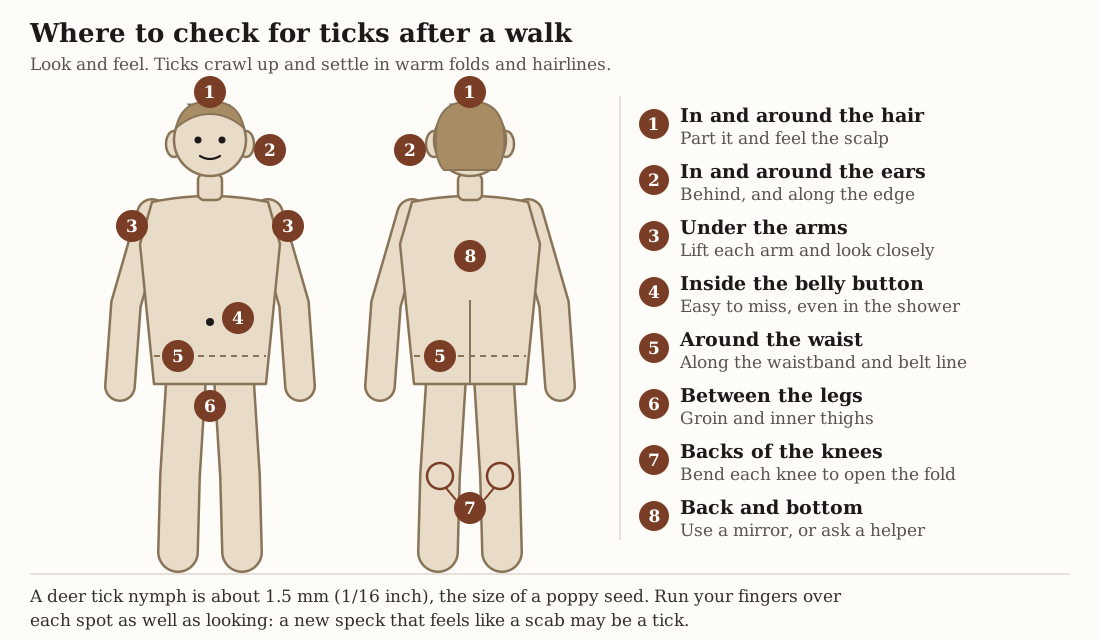
Use a full-length mirror and a hand mirror for your back, or ask a partner. Check children every day they play outside, including the scalp and behind the ears. A tick on clothes or crawling skin can be lifted off with tape. Not sure whether a speck is a tick? Our page on what a tick looks like shows each stage at true size.
Daily checks work because ticks feed slowly. In most cases, CDC says, a tick must be attached for more than 24 hours to pass on Lyme disease. A check every evening catches most ticks well inside that window. If you find one attached, take it off at once. Our guide on removing a tick safely shows the grip.
After the walk: the shower, dryer and 2-hour routine
When you come in from tick country, dry your clothes on high heat for 10 minutes, shower within 2 hours, and do a full tick check. That routine catches ticks still crawling on you and your clothes. CDC lists each step, and its scientists tested the dryer times themselves.
What to do in the first 2 hours
Check your clothes and gear before you go in
Brush off or tape off any tick you see on your pants, socks, shoes and pack. Ticks ride into the house on clothes and pets, then bite someone later. A lint roller or a strip of packing tape picks up tiny ones.
Put dry clothes in the dryer on high heat
CDC says 10 minutes on high heat kills ticks on dry clothes. Damp clothes need longer. Wisconsin's health department says 60 minutes, and a CDC lab test needed 50 minutes after a wash.
Wash in hot water only if the clothes need it
A cold or warm wash does not kill ticks. In the CDC lab test, every tick survived a cold wash and 94% survived a warm one. Only water at 130°F (54°C) or hotter killed them all. So dry first, then wash.
Shower within 2 hours of coming inside
CDC says a shower within two hours of coming indoors has been shown to lower the risk of Lyme disease. It washes off ticks that have not attached yet. Use a washcloth on the scalp, behind the ears and in skin folds.
Do a full tick check, by sight and by touch
Use a hand mirror or a full-length mirror, or ask someone to check your back. Look at the 8 spots in the diagram below, then feel each one. A nymph is about the size of a poppy seed.
Check children and pets the same day
Children get the same check, including the scalp. Run your hands over your dog, too. Then deal with any tick you find right away, because the risk of Lyme disease rises the longer a tick stays on.
The dryer is the step people skip, yet it matters most for clothes. In the 2016 CDC lab test, all ticks on dry clothes died within 6 minutes on high heat. Damp clothes are slower, because the water has to dry off first. So CDC’s 10 minutes for dry loads leaves a margin, and CDC says damp loads need more time.
Pets bring ticks inside too. Check your dog after every walk in grass or woods, and ask your vet about a tick preventive. Our guide to ticks on dogs shows where to look.
Tick repellent for children and babies
Knowing how to prevent ticks on children starts with an EPA-registered repellent, applied by an adult. The EPA sets no age limit for DEET. The one firm rule is about oil of lemon eucalyptus and PMD: CDC says not to use either on children under 3. For babies, the first line is clothing that covers arms and legs, plus netting over the stroller.
- Apply it for them. Put repellent on your own hands, then spread it on the child. Never put it on a child’s hands, which go to the eyes and mouth.
- Read OLE labels closely. The EPA says a few products with OLE as the only active ingredient, at 30% or less, carry no under-3 limit. If you are unsure, pick DEET or picaridin.
- Go easy with newborns. The American Academy of Pediatrics asks parents of newborns and premature babies to be especially careful with any chemical on the skin.
- Treat their clothes instead. Permethrin on clothes and shoes keeps product off young skin. The EPA found treated clothing safe even for toddlers who chew it.
- Wash it off. Bathe the child or wash treated skin and clothes when you come inside.
Johns Hopkins’ Lyme center tips, from 2019, say many doctors consider repellents unsafe for children and advise against them under age 3. That is out of step with federal guidance. The EPA and CDC say registered repellents are safe for children when used as labeled. Their under-3 limit applies only to OLE and PMD.
Tick repellent during pregnancy and breastfeeding
EPA-registered repellents are safe during pregnancy and breastfeeding when used as the label directs. CDC and the EPA both say so. That covers DEET, picaridin, IR3535, OLE, PMD and 2-undecanone. Permethrin-treated clothing is fine too: the EPA found no evidence of harm to mother or child.
A tick bite is the bigger worry. So keep using repellent and doing checks, and tell your doctor about any tick bite while you are pregnant. For the warning signs after a bite, see our tick bite guide.
Pest control disclaimer. Photo-based identification can help, but it is not always perfect. For dangerous spiders, large infestations, or anything you are unsure about, contact a licensed pest control professional.
Tick prevention FAQ
Is there a pill humans can take to prevent ticks?
What's the worst month for ticks?
Does regular bug spray repel ticks?
Do I still need a tick check if I used repellent?
Should I spray repellent on top of permethrin clothes?
Related guides
How to remove a tick
The tweezer grip, a stuck head, and what never to put on a tick.
Getting rid of ticks
Yard and house: landscaping, when spraying helps, and pros.
Ticks on dogs
Where to check your dog, safe preventives, and removal.
Seed ticks
Dozens of tiny larvae at once, and how to get them off fast.
Deer tick
The Lyme disease tick at its real size, stage by stage.
Bitten already?
Symptoms to watch for and when a bite needs a doctor.
All about ticks
Every common US tick, where it lives, and what it carries.
Sources
- CDC, Preventing Tick Bites (August 28, 2024)
- CDC Yellow Book, Mosquitoes, Ticks and Other Arthropods (repellents, permethrin, children)
- US EPA, Find the Repellent that is Right for You
- US EPA, Using Insect Repellents Safely and Effectively (children and OLE)
- US EPA, Repellent-Treated Clothing (permethrin)
- US EPA, Regulation of Skin-Applied Repellents (unregistered products)
- National Pesticide Information Center, Permethrin General Fact Sheet
- American Academy of Pediatrics, HealthyChildren.org, How to Choose an Insect Repellent for Your Child
- Wisconsin Department of Health Services, Tick Bite Prevention
- Johns Hopkins Lyme Disease Research Center, 5 Tips for Preventing Tick Bites and Lyme Disease (2019)
- Eisen L, Efficacy of Unregulated Minimum Risk Products to Kill and Repel Ticks, Emerging Infectious Diseases 30(1) (2024)
- Nelson CA and others, The heat is on: Killing blacklegged ticks in residential washers and dryers, Ticks and Tick-borne Diseases 7(5) (2016)
- Vaughn MF and others, Long-lasting permethrin impregnated uniforms: a randomized-controlled trial for tick bite prevention, American Journal of Preventive Medicine 46(5) (2014)
- Richards SL and others, Assessing Durability and Safety of Permethrin Impregnated Uniforms after One Year of Use, Journal of Medical Entomology 59(2) (2022)
- England SJ, Lihou K, Robert D, Static electricity passively attracts ticks onto hosts, Current Biology 33(14) (2023)