What does a tick look like?
A tick is a small, flat arachnid shaped like a teardrop or an apple seed. Adults and nymphs have eight legs, and larvae have six. Ticks have no antennae, no wings and no waist. Unfed, most adults are 1/16 to 3/16 inch (2 to 5 mm) long, and their bodies are brown, reddish brown or nearly black.
Ticks belong to the order Ixodida, in the same class as spiders and mites. The ticks that bite people outdoors in the US are hard ticks (family Ixodidae). Every hard tick has a hard plate, called the scutum or shield, just behind its mouthparts. Soft ticks (family Argasidae) have no shield, and you are unlikely to meet one outdoors.
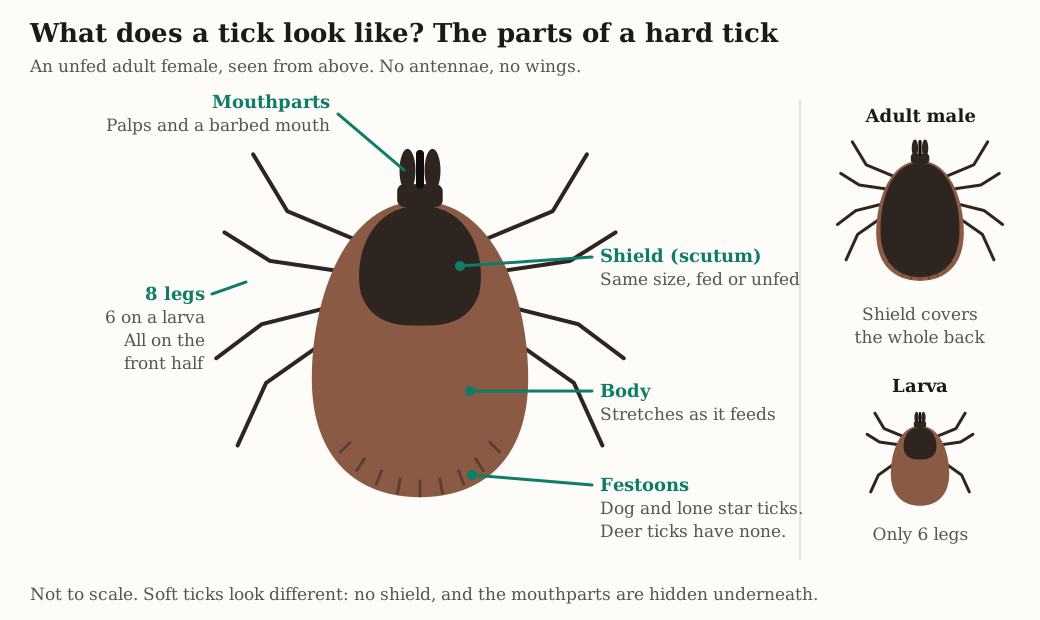
A tick’s body has only two parts. At the front sits a small head-like part that carries the mouthparts. Behind it is one large body with no segments, which holds the legs and stretches when the tick feeds. An insect, by contrast, has three body parts, six legs and a pair of antennae.
How can you tell if it’s a tick?
Count the legs first, then look for antennae and wings. Eight legs with no antennae and no wings means a tick or a mite. Six legs plus antennae means an insect, such as a beetle or a bed bug. Tick larvae are the exception, because they also have six legs. Even so, they still have no antennae.
Is it a tick? Check these five things
Check each clue below to narrow down what you saw.
Eight legs, or six on a speck under 1 mm
Six legs plus a pair of antennae means an insect.
No antennae and no wings
Ticks often hold their front legs out like feelers. Look at where they join the body.
Mouthparts that stick out in front of the body
Seen from above, a hard tick looks like it has a tiny beak.
A flat, oval body in one piece, with no waist
A pinched waist or three body parts means an insect.
It crawls, and it never jumps or flies
A bug that hops is more likely a flea. Lone star ticks crawl fast, so speed alone settles nothing.
Still unsure after the legs and antennae? Our round-up of bugs that are often mistaken for ticks shows each look-alike and the one feature that gives it away.
Tick body parts: mouthparts, shield and festoons
Tick experts look at three parts first: the shield, the mouthparts and the back edge of the body. These are the parts that tell one kind of tick from another. So they are worth a close look with your phone’s zoom.
The shield is the hard plate behind the head. On adult females, nymphs and larvae, it covers about the front third of the back. On adult males, it covers almost the whole back. The shield never grows, even when a female swells with blood. As a result, a fed tick still has a small, dark patch at the front.
The mouthparts point forward. Two side pieces, the palps, fold back when the tick bites. Between them is a mouth lined with backward-pointing barbs that anchor the tick in the skin. Deer ticks and lone star ticks have long mouthparts. American dog ticks have short ones, while brown dog ticks have short ones on a six-sided base.
Festoons are small panels, separated by grooves, along the back edge of the body. Lone star ticks, dog ticks and most other hard ticks have them. Deer ticks, like all Ixodes ticks, do not. In addition, some kinds have a pair of pale eye spots near the edges of the shield.
How many legs does a tick have?
Adult and nymph ticks have eight legs, in four pairs. Larvae, the first stage after the egg, have six. A larva gains its fourth pair of legs when it molts into a nymph. All the legs join the front half of the body. That is why a fed tick looks like a bean with tiny legs bunched at one end.
So a speck with six legs is not always an insect. Check for antennae, because a larval tick has none. Our page on seed ticks and other tiny ticks covers larvae and nymphs in detail.
Do ticks have antennae?
No. Ticks have no antennae at all. However, a tick waiting for a host climbs a grass stem and holds its front legs out in front of it, a habit called questing. Those waving front legs, or the two palps at the front, are what people mistake for antennae. Ticks find a host by sensing breath, body heat, body odor, light and vibration.
How big is a tick? Size by life stage
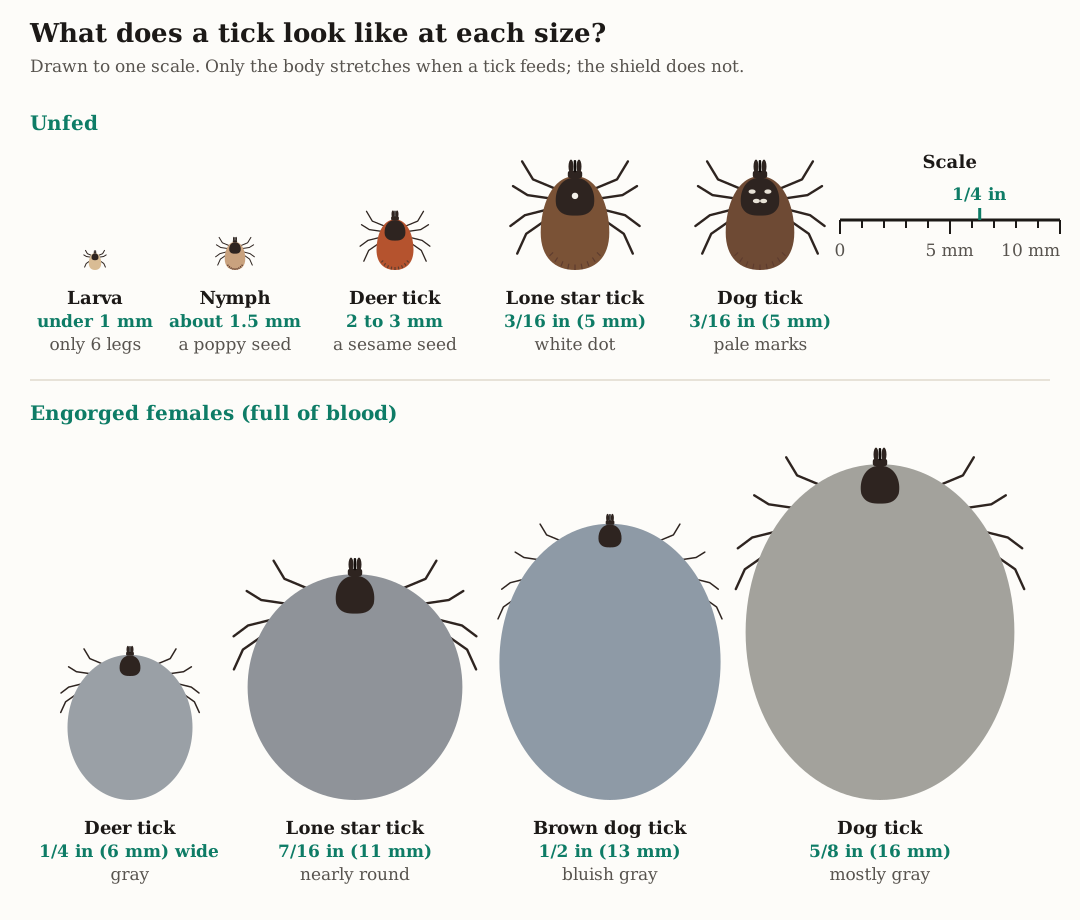
A tick’s size depends on its life stage and whether it has fed. Larvae are under 1 mm, about a grain of sand. A nymph is about 1.5 mm (1/16 inch), the size of a poppy seed. Unfed adults are about 2 to 5 mm (1/16 to 3/16 inch), like a sesame or apple seed. Fed females swell to 1/4 to 5/8 inch (6 to 16 mm).
Tick sizes by life stage, unfed and fed
A moving speck with 6 legs, often in a cluster
- Stage
- Larva (seed tick)
- Unfed
- Under 1 mm (less than 1/25 in)
- Fed
- Slightly larger and rounder
- Good to know
- Lone star larvae can latch on by the hundreds
A dot with 8 legs, pale, gray or see-through
- Stage
- Nymph
- Unfed
- About 1.5 mm (1/16 in)
- Fed
- Swells, but stays much smaller than an adult
- Good to know
- The deer tick stage that most often passes on disease to people
Black shield, orange-red body, black legs
- Stage
- Adult female deer tick
- Unfed
- 2 to 3 mm (1/16 to 1/8 in)
- Fed
- About 1/4 in (6 mm) wide, gray
- Good to know
- As wide as a pencil eraser when full
Dark brown all over, very small
- Stage
- Adult male deer tick
- Unfed
- 2 to 3 mm
- Fed
- Males do not swell
- Good to know
- Looks like a tiny watermelon seed
Brown, one white dot on the back
- Stage
- Adult female lone star tick
- Unfed
- About 3/16 in (5 mm)
- Fed
- About 7/16 in (11 mm), nearly round
- Good to know
- Males have white streaks on the rear edge instead
Brown with pale silvery marks
- Stage
- Adult American dog tick
- Unfed
- About 3/16 in (5 mm)
- Fed
- About 5/8 in (16 mm), mostly gray
- Good to know
- Ohio State calls it the largest tick in Ohio
Plain reddish brown, no marks
- Stage
- Adult brown dog tick
- Unfed
- About 1/8 in (3 mm)
- Fed
- About 1/2 in (13 mm), bluish gray
- Good to know
- Can live indoors where dogs live
Sizes from Ohio State University fact sheets HYG-2073 and ENT-0096. Seed comparisons are a rough guide only.
How small can a tick be?
The smallest ticks are larvae, at under 1 mm, and deer tick larvae are nearly see-through. Nymphs are about 1.5 mm, small enough to pass for a freckle that moves. So what does a tick look like before it feeds? Washington State’s health department tells people to look for “a new freckle or speck of dirt” when they check for unfed ticks.
If a speck walks, zoom in with your phone before you brush it away. Then count the legs. Ticks under 3 mm (1/8 inch) are usually young ticks that are hard to identify, so the Illinois health department suggests sending them to an expert.
How big can a tick get?
In the US, the biggest ticks people find are fed females. An engorged American dog tick reaches about 5/8 inch (16 mm), about the size of a raisin. Unfed, no common US tick is much larger than 3/16 inch (5 mm). So a “giant tick” in the grass or on a dog is almost always a female that has fed for days. We found no reliable measurement for the biggest tick in the world, so this page gives none.
Why tick sizes online disagree
Published tick sizes vary for three reasons. First, a fed tick can be several times longer than an unfed one, and not every page says which it measured. Second, males stay small while females swell. Third, the seed comparisons get shuffled from page to page.
Here is a real example. The Missouri Department of Conservation says engorged ticks swell up to about 3/8 inch. In contrast, Ohio State measures a fed American dog tick at about 5/8 inch and a fed brown dog tick at about 1/2 inch. Likewise, Missouri compares a larva to a poppy seed, while Ohio State and Cornell give the poppy seed to the nymph. This page uses Ohio State’s measurements.
What does an engorged tick look like?
An engorged tick is a female that has filled with blood. She looks like a smooth, round or bean-shaped bump, gray, bluish gray or tan, and 1/4 to 5/8 inch (6 to 16 mm) long. Her legs look tiny and bunched at the front, next to a small shield that did not grow. Before feeding, the same tick was flat and brown.
Only females swell this much. Males feed briefly and stay flat, so a big, round tick is a female. Engorging also takes days, not hours. Deer ticks usually feed for 3 to 5 days, and dog tick and lone star females can take a week or more. A swollen tick, then, has been attached for a while.
That matters because the chance of infection grows the longer a tick feeds. The CDC says that in most cases a tick must be attached for more than 24 hours to pass on Lyme disease. So removing a tick within a day greatly lowers the chance.
What does a tick look like on skin?
An attached tick looks like a small dark speck, a scab or a new mole. Only the mouthparts go into the skin, so the body stays on the surface where you can see it. A fed tick looks like a gray or tan bump. If the “scab” has legs at the skin end, it is a tick.
Ticks often settle in warm, hidden places: the hairline, behind the ears, under the arms, around the waist, between the legs and behind the knees. The mark a tick leaves after it is gone is a different question. Our guide to what a tick bite looks like covers it, and a bite alone can never tell you which bug made it.
What color are ticks?
If you are asking what does a tick look like by color, the answer is usually brown: most ticks are brown, reddish brown, or dark brown to black. Color, shield markings and size together point to the kind. Female deer ticks have an orange-red body behind a black shield. Lone star females carry one white dot, and American dog ticks have silvery marks. Fed ticks usually turn gray, bluish gray or tan.
What a tick's color usually means
Dark brown to black all over, very small
- What it most likely is
- An adult male deer tick
- Check next
- No festoons on the back edge; long, straight mouthparts
Orange-red body behind a black shield, black legs
- What it most likely is
- An adult female deer tick
- Check next
- Long mouthparts; about 2 to 3 mm unfed
Brown with one white or yellowish dot on the shield
- What it most likely is
- An adult female lone star tick
- Check next
- The dot sits on top, in the middle of the back
Brown with white streaks around the rear edge
- What it most likely is
- An adult male lone star tick
- Check next
- Only females carry the single dot
Brown with silvery or grayish-white marks
- What it most likely is
- An American dog tick
- Check next
- Short mouthparts; on males the marks streak across the whole back
Plain reddish brown, no markings, found indoors
- What it most likely is
- Likely a brown dog tick
- Check next
- Is there a dog in the home?
Tan, pale or see-through, very small
- What it most likely is
- A nymph or a larva
- Check next
- Count the legs: six means a larva
Gray, bluish gray or tan, and swollen
- What it most likely is
- An engorged female of any kind
- Check next
- The small shield at the front still shows the kind
Bright red all over, tiny, many crawling together
- What it most likely is
- Most likely a mite, not a tick
- Check next
- See the red ticks section below
Black ticks
A small black tick is usually a deer tick, also called the blacklegged tick. Ohio State describes both sexes as dark chocolate brown, and the adult male is dark all over, like a tiny watermelon seed. The female adds an orange-red body behind her dark shield. In both, the black legs are the giveaway.
Color matters most for Lyme disease. The CDC says that in the US only blacklegged ticks spread it. Lone star, American dog, Rocky Mountain wood and brown dog ticks cannot, although they carry other diseases.
Deer tick nymphs are lighter, from see-through to slightly gray or brown, with a dark shield. Our deer tick guide covers where they live and which diseases they carry.
Brown ticks
Brown is the most common tick color. A brown tick with pale, silvery marks on its shield is an American dog tick, also called a wood tick; our dog tick guide shows both sexes. One with a single white dot is a female lone star tick, the tick linked to red meat allergy.
A plain reddish-brown tick with no markings is likely a brown dog tick, especially if you found it inside a home with a dog: see how to confirm one and clear it from the house. Light brown and tan ticks are often nymphs. Ohio State notes that young ticks of most kinds are plain tan or brown and hard to name to species.
White and gray ticks
A “white tick” is usually one of three things. It may be a lone star female, whose white dot stands out. It may be an American dog tick, whose pale marks can look white. Most often, though, it is an engorged tick, because fed ticks turn gray, bluish gray or light tan.
A gray tick is not a more dangerous kind. Gray simply means it has fed, so it has probably been attached for days. The shield at the front still tells you which tick it is.
Red ticks: is that tiny red bug a tick?
Usually not. A tiny, bright red bug crawling in a group on a wall, a porch or a sill is most often a mite, such as a clover mite. No common US tick is bright red all over. The red tick people do meet is the adult female deer tick, whose red-orange body sits behind a black shield, on black legs.
To tell them apart, look for that black shield and count the legs. Clover mites are under 1 mm, red all over, with a long front pair of legs. Chiggers are too small to see clearly at all. Our guide to tiny red bugs in the house and yard covers clover mites, chiggers and velvet mites.
Some pages say a tick turns red after it feeds. Hard ticks, the ones that bite people outdoors, do the opposite. Ohio State, Harvard Health and Washington State’s health department all describe fed ticks as gray, bluish gray or tan. Soft ticks can look reddish for a short time after a meal. However, they live in rodent and bird nests, and people meet them mostly in rustic cabins.
The Illinois health department adds one more wrinkle: it describes deer ticks as ranging from dark brown to bright red. That red is on the female’s body only. Her shield and legs stay black, so a bug that is red from end to end is still more likely a mite.
What each common US tick looks like
So what does a tick look like where you live? Three ticks bite most people in the US: the deer (blacklegged) tick, the lone star tick and the American dog tick. On adults, two features tell them apart in seconds: the markings on the shield and the length of the mouthparts. Where you were matters too, because each tick has its own range.
Common US ticks at a glance
Black shield, orange-red body, black legs, no festoons
- Tick
- Deer tick (blacklegged tick)
- Unfed adult female
- 2 to 3 mm, red-orange and black
- Where in the US
- Northeast, Upper Midwest and Great Lakes most of all
Like a deer tick, but on the West Coast
- Tick
- Western blacklegged tick
- Unfed adult female
- Small, red-brown, a little more oval
- Where in the US
- Pacific Coast states
One white dot on a brown shield
- Tick
- Lone star tick
- Unfed adult female
- About 3/16 in (5 mm), rounder body
- Where in the US
- Southeast, south-central and mid-Atlantic, spreading north and west
Silvery marks on a brown shield, short mouthparts
- Tick
- American dog tick (wood tick)
- Unfed adult female
- About 3/16 in (5 mm)
- Where in the US
- Most of the US east of the Rockies, plus parts of the West
Like a dog tick, with long, narrow mouthparts
- Tick
- Gulf Coast tick
- Unfed adult female
- Brown with pale marks, more angular shield
- Where in the US
- Coasts from New Jersey to Texas, inland to Oklahoma and Kansas
Like a dog tick, in the mountain West
- Tick
- Rocky Mountain wood tick
- Unfed adult female
- Brown with pale marks
- Where in the US
- Mountain states and the inland Northwest
Plain reddish brown, no marks, indoors with dogs
- Tick
- Brown dog tick
- Unfed adult female
- About 1/8 in (3 mm)
- Where in the US
- Nationwide, most common in the South
For each of the big three in depth, see our guides to the blacklegged deer tick, the lone star tick and its white dot and the American dog tick, or wood tick. Our tick identification chart for every US species adds the Asian longhorned tick, the woodchuck tick and the rest, with where each one lives.
When you ask for help, always say where you found the tick. Tick experts at the University of Rhode Island use the location, the season and any recent travel alongside the shield and mouthparts. Similarly, the tick community on Reddit asks for a location on every ID request.
Soft ticks look different
Soft ticks have no shield. Their bodies are soft and leathery, and from above you cannot see their mouthparts, which sit underneath. They live in rodent and bird nests and in rodent-infested cabins. They also feed at night for a short time, much like bed bugs, so most people never know they were bitten. In the West, some soft ticks carry tick-borne relapsing fever.
Is it really a tick? Common look-alikes
Plenty of small, round bugs get mistaken for ticks. At the University of Rhode Island’s TickSpotters program, about 1 in 20 photos people send in shows a look-alike instead. Spider beetles, weevils, carpet beetles, bed bugs, young stink bugs, clover mites and pseudoscorpions are the usual ones.
Bed bugs cause the most worry, since both feed on blood. A bed bug has six legs, antennae and a body with visible bands, and it hides in mattress seams. A tick has eight legs and no antennae, and it usually comes in from outdoors on you or a pet. Our tick vs bed bug comparison puts the two side by side, and the round-up of bugs that look like ticks covers the rest.
How to photograph a tick for an ID
A useful tick photo shows the shield, the mouthparts and the back edge, sharp enough to count the legs. Take it from straight above in daylight, next to a ruler or a coin for scale. Then add where and when you found it. With those three things, an expert has what they need.
Keep it whole
If it is crawling, press clear tape over it, or put it in a sealed bag or a small jar. Do not crush it. A squashed tick loses the parts an expert needs to see.
Remove an attached tick first
Do not wait to take a photo. Pull it out with fine-tipped tweezers, then photograph it on the tape or inside the bag.
Add a size scale
Set it on white paper beside a ruler or a coin. A US penny is 3/4 inch (19 mm) across.
Use daylight, not the flash
Shoot near a window. A flash can change the color you see, and color is one of the clues.
Shoot the top, then the underside
Fill the frame and tap to focus. The top shows the shield, the mouthparts and the back edge. The underside helps an expert too.
Write down where and when
Note the state, the date, what you were doing and any recent travel. Experts use all of it alongside the photo.
Ask an expert, and keep the tick
Many state health departments and extension offices identify ticks, and the University of Rhode Island's TickSpotters accepts photos. Keep the tick sealed in case a doctor asks about it.
Photo apps and chatbots give a first guess, not an answer. On Reddit, people report an app giving different answers for the same tick, and in one thread we read, an exterminator called a bed bug a tick. Use our photo bug identifier to narrow it down. Then check the legs, the shield and the mouthparts yourself.
You found a tick: what to do next
First, check whether it is attached. A tick that is only crawling has not fed yet, so lift it off with tape and check the rest of your body. An attached tick should come off now, with fine-tipped tweezers held close to the skin. Then clean the bite, keep the tick, and watch for a rash or fever over the next few weeks.
What your tick find likely means
A tick crawling on your skin or clothes
- What it likely means
- It has not fed yet
- What to do
- Tape it, seal it in a bag, and check your body, hair and clothes
A flat tick attached to your skin
- What it likely means
- It started feeding recently
- What to do
- Remove it now with fine-tipped tweezers and note the date
A swollen, gray tick attached to your skin
- What it likely means
- It has fed for days
- What to do
- Remove it now, and call a doctor if you live in or visited a Lyme area
Dozens of specks with six legs
- What it likely means
- A cluster of larvae, often lone star ticks
- What to do
- Lift them off with duct tape, shower, and dry your clothes on high heat
Ticks on a dog, or on walls and furniture
- What it likely means
- Possibly brown dog ticks living indoors
- What to do
- Talk to your vet about the dog, then treat the home
A tiny bug that is red all over
- What it likely means
- Most likely a mite
- What to do
- Check the legs and look for a dark shield
The safe way to remove a tick is the same for every kind. Grip it close to the skin with fine-tipped tweezers and pull straight out with steady pressure, without twisting or jerking. Skip nail polish, petroleum jelly and heat. They do not make a tick let go, and Washington State’s health department warns they may make it release more saliva. Our step-by-step guide on removing a tick safely also covers what to do if part of it stays in the skin.
For a tick on a pet, our guide to finding and removing ticks on dogs shows where to check. For ticks in the yard or the house, see how to get rid of ticks.
For everything else about ticks, from where they live to when they are most active, start at our complete guide to ticks.
Medical disclaimer. This page is for general information only. It is not a medical diagnosis. If you have severe symptoms, trouble breathing, swelling of the face or throat, fast spreading redness, fever, severe pain, pus, or signs of infection, contact a doctor or your local emergency number.
Pest control disclaimer. Photo-based identification can help, but it is not always perfect. For dangerous spiders, large infestations, or anything you are unsure about, contact a licensed pest control professional.
Tick appearance FAQ
Do ticks have eyes?
Can ticks jump or fly?
Are ticks insects?
Is a tick with a white spot always a lone star tick?
What does a tick look like on a dog?
Related guides
Ticks
The full guide: what ticks are, where they live, the diseases they carry and how to stay safe.
Types of ticks
Every common US tick on one identification chart, with where each one lives.
Deer tick
The black-legged tick behind Lyme disease, at every life stage.
Lone star tick
The tick with the white dot, and the red meat allergy linked to it.
Dog tick
The American dog tick, or wood tick: silvery marks, range and risks.
Seed ticks
Six-legged larvae and poppy-seed nymphs, and what to do about a cluster.
Bugs that look like ticks
Spider beetles, weevils, bed bugs and mites, with the feature that separates each.
How to remove a tick
The tweezer method step by step, and what to do if the head stays in.
Sources
- Ohio State University Extension, HYG-2073, Ticks and their control
- Ohio State CFAES, ENT-0096, Blacklegged (deer) tick
- University of Rhode Island TickEncounter, Tick ID guide
- University of Rhode Island TickEncounter, Tick growth comparison charts
- University of Rhode Island TickEncounter, Tick look-alikes
- Illinois Department of Public Health, Tick identification
- Missouri Department of Conservation, Ticks
- Cornell CALS, Tick biology
- Washington State Department of Health, Tick photo gallery
- Washington State Department of Health, Ticks
- Harvard Health Publishing, Tick bites A to Z
- Virginia Department of Health, Tick identification
- Minnesota Department of Health, Ticks
- CDC, How Lyme disease spreads
- Mayo Clinic, Guide to different tick species and the diseases they carry