What to do right after a tick bite
Right after a tick bite, take the tick off at once with tweezers, wash the bite, and keep the tick. Then write down the date and where you were. CDC says that in most cases a tick must be attached for more than 24 hours to pass on Lyme disease. So the first minutes matter more than anything you put on the skin.
After a tick bite: step by step
Take the tick off now
Do not wait to see a doctor first. CDC says waiting could raise your risk of a tick-borne disease. Grip the tick with clean, fine-tipped tweezers, as close to the skin as you can. Then pull straight out with steady, even pressure. Do not twist or jerk it.
Skip the home remedies
Do not use petroleum jelly, nail polish, heat or anything else to make the tick let go. CDC says these can make it push infected fluid into the skin. Do not crush the tick with your fingers.
Leave stuck mouthparts alone
If bits of the mouth stay in the skin, try once to lift them out with the tweezers. If they do not come out easily, leave them. The skin pushes them out as it heals.
Wash the bite and your hands
Soap and water is enough. The bite needs no oil or home remedy. The Red Cross says a dab of antibiotic ointment is fine if you are not allergic to it.
Keep the tick
Seal it in a small bag or a jar, or wrap it tightly in tape. If it is too small to handle, take a clear photo of it on white paper next to a coin or a ruler.
Write down the date and the place
Note the day you found it, where you think you picked it up, and how long it may have been on. Keep the note for a few months, because some tick illnesses start weeks later.
Check for more ticks
One tick often means another. Check the scalp, ears, armpits, belly button, waist, groin and behind the knees. Look over children and pets too.
Ask about an antibiotic if Lyme is common where you were
CDC says a single dose of doxycycline after a tick bite in an area where Lyme disease is common may lower the risk. Call your doctor soon and ask whether it is right for you.
Watch for symptoms for 30 days
Look for a rash, fever, headache, tiredness, muscle pain or swollen, painful joints. If any of them start, see a doctor and say when and where the bite happened. A few signs, such as swollen knees or a red meat allergy, can take months.
Our guide on how to remove a tick safely shows the grip step by step, and what to do when the head stays in. Not sure what kind of tick it was? Compare it with our chart of the common US ticks. You can also take a photo and try the bug identifier by picture.
How long was it on, and why it matters
The shorter the time a tick feeds, the lower the risk. CDC’s tick bite fact sheet says your risk of Lyme disease is very low if the tick was attached for less than 24 hours. Even so, it adds that some germs need only minutes to pass on, and others need days. So the 24-hour figure is good news for Lyme, not a safe window for every germ.
You can often judge the time from the tick itself. A flat tick has only just started to feed. In contrast, a tick that is swollen, round or gray has been feeding for longer. Tell your doctor which one you found, since it changes what they may suggest.
What is normal after a tick bite
A normal tick bite leaves a small red bump or patch, often like a mosquito bite, right where the tick was. CDC says this redness is common, usually fades in 1 to 2 days, and is not a sign of Lyme disease. The bump may itch or feel tender, and that alone is no cause for worry.
A normal reaction also stays small. Doctors at the Johns Hopkins Lyme Disease Research Center describe it as usually under 1 to 2 inches (2.5 to 5 cm) across. It does not keep growing when you check it over 24 to 48 hours. Some reactions can still last days or even weeks, which is why a bump alone is not a reason to panic.
What a tick bite looks like
Usually a single small red bump, much like a mosquito bite, right where the tick was attached. It is often found only because the tick was found. Our guide to what a tick bite looks like, day by day shows a normal bite next to the Lyme rash.
Do tick bites itch or hurt?
Most tick bites do not hurt when they happen, so many people never feel them. CDC notes that tick bites can be painless and that many people with a tick-borne illness do not remember being bitten. MedlinePlus adds that a tick often moves to a warm, moist spot before it bites, such as the armpits, the groin or the hair.
After you remove the tick, though, the bite often itches. The itch usually settles in a few days. NHS inform lists swelling, itching, blistering and bruising as possible reactions at the bite. On Reddit, some readers describe an itchy bump that lasted for weeks, and a few say the bite stung at the time. Both fit a local reaction to the tick’s saliva, which Harvard Health says can cause itching and raised bumps.
Interestingly, the Lyme rash is the opposite. CDC says it may feel warm but is rarely itchy or painful. So a bump that itches for a week is not a sign of Lyme disease. By the same logic, a rash that does not itch is not a sign of safety.
How long does a tick bite last?
The redness usually fades in 1 to 2 days, CDC says, while a small bump can last days or even weeks. Harvard Health notes that a tick’s saliva can also leave a firm lump, called a granuloma, that lasts much longer. Such a lump is harmless in most cases. See a doctor if it keeps growing, breaks open, or comes with swollen glands nearby.
Tick bite symptoms to watch for, and when they start
Tick-borne illnesses start days to weeks after the bite, not on the first day. CDC lists the common symptoms as fever or chills, aches and pains, and a rash. Rocky Mountain spotted fever starts 3 to 12 days after the bite, and Lyme disease 3 to 30 days after. Alpha-gal syndrome, a meat allergy, can take weeks to months.
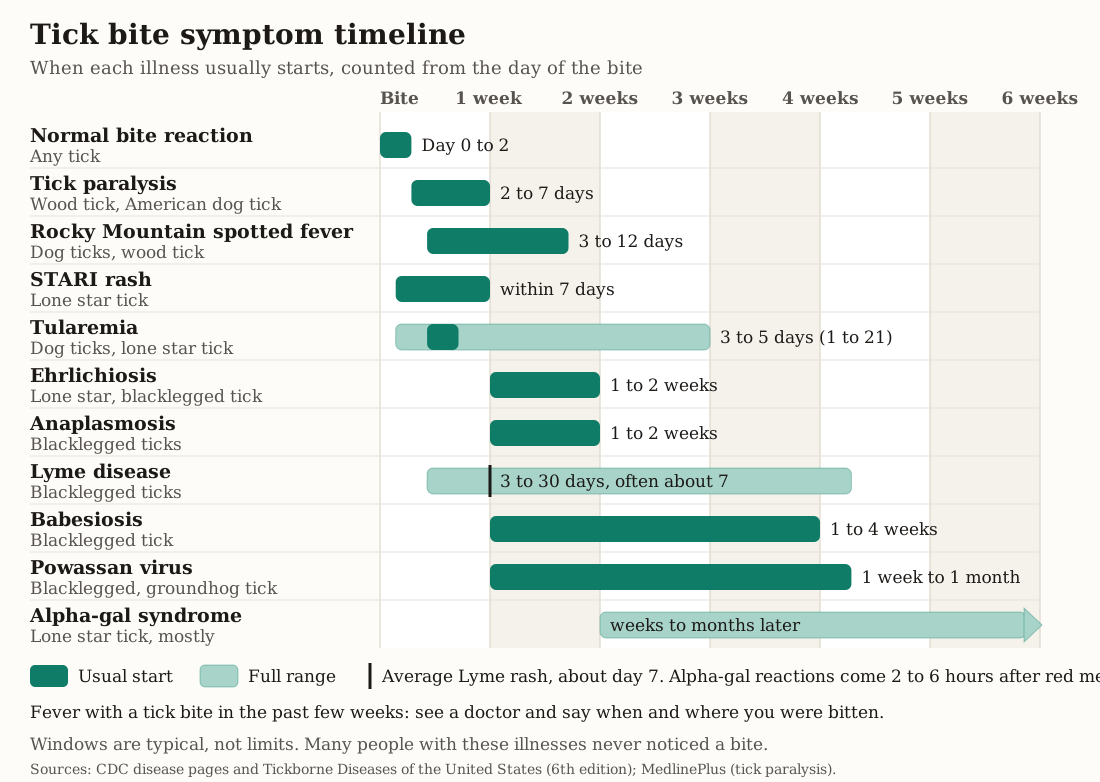
The timeline above shows why the 30-day watch matters. Most of these windows close within a month. A fever that starts two weeks after a hike still counts as a tick bite symptom, even though the bite itself has healed.
Which illness you might get depends on the tick and the place. Blacklegged (deer) ticks carry Lyme disease, anaplasmosis and babesiosis, mostly in the Northeast, the mid-Atlantic and the upper Midwest. In contrast, dog ticks carry Rocky Mountain spotted fever. The lone star tick carries ehrlichiosis and is the main cause of alpha-gal syndrome. Many of these diseases look alike at first, so the table below is a reference, not a way to diagnose yourself.
Table 1. Tick-borne illnesses in the US: the tick, when they start, and the warning sign
Lyme disease
- Spread by
- Blacklegged (deer) ticks
- Usually starts
- 3 to 30 days, often about day 7
- The warning sign
- A red rash that keeps growing over days, often past 2 inches (5 cm), with or without fever and aches. Later: a drooping face, an irregular heartbeat, swollen knees
Rocky Mountain spotted fever
- Spread by
- American dog tick, Rocky Mountain wood tick, brown dog tick
- Usually starts
- 3 to 12 days
- The warning sign
- Fever and headache first. A rash of small spots on the wrists and ankles may follow 2 to 5 days later, or never. Deadly if treatment is late
Ehrlichiosis
- Spread by
- Lone star tick, blacklegged tick
- Usually starts
- 1 to 2 weeks
- The warning sign
- Fever, chills, a severe headache, muscle aches, nausea. A rash in up to 1 in 3 people, more often in children
Anaplasmosis
- Spread by
- Blacklegged ticks
- Usually starts
- 1 to 2 weeks
- The warning sign
- Fever, chills, a severe headache, muscle aches, nausea or vomiting
Babesiosis
- Spread by
- Blacklegged tick
- Usually starts
- 1 to 4 weeks
- The warning sign
- Often none. Fever, chills, sweats and tiredness. Serious for people with no spleen, a weak immune system, or over 50
Tularemia
- Spread by
- Dog ticks, lone star tick, also deer flies
- Usually starts
- 3 to 5 days, up to 21
- The warning sign
- Fever as high as 104°F (40°C), a sore where the tick fed, swollen glands in the armpit or groin
STARI (southern tick-associated rash illness)
- Spread by
- Lone star tick
- Usually starts
- Within 7 days
- The warning sign
- A red rash that grows to 3 to 12 inches (8 to 30 cm), much like the Lyme rash, with tiredness, fever or aches
Powassan virus
- Spread by
- Blacklegged and groundhog ticks
- Usually starts
- 1 week to 1 month
- The warning sign
- Fever, headache, vomiting, weakness. Then confusion, loss of balance, trouble speaking or seizures
Alpha-gal syndrome
- Spread by
- Lone star tick, mostly
- Usually starts
- Weeks to months after the bite
- The warning sign
- Hives, stomach pain, vomiting, or swelling and trouble breathing 2 to 6 hours after eating red meat or dairy
Tick paralysis
- Spread by
- Rocky Mountain wood tick, American dog tick
- Usually starts
- 2 to 7 days after the bite
- The warning sign
- Unsteady walking, then weakness that climbs up from the legs. The tick is still attached, often in the hair
From CDC disease pages and CDC’s reference manual, Tickborne Diseases of the United States (6th edition), with tick paralysis from MedlinePlus. Times vary from person to person.
Each tick has its own guide. For Lyme disease and the blacklegged tick, see our deer tick guide. For Rocky Mountain spotted fever, read about the American dog tick. The meat allergy and ehrlichiosis are covered on our lone star tick page.
When to worry about a tick bite
Worry about a tick bite when new symptoms appear, not when the bite itches. A fever, a headache or a growing rash in the 30 days after a bite means a doctor. A fever means a call the same day. Trouble breathing, confusion or weakness that spreads means 911. The table matches each sign to how fast to act.
Table 2. After a tick bite: what you notice, how soon to act, and who to call
Trouble breathing, a swelling face, lips, tongue or throat, hives all over, or fainting
- How soon
- Now
- Who to call
- 911. This can be anaphylaxis, including an alpha-gal reaction hours after a meal of red meat
Confusion, a seizure, trouble speaking, loss of balance, or weakness that climbs from the legs
- How soon
- Now
- Who to call
- 911 or the emergency room. Check the scalp and hair for a tick that is still attached
A fever of 100.4°F (38°C) or higher, chills or a bad headache in the 2 weeks after a bite, with or without a rash
- How soon
- Same day
- Who to call
- Your doctor, urgent care, or the ER if very ill. Rocky Mountain spotted fever can be deadly if treatment is late
A drooping face, a severe headache with a stiff neck, or a racing or irregular heartbeat
- How soon
- Same day
- Who to call
- Your doctor or the ER. A face that droops suddenly with arm weakness or slurred speech is a stroke sign: call 911
A red rash that keeps growing over several days, 3 to 30 days after the bite
- How soon
- Within a day or two
- Who to call
- Your doctor. Take a dated photo of the rash each day
Tiredness, muscle or joint aches, or swollen glands in the weeks after a bite
- How soon
- Within a few days
- Who to call
- Your doctor. Mention the bite, even if it healed
Hives, stomach cramps or vomiting a few hours after red meat, weeks or months after a bite
- How soon
- Soon, or 911 if breathing is affected
- Who to call
- Your doctor or an allergist. Ask about alpha-gal syndrome
The bite gets more painful, hot or swollen after day 2, oozes pus, or shows red streaks
- How soon
- Same or next day
- Who to call
- Your doctor or urgent care. Same day if you also have a fever
A swollen tick was on a long time, or for an unknown time, where Lyme disease is common
- How soon
- Within a few days
- Who to call
- Your doctor, to ask whether an antibiotic after the bite is right for you
A small red bump that fades in 1 to 2 days, and you feel well
- How soon
- No visit needed
- Who to call
- Nobody. Keep watching for 30 days
Signs from CDC pages on Lyme disease, Rocky Mountain spotted fever, Powassan virus and alpha-gal syndrome, and from CDC’s tick bite fact sheet. When in doubt, call: a doctor would rather hear about a fever after a tick bite than miss it.
Why a fever after a tick bite cannot wait
Rocky Mountain spotted fever starts like the flu, with fever and headache. CDC says it can turn serious fast. Its reference manual adds that antibiotics are most likely to prevent death when started in the first 5 days of symptoms. About 1 in 10 people never get the rash, so do not wait for one. CDC adds that cases occur throughout the US.
Doctors treat a suspected case before the blood test comes back, because the test can take weeks. That is why a same-day visit, and a clear mention of the bite, can change the outcome. CDC’s Rocky Mountain spotted fever page lists the full set of signs.
The rash that keeps growing
The Lyme rash, erythema migrans, starts at the bite 3 to 30 days later, about 7 days on average, and CDC says about 70 to 80 percent of infected people get it. Its key feature is that it keeps growing, which a normal bite does not, so a growing rash needs a doctor. Draw a pen line around the edge to show the change. Our guide to a normal tick bite vs a Lyme rash shows the forms it takes, the 2 inch (5 cm) line and how it looks on darker skin.
A meat allergy weeks later
Alpha-gal syndrome is easy to miss because it shows up long after the bite. CDC says it can take weeks to months after a tick bite for symptoms to start. Once they do, they usually appear 2 to 6 hours after eating red meat or dairy. A bout of hives or stomach cramps in the middle of the night, after a steak dinner, is the classic story. CDC explains the symptoms on its alpha-gal syndrome symptoms page.
When to see a doctor after a tick bite, and what to tell them
See a doctor after a tick bite if you get a rash, a fever or other symptoms within several weeks, CDC says. Also call if a swollen tick was on you where Lyme disease is common, or if you cannot get the tick out. Most people with a tick bite and no symptoms do not need a visit.
Before the visit, have these answers ready. They shape what the doctor does next.
- When you were bitten, or when you found the tick.
- Where you most likely picked it up: the state, the county, and whether it was woods, a trail or your yard.
- How long it may have been on, and whether it was flat or swollen with blood.
- What kind of tick it was: bring the tick in its bag, or a photo of it.
- Your symptoms and the day each one started, with dated photos of any rash.
- Anything that changes treatment: pregnancy, breastfeeding, drug allergies, or a weak immune system.
CDC asks people to tell the doctor about a recent tick bite, when it happened and where it was most likely picked up. Harvard Health adds the tick’s size, whether it was attached, and how long. CDC’s What to Do After a Tick Bite page also links an online tick bite guide that walks through these questions.
Do you need an antibiotic after a tick bite?
Sometimes, and only for Lyme disease. CDC says a single dose of doxycycline after a tick bite may lower the risk in certain cases. That applies in areas where Lyme disease is common. Ask your doctor soon whether an antibiotic after the bite is right for you. The answer depends on the tick, the place and how long it fed.
That dose does not cover everything, however. CDC’s reference manual says antibiotics after a bite are not recommended to prevent anaplasmosis, babesiosis, ehrlichiosis or Rocky Mountain spotted fever. So even after a dose, keep watching for fever for the full 30 days. Never take leftover antibiotics from home.
Should you test the tick?
No. CDC does not recommend tick testing, even though some labs sell it, and says the results should not be used for treatment decisions. A tick that carries a germ may not have passed it on. A clean result can give false comfort, since another tick may have bitten you unseen. Besides, you would likely feel sick before the result came back. Keep the tick so a doctor can see what kind it was.
Should you get a Lyme blood test right after the bite?
No, not without symptoms. The Johns Hopkins Lyme Disease Research Center says blood tests do not accurately diagnose Lyme disease in the first few weeks of infection. Harvard Health adds that no tests are needed after a bite unless symptoms develop. A test on the day of the bite would come back negative even if you were infected. Watching for symptoms is the better test.
Infected tick bite or allergic reaction?
An infected tick bite gets worse after the second day instead of better. Look for more pain, heat and swelling, pus, or red streaks spreading from the spot. That is a skin infection, and it needs a doctor within a day, or the same day with a fever. Local itching and swelling in the first 2 days is usually a reaction to the saliva.
MedlinePlus notes that mouthparts left in the skin usually work their way out without trouble, but a local infection is possible. Scratching an itchy bite can also let bacteria in. Keep the bite clean and try not to scratch. For an itch that bothers you, ask a pharmacist which anti-itch product suits you.
A few bites cause bigger reactions. Harvard Health lists pus-filled bumps, hardened skin and the lumps called granulomas. A whole-body allergic reaction, with hives, swelling or trouble breathing, is rare but needs 911, as our bee sting guide explains for stings. Meanwhile, an open sore with swollen glands nearby can be tularemia. CDC says that illness causes a skin ulcer where the tick fed.
An infection is also not the same as a Lyme rash. An infected bite is hot, painful and often has pus. The Lyme rash spreads steadily outward, is rarely painful, and starts days after the bite. If you cannot tell which one you have, show a doctor.
Tick bites on children and during pregnancy
Treat a tick bite on a child or during pregnancy the same way: remove the tick at once and keep it. After that, call the child’s doctor or your own for advice, even without symptoms. A fever after a tick bite in a child, or in pregnancy, needs a same-day call. Treatment choices depend on age and pregnancy.
Children
Children pick up ticks in the hair, behind the ears and in skin folds. Check the scalp after every outdoor play day. Tick paralysis affects children more than adults, MedlinePlus says. It starts with unsteady walking and weakness in the legs. If your child suddenly turns unsteady or weak, search the hair for a tick and get medical help right away. Recovery is usually fast once the tick is off.
Parents often worry about antibiotics in young children. Yet CDC says doxycycline is the treatment of choice for adults and children of all ages with Rocky Mountain spotted fever or ehrlichiosis. So worry about the medicine is no reason to delay a visit. A calm, well child with a removed tick is not an emergency. In that case, a call to the pediatrician during office hours is enough.
Pregnancy
If you are pregnant, tell your doctor or midwife about any tick bite. Remind them you are pregnant at every call. CDC says untreated Lyme disease during pregnancy can infect the placenta. Spread to the baby is possible but extremely rare. With the right treatment, CDC says, there is no higher risk of a poor birth outcome.
The antibiotic and how long it is taken depend on pregnancy, CDC notes. That is why the choice belongs to your doctor. Do not take antibiotics left over from home or from someone else.
Tick bite or spider or mosquito bite?
You cannot tell a tick bite from a spider or mosquito bite by looking at the mark. The best clue is the tick itself, still attached or found nearby. A single painless bump in the hairline, waist, groin, armpit or behind the knee also points to a tick. Mosquito bites, by comparison, itch within minutes and usually come in several.
A rash can fool people too: the Lyme rash is often mistaken for a spider bite or ringworm. If you never found a tick, it may have fed and dropped off. The look-alike rashes are covered in what a tick bite looks like.
To compare 20 kinds of bites side by side, use our bug bite identification chart. To tell a tick from the bugs that look like one, see what ticks look like. For tiny ticks in clusters, read our guide to seed ticks.
Tick bite myths, corrected
At least 7 common beliefs about tick bites are wrong or out of date. Some come from health sites that rank well. Each one below is checked against CDC or another medical source.
Myth 1
Myth: “Burn the tick, or smother it with nail polish or petroleum jelly, so it backs out.”
Truth: CDC warns against petroleum jelly, nail polish, heat and other substances. They can make the tick push infected fluid into the skin. Tweezers are faster and safer.
Myth 2
Myth: “A tick must be attached 48 to 72 hours to spread Lyme disease.”
Truth: A 2024 Mercy Health blog still says 48 to 72 hours. CDC now says more than 24 hours in most cases. Its fact sheet notes that some other germs pass in minutes.
Myth 3
Myth: “No bull's-eye, no Lyme disease.”
Truth: CDC says the Lyme rash shows in about 70 to 80 percent of infected people and is not always a bull's-eye. Fever and aches can come without any rash.
Myth 4
Myth: “Test the tick to decide whether you need antibiotics.”
Truth: CDC strongly discourages using tick test results to decide on antibiotics. A positive tick may not have infected you, and a negative one may give false comfort.
Myth 5
Myth: “Get a Lyme blood test the day after the bite.”
Truth: The Johns Hopkins Lyme Disease Research Center says blood tests do not accurately diagnose Lyme disease in the first few weeks of infection. Watch for symptoms instead.
Myth 6
Myth: “One dose of antibiotic after a bite protects you from every tick disease.”
Truth: CDC says the single dose may lower the risk of Lyme disease only, in certain cases. Its reference manual says it is not recommended to prevent anaplasmosis, babesiosis, ehrlichiosis or Rocky Mountain spotted fever.
Myth 7
Myth: “A bull's-eye rash means call 911.”
Truth: A Red Cross first aid page marks a bull's-eye rash for emergency care. Yet a growing rash needs a doctor within a day or two, not an ambulance. Save 911 for trouble breathing, confusion or spreading weakness.
Myth 8
Myth: “If the head stays in, it will give you Lyme disease.”
Truth: The Johns Hopkins center says embedded mouthparts do not transmit Lyme disease. CDC says to leave them if they do not come out easily.
Medical disclaimer. This page is for general information only. It is not a medical diagnosis. If you have severe symptoms, trouble breathing, swelling of the face or throat, fast spreading redness, fever, severe pain, pus, or signs of infection, contact a doctor or your local emergency number.
Tick bite FAQ
Can you get sick from a tick that was crawling on you but had not bitten?
How long can a tick stay attached?
Can you get a tick bite in winter?
Can my dog give me a tick disease?
Most bites can be avoided. Our guide on how to prevent ticks covers repellent, tucked-in clothing and a daily tick check. To cut the ticks in your own yard, see our guide to tick control for the yard and house. For pets, see ticks on dogs. For everything else about ticks, start at our ticks hub.
Related guides
How to remove a tick
The tweezer grip, and what to do when the head stays in.
What a tick bite looks like
A normal bite day by day, next to the Lyme rash.
Ticks
The hub: what ticks are, where they live, and when they bite.
Deer tick
The blacklegged tick behind Lyme disease, at every life stage.
Lone star tick
The white-dot tick behind ehrlichiosis and the meat allergy.
American dog tick
The large brown tick that can carry Rocky Mountain spotted fever.
Bug bite identification
A chart of 20 bites by look, place and timing.
How to prevent ticks
Repellents, clothing and tick checks that stop the next bite.
Sources
- CDC, What to Do After a Tick Bite (June 9, 2026)
- CDC, Tick Bite: What to Do, fact sheet CS310465-A (November 3, 2021, PDF)
- CDC, About Ticks and Tickborne Disease (May 15, 2024)
- CDC, Tickborne Diseases of the United States: A Reference Manual for Healthcare Providers, 6th edition (2022, PDF)
- CDC, Signs and Symptoms of Untreated Lyme Disease (May 15, 2024)
- CDC, How Lyme Disease Spreads
- CDC, Preventing Lyme Disease: post-exposure antibiotics (May 21, 2026)
- CDC, About Rocky Mountain Spotted Fever (May 15, 2024)
- NHS inform (Public Health Scotland), Tick bites (updated September 15, 2026)
- CDC, Symptoms of Alpha-gal Syndrome (January 5, 2026)
- CDC, Symptoms of Powassan (June 23, 2026)
- CDC, About Southern Tick-Associated Rash Illness (March 24, 2026)
- MedlinePlus Medical Encyclopedia, Tick paralysis (reviewed May 12, 2025)
- Johns Hopkins Lyme Disease Research Center, What to Do After a Tick Bite
- Harvard Health Publishing, Tick Bites (reviewed March 17, 2026)