Found a tick on your dog? Should you be worried?
Ticks on dogs are common, and most dogs with one tick stay healthy, so you do not need to panic. Still, take the tick off the same day. Many tick germs need hours to a day or more of feeding to pass to a dog, and Merck’s vet manual says Lyme usually takes 1 to 2 days. Then watch your dog for 3 weeks.
Here is the short version. First, put on gloves and remove the tick with tweezers, as shown below. Next, wash the spot and your hands. Keep the tick in a sealed bag for a few weeks, with the date on it. Finally, check the rest of the dog, because ticks rarely travel alone.
CDC says signs of tickborne disease in pets can take 7 to 21 days or longer to appear. So you are watching for changes later, not on the first night. A fever, limping, tiredness or a dog that stops eating is the reason to call your vet.
Some cases need a vet sooner. A tick on the eyelid or deep in the ear canal is one. Many ticks at once, a dog that will not let you near the tick, or a dog that is already acting sick are others. The red flags are in a box further down.
What does a tick look like on a dog?
An unfed adult tick on a dog is a flat, oval, brown or reddish bug about 1/8 to 3/16 inch (3 to 5 mm) long, the size of an apple seed. After a few days of feeding, it swells into a gray or tan bean about 1/2 inch (12 mm) long. In both cases, its legs sit where it meets the skin.
You usually feel ticks on dogs before you see them. A tick shows up as a small, hard bump under your fingers while you pet the dog. Part the fur and look closely. A tick is attached at one small point at its front end, and its body sticks up away from the skin.
Merck’s vet manual gives a useful rule of thumb. A tick that has been on the dog for an hour to a few days looks flat. One that has fed for days looks round and swollen. Young ticks, the nymphs, are only the size of a poppy seed, so they are easy to miss in thick fur.
Embedded tick on a dog: is it under the skin?
No. A tick never burrows fully under the skin, even when it looks buried. It cuts a small hole, pushes in a barbed, straw-like mouthpart, and then glues it in place with a cement-like substance, Utah State University explains. The body stays on top. That glue is the clear, jelly-like bit people sometimes see on a tick they pulled off.
A swollen tick can look sunk in because the skin around it puffs up and the fur closes over it. So look for the legs at the skin end. If you see them, it is a tick, and the steps below will remove it.
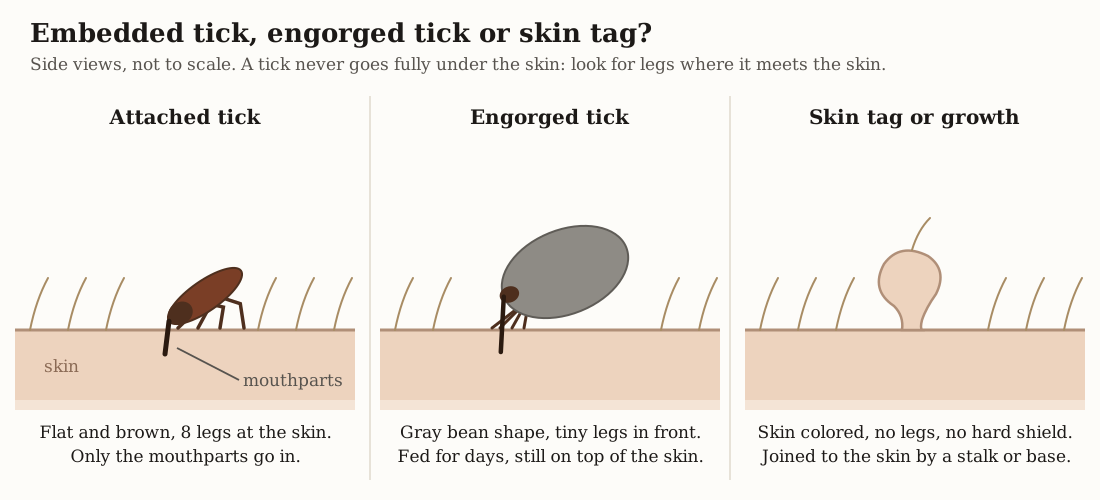
Tick or skin tag? How to tell
The quickest test is legs. A tick has 8 short legs (6 on a tiny larva) clustered where it meets the skin, and a hard plate just behind its mouthparts. A skin tag, wart or other growth has no legs, is usually the color of the skin around it, and joins the skin along a stalk or a broad base.
In the dog owner forums we read, “tick or skin tag?” was the most common question of all. Several of those bumps turned out to be growths that needed a vet. So if you see no legs, do not pull. Pulling a skin tag or a blood blister hurts, and it can bleed. Show it to your vet instead.
Table 1. Tick, skin tag or nipple on a dog
Legs where it meets the skin
- Tick
- Yes, 8 (6 on a larva)
- Skin tag or growth
- None
- Nipple
- None
Color
- Tick
- Brown or red-brown; gray or tan when fed
- Skin tag or growth
- Same as the skin, or darker
- Nipple
- Same as the skin
How it joins the skin
- Tick
- One small point at the front end
- Skin tag or growth
- A stalk or a broad base of skin
- Nipple
- Part of the skin
Where on the dog
- Tick
- Anywhere, often the head, ears, neck and feet
- Skin tag or growth
- Anywhere
- Nipple
- Two rows along the belly
Changes over days
- Tick
- Swells, then drops off
- Skin tag or growth
- Stays the same or grows slowly
- Nipple
- Stays the same
Which tick is on my dog?
VCA Animal Hospitals names the four ticks a US dog is most likely to meet: the American dog tick, the deer tick, the lone star tick and the brown dog tick. You do not need to know which one it is to remove it. Still, the species tells your vet which diseases to think about, so keep the tick.
Table 2. The ticks most often found on US dogs
Red-brown with pale silvery marks, about 3/16 in (5 mm)
- Tick
- American dog tick (wood tick)
- Can spread to dogs
- Rocky Mountain spotted fever
- More
- Dog tick guide
Small, black shield, orange-red rear, dark legs
- Tick
- Deer (blacklegged) tick
- Can spread to dogs
- Lyme disease, anaplasmosis
- More
- Deer tick guide
One white dot on the female's back
- Tick
- Lone star tick
- Can spread to dogs
- Ehrlichiosis
Plain red-brown, slim, no markings; often indoors
- Tick
- Brown dog tick
- Can spread to dogs
- Ehrlichiosis, babesiosis, Rocky Mountain spotted fever
Vectors from the Merck Veterinary Manual (Lyme disease, ehrlichiosis), the AKC Canine Health Foundation and Ohio State University Extension.
Many people search for “dog tick” when they mean ticks on dogs in general. The American dog tick is a real species, though. Female or male, fed or flat, and whether it bites people too: our American dog tick guide answers all of it, and it does not carry Lyme disease. To compare every US species, see types of ticks, or start with our guide to ticks.
Dead tick on your dog
A dead or dried-up tick in the fur usually means your dog’s tick preventive did its job. Many vet products kill a tick after it starts to feed, so you may still find a dead one attached. Remove it the same way as a live one, with tweezers at the skin, and wash the spot.
Where to check for ticks on dogs
CDC names seven places to check: in and around the ears, around the eyelids, under the collar, under the front legs, between the toes, between the back legs and around the tail. Check every day in tick season, and after every walk through tall grass, brush or woods.
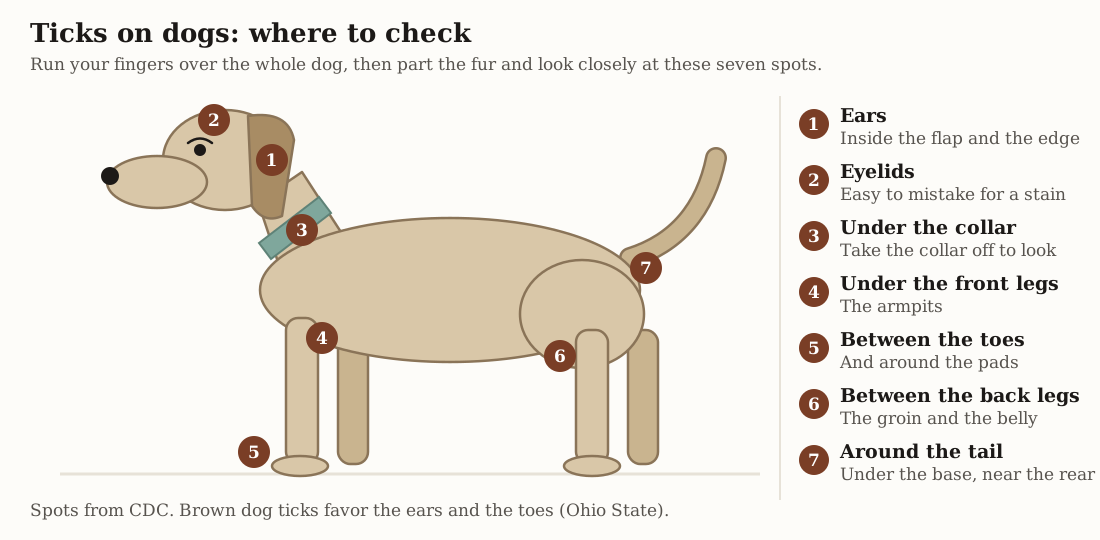
Start with your hands. Run your fingers slowly over the whole dog, pressing enough to feel small bumps through the coat. When you feel one, part the fur and look. A fine-toothed flea comb helps on long or dark coats, where ticks on dogs are hardest to see. If what you comb out jumps, it is a flea, not a tick: see how to tell fleas from ticks.
Take the collar off, because a tick can sit under it for days. Then fold back each ear flap and look inside. The MSPCA-Angell animal hospital adds the lips and gums for dogs that eat grass. Brown dog ticks often pick the ears and between the toes, Ohio State says.
A dog that keeps scratching at one ear may have a tick in it. However, many dogs show no sign at all, so do not wait for one. Check yourself too, because ticks crawl off dogs onto people.
Removing a tick from your dog
Put on gloves, part the fur, grip the tick with fine-tipped tweezers right at the skin and pull straight out with slow, steady pressure. Put nothing on the tick first: no Vaseline, alcohol or heat. Our step-by-step guide to removing a tick from a dog covers which tool to use, a stuck head, the bump afterward, puppies and dogs that won’t hold still. For a tick on a person, see our tick removal guide.
A dog covered in ticks needs a vet promptly, Merck says. Heavy infestations can cause blood loss, skin damage and paralysis.
Killing ticks on dogs: the short answer
Nothing safely kills a tick that is already attached to your dog in seconds. Take it off with tweezers, which takes a minute or two, and drop it in rubbing alcohol. Vinegar, dish soap, alcohol and oils on an attached tick do not make it let go.
For the next ticks, ask your vet about a tick preventive: a chew, a spot-on or a collar. Our guide to which tick killers work on dogs, and how fast tests each home remedy and compares the product classes, with the FDA warning and the label rule.
Tick bite on a dog: the bump and scab afterward
After you remove a tick, a small red bump or scab at the bite is normal for a few days. Tick feeding causes some swelling and irritation at the spot, Ohio State says. Call your vet if the bump grows, turns hot or very red, oozes pus, or seems to hurt your dog.
A tick bite on a dog is easy to lose track of in the fur. So note where it was, or snap a photo the first day. That way you can compare it a few days later. A spot that is shrinking and drying is healing.
Merck’s vet manual describes a tick “crater”: a small hole with a slightly raised, red rim where a tick fed. It can help a vet confirm a tick bite when the tick is gone. A photo of a bite cannot tell you which tick it was, or whether it passed on a germ, so keep the tick if you can.
Does a bullseye rash on a dog mean Lyme disease?
Not usually. The bullseye rash is a classic early sign of Lyme disease in people. However, it is not on the list of Lyme signs that Merck’s vet manual gives for dogs. A red ring around a bite on a dog is more often local irritation. Show any spreading redness to your vet, and watch for the signs in the next section.
Signs your dog is sick after a tick bite
The signs of tickborne disease in dogs are fever, low energy, a poor appetite, stiffness and limping, often 1 to 3 weeks or more after the bite. CDC gives 7 to 21 days or longer. Lyme signs can take months, says the AKC Canine Health Foundation, and many infected dogs never show any.
Table 3. Tickborne diseases in US dogs and the signs to tell your vet about
Lyme disease
- Main ticks
- Deer (blacklegged) tick
- Signs to watch for
- Fever, poor appetite, swollen or sore joints, limping that moves from leg to leg, swollen lymph nodes, low energy
Ehrlichiosis
- Main ticks
- Brown dog tick, lone star tick, deer tick
- Signs to watch for
- Fever, swollen lymph nodes, poor appetite, stiffness, nosebleeds or easy bleeding
Anaplasmosis
- Main ticks
- Deer (blacklegged) tick
- Signs to watch for
- Fever, poor appetite, stiff joints, tiredness, sometimes vomiting or diarrhea
Rocky Mountain spotted fever
- Main ticks
- American dog tick, brown dog tick
- Signs to watch for
- Fever, stiffness, nervous system signs, skin sores
Tick paralysis
- Main ticks
- Several kinds, including dog and wood ticks
- Signs to watch for
- Change in bark, wobbly back legs, then weakness that spreads
From the Merck Veterinary Manual (Lyme disease, ehrlichiosis, tick paralysis), the AKC Canine Health Foundation (anaplasmosis, Rocky Mountain spotted fever) and Ohio State University Extension.
Tick paralysis in dogs
Tick paralysis is caused by a toxin in the saliva of some feeding ticks. Merck’s vet manual says signs start 3 to 9 days after the tick attaches. First come a change in voice, wobbly back legs, changes in breathing, gagging or vomiting. Within 24 to 72 hours, the weakness can spread to all four legs.
The cure is finding every tick. In North America, a dog usually improves greatly within 24 hours of the tick being removed, Merck says. If it does not, there may be another tick still attached. Long-haired dogs need a slow, careful search.
How long does a tick have to be on a dog?
It depends on the germ, so there is no safe number. The Companion Animal Parasite Council, a veterinary group, says the germs behind ehrlichiosis and Rocky Mountain spotted fever can pass within 3 to 6 hours of attachment. Lyme bacteria take longer: 24 to 48 hours, and Merck’s vet manual also gives 1 to 2 days. So remove ticks as soon as you find them, and check daily.
Can a tick kill a dog?
Rarely, but yes. Merck’s vet manual describes three ways: tick paralysis that reaches the breathing muscles, heavy infestations that cause severe blood loss, and Lyme disease that attacks the kidneys, which is often fatal. A single tick found and removed within a day is very unlikely to do any of these.
Not veterinary advice. This section is general reference for dog owners. It is not a diagnosis and gives no treatment. If your dog seems unwell after a tick bite, call your vet.
Can ticks on dogs spread to people?
Your dog cannot give you Lyme disease directly. CDC says there is no evidence that dogs or cats pass it to their owners. However, dogs carry ticks into the house and yard, and a tick that crawls off the dog can bite you. That is the real risk, and it is why you check yourself after you check the dog.
Ticks on dogs can bite you too. The American dog tick bites people readily, while the brown dog tick rarely does. Wear gloves when you handle ticks, because VCA says some tick germs can enter through broken skin or the eyes, and Merck names Rocky Mountain spotted fever as one.
If you find a tick on yourself, use our guide to removing a tick from a person, and see tick bite symptoms for when to call a doctor.
Ticks in the house: the brown dog tick
Most ticks that ride into the house on a dog do not settle and breed indoors. The brown dog tick is the exception, the only US tick that can finish its life cycle indoors. It is plain red-brown, about 1/8 inch (3 mm) unfed, and likes the ears and toes. Treat every dog through your vet and the house at the same time; our brown dog tick guide covers the house plan.
Other ticks still survive for a while. In a 2026 Ohio State study, unfed lone star ticks lived about 11 days on average on home floors, and Gulf Coast ticks about 18 days, up to 25 days on vinyl. So check your dog before it comes inside, with your hands or a brush.
Do ticks lay eggs on dogs?
No. A fed female drops off the dog and lays her eggs in one clump on the ground or, for the brown dog tick, in a hidden spot indoors. VCA says a female lays 3,000 to 6,000 eggs. Dozens of pinhead ticks on a dog at once are larvae that hatched from one of those clumps. See seed ticks and tick eggs for what they look like.
How to prevent ticks on dogs
Preventing ticks on dogs takes three things: a daily tick check in season, a tick preventive from your vet, and a yard that ticks dislike. The first and last cost nothing. Together they catch most ticks before they have fed long enough to pass on a germ.
- Check daily after time outdoors, using the seven spots above. Remove any tick right away.
- Stay in the middle of trails and mowed paths, away from tall grass and brush at the edges.
- Keep grass short and clear brush and leaf litter where your dog plays.
- Keep the coat short in tick season if your dog’s breed allows. It makes checks faster.
- Use a tick preventive all year. CAPC, the veterinary parasite council, advises year-round use for every dog, because brown dog ticks can infest homes in any month.
Do not stop in the winter without asking your vet. VCA says some ticks are active on winter days when the ground is above 32°F (0°C), and deer tick adults are out in both spring and fall. Our tick prevention guide covers repellents and clothing for the people on the walk.
Is there a Lyme vaccine for dogs?
Yes. CDC notes that Lyme disease is the only tickborne disease dogs can be vaccinated against. The American Animal Hospital Association lists it as a noncore vaccine, meaning it depends on where your dog lives, travels and walks. In areas where Lyme is common, many vets treat it as standard. It does not replace a tick preventive, because it does nothing against the other diseases or the ticks themselves.
Myths about ticks on dogs, corrected
Some of the most shared advice about ticks on dogs is wrong, and a few of these myths sit on pages that rank near the top of Google. Here is what the vet and public health sources say instead.
Myth 1
Myth: “Vinegar, dish soap or alcohol will make a tick let go.”
Truth: We found no vet or university source that shows it. CDC says to put nothing on an attached tick. Tweezers are faster.
Myth 2
Myth: “Burn the tick with a match so it backs out.”
Truth: Merck and VCA both say no. Heat can hurt your dog and can make the tick salivate into the bite.
Myth 3
Myth: “Twist the tick to unscrew it.”
Truth: With tweezers, CDC says not to twist or jerk, which can snap off the mouthparts. Pull straight out. A pet tick tool is fine if you use it as its instructions say.
Myth 4
Myth: “An embedded tick has burrowed under the skin.”
Truth: Only the mouthparts go in, glued with a cement-like substance (Utah State University). The body stays on top.
Myth 5
Myth: “Ticks jump onto dogs from the grass.”
Truth: Ticks cannot jump or fly, VCA says. They wait on grass tips and grab on as a dog brushes past.
Myth 6
Myth: “My dog can give me Lyme disease.”
Truth: CDC says there is no evidence pets pass Lyme to people directly. The risk is a tick crawling from the dog to you.
Myth 7
Myth: “If my dog is on a preventive, I won't find ticks.”
Truth: With a chew, a tick has to bite before it dies (MSPCA-Angell). Finding a dead or dying tick is normal.
Myth 8
Myth: “A tick has to be on a dog for a day or two before it can make it sick.”
Truth: That fits Lyme disease, at 24 to 48 hours. The Companion Animal Parasite Council says ehrlichiosis and spotted fever germs can pass within 3 to 6 hours.
Myth 9
Myth: “A dog flea and tick product is safe to use on the cat.”
Truth: Permethrin in many dog products can cause tremors and seizures in cats (ASPCA, Merck).
Still unsure what you found? Compare it with our guide to what ticks look like at every size, or read about bugs that look like ticks.
Pest control disclaimer. Photo-based identification can help, but it is not always perfect. For dangerous spiders, large infestations, or anything you are unsure about, contact a licensed pest control professional.
Veterinary disclaimer. This page is general information for dog owners. It is not veterinary advice, a diagnosis or a treatment plan. Ask your veterinarian which tick products are right for your dog, and call them if your pet seems unwell after a tick bite.
Ticks on dogs: FAQ
How long will a tick stay on a dog?
Should I get the tick tested?
How do ticks get on dogs?
Related guides
Ticks
The ticks that bite people and pets in the US, where they live, and what each can spread.
American dog tick
The red-brown tick with pale markings, female and male, and why it does not carry Lyme.
What kills ticks on dogs instantly?
Why home remedies fail on an attached tick, and how fast vet tick products work.
How to remove a tick from a dog
Gloves, the grip, the pull, a stuck head and the bump afterward, step by step.
How to remove a tick
The CDC method for a tick on a person, including a stuck head.
Deer tick
The small black-shielded tick behind Lyme disease in people and dogs.
Lone star tick
The tick with the white dot, and what it means for pets.
Ticks on cats
Where to check a cat, and why dog tick products can kill it.
Brown dog tick
Ticks on the walls near the dog bed: the indoor tick and the house plan.
Flea vs tick
Is it a flea or a tick? Legs, body shape and the jump.
Getting rid of ticks
Ticks in the house or the yard, and when to call a professional.
Seed ticks
Dozens of tiny ticks at once: what they are and what to do.
What a tick looks like
Sizes and colors from larva to engorged adult, with a size scale.
Sources
- CDC, Preventing Ticks on Pets (May 2024)
- CDC, What to Do After a Tick Bite
- CDC, How Lyme Disease Spreads
- Merck Veterinary Manual, Ticks of Dogs (dog owners)
- Merck Veterinary Manual, Tick Paralysis in Dogs (dog owners)
- Merck Veterinary Manual, Lyme Disease in Dogs (dog owners, June 2026)
- Companion Animal Parasite Council, Ticks guideline (March 30, 2023)
- Merck Veterinary Manual, Ectoparasiticides Used in Small Animals
- US FDA, Fact Sheet for Pet Owners and Veterinarians about Isoxazoline Flea and Tick Products
- ASPCA, Feline Toxins to Steer Clear of This Kitten Season (permethrin)
- American Animal Hospital Association, 2022 Canine Vaccination Guidelines: core and noncore vaccines
- Ohio State University Extension, Ticks and Tick-Borne Diseases, HYG-2073
- Utah State University Extension, Ticks and Tickborne Diseases of Utah
- VCA Animal Hospitals, Ticks in Dogs
- Sabet and others (2026), tick survival on home flooring, Journal of Vector Ecology, via Ohio State College of Veterinary Medicine