Part 1 of 5
Start here
Is it a tick? The one-minute leg check
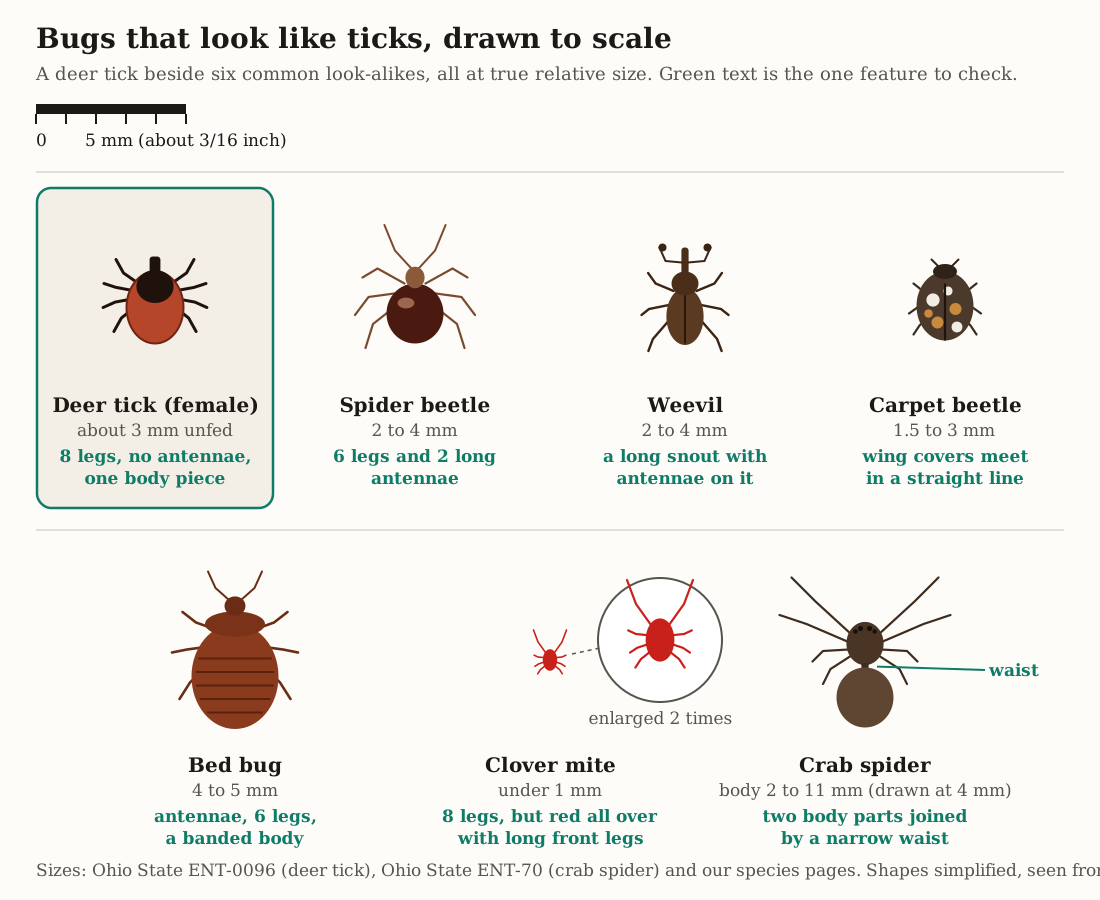
A tick has 8 legs, no antennae and a body in one piece with no waist or segments. Its mouthparts stick out in front like a short beak. Larvae, the youngest ticks, have only 6 legs, yet they still have no antennae. Ticks never have wings, and they crawl rather than jump or fly.
That one check rules out most of the bugs people send in. At the University of Rhode Island’s TickSpotters program, about 1 in 20 photos shows a look-alike instead of a tick. Spider beetles, weevils, bed bugs and young stink bugs are the usual ones.
A tick has all of these
Check each clue below to narrow down what you saw.
Eight legs, or six on a speck under 1 mm
Six legs plus a pair of antennae means an insect, not a tick.
No antennae at all
Ticks wave their front legs like feelers. Check where they join the body.
One flat, oval body with no waist and no segments
A pinched waist means a spider. Bands across the back mean a bed bug.
Mouthparts that stick out in front
Seen from above, a hard tick has a small dark shield behind a short beak.
No wings, and it only crawls
Wing tips folded over the back rule out a tick. A bug that jumps is more likely a flea.
Speed is a weak clue. Most ticks crawl slowly, although lone star ticks move quickly. For the parts that make a tick a tick, and what each kind looks like, see our guide to what a tick looks like at every size.
What bugs look like ticks?
Seventeen bugs that look like ticks turn up often enough to matter. Beetles make up the biggest group: spider beetles, weevils, carpet beetles and drugstore beetles. Next come bed bugs, cockroach nymphs, fleas and lice indoors. Outdoors, young stink bugs, spotted lanternfly nymphs and deer keds fool people. The rest are mites, pseudoscorpions and small spiders.
Each look-alike has one feature that settles it, so the table puts that feature first. In addition, where you found the bug narrows the list fast. A bug in a pantry is almost never a tick, while one on your skin after a walk in tall grass very often is.
The 17 bugs that look like ticks, and the one feature that separates each
6 long legs and 2 long antennae; round, shiny body
- Look-alike
- Spider beetle
- Where you find it
- Pantries, old stored food, dark corners
- Bites people?
- No
A snout with bent antennae near its tip
- Look-alike
- Weevil
- Where you find it
- Flour, rice and grain; some on trees outdoors
- Bites people?
- No
Hard wing covers meeting in a line; mottled or shiny black
- Look-alike
- Carpet beetle
- Where you find it
- Sunny windowsills, closets, under rugs
- Bites people?
- No
Head hidden under a hood; flies to lights
- Look-alike
- Drugstore beetle
- Where you find it
- Spices, flour, pet food
- Bites people?
- No
Antennae, 6 legs and bands across a flat body
- Look-alike
- Bed bug
- Where you find it
- Mattress seams, bed frames
- Bites people?
- Yes
Long antennae; fast, flat and shy of light
- Look-alike
- Cockroach nymph
- Where you find it
- Kitchens and bathrooms
- Bites people?
- No
Flattened side to side; jumps
- Look-alike
- Flea
- Where you find it
- Pets, pet beds, carpet
- Bites people?
- Yes
6 clawed legs; clings to hair
- Look-alike
- Louse
- Where you find it
- On the scalp or body hair
- Bites people?
- Yes
Two long pincers held out in front
- Look-alike
- Pseudoscorpion
- Where you find it
- Bathroom sinks and tubs, books
- Bites people?
- No
Shield shape, antennae, red and black young
- Look-alike
- Stink bug nymph
- Where you find it
- Garden plants, sides of houses
- Bites people?
- No
Black with white spots; jumps
- Look-alike
- Spotted lanternfly nymph
- Where you find it
- Trees, vines and garden plants
- Bites people?
- No
6 legs and small wing stubs; flat fly
- Look-alike
- Deer ked
- Where you find it
- Deer, hunters and hikers in fall
- Bites people?
- Yes
8 legs but under 1 mm, red all over, long front legs
- Look-alike
- Clover mite
- Where you find it
- Sunny walls and sills, spring and fall
- Bites people?
- No
Too small to see clearly; 6 legs; reddish
- Look-alike
- Chigger
- Where you find it
- Grass and brush; on skin at sock lines
- Bites people?
- Yes
Tiny specks in large numbers near a nest
- Look-alike
- Bird mite
- Where you find it
- Near nests in eaves, attics and vents
- Bites people?
- Sometimes
Under 0.5 mm, with fine webbing on leaves
- Look-alike
- Spider mite
- Where you find it
- Undersides of plant leaves
- Bites people?
- No
A narrow waist between two body parts
- Look-alike
- Small spider
- Where you find it
- Gardens, corners, webs
- Bites people?
- Rarely
Part 2 of 5
Insects mistaken for ticks
Beetles that look like ticks
Of all the bugs that look like ticks, beetles are the ones people find most. A small beetle is round or oval, 1/16 to 3/16 inch (1.5 to 5 mm) long, and often reddish brown, so it passes for a tick at a glance. Yet every beetle has 6 legs, a pair of antennae and hard wing covers that meet in a straight line down the back.
That seam is the quickest tick vs beetle check when the legs are tucked under. A tick’s back has no seam at all, only a small shield behind the head. Beetles also have a separate head and a middle section you can see, while a tick looks like one piece.
Spider beetles
Spider beetles are the classic tick look-alike. They are 2 to 4 mm long, with a round, shiny, reddish-brown to black body on long, thin legs. Two long antennae stick out in front and look like an extra pair of legs, which is why people count eight. Look closely, and only six of those limbs reach the ground.
They live in old, stored food, such as flour and grain, feathers and even rodent droppings, so they turn up in pantries and dark corners. They do not bite. If you keep finding them, clear out old food and vacuum the shelves.
Weevils
A weevil is a beetle with a snout. Rice and granary weevils are 2 to 4 mm long, dark brown to black, and live in flour, rice and grain. Their clubbed antennae sit on the snout itself. So in a weevil vs tick check, look for that long nose: no tick has one.
Other weevils live outdoors on plants, so one can land on you in the yard. They are harmless. Still, the University of Rhode Island calls the weevil a bug that many people mistake for a tick, so it is worth a close look.
Carpet beetles
Adult carpet beetles are round, 1/16 to 1/8 inch (1.5 to 3 mm) long, and often speckled with white, brown and yellow scales. The black carpet beetle is shiny black and a little larger, at 3 to 5 mm. Adults gather on sunny windowsills in spring, and their fuzzy larvae feed on wool, fur and pet hair. They do not bite.
Drugstore beetles
A drugstore beetle is about 1/10 inch (2.5 mm) long, reddish brown and shaped like a short cylinder. Its head tucks under a hood, so from above it looks headless, which makes it read as a tick. However, it has 6 legs and short antennae, and adults fly to lamps and windows. It lives in spices, flour and pet food.
Part 3 of 5
House and garden look-alikes
Bugs in the house that look like ticks
The tick-like bugs people find in the house are usually beetles, bed bugs, cockroach nymphs, fleas or pseudoscorpions. Real ticks rarely live indoors. The exception is the brown dog tick, a plain reddish-brown tick about 1/8 inch (3 mm) long that can breed inside a home where dogs live.
So where you found it matters. A bug in bedding points to bed bugs, one on a pet to fleas or ticks, and one in a sink to a pseudoscorpion. Pale, soft specks 1 to 2 mm long on damp paper or a humid sill are booklice, which have 6 legs and long antennae and never bite; see our guide to tiny white bugs. Ticks that ride in on clothes or a dog usually turn up one at a time.
Bed bugs
Bed bugs are the look-alike that worries people most, because both feed on blood. An adult bed bug is 4 to 5 mm long, flat, oval and reddish brown, about the size of an apple seed. It has 6 legs, short antennae, eyes and visible bands across its body, and it hides in mattress seams and bed frames.
A tick has 8 legs and no antennae, and it usually comes in from outdoors on you or a pet. Our tick vs bed bug comparison puts the two side by side, and our guide to what bed bugs look like shows every stage. A much larger blood-feeder with a cone-shaped head, 1/2 to 1 inch long, is a kissing bug. A bed bug twin in a room below an attic where bats roost may be a bat bug, a close relative covered in our bed bug guide.
Cockroach nymphs
Young cockroaches are flat, oval, wingless and brown, so a small one can pass for a tick. They give themselves away with long antennae and speed, since they dash for cover when the light comes on. Dark nymphs about 1/8 inch long with one pale stripe down the back are German cockroach nymphs, a sign of a colony nearby.
Fleas and lice
Fleas are the look-alike on pets. An adult flea is no more than 1/8 inch (3 mm) long, dark reddish brown, and flattened from side to side, so it looks thin from above. It jumps, which a tick never does. See how a flea differs from a tick. Lice are the look-alike on people. A head louse is 2 to 3 mm long, tan, with 6 clawed legs, and it clings to hair near the scalp. Our guide to head lice shows how to check.
Pseudoscorpions
Pseudoscorpions are tiny arachnids, so like ticks they have 8 legs. The house pseudoscorpion is 3 to 4 mm long and mahogany brown. But it holds two long pincers out in front, more than twice as long as its legs, and no tick has pincers. Penn State Extension notes that people often find them in bathroom sinks and tubs and take them for ticks.
They are harmless to people and pets. In fact, they eat booklice, ants, beetle larvae and other small pests, so there is no reason to spray them. Simply carry one outside on a piece of paper.
Outdoor bugs that look like ticks
Outdoors, three bugs that look like ticks fool people most: young stink bugs, spotted lanternfly nymphs and deer keds. All three are insects with 6 legs. Stink bug and lanternfly nymphs live on plants and never bite. Deer keds, on the other hand, are blood-feeding flies that crawl onto hunters and hikers in fall, and they can bite.
Stink bug nymphs
Newly hatched stink bugs are small, round and black and red, so they look a lot like ticks on a leaf or a deck rail. They turn up again and again in the University of Rhode Island’s gallery of look-alikes. Check for antennae and a shield-shaped body. Brown marmorated stink bug nymphs pass through five stages before they grow wings.
Spotted lanternfly nymphs
Spotted lanternfly nymphs are about 1/8 inch (3 mm) long at first, black with bright white spots. Penn State Extension warns that they may be mistaken for small ticks or spiders. The white spots settle it, and so does their habit of jumping. Older nymphs turn red with white dots and reach about 1/2 inch.
Deer keds
Deer keds are flat, brown flies that live on deer. They fly to a host, then shed their wings and crawl into the fur, and at that point they look a lot like ticks. Count the legs: a ked has 6, and you can often see small wing stubs on its back. In the Northeast, European deer keds come out in fall, which puts them on hunters, deer processors and hikers.
Keds bite people as well as deer. Scientists have found germs in them, but it is not clear whether keds pass any on. Penn State Extension advises treating a ked bite like a tick bite and talking to your doctor if a flu-like illness follows in the weeks after.
Part 4 of 5
Eight-legged look-alikes
Mite vs tick: the closest look-alikes
Mites are the hardest look-alikes, because ticks and mites belong to the same group of arachnids. Both have 8 legs as adults and 6 as larvae. The difference is mostly size: most mites are under 1 mm, while unfed adult ticks are 2 to 5 mm (1/16 to 3/16 inch). A tick also has a hard shield and a beak.
So the mite vs tick difference comes down to four mites people meet: clover mites on walls, chiggers in grass, bird mites from nests and spider mites on plants. Only chiggers and bird mites bite.
Clover mites, the “red ticks”
A tiny bright red bug crawling with dozens of others on a sunny wall or sill is almost always a clover mite, not a tick. Clover mites are smaller than a pinhead, under 1 mm, red all over, with an unusually long front pair of legs. They swarm in spring and fall, mostly on the sunny side of the house.
No common US tick is bright red all over. The red tick people do meet is the adult female deer tick, whose red-orange body sits behind a black shield on black legs. Clover mites do not bite, but they leave a rusty stain when crushed, so vacuum them instead. Our guide to tiny red bugs in the house and yard covers clover mites and red velvet mites.
Chiggers
Chiggers are the larvae of a mite, and they are the one look-alike you will almost never see. Each is about 1/150 inch (0.2 mm) long, yellow to reddish, with 6 legs. They climb onto skin from grass and brush and settle where clothing is tight, such as sock lines and waistbands.
Unlike a tick, a chigger does not burrow into the skin. On people, it is usually knocked off or dies within hours, and a shower helps wash it away. The itchy welts show up hours later, often after the chigger is gone. A visible speck with 8 legs on your skin is therefore far more likely to be a young tick. Our page on seed ticks and how they differ from chiggers covers the tiniest ticks.
Bird mites
Bird mites live in nests in huge numbers. When the young birds leave, the mites stray and wander in search of a new host, sometimes into the house next to the nest. They are tiny specks, far smaller than a tick, and they appear in large numbers near one spot. They can bite people, though usually they do not. Look for an old nest in the eaves, an attic or a vent nearby.
Spider mites
Spider mites are under 0.5 mm and live on the undersides of plant leaves, where they look like moving dust. Fine webbing and pale, speckled leaves are the clue. They feed on plants, never on people or pets.
Tick vs spider: spiders that look like ticks
Ticks and spiders are both arachnids with 8 legs, so the leg count will not separate them. Look at the body instead. A spider has two body parts joined by a narrow waist, while a tick is one flat oval with no waist. Small spiders also show fangs, a cluster of eyes and silk spinnerets at the rear.
Most of the spiders that look like ticks are crab spiders and small, round cobweb spiders. Crab spiders have a body 2 to 11 mm long, hold their front two pairs of legs out wide and walk sideways like a crab. Small cobweb spiders hang in messy webs, which no tick builds. Our spider identifier and the guide to common house spiders show the usual indoor ones.
A spider on your skin also behaves differently from a tick. It runs, drops on a silk line or jumps, as jumping spiders do. A tick crawls steadily upward, looking for a place to bite, and then stays put.
Tiny black bugs that look like ticks
A tiny black bug on your skin after time outdoors may well be a tick. Adult male deer ticks are dark brown to black all over and only 2 to 3 mm long. Indoors, the tiny black bugs that look like ticks are usually black carpet beetles, weevils, fleas or fed bed bug nymphs. Where you found it is the best first clue.
Where you found a tiny black bug, and what it most likely is
On your skin or clothes after grass or woods
- Most likely
- A tick: an adult male deer tick or a nymph
- Check next
- Eight legs, no antennae, a beak in front
On a pet or in its bedding
- Most likely
- A flea, or a tick
- Check next
- A flea jumps and is thin from above
In flour, rice or a pantry
- Most likely
- A weevil or a spider beetle
- Check next
- A snout, or long legs and long antennae
On a windowsill or in a closet
- Most likely
- A black carpet beetle
- Check next
- Wing covers that meet in a line
In a mattress seam
- Most likely
- A fed bed bug nymph
- Check next
- Six legs, antennae, bands across the body
On plant stems or leaves
- Most likely
- Black aphids or a young lanternfly
- Check next
- Soft pear shape, or white spots
If you found a lone black speck on yourself, treat it as a tick until you can count its legs. For the indoor kinds, our guides to small black bugs in the house and to tiny black beetles sort out the rest. Our deer tick guide shows the black tick at every stage.
Not a bug at all: skin tags, specks and sea ticks
Some “ticks” are not bugs. On pets, the usual mix-up is a skin tag, a nipple or a scab. On people, it is a freckle, a scab or a seed stuck to a sock. At the beach, “sea ticks” turn out to be harmless crabs. The rule is the same for all of them: a tick has 8 legs, and none of these has any.
A black growth on a dog that looks like a tick
A tick on a dog has 8 short legs bunched where it meets the skin and a small hard shield behind its mouthparts. A skin tag, wart or other growth has no legs, is usually skin-colored or dark, and joins the skin along a stalk or a broad base. Nipples sit in two rows along the belly.
If you see no legs, do not pull. Pulling a growth hurts and can bleed, so show it to your vet instead. The same check works on a cat. Our guide to ticks on dogs has a side-by-side table of ticks, skin tags and nipples, plus where to look, and our cat tick guide compares a tick with a scab, skin tag and nipple on a cat.
Sea ticks are mole crabs
No tick lives in the sea. People who search for sea ticks usually mean the small tan crabs that kids dig up where the waves wash over the sand. Those are mole crabs, also called sand crabs or sand fleas. They are harmless to people, since they have no pincers, and they can only dig backward into the sand.
The name may also be a mishearing of seed ticks, the six-legged tick larvae that can latch on by the hundreds in late summer. If the “sea ticks” came from a grassy path rather than the surf, read our guide to seed ticks.
Freckles, scabs and seeds
An unfed tick nymph is about 1.5 mm, the size of a poppy seed. That makes it easy to mistake for a freckle or a speck of dirt, and the reverse. Nudge it with a fingernail or tape. A seed or a crumb has no legs and does not move, while a scab is part of the skin. Anything that walks, or that has tiny legs at the skin end, is worth a closer look.
Part 5 of 5
What to do next
Which look-alikes bite, and which ones matter
Ten of the 17 bugs that look like ticks never bite people. Five do: bed bugs, fleas, lice, chiggers and deer keds. Bird mites sometimes bite, and small spiders rarely do. None of these look-alikes is known to carry Lyme disease, which comes from ticks. Sort what you found into one of the groups below before you spend money on it.
What each look-alike means for you
Spider beetles, weevils or drugstore beetles
- What it means
- Old or open food in the pantry
- What to do
- Throw out infested food, vacuum shelves, store food in sealed jars
Carpet beetles
- What it means
- Larvae feeding on wool, fur or pet hair
- What to do
- Find and clean the source; vacuum under furniture and rugs
Clover mites, stink bug nymphs, lanternfly nymphs or spiders
- What it means
- Outdoor bugs passing by or wandering in
- What to do
- Vacuum them; seal gaps around windows
Pseudoscorpions or spider mites
- What it means
- Harmless, or a plant problem
- What to do
- Nothing indoors; check houseplants for webbing
Bed bugs, fleas, lice or bird mites
- What it means
- A biting pest with its own plan
- What to do
- Follow a bed bug, flea, lice or nest plan, not a tick plan
Deer keds
- What it means
- A biting fly from deer
- What to do
- Treat a bite like a tick bite and watch for illness
Eight legs, no antennae, a shield and a beak
- What it means
- A tick
- What to do
- Remove it if attached, keep it, and watch for a rash or fever
What to do with a bug you think is a tick
Catch it whole, photograph it from above next to a coin, and count the legs before you do anything else. That takes about five minutes and costs nothing. If the bug is attached to skin, remove it first with fine-tipped tweezers, because a tick should come off as soon as you find it.
Seven steps, cheapest first
Keep it whole
Press clear tape over it, or seal it in a small bag or jar. Do not crush it. A squashed bug loses the legs and antennae you need to see.
If it is attached to skin, remove it now
Grip it close to the skin with fine-tipped tweezers and pull straight out with steady pressure. Do not twist or jerk, and skip nail polish, petroleum jelly and heat.
Photograph it from above
Use daylight, not the flash, and set a coin or a ruler beside it. A US penny is 3/4 inch (19 mm) across.
Count the legs and look for antennae
Eight legs and no antennae means a tick or a mite. Six legs with antennae means an insect. Zoom in on where the legs join the body.
Write down where you found it
A bed, a pantry shelf, a sunny sill, a pet or a hiking trail each points to a different short list. Add the state and the date.
Hold off on spraying
Most look-alikes need cleaning, sealing or a fix for damp, not a pesticide. Spraying also ruins the evidence.
Ask an expert if you are still unsure
Send the photo to the University of Rhode Island's TickSpotters or your county extension office. Keep a real tick sealed in case a doctor asks about it.
If it turns out to be a tick, our step-by-step guide to removing a tick safely covers what to do if part of it stays in the skin. To name the kind, use our tick identification chart. To avoid the next one, see how to prevent tick bites, and for everything else, start at our complete guide to ticks.
Mistakes in other tick look-alike guides
Several of the pages that rank for this search repeat errors that can send readers the wrong way. Here are four, each with where it comes from and what the extension and state sources say. They matter, because each one can make a tick look like something harmless, or the reverse.
Mistake 1
Mistake: Ticks have a rounded, segment-free body with no hard shell (All South Pest Control).
Reality: The ticks that bite people outdoors are hard ticks. Ohio State Extension explains they are named for the scutum, a hard plate behind the mouthparts, and Utah's health department lists that patterned shield as a tick feature.
Mistake 2
Mistake: Ticks hide in vegetation, then jump on a host (wikiHow).
Reality: The Missouri Department of Conservation says ticks cannot jump or fly, only crawl. They wait on a grass stem with their front legs out and grab on as you brush past.
Mistake 3
Mistake: Drugstore beetles have wings but cannot fly (TickSafety).
Reality: Clemson Extension says adult drugstore beetles can fly and are drawn to light. Flying to a lamp or a window is one of the ways to tell them from ticks.
Mistake 4
Mistake: Tick nymphs have six legs (a common answer on Reddit tick threads).
Reality: Only larvae do. Cornell's tick biology page says larvae have six legs, while nymphs and adults have eight. A six-legged speck with no antennae is a larva, often called a seed tick.
Still not sure what you caught? Upload a clear photo to our bug identifier by picture, then count the legs yourself.
Pest control disclaimer. Photo-based identification can help, but it is not always perfect. For dangerous spiders, large infestations, or anything you are unsure about, contact a licensed pest control professional.
Tick look-alikes FAQ
Do bugs that look like ticks carry Lyme disease?
Why did I suddenly get carpet beetles?
How do people get ticks?
Are there bugs that look like ticks but fly?
Can a bug app or AI tell a tick from a look-alike?
Related guides
Ticks
The full guide: what ticks are, where they live, the diseases they carry and how to stay safe.
What does a tick look like?
Size, color and legs at every stage, unfed and engorged.
Tick vs bed bug
Eight legs or six, and where each one hides.
Flea vs tick
Fleas jump and ticks crawl: both drawn to scale.
Types of ticks
Every common US tick on one identification chart, with where each lives.
Seed ticks
Six-legged larvae and poppy-seed nymphs, and how they differ from chiggers.
Ticks on dogs
A tick or a skin tag, where to check, and how to take one off.
Tiny red bugs
Clover mites, chiggers and velvet mites, the red specks mistaken for ticks.
Small black bugs
Beetles, fleas and other black specks in the house, by room.
Sources
- University of Rhode Island TickEncounter, Tick look-alikes
- Utah Department of Health and Human Services, Tick look-alikes (PDF)
- Penn State Extension, Deer keds
- Cornell CALS, Tick biology
- Penn State Extension, Pseudoscorpions
- Ohio State University Extension, HYG-2073, Ticks and their control
- Missouri Department of Conservation, Ticks
- Penn State Extension, Spotted lanternfly management guide
- Washington State University Pestsense, Spider beetle
- Ohio State University Extension, ANR-0182, Chiggers (PDF)
- Clemson Cooperative Extension, HGIC 2419, Drugstore beetles
- Penn State Extension, Brown marmorated stink bug
- Colorado State University Extension, Clover and other mites of turfgrass
- Ohio State University Extension, ENT-70, Crab spiders
- Ask Extension, Atlantic mole crabs (sand fleas)