Flea vs tick: the one-look answer
To settle flea vs tick, watch how it moves and count the legs. A flea is a wingless insect with 6 legs, a body flattened from side to side, and big back legs that throw it into the air. A tick is an arachnid with 8 legs as a nymph or adult. Its body is flat from top to bottom, and it can only crawl.
So if it jumped, it was not a tick. Ticks cannot jump or fly. Instead, they climb grass and brush and wait, front legs out, for a person or a pet to brush past. A flea, by contrast, rarely sits still long enough for you to count anything.
Shape is the next clue. Seen from above, a flea looks as thin as a sliver, because its body is pressed flat from side to side. That shape lets it slip between hairs. A tick is the opposite: a wide, flat oval with a hard shield behind the head on the common kinds.
A flea compared with a tick
How it moves
- Flea
- Jumps, often out of sight
- Tick
- Crawls; cannot jump or fly
Legs
- Flea
- 6; the back pair much bigger
- Tick
- 8 on nymphs and adults; 6 on larvae under 1 mm
Body shape
- Flea
- Flattened side to side: tall, and narrow from above
- Tick
- Flat top to bottom: a wide oval from above
Size before a meal
- Flea
- About 1/16 to 1/8 in (1.5 to 3 mm)
- Tick
- About 1/16 to 1/4 in (1.5 to 6 mm) for the common kinds
After a meal
- Flea
- Stays small, never over about 1/8 in
- Tick
- Swells into a gray bean, up to 5/8 in (16 mm)
Color
- Flea
- Dark reddish brown and shiny
- Tick
- Brown, reddish or black, often with a shield of another color
Where it lives
- Flea
- On the pet; eggs and larvae in carpet and bedding
- Tick
- Outdoors in grass, brush and leaf litter
How it feeds
- Flea
- Small meals while it lives on the pet
- Tick
- Attaches and feeds for days, then drops off
What it is
- Flea
- An insect (order Siphonaptera)
- Tick
- An arachnid, like spiders and mites
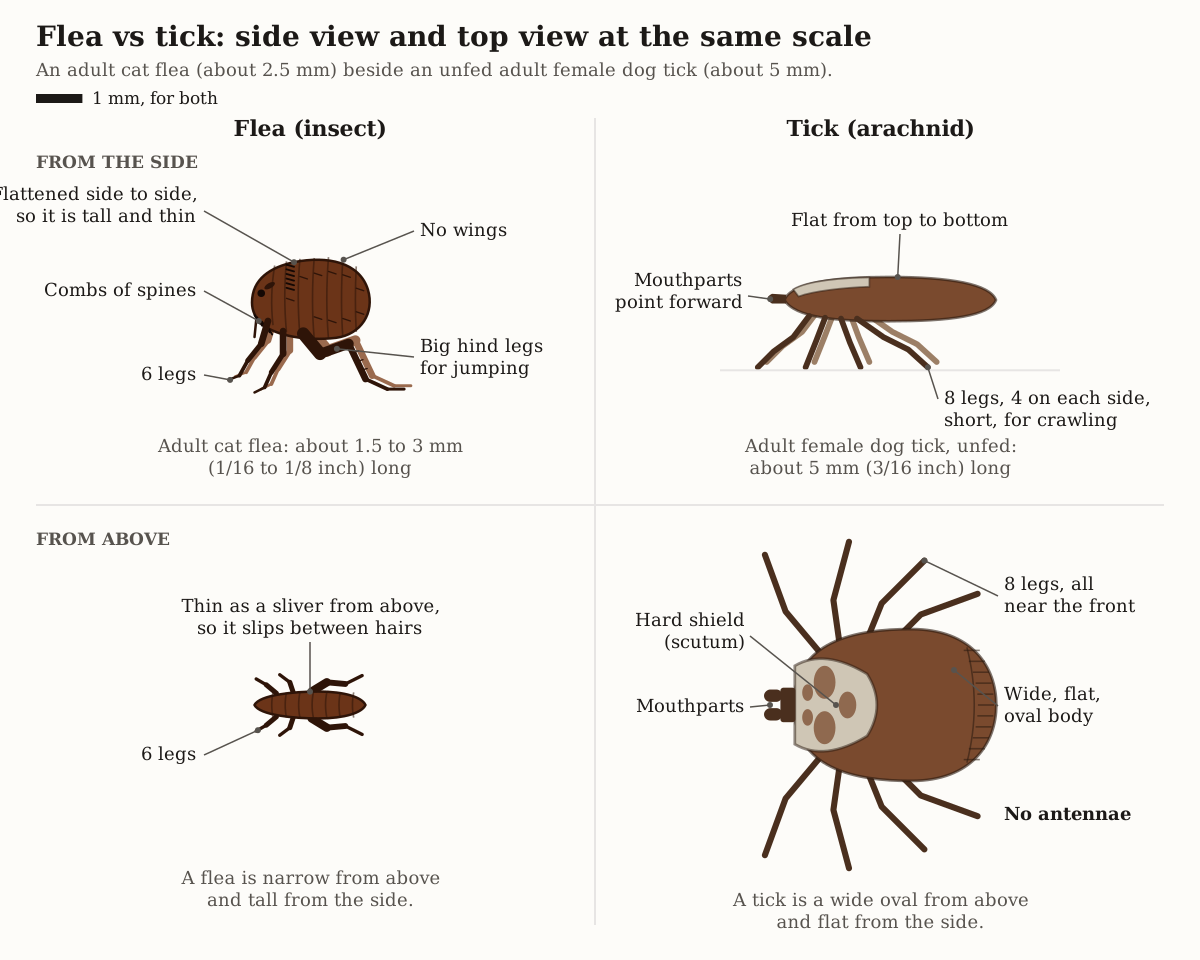
Cannot count the legs? Think about how it moved
A flea moves too fast to count, and a small tick tucks its legs under its body. So the way it moved is often the best clue. In a 2000 lab study from a French vet school, cat fleas jumped about 8 inches (20 cm) on average, and the longest jump reached 19 inches (48 cm). Half of them cleared a tube about 5 inches (13 cm) high, and the best reached about 7 inches (17 cm).
Several pages that rank for this search say fleas jump 7 inches high and 13 inches across. The high jump matches that study’s record. Its long jumps, however, averaged about 8 inches, with a record of 19. Either way, a tick could not manage a fraction of it.
A slow crawl points the other way. “Fleas jump very quickly, only ticks crawl around all slow like this,” one r/DogAdvice commenter wrote under a video of a tick. Some ticks, such as the lone star tick, do move fast, though. If you are not sure, press clear tape over the bug and count the legs on white paper. A sharp photo in our free bug identifier also gives a quick first answer.
Can a flea turn into a tick?
No. Fleas and ticks belong to different classes of animals, and neither one changes into the other. A flea hatches as a legless, wormlike larva, then spins a cocoon and comes out as an adult flea. A tick, on the other hand, hatches as a 6-legged larva, molts into an 8-legged nymph and then into an adult. It looks like a tick at every stage.
Flea vs tick size, side by side
In a flea vs tick size check, the flea is the steady one. An adult cat flea runs from about the size of a pinhead to 1/8 inch (3 mm) long. Unfed ticks overlap with that range: a deer tick nymph is about 1.5 mm, and an adult dog tick about 3/16 inch (5 mm). After feeding, though, a female tick can swell to 5/8 inch (16 mm), five times the length of a flea.
Flea and tick sizes, before and after feeding
Dark, shiny and narrow; jumps
- Bug and stage
- Adult cat flea
- Unfed
- 1.5 to 3 mm (1/16 to 1/8 in)
- Fed
- About the same; no flea grows past about 1/8 in
Tiny pale worm with no legs, in carpet or a pet bed
- Bug and stage
- Flea larva
- Unfed
- Up to about 3/16 in (5 mm)
- Fed
- Eats flea dirt, not the pet
A pale speck with 8 legs
- Bug and stage
- Deer tick nymph
- Unfed
- About 1.5 mm (1/16 in)
- Fed
- Swells, but stays small
A speck under 1 mm with 6 legs
- Bug and stage
- Tick larva (seed tick)
- Unfed
- Under 1 mm
- Fed
- Slightly larger and rounder
Orange-red body, black shield and legs
- Bug and stage
- Adult female deer tick
- Unfed
- 2 to 3 mm
- Fed
- About 1/4 in (6 mm) wide, gray
Brown with a pale, silvery shield
- Bug and stage
- Adult female American dog tick
- Unfed
- About 3/16 in (5 mm)
- Fed
- About 5/8 in (16 mm), mostly gray
Plain reddish brown, indoors with a dog
- Bug and stage
- Adult brown dog tick
- Unfed
- About 1/8 in (3 mm)
- Fed
- About 1/2 in (13 mm), bluish gray
Flea sizes from UC IPM and Cornell’s feline health center. Tick sizes from Ohio State University fact sheets HYG-2073 and ENT-0096.
A flea or a tick nymph?
This is the pair that fools people. A deer tick nymph is about 1.5 mm, the size of a poppy seed, which is about the size of a small flea. Both look brownish. At that size, the shape from above helps most. A flea is narrow, while a nymph is round and flat, with 8 legs near the front.
Then look at what it does. A flea jumps or races through the fur. A nymph crawls, and one with its head in the skin is a tick. The exception is the sticktight flea, which clamps onto the ears and eyes of poultry and sometimes of roaming pets. Our guide to what a tick looks like at every stage shows the nymph beside a poppy seed.
Where fleas and ticks live: on the pet or out in the grass
Where it lives is the biggest flea vs tick difference after the legs. Fleas live on the animal. An adult cat flea stays on a dog or cat and lays 20 to 50 eggs a day, which fall off into bedding and carpet. Ticks live outdoors in grass, brush and leaf litter. A tick climbs on to feed for days, then drops off and goes back to the ground.
That is why fleas become a house problem and ticks usually do not. Flea larvae grow deep in carpet, between floorboards and in pet beds. Next, they spin cocoons. A fully formed flea can wait inside one for up to a year until a pet or a person walks by. Merck’s vet manual notes that these newly emerged, unfed fleas are the ones that bite people.
Ticks, by contrast, need the damp of the outdoors. One that drops off indoors does not start an infestation in most cases. Even so, it can live for a while. In a 2026 Ohio State study, unfed lone star ticks lasted about 11 days on house floors on average, and Gulf Coast ticks about 18 days.
Fleas do live outdoors too, but only in shaded, damp spots where pets or wildlife rest, such as under decks and porches. Opossums, raccoons, feral cats and other wild animals can seed a yard with them. Cat fleas also die when it stays below 37°F (3°C) for several days. So outdoor fleas fade in a cold winter, while the ones indoors keep breeding.
Can fleas live in your bed?
Yes, if a pet sleeps on it. Flea eggs drop from the pet onto the bedding, and the larvae can grow in the seams and in the carpet nearby. Fleas do not live on people, though. Instead, they may ride in on your clothes and then find the pets, Merck’s vet manual says.
Small bugs in a bed with no pet in the house are more likely something else. Our guide to telling a tick from a bed bug shows how to check a mattress, and why the antennae matter.
The one tick that lives indoors: the brown dog tick
The brown dog tick breaks the outdoor rule. It is the only tick that can become established indoors in homes with dogs and in kennels, according to Ohio State Extension. It is plain reddish brown, about 1/8 inch (3 mm) long, and it rarely bites people. After a meal, it drops off the dog and hides close by.
In a home with a dog, many small ticks on walls, curtains or baseboards point to this tick rather than to fleas. It needs the dog and the house treated at the same time. Our brown dog tick guide explains how.
Which is worse, fleas or ticks?
For disease, ticks are worse. One tick bite can pass on Lyme disease, Rocky Mountain spotted fever or ehrlichiosis to a person or a dog. For your home and your pet’s comfort, fleas are worse. A single female flea can lay up to 50 eggs a day, and clearing a home can take 6 weeks to 3 months. So the flea vs tick answer depends on what worries you most.
What fleas do to dogs and cats
The biggest problem is flea allergy dermatitis, an allergy to flea saliva. Just one bite can set it off in a sensitive pet. Allergic dogs chew and scratch, mostly over the hips, the base of the tail and the thighs. Over time, they lose hair and get skin infections. Cats are bitten mostly on the back of the neck and the base of the tail, Cornell’s feline health center says.
Fleas also pass on tapeworms. A pet swallows an infected flea while grooming, and the worm grows in its gut. Small, rice-like segments near the tail or in the bedding are the usual sign. In a heavy infestation, fleas can also take enough blood to cause anemia, and kittens and puppies are most at risk. A young pet with fleas, pale gums and weakness needs a vet the same day.
What ticks do to dogs and cats
Ticks rarely itch, so a pet may never show you where one fed. The risk is the germs. The Companion Animal Parasite Council says some, such as Ehrlichia and Rickettsia, can pass within 3 to 6 hours of attachment. Lyme bacteria usually take 24 to 48 hours in dogs. Signs such as fever, low energy, limping or a poor appetite can show up 7 to 21 days or longer after the bite, CDC says.
Lyme disease is the only tick disease dogs can be vaccinated against. Cats face their own risk: the American Animal Hospital Association warns that lone star ticks can give them cytauxzoonosis, which is often fatal. Our guides to checking a dog for ticks and to ticks on cats cover the signs and what a vet will do.
Not veterinary advice. This section is general reference for pet owners. It is not a diagnosis and gives no treatment. If your pet seems unwell, call your vet.
Are fleas or ticks more harmful to humans?
Ticks are the bigger risk to people. Fleas are mostly a nuisance: the bites itch, and scratching can lead to a skin infection. Serious flea-borne disease is rare in the US but real. It includes flea-borne typhus in southern California, Hawaii and southern Texas, and plague in parts of the West.
Flea-borne typhus, plague and cat scratch disease
Flea-borne (murine) typhus spreads when infected flea droppings get rubbed into a bite or another break in the skin, CDC explains. Cat fleas and rat fleas carry it, and animals such as rats, cats and opossums keep it going. Symptoms start 3 to 14 days later with fever, chills, headache and body aches. About half of patients get a rash.
Plague is much rarer. The New Mexico Department of Health calls it a rare disease and says about half of US cases each year happen in that state. In the US, it spreads mostly through ground squirrel fleas in rural parts of the West, or from handling a sick animal.
Two more problems come from the cat flea. The germ behind cat scratch disease passes out in flea droppings. A cat’s scratch then carries it into a person’s skin, CDC says. Small children can also get flea tapeworms by swallowing an infected flea, since they spend more time near the floor. Most never have symptoms.
What ticks can give you
In the US, ticks spread Lyme disease, Rocky Mountain spotted fever, anaplasmosis, ehrlichiosis, babesiosis and more. With Lyme disease, time matters. CDC says that in most cases a tick must be attached for more than 24 hours to pass it on. So finding and removing a tick quickly is the best protection. Our tick bite guide explains which symptoms matter.
Flea bites vs tick bites: why the bite will not tell you
A bite mark cannot settle flea vs tick, and this site never identifies a bug from a bite. As reference only, flea bites tend to itch right away and often turn up in small groups on the ankles and lower legs. A tick bite usually does not hurt, and the tick tends to stay attached, so people find the tick before the bite.
UC IPM describes a flea bite as a small red spot with a red halo, usually without much swelling. In people who react strongly, the itch can last up to 5 days. Many other bugs leave the same marks, however, from mosquitoes to bed bugs and chiggers, and people react in different ways. So look for the bug, or for flea dirt on the pet.
A small red bump where a tick fed is normal and fades in a day or two. A Lyme rash, if one comes, starts 3 to 30 days after the bite. For more, see our bug bite reference chart and our guide to what a tick bite looks like day by day.
Flea or tick? What to do next
Whatever the flea vs tick answer turns out to be, start with what costs nothing. Check whether the bug is attached, catch it whole, and look at the legs and the way it moved. An attached tick comes off now with fine-tipped tweezers. Fleas call for a flea comb, a call to your vet and a few weeks of vacuuming, because the eggs are already in the house.
When you cannot tell a flea from a tick, step by step
Check whether it is attached
If the bug is fixed in the skin, on you or the pet, with its head down and its body sticking out, it is a tick. Take it off now and identify it afterward.
Remove an attached tick
Grip it close to the skin with fine-tipped tweezers and pull straight up with steady, even pressure. Do not twist or jerk it, and skip nail polish, petroleum jelly, matches and heat.
Catch a loose bug whole
Press clear tape over it, or seal it in a zip bag. Do not crush it, because a squashed bug loses the legs you need to count.
Count the legs and think about how it moved
Use daylight, white paper and your phone's zoom. Six legs, a narrow body and a jump mean a flea. Eight legs, a wide flat body and a crawl mean a tick.
Comb the pet over damp white paper
Run a fine-toothed flea comb through the fur at the neck and the base of the tail. Tap what comes out onto damp white paper. Black specks that spread into red-brown smears are flea dirt, and they confirm fleas even when no flea shows up.
If it is fleas, treat every pet and the house
Call your vet about a flea product for every dog and cat in the home, not just the one that itches. Then vacuum every day and wash pet bedding in hot, soapy water.
If it was a tick, watch for illness
Wash the bite and your hands with soap and water. Watch yourself for a rash or fever over the next few weeks. Watch your pet for fever, low energy or limping for 3 weeks.
What you found, what it likely is, and what to do
A bug fixed in the skin, not moving
- What it likely is
- A tick
- What to do
- Remove it now with fine-tipped tweezers
A dark speck that jumps off the pet or your sock
- What it likely is
- A flea
- What to do
- Comb the pet, call your vet, vacuum daily
Black specks in the fur that turn red on damp paper
- What it likely is
- Flea dirt
- What to do
- Treat for fleas, even if you see no flea
Tiny pale worms in a pet bed
- What it likely is
- Probably flea larvae
- What to do
- Wash the bedding hot and vacuum around it
Rice-like bits near the pet's tail
- What it likely is
- Tapeworm segments, often from fleas
- What to do
- See your vet for a dewormer and flea control
Small reddish-brown ticks on walls in a home with a dog
- What it likely is
- Brown dog ticks
- What to do
- Ask your vet about the dog, then treat the home
Dozens of specks with 6 legs and no jump, after a walk
- What it likely is
- Tick larvae (seed ticks)
- What to do
- Lift them off with tape and shower
If it is a flea: treat the pet and the home together
Flea control works when it hits the pet and the house at the same time. Treating only the pet leaves eggs, larvae and cocoons in the carpet. Treating only the carpet leaves the egg layers on the dog. The EPA’s home advice starts with no chemicals at all. Vacuum every day and steam clean carpets. Then wash pet bedding, plus any bedding pets lie on, in hot, soapy water.
Expect to see fleas for a while. Adults keep coming out of their cocoons for about 2 weeks after a treatment, and UC IPM says to keep vacuuming rather than spray again. Merck’s vet manual puts full control at 6 weeks to 3 months. A few fleas on a treated pet in that time do not mean the product failed.
Pesticides come last, and often you will not need one in the house. If you do treat carpets, UC IPM says sprays with an insect growth regulator work best. Plain foggers miss the larvae at the base of the carpet fibers. Use only an EPA-registered product labeled for fleas indoors, and follow the label exactly. The label is the law. Our guide to small black bugs in the house shows fleas and flea dirt beside the other dark specks people find.
If it is a tick: take it off and watch
The safe way to remove a tick is the same on people, dogs and cats: fine-tipped tweezers, close to the skin, and a steady pull. CDC warns against nail polish, petroleum jelly and heat. If the mouthparts stay behind, take them out with clean tweezers if you can. Otherwise, leave them to come out as the skin heals.
Afterward, seal the tick in a bag or tape it to a card, and note the date. Our step-by-step guides cover removing a tick from a person and getting a tick off a dog, including the parts that go wrong.
Fleas and ticks: one prevention plan for your pet
Flea vs tick prevention is rarely a choice between the two. Many vet products now cover fleas and ticks together, as monthly or longer-acting chews, spot-on liquids or collars. Ask your vet which one fits your pet’s species, weight, age and health, and the ticks where you live. Then add the free parts: daily checks after time outdoors, a flea comb, and clean bedding.
The types work in different ways. With a chew, a flea or tick has to bite before it dies. Spot-ons and collars, on the other hand, can kill on contact. Some products kill fleas only, some cover only certain ticks, and some also stop flea eggs from hatching. The label lists exactly which pests a product covers.
Two agencies regulate these products. The EPA covers most spot-ons and collars as pesticides, while the FDA covers products that work through the bloodstream, the EPA explains. Either way, use a product only on the species and weight on its label. Never use it on a kitten or puppy younger than the label allows. Also tell your vet if your pet has ever had a seizure. The FDA has linked one class of flea and tick drugs to tremors and seizures in some pets.
In the yard
Fleas and ticks need different yard work. Ticks gather in leaf litter, tall grass and the brushy edge where the lawn meets woods. Mowing, raking and a dry border all help. Fleas breed outdoors only in shaded, damp spots where pets or wildlife rest. Merck’s vet manual says spraying a whole yard for fleas is not worthwhile, so focus on those resting spots.
For the tick side, see our guides to getting rid of ticks in the yard and house and to keeping ticks off you.
Flea and tick myths, corrected
Myth 1
Myth: “Fleas and ticks are the same kind of bug, just different sizes.”
Truth: A flea is an insect with 6 legs. A tick is an arachnid, a relative of spiders and mites, with 8 legs as a nymph or adult. Neither one turns into the other.
Myth 2
Myth: “Ticks jump onto you, like fleas do.”
Truth: Ticks cannot jump or fly. They climb grass and brush and wait with their front legs held out until something brushes past.
Myth 3
Myth: “Brewer's yeast or vitamin B1 keeps fleas off a pet.”
Truth: Studies show that neither one stops fleas from feeding, UC IPM says. Herbal collars and ultrasonic devices do not repel fleas either.
Myth 4
Myth: “A match or a lighter makes a tick let go.”
Truth: Heat, nail polish and petroleum jelly can make an attached tick release more fluid into the bite, CDC warns. Use fine-tipped tweezers and a steady pull.
Lice, bed bugs and other bugs mistaken for a flea or a tick
Many small dark bugs that start a flea vs tick search are neither one. Carpet beetles, bed bugs, head lice, springtails and spider beetles all get called fleas or ticks. Two checks narrow it fast: whether it jumps, and how many legs it has. After that, where you found it settles most cases.
Other bugs people mistake for a flea or a tick
Round and mottled; slow; fuzzy, striped larvae nearby
- What it is
- Carpet beetle
- Where you find it
- Windowsills, rugs, closets
6 legs and antennae; flat oval; no jump
- What it is
- Bed bug
- Where you find it
- Mattress seams and bed frames
6 clawed legs; holds onto hair; no jump
- What it is
- Head louse
- Where you find it
- On the scalp, not on pets
Jumps, but tiny, soft and does not bite
- What it is
- Springtail
- Where you find it
- Damp spots: sinks, plant pots, basements
Round, shiny and humped; long legs and antennae
- What it is
- Spider beetle
- Where you find it
- Pantries and old buildings
Lice are the ones that live on people. A head louse is 2 to 3 mm long, tan, and clings to hair near the scalp. It cannot jump, which rules out a flea, and it has 6 legs, which rules out a tick. Our head lice guide shows how to check.
On Reddit’s r/whatsthisbug, “flea or tick?” posts turn up every week, and the answer is often a beetle. In one 2025 thread, a “flea or tick” found on a tissue in Ontario turned out to be a varied carpet beetle. It is harmless to people and pets. Our carpet beetle guide covers them, and our round-up of bugs often mistaken for ticks gives the one feature that separates each.
For everything else about ticks, from where they live to when they are most active, start at our complete guide to ticks.
Pest control disclaimer. Photo-based identification can help, but it is not always perfect. For dangerous spiders, large infestations, or anything you are unsure about, contact a licensed pest control professional.
Veterinary disclaimer. This page is general information for pet owners. It is not veterinary advice, a diagnosis or a treatment plan. Ask your veterinarian which flea and tick products are right for your pet, and call them if your pet seems unwell.
Flea vs tick FAQ
Do fleas carry Lyme disease?
Can fleas and ticks live on humans?
Does a flea product also stop ticks?
When is flea and tick season?
Do I need an exterminator for fleas?
Related guides
Ticks
The full guide: what ticks are, where they live, the diseases they carry and how to stay safe.
How to remove a tick
The tweezer method step by step, and what to do if part of it stays in.
Ticks on dogs
Where ticks hide on a dog, how to take one off, and the signs that need a vet.
Small black bugs
Fleas, flea dirt, beetles and the other dark specks people find at home, by room.
Ticks on cats
Checking a cat for ticks, removing one safely, and the products that can poison cats.
Brown dog tick
The one tick that breeds indoors, and how to clear it from a home with a dog.
Bugs that look like ticks
Spider beetles, weevils, bed bugs and mites, with the feature that separates each.
Tick vs bed bug
Legs, antennae and the shield, both bugs drawn to scale before and after a meal.
Sources
- UC IPM Pest Notes 7419, Fleas (M.K. Rust, UC Riverside)
- Merck Veterinary Manual, Fleas of Dogs (dog owners, updated September 2024)
- Cornell Feline Health Center, Fleas
- US EPA, Controlling Fleas and Ticks Around Your Home
- US EPA, Controlling Fleas and Ticks on Your Pet
- CDC, About Flea-borne Typhus (December 2025)
- New Mexico Department of Health, Plague
- Cadiergues, Joubert and Franc (2000), jump performances of the dog flea and the cat flea, Veterinary Parasitology
- CDC, Preventing Ticks on Pets (May 2024)
- CDC, What to Do After a Tick Bite
- CDC, How Lyme Disease Spreads
- Companion Animal Parasite Council, Ticks guideline (March 30, 2023)
- American Animal Hospital Association, The Health Risks of Fleas and Ticks
- Ohio State University Extension, HYG-2073, Ticks and Tick-Borne Diseases
- CDC, About Fleas (May 2024)