How to remove a tick from a dog, step by step
To take a tick off a dog you need gloves, fine-tipped tweezers or a tick tool, and a second pair of hands. Grip the tick right at the skin, at its mouthparts, and pull straight out with steady pressure. It can take a minute or two of slow pulling before the tick lets go.
Do it the day you find the tick, because some germs move fast. The Companion Animal Parasite Council, a veterinary group, says the germs behind ehrlichiosis and Rocky Mountain spotted fever can pass within 3 to 6 hours of attachment. Lyme bacteria usually need 24 to 48 hours.
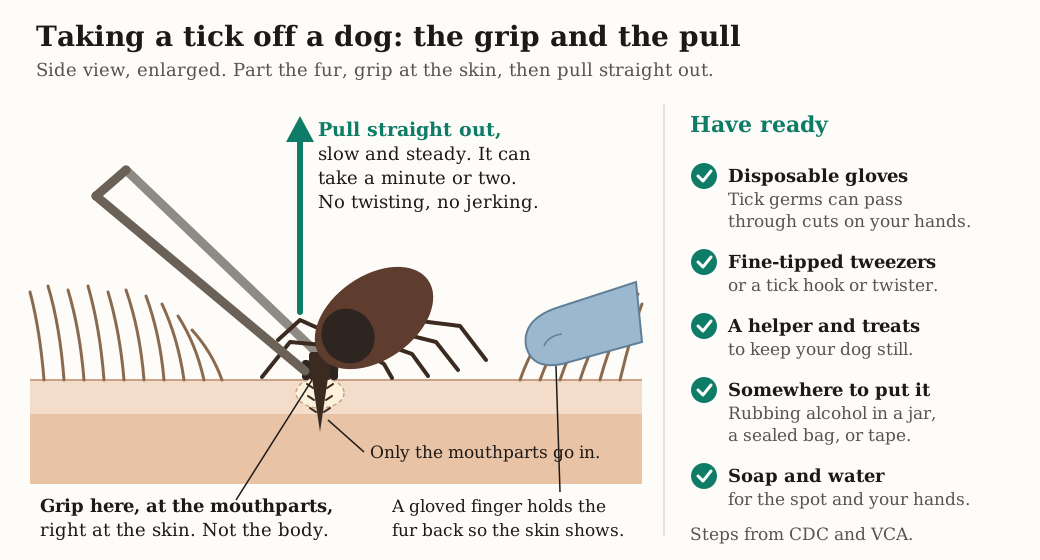
Taking the tick off your dog in 7 steps
Get everything ready first
Put on disposable gloves, and have the tweezers, a small jar of rubbing alcohol or a sealable bag, and some treats within reach. Gloves matter here. Merck's vet manual says some tick germs, such as the one behind Rocky Mountain spotted fever, can pass through small breaks in your skin.
Settle your dog and get a helper
Choose a calm moment in good light, such as after a walk. A helper can hold the dog gently and feed small treats one at a time. A small dog can sit on a lap.
Part the fur
Spread the fur with your fingers until you can see exactly where the tick meets the skin. On a thick or long coat, a comb helps hold the hair back. You cannot grip low enough if you cannot see the skin.
Grip the tick right at the skin
Close fine-tipped tweezers around the tick's mouthparts, as close to the skin as you can. Keep the tips off the swollen body. Squeezing the body can push the tick's fluids into the bite.
Pull straight out, slowly
Pull straight away from the skin with steady, even pressure. Don't twist or jerk. The skin may lift a little as you pull, which is normal. Keep the pressure on, because VCA says it can take a minute or two before the tick lets go.
Put the tick away safely
Drop it in rubbing alcohol, seal it in a small bag, or wrap it tightly in tape. Never crush it with your fingers. If you keep it for your vet, write the date on the bag.
Clean up, then check for more
Wash the spot with soap and water, take off the gloves, and wash your hands. Give your dog a treat. Then check the rest of the dog, because one tick often means more.
Can I remove a tick from my dog at home?
Yes, for one or a few ticks. Vetster’s vets say a vet visit is not usually needed unless the tick is hard to remove, your dog seems ill, or there are many ticks. Leave it to your vet if the tick is on an eyelid or inside the ear canal, or if your dog snaps when you try.
That is how to remove a tick from a dog with tweezers. It is the same method CDC gives for people, with gloves and a helper added. For a tick on you or your child, see our guide to removing a tick from a person. To learn which tick you found and what it can carry, start with our guide to ticks.
Tweezers, a tick hook or a twister: which tool is best?
Fine-tipped tweezers are all most owners need. CDC says a plain set of tweezers works very well, and the many tick tools on sale are optional. A tick hook or twister suits some owners, especially on a wriggly dog. Whatever you use, it has to grip the tick right at the skin.
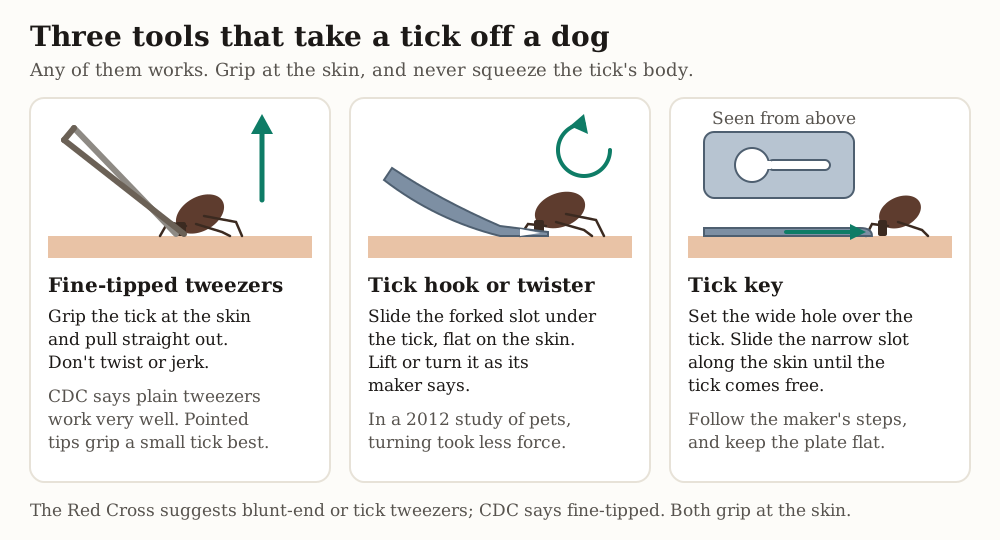
Table 1. Tick removal tools for dogs
Fine-tipped tweezers
- How to use it
- Grip at the skin and pull straight out
- Good to know
- CDC's first choice. Pointed tips get under a small tick
Blunt-end or tick tweezers
- How to use it
- The same grip and pull
- Good to know
- The Red Cross pet first aid page suggests these; CDC says fine-tipped
Tick hook or twister
- How to use it
- Slide the slot under the tick at the skin, then lift or turn as the maker says
- Good to know
- Comes in sizes. PDSA says to switch sizes if it doesn't fit neatly
Tick key
- How to use it
- Set the wide hole over the tick, then slide the narrow slot along the skin
- Good to know
- Follow the maker's steps and keep it flat
Bare fingers
- How to use it
- Don't
- Good to know
- Merck's vet manual says never use bare hands, and fingers squeeze the body
Should you twist a tick out of a dog?
Not with tweezers. CDC and VCA say to pull straight out without twisting, because twisting can snap off the mouthparts. The Companion Animal Parasite Council also describes a slow, steady, straight pull. British vet charities teach the opposite with a twister tool. PDSA and Blue Cross both say to slide it under the tick and turn it until the tick lets go.
There is some evidence for the British way. In a 2012 Austrian study, 22 vets and 4 owners removed 596 ticks from pets with five different tools. Twisting needed less force, took less time and upset the animals less. The tool with a V-shaped slot left the most ticks whole. However, the study looked at one European tick, the castor bean tick.
So here is our advice. With tweezers, pull straight, as CDC says. With a hook or twister, follow its maker’s steps, which often include turning. Either way, grip low and never squeeze the body.
What not to put on a tick on your dog
Put nothing on an attached tick. Vaseline, nail polish, rubbing alcohol, dish soap, essential oils and a hot match do not make a tick let go. CDC warns that such tricks can agitate the tick and force infected fluid into the skin. Meanwhile the tick keeps feeding, and tweezers would have had it out in a minute or two.
The evidence is old but clear. In a 1985 test, G. R. Needham tried petroleum jelly, nail polish, 70% rubbing alcohol and a hot match on American dog ticks. None of them made a tick let go, whether it had fed for half a day or for 3 to 4 days. By contrast, forceps or gloved fingers removed all 29 ticks pulled that way.
VCA Animal Hospitals answers the Vaseline question with one word: false. Its vets add that heat from a match or a hot nail is risky as well as useless. VCA also says these tricks can make the tick salivate into the bite. A burn on your dog is the last thing you need on top of a tick.
So will rubbing alcohol make a tick back out? No. Is there anything that will draw a tick out of a dog? Also no. Barbed mouthparts and a glue the tick makes hold it in place, so it cannot simply back out.
Rubbing alcohol does have one use: killing a tick once it is off. For ticks still crawling in the coat, and for what stops new ones, see what kills ticks on dogs, and what doesn’t. It covers dish soap, vinegar and the products vets use.
Tick head stuck in your dog: what to do
What stays behind is the mouthparts, not a head, and the piece is smaller than a poppy seed. Try once to lift it out with clean tweezers. If it won’t come, leave it. CDC says the skin pushes leftover mouthparts out as it heals, and digging at the spot only adds damage.
A tick has no separate head. Its mouthparts sit at the front of the body, and one barbed piece anchors in the skin. The germs a tick carries live in its body. So once the body is off, the bite stops getting riskier.
Often nothing was left at all. Dr. Jo Myers, a vet who writes for Vetster, says a scabby sore with a dark spot in the middle is the normal result of a tick bite. Owners easily mistake that dark dot for the head. Watch the spot rather than dig at it.
PDSA, a UK vet charity, takes a more careful line. It suggests a vet check whenever part of the tick is left behind. We agree when the spot turns hot, red or swollen, or starts to ooze, which PDSA lists as signs of infection.
How to tell if you got the whole tick
Look at the front end of the tick you pulled. Small dark mouthparts there mean they came out with it. Next, look at the bite with your phone camera on zoom. A hard black speck that won’t wipe off may be mouthparts. By contrast, a flat brown crust is a scab.
A bit of skin or a clear, jelly-like blob on the tick is normal too. That is the glue the tick makes to hold on, not the head. Sometimes the glue stays in the skin instead. In the 1985 test, it stayed behind for all 22 lone star ticks pulled, even though no mouthparts broke off.
After removal: the bump or scab on your dog
A small red bump or scab where the tick was is normal for a few days, and the scab can take a little longer to fade. Wash the spot once with soap and water, then leave it alone. Call your vet if the bump keeps growing, feels hot, oozes pus or sits close to the eye.
Merck’s vet manual says a bite that turns red or swells deserves a prompt vet visit. In practice, that means a spot that is getting worse, not one that is fading. Take a photo on the first day so you can compare it later.
Ask your vet before you put any cream, ointment or spray on the spot. Plain soap and water is what CDC and VCA give for cleaning. Also, don’t pick at the scab or squeeze the bump to check for the head. In one dog forum thread we read, a lump near the eye grew worse for three days of home care. The dog then went to the vet.
Owners also describe a small bald or darker patch that lasts weeks or months after a tick. Mention it at your dog’s next checkup if it doesn’t fade. For what a tick bite on a dog looks like, the bullseye question and the tick crater vets look for, see our guide to ticks on dogs.
Where to look for more ticks on your dog
Ticks rarely travel alone, so check the whole dog after you remove one. CDC names seven places: in and around the ears, around the eyelids, under the collar, under the front legs, between the toes, between the back legs and around the tail. Run your hands slowly over the coat to feel for small bumps.
Our page on ticks on dogs has a diagram of all seven spots. It also shows how to tell a tick from a skin tag or a nipple. That check matters before you pull: never pull a bump that has no legs.
How to remove a tick from a dog that won’t hold still
Use two people, food and patience. One person holds and rewards the dog while the other works. Pulling at a moving tick is how mouthparts snap off, so stop and reset rather than chase it. If your dog growls, snaps or panics, let your vet or a vet nurse take the tick off.
- Pick your moment. A tired dog after a walk, or a sleepy one on the sofa, holds still best.
- Use food. A helper can feed small treats one at a time, or hold a lick mat with something your dog loves.
- Hold gently. Vetster suggests wrapping a squirmy puppy in a towel, and that works for a small dog too. A larger dog can lie on its side while the helper leans over its shoulders.
- Get set before you grip. Part the fur and line up the tool, then grip and pull in one calm movement.
- Try a hook or twister. In the 2012 study, turning upset the animals less than pulling did.
- Leave the hard spots to a vet. A tick on the eyelid or inside the ear canal is not a job for home.
A short break is fine. The tick should come off today, not in the next ten minutes, so calming your dog first costs you nothing.
Removing a tick from a puppy
Our steps for how to remove a tick from a dog work the same on a puppy: gloves, tweezers and a slow, straight pull. Wrap a small puppy in a towel or have someone hold it on a lap. Take several ticks on a puppy seriously, though: Vetster and Merck both warn that heavy tick loads can cause blood loss, especially in small animals.
Call your vet if a puppy has many ticks, seems weak or tired, has pale gums, or goes off its food. Don’t reach for a tick product on your own, either. Pet tick product labels list a minimum age and weight, so ask your vet which one suits your puppy, and follow the label exactly.
What about a cat?
The grip is the same on a cat, but the product rules are not. Merck’s vet manual says permethrin, found in many dog tick products, can be highly toxic to cats. Never use a dog tick product on a cat. Our guide to ticks on cats covers the rest.
What to do when your dog has a lot of ticks
A few ticks can come off one by one at home, using the steps above. A dog covered in ticks needs a vet promptly, Merck’s vet manual says. Heavy infestations can cause blood loss, skin damage and paralysis. A vet can take them off safely and start a product that kills the rest.
Dozens of ticks the size of a pinhead, all in one patch, are larvae from a single egg clump. Our page on seed ticks shows what they look like and how to get them off quickly.
Keep finding ticks on a dog that rarely goes outside? That points to the brown dog tick, which CDC says can infest homes and kennels. In that case the house needs attention along with the dog.
Should you keep the tick you took off your dog?
Yes, if you can. Seal it in a small bag or wrap it in tape, write the date on it, and keep it for a few weeks. VCA suggests saving a removed tick in a labeled container, and the Companion Animal Parasite Council gives the same advice for ticks taken off people. The type of tick tells your vet which diseases to look for if your dog gets sick.
Vetster’s vets see it differently and say keeping the tick is usually not needed. Both views are fair. A dated bag costs nothing, though, and it can save a guess later.
Take a clear photo of the tick on white paper. Then compare it with our pages on the American dog tick, the deer tick and the lone star tick, or upload it to our bug identifier by picture.
To throw a tick away, drop it in rubbing alcohol, wrap it in tape or seal it in a bag. CDC also lists flushing. However, New Jersey’s health department says not to flush ticks, because they can survive in water, so a sealed bag is the safer pick.
Should you get the tick tested?
Ask your vet first. VCA says your vet can tell you whether a tick needs testing once it is identified. For people, CDC advises against tick testing, because a germ in the tick does not prove an infection. For dogs, a blood test later is usually more useful.
When to call the vet after removing a tick
Call your vet if your dog has a fever, limps, seems tired or stops eating in the weeks after a tick bite. CDC says these signs can take 7 to 21 days or longer to show. Go to a vet now for wobbly back legs, a change in bark or breathing, or trouble standing.
Finding every tick is the treatment for tick paralysis. In North America, a dog usually improves greatly within 24 hours of the tick coming off, Merck says. If it doesn’t, another tick may still be attached, so the vet will search the whole coat.
How long will a tick stay on a dog?
Several days, if nobody finds it. VCA says ticks take several days to finish feeding, and a fed female then drops off to lay thousands of eggs. Merck gives a rule of thumb for timing: a flat tick has been on for an hour to a few days, and a round, swollen one for days.
Does my dog need a Lyme test or antibiotics now?
Not usually, if your dog is well. Vetster’s vets say a vet visit right after removing a tick from a healthy pet is usually not needed. Blood tests done straight away don’t help either, because the antibodies they look for take weeks to show. Merck’s vet manual is more cautious and suggests a disease check even after a few ticks, so ask at the next visit. Ask about the Lyme vaccine too if Lyme is common where you live. CDC notes it is the only tickborne disease dogs can be vaccinated against.
Not veterinary advice. This page is general reference for dog owners. It is not a diagnosis and gives no treatment. If your dog seems unwell after a tick bite, call your vet.
Pest control disclaimer. Photo-based identification can help, but it is not always perfect. For dangerous spiders, large infestations, or anything you are unsure about, contact a licensed pest control professional.
Veterinary disclaimer. This page is general information for dog owners. It is not veterinary advice, a diagnosis or a treatment plan. Ask your veterinarian which tick products are right for your dog, and call them if your pet seems unwell after a tick bite.
Removing a tick from a dog: FAQ
Is it okay to leave a tick on a dog?
Can I pull a tick off my dog with my fingers?
Should I put antibiotic cream on my dog's tick bite?
My dog is on a tick preventive. Why does it still have a tick?
Can I catch something from the tick I pulled off my dog?
Related guides
Ticks on dogs
Where ticks hide on a dog, a tick or a skin tag, the bite afterward, and prevention.
What kills ticks on dogs instantly
Why nothing safely kills an attached tick on the spot, and what vets use instead.
How to remove a tick from a person
The CDC method for you or your child, including a stuck head.
Ticks on cats
Taking a tick off a cat, and why dog tick products can poison cats.
Brown dog tick
The one US tick that can infest a house or kennel.
American dog tick
The red-brown tick with pale markings that dogs pick up most.
Seed ticks
Dozens of tiny ticks at once: what they are and what to do.
Guide to ticks
Every common US tick, where it lives, and what it can carry.
Sources
- CDC, What to Do After a Tick Bite (June 9, 2026)
- CDC, Preventing Ticks on Pets (May 15, 2024)
- Companion Animal Parasite Council, Ticks guideline (March 30, 2023)
- Merck Veterinary Manual, Ticks of Dogs (dog owners)
- Merck Veterinary Manual, Tick Paralysis in Dogs (dog owners, updated July 2026)
- VCA Animal Hospitals, Ticks in Dogs (June 28, 2023)
- VCA Animal Hospitals, True or False: can you take a tick off pets with petroleum jelly or nail polish?
- American Red Cross, Dogs and Ticks: How to Spot and Remove (Deborah C. Mandell, VMD)
- Vetster, How to remove ticks from your dog, cat, or horse (verified by Dr. Jo Myers, March 19, 2026)
- PDSA, How To Remove a Tick From A Dog Or Cat (July 2022)
- Blue Cross, Ticks on dogs (reviewed May 3, 2023)
- Needham GR, Evaluation of five popular methods for tick removal, Pediatrics 75(6):997-1002 (1985)
- Duscher GG, Peschke R, Tichy A, Mechanical tools for the removal of Ixodes ricinus female ticks: differences of instruments and pulling or twisting?, Parasitology Research 111(4):1505-1511 (2012)
- New Jersey Department of Health, Lyme Disease Frequently Asked Questions (2024, PDF)