What is a lone star tick?
The lone star tick, Amblyomma americanum, is a hard tick of the eastern, southern and midwestern United States. Three features identify it: a reddish-brown, rounded body, one white spot on the adult female’s back, and long mouthparts. An unfed female is about 4 to 6 mm (1/6 to 1/4 inch) long.
The name comes from that white spot, not from Texas. In fact, the tick lives in most of the eastern half of the country. Older names include the turkey tick and the northeastern water tick.
It is one of the most common ticks that bite people. The University of Florida calls it the tick most often reported biting humans in the southeastern and south-central US. All three active stages bite: the larva, the nymph and the adult. CDC says nymphs and adult females bite people most often.
Our guide to ticks covers the whole group. This page is about this one species: what it looks like, where it lives now, and what a bite means.
How to identify a lone star tick
To identify a lone star tick, check the back. An adult female has one white or silvery spot near the middle of a reddish-brown body. An adult male has pale streaks and spots around his rear edge and no single spot. Both are about 2 to 6 mm (1/10 to 1/4 inch) long before feeding.
Table 1. Each life stage and what gives it away
One white spot on a reddish-brown back
- Stage
- Adult female
- Size before feeding
- 4–6 mm (1/6–1/4 in)
- Legs
- 8
Pale streaks and spots around the rear edge, no single spot
- Stage
- Adult male
- Size before feeding
- 2–5 mm (1/10–1/5 in)
- Legs
- 8
Tiny, flat, reddish brown, no spot yet
- Stage
- Nymph
- Size before feeding
- 1.5–2.5 mm (1/16–1/10 in)
- Legs
- 8
Smaller than a pinhead, often dozens at once
- Stage
- Larva (seed tick)
- Size before feeding
- 0.5–1 mm (under 1/25 in)
- Legs
- 6
Swollen, slate gray, spot still near the head
- Stage
- Fed female
- Size before feeding
- Up to 16 mm (5/8 in)
- Legs
- 8
Adult sizes from Texas A&M AgriLife; nymph and larva sizes from the University of Florida. Inch figures are rounded.
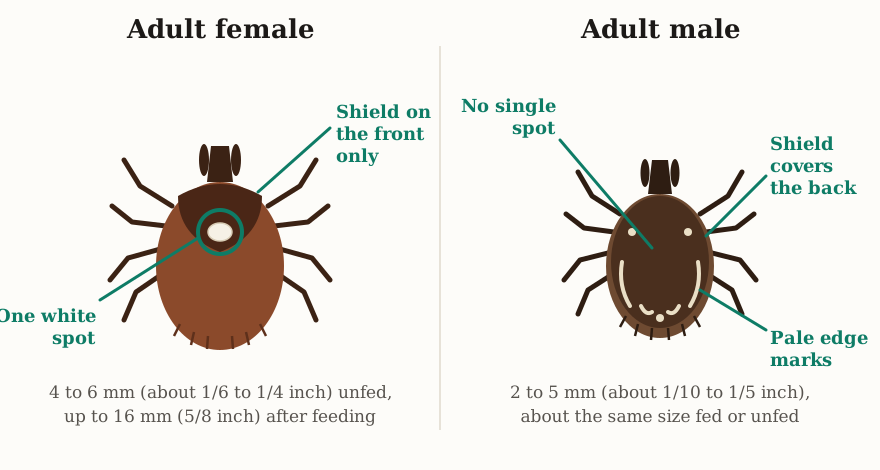
The female: one white spot
The female’s spot sits at the back of a small, dark shield that covers only the front of her body. Texas A&M says it is often shiny and can look white, cream, gold or bronze. The rest of her back is reddish brown. When she fills with blood, her body swells and turns slate gray, but the shield and its spot stay the same size near her head.
The male: white marks at the edges
A male’s shield covers his whole back, so he looks darker and flatter than a female. Instead of one spot, he has cream or whitish marks along the rear edge. Some people call them inverted horseshoes. He also stays about the same size whether he has fed or not, because males take only small meals.
Nymphs and seed ticks
Nymphs are about the size of a pinhead, with eight legs and no white spot. Larvae are even smaller and have six legs. People call them seed ticks, because a cluster of them looks like a sprinkle of seeds on a pant leg. Our seed tick guide explains how to tell them from chiggers and what to do after a swarm.
How big is a lone star tick?
Sources do not agree on the exact size, so here are their numbers. Texas A&M AgriLife gives 4 to 6 mm for an unfed female and 2 to 5 mm for a male. The University of Florida gives 3 to 4 mm for adults. Illinois DNR says about 1/8 inch for an unfed female, which is about 3 mm.
PestWorld, run by the pest control industry, gives two figures on the same page: 1/6 to 1/4 inch in its size box, and about 1/8 inch in its text. Both can be right, since ticks vary. As a rule of thumb, an unfed adult is about the size of a sesame seed. A fed female can reach 16 mm (5/8 inch).
Lone star tick or another tick?
Three other common ticks get mixed up with this one. The fastest check is the pattern on the shield, as Table 2 shows. Our types of ticks chart covers every common US species, and what a tick looks like explains the body parts.
Table 2. Ticks that get mistaken for a lone star tick
One white or silvery spot, reddish-brown body
- Tick
- Lone star tick, female
- Notes
- East, South and Midwest
Whole shield cream colored with dark brown marks
- Tick
- American dog tick, female
- Notes
- Mostly east of the Rockies. See our dog tick guide
Orange-red body around a black shield, no white
- Tick
- Blacklegged (deer) tick, female
- Notes
- Smaller; spreads Lyme disease. See our deer tick guide
Pale cream shield with reddish-brown streaks
- Tick
- Gulf Coast tick
- Notes
- Coastal South, Oklahoma and Kansas; long mouthparts like the lone star tick
Descriptions from Texas A&M AgriLife and the University of Rhode Island TickEncounter.
If you are torn between two of them, the American dog tick and deer tick pages show each one up close. A male lone star tick is the one most often called a dog tick by mistake.
Tick with a white dot on its back: what it means
A tick with a white dot on its back is almost always an adult female lone star tick. CDC describes her by that white dot, or “lone star.” No other common US tick has one single spot. A male has pale marks around the edges instead, and an American dog tick has a whole pale shield.
Is a tick with a white spot bad? It is a tick to take seriously, but not to panic over. She bites readily and can carry the germs listed below. Still, most bites lead to nothing more than an itchy bump. Remove her the same way you would any tick.
Do white ticks carry Lyme disease? The white-spotted one does not. As covered below, lone star ticks do not spread the Lyme germ. A tick that looks gray or white all over is often a fed tick, swollen with blood.
Not every bug with a white mark is a tick, either. One Reddit user in Maine posted a “tick” with a white dash, found on a kitchen counter. Commenters said it was not a tick at all. Our bugs that look like ticks page covers the beetles, bugs and mites that fool people.
Do lone star ticks chase you?
Yes, in a way. Adult lone star ticks hunt: they crawl across the ground toward the carbon dioxide you breathe out. In a 2025 field study in Oklahoma, adults crawled up to 9 m (about 30 feet) toward a carbon dioxide source in 24 hours. The average was 3.2 m, or about 10 feet.
Most ticks wait instead. They climb a grass stem, hold out their front legs and grab whatever brushes past. Lone star ticks do that too, but the adults also go looking. The study team, from Washington State University and Oklahoma State University, wrote in Parasites & Vectors that ticks outside this genus usually move less than 1 to 2 m over days to weeks.
So sitting on the ground near tick habitat for a while gives them time to find you. A picnic on a shady lawn edge or a long break on a log is the classic setup. Nymphs are fast too. The University of Rhode Island says they latch on at shoe or shin height but crawl so quickly they can reach your waist before you notice.
Where lone star ticks live: range map by state
Lone star ticks live across the South, the East and the Midwest. CDC’s county data through 2025 shows established populations in 1,139 of 3,110 counties, in 33 states plus Washington, DC. Ticks have been reported in 635 more counties. Nine western states have no records.
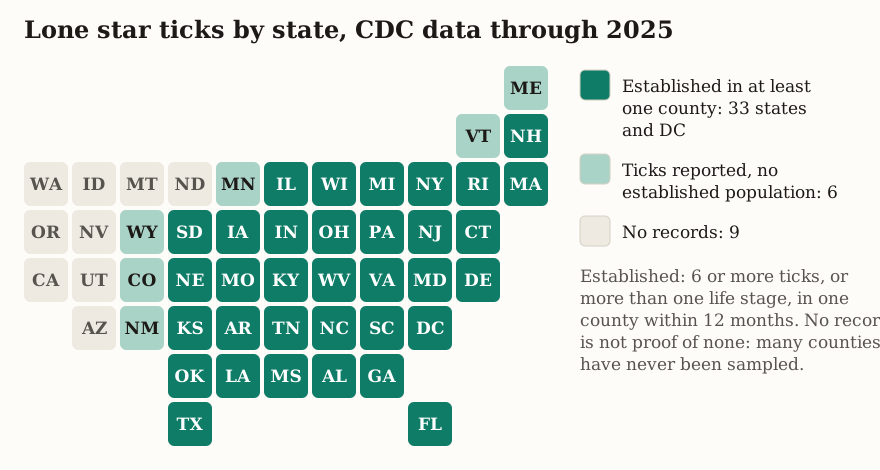
The heart of the range runs from Texas and Oklahoma east to the Atlantic coast, and north to Missouri, Illinois, Indiana and Kentucky. Arkansas has established ticks in 73 of 75 counties, and Oklahoma in 69 of 77. The tick thins out toward the edges of the map, in the Plains, the upper Midwest and New England.
Read the map with one caution. CDC calls a county established when it has 6 or more ticks of one life stage, or more than one life stage, in 12 months. A county with no record may simply never have been sampled. CDC also notes that a county changing status often means someone looked there for the first time, not that the ticks just arrived.
Lone star ticks in the states people ask about
Table 3. CDC county status for the lone star tick, 2025
Michigan
- Counties with established ticks
- 5 of 83
- Counties with reports only
- 39
- What it means
- Established in a few counties, reported in many more
Ohio
- Counties with established ticks
- 19 of 88
- Counties with reports only
- 29
- What it means
- Mostly the southern counties, plus a few in the north
Illinois
- Counties with established ticks
- 68 of 102
- Counties with reports only
- 25
- What it means
- Common, most of all in the south
Indiana
- Counties with established ticks
- 49 of 92
- Counties with reports only
- 14
- What it means
- Common
Florida
- Counties with established ticks
- 48 of 67
- Counties with reports only
- 14
- What it means
- Common statewide
Texas
- Counties with established ticks
- 118 of 254
- Counties with reports only
- 66
- What it means
- Common in the east and center; no records in much of the Panhandle and far west
New York
- Counties with established ticks
- 19 of 62
- Counties with reports only
- 32
- What it means
- Long Island, the Hudson Valley and parts of the west
Connecticut
- Counties with established ticks
- 3 of 8
- Counties with reports only
- 1
- What it means
- Fairfield, New Haven and New London counties
Colorado
- Counties with established ticks
- 0 of 64
- Counties with reports only
- 4
- What it means
- Reported, not established
Maine
- Counties with established ticks
- 0 of 16
- Counties with reports only
- 12
- What it means
- Reported, not established in CDC's file
California, Oregon, Arizona
- Counties with established ticks
- 0
- Counties with reports only
- 0
- What it means
- No records
Counts from CDC’s 2025 lone star tick surveillance data set. The “What it means” column draws on the county names in the same file.
Sources differ at the northern edge. Texas A&M AgriLife says populations now survive the winter as far north as coastal Maine. CDC’s file, which needs repeat finds to call a county established, does not list any Maine county yet. Both can be true: a few ticks can overwinter before anyone has collected enough of them to meet CDC’s rule.
Why are lone star ticks spreading north?
They are mostly taking back old ground. CDC says the tick’s range in the 1750s reached across the eastern US. It shrank as forests were cut and white-tailed deer, its key host, were hunted out. Since the 1940s, deer have come back, and the tick has followed them.
A 2022 review by Ilia Rochlin and colleagues reached the same view: the spread north is a recolonization of a former range. Milder winters and more forest edge near homes likely help too, because this tick thrives where woods meet lawns.
Where they hide in the yard and the woods
Lone star ticks need shade and damp air. They do best in second-growth woods with thick underbrush, and along the edge where woods meet a lawn or a meadow. University of Kentucky entomologists say tick numbers run highest along wooded edges and in overgrown plants. Open, sunny, mowed grass holds few of them.
Lone star tick season
Lone star tick season runs from about March to September in most of the range. Adults and nymphs peak in spring and early summer, from about April to July. Larvae, the seed ticks, peak from July to September. Warm winter days can bring adults out as early as January, Texas A&M says.
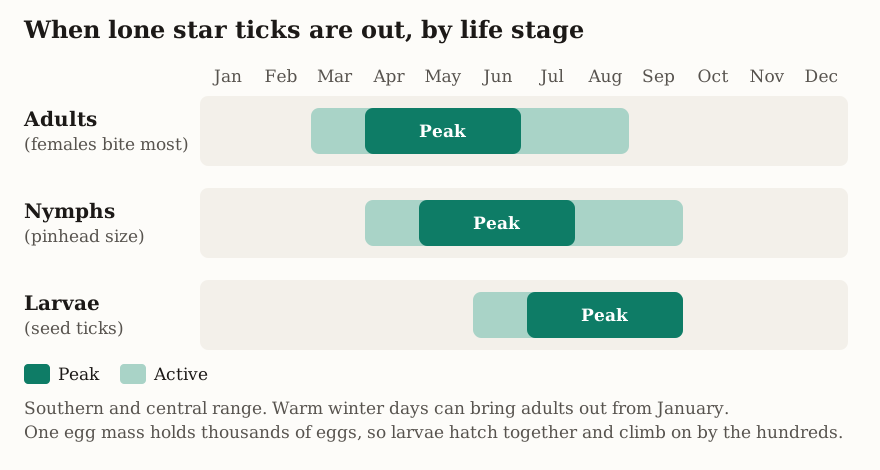
The late summer swarms surprise people the most. A female lays one mass of thousands of eggs, so the larvae hatch together and wait in a cluster. Walk through that spot and dozens can climb on at once. One Reddit user found about 20 “poppy seed sized ticks” on their legs after a dog walk. Over the next days they counted 50 or more bites.
Is the lone star tick dangerous? The diseases it spreads
The lone star tick can spread several illnesses, but most bites cause none. CDC lists ehrlichiosis, tularemia, Heartland virus and Bourbon virus. Its bite is also linked to a rash illness called STARI and to alpha-gal syndrome, a meat allergy. Ehrlichiosis symptoms usually start 1 to 2 weeks after a bite.
Table 4. Illnesses linked to the lone star tick
Ehrlichiosis
- Cause
- Ehrlichia bacteria
- What CDC says to know
- Fever, chills, headache and muscle aches, usually 1 to 2 weeks after the bite. A delay in treatment can make it severe
STARI (southern tick-associated rash illness)
- Cause
- Unknown
- What CDC says to know
- A red, expanding rash at the bite, usually within 7 days, growing to 3 to 12 inches (8 to 30 cm)
Tularemia
- Cause
- Francisella tularensis bacteria
- What CDC says to know
- Spread by ticks, deer flies and contact with sick animals, mostly rabbits and rodents
Heartland virus disease
- Cause
- Heartland virus
- What CDC says to know
- Fever, tiredness, nausea and aches, a few days to weeks after the bite. No vaccine or specific medicine
Bourbon virus disease
- Cause
- Bourbon virus
- What CDC says to know
- Rare; first found in Bourbon County, Kansas, in 2014. Cases in the Midwest, East and South
Alpha-gal syndrome
- Cause
- An allergy, not an infection
- What CDC says to know
- Delayed allergic reactions after eating red meat. See the next section
From CDC’s pages on each illness and its Where Ticks Live page (2024 to 2026). Reference only, not a diagnosis.
Many bites are itchy without being infected. CDC says lone star tick saliva can irritate the skin, so redness and discomfort at the bite do not by themselves mean an infection. University of Kentucky entomologists add that the itching and redness can last 2 weeks or longer.
The risk from any one bite is small. University of Kentucky entomologists note that very few lone star ticks in Kentucky are infected, and that an infected tick must feed for several hours before it passes on a germ. Hours, not days: the Companion Animal Parasite Council, a veterinary group, says Ehrlichia can pass within 3 to 6 hours of attachment. That is why removing it quickly matters.
Rocky Mountain spotted fever is a different story. CDC does not list it for this tick, and the University of Kentucky says the lone star tick has no significant role in spreading spotted fevers. CDC lists the American dog tick as a carrier instead.
Do lone star ticks carry Lyme disease?
No. Lone star ticks do not spread the bacterium that causes Lyme disease, Borrelia burgdorferi. CDC says they have not been shown to transmit it, and that their saliva has been shown to kill it. A 2018 review in the Journal of Medical Entomology covered 54 surveys of more than 52,000 ticks.
That review also found that at least nine lab experiments failed to show this tick can pass on the Lyme germ. Much of the confusion comes from STARI, whose rash can look like the Lyme bull’s-eye. Lyme disease in the East comes from the blacklegged or deer tick.
The tick that makes you allergic to meat: alpha-gal syndrome
The tick that makes people allergic to red meat is mainly the lone star tick. Doctors call the condition alpha-gal syndrome. CDC says symptoms usually start 2 to 6 hours after eating red meat or dairy, and can first appear weeks to months after the tick bite. Trouble breathing after eating is an emergency.
Alpha-gal is a sugar molecule found in most mammals, but not in people. It is also in the saliva of some ticks. When the tick bites, the immune system can learn to treat alpha-gal as a threat. Later, a burger, a pork chop or another mammal product can set off an allergic reaction. CDC also calls this a red meat allergy or tick bite meat allergy.
Timing figures vary a little by source. CDC gives 2 to 6 hours from the meal to the reaction. University of Kentucky entomologists give 3 to 6 hours. Either way, the delay is why many people do not connect the reaction to the steak they ate at dinner.
Does every lone star tick bite cause it?
No. CDC says not every person bitten develops alpha-gal syndrome, and no one yet knows why some people do. Alpha-gal comes from the tick’s saliva, not from a germ that only some ticks carry. So the real question is how each person’s body reacts.
It is still common enough to know about. CDC counts more than 110,000 suspected cases from 2010 to 2022, and estimates that as many as 450,000 people may be affected. Most reported cases are in the South, the East and the central states, where the tick lives.
Is the meat allergy permanent?
Not always. Google’s AI answer for this tick calls the allergy lifelong, and it is not, for everyone. CDC says some people who avoid more tick bites may be able to eat alpha-gal foods again. That is a decision to make with a doctor. New tick bites can bring the reactions back.
Dairy is a “some people” trigger, not an every-case one. CDC says most doctors advise stopping mammal meat, and stopping dairy only if a person cannot tolerate it. If you think you have alpha-gal syndrome, see an allergist or your doctor. They diagnose it with a history, an exam and a blood test.
What to do if a lone star tick bites you
If a lone star tick bites you, remove it right away with fine-tipped tweezers, pulling straight out with steady pressure. Clean the bite, bag the tick, and check yourself for more. Then watch the bite for about a month, and see a doctor for a growing rash or a fever.
After a lone star tick bite: step by step
Remove it now
Grip the tick as close to the skin as you can with clean, fine-tipped tweezers. Pull straight out with steady, even pressure, and do not twist or jerk. CDC says not to wait for a doctor to do it, because a delay can raise the risk of disease.
Skip the home remedies
Do not use petroleum jelly, nail polish or heat to make it let go. CDC warns these can agitate the tick and push fluid into the skin. Do not crush it with your fingers either.
Leave stuck mouthparts alone
Lone star ticks have long mouthparts, so a piece may stay in the skin. Lift it out with the tweezers if it comes easily. If it does not, leave it: CDC says the skin pushes it out as it heals.
Clean the bite and your hands
Wash the bite and your hands with soap and water, or use hand sanitizer.
Bag the tick and check for more
Seal the tick in a bag or container, or wrap it tightly in tape. Then check your whole body, your children and your pets. Where there is one tick there are often more, and seed ticks come by the dozen.
Write down the date and place
See a doctor if a rash or a fever starts in the next few weeks. Tell them when the bite happened and where you picked up the tick.
Our tick removal guide shows the grip and what to do when the head seems stuck. For what is normal at the bite and what is not, see what a tick bite looks like, and for when to worry, our tick bite guide.
A photo of a bite cannot tell you which tick made it. If you saved the tick, a clear photo of its back is what settles it. Try the bug identifier by picture with the tick on a white card.
Covered in seed ticks?
Act fast, because many will not have bitten yet. The University of Rhode Island says sticky duct tape is a good way to lift larvae off skin and clothes before they attach. Then shower with soap and do a full check. Any that are attached come off with tweezers, one at a time. Expect strong itching for a few days. Our seed tick page has the full routine.
Lone star ticks on dogs and cats
Lone star ticks bite dogs and cats as well as people. Texas A&M lists dogs among the hosts of the adults. The Companion Animal Parasite Council lists ehrlichiosis and tularemia among the infections it spreads to pets, and cytauxzoonosis, a parasite disease of cats.
A tick with a white dot on a dog is the same adult female. Remove it the same way, and save it if your vet may want to see it. Check the ears, the face, between the toes and under the collar after every walk in season. Ask your vet which tick prevention suits your pet. Our ticks on dogs guide covers checks, removal and warning signs. In cats, the lone star tick is the main carrier of cytauxzoonosis, which is often fatal within a week of the first signs, CAPC says. Our guide to ticks on cats lists the signs that need a vet now.
How to avoid lone star ticks
To avoid lone star ticks, start with what costs nothing: stay on cleared paths, do not sit on the ground at wooded edges, and check your body after time outdoors. Add an EPA-registered repellent on skin and 0.5% permethrin on clothing. University of Kentucky entomologists suggest a tick check every 2 hours in tick areas.
- Check early and often. Ticks can wander on you for a while before they bite, so a quick check catches many before they attach.
- Mow and trim. Kentucky entomologists suggest keeping problem lawns at 3 inches (8 cm) or less, which dries the ground out. Over time, they say, that can cut tick numbers by about 75%.
- Move play areas away from the edge of woods and overgrown corners.
- Use a repellent. CDC lists DEET, picaridin, IR3535, oil of lemon eucalyptus, PMD and 2-undecanone. Look for an EPA registration number on the label.
- Treat clothes and gear with 0.5% permethrin, following the label. It goes on fabric, not skin.
- Shower soon after coming in, and check the scalp, the waist, behind the knees and the armpits.
For the full plan, see how to prevent tick bites for people and getting rid of ticks in the yard.
Lone star tick myths, corrected
At least 6 common claims about this tick are wrong or overstated. Some come from health sites that rank well, one from a tick testing lab, and one from Google’s own AI answer. Here is what each gets wrong.
Myth 1
Myth: “The meat allergy is lifelong.”
Truth: Google's AI Overview for this tick says so. CDC says some people who avoid more tick bites may tolerate alpha-gal foods again, with a doctor's guidance.
Myth 2
Myth: “Alpha-gal means giving up dairy too.”
Truth: Only for some people. CDC says most doctors advise stopping mammal meat, and dairy only if a person cannot tolerate it.
Myth 3
Myth: “Lone star ticks spread Lyme disease.”
Truth: CDC says they have not been shown to transmit the Lyme germ, and their saliva kills it. A 2018 review of more than 52,000 ticks agrees.
Myth 4
Myth: “STARI is caused by Borrelia lonestari.”
Truth: A tick testing lab's page still suggests this. CDC says researchers once thought so, but later work did not support it. The cause is unknown.
Myth 5
Myth: “It is named after Texas.”
Truth: The name comes from the female's single white spot, the lone star. The tick lives across much of the eastern US.
Myth 6
Myth: “Ticks bury their heads in your skin.”
Truth: Cleveland Clinic's page says they burrow their heads in. The tick cuts in with its mouthparts and glues itself on with a cement-like substance, the University of Florida explains. Only the mouthparts go in.
When to call someone
Most lone star tick bites need only removal and a few weeks of watching. Get help in 4 cases: an allergic reaction, a growing rash or a fever after a bite, a reaction hours after eating meat, or a tick problem around the house you cannot control. Here is who to call.
- 911 for trouble breathing, a swelling face, lips or throat, or fainting, at any time after a bite or a meal.
- Your doctor for a rash that keeps growing, a fever, or flu-like illness in the weeks after a bite. Say when and where it happened.
- An allergist if you get hives, belly pain or other reactions a few hours after eating red meat.
- Your vet for a pet with ticks that keep coming back, or one that seems sick after a tick bite.
- Poison Control, 1-800-222-1222, if someone swallows a pesticide or a tick product.
- A licensed pest professional if ticks keep turning up in the yard after mowing and clearing the edges.
Medical disclaimer. This page is for general information only. It is not a medical diagnosis. If you have severe symptoms, trouble breathing, swelling of the face or throat, fast spreading redness, fever, severe pain, pus, or signs of infection, contact a doctor or your local emergency number.
Pest control disclaimer. Photo-based identification can help, but it is not always perfect. For dangerous spiders, large infestations, or anything you are unsure about, contact a licensed pest control professional.
Lone star tick FAQ
How long does a lone star tick stay attached?
Can lone star ticks live in your house?
How rare is a lone star tick?
Was the lone star tick made in a lab?
Should I send the tick to be tested?
Related guides
Ticks
The hub: every tick guide on the site, by species and by problem.
Seed ticks
The tiny larvae that swarm in late summer, and how to get them off.
Deer tick
The blacklegged tick that spreads Lyme disease, and how to tell it apart.
American dog tick
The large tick with a pale shield, also called the wood tick.
How to remove a tick
The tweezer method step by step, and what to do about a stuck head.
What a tick bite looks like
A normal bump, a growing rash, and the signs that need a doctor.
Ticks on dogs
Checks, removal and prevention for pets.
Types of ticks
An identification chart of the common US ticks.
Sources
- CDC, Lone Star Tick Surveillance, with the 2025 county data set (May 26, 2026)
- CDC, Where Ticks Live (July 30, 2025)
- CDC, What to Do After a Tick Bite (June 9, 2026)
- CDC, About Southern Tick-Associated Rash Illness (March 24, 2026)
- CDC, About Alpha-gal Syndrome (January 5, 2026)
- CDC, Symptoms of Alpha-gal Syndrome (January 5, 2026)
- CDC, Managing Alpha-gal Syndrome (January 5, 2026)
- Texas A&M AgriLife, The Tick App: Lone star tick
- Holderman CJ and Kaufman PE, Lone Star Tick, University of Florida EDIS EENY580 (archived copy)
- University of Kentucky Entomology, ENTFACT-648: The Lone Star Tick in Kentucky
- University of Rhode Island TickEncounter, Lone Star Tick
- Companion Animal Parasite Council, Ticks guideline (updated March 30, 2023)
- Marshall DS and others, Spatial and temporal activity patterns of Amblyomma americanum, Parasites & Vectors 18:12 (2025)
- Stromdahl EY and others, Amblyomma americanum Ticks Are Not Vectors of the Lyme Disease Agent, Borrelia burgdorferi: A Review of the Evidence, Journal of Medical Entomology (2018)
- Rochlin I, Egizi A and Lindström A, The Original Scientific Description of the Lone Star Tick and Implications for the Species' Past and Future Geographic Distributions, Journal of Medical Entomology (2022)