What do tick eggs look like?
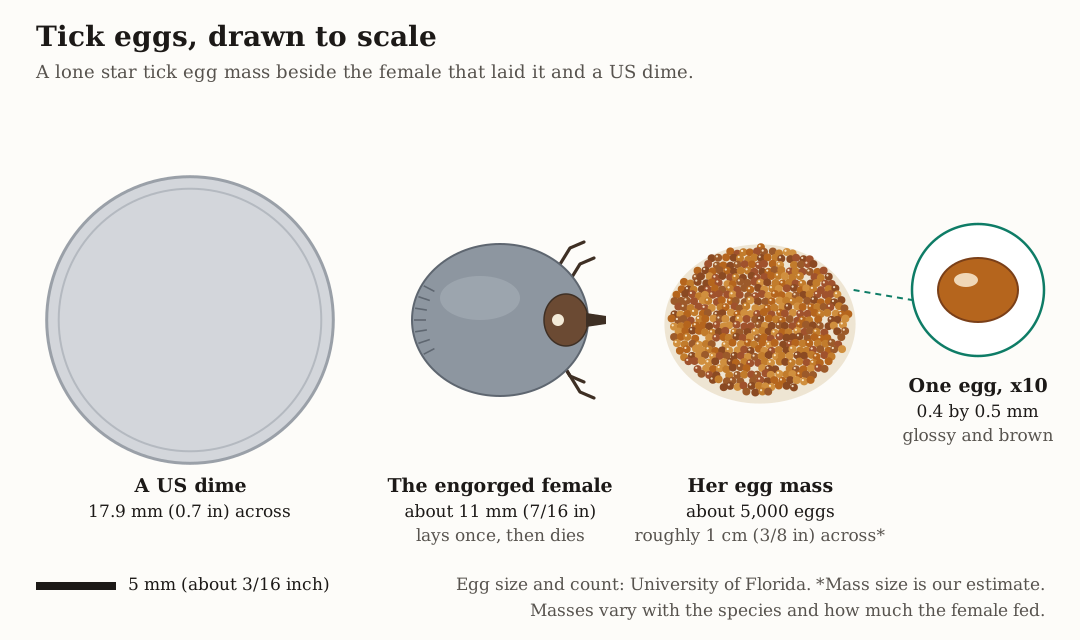
Tick eggs look like a tiny heap of fish roe. Each egg is a shiny, oval bead about 0.5 mm (1/50 inch) long, amber, reddish brown or dark brown. A female lays thousands in one spot, so you see one sticky clump rather than loose eggs. A large clump is only about 3/8 to 1/2 inch (1 to 1.3 cm) across.
The University of Florida measures lone star tick eggs at about 0.4 by 0.5 mm and calls them glossy, brown and oval. Brown dog tick eggs are round and dark brown. Fresh eggs can also look a little see-through, which is why people compare a clump to caviar.
The shine has a job. As she lays, the female coats each egg in wax from a gland called Gené’s organ. A 2019 study in Ticks and Tick-borne Diseases describes that wax as waterproof, sticky and germ-fighting. So it keeps the eggs from drying out and holds the clump together.
How big is a tick egg mass?
A tick egg mass is smaller than a dime. By our own math, about 5,000 eggs of 0.5 mm piled together fill roughly the space of a pea, a heap about 3/8 to 1/2 inch (1 to 1.3 cm) wide. A deer tick’s clutch of about 2,000 eggs is smaller still. In fact, the egg mass is often no bigger than the swollen female that laid it.
Pest control pages give up to 1 inch, the size of a quarter, as the top of the range. That works as an upper limit, but most clumps are well under it. As a result, they are easy to miss under a leaf. A quarter-sized pile of large black balls is not tick eggs at all, as the look-alike section below explains.
How can you tell if a tick laid eggs?
You usually find the mother with them. Only a female that has fed for days and dropped off can lay eggs. A lone star female starts 7 to 16 days after her last meal, Pennsylvania’s environment department says. She then sits still beside a growing pile for days to weeks. Brown dog tick females keep laying for 15 to 18 days, for example. When she is done, she dies, so a dead tick next to a brown clump is a sure sign.
If you kept a swollen tick in a jar to show a doctor, check the jar. A clump of brown beads beside her means she has laid her eggs. Seal the jar or tape it shut and throw it away, unless your doctor still wants to see the tick.
Is there such a thing as a tick nest?
No. Ticks build no nest of any kind. When people say tick nest, they mean one of two things. It is either a female’s egg mass, a clump of 1,500 to 6,500 eggs on the ground, or the swarm of tiny larvae that hatches from it. Neither has walls, silk or bedding, and no adult tick guards it.
The swarm is the version that goes viral. In June 2026, a Reddit post titled “Was sitting in a ticks nest while reading” drew about 53,000 upvotes and 5,400 comments. The poster had sat in a park and found hundreds of “mini ticks” on their legs. One top reply joked that their freckles were moving. Those were larvae from one egg mass, not a nest.
Ticks do use other animals’ nests, though. Young deer ticks feed mostly on mice and chipmunks, and soft ticks live in the nests and roosts of rodents, birds and bats. That is an animal’s nest with ticks in it. Our guide to every kind of US tick, hard and soft covers the soft ticks.
Do ticks lay eggs in trees?
No. Ticks lay their eggs on the ground, so a “tick nest on a tree” is something else, such as insect eggs or a spider egg sac. Ticks do not drop from trees either. Ohio State, citing CDC, says they wait on low plants, about 0 to 3 feet up, and grab on as you brush past.
Where do ticks lay eggs?
Ticks lay eggs outdoors on the ground, in a damp, shady and sheltered spot. After a fed female drops off her host, she crawls into leaf litter, mulch, soil or thick ground cover and lays there. The one common US exception is the brown dog tick, which lays in cracks and crevices in and around homes and kennels.
The female picks her spot with care. In a field study the University of Florida describes, lone star females crawled up to 2 feet (61 cm) to find a humid place at soil level. That matters, because the eggs dried out when the soil was very dry and its surface was hotter than 104°F (40°C).
Deer tick females that feed in fall drop into the leaf litter. Many wait out the winter there and lay their eggs in mid to late May, the University of Rhode Island says. Our deer tick guide shows the rest of that two-year life cycle.
Where would tick eggs be in my yard?
Look where ticks live: leaf litter under trees, the shady edge where lawn meets woods, thick ground cover and brush. Eggs are less likely in an open, sunny lawn, since they dry out there. These are also the spots CDC tells homeowners to fix: remove leaf litter, clear tall grass and brush at the lawn’s edge, and stack wood neatly in a dry place.
Can ticks lay eggs in your house?
Most ticks cannot breed indoors, because their eggs need the damp of the outdoors. Ohio State calls the brown dog tick the only tick that can become established inside homes with dogs and in kennels. Its females lay up to 4,000 eggs on top of kennels, on ledges and in cracks and crevices, according to the University of Rhode Island.
These ticks hide while they lay and molt, so they seem to vanish and then come back. Owners then see ticks crawling on furniture, baseboards, carpet and dog beds, the University of Florida notes. Texas A&M adds that they are often seen “literally crawling up the walls.”
A deer tick or an American dog tick that drops off a pet indoors is a different case. One swollen female in a dry house is unlikely to start an infestation. Still, pick it up with tape and seal it, so it cannot lay her eggs in a corner.
No dog in the home, but dozens of tiny specks on window sills and walls in spring? Those are more often mites, such as clover mites, than ticks. Our guide to tiny red bugs in the house shows how to tell them apart.
Do ticks lay eggs on humans or dogs?
No. A tick never lays eggs on a person or a pet. Only a female that has finished feeding lays eggs, and she drops off her host first. Then she lays on the ground, or, for a brown dog tick, in a crack nearby. So “tick eggs on skin” are never really eggs.
A cluster of tiny specks on your skin that crawl is a group of newly hatched larvae, called seed ticks. Lift them off with tape and shower. On a dog, anything you find attached is a tick feeding, not an egg. Our guide to finding and removing ticks on dogs shows where to check.
How many eggs does a tick lay?
A female tick lays one batch of eggs in her life, then dies. Depending on the kind, that batch holds about 1,500 to 6,500 eggs. A large brown dog tick can lay more than 7,000, and Pennsylvania puts a lone star female at up to 8,000. The count also depends on how much blood she drank. A bigger, fuller female lays more eggs, the University of Florida notes.
Eggs per female, by kind of tick
Deer tick (blacklegged tick)
- Eggs per female
- 1,500 to 2,000 (URI); about 2,000 (Ohio State)
- Where she lays them
- Forest leaf litter, all in one spot
- When
- Mid to late May
Lone star tick
- Eggs per female
- 2,500 to 3,000 (URI); about 5,000 (UF); 3,000 to 8,000 (Pennsylvania DEP)
- Where she lays them
- Mulch or leaf litter, in a humid, shaded spot
- When
- Spring, summer and fall
American dog tick (wood tick)
- Eggs per female
- 4,000 to 6,500 (UF); about 6,000 (Ohio State)
- Where she lays them
- On the ground
- When
- Late spring and summer
Brown dog tick
- Eggs per female
- Up to 4,000 (URI, Texas A&M); 4,000 on average, over 7,000 at most (UF)
- Where she lays them
- Cracks, ledges and kennels, often indoors
- When
- All year indoors
Asian longhorned tick
- Eggs per female
- Up to 2,000, without mating (Penn State)
- Where she lays them
- On the ground, in grass
- When
- Late spring and early summer
URI: University of Rhode Island TickEncounter. UF: University of Florida Featured Creatures. Where two sources differ, both figures are shown.
The sources disagree because they studied different ticks in different places, and a well-fed female lays far more eggs. So we show both figures rather than pick one. Either way, it is thousands, all in one place, which explains the swarms of larvae later.
Most of those eggs never become adults. CDC notes that most ticks die before they find a host for their next meal. Even so, a single egg mass can put hundreds of hungry larvae in one small patch of ground.
The Asian longhorned tick is the odd one out. In the US, its populations are all female, and each one lays eggs without mating, Penn State Extension says. That is why one tick can start a new population, and why large numbers can gather on one animal.
How long do tick eggs take to hatch?
Tick eggs hatch in about 1 week to 2 months or more, depending on the kind of tick and the weather. Brown dog tick eggs can hatch in as little as 6 days. By contrast, lone star tick eggs took 31 to 60 days or more in a field study. Warm weather speeds hatching, and cool weather slows it down.
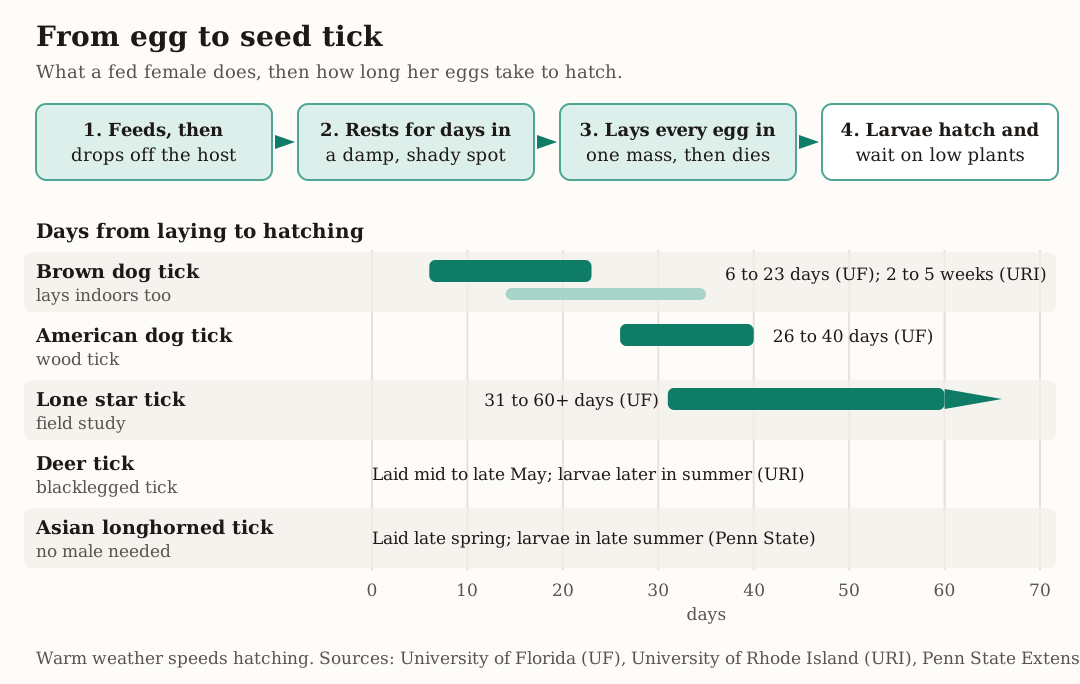
American dog tick eggs hatch in about 26 to 40 days, the University of Florida says. For brown dog ticks, Florida gives 6 to 23 days, while URI gives 2 to 5 weeks. Deer tick eggs, laid in mid to late May, hatch later in the summer. Asian longhorned tick larvae also appear in late summer.
What month do ticks lay eggs?
Most ticks lay eggs in late spring and summer, so the hatch lands in mid to late summer. Deer ticks lay in mid to late May. Lone star ticks lay in spring, summer and fall, and their spring and fall clutches survive best. Indoors, brown dog ticks can lay in any month.
That timing explains when seed ticks swarm. Ohio State’s records show deer tick larvae active in late summer, and the lone star tick’s seed ticks peak around the same time. So a late summer walk through shady brush is when most people meet a hatch.
What happens when tick eggs hatch? The “tick bomb”
When tick eggs hatch, hundreds to thousands of six-legged larvae, called seed ticks, crawl up nearby grass and low plants and wait together. People call that cluster a tick bomb. Brush past it and you can pick up hundreds at once, as both Ohio State and the University of Rhode Island warn about lone star larvae.
If it happens, act in the first minutes. Press wide tape, such as duct tape or masking tape, over the crawling larvae to lift them off. Next, shower and check your whole body. Then put your clothes in the dryer on high heat for 10 minutes, as CDC advises for ticks on dry clothing.
Do not use a lighter, a match or any other heat on them, as one popular Reddit reply suggested. Heat does not make a tick let go, and it can burn you. Pull any attached larva out with fine-tipped tweezers, the same way as any tick. Our step-by-step guide to removing a tick with tweezers shows how.
Seed ticks get their own page because there is a lot more to know. Our guide to seed ticks and tick larvae covers how to tell them from chiggers and nymphs, and what to do about dozens of itchy bites.
Can tick eggs or baby ticks give you Lyme disease?
No, not Lyme disease. CDC says female ticks infected with Lyme bacteria do not pass the infection to their offspring, so larvae hatch free of it. A larva can pick up the bacteria later by feeding on an infected mouse, then spread it as a nymph. Eggs cannot bite, so they cannot infect anyone.
That corrects two claims that rank on Google. Google’s AI answer for seed ticks says they can still transmit Lyme disease. Healthline’s tick nest article says the eggs “can carry disease” and that Lyme comes from adult ticks. Yet CDC’s page on how Lyme disease spreads rules out the egg, and Ohio State says the nymph is usually the stage that spreads Lyme.
A few germs do pass from mother to egg. In a 2018 CDC lab study, deer tick larvae infected through the egg passed on Borrelia miyamotoi, which causes a rare relapsing fever, to mice. The bacteria behind Rocky Mountain spotted fever can also reach the eggs of dog ticks and wood ticks. However, an NIH lab study found the infection killed most of those ticks, which may explain why so few carry it in nature.
Larvae do bite people, even if few notice. A 2016 Dutch study in Parasites & Vectors estimated that about 30,000 of the 1.1 million people bitten by ticks each year in the Netherlands were bitten by larvae. It also found Lyme-group bacteria in 0.62% of wild larvae of a European tick, and those larvae infected 2 of 20 lab mice. For US deer ticks, though, CDC’s answer stands, so the risk from a fresh hatch stays low.
Lone star larvae, the most common seed ticks, do not carry disease germs, according to the University of Rhode Island, though their bites still itch. Our seed ticks guide has a germ-by-germ table, and the lone star tick guide explains which illnesses its nymphs and adults can spread.
Tick eggs or something else? Common look-alikes
Most clumps of tiny eggs people find in a yard are not tick eggs. Real tick egg masses are small and hidden, and snails, slugs, spiders, insects and frogs all lay eggs that get mistaken for them. To tell them apart, check the size of each egg, where the clump sits, what holds it together, and whether a dead tick lies beside it.
Tick eggs and their look-alikes
Glossy amber to brown beads, about 0.5 mm, in one sticky heap, often with a swollen or dead tick beside it
- What it most likely is
- Tick eggs
- Where you find it
- On soil, under leaf litter or mulch; indoors in cracks if brown dog ticks
Clear, oval to round eggs in small batches of 3 to 40
- What it most likely is
- Slug eggs
- Where you find it
- Under leaves, in cracks in the soil and other damp, sheltered spots
Pearly white round eggs, about 80 in a batch
- What it most likely is
- Snail eggs
- Where you find it
- In a small hole in garden soil
Light yellow, barrel-shaped eggs lined up side by side in groups of 20 to 30
- What it most likely is
- Stink bug eggs
- Where you find it
- Stuck to the underside of a leaf, not on the ground
A round ball wrapped in silk, smooth or papery
- What it most likely is
- Spider egg sac
- Where you find it
- In a web, a corner or under a ledge
A mass of 500 to 1,000 eggs, in water
- What it most likely is
- Frog or salamander eggs
- Where you find it
- In a pond or a spring pool
Black or purple balls the size of peas, on a path
- What it most likely is
- Not tick eggs
- Where you find it
- The viral “tick nest” photo; see below
Since 2015, a Facebook photo of a clump of black balls on a path has circulated as a “tick nest,” with advice to burn it on sight. It is not tick eggs. Tick eggs are about 0.5 mm and brown, so pea-sized black balls are far too big. The fact-checking site Snopes guessed they were frog eggs spat out by a predator.
Not sure what you found? Take a sharp photo next to a coin and try our photo bug identifier. For a crawling tick rather than eggs, our guide to how to recognize a tick at every size helps.
How to get rid of tick eggs
Outdoors, you usually do not need to do anything. One egg mass under leaf litter will rarely be found, and it does not call for pesticide. If you do find one on a path, a patio or near a play area, lift it with tape, seal it and throw it away. Never burn it. The five steps below take about two minutes and cost nothing.
5 steps to remove a tick egg mass outdoors
Make sure it is tick eggs
Look for glossy amber to brown beads, each about 0.5 mm, stuck together in one heap on soil or leaf litter. A dead or swollen tick beside the clump settles it. Clear, silky or jelly-covered eggs belong to something else.
Put on gloves and use tape
Press a strip of duct tape or packing tape onto the clump and lift it in one piece. Do not crush the eggs with your bare fingers.
Seal it and throw it away
Fold the tape over on itself, or drop the clump into a bag or jar that seals, and put it in the trash. These are the same ways CDC lists for getting rid of a live tick.
Check for hatchlings
If tiny specks are crawling nearby, the eggs have already hatched. Lift any on you with tape, then shower and check your whole body when you get inside.
Fix the spot
Rake out leaf litter and clear tall grass and brush where the lawn meets woods or gardens. That takes away the damp, shady ground where females lay their eggs.
Tick eggs in the house
Indoors, eggs, or tiny ticks crawling on walls and baseboards, almost always mean brown dog ticks, and one clump means more nearby. First, vacuum cracks, baseboards, furniture seams and the dog’s resting spots, then seal and throw out the vacuum contents. Ohio State says this cleaning should come before any treatment.
Next, wash and dry dog beds and blankets on hot water and high dryer heat, as the University of Florida advises, and seal the cracks where ticks hide. At the same time, ask your vet to treat every dog in the home, since the dog is the ticks’ food. Florida and Texas have reported brown dog ticks that resist permethrin, so let your vet choose the product.
A house infestation usually needs a licensed pest professional too, because the ticks hide in so many cracks. Our guide on how to get rid of ticks in the yard and the house covers the full plan.
The cheapest way to have fewer tick eggs next year is to have fewer ticks this year. Our page on how to prevent tick bites covers repellents, clothing and tick checks.
Tick egg myths, corrected
At least 6 common claims about tick eggs and tick nests are wrong. Some come from health and pest control sites that rank on Google, and one is a Facebook post that returns every spring. Here is what each one gets wrong, and the source that sets it straight.
Myth 1
Myth: “Ticks build nests.”
Truth: No tick builds a nest. A fed female lays one egg mass on the ground and dies. The so-called nest is that clump, or the larvae that hatch from it.
Myth 2
Myth: “A tick nest is a clump of black balls the size of peas.”
Truth: That is a viral Facebook photo. Tick eggs are about 0.5 mm and amber to brown, so pea-sized black balls are something else.
Myth 3
Myth: “Tick eggs and newly hatched ticks can give you Lyme disease.”
Truth: Google's AI answer and Healthline suggest so. CDC says infected females do not pass Lyme bacteria to their offspring.
Myth 4
Myth: “Ticks lay eggs on your skin or on your dog.”
Truth: A female drops off her host before she lays. Tiny crawling specks on skin are larvae that already hatched.
Myth 5
Myth: “Tick nests hide in carpets, curtains and coat pockets.”
Truth: Healthline says so. Only the brown dog tick breeds indoors, and it lays in cracks, on ledges and on kennels, according to URI and the University of Florida.
Myth 6
Myth: “Lone star ticks lay eggs in sunny, brushy spots.”
Truth: A deer control company's page says so. The University of Florida describes females seeking humid, protected ground, because eggs dry out in hot, dry soil.
Myth 7
Myth: “Burn a tick nest when you see one.”
Truth: Fire is a hazard and is not needed. Lift the clump with tape, seal it and throw it away.
For everything else about ticks, from the life cycle to when each kind is out, start at our complete guide to ticks.
Pest control disclaimer. Photo-based identification can help, but it is not always perfect. For dangerous spiders, large infestations, or anything you are unsure about, contact a licensed pest control professional.
Tick egg FAQ
Is there a tick egg sack?
Can you see tick eggs with the naked eye?
Is it OK to flush tick eggs down the toilet?
Do male ticks lay eggs?
What is the worst month for ticks?
Related guides
Seed ticks
Six-legged larvae that hatch from an egg mass, and how to get them off fast.
Ticks
The full guide: what ticks are, their life cycle, where they live and how to stay safe.
Lone star tick
Behind most late summer swarms of larvae, and known for its white dot.
How to get rid of ticks
Yard and house steps that work, with pesticides last.
Deer tick
The blacklegged tick behind Lyme disease, at every stage.
Ticks on dogs
Where ticks hide on a dog and how to remove them safely.
Types of ticks
Every common US tick on one chart, with where each one lives.
Sources
- CDC, How Lyme Disease Spreads (September 24, 2024)
- CDC, Tick Lifecycles (October 11, 2024)
- CDC, What to Do After a Tick Bite (June 9, 2026)
- CDC, Preventing Tick Bites (August 28, 2024)
- Holderman CJ and Kaufman PE, Lone Star Tick, University of Florida EENY-580 (archived copy)
- Tian Y, Lord CC and Kaufman PE, Brown Dog Tick, University of Florida EENY-221 (archived copy)
- Chan W-H and Kaufman PE, American Dog Tick, University of Florida EENY-443 (archived copy)
- Ohio State University Extension, HYG-2073, Ticks and their control
- University of Rhode Island TickEncounter, Blacklegged (Deer) Tick
- University of Rhode Island TickEncounter, Brown Dog Tick
- University of Rhode Island TickEncounter, Lone Star Tick
- Penn State Extension, Asian Longhorned Tick, Haemaphysalis longicornis
- Breuner NE and others (CDC), Transmission of Borrelia miyamotoi by single transovarially-infected larval Ixodes scapularis ticks, Ticks and Tick-borne Diseases (2018)
- Niebylski ML and others (NIH), Lethal effect of Rickettsia rickettsii on its tick vector, Applied and Environmental Microbiology (1999)
- van Duijvendijk G and others, Larvae of Ixodes ricinus transmit Borrelia afzelii and B. miyamotoi to vertebrate hosts, Parasites & Vectors (2016)