What to do right after fire ant bites
After fire ant bites, first check for signs of a severe allergic reaction and call 911 if you see any. Then move away from the mound, brush the ants off fast, and wash with soap and water. Next, MedlinePlus suggests ice wrapped in a cloth, 10 minutes on and 10 off. Most stings need nothing more than this, plus time.
Speed matters in the first minute, because every ant still on you keeps stinging. Here is the whole routine, in order.
First aid for fire ant stings, step by step
Check for emergency signs first
Trouble breathing or swallowing, swelling of the face, lips, tongue or throat, hives spreading over the body, dizziness or fainting can mean a severe allergic reaction. Call 911 at once. If the person has a prescribed epinephrine auto-injector, help them use it. Everything below is for a reaction that stays at the stings.
Move away from the mound
Step well clear before you do anything else, so more ants cannot climb on. If someone has fallen near a mound, Poison Control says to help them move away as quickly as possible.
Brush the ants off, fast
Each ant holds on with its jaws and keeps stinging, so brush hard and quickly with a gloved hand, a cloth or a towel. Pull off shoes, socks and gloves that ants have crawled into. Do not try to hose them off.
Wash with soap and water
Wash the stings with plenty of soap and water. MedlinePlus says not to use alcohol on them. If venom gets into an eye, rinse it with plenty of water.
Cool the stings
Hold ice wrapped in a clean cloth on the area, on and off, as MedlinePlus describes. Never put ice straight on the skin. If the stings are on an arm or a leg, raise it.
Ease the itch and the pain
The American College of Allergy, Asthma and Immunology says a steroid cream on the skin and an antihistamine by mouth may relieve the itch. Poison Control adds an over-the-counter pain reliever. Follow each package label. Ask a pharmacist first for a child, during pregnancy, or if you take other medicines.
Leave the pustules alone
A white blister will form at each sting within about a day. Do not pop, squeeze or scratch it. It is sterile, and breaking it is what lets infection in.
Watch the next 2 to 3 days
See a doctor for redness or swelling that keeps spreading after the second day, warmth, pus, red streaks or a fever. Also get medical advice for many stings on a small child, an older adult or anyone who could not get away.
Brush them off, do not hose them off
Brush the ants off with quick, hard strokes. A fire ant is holding on with its jaws, so a light swipe or a shake of the leg leaves most of them in place. Wear gloves or use a towel if you can, so you do not get stung on the hand.
Water is a poor tool here. Texas A&M AgriLife Extension says not to spray fire ants off a pet with a hose, because they hang on with their jaws and sting again and again. Western Australia’s health department warns that ants sprayed with water may latch on. So wash the skin with soap and water after the ants are off, not while they are still on.
The sources do not fully agree on the best way to get them off. Most US medical pages say to brush. The American College of Allergy, Asthma and Immunology notes that stinging ants are hard to brush off and often have to be pulled off one at a time. Cleveland Clinic lists slapping as an option, while Next Level Urgent Care, a Texas clinic chain, says to brush and not slap. So brush first, then pick off the stragglers.
What to put on fire ant bites
Soap and water first, then cold. For the itch, the American College of Allergy, Asthma and Immunology says a steroid cream on the skin and an antihistamine by mouth may help. Texas A&M suggests an insect sting product with a numbing ingredient such as benzocaine. Use any product exactly as its label says.
Nothing you put on the skin makes the pustule go away faster. In a 1987 study of fire ant stings on 22 medical students, meat tenderizer did no better than nothing at all. Products ease the itch and pain while the sting heals on its own.
How to stop fire ant bites from itching
Cold helps fire ant bites most in the first hours. After that, an anti-itch cream or an oral antihistamine, used as labeled, can take the edge off. Keep fingernails short and cover the stings at night if you scratch in your sleep. Itching is the part that lasts longest, often a week. If it keeps you awake for days, a doctor can prescribe something stronger.
Do fire ants bite or sting?
Fire ants do both, but the sting is what hurts. A worker grips your skin with its jaws, then drives in the sting at the tip of its abdomen. It swings around while it holds on and stings again, on average 7 to 8 times, Poison Control says. That is why the marks form a half ring.
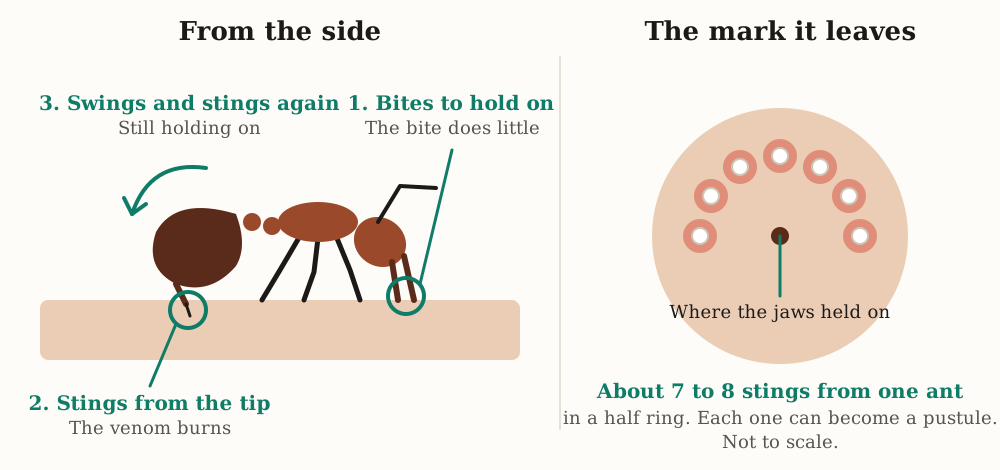
The bite itself is of no lasting consequence, Mississippi State University Extension says. The ant only uses its jaws to anchor itself. Unlike a honey bee’s, its sting has no barbs, so it does not tear out. The same ant lives on and can keep stinging until it is brushed off.
The burn comes from the venom. It holds toxins that kill a tiny patch of skin cells, which is what makes the pustule. It also holds proteins that cause the swelling and the itch, and those proteins are what people become allergic to, Virginia Tech Extension explains.
Why do fire ants all sting at once?
They react to movement. Texas A&M says fire ants tend to sting when the thing they are standing on moves. Many can run up your leg before the first sting. Then you jerk your foot, and they all sting together. Virginia Tech adds that alarm scents called pheromones call more of the colony out to attack. Texas A&M notes, though, that no known pheromone tells them when to sting. Either way, move away first and brush second.
What do fire ant bites look like?
Fire ant bites look like clusters of small red bumps, often in a half ring, usually on the feet, ankles and legs. Within about 24 hours each bump grows a white or yellowish head, like a pimple. These pustules are the clearest sign of fire ant stings, and they come in groups, not one at a time.
Most fire ant bites land on whatever touched the mound: bare feet, ankles, hands during yard work, or the back of the legs after sitting on the grass. A pediatric triage guide used by many US doctors’ offices calls the pustules almost diagnostic of fire ant stings. Even so, a skin mark is a clue, not proof.
How do I know if I was bit by a fire ant?
The surest way is to see the ants. Fire ants are small and reddish brown, 1/16 to 1/4 inch (1.5 to 6 mm), in mixed sizes, and they pour out of a dome of loose soil with no hole on top. A sharp burn at the moment of the sting, then white pustules the next day, make a fire ant very likely.
This page shows no photos of stung skin, on purpose. A photo of someone else’s skin invites a wrong match, and a bite cannot tell you what bit you. If you are not sure, look for the ants and the mound. Our fire ant identification guide walks through the four checks.
Red ant bites: was it a fire ant?
Probably, if you live in the South. In the 13 states with imported fire ants, red ants that sting from a mound are usually fire ants. Elsewhere, “red ant” can mean several other ants, and some sting hard without leaving pustules. Big red ants with a wide bare patch around one hole are harvester ants, whose sting hurts for hours. A fuzzy red and black “ant” running alone is a velvet ant, which is really a wasp.
For bites from ants you cannot name, such as small black ants in the kitchen or carpenter ants in the house, see our guide to which ant bit you and what to do.
How long do fire ant bites last?
Fire ant bites usually last one to two weeks. The burn fades within minutes to an hour, the pustule forms within about 24 hours, and it is at its worst around days 2 to 3. Then it dries and crusts. Most medical sources put healing at about 7 to 10 days, and a mark can linger for weeks.
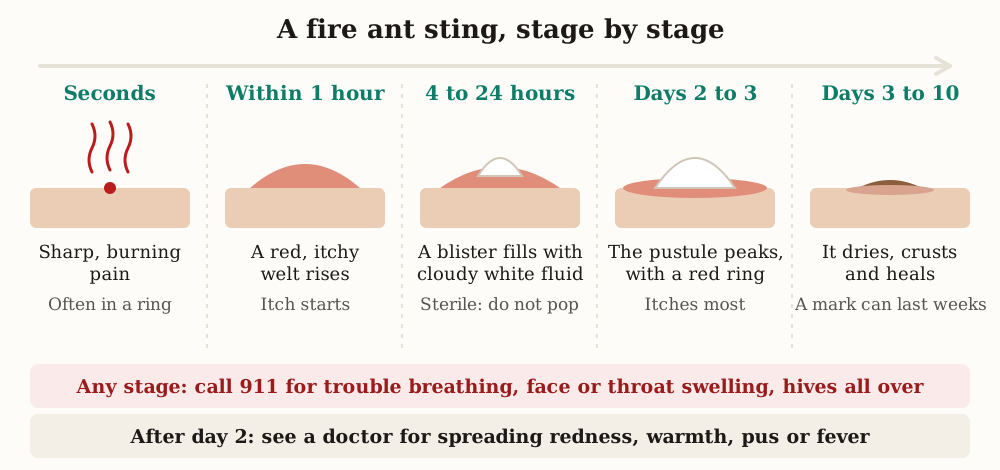
The sources agree on the order of the stages but not on the exact days. Here is what each says, side by side:
How long a fire ant sting lasts, by source
American College of Allergy, Asthma and Immunology
- Pustule appears
- Blister within 4 hours, looks filled with pus by 8 to 24 hours
- How long it lasts
- Not given; may leave scars
Mississippi State University Extension
- Pustule appears
- Within about 24 hours
- How long it lasts
- Peaks at 72 hours, open sore by one week, faint scars at one month
Cleveland Clinic
- Pustule appears
- About a day after the sting
- How long it lasts
- Goes away in 7 to 10 days
MedlinePlus
- Pustule appears
- Not given
- How long it lasts
- Blisters 3 to 8 days, scab 3 to 10 days
Texas A&M AgriLife
- Pustule appears
- In a day or two
- How long it lasts
- Can leave permanent scars
Poison Control
- Pustule appears
- Not given
- How long it lasts
- Pustules can linger for a couple of weeks
Our reading: expect the pustule by the next day, the worst itch around days 2 to 3, and healing in 1 to 2 weeks. A flat mark can last a month or more.
Why the healing times differ
The sources measure different things. Some count until the pustule dries, and others until the skin looks normal again. Mississippi State’s time-lapse photos follow one finger for a whole month, so they show the longest tail. Scratching, the number of stings and your own reaction all stretch the timeline, too.
Should you pop a fire ant blister?
No, do not pop fire ant pustules. The white head that forms within about 24 hours is not pus from an infection. It is dead tissue from the venom, and it is sterile. Mississippi State says it is not infected despite how it looks. Breaking it open lets bacteria in and raises the chance of a scar.
The American College of Allergy, Asthma and Immunology says the blister has little chance of infection unless it is opened. Poison Control adds that the venom itself kills germs, which helps keep the pustule sterile. Left alone, most pustules dry up and flatten within days.
If one breaks by accident, wash it gently with soap and water and keep it clean. A clean, loose bandage helps if it rubs on a shoe or sock. One Reddit user with about 25 pustules asked whether to pop them, and the reply summed it up: “There’s no good reason to pop them.”
Are fire ant bites dangerous? Normal, see a doctor, or 911
For most people, fire ant bites are painful but not dangerous. Three things change that: an allergic reaction, which can start within minutes; an infection, which shows up after day 2; and very many stings on someone small or frail. Texas A&M says about 1% of people are hypersensitive to fire ant venom.
Use this table to decide what to do:
Fire ant stings: normal, see a doctor, or call 911
Burning pain, red bumps, white pustules the next day, itching
- What it usually means
- A normal reaction
- What to do
- Home care. Leave the pustules alone
Swelling that spreads past the stings, such as a whole forearm or foot, lasting 2 to 3 days
- What it usually means
- A large local reaction. Uncomfortable, but not an allergy emergency
- What to do
- Cold, rest, raise it. See a doctor if it is huge, crosses a joint or stops you using the limb
Redness still spreading after 48 hours, warmth, pus, red streaks, fever
- What it usually means
- Possible infection
- What to do
- See a doctor soon
Stings in the mouth or on the eye
- What it usually means
- Swelling in these spots needs a closer look
- What to do
- Get medical care now
Many stings on a baby, a small child, a frail adult or someone who could not get away
- What it usually means
- Risk of a toxic reaction to the venom
- What to do
- Get medical care now
Hives all over, flushing, swelling of the face, lips, tongue or throat, wheezing, hoarse voice, chest tightness, vomiting, dizziness, fainting
- What it usually means
- Anaphylaxis, a severe allergic reaction
- What to do
- Call 911. Use epinephrine if it was prescribed
You know you are allergic, you were stung, and you feel fine so far
- What it usually means
- A reaction may still be coming
- What to do
- Follow your action plan. Poison Control says go to an ER without waiting for symptoms
From the American College of Allergy, Asthma and Immunology, Cleveland Clinic, MedlinePlus, Poison Control and the Schmitt pediatric guidelines.
Signs of an infected fire ant bite
Infected fire ant bites get worse after the second day instead of better. Watch for redness that keeps growing, red streaks, warmth, more pain, pus from a broken pustule, or a fever with chills. Cleveland Clinic lists these as reasons to see a doctor. Redness in the first day is the normal reaction, not infection.
Some people heal more slowly. Mississippi State says the risk of problems is higher for people with diabetes or a weak immune system. If that is you, have a doctor look at stings that are not settling.
Large swelling after fire ant stings
A sting on the foot can swell the whole foot. This is a large local reaction. It looks alarming, but it stays in one area and is treated like a normal reaction, the American College of Allergy, Asthma and Immunology says. It can last two to three days. Swelling that spreads to other parts of the body is different: that is an allergic reaction.
Fire ant allergy: signs and what to do
A fire ant allergy shows up away from the stings: hives over the body, a swelling face or throat, trouble breathing or dizziness. It usually starts within minutes, almost always within 2 hours. After one allergic reaction, the chance of a similar or worse one is about 60%, the American College of Allergy, Asthma and Immunology says.
An allergy can appear at any age, even after many normal stings. That is why a first severe reaction often comes as a shock. Children can react too. A pediatric guide puts severe reactions to fire ant stings at 1 to 2% of children.
On Reddit’s r/AskDocs, one parent described a 3-year-old stung about 20 times at daycare who broke out in hives over the whole body within an hour. That is exactly the picture that needs urgent care. Hives alone can still turn into anaphylaxis, so call a doctor or 911 rather than wait and see.
If you already know you are allergic
Follow the action plan your doctor gave you. Carry your epinephrine auto-injector outdoors, and the American College of Allergy, Asthma and Immunology says to keep two doses with you, because one may not be enough. If you are stung, use it at the first sign of anaphylaxis and call 911. Poison Control goes further: with a known severe allergy, go to an ER after a sting without waiting for symptoms.
Tell the people you work or walk with what to do. Texas A&M advises letting someone know when you have been stung, and staying with others who can help.
Allergy testing and allergy shots for fire ants
After any whole-body reaction, see an allergist. Testing shows whether you are allergic to fire ant venom. The long-term treatment is allergy shots, called immunotherapy. For fire ants, the shots use an extract of the whole ant. The American College of Allergy, Asthma and Immunology explains that the venom cannot yet be isolated from fire ants.
These shots work. The same group says they can lower the risk of a future reaction to that of the general population. For venom shots in general, a course usually runs three to five years. Your allergist decides whether you need them. If you live where fire ants are common and have reacted badly once, it is worth asking.
Many stings at once: children, older adults and anyone who cannot move
Dozens of fire ant bites are miserable but rarely dangerous for a healthy adult who can walk away. For a baby, even 20 stings can be too many. Mississippi State says stings become truly threatening in the many hundreds or thousands, usually on someone who cannot move away because of age, an accident or illness.
Large numbers of stings can poison the body even without an allergy. MedlinePlus says many fire ant stings can cause vomiting, diarrhea, swelling throughout the body, shortness of breath, low blood pressure and shock. That is an emergency, allergy or not.
How many stings is too many for a child?
Small bodies get more venom per pound. The Schmitt pediatric guidelines, which many US pediatric offices use for phone advice, say to seek care right away in these cases:
- A baby under 1 year old with 20 or more stings, or a newborn with more than 5.
- More than 5 stings for every 10 pounds (5 kg) of body weight.
- A teen with more than 50 stings.
- Any sting inside the mouth or on the eye.
Below those numbers, and with no other warning signs, home care is usually enough. Still, call your child’s doctor whenever you are unsure. Teach children to spot a mound and stay off it, which is the advice Texas A&M gives first.
Fire ants indoors near someone who cannot get up
Fire ants rarely attack people indoors, and the reported victims are mostly people who cannot move away. A 2004 review in the American Journal of Medicine found six attacks on nursing home residents, and four of those patients died within a week. In most cases, staff had seen ants in the building days before.
So treat ants near a bed as urgent if the person in it is frail, bedridden or confused. Move the person, check the bed and the floor, and call a licensed pest professional the same day. If you have a relative in a care home in the South, it is fair to ask how the staff handle ants.
Can fire ant bites kill you?
Rarely, but yes. Mississippi State says there are deaths every year, from allergic reactions or from huge numbers of stings on people who could not get away. Texas A&M adds that relatively few deaths have been documented compared with bee and wasp stings. For a healthy adult who is not allergic, the risk is very small.
Fire ant stings on dogs, cats and livestock
Vets treat pets for fire ant injuries more often than any other animals, Texas A&M says. Very young, old and penned animals are most at risk. Fire ants sting where fur is thin, such as the face and belly. Brush them off with gloves, never with a hose. Call a vet for face swelling, weakness or stings near the eyes.
Fire ant bites on a dog’s paw or face
Fire ant bites on dogs usually land on the paws and legs, from walking through a mound. A dog that sniffs or digs at one gets stung on the muzzle and around the eyes. Move the dog away first. Then brush or comb the ants out, wearing gloves, and check between the toes, where ants hide.
Getting every ant off matters for another reason. A Texas A&M veterinary guide notes that animals swallow fire ants while they lick or bite at painful stings. Those ants can then sting the throat and stomach. Australia’s fire ant program suggests a cool bath for comfort once the ants are gone.
Call your vet now if your pet shows any of these:
- Swelling of the face, muzzle or throat.
- Drooling, vomiting or trouble breathing.
- Weakness, collapse or unusual tiredness.
- Stings on or around the eyes.
- Many stings on a puppy, a kitten or an old or sick animal.
Pets can have allergic reactions too. A Yorkie owner on Reddit described a dog that stepped in a red ant pile and needed an emergency vet visit for anaphylaxis. Do not give a pet any human medicine unless your vet tells you to.
Fire ant stings on calves, foals and other livestock
Newborn and weak animals suffer most. Texas A&M AgriLife Extension says fire ants sting livestock on hairless areas such as the eyes, muzzle, belly and around the tail. The eyes are the most serious site, because stings can cause ulcers on the surface of the eye. A newborn calf or fawn lying near a mound can be stung hundreds of times.
Call a vet for any animal with stings on the eyes or many stings on its body. Eye drops and ointments for animals differ by species, and Texas A&M warns that some medicines used on cattle eyes are wrong for horses. That is a job for the vet, not the medicine cabinet. For calving and lambing in fire ant country, keep pens and nursery pastures checked for mounds.
Home remedies that do not work
No home remedy heals fire ant bites faster. Bleach, vinegar, toothpaste, rubbing alcohol and meat tenderizer all circulate online. The one that was tested, meat tenderizer, did no better than nothing in a 1987 study. Plain soap and water, cold and time are what medical sources recommend.
Most of these remedies are simply useless. Popping the pustules, the most common one, can make things worse. Here is what the sources say about each.
Myth 1
Myth: “Dab the stings with half bleach and half water.”
Truth: Wikipedia lists this among home remedies. None of the medical sources we read recommend bleach on skin. MedlinePlus says to wash with soap and water.
Myth 2
Myth: “Vinegar takes the sting out.”
Truth: We found no study or medical source that supports vinegar on fire ant stings. Cold is what medical sources suggest for the burn.
Myth 3
Myth: “Toothpaste or a baking soda paste draws out the venom.”
Truth: You cannot draw out fire ant venom, WebMD says. No study shows that a paste changes the pustule.
Myth 4
Myth: “Rubbing alcohol cleans and soothes the stings.”
Truth: MedlinePlus says not to use alcohol to wash the area. Use soap and water.
Myth 5
Myth: “Meat tenderizer breaks down the venom.”
Truth: In a 1987 study of 22 medical students, stings treated with meat tenderizer did no better than untreated stings.
Myth 6
Myth: “A shower as hot as you can stand stops the itch.”
Truth: Reddit users swear by it. WebMD, though, says to use cold and not heat, and very hot water can scald skin that is already sore.
Myth 7
Myth: “Pop the pustules to drain the pus.”
Truth: The white head is sterile dead tissue, not an infection. Breaking it is what lets infection in, and it can leave a scar.
Myth 8
Myth: “Hose the ants off with water.”
Truth: Texas A&M says ants sprayed with a hose hang on with their jaws and keep stinging. Brush them off, then wash.
How to avoid fire ant stings
To avoid fire ant stings, learn to spot a mound: a dome of loose soil with no hole on top. Undisturbed mounds reach about 18 inches, but in a mowed lawn they are often a few inches tall. Wear closed shoes and socks, tuck pant legs into the socks, and look before you kneel or sit.
Fire ants do not go looking for people. Mississippi State says most stings happen when someone steps in, lies in or disturbs a mound by accident. The ants climb anything upright and react to vibration, so a person standing on a mound is covered in seconds.
- Teach children what a mound looks like and to stay off it.
- Check the ground first before you kneel to garden, sit at a game or lay out a towel.
- Wear gloves when you move pots, logs, bricks or stones, since colonies nest under them.
- Keep moving if ants get on you. Step off the mound at once, then brush.
- Watch after rain. New mounds pop up a few days after heavy rain.
Insect repellent is where the sources split. Virginia Tech Extension suggests repellent on shoes and clothing in fire ant areas. The American College of Allergy, Asthma and Immunology says repellents do not work against stinging insects. Use it if you like, but rely on shoes, socks and watching where you step.
Fewer mounds in the yard means fewer fire ant bites. Our guide to the two-step bait method for fire ants explains how to treat a whole yard. For ants that come inside, see how to get rid of ants in the house.
Medical disclaimer. This page is for general information only. It is not a medical diagnosis. If you have severe symptoms, trouble breathing, swelling of the face or throat, fast spreading redness, fever, severe pain, pus, or signs of infection, contact a doctor or your local emergency number.
Fire ant bites FAQ
What is the fastest way to heal a fire ant bite?
How long does fire ant venom stay in your body?
Why do my fire ant bites still itch after a week?
Are red ant bites in the UK the same as fire ant bites?
Can you be stung by fire ants without stepping on a mound?
Related guides
Fire ants
How to tell fire ants from other red ants, which states have them, and the two-step method.
Ant bites
Bites from black, sugar and carpenter ants, and how to tell which ant it was.
Bee sting
First aid and how to tell a normal swelling from an allergic one.
Harvester ants
The big red ants with a bare circle around one hole, and a sting that hurts for hours.
Bug bite identification
Fire ant stings next to 20 other bites, with the signs that need a doctor.
How to get rid of ants
Why bait beats spray for ants in the house, and how to match the bait to the ant.
Sources
- Mississippi State University Extension, The Fire Ant Sting (with the lesion time-lapse by J. Goddard)
- American College of Allergy, Asthma and Immunology, Insect Sting Allergies (reviewed June 28, 2023)
- MedlinePlus Medical Encyclopedia, Fire ants (US National Library of Medicine)
- Poison Control (National Capital Poison Center), Stung by an ant?
- Cleveland Clinic, Fire Ant Bites (updated June 28, 2022)
- WebMD, Fire Ant Bites and Stings: Symptoms, Care, and Relief, reviewed by P. Sachdev, MD (July 20, 2025)
- Texas A&M AgriLife, Texas Imported Fire Ant Research and Management Project: Fire Ant Frequently Asked Questions
- Texas A&M AgriLife, Texas Imported Fire Ant Research and Management Project: Medical Information
- Texas A&M AgriLife Extension, ENTO-014, Fire Ant Control Methods around Pets
- Texas A&M AgriLife Extension, ENTO-004, Diagnosing and Treating Animals for Red Imported Fire Ant Injury, B. M. Drees
- Virginia Cooperative Extension, Avoiding Fire Ant Stings, ENTO-481, T. Dellinger and E. Day (revised 2024)
- Schmitt Pediatric Guidelines, Fire Ant Sting, as published by West Side Pediatrics
- deShazo RD and others, Fire ant attacks on patients in nursing homes: an increasing problem, American Journal of Medicine 116(12):843-846 (2004)
- Ross EV and others, Meat tenderizer in the acute treatment of imported fire ant stings, Journal of the American Academy of Dermatology 16(6):1189-1192 (1987)
- Government of Western Australia, HealthyWA, First aid for fire ant stings
- National Fire Ant Eradication Program (Australia), How to treat fire ant stings
- Wikipedia, Fire ant: Sting effects and Treatment (the bleach remedy, corrected above)