What is a cow killer?
A cow killer is a velvet ant, a wasp whose wingless females look like large, hairy ants. Its scientific name is Dasymutilla occidentalis, and at about 3/4 inch (19 mm) long it is the largest velvet ant in the eastern US. People also call it the red velvet ant, the eastern velvet ant and the cow ant.
Velvet ants make up their own family of wasps, called Mutillidae. Counts of the species differ by source. Justin Schmidt put it at more than 4,300 in 2021, while the University of Florida gives about 8,000. The field guide Velvet Ants of North America covers nearly 460 species in the US and Canada. Every one of them lives alone, with no colony, no queen and no nest of its own.
They are not paper wasps, although the NIEHS kids’ page on red velvet ants says so. Paper wasps belong to a different family, the Vespidae, and build the gray paper nests you see under eaves. A velvet ant never builds a nest at all. Our bee and wasp guide shows how the big groups differ.
The cow killer at a glance
Length
- What to know
- About 3/4 in (19 mm) for a female
Look
- What to know
- Black, with dense bright red hair on top of the head, thorax and abdomen
Wings
- What to know
- Females have none. Males have dark, see-through wings
Who stings
- What to know
- Females only
Sting pain
- What to know
- About 3 on a 1 to 4 scale, for 15 minutes or more
Adult food
- What to know
- Nectar from flowers
Young
- What to know
- Grubs that eat the young of ground-nesting bees and wasps
Where
- What to know
- The eastern US, from Connecticut west to Kansas and Colorado, and south to Florida and Texas
When
- What to know
- Mostly July to September, peaking in August
Why is it called a cow killer?
The name is a boast about the pain, not a fact. Old folklore said the sting was bad enough to kill a cow. Arkansas Extension tells the story of a cow stung on the tongue, whose throat swelled until it choked, and then notes that no livestock deaths have been recorded. Clemson calls the nickname undeserved. Another name, mule killer, makes the same claim about mules.
Is a velvet ant an ant or a wasp?
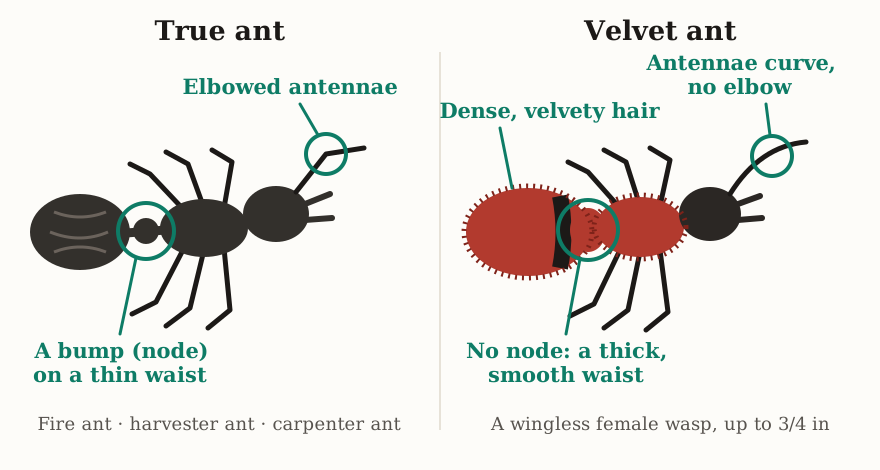
A wasp. Two features tell a velvet ant from a true ant in a few seconds. First, an ant’s antennae bend sharply partway along, like an elbow. A velvet ant’s antennae curve with no elbow. Second, an ant has a thin waist with one or two small bumps on it, called nodes. A velvet ant’s waist is thick and smooth.
What does a cow killer look like?
A female cow killer is about 3/4 inch (19 mm) long and looks like a big, fuzzy ant. She is black, with dense bright red or orange-red hair on top of the head, thorax and abdomen. Her legs are black, and she has no wings. She runs fast and alone over bare ground, often in a zigzag.
The hair is a warning. Bright colors tell birds and lizards that something will hurt them, and the cow killer backs that up with a sting, a squeak and a body that is very hard to crush. Sources differ a little on size: Virginia Tech gives about 3/4 inch (19 mm), while Kentucky and Arkansas say nearly or up to an inch.
How to recognize a cow killer
Most of these should match. The hair and the waist settle it fastest.
About 3/4 inch long
Far bigger than a fire ant, which is 1/16 to 1/4 inch.
Dense red or orange-red hair on a black body
It looks like velvet. A true ant is shiny or only lightly hairy.
No wings on the one that runs
The winged ones are males, which look like hairy wasps with dark wings.
Antennae with no elbow
An ant's antennae bend sharply partway along.
A thick waist with no bumps
An ant's thin waist carries one or two small nodes.
Alone, on bare or sandy ground, in summer
No trail of ants and no mound. Each velvet ant works alone.
Male vs female velvet ant
The two sexes look like different insects. A female has no wings and runs on the ground. A male has dark, see-through wings and flies, so he looks like a hairy wasp. In the cow killer, males are red on the head, the thorax and the back half of the abdomen, and black on the rest. Across velvet ants, the sexes can differ so much in color and size that scientists have trouble matching males to females.
Only the female can sting. The stinger is a changed egg-laying tube, so males, like all male wasps, ants and bees, have none. So if a winged insect stung you, it was some other wasp. Males are not always the smaller sex, either. In one Florida study, males outweighed females in 7 of 13 species.
How bad is a cow killer sting?
Very bad, but short. Justin Schmidt rated a velvet ant sting a 3 on his 1 to 4 pain scale, where a honey bee scores 2. In his 2016 book he described it as “explosive and long lasting, you sound insane as you scream.” In stings his team recorded, the pain lasted 15 minutes or more.
Two details matter here. First, Schmidt’s 3 was for Klug’s velvet ant, a close western relative that his table also calls the cow killer. The eastern cow killer is usually given the same score. Second, the length of the pain differs by source. Schmidt and his co-authors wrote in 2021 that it continued for “15 minutes or more,” while Wikipedia gives up to 30 minutes.
Readers on Reddit report a wide spread. One stung by a velvet ant felt the pain for about an hour and stayed swollen for 2 days. Another let a small velvet ant sting them 4 times and compared it to a thorn prick. That fits Schmidt’s ratings, where big species hurt far more than small ones. Readers also report stings through a sock or a thin glove.
The sting itself is long. Schmidt and his co-authors note that female velvet ants have the longest stinger, for their body size, of any stinging wasp, bee or ant. It coils inside her abdomen like a watch spring, so she can reach a hand that holds her from almost any angle.
Sting pain against venom strength (Schmidt 2019 and 2021)
Klug's velvet ant (Dasymutilla klugii)
- Pain, 1 to 4
- 3
- Venom LD50, mg per kg (higher is weaker)
- 70
Cow killer (Dasymutilla occidentalis)
- Pain, 1 to 4
- Not rated separately
- Venom LD50, mg per kg (higher is weaker)
- 32, from only 2 mice
Thistledown velvet ant (Dasymutilla gloriosa)
- Pain, 1 to 4
- 2
- Venom LD50, mg per kg (higher is weaker)
- Not measured
Small nocturnal velvet ant
- Pain, 1 to 4
- 1.5
- Venom LD50, mg per kg (higher is weaker)
- Not measured
Honey bee
- Pain, 1 to 4
- 2
- Venom LD50, mg per kg (higher is weaker)
- 2.8
German yellowjacket
- Pain, 1 to 4
- 2
- Venom LD50, mg per kg (higher is weaker)
- 2.8
Harvester ants (20 North American species)
- Pain, 1 to 4
- 3
- Venom LD50, mg per kg (higher is weaker)
- 0.12 to 0.7
Red imported fire ant
- Pain, 1 to 4
- 1
- Venom LD50, mg per kg (higher is weaker)
- Not listed
Tarantula hawk
- Pain, 1 to 4
- 4
- Venom LD50, mg per kg (higher is weaker)
- 90 to 120
Bullet ant
- Pain, 1 to 4
- 4
- Venom LD50, mg per kg (higher is weaker)
- 1.4
The LD50 is the dose that kills half of the lab mice tested, so a higher number means weaker venom. Gram for gram, velvet ant venom comes out about 11 to 25 times weaker than a honey bee’s. Harvester ants, which score the same 3 for pain, carry venom far stronger than either. A velvet ant’s sting works by pain, not by poison.
A 2025 study from Indiana University, published in Current Biology, shows how. The cow killer’s venom fires the pain-sensing nerves directly. In insects, one peptide does most of the work. In mice, other peptides cause the pain. The authors read the weak toxicity as a sign that the venom is meant to deter, not to kill.
Velvet ant vs bullet ant and tarantula hawk
Both hurt more. The bullet ant of Central and South America and the tarantula hawk of the Southwest score 4, the top of the scale, against the velvet ant’s 3. The bullet ant’s venom is also about 20 to 50 times stronger. So the cow killer sits one step below the worst insect stings, which is still far beyond a bee.
Do velvet ants bite?
They have jaws, but the sting is their weapon. When someone says a cow killer “bit” them, it was almost always the sting, from the tip of the abdomen. We found no record of a velvet ant bite on a person that caused a problem. Treat any wound from one as a sting.
Are velvet ants dangerous?
Only a little, unless you are allergic. The University of Florida says velvet ants pose no real threat to humans, livestock or domestic animals. In Schmidt’s lab tests, their venom was 11 to 25 times weaker than a honey bee’s. The risk that matters is an allergic reaction. MedlinePlus warns that a severe one can come on very quickly.
So the warning signs in the red box below matter more than how much it hurts. A healthy adult who is not allergic will be in a lot of pain for a while and then fine. A small child will be very upset and needs watching for the same signs.
Are velvet ants aggressive?
No. A velvet ant runs away from people, and she often squeaks when she is disturbed. Readers on Reddit say the same thing again and again: they are “far more likely to attempt to run from danger.” Stings happen when someone picks one up, steps on one barefoot, or traps one in clothing, as in one thread from a gardener stung four times “up my shorts.”
What to do if a velvet ant stings you
Get away from her first, because she can sting again. If any warning sign in the red box appears, call 911 right away and do not wait for the pain to pass. Otherwise, treat it like a bee sting: wash it and cool it. Steps 2 to 5 follow MedlinePlus advice for insect stings.
Move away first
Step away or brush her off with a stick or a shoe, not your hand. Unlike a honey bee, a velvet ant keeps her stinger and can sting again. If any warning sign in the red box appears, call 911 right away.
Wash the sting
Clean the spot with soap and water. There is usually no stinger left in the skin, so there is nothing to scrape out.
Cool it
Hold ice wrapped in a cloth on the sting, 10 minutes on and 10 minutes off. Take off rings or anything tight nearby in case it swells.
Ease the itch
An antihistamine or an anti-itch cream can help with the itch, used exactly as the package says. MedlinePlus advises against aspirin or other pain medicine unless a doctor prescribes it. Try not to scratch.
Keep watching
Watch for the signs in the red box, even after the pain fades. Over the next few days, check the spot for spreading redness, swelling or pain, which can mean an infection.
A note on other advice you may read. PestWorld tells readers to look for a small black dot, scrape it off with a credit card, and says the stinger takes 2 to 3 minutes to release its venom. That is honey bee advice, and even a honey bee’s stinger pumps venom for about a minute, not 2 to 3. A velvet ant keeps her stinger, so scraping does nothing. PestWorld’s advice to wash the sting and ice it is sound.
If your dog or cat gets stung
A dog that sniffs or snaps at a velvet ant can get stung on the nose or mouth, and the Merck Veterinary Manual says stings on pets most often land on the face and mouth. It lists a cool compress among the usual care. Our bee and wasp sting guide lists the signs that mean an emergency vet, such as swelling in the mouth, vomiting, pale gums or collapse.
Where do velvet ants live?
Velvet ants have been recorded in every state except Alaska and Hawaii, but the cow killer itself is eastern. It ranges from Connecticut west to Kansas and Colorado, and south to Florida and Texas. Of 19,359 US iNaturalist records of the cow killer, Texas holds 15.4%, Florida 12.9% and North Carolina 8.6%. Not one comes from California.
They favor open, sunny ground with bare or sandy soil, such as lawns with thin grass, pastures, field edges, paths and driveways. That is where ground-nesting bees and wasps dig, and those nests are what a female is searching for. The table counts records that people posted with photos, so it shows where people meet cow killers, which is not quite the same as where most of them live.
Where people find cow killers: US iNaturalist records by state, read October 2026
Texas
- Records
- 2,977
- Share of US records
- 15.4%
Florida
- Records
- 2,500
- Share of US records
- 12.9%
North Carolina
- Records
- 1,659
- Share of US records
- 8.6%
Virginia
- Records
- 1,408
- Share of US records
- 7.3%
Georgia
- Records
- 1,317
- Share of US records
- 6.8%
Tennessee
- Records
- 1,166
- Share of US records
- 6.0%
South Carolina
- Records
- 1,024
- Share of US records
- 5.3%
Alabama
- Records
- 993
- Share of US records
- 5.1%
Maryland
- Records
- 842
- Share of US records
- 4.3%
Louisiana, Oklahoma, Arkansas, Mississippi
- Records
- 460 to 704 each
- Share of US records
- 12.2% together
New Jersey, Missouri, Kentucky, Kansas, Illinois
- Records
- 311 to 442 each
- Share of US records
- 10.3% together
Delaware, Indiana, Nebraska and 18 more, with Washington, D.C.
- Records
- 1 to 235 each
- Share of US records
- 5.8% together
California
- Records
- 0
- Share of US records
- 0%
A few records from Oregon and Idaho sit far outside that range and are probably look-alikes that were named wrong. Across the whole family, people have logged 82,454 velvet ants in the US, in all 48 lower states and Washington, D.C. California has the most, with 21.1%, followed by Texas with 18.5%.
Red velvet ants in California and the West
If you live in California, Arizona or the Southwest, your fuzzy red ant is a relative, not the cow killer. The most commonly logged one in the US after the cow killer is the Pacific velvet ant, Dasymutilla aureola, and 94% of its records come from California. Klug’s velvet ant is the big one of Texas and New Mexico, and the thistledown velvet ant is white. The next section sorts them.
When are velvet ants out?
Cow killers are out from late spring to early fall, and August is the peak. In US iNaturalist records, July to September holds 79.6% of cow killer sightings, and August alone holds 33.7%. December to February holds just 0.3%. Females run over the ground during the day, in the heat of summer.
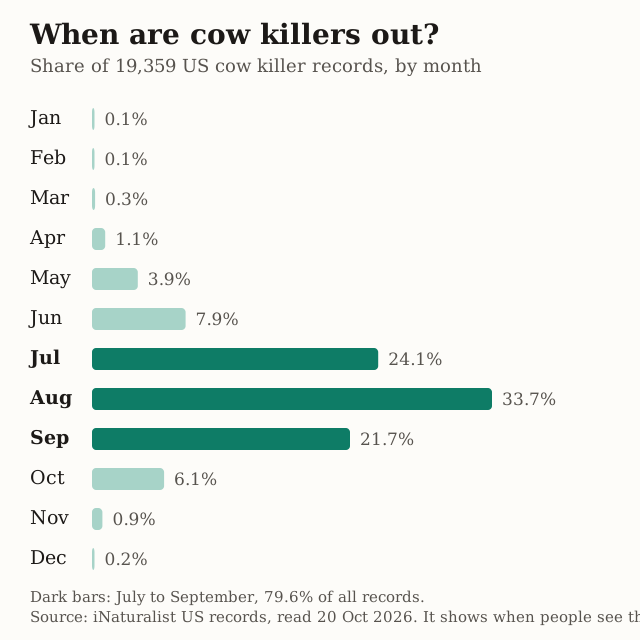
Usually one generation grows up each year. The family as a whole has a longer season than the cow killer, from March into November, with July and August tied at about 20% each. Winter sightings are rare: December to February holds about 1% of all velvet ant records.
Types of velvet ants
The US and Canada have nearly 460 velvet ant species, in red, orange, yellow, white, gold and black. The cow killer is the big red one in the East. Out West, the Pacific velvet ant is seen most, and the thistledown velvet ant has white hair. Some species are only 1/8 inch (3 mm) long.
Velvet ants people ask about, with where US records come from (iNaturalist, October 2026)
Cow killer (Dasymutilla occidentalis)
- What sets it apart
- The largest in the East, about 3/4 in, red and black
- Where it lives
- The East, Connecticut west to Colorado, south to Florida and Texas
- Sting, 1 to 4
- About 3
Pacific velvet ant (D. aureola)
- What sets it apart
- The most-recorded velvet ant in California
- Where it lives
- California 94% of records, also Oregon and Washington
- Sting, 1 to 4
- Not rated
Klug's velvet ant (D. klugii)
- What sets it apart
- Large. The second most recorded velvet ant in Texas, after the cow killer
- Where it lives
- Texas 75%, New Mexico 16%, Utah to central Mexico
- Sting, 1 to 4
- 3
Thistledown velvet ant (D. gloriosa)
- What sets it apart
- About 1/2 to 5/8 in (13 to 16 mm), with long white hair
- Where it lives
- Deserts: Arizona 43%, California 29%, Texas, Nevada, New Mexico
- Sting, 1 to 4
- 2
Sacken's velvet ant (D. sackenii)
- What sets it apart
- Cream hair on the back, black underneath
- Where it lives
- Almost all records from California
- Sting, 1 to 4
- Not rated
Magnificent velvet ant (D. magnifica)
- What sets it apart
- Similar in size and color to Klug's
- Where it lives
- Mojave and Sonoran deserts: Arizona 58%, California 33%
- Sting, 1 to 4
- Not rated
Four-spotted velvet ant (D. quadriguttata)
- What sets it apart
- Named for its spots, though the number varies
- Where it lives
- Mostly the Southeast and Texas, in 36 states
- Sting, 1 to 4
- Not rated
Little velvet ants and nocturnal species
- What sets it apart
- Small, and some are active at night
- Where it lives
- Many species, most of them in the dry South and West
- Sting, 1 to 4
- 1 to 1.5
Panda ant (Euspinolia militaris)
- What sets it apart
- Black and white, up to about 1/3 in (8 mm)
- Where it lives
- Chile only, not in the US
- Sting, 1 to 4
- Not rated
The thistledown’s white hair was long said to copy the fluffy fruit of the creosote bush, and many pages still say so. A 2020 study by Joseph Wilson and colleagues found the white color arose before creosote spread across the deserts, so it likely did not evolve as camouflage. The hair may help keep the insect cool.
People also search for black, orange, yellow and blue velvet ants. Black, orange and yellow forms are real, and the colors vary within some species. We found no blue velvet ant in the US in any source we checked, so a bright blue one in a photo is most likely edited or another insect.
Cow killer look-alikes
The insects most often mixed up with a cow killer are fire ants, harvester ants and red carpenter ants, plus a red jumping spider. Size, hair and numbers sort them fast. A cow killer is about 3/4 inch, fuzzy and alone. Fire ants are 1/16 to 1/4 inch, smooth and come by the dozen.
Cow killer or look-alike? Check the hair and the numbers first
One fuzzy red and black insect, about 3/4 in, running alone
- Likely
- Cow killer (female velvet ant)
- How it differs from a cow killer
- This is the one. No elbow in the antennae, no node on the waist
Dozens of small, smooth reddish ants pouring out of a dirt mound
- Likely
- Red imported fire ant
- How it differs from a cow killer
- 1/16 to 1/4 in, two nodes, elbowed antennae, no fuzz. Stings in numbers
Bigger red ants and a wide bare patch with one hole
- Likely
- Harvester ant
- How it differs from a cow killer
- 1/4 to 1/2 in, smooth, with a nest. Stings hard too
Large red and black ants with one node, near wood
- Likely
- Red carpenter ant
- How it differs from a cow killer
- 1/4 to 1/2 in, smooth, lives in a colony. Bites, does not sting
A red and black hairy 'ant' that jumps, with eight legs
- Likely
- Cardinal jumping spider
- How it differs from a cow killer
- A spider, with big front eyes. Thought to copy velvet ants for protection
A hairy wasp with dark wings, red on the head, thorax and rear of the abdomen
- Likely
- Male cow killer
- How it differs from a cow killer
- Same insect, other sex. He flies and cannot sting
A fuzzy red speck after rain, 2 to 4 mm, eight legs
- Likely
- Red velvet mite
- How it differs from a cow killer
- Tiny and harmless. Not an insect
Our fire ant guide covers the mound and the many look-alike red ants in detail. The red spider guide covers the cardinal jumper, and the tiny red bug guide covers velvet mites. If you are still not sure, a clear photo in the free insect identifier will name it in seconds.
How velvet ants live
A female cow killer searches bare ground for the nest of a ground-nesting bee or wasp. She digs down, chews through a cocoon and lays one egg on the young insect inside. Her grub eats it within a week or two, then pupates in the host’s cocoon, which takes about 23 days.
The hosts differ by source. Kentucky, Missouri Conservation and the University of Arkansas name bumble bees. Wikipedia names eastern cicada killers and horse guard wasps. Both are large ground nesters, and the cow killer likely uses more than one.
What do velvet ants eat?
Adults drink nectar from flowers, and some take pollen. They do not hunt. Only the grubs eat meat, and their one meal is the bee or wasp young in the nest where their mother left them. Some pest-control pages say adults come into buildings to hunt insects, but they do not.
How long do velvet ants live?
Females live a long time for a wasp. The University of Arkansas Arthropod Museum reports field-caught females living more than 500 days in the lab. Justin Schmidt lists the long adult life among the female’s unusual traits, along with her armor and her sting.
Do velvet ants have a nest or a colony?
No. Every velvet ant lives alone. There is no colony, no queen and no nest to find, which is why spraying a “nest” never works. A male finds a female on the ground and carries her off in his jaws to mate, and she then works alone for the rest of her life.
Why are velvet ants so hard to kill?
Because her body is built like armor. In tests by Schmidt and Blum in 1977, it took 11 times more force to crush a velvet ant than a honey bee. Add a long sting, a warning squeak, a chemical smell and bright warning colors, and very few predators try twice. Entomologists often struggle to push a pin through one.
A 2018 study by Brian Gall and colleagues tested that armor against lizards, toads, birds, shrews and a mole. Every velvet ant survived the lizards, the wild birds and the mole. Two shrews injured one after many failed attacks. The only predator that ate one was a single American toad, and it refused the next one a week later.
The squeak is a sound she makes by rubbing parts of her abdomen together. It is one of the first things people notice when they trap one. In lab tests, shrews often let go when it squeaked, though some kept trying.
Why so many velvet ants look alike
Velvet ants copy each other. In 2015, Joseph Wilson and colleagues studied 351 North American species and color forms and found that 336 fall into eight mimicry rings, groups of unrelated species that share the same warning colors. It is one of the largest known mimicry groups in the world. A predator stung by one member tends to avoid the rest.
Other animals borrow the look too. The cardinal jumping spider is thought to copy red velvet ants. That is part of why a quick look is not always enough, and why the antennae and the waist are worth checking.
Velvet ants in your yard or house
Leave it alone, and wear shoes. The University of Florida says no control measures are necessary, and Missouri calls velvet ants not pests. She is passing through, looking for a bee or wasp nest. Clemson says the best control is to move her carefully to a better spot, and the 6-step jar method below does that safely.
Why is she in your yard? Usually because ground-nesting bees and wasps nest in bare, sunny, sandy patches there. There is no way to find and treat the young velvet ants, since they are sealed underground inside those nests. Kentucky suggests overseeding bare patches for thicker grass, which over time discourages the host bees and wasps. Readers who moved into new houses have reported many velvet ants at first, when the yard is still bare soil.
A few habits keep everyone safe in summer. Wear closed shoes on bare ground and thin lawns. Teach children that fuzzy “ants” are for looking at, not holding. Shake out shoes, towels and clothes left on the ground. Watch the dog on walks across open, sandy ground in July and August.
How to move a velvet ant out of your yard or house
Keep children and pets back
Move them a few steps away. A dog that noses at a velvet ant can get stung on the face.
Do not touch her with your hands or bare feet
Stings happen when a female is grabbed, stepped on or trapped against skin. Put closed shoes on first. Readers report stings through socks and thin gloves, so never pick one up, even with gloves on.
Cover her with a jar or a cup
Wait until she stops for a moment, then set a clear jar or cup over her. She runs fast, so a wide cup is easier than a narrow one.
Slide a stiff card underneath
Slide thin cardboard or a stiff envelope under the rim. Keep the card pressed flat against the jar as you lift it.
Carry her somewhere wild
Take her to an open, sunny patch away from paths, play areas and doors, such as a field edge or a sandy corner of the yard.
Tip her out and step back
Lay the jar on its side, lift the card and walk away. She will run off on her own.
Cow killer myths
Most of what goes around about the cow killer comes from its nickname, and a lot of it is wrong. Even the top pages disagree on what it is, what it eats and how to treat the sting. Here are 9 claims you will still see, set against what the research and the agencies actually say.
Myth 1
Myth: “A cow killer can kill a cow.”
Truth: No livestock deaths from a velvet ant sting have been recorded. The name is folklore about the pain, and Clemson calls it undeserved.
Myth 2
Myth: “A velvet ant is a kind of ant.”
Truth: It is a wasp. The females have no wings, so they look like big, hairy ants, but the antennae and the waist give them away.
Myth 3
Myth: “Male velvet ants sting too.”
Truth: Only females can sting, because the stinger is a changed egg-laying tube. A winged male has none.
Myth 4
Myth: “Look for the stinger and scrape it out.”
Truth: That is honey bee advice. A honey bee's barbed stinger stays in the skin. A velvet ant keeps hers and can sting again.
Myth 5
Myth: “The venom is deadly.”
Truth: In lab tests, gram for gram, it is about 11 to 25 times weaker than honey bee venom. The danger is an allergic reaction, as with any sting.
Myth 6
Myth: “There is a velvet ant nest or colony in my yard.”
Truth: Each one lives alone. There is no nest, no queen and no colony to find. The young grow up inside other insects' nests.
Myth 7
Myth: “Velvet ants come indoors to hunt insects.”
Truth: Adults drink nectar. Only the larvae eat other insects, and they do it inside a bee or wasp nest underground.
Myth 8
Myth: “The pain lasts up to 24 hours.”
Truth: That describes the bullet ant of Central and South America. For velvet ants, Schmidt's team found the pain lasted 15 minutes or more.
Myth 9
Myth: “Any fuzzy red ant in California or the desert Southwest is a cow killer.”
Truth: The cow killer lives in the East, reaching west only to Colorado and Texas. Of 19,359 US records, not one is from California. Western red velvet ants are relatives.
When to call someone
Call 911 for breathing trouble, a swollen face or throat, or fainting after any sting. For a pet stung in the mouth, or one that collapses, call an emergency vet. A velvet ant never needs a pest control company. For an insect you cannot identify, your county extension office can name it from a photo.
Who to call, and when
Trouble breathing, swelling of the face or throat, or fainting after a sting
- Who to call
- 911
- Why
- Signs of a severe allergic reaction (MedlinePlus)
A sting inside the mouth or throat
- Who to call
- Poison Help, 1-800-222-1222, or the emergency room
- Why
- MedlinePlus says to get help fast for a sting there
Questions about a sting, or a child who was stung
- Who to call
- Poison Help, 1-800-222-1222
- Why
- Free, confidential, from anywhere in the US (MedlinePlus)
A sting that is red, swollen and more painful days later
- Who to call
- Your doctor
- Why
- Signs of infection
A dog or cat stung in the mouth, vomiting or collapsing
- Who to call
- An emergency vet
- Why
- Swelling in the mouth or throat can block the airway
A fuzzy insect you cannot identify
- Who to call
- Your county extension office
- Why
- Experts can name an insect from a photo
A velvet ant in the yard
- Who to call
- No one
- Why
- No control is needed (University of Florida)
Not sure what stung you? Our bite and sting chart compares the usual suspects by how the mark looks and how it felt.
Pest control disclaimer. Photo-based identification can help, but it is not always perfect. For dangerous spiders, large infestations, or anything you are unsure about, contact a licensed pest control professional.
Medical disclaimer. This page is for general information only. It is not a medical diagnosis. If you have severe symptoms, trouble breathing, swelling of the face or throat, fast spreading redness, fever, severe pain, pus, or signs of infection, contact a doctor or your local emergency number.
Frequently asked questions
How rare is it to see a velvet ant?
Can I let my child hold a velvet ant?
Does a velvet ant sting hurt more than a fire ant?
Is there such a thing as a baby velvet ant?
Do velvet ants come into houses?
Should I kill a velvet ant?
Related guides
Fire ants
The small red ants that sting in numbers, and the many red ants mistaken for them.
Bee sting
First aid, the swelling timeline, stings on pets, and how to tell a bee sting from a wasp sting.
Tarantula hawk
The other famous sting of the Southwest, a 4 on the pain scale from a wasp that rarely stings.
Types of bees
Sort bees from wasps, then find the guide for the one you saw.
Red spiders
The cardinal jumper and the other red spiders, some of which copy velvet ants.
Insect identifier
Upload a photo and get an identification from the free AI tool.
Sources
- Virginia Cooperative Extension, Velvet Ants (Dellinger and Day, ENTO-22NP, revised 2022)
- Clemson Home and Garden Information Center, Velvet Ants
- University of Florida, Velvet Ants, Mutillidae (Hertz, EENY-378)
- University of Arkansas Arthropod Museum, Red velvet ant; cow killer
- University of Arkansas Extension, What's that bug? Red Velvet Ant (Zawislak, Jones and Haigwood)
- Missouri Department of Conservation, Velvet Ants
- University of Kentucky Entomology, Velvet Ants (Bessin, ENTFACT-442, revised January 2026)
- Schmidt, Pain and lethality induced by insect stings, Toxins 11(7): 427 (2019)
- Schmidt, Schmidt and Schmidt, The paradox of the velvet-ant, Journal of Hymenoptera Research 84: 327-337 (2021)
- Borjon and others, Multiple mechanisms of action for an extremely painful venom, Current Biology 35(2) (2025)
- Gall and others, The indestructible insect: velvet ants from across the United States avoid predation, Ecology and Evolution 8(11) (2018)
- Wilson and others, North American velvet ants form one of the world's largest known Müllerian mimicry complexes, Current Biology 25(16) (2015)
- Wilson and others, on the white thistledown velvet ants, Biology Letters 16(7): 20200242 (2020)
- MedlinePlus, Insect bites and stings
- MedlinePlus, Bee, wasp, hornet, or yellow jacket sting (Poison Help, 1-800-222-1222)
- Merck Veterinary Manual, Wasp, bee and ant stings to animals
- iNaturalist, cow killer (Dasymutilla occidentalis) observations in the United States (read October 20, 2026)