What are harvester ants?
Harvester ants are large ants that collect seeds and store them underground. In the US they belong to the genus Pogonomyrmex, with 22 species, almost all of them west of the Mississippi River. The best known is the red harvester ant, Pogonomyrmex barbatus, the big red ant of Texas, Oklahoma and Arizona.
Three things give one away: its size, a beard of long hairs under its head, and its nest. The nest is a flat, bare circle of ground with a single hole near the middle. No other common ant in a US yard builds anything like it.
These ants are native to the Americas. They are not a pest that arrived from somewhere else, unlike the red imported fire ant. In fact, they lose ground wherever fire ants spread, as you will see below.
Other ants are called harvester ants too. In the deserts of southeastern California, the black harvester ant (Veromessor pergandei) also collects seeds. In Europe and Asia, the name belongs to Messor ants, which is why a phone app may suggest Messor barbarus for an American ant. This page is about Pogonomyrmex, the ones with the painful sting.
What are the big red ants in Texas called?
In Texas, the big red ants are usually red harvester ants, also called Texas red ants. Workers are 1/4 to 1/2 inch long, bigger than any fire ant. Of the 14,025 US iNaturalist records of the red harvester ant we counted, 80% come from Texas, 15% from Arizona and 4% from Oklahoma.
The other red ant you will meet in Texas is the red imported fire ant. It is smaller and builds a fluffy mound, and our fire ant guide covers it in full. If your “big red ant” is fuzzy and runs alone across the ground, it is not an ant at all. It is a velvet ant, the cow killer, which is a wingless wasp.
How to identify harvester ants
A harvester ant is a large, red to dark brown ant, 1/4 to 1/2 inch (6 to 13 mm) long, with a big square head and a beard of long hairs under it. In most species, all the workers in one nest are about the same size. Closer up, look for two bumps on the waist and two spines on the back.
Is it a harvester ant? Check these
Most of these should match. The nest and the size settle it fastest.
Large: 1/4 to 1/2 inch (6 to 13 mm)
Bigger than any fire ant, which is 1/16 to 1/4 inch.
Red, orange-red, dark brown or black
The color depends on the species. The red harvester ant is red to dark brown.
A big, square head with strong jaws
The head looks almost as wide as it is long.
A beard of long, curved hairs under the head
Look from the side. It does not show from above.
Two bumps (nodes) on the narrow waist
A carpenter ant has only one.
Two spines on the back of the thorax
Every common species except the Florida harvester ant.
Elbowed antennae with no club at the tip
A velvet ant's antennae curve with no elbow.
Trails to and from one hole in a bare patch
The flat, cleared circle is the surest sign of all.
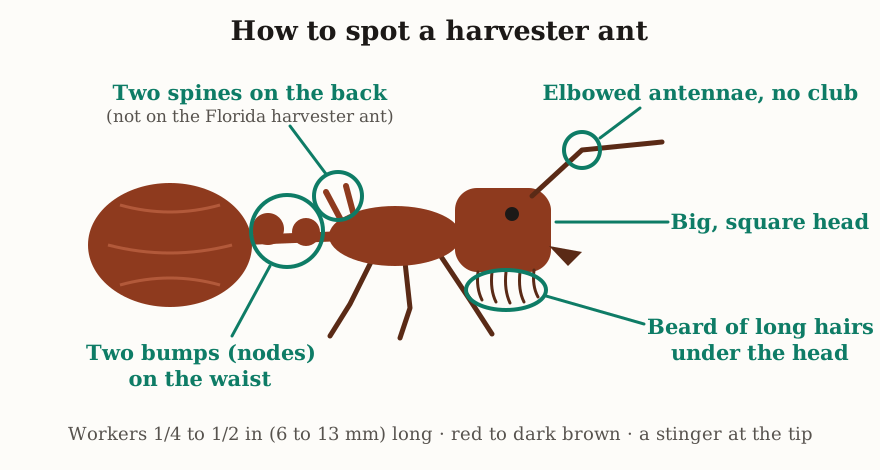
Some sources say these ants have no spines. Texas A&M’s leaflet on the red harvester ant says so, and Google’s AI summary repeats it. That is wrong for the red harvester ant. The standard key to these ants, by Taber (1998), describes its spines as “elongate and thickened, directed upward”. Only the Florida harvester ant lacks them.
How big are harvester ants?
Harvester ant workers are 1/4 to 1/2 inch (6 to 13 mm) long, which makes them some of the largest ants in a western yard. The Florida harvester ant runs 1/4 to 3/8 inch (6 to 10 mm). Queens are bigger still. In the Florida species they reach 10 to 12 mm, about 1/2 inch.
The size you read online depends on the source. Two popular pages convert the inches to millimetres wrongly, and one encyclopedia figure is low. This table shows each figure and what it measures:
Harvester ant size, by source
Texas A&M AgriLife (E-402)
- Size given
- 1/4–1/2 in
- What to know
- Red harvester ant workers
University of Arizona
- Size given
- 1/4–1/2 in
- What to know
- All harvester ants in Arizona
UF/IFAS
- Size given
- 1/4–3/8 in
- What to know
- Florida harvester ant, workers of mixed sizes
Colorado State
- Size given
- 5–7 mm
- What to know
- Western and rough harvester ants
Wikipedia
- Size given
- 5–7 mm
- What to know
- Red harvester ant. Below every extension figure
PestWorld
- Size given
- 1/4–1/2 in (4.7–11.5 mm)
- What to know
- The inches are right. In millimetres that is 6.4–12.7 mm
Orkin
- Size given
- 1/4–1/2 in (6.5–10 mm)
- What to know
- 1/2 inch is 12.7 mm, not 10
Why are harvester ants called bearded ants?
Harvester ants are called bearded ants because of a basket of long, curved hairs under the head, called a psammophore. The ants use it to carry sand, small seeds and eggs. The genus name Pogonomyrmex means “bearded ant” in Greek. A few small species, in the subgroup Ephebomyrmex, have no beard.
You need a close look or a good phone photo to see it. Hold the camera low and to the side, since the beard hangs under the head and does not show from above.
Harvester ant mounds
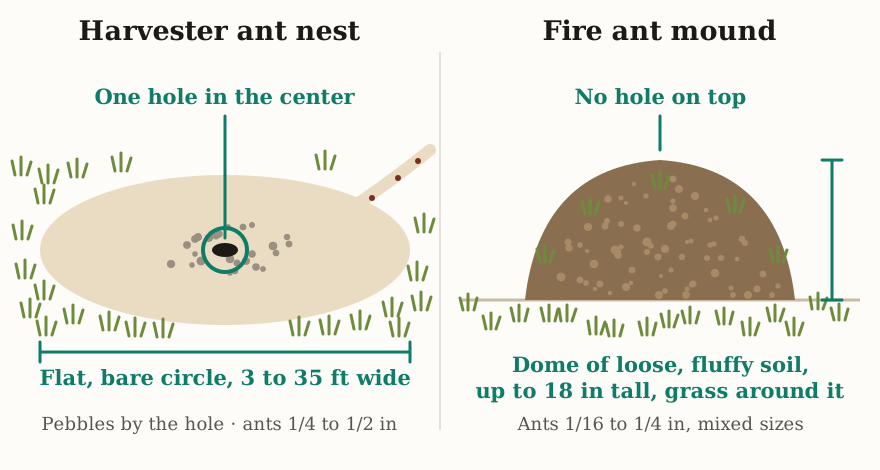
A harvester ant nest is a flat, bare circle of ground with one hole near the center, often ringed with small pebbles. Texas A&M puts the average clearing at about 12 feet across, with a range of 3 to 35 feet. The ants cut down every plant inside the circle and carry the pieces away.
That bare ground has a purpose. The University of Arizona says the ants keep plants off the nest to control the temperature underground. Look closely and you will often find gravel, small pebbles and bits of charcoal on the surface near the hole.
Foraging trails run out from the circle like spokes. Texas A&M has measured red harvester ant trails of about 200 feet. You will see workers walking out empty and coming back with seeds.
Sources give very different clearing sizes, because they describe different species and nests. Any bare patch with a single hole, pebbles and large red ants on trails fits.
Harvester ant clearing size, by source
Texas A&M AgriLife (E-402)
- Clearing size
- 3–6 ft
Texas A&M Urban Entomology
- Clearing size
- About 12 ft on average, 3–35 ft
University of Arizona
- Clearing size
- 4–35 ft
Texas A&M fire ant project
- Clearing size
- About 3 ft (1 m)
How deep is a harvester ant nest?
Most harvester ant nests go about 3 feet (1 m) down, and old ones go much deeper. Wikipedia gives 2.5 m (8 ft) for the red harvester ant and 5 m (16 ft) for the western harvester ant. Texas A&M once dug out a nest 15 feet deep, with 436 chambers.
That depth explains a lot. Water, sprays or dust poured on top reach only the first few inches of the nest, while the colony lives far below. It also means you cannot dig a nest out with a shovel.
Harvester ants vs fire ants
Harvester ants are bigger than fire ants and build a different nest. A harvester ant is 1/4 to 1/2 inch long and clears a flat, bare circle around one hole. Fire ants are 1/16 to 1/4 inch, come in mixed sizes, and pile up a fluffy mound of soil with no hole on top.
Harvester ant, fire ant or velvet ant?
Size
- Harvester ant
- 1/4–1/2 in
- Fire ant
- 1/16–1/4 in
- Velvet ant (cow killer)
- About 3/4 in
Workers in one nest
- Harvester ant
- About the same size (mixed in Florida)
- Fire ant
- Small to large, all mixed
- Velvet ant (cow killer)
- No nest, travels alone
The nest
- Harvester ant
- Flat bare circle, one hole, pebbles
- Fire ant
- Dome of loose soil, no hole on top, up to 18 in tall
- Velvet ant (cow killer)
- None of its own
Body
- Harvester ant
- Smooth, with a beard under the head
- Fire ant
- Smooth, no beard
- Velvet ant (cow killer)
- Covered in red and black fuzz
When disturbed
- Harvester ant
- Workers pour out of the hole and sting
- Fire ant
- Swarm up from the whole mound and sting many times
- Velvet ant (cow killer)
- Runs off, stings if grabbed
What it is
- Harvester ant
- Native ant
- Fire ant
- Imported ant
- Velvet ant (cow killer)
- Wingless wasp
Where fire ants move in, the native ants often disappear. Texas A&M notes that fire ants kill newly mated harvester ant queens before they can start a nest. Fire ant bait spread across a whole yard kills them too. So if you have both and want to keep the harvesters, treat each fire ant mound on its own, as our guide to fire ants explains.
How bad is a harvester ant sting?
A harvester ant sting is one of the most painful insect stings in North America. The entomologist Justin Schmidt rated it 3 on his 4-point pain scale, a step above a honey bee. The pain peaks in 20 to 30 minutes and can last more than eight hours, according to entomologist Derek Uhey, who has been stung hundreds of times.
Schmidt described a Maricopa harvester ant sting as “eight unrelenting hours” of drilling into an ingrown toenail. In the desert Southwest, Uhey writes, only the tarantula hawk has a worse sting.
Besides pain, a sting can cause redness, swelling, goosebumps and sweating around it. Often the skin then hardens into a red welt that stays itchy for a few days. One Nevada reader described 8 to 9 hours of pain from a single sting, eased only by ice water.
Where you are stung matters most. The ants struggle to sting through thick skin. A sting on the calf or forearm is often mild, while one on the top of the foot can be shocking. Many stings happen to bare feet, to hands that reach into grass, and to ants that climb inside a shoe or a sock.
Harvester ant venom works differently from fire ant venom. It is mostly small proteins (peptides) that act on nerve cells, according to a 2023 study in the Journal of Biological Chemistry. Some pest control pages, and Google’s AI summary that quotes them, call it “piperidine-alkaloid venom”. Those alkaloids are fire ant venom.
Do harvester ants bite or sting?
They do both, but the sting is what hurts. A worker grips the skin with its jaws, then drives in the stinger at the tip of its abdomen. That is why people say the ants “keep biting”. Only workers and queens can sting. The winged males have no stinger.
In some species, such as the Maricopa and Florida harvester ants, the stinger can tear off and stay in the skin, as a honey bee’s does. If you see one, scrape it out with the edge of a credit card.
Can harvester ants kill you?
A healthy adult will not die from a few harvester ant stings. The real danger is an allergic reaction, which can follow even one sting, or a very large number of stings at once. People who know they are allergic to bee or wasp stings should treat these ants with the same care.
The Maricopa harvester ant has the most toxic insect venom ever measured. In mice, its LD50 (the dose that kills half the animals tested) is 0.12 mg per kg of body weight, compared with 2.8 for honey bee venom. That makes it more than 20 times as toxic by weight. Yet Uhey estimates an adult would need “hundreds to thousands of stings” to die from the venom alone. Red harvester ant venom is milder, at 1.9 mg/kg.
Allergic reactions are rare but real. Doctors in Tucson reported a case of anaphylaxis, a severe whole-body allergic reaction, from a single rough harvester ant sting (Klotz and colleagues, 2005).
What to do if harvester ants sting you
Most harvester ant stings can be treated at home. Move away from the nest first, because more ants may be on your clothes. Then wash the sting and cool it to ease the pain and swelling. The steps below follow MedlinePlus guidance for insect stings.
Get away from the nest
Brush ants off your legs, and check inside your shoes and socks. If any warning sign in the red box appears, call 911 right away.
Remove a stinger
In some species the stinger stays in the skin. Scrape it out with the edge of a credit card. Do not use tweezers, which can squeeze in more venom.
Wash the sting
Clean the spot with soap and water.
Cool it
Hold ice wrapped in a washcloth on the sting for 10 minutes, then take it off for 10 minutes. Repeat as needed.
Ease the itch
An antihistamine or an anti-itch cream can help, used as the label directs. MedlinePlus advises against aspirin or other pain medicine unless your doctor prescribed it.
Keep watching
Watch for the signs in the red box over the next few hours. Over the next few days, see a doctor if the redness, swelling or pain keeps growing, since that can mean an infection.
For a wider look at stings and what a normal reaction looks like, see our bee sting guide. It covers bees and wasps, but the first aid and warning signs are the same. We cannot tell which bug stung you from a photo of the mark, and neither can anyone else, so bug bite identification starts with the bug, not the bump.
If a harvester ant stings your dog
Dogs get stung on the nose, mouth and paws when they sniff, lie on or dig at a nest. Hold a cold pack on the sting for 10 minutes. Then watch the dog closely: VCA Animal Hospitals says allergic reactions usually start within 20 minutes, though some come hours later.
Go to an emergency vet at once if your dog’s face or neck swells, or if it gets hives, drools heavily, vomits, struggles to breathe or has a seizure. Do not give a human antihistamine until your vet has given you the dose.
A dog that has been stung once will often go back to the same nest. One Arizona owner posted “Second time for my poor boy” about their dog. Mark the nest with a flag or a small fence, and keep your dog leashed near it until you decide what to do.
Types of harvester ants
The US has 22 species of harvester ants. Seven of them account for most sightings: the red, rough, Florida, California, western, Comanche and Maricopa harvester ants. Which one you have depends mostly on where you live, and only the Florida harvester ant lives east of the Mississippi River.
The harvester ants most often seen in the US (iNaturalist records, October 2026)
Red harvester ant (P. barbatus)
- Where it lives most
- Texas (80% of records), Arizona, Oklahoma, Kansas
- What to know
- The “Texas red ant”. Red to dark brown, with long spines on the back
Rough harvester ant (P. rugosus)
- Where it lives most
- California, New Mexico, Texas, Arizona
- What to know
- Often a darker head and thorax. Can cross with the red harvester ant
Florida harvester ant (P. badius)
- Where it lives most
- Florida (85%), the Carolinas, Georgia, Alabama
- What to know
- The only eastern species. Workers of mixed sizes, no spines, nests in sand
California harvester ant (P. californicus)
- Where it lives most
- California (91%), Arizona, Nevada
- What to know
- A colony sometimes has more than one queen
Western harvester ant (P. occidentalis)
- Where it lives most
- Colorado (40%), Utah, New Mexico, the northern Plains
- What to know
- Colonies up to 20,000 workers. Nests up to 5 m (16 ft) deep
Comanche harvester ant (P. comanche)
- Where it lives most
- Texas (84%), Kansas, Oklahoma, Louisiana
- What to know
- Thinner spines that angle back
Maricopa harvester ant (P. maricopa)
- Where it lives most
- Arizona (57%), New Mexico, Texas
- What to know
- The most toxic insect venom measured
Where are harvester ants found?
Harvester ants live in 26 US states, mostly in the West and on the Great Plains, plus Florida and its neighbors. Of 58,722 US iNaturalist records, Texas holds 30.8%, California 25.7%, Arizona 10.5%, Florida 8.6% and New Mexico 7.3%. Twenty-four states, from the Midwest to New England, have no records at all.
They like open, sunny, dry ground with little shade: desert, grassland, prairie, pasture, roadsides, and lawns, parks and golf courses in dry regions. The Florida harvester ant needs sand and open spaces, such as sandhills and open woodland.
Where harvester ants are seen: US iNaturalist records by state, read October 2026
Texas
- Share of US records
- 30.8%
- Most-seen harvester ant
- Red harvester ant
California
- Share of US records
- 25.7%
- Most-seen harvester ant
- California harvester ant
Arizona
- Share of US records
- 10.5%
- Most-seen harvester ant
- Red harvester ant
Florida
- Share of US records
- 8.6%
- Most-seen harvester ant
- Florida harvester ant
New Mexico
- Share of US records
- 7.3%
- Most-seen harvester ant
- Rough harvester ant
Colorado
- Share of US records
- 5.3%
- Most-seen harvester ant
- Western harvester ant
Utah
- Share of US records
- 3.0%
- Most-seen harvester ant
- Western harvester ant
Nevada
- Share of US records
- 2.5%
- Most-seen harvester ant
- Rough harvester ant
Oklahoma
- Share of US records
- 1.6%
- Most-seen harvester ant
- Red harvester ant
Idaho
- Share of US records
- 0.8%
- Most-seen harvester ant
- Western harvester ant
Oregon, South Carolina, Kansas, North Carolina, Wyoming, Georgia, Washington, Nebraska, Alabama, South Dakota, Montana, North Dakota
- Share of US records
- 0.1–0.5% each
- Most-seen harvester ant
- Western harvester ant in the north and Plains, Florida harvester ant in the Southeast, red harvester ant in Kansas
Louisiana, Arkansas, Mississippi
- Share of US records
- Under 0.1%
- Most-seen harvester ant
- Comanche, red and Florida harvester ants
These are photos people uploaded, not a census, so busy towns and popular parks count for more. Still, the pattern matches the extension sources: these are western and southern ants.
Harvester ants in Texas, Oklahoma and Kansas
Texas has more harvester ants than any other state, with 18,061 iNaturalist records. Most are red harvester ants, and Texas also has the Comanche harvester ant. Texas A&M lists 10 species in the state, 7 of them only in far West Texas. Oklahoma (943 records) and Kansas (266) mostly have the same species.
That is why “Texas red ants” and “red ants in Kansas” so often mean this ant. In East Texas, though, fire ants have pushed them out of many places, so a red ant there is more likely a fire ant.
Harvester ants in Arizona, New Mexico and the West
In Arizona, the most common is the red harvester ant, followed by the rough and Maricopa harvester ants. New Mexico’s most common is the rough harvester ant. California has its own California harvester ant, along with the rough harvester ant and several smaller species.
Farther north, the western harvester ant takes over. It is the most common harvester ant in Colorado, Utah, Wyoming, Idaho and the northern Plains. In Washington, Idaho and Oregon you may also meet the Owyhee harvester ant, recorded as P. salinus on iNaturalist.
Harvester ants in Florida and the Southeast
The Florida harvester ant is the only harvester ant east of the Mississippi River. It lives in Florida (5,065 records), with smaller numbers in South Carolina, North Carolina, Georgia and Alabama, nearly always in sandy soil. Its workers vary in size, the largest with big heads, and it has no spines on its back.
It has the same painful sting as its western cousins, rated 3 on Schmidt’s scale. One Florida colony studied by UF/IFAS lasted at least 19 years.
When are harvester ants active?
Harvester ants are out from spring to fall and quiet in winter. US sightings peak in April, with 19.2% of all records, and March to May holds 41.6%. A second, smaller rise comes in September and October. On hot summer days they forage in the morning and late afternoon and stay inside through the midday heat.
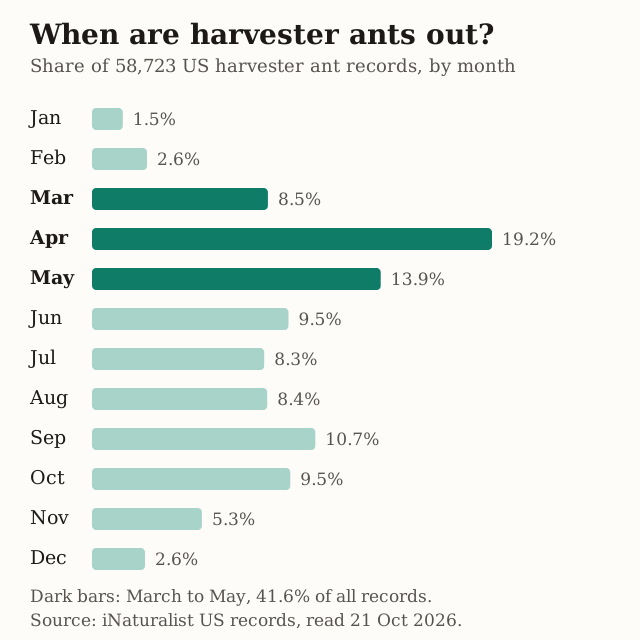
December to February holds only 6.7% of records. In winter the colony stays deep in the nest and lives off its stored seeds, so a nest that looked empty in January can be busy again by March.
Winged harvester ants
Winged harvester ants are new queens and males leaving the nest to mate. Red harvester ant queens and males fly in late summer, usually on the afternoon after a heavy rain, mostly in August and September in Texas. After mating, the males die within 24 hours, and each queen drops her wings and digs a new nest alone.
The Florida harvester ant flies from June to October, also in the afternoon after rain. Few new queens survive to start a colony, and Texas A&M names fire ants as one of their main killers.
A swarm of winged ants outdoors after a storm needs no action. If winged ants come out inside a house, that is a different problem, and our flying ants guide explains what it means. A big, red, winged “ant” that looks fuzzy may also be a male velvet ant, which is a harmless wasp.
How harvester ants live
A harvester ant colony is one queen and a few thousand to more than 10,000 workers, living off a store of seeds. Workers live about a year. The queen lives far longer, and the colony lasts as long as she does: up to about 30 years in a long-term study in New Mexico.
What do harvester ants eat?
They eat mostly seeds, from grasses, weeds and wildflowers, plus dead insects. Foragers carry the seeds home and store them in underground chambers called granaries, where they can keep for months or even years. That store lets a colony ride out a drought or a winter.
Texas A&M lists the seeds the red species collects, among them alfalfa, oats, wheat, Bermuda grass, Johnson grass, wild sunflower and mesquite. In a field, that can mean seed loss around the nest. In a yard, it mostly means the bare circle.
The queen and the colony
Each colony starts with a single queen, who mated on her flight and dug a small chamber alone. She lays every egg the colony ever has. When she dies, no new queen takes over, and the colony dies out about a year later, as its last workers age.
The best evidence on colony life comes from Deborah Gordon of Stanford University. Since 1988, her team has followed about 300 red harvester ant colonies a year near Rodeo, New Mexico. They found colonies can live up to about 30 years. How long depends on rainfall and on how many neighbor colonies compete for the same seeds.
Workers change jobs as they age. Young ants tend the queen and the brood, and the oldest become patrollers and foragers. Gordon’s team showed that foragers will not head out until patrollers come back safely, which is how a colony avoids wasting effort on a bad day.
Colony size varies by species. A mature red harvester ant colony has a few thousand to 10,000 or more workers, a rough harvester ant colony up to 15,000, and a western harvester ant colony up to 20,000.
Do harvester ants come into the house?
Harvester ants almost never come indoors. Texas A&M says plainly that they “do not invade homes or structures”. Their food and their nest are outside, and they have no reason to enter. A trail may cross a patio or a driveway, but it will lead back to a nest in the open ground.
If you find big red or black ants inside, look at our carpenter ant guide, or take a clear photo for our insect identifier.
Should you get rid of harvester ants?
Often not. A harvester ant nest away from paths, play areas and dog runs does no harm if you leave it alone, and horned lizards get 69% of their diet from these ants. Act when a nest sits where people or pets walk, play or sit, or when someone at home is allergic to stings.
Horned lizards are the “horned toads” many Texans grew up with. The 69% figure for the Texas horned lizard comes from a Texas A&M-Kingsville bulletin, which adds that one lizard eats 70 to 100 ants a day. The lizard does not eat fire ants. It has been a threatened species in Texas since 1977, and it is now gone from most of East Texas.
The ants help the land in other ways too. The University of Arizona says they spread seeds, open up the soil so water soaks in, and feed other animals. A 2022 review by Uhey and Hofstetter concludes that control “is rarely needed” and only makes sense where the ants are an immediate health risk.
Keep it or treat it? Where the nest is decides
In a field, pasture edge or empty lot
- What to do
- Leave it alone
At the back of the yard, where nobody walks
- What to do
- Leave it, mark it, and keep the dog away
Beside a path, patio, play set or dog run
- What to do
- Treat it with a labelled bait
Anywhere, if someone at home is allergic to stings
- What to do
- Treat it, and keep the allergy kit handy
Fire ant mounds nearby as well
- What to do
- Treat the fire ant mounds one at a time, and leave the harvester ants
How to get rid of harvester ants
To get rid of harvester ants, treat the colony, not the ants you can see. Scatter a granular bait labelled for harvester ants around the nest opening, so the foragers carry it deep into the nest. Pouring water, gasoline or spray on the mound kills ants near the surface and misses the colony 3 or more feet down.
Start with what costs nothing. Mark the nest with a flag, keep dogs leashed near it, and wear closed shoes and socks in the yard. In fields and large lots, Texas A&M says regular discing and mowing “may eliminate them without resorting to use of insecticides”. In a lawn, thick, watered grass leaves fewer bare, dry spots for a new queen to dig in.
If keeping people and pets away is enough, no insecticide is needed. If the nest has to go, bait is the method that reaches the colony.
How to get rid of harvester ants with bait
Make sure of the ant
Check for the bare circle with one hole and the large ants of one size, using the comparison above. Fire ants need a different plan.
Choose a bait whose label lists harvester ants
Granular baits with the active ingredient hydramethylnon are among the products on Texas A&M's list. Read the whole label before you buy.
Pick a dry day
Bait that gets wet stops working, so skip days with rain or sprinklers due.
Do not disturb the nest first
The ants need to be calm and foraging to pick up the bait.
Scatter the label amount
Spread it around the nest opening and along the trails, not into the hole. Use exactly the amount and timing the label gives.
Keep people and pets away
Keep them off the treated area for as long as the label says.
Check the nest after a week
If ants are still carrying seeds, follow the label on whether and when to treat again.
If bait fails, Texas A&M also lists insecticide dusts injected into the nest opening. The University of Arizona and UF/IFAS advise treating at the hottest part of the day, when the ants are inside. Texas A&M calls drenching the mound the “least desirable” method. Our guide to getting rid of ants explains why baits beat sprays for every kind of ant.
Why do harvester ant mounds come back?
A treated mound often comes back because the treatment never reached the colony below. Nests run 3 to 15 feet deep, and surface treatments kill only the workers near the top. The colony then opens new holes nearby, sometimes within days. One Albuquerque reader fought the same mound for seven months.
“These harvester ant just make new holes after about 3 days,” that reader wrote on Reddit. Another summed up the usual result of home remedies: “All it seems you can really do is make them go away for a little bit.” A bait that the workers carry down gives you the best chance of ending it for good.
Harvester ant myths
Most bad advice about harvester ants comes from treating them like fire ants or like kitchen ants. These nine myths turn up on forums, on pest company pages and even in Google’s AI summary. Each one wastes your time, misses a nest that runs 3 to 15 feet deep, or puts you at risk.
Myth 1
Myth: “Harvester ants have no spines.”
Truth: Texas A&M's E-402 leaflet and Google's AI summary say so. The red harvester ant has long, thick spines on its back. Only the Florida harvester ant has none.
Myth 2
Myth: “All big red ants are fire ants.”
Truth: In Texas, Oklahoma and the West, many are harvesters, which are larger and build a flat, bare nest.
Myth 3
Myth: “Gasoline kills the colony.”
Truth: It kills ants near the surface, poisons the soil and can catch fire. The EPA warns against using fuel on pests.
Myth 4
Myth: “Boiling water reaches the queen.”
Truth: It cools long before it gets 3 feet down, and it scalds your lawn and you. Readers who tried it say the ants just pop up elsewhere.
Myth 5
Myth: “Borax and sugar will wipe them out.”
Truth: These ants live on seeds. The extension guides we read recommend granular baits labelled for them, not sweet baits.
Myth 6
Myth: “Diatomaceous earth on the mound ends it.”
Truth: It only works on ants that walk through it while it stays dry, and it never reaches the nest. Use only an EPA-registered product, and never spread it across the yard.
Myth 7
Myth: “Harvester ants bite.”
Truth: They grip with their jaws first. The pain comes from the stinger at the tip of the abdomen.
Myth 8
Myth: “A harvester ant sting can easily kill you.”
Truth: Without an allergy, it would take hundreds to thousands of stings. The real risk is an allergic reaction.
Myth 9
Myth: “Harvester ants invade homes.”
Truth: Texas A&M says they do not. Their seeds and their nest are outside.
Harvester ants in ant farms
Many ant farms use harvester ants, shipped as workers without a queen. Insect Lore sends the western species and says most live 2 to 4 months in a habitat. The maker of the Uncle Milton ant farm tells buyers it is “not allowed to send a queen”. Without a queen, the ants cannot start a new colony.
These are the same stinging ants as in the wild. Insect Lore’s own advice is “Do not touch the ants; they can sting.” Keep the lid closed and let an adult handle any transfers.
When to call someone
Most harvester ant problems need no outside help. Call 911 for breathing trouble or swelling in the face or mouth after a sting, an emergency vet for a dog with the same signs, and a pest professional when a nest near a play area survives two bait treatments. The table lists who else can help.
Who to call about harvester ants
911
- When
- Trouble breathing, a swollen face, mouth or throat, or weakness after a sting
- Why
- Signs of a severe allergic reaction (MedlinePlus)
Poison Help, 1-800-222-1222
- When
- Many stings at once, a sting in the mouth, a child stung several times, or a child who ate ant bait
- Why
- Free expert advice, day or night
Your doctor
- When
- Redness, swelling or pain growing days later, or a known sting allergy
- Why
- Infection, or a prescription for epinephrine
An emergency vet
- When
- A stung dog with face swelling, hives, drooling, vomiting or breathing trouble, or a pet that ate bait
- Why
- Pets can react badly to stings and to bait
A licensed pest professional
- When
- A nest by a play area that survives two bait treatments, or many nests
- Why
- They can use products and methods not sold to homeowners
Your county extension office
- When
- You are not sure if they are harvester ants or fire ants
- Why
- Free identification and local advice
Pest control disclaimer. Photo-based identification can help, but it is not always perfect. For dangerous spiders, large infestations, or anything you are unsure about, contact a licensed pest control professional.
Medical disclaimer. This page is for general information only. It is not a medical diagnosis. If you have severe symptoms, trouble breathing, swelling of the face or throat, fast spreading redness, fever, severe pain, pus, or signs of infection, contact a doctor or your local emergency number.
Frequently asked questions
Do harvester ants ruin lawns?
Can I dig out a harvester ant nest?
What attracts harvester ants to my yard?
Are harvester ants protected in Texas?
What eats harvester ants?
Are harvester ants active at night?
Related guides
Fire ants
The small red ants with the fluffy mound, and how to treat them without harming native ants.
How to get rid of ants
Why bait beats spray, and how to match the bait to the ant you have.
Cow killer (red velvet ant)
The fuzzy red “ant” that is really a wingless wasp, with an even worse sting.
Flying ants
What a swarm of winged ants means indoors and out, and how to rule out termites.
Bee sting
First aid, the swelling timeline, stings on pets, and the signs that need a doctor.
Insect identifier
Upload a photo and get an identification from the free AI tool.
Sources
- Drees, Red Harvester Ants, Texas A&M AgriLife Extension (E-402)
- Texas A&M Urban Entomology, Red Harvester Ants
- University of Arizona Cooperative Extension, Backyard Gardener #16, Harvester Ants (2022)
- UF/IFAS EDIS, Florida Harvester Ant (EENY-298/IN536)
- Colorado State University Extension, Harvester Ants, Colorado Insects of Interest
- Taber (1998), Key to Pogonomyrmex species in the Southeastern United States, Mississippi Entomological Museum
- Uhey, The Painful but Fascinating Stings of Harvester Ants, Entomology Today (2025)
- Uhey and Hofstetter, From Pests to Keystone Species: Ecosystem Influences and Human Perceptions of Harvester Ants, Annals of the Entomological Society of America 115(2): 127-140 (2022)
- Robinson and others, Peptide toxins that target vertebrate voltage-gated sodium channels underly the painful stings of harvester ants, Journal of Biological Chemistry 300(1) (2023)
- Klotz, Schmidt, Pinnas and Klotz, Consequences of harvester ant incursion into urbanized areas: a case history of sting anaphylaxis (2005)
- Gordon, Rainfall, neighbors, and foraging: the dynamics of a population of red harvester ant colonies 1988-2019, Ecological Monographs (2021)
- Henke and Fair, Texas horned lizard bulletin (Bulletin 2), Caesar Kleberg Wildlife Research Institute, Texas A&M-Kingsville
- MedlinePlus, Insect bites and stings
- VCA Animal Hospitals, First Aid for Insect Stings in Dogs
- Insect Lore, The Ultimate Guide to Raising Harvester Ants
- iNaturalist, harvester ant (Pogonomyrmex) observations in the United States (read October 21, 2026)