What are fire ants?
Fire ants are small stinging ants in the genus Solenopsis. In the US, the one people mean is the red imported fire ant, Solenopsis invicta. Workers are 1/16 to 1/4 inch long, copper-brown with a darker abdomen, and come in mixed sizes. They live in soil mounds and sting when the mound is disturbed.
Why are fire ants called fire ants? Because of the sting. UC IPM says the venom causes a burning feeling, hence the name. Wikipedia counts over 200 species of Solenopsis, but only about 20 are true fire ants. Most of the rest are tiny thief ants, which Wikipedia describes as unable to sting.
The red imported fire ant came from South America. Texas A&M says it arrived around the 1930s through the port of Mobile, Alabama. It probably came in soil used as ship ballast. Its cousin, the black imported fire ant, came through the same port a few decades earlier, UT Tennessee says. Both have spread since.
What do fire ants look like?
Check each clue below to narrow down what you saw.
Size: 1/16 to 1/4 inch (1.5 to 6 mm)
Texas A&M says the largest workers are 2 or 3 times the size of the smallest.
Mixed sizes in one mound
Many native ants have workers of one size, according to Texas A&M. Fire ant workers run from tiny to large in the same mound.
Copper-brown head and middle, darker abdomen
Wikipedia and Australia's fire ant program describe the same coloring. The black imported fire ant is darker.
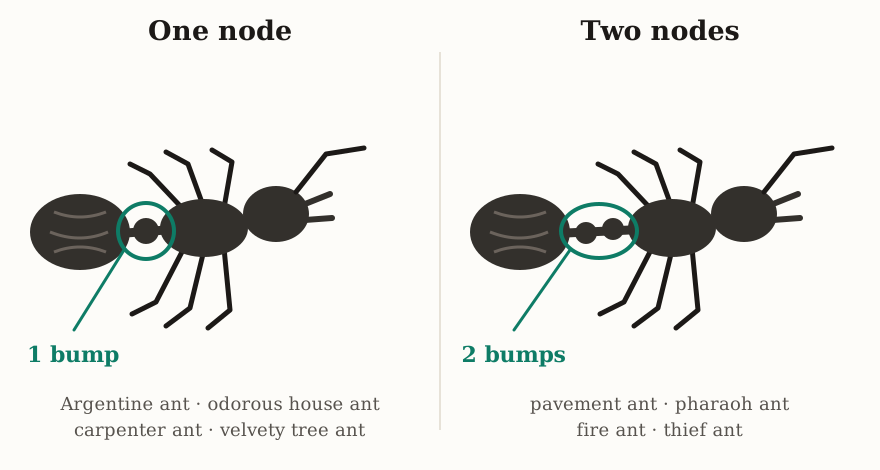
Two nodes at the waist
From the side, two small bumps join the middle of the body to the abdomen. Carpenter ants have one.
Antennae with 10 segments and a two-part club
UT Tennessee lists this for all three imported types. You need a hand lens to count them.
How big are fire ants?
Fire ant workers are 1/16 to just under 1/4 inch long, about 1.5 to 6 mm. Winged queens and males are bigger, about 1/3 inch according to Alabama Extension. Sources disagree a little on the worker range, because one mound holds tiny and large workers at the same time.
How big fire ant workers are, by source
Texas A&M, FAQ
- Workers
- 1/16 to almost 1/4 in
- Note
- The largest are 2 or 3 times the smallest
Texas A&M, identification page
- Workers
- 1.5 to 4 mm
- Note
- Workers from many-queen colonies are smaller
UC IPM
- Workers
- 1/16 to 1/5 in
- Note
- Dark reddish brown
USDA APHIS and NPS
- Workers
- 1/8 to 1/4 in
- Note
- Reddish brown or black
Wikipedia and Australia's program
- Workers
- 2 to 6 mm
- Note
- Every size present in one nest
Alabama Extension
- Workers
- About 1/3 in
- Note
- Winged swarmers, not workers
Our reading: workers are 1/16 to 1/4 inch. An ant of about 1/3 inch with wings is a swarmer. One that size without wings, inside a mound, is probably a queen that has shed her wings.
Types of fire ants in the US
Seven kinds of ant go by the name fire ant in the US. Two were imported from South America, and a hybrid formed between them. Two are native. The last two are separate invaders that do not belong to Solenopsis at all. Each one’s giveaway is in the first column.
The fire ants of the United States
Reddish brown, darker abdomen, mixed sizes
- Ant
- Red imported fire ant (Solenopsis invicta)
- Where
- Across the South and in parts of California
- Note
- The main pest. Far more aggressive than native fire ants
Darker, with a golden patch at the top of the abdomen
- Ant
- Black imported fire ant (S. richteri)
- Where
- Northeastern Mississippi, northwestern Alabama, southern Tennessee
- Note
- Came first, a few decades before the red one
A blurry golden patch, between the two
- Ant
- Hybrid imported fire ant
- Where
- Much of Tennessee, northwestern Georgia, northern Alabama and Mississippi
- Note
- Color is not reliable. Labs confirm it
Irregular patches of loose soil with several hidden holes
- Ant
- Southern fire ant (S. xyloni)
- Where
- Native, from the Carolinas to California
- Note
- Milder sting than the red imported fire ant
A few large workers with big, square heads
- Ant
- Tropical fire ant (S. geminata)
- Where
- Native; the most common native fire ant in Texas
- Note
- Almost identical to the red imported fire ant by eye
3/16 inch, red, two spines on the waist, nests under logs
- Ant
- European fire ant (Myrmica rubra)
- Where
- Coastal Maine
- Note
- Not a true fire ant, but stings readily
1/16 inch, yellow-red, no mound, falls from trees
- Ant
- Little fire ant
- Where
- Hawaii, linked to colonies in Florida
- Note
- Not a true fire ant. Painful welts that can last weeks
Sources: UT Tennessee for the imported and hybrid ants. Wikipedia gives the southern fire ant’s range and sting, and UC IPM its nests. Texas A&M covers the tropical fire ant and UMaine the European one. The little fire ant is from the Hawaii Invasive Species Council. Hawaii now lists it as Allomerus auropunctatus, after a 2026 study moved its whole genus. Older sources call it Wasmannia auropunctata.
How to identify fire ants
To identify fire ants, look for 4 things from a safe distance. The mound has no hole on top. The workers come in mixed sizes. They rush out and climb grass stems when the mound is touched. And a sting turns into a white pustule a day or so later. Two or more together make a fire ant very likely.
- The mound has no hole in the middle. Texas A&M says these ants come and go through tunnels under the ground. Most ant mounds have an opening in the center. That is the quickest way to tell a fire ant mound from a regular ant mound.
- Workers come in many sizes. Texas A&M notes that many other ants are all one size.
- They charge up anything upright. Disturb a mound and dozens to hundreds of workers run up grass and objects. “Few native ants charge up vertical surfaces,” Texas A&M says.
- A sting turns into a white pustule. Texas A&M says the blister forms a day or so later and is typical of fire ant venom. Still, a doctor, not a photo, should judge any reaction.
Check from a distance. Australia’s fire ant program suggests covering your skin with long sleeves, long pants, boots and gloves. Then gently poke the nest with a long stick, step back and watch. Never use your hands.
What does a fire ant mound look like?
A fire ant mound, or fire ant hill, is a dome of loose, fluffy soil with no opening on top. Undisturbed mounds in pastures reach about 18 inches high. However, most mounds in lawns are only a few inches tall, according to Texas A&M. New mounds often show up a few days after heavy rain.
Mississippi State explains why mounds come and go. In cool, wet weather the ants build high to keep their young warm and dry. In hot, dry weather they stay deep, and even big colonies may not show above the grass. So mounds seem to multiply in spring and after rain, when the colony was there all along.
Under the dome, UT Tennessee says, the fire ant nest goes down about 12 to 16 inches (30 to 40 cm). A few tunnels reach the water table. The ants do not use the mound as a door, either. MSU says foraging tunnels can come up 5 to 25 feet away. That is why the ants can turn up on a patio far from any mound.
Other mounds look different. Harvester ants clear a large bare patch around a single hole, according to Texas A&M. Pyramid ants pile a small crater, 2 to 4 inches across, around one hole. A fan of soil with a plugged hole to one side is a gopher mound, not an ant nest. Even so, UC IPM warns that California fire ant mounds can look like gopher mounds, and mowing often flattens them.
Ants that look like fire ants
Many red ants are not fire ants. Common mix-ups are harvester ants, velvet ants, bigheaded ants, pyramid ants and red carpenter ants. Size, the number of nodes and the nest separate them. A harvester ant, for example, is 1/4 to 1/2 inch long. Even a small one is as big as the largest fire ant worker.
Ants and insects mistaken for fire ants
Bigger red ants and a wide bare patch with one hole
- Likely
- Harvester ant
- How it differs from a fire ant
- 1/4 to 1/2 in, often a beard of long hairs under the head and a pair of spines on the back. Stings painfully. West of the Mississippi, plus Florida
A fuzzy, bright red and black “ant” running alone
- Likely
- Velvet ant, a wingless wasp
- How it differs from a fire ant
- 1/8 to 7/8 in. Females are fuzzy, have no wings and can sting hard; males have wings and cannot sting
Some workers with huge heads, nests under stones and pavers
- Likely
- Bigheaded ant
- How it differs from a fire ant
- Only two worker sizes. Imported fire ants do not have big-headed workers
Small red-black ants, a 2 to 4 inch crater around one hole
- Likely
- Pyramid ant
- How it differs from a fire ant
- About 1/8 in, with a pyramid-shaped bump on the back. Builds near harvester ant nests
Large red and black ants with one node, near wood
- Likely
- Red carpenter ant
- How it differs from a fire ant
- 1/4 to 1/2 in, one node, an evenly rounded back. Bites but does not sting
Tiny yellow-red ants that drop from trees, no mound
- Likely
- Little fire ant
- How it differs from a fire ant
- 1/16 in and all one size. Mostly in Hawaii
Small red ants in a damp yard in Maine, many flat holes under logs
- Likely
- European fire ant
- How it differs from a fire ant
- 3/16 in, two spines on the waist
Winged insects with straight antennae and four equal wings
- Likely
- Termite swarmers
- How it differs from a fire ant
- Ants have elbowed antennae, a narrow waist and a larger front pair of wings
Harvester and velvet ants are from PestWorld. Bigheaded, pyramid and carpenter ants and the termite test are from Texas A&M. The little fire ant is from the Hawaii Invasive Species Council, and the European fire ant from UMaine.
Big red and black ants near wood are covered in our carpenter ant identification guide. Still unsure? A sharp photo through the free insect identifier will name it. Your county Extension office can also confirm it, as APHIS and UT Tennessee both suggest.
Fire ants vs red ants: are all red ants fire ants?
No. “Red ant” is a nickname, not a species. In the 13 states on the USDA fire ant quarantine list, red ants stinging from a mound are usually fire ants. Elsewhere, the name goes to other ants, such as harvester ants, field ants and the European fire ant.
Wikipedia notes that both Myrmica rubra, the European fire ant, and Pogonomyrmex barbatus, the red harvester ant, are commonly called red ants. UC IPM says many Californians call their harvester ants red ants. Texas A&M even lists a native field ant, Formica pallidefulva, whose common name is simply the red ant.
So the useful test is not color. It is the four checks above: no hole in the mound, mixed sizes, climbing ants and the pustule after a sting.
One pest company comparison that ranks for this question, from HomeTeam Pest Defense, gets the fire ant’s antennae wrong. It gives fire ants 11 antenna segments. UT Tennessee and Wikipedia both give them 10, ending in a two-part club. The same article calls fire ant mounds cone-shaped, while UT Tennessee describes them as dome shaped.
Are there black fire ants?
Yes. The black imported fire ant, Solenopsis richteri, is darker than the red one. UT Tennessee says it has a golden patch at the top of the abdomen. It lives in a small area: northeastern Mississippi, northwestern Alabama and southern Tennessee. A hybrid of the two covers much of Tennessee and nearby states.
Color alone does not separate the hybrid from either parent. UT Tennessee says scientists use chemical and DNA tests to be sure. For your yard it matters little. Mississippi State says the red and black imported fire ants are similar in biology and behavior. So the advice on this page fits all three.
Are fire ants dangerous? Do they bite or sting?
Fire ants bite to get a grip, then sting, and each ant can sting several times. The sting burns, and a white pustule forms a day or so later. For most people that is painful but not dangerous. However, Texas A&M says around 1% of people are hypersensitive and can have a life-threatening reaction.
The bite itself does little. Mississippi State says the ant grips the skin with its jaws to anchor itself, then drives in its sting. Unlike a honey bee’s, the sting is not barbed, so the same ant can sting again and again. NPS adds that the ants pivot on the head as they sting, so the stings land in a circle.
That is also why one mistake means many stings. Texas A&M explains that they react to movement. When you jerk your leg, the ants already on it sting together. It knows of no chemical signal that sets them off.
The pustule looks infected but is not. MSU says it is sterile and lasts many days. Scratching or breaking it can let infection in. UC IPM notes it may take several weeks to fade and can leave a scar. So leave it alone.
Can fire ants kill you? Rarely, but yes. Mississippi State says the real danger is an allergic reaction. The other is hundreds of stings on someone who cannot escape because of age, injury or illness. Each year there are deaths for those reasons. APHIS adds that young and newborn animals are especially at risk.
What to do if fire ants sting you
- Move away from the mound first, then brush the ants off. They hold on with their jaws, so shaking a leg is not enough.
- Keep the stings clean. Texas A&M advises keeping them clean and intact to avoid infection.
- Do not pop or scratch the pustules. UT Tennessee warns that scratched stings infect easily and can scar.
- For pain and itching, use an over-the-counter insect sting product as its label directs. Texas A&M suggests one with a numbing ingredient such as benzocaine.
- Watch for a bigger reaction, such as swelling or redness spreading well beyond the stings. Also watch for the red flags below.
Call your vet if a pet is stung many times or its face swells. APHIS says young and newborn animals are especially at risk, so puppies, kittens and young livestock need the most care. Our bug bite identification chart compares fire ant stings with other bites. The bee sting guide covers allergic reactions in more depth.
Where do fire ants live?
In the US, imported fire ants infest more than 367 million acres in 13 states and Puerto Rico, according to USDA APHIS. The states are Alabama, Arkansas, California, Florida, Georgia, Louisiana, Mississippi, North Carolina, Oklahoma, South Carolina, Tennessee, Texas and Virginia. They prefer open, sunny ground such as lawns, pastures, parks and fields.
Within those states, Wikipedia notes they often nest near water, such as pond shores, watered lawns and highway shoulders. They also nest under logs, rocks or bricks. They can be very common. UT Tennessee says quarantine areas covered about 80% of the state’s land in 2021. About 87% of Tennesseans live in infested counties.
Cold is what stops them. Mississippi State expects winters that freeze the soil deeply to limit their spread north. Texas A&M says the northern edge has reached the middle of Oklahoma. In the West, they have reached eastern New Mexico, it adds, though New Mexico is not on APHIS’s list. In California they arrived in 1998, and UC IPM names Orange, Los Angeles, Riverside, San Bernardino and San Diego counties.
Fire ants by state
Texas, Louisiana, Mississippi, Alabama, Georgia, Florida, South Carolina, Arkansas
- Fire ants there
- Red imported fire ants, widespread. Black and hybrid fire ants in parts of Mississippi and Alabama
- What it means
- A stinging mound in the lawn is most likely fire ants. Federal quarantine
Tennessee, North Carolina, Virginia, Oklahoma
- Fire ants there
- Red imported and hybrid fire ants, still spreading north
- What it means
- Federal quarantine in parts of each state. Check the APHIS map for your county
California
- Fire ants there
- Red imported fire ants in southern counties. The native southern fire ant
- What it means
- Quarantined. Report new finds to CDFA or your county agricultural commissioner
New Mexico and the desert Southwest
- Fire ants there
- Native fire ants, such as the southern fire ant. Imported fire ants reported in eastern New Mexico
- What it means
- Not on the APHIS quarantine list. Have a stinging ant confirmed by Extension
Hawaii
- Fire ants there
- The little fire ant, a separate invader
- What it means
- Collect and submit suspect ants, or report them to 643-PEST
Coastal Maine
- Fire ants there
- The European fire ant, a separate invader
- What it means
- Inspect plants, soil, compost and wood chips before you bring them home
Ohio, Michigan, Pennsylvania, New York, New Jersey, Indiana, Illinois and the rest of the North
- Fire ants there
- No imported fire ants on the APHIS quarantine list
- What it means
- A red ant here is most likely another species. Have a suspected fire ant confirmed by your county Extension office
Sources: USDA APHIS (page modified September 17, 2026), UC IPM, Texas A&M and Wikipedia. UMaine and the Hawaii Invasive Species Council cover Maine and Hawaii. Quarantine lines move, so check the APHIS interactive map for your county.
Beyond the US, Wikipedia says the red imported fire ant has also invaded Australia, China and Taiwan. It most likely traveled there in shipping crates.
Fire ant colonies, queens and swarms
A fire ant colony holds 100,000 to 500,000 workers, according to Texas A&M. It also has up to several hundred winged males and future queens. The queen lays up to 800 eggs a day and can live 7 years or more. Workers live about 5 weeks. Most colonies have one queen, but some have many.
The queen fire ant and a new colony
A new colony starts small. After mating, a queen fire ant sheds her wings, digs a chamber and lays about a dozen eggs. Texas A&M says they hatch in 7 to 10 days. The larvae grow for 6 to 10 days, and then the pupae take 9 to 15 days to become adults. Those first small workers raise the rest.
Mississippi State says it takes several months for a colony to build a mound big enough to notice. For every large mound in a lawn, there are usually many young colonies too small to see. That is why treating only the mounds you can see falls short.
Some colonies have a single queen and others have many. Texas A&M says single-queen areas hold 40 to 150 mounds per acre. Many-queen areas can hold 200 or more, because workers move freely between mounds. UC IPM adds that every queen must die before a many-queen colony ends.
Fire ant facts and figures, by source
The sources disagree on almost every number, sometimes on the same page. Here they are side by side, so you can see the range rather than one figure picked at random.
Fire ant numbers from four sources
Eggs a queen lays per day
- Texas A&M
- Up to 800
- UT Tennessee
- 800 to 1,000
- NPS
- Up to 1,500
- Wikipedia
- Up to 1,600
Workers per colony
- Texas A&M
- 100,000 to 500,000
- UT Tennessee
- 100,000 to 245,000
- NPS
- 300,000 to 500,000
- Wikipedia
- Up to 250,000
Worker lifespan
- Texas A&M
- About 5 weeks
- UT Tennessee
- About 5 weeks
- NPS
- 4 to 6 weeks, and elsewhere “up to 180 days”
- Wikipedia
- Not given
Queen lifespan
- Texas A&M
- 7 years or more
- UT Tennessee
- 7 years or more
- NPS
- 2 to 6 years, and elsewhere “7 years or more”
- Wikipedia
- Up to 7 years
Mound height
- Texas A&M
- Up to 18 in
- UT Tennessee
- 18 to 24 in
- NPS
- About 18 in, some several feet
- Wikipedia
- 16 in, up to 3 ft 3 in on heavy soil
How deep the nest goes
- Texas A&M
- Not given
- UT Tennessee
- 12 to 16 in (30 to 40 cm), a few tunnels to the water table
- NPS
- 20 ft or more
- Wikipedia
- Not given
Our reading: a big colony holds a few hundred thousand workers. A queen lays several hundred eggs a day, and a worker lives about 5 weeks. NPS gives two different lifespans on one page, and its 20-foot depth is far beyond UT Tennessee’s figure.
Do fire ants have wings? Swarms and flying fire ants
Only the reproductives have wings. Winged males and future queens leave the mound on mating flights from spring through late fall, according to Alabama Extension. Flights are most likely a day or two after rain that follows a dry spell. They are about 1/3 inch long, bigger than workers, and they mate in the air.
Alabama Extension says the winged ones can sting. Still, it is unlikely while they are flying or looking for a nest site. After mating, the males die. Queens drop to the ground, shed their wings and dig in. Most never make it, because other ants, birds, spiders and lizards kill them first. A queen may fly as far as 10 miles, though most land much closer.
Swarmers are drawn to shiny surfaces, so they often end up in pools. A swarm in your yard also means new mounds are coming. Texas A&M says they appear one to two months after a successful mating flight. For other winged ants, and how to tell any of them from termites, see our flying ants guide.
What do fire ants eat?
Fire ants eat almost anything: insects, honeydew, plant nectar, seeds, fruit and dead animals. Mississippi State says they especially like fatty foods. Oddly, adult workers cannot swallow solid food. They carry it home, where older larvae digest it and share the liquid with the colony.
UT Tennessee adds that workers filter out any solid bigger than 0.88 microns and feed it only to the oldest larvae. This is why baits work. UC IPM explains that foragers carry the bait back to the nest and the rest of the colony.
Fire ant rafts and floods
A fire ant colony survives floods by floating. When water rises, the colony links bodies into a raft. It drifts until it reaches land, then builds a new mound. Wikipedia reports clumps of up to 100,000 ants during Hurricane Harvey in Texas in 2017. Mississippi State says workers will even bridge narrow water to move their young.
Give a raft plenty of room. It is a whole colony, queen included, and it stings like any other.
Fire ants in the house: why they come inside
Fire ants rarely live indoors. Mississippi State gives 2 reasons they come in. Foragers find food, such as pet food or crumbs, and recruit a trail. Or a whole colony moves in after a flood, drought or landscaping work. The second kind carries white brood inside and stings aggressively.
Texas A&M often hears about them in laundry piles, utility rooms, bathrooms and near water heaters. It happens most after a flood or a long dry spell. NPS adds that they sometimes nest indoors in winter near warm spots, such as bathtubs, water heaters and air units.
Do not spray the trail. Texas A&M says contact sprays on foraging ants do not reach the colony. They may also make it split into several smaller ones. Instead, remove the food, seal the gap they use, and deal with the colony outside. If cleanup and sealing stop the trail, insecticide treatments indoors are not required. A colony carrying brood into the house is a job for a licensed pest professional.
Small indoor ants of other kinds need a different bait. Our guide to getting rid of ants in the house matches the bait to the ant.
How to get rid of fire ants
For yards, Texas A&M and Mississippi State recommend the two-step method. First, spread a fire ant bait over the whole yard. Then treat only the mounds that are a problem. Texas A&M says it brings an 80 to 90% drop in mounds. No method is permanent, so expect them back within a year.
Start with what costs nothing. Decide where the ants actually matter: play areas, paths, the garden and the walls of the house. UT Tennessee points out that they also eat pests such as flea larvae and ticks. If the mounds are far from where people, pets and livestock go, you may not need to treat at all.
The two-step method, in 5 steps
Check that the ants are feeding
Bait only works when workers are out collecting food. Texas A&M says that is between about 65 and 95F (18 to 35C). Bait mid-morning after the dew dries, or late afternoon on hot days. Put a potato chip near a mound. If ants are all over it within 45 to 60 minutes, the bait will be picked up.
Spread bait over the whole yard
Spread a fire ant bait thinly over the entire area with a hand-held seed spreader. Use the rate on the label. Mississippi State says not to wait for mounds and not to pile bait on top of them. Workers find it and carry it home to the colony.
Time it for spring and fall
Texas A&M suggests broadcasting once or twice a year. Late August through October is best, so colonies shrink over winter. Mississippi State uses 2 to 4 rounds a year, with Easter, Independence Day and Labor Day as reminders. Baits are slow, so expect results over weeks, not hours.
Treat only the mounds that matter
Between broadcasts, treat mounds in play areas, paths and gardens. Pick a product labeled for individual mounds. Texas A&M says about 3 gallons of very hot water kills a colony roughly 60% of the time. But it can scald you, and it kills the grass it touches.
Expect them back
No method is permanent. Texas A&M says new colonies appear after the next rain and certainly within a year. They come from mating flights and from untreated yards nearby. Treat again when mounds return. Neighbors who treat together stay clear longer, because a bigger area takes longer to reinvade.
California is a special case. UC IPM covers finds where fire ants are not yet established. Contact CDFA or the county agricultural commissioner, and do not start your own control program. In Orange County and the Coachella Valley, local vector control districts help residents with treatment.
What does not work
The most common mistake is treating only the mounds you can see. Mississippi State says young colonies too small to notice surround every big mound. UC IPM warns that spraying a nest may scatter the colony. Three favorite home remedies also fail or carry real risks: grits, gasoline and boiling water. Texas A&M and UMaine field tests back that up.
Myth 1
Myth: “Instant grits make fire ants explode.”
Truth: Workers cannot swallow anything over 2 microns, Texas A&M says, so grits do nothing. UMaine also found plain cornmeal grit useless against the European fire ant.
Myth 2
Myth: “Pour gasoline on the mound.”
Truth: Texas A&M says do not do it. It often fails to kill the colony and is dangerous to handle. It also kills plants and can seep into soil and water.
Myth 3
Myth: “Boiling water always works.”
Truth: Texas A&M gives very hot water about 60% success per mound. It can also scald you. In UMaine field tests, boiling water failed against the European fire ant.
Myth 4
Myth: “Spraying the trail or the mound kills the colony.”
Truth: Texas A&M and UC IPM both say sprays on foraging ants miss the colony. Spraying a nest may scatter it into new ones.
Myth 5
Myth: “Kill the queen and you are done.”
Truth: Many colonies have more than one queen. UC IPM says every queen must die. Texas A&M adds that new colonies move into treated yards within a year anyway.
Myth 6
Myth: “Fire ants only live in the Deep South.”
Truth: APHIS lists California, Virginia, North Carolina and Oklahoma among the infested states. Texas A&M says they have reached eastern New Mexico.
Myth 7
Myth: “Pop the pustules, they are full of pus.”
Truth: Mississippi State says the pustule is not infected. Scratching or breaking it is what lets infection in, and UT Tennessee warns it can leave a permanent scar.
Myth 8
Myth: “Bleach, ammonia or vinegar takes the sting out.”
Truth: None of the extension sources we read recommend them. Keep the stings clean, use an insect sting product as labeled, and watch for an allergic reaction.
Myth 9
Myth: “A homemade borax bait will do the job.”
Truth: In UMaine field tests, neither homemade nor store-bought boric acid baits worked on the European fire ant. Borax is a pesticide too. If you bait, use a product registered with EPA for fire ants, as labeled.
Are fire ants good for anything?
Yes, a little. UT Tennessee lists 4 pests they eat in towns and cities: flea larvae, chinch bugs, cockroach eggs and ticks. Texas A&M adds that a mound at the base of a mature tree is probably not hurting it. In most yards, though, the stings outweigh the benefits.
The harm is real. APHIS says the imported species feed on crops and seeds and girdle young trees. They also injure animals and people and damage farm equipment. UC IPM adds that colonies build around pipes and in walls and can damage outdoor electrical fixtures. They also push out native ants.
What eats fire ants? Other ants, birds, spiders and lizards kill most new queens. There are also tiny phorid flies from South America that lay eggs in the ants. The larva ends up in the ant’s head. Researchers have released several species in the US. Even so, Texas A&M says the flies affect only about 3% of workers, even in their homeland.
When to call someone
Call 911 for trouble breathing, chest pain, slurred speech or swelling of the face or throat after stings. See a doctor for a child, an older adult or anyone with many stings. Also see one for spreading redness, pus or fever. Call a pest professional when mounds sit where children play or a colony moves indoors.
- 911 or the ER for any red flag in the emergency box above.
- A doctor for many stings at once on a child, an older adult or someone with diabetes. MSU says a condition like diabetes raises the risk of problems.
- An allergist if you have reacted strongly to stings before, as Texas A&M advises.
- Your vet if a pet is stung many times or its face swells.
- A licensed pest professional for a colony moving into the house, mounds you cannot treat safely, or a large property.
- Your county Extension office to confirm which ant you have, as APHIS and UT Tennessee advise.
- Your state agriculture department if you find what look like fire ants outside the known range. In California, contact CDFA or your county agricultural commissioner.
- Your landlord if you rent and mounds are in shared areas or the ants are coming inside.
Not sure what you have? Take a clear photo from a safe distance and run it through our bug identifier by picture.
Pest control disclaimer. Photo-based identification can help, but it is not always perfect. For dangerous spiders, large infestations, or anything you are unsure about, contact a licensed pest control professional.
Medical disclaimer. This page is for general information only. It is not a medical diagnosis. If you have severe symptoms, trouble breathing, swelling of the face or throat, fast spreading redness, fever, severe pain, pus, or signs of infection, contact a doctor or your local emergency number.
Fire ants FAQ
What happens if you disturb a fire ant nest?
Do fire ants go away in winter?
What month are fire ants most active?
Are fire ants nocturnal?
How do you keep fire ants from stinging you?
What smell do fire ants hate? Does vinegar work?
Related guides
How to get rid of ants
Small ants in the kitchen: why bait works, spraying backfires, and how to match the bait to the ant.
Flying ants
Winged ants after rain: which species swarms when, and how to rule out termites.
Carpenter ants
Big black or red and black ants near wood: what a sighting means and how to find the nest.
Phorid flies
Tiny humpbacked flies, including the ones that hunt fire ants.
Bug bite identification
Fire ant stings next to 20 other bites, with the signs that need a doctor.
Insect identifier
Upload a photo and get an identification from the free AI tool.
Sources
- Texas A&M AgriLife, Texas Imported Fire Ant Research and Management Project: Fire Ant Frequently Asked Questions
- Texas A&M AgriLife: How can I tell if I have fire ants?
- Texas A&M AgriLife: Fire Ant Identification
- Texas A&M AgriLife: Biology
- Texas A&M AgriLife: Medical Information
- Texas A&M AgriLife: Native Ants, L. Lennon
- Mississippi State University Extension: Fire Ants (the two-step method)
- Mississippi State University Extension: Fire Ant Facts
- Mississippi State University Extension: Fire Ant Biology
- Mississippi State University Extension: The Fire Ant Sting
- Mississippi State University Extension: Indoor Fire Ant Invasions
- UT Institute of Agriculture, Fire Ants in Tennessee: About Fire Ants
- UT Institute of Agriculture, Fire Ants in Tennessee: Identification
- UT Institute of Agriculture, Fire Ants in Tennessee: Biology
- UT Institute of Agriculture, Fire Ants in Tennessee: Human Medical Impact
- UT Institute of Agriculture, Fire Ants in Tennessee: History
- USDA APHIS, Imported Fire Ants (last modified September 17, 2026)
- UC Statewide IPM Program, Pest Notes: Red Imported Fire Ant (Publication 7487)
- Alabama Cooperative Extension System, Swarming Fire Ants, X. P. Hu (June 15, 2021)
- University of Maine Cooperative Extension, Bulletin #2551, European Fire Ant: Management for Homeowners
- Hawaii Invasive Species Council, Little Fire Ant (LFA)
- Longino and Branstetter, Wasmannia is Allomerus, Insect Systematics and Diversity (2026)
- National Park Service, Fort Smith: Fire Ants (updated November 5, 2024)
- National Fire Ant Eradication Program (Australia), How to identify fire ants and nests
- National Pest Management Association (PestWorld), Harvester Ants
- National Pest Management Association (PestWorld), Velvet Ants
- HomeTeam Pest Defense, Red Ants vs. Fire Ants (corrected above)
- Wikipedia, Fire ant
- Wikipedia, Southern fire ant