What is a gopher?
A gopher is a small burrowing rodent with fur-lined pockets on the outside of its cheeks. In the US the word almost always means a pocket gopher, one of about 41 species in the family Geomyidae. All of them live in North and Central America, and ICWDM counts 14 species in the United States.
The pockets are the giveaway. Each cheek pouch opens outside the mouth, has a fur lining, and reaches back toward the shoulder. A gopher stuffs its pouches with cut plants and carries them home. WDFW notes the pouches turn inside out for cleaning, and Montana FWP says one can easily hold a human thumb.
Everything else about a gopher is built for digging. It has a thick body, short legs, long front claws, small eyes and ears, and big front teeth. UC IPM explains that its lips close behind those teeth, so it can bite through soil without a mouthful of dirt.
People also call it a pouched rat, a gopher rat or a ground gopher. Montana FWP lists “pouched rat” as one of its names. Some people search for a “pocket mole” too. As far as we can tell they mean the pocket gopher, since no mole has cheek pockets. “Pocket gopher” and “gopher” are the same animal.
Is a gopher a rodent or a rat?
A gopher is a rodent, but it is not a rat. Rodents form the order Rodentia, which includes rats, mice, squirrels and gophers. Pocket gophers have a family of their own, Geomyidae, so “gopher rat” is a nickname rather than a kind of rat. Their closest look-alikes in a yard are moles, which are not rodents at all.
What does a gopher look like?
A gopher is a thick, brown rodent 5 to 14 inches (13 to 36 cm) long. It has small eyes and ears, long front claws, and big yellow front teeth that show with its mouth shut. Its tail is short and nearly bare. You will rarely see one, because it almost never leaves its tunnels.
How to recognise a gopher
Check each clue below to narrow down what you saw.
Size: 5 to 14 inches (13 to 36 cm) long
NWF and ICWDM give 5 to 14 inches across all species. Wikipedia says most weigh about half a pound (200 g).
Yellow front teeth outside the lips
Four big, chisel-like teeth stay in view because the lips close behind them (UC IPM, Oklahoma State).
Long claws on the front feet
Long, sharp front claws and powerful neck and shoulder muscles, made for digging (Montana FWP).
Small eyes and small ears
Small, but easy to see. A mole's eyes and ears are hard to find at all (NWF, UC IPM).
A short, nearly bare tail
About 1 to 2 inches (2.5 to 5 cm). It works as a feeler when the gopher backs up (Wikipedia, WDFW).
Fur the colour of the soil
Usually brown, yellowish brown or gray. Oklahoma State says spotted and white gophers are fairly common.
Fur-lined pouches on the cheeks
They open on the outside of the face and can bulge with food.
How big is a gopher?
Most gophers are about 6 to 10 inches (15 to 25 cm) long, tail included, and weigh about half a pound (200 g). The biggest in the US, the plains pocket gopher, reaches 14 inches (36 cm) and up to 1 pound (450 g), according to ICWDM. Wikipedia notes that males can weigh nearly twice as much as females of the same species.
So even a big gopher is a fraction of a groundhog’s size. The species table further down gives the size of each common US gopher.
Gopher teeth
A gopher has four large front teeth, two on top and two below (UC IPM), and NWF notes they never stop growing. They are yellowish and chisel-shaped, and they sit outside the lips (Oklahoma State). The gopher uses them to loosen soil and rocks and to cut roots, so they wear down all the time.
The teeth also tell the groups apart. ICWDM explains that the front of each upper tooth is smooth in western Thomomys gophers. In the Geomys gophers of the Plains and the Southeast, it has two grooves.
Does a gopher have a tail?
Yes, a short one, about 1 to 2 inches (2.5 to 5 cm) long, with very little hair. It is more than a stub. WDFW says the tail works as a sense organ. Gophers can run backward almost as fast as forward, feeling the tunnel behind them as they go. In Washington, the northern pocket gopher is about 8 inches long, and 2 of those inches are tail.
Gopher or mole? How to tell a gopher from its look-alikes
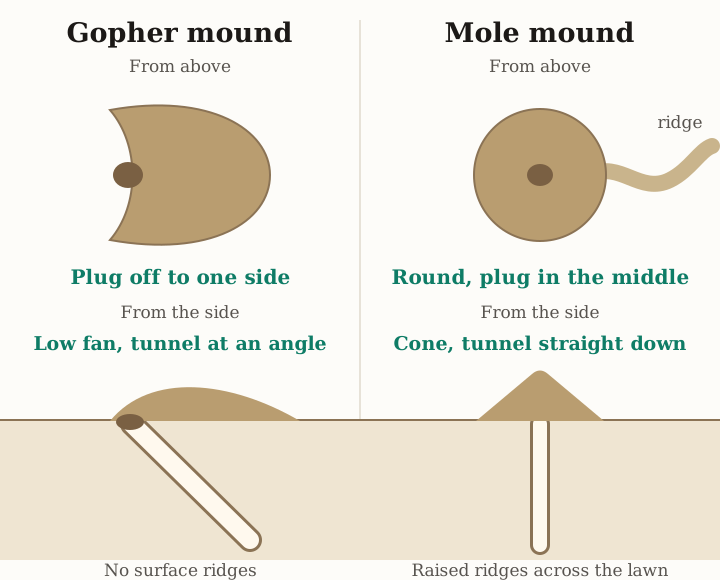
Read the dirt, not the animal. A gopher mound is a fan with its plug off to one side. A mole mound is round, with the plug in the middle, and moles leave ridges. Open holes with no mound mean a vole or ground squirrel. An open hole 10 to 12 inches (25 to 30 cm) wide is a groundhog.
Gopher, mole, vole, ground squirrel or groundhog: read the signs
Mound of soil
- Pocket gopher
- Fan or crescent, plug off to one side
- Mole
- Round cone, plug in the middle
- Vole
- No mound
- Ground squirrel
- No fan mound at the hole
- Groundhog
- Loose soil in front of the den
Hole you can see
- Pocket gopher
- None, it is plugged
- Mole
- None, it is plugged
- Vole
- Open, 1 1/2 to 2 in
- Ground squirrel
- Open, about 4 in
- Groundhog
- Open, 10 to 12 in
Marks on the surface
- Pocket gopher
- None
- Mole
- Raised ridges
- Vole
- Runways hidden in the grass
- Ground squirrel
- Animals out in the open by day
- Groundhog
- Animals out in the open by day
Size of the animal
- Pocket gopher
- 5 to 14 in
- Mole
- Usually smaller than a gopher
- Vole
- 5 to 8 in with tail
- Ground squirrel
- 9 to 11 in, plus a 5 to 9 in tail
- Groundhog
- 16 to 20 in, plus a 4 to 7 in tail
Gopher and mole mounds, and mole size, from UC IPM. Vole holes and size from UC IPM’s vole Pest Note. Ground squirrel holes, size and daytime habits from UC IPM’s ground squirrel Pest Note. Groundhog size and den from ICWDM. Gopher size from NWF.
Gopher or mole?
Moles eat earthworms and insects, not plants. They leave round mounds, and raised ridges where they tunnel just under the surface. Gophers eat roots and leave fan-shaped mounds with no ridges. If plants are vanishing from below, the culprit is not a mole. UC IPM says moles rarely eat plants, and gophers or voles are almost always behind chewing damage.
The animals differ too, if you ever see one. NWF points out that a gopher’s long front teeth stick out and its eyes are easy to see. A mole has small teeth, tiny hidden eyes and no visible ears.
Gopher or groundhog?
A groundhog, also called a woodchuck, is far bigger. ICWDM puts it at 16 to 20 inches (41 to 51 cm) plus a 4 to 7 inch tail, and 5 to 10 pounds (2.3 to 4.5 kg). It digs an open den hole 10 to 12 inches (25 to 30 cm) across and is often seen out by day. Groundhogs live across eastern and central North America. So a big burrowing animal in Michigan or Ohio, where pocket gophers do not live, is likely a groundhog.
Gopher, ground squirrel or prairie dog?
Ground squirrels and prairie dogs live in the open, often in colonies, and leave their holes open. Pocket gophers live alone and plug every opening. UC IPM says the California ground squirrel is active from midmorning to late afternoon. Its body is 9 to 11 inches long, and its open burrow is about 4 inches (10 cm) wide.
The names overlap, though. Montana FWP warns that people often call ground squirrels and prairie dogs “gophers”. Some of those species are or may be protected. So check before you trap anything that runs around above ground in daylight.
Gopher holes and mounds: the signs in your yard
The surest sign of a gopher is a fresh mound of loose, dark soil. It is shaped like a fan, with a plugged hole off to one side. One gopher can push up several a day and up to 200 a year. Other signs are feed holes ringed by clipped plants, and ropes of soil after snow melts.
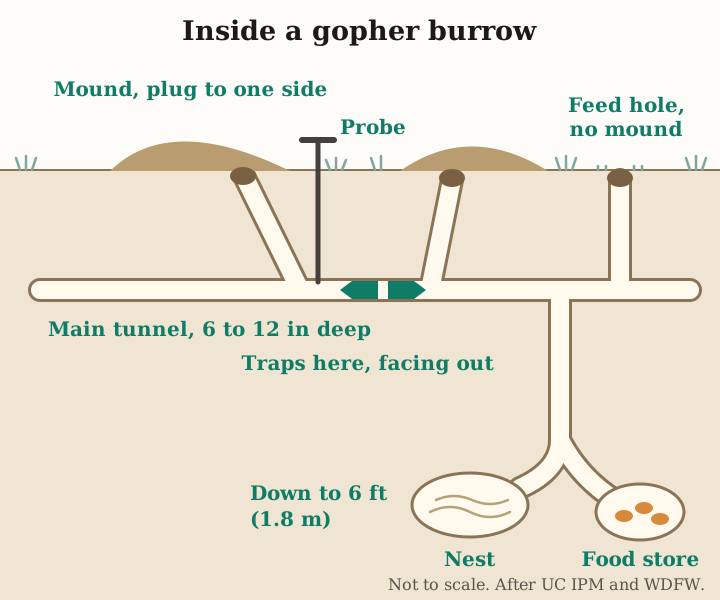
A mound is the spoil from tunnelling. The animal loosens soil with its claws and teeth, then turns around. As WDFW explains, it bulldozes the loose earth up a short side tunnel with its head and front feet. Then it plugs the opening from below. Oklahoma State measures typical mounds at 18 to 24 inches (46 to 61 cm) across and about 6 inches (15 cm) high, and one gopher can make up to 200 a year.
- Fresh mounds of dark, moist soil mean recent digging (UC IPM).
- Feed holes: a hole with no dirt mound and a ring of clipped plants around it (UC IPM).
- Soil plugs: circles of disturbed soil 1 to 3 inches (2.5 to 7.5 cm) wide where a gopher came up and closed the hole (WDFW).
- Plants that wilt or vanish, pulled down from below, sometimes along a whole garden row (UC IPM).
- Wet spots or leaks where a gopher has chewed a drip line (UC IPM).
- Ropes of packed soil on the grass in spring, in places with snow (WDFW).
Why you never see an open gopher hole
Because the gopher closes it. WDFW says gophers plug any opening in their system within 24 hours, and FWC notes the plugs keep out snakes and other predators. So a mound with no hole is normal for a gopher. An open hole with no mound belongs to someone else: a vole, a ground squirrel or a groundhog, sorted by size in the table above.
Lots of tiny holes, each about a quarter inch wide, in a dry, bare patch are not gophers at all. Those are usually ground bees nesting in the lawn, which are close to harmless.
How deep do gophers dig?
Feeding tunnels run 6 to 12 inches (15 to 30 cm) below the surface and are about 2 1/2 to 3 1/2 inches (6 to 9 cm) wide, says UC IPM. The nest and food store can be as deep as 6 feet (1.8 m). One gopher’s system covers 200 to 2,000 square feet (19 to 186 square meters). Montana FWP says systems sometimes reach 400 to 500 feet (120 to 150 m) long, while FWC calls 145 feet (44 m) typical in Florida.
Tunnels tend to run deeper in dry soil, WDFW adds. That matters for trapping, because the main tunnel is where the gopher travels and where traps catch it.
Dirt tubes on the lawn after the snow melts
Those ropes of packed soil are gopher work too. In winter, gophers tunnel through the snow above the ground and fill old snow tunnels with spare soil. When the snow melts, the soil cores are left lying on the grass, WDFW explains. They show where a gopher worked last winter, so check for fresh mounds before you act.
Gopher poop
You will almost never see it. Gophers keep their droppings underground in tunnels set aside for waste, Montana FWP notes. WDFW says old toilets end up buried deep, where they feed the soil. Small droppings on top of a lawn are more likely to come from voles. UC IPM describes those as about 3/16 inch (5 mm) long and greenish when fresh.
Are gophers dangerous?
No, not to people who leave them alone. WDFW says gophers are not a significant source of disease for people or pets. Grabbed, a gopher can give a serious bite with its long teeth (Wikipedia). The bigger risk to children and pets is poison bait, which can kill with a single feeding.
Rabies is not a realistic worry with gophers. CDC guidance says rodents are not reservoirs of rabies, and small rodents are rarely infected. From 1990 to 1996, woodchucks made up 93% of the 371 rodent rabies cases reported to CDC from areas where raccoon rabies was common. Even so, CDC asks that the local health department be consulted after any rodent bite, before anyone decides on rabies shots.
For children and pets, the danger is the treatment rather than the animal. UC IPM warns that toxic baits can harm wildlife, pets and children, especially in backyards. A dog can dig up bait or find a poisoned gopher, which is one more reason to use traps where pets roam. Traps can catch fingers and paws, so cover every set where people and pets go.
Gopher damage, and the good gophers do
Gophers damage plants from below. They eat roots, bulbs and tubers, and pull whole plants down into the tunnel. They also gnaw drip lines, sprinkler tubing and buried cables thinner than about 2 inches (5 cm), and their tunnels drain irrigation water and cause erosion. UC IPM says a single gopher can ruin a garden in a short time.
- Vegetables and flowers. Montana FWP says vegetables are often eaten below ground, with only the leaves left on top.
- Trees, vines and shrubs. Gophers chew roots and bark below ground. Under snow they can strip bark several feet up a trunk (UC IPM).
- Irrigation. Flexible plastic lines, especially drip systems, get gnawed through (UC IPM).
- Cables and pipes. Oklahoma State says pipes and cables wider than 2.1 inches (5.3 cm) resist gnawing. Montana FWP gives 2 7/8 inches (7.3 cm).
- Lawns. Mounds smother grass and get in the way of mowing (UC IPM).
- Soil and water. Tunnels carry irrigation water away and can lead to erosion (UC IPM).
Are gophers bad for your house? We found no extension or wildlife agency source that says pocket gophers damage foundations. The damage they list is to plants, irrigation, buried lines and lawns.
Not every chewed plant is a gopher, either. UC IPM says voles gnaw bark mostly above the soil line, in small marks about 1/8 inch (3 mm) wide. Leaves stripped from the top of a tomato plant point to a tomato hornworm rather than anything underground.
Are gophers good for anything?
Yes. A gopher moves a lot of soil: about a ton a year by WDFW’s count, and 2 to 4 tons by Montana FWP’s. That loosens packed ground, lets rain and snowmelt soak in, and buries plant matter that feeds the soil. Old burrows shelter toads, salamanders and lizards, and gophers feed hawks, owls, snakes and coyotes (WDFW).
WDFW says that where gophers are not numerous enough to cause heavy damage, they should be considered neutral. Oklahoma State goes further: where they cause no economic harm, they should not be destroyed. That fits one gopher in a wild corner of a big yard.
How many gophers are in my yard?
Probably fewer than you think. One gopher can push up several mounds a day and up to 200 a year, and each gopher lives alone in its own tunnel system. So 20 fresh mounds may be one animal. Count groups of mounds, not single mounds. The exceptions are a mother with young in spring, and yards next to open land.
UC IPM says each system covers 200 to 2,000 square feet. Our rule of thumb: fresh mounds that fit inside a square about 45 feet (14 m) wide may all belong to one animal. Clusters well apart are usually separate gophers, and each needs its own trap set.
Numbers can still climb in good habitat. UC IPM has recorded 60 or more per acre in irrigated alfalfa fields and vineyards, while WDFW gives 2 to 20 per acre for the northern pocket gopher. A watered lawn next to a vacant lot or wild land will keep getting new arrivals.
How gophers live: food, activity and life cycle
Gophers live alone underground, eat only plants, and stay active all year. They breed once a year in most places, more often where land is watered, and live up to 3 years. Knowing their year tells you when new gophers show up and when trapping works best.
What do gophers eat?
Gophers eat plants only. They feed on the roots, bulbs and tubers they meet while digging, and on stems and leaves they pull in from around a tunnel opening. Montana FWP says winter food is mostly roots and tubers, while spring and summer diets are 60 to nearly 100% leaves and stems. UC IPM adds that gophers find food by smell.
They also get their water from food, so they need no pond or puddle (WDFW). That is why a watered garden is so attractive: soft soil, juicy roots and moisture all in one place.
Are gophers nocturnal? Do they hibernate?
Neither. UC IPM says gophers are active all year and at all hours, day and night, even when you see no new mounds. They do not hibernate. Oklahoma State says they seldom come above ground, though they may come out at night and on cloudy days. Montana FWP says they rarely go more than 2 1/2 feet (75 cm) from a hole. That is why seeing a gopher is rare.
In snowy places they keep working through winter, tunnelling through the snow and gnawing bark above the ground (WDFW). Gophers are not blind, either. NWF notes that their eyes are small but easy to see, unlike a mole’s. In the dark, they rely on their whiskers and tail.
Gopher life cycle
Gophers mature at about a year old and live up to 3 years, according to UC IPM. Where land is not watered, they breed in late winter and spring and have one litter a year. In irrigated yards and fields they can have up to three. A litter averages 5 to 6 young, and WDFW says the young leave the nest at 5 to 6 weeks to find their own territory.
The gopher year, and what to do in each season
Late winter and spring
- What gophers are doing
- Breeding; heavy digging in moist soil
- What you see
- Lots of fresh mounds
- What to do
- Trap now, before the young arrive
Late spring and early summer
- What gophers are doing
- Young leave the nest and move above ground
- What you see
- Mounds in new places, even in a cleared yard
- What to do
- Trap the new arrivals; reset traps after a catch
Summer, unwatered ground
- What gophers are doing
- Less mound building in dry soil
- What you see
- Few new mounds, except in watered beds and lawns
- What to do
- Wire beds, protect drip lines
Fall
- What gophers are doing
- Digging picks up as the soil gets moist
- What you see
- Fresh mounds again
- What to do
- Trap again
Winter, snowy places
- What gophers are doing
- Tunnels through snow, bark chewing
- What you see
- Soil casts after the melt
- What to do
- Protect young trees; trap in spring
From UC IPM, WDFW, Montana FWP and Oklahoma State. In California, UC IPM says unwatered ground sees the most mounds in winter and spring. Montana FWP says trapping works best in spring and fall, and Oklahoma State says the same of control in general.
Why do I suddenly have gophers?
Usually a young gopher has just moved in, or your yard has become better for gophers. WDFW says they breed from early spring to early summer. The young leave the nest after 5 to 6 weeks and wander above ground looking for a territory. That puts new arrivals in late spring and summer. Watered lawns and gardens offer soft soil and food all year (UC IPM). And yards next to fields, vacant lots or wild land get new arrivals again and again.
Where do gophers live? Types of gophers in the US
Pocket gophers live across the western half of the US, the Great Plains and parts of the Midwest. They also live in the northern half of Florida and parts of Georgia and Alabama. They like loose, moist or sandy soil with plants to eat, so lawns, gardens, pastures and fields suit them. ICWDM counts 14 species in the US.
The pocket gophers you are most likely to meet
Botta's pocket gopher (Thomomys bottae)
- Where in the US
- Most of the southern half of the West
- Size and notes
- The most widespread of California's five species (UC IPM)
Northern pocket gopher (T. talpoides)
- Where in the US
- Most of the Northwest and northern Rockies
- Size and notes
- About 8 in with a 2 in tail, Washington's smallest (WDFW). Montana FWP lists pouched rat as another name
Mazama or western pocket gopher (T. mazama)
- Where in the US
- In Washington, the west side of the state
- Size and notes
- About 8 in with a 2 1/2 in tail. State threatened in four counties, federally threatened in two (WDFW)
Plains pocket gopher (Geomys bursarius)
- Where in the US
- Great Plains, Canada to Texas, east to western Indiana and Wisconsin (Wikipedia). ICWDM adds Louisiana
- Size and notes
- 7 1/2 to 14 in, up to 1 lb, the biggest (ICWDM)
Yellow-faced pocket gopher (Cratogeomys castanops)
- Where in the US
- West Texas, eastern New Mexico, southeast Colorado, southwest Kansas (ICWDM), the Oklahoma Panhandle (Oklahoma State)
- Size and notes
- 5 1/2 to 7 in (ICWDM)
Southeastern pocket gopher (Geomys pinetis)
- Where in the US
- The northern half of Florida, into central Georgia and Alabama (FWC)
- Size and notes
- 10 to 12 in with tail. Locally called a sandy mounder or salamander (FWC)
Desert pocket gopher (Geomys arenarius)
- Where in the US
- A very small range
- Size and notes
- The most threatened species, says NWF
Ranges from ICWDM, with the plains pocket gopher from Wikipedia, the Southeast from FWC and Washington from WDFW.
What “gopher” means where you live
The word changes with the map. In California it means a pocket gopher. Minnesota’s Golden Gopher is a thirteen-lined ground squirrel, which Wikipedia notes is not a member of the pocket gopher family. In Florida, a “gopher” may be a tortoise. Check which one you have before you do anything.
What people mean by gopher, region by region
California, the West, the Rockies
- What a gopher usually is
- A pocket gopher
- Check before you act
- Fan-shaped mounds with plugged holes
Great Plains and upper Midwest
- What a gopher usually is
- A pocket gopher, or often a ground squirrel
- Check before you act
- Ground squirrels are out by day and leave open holes
Montana and the northern Plains
- What a gopher usually is
- A pocket gopher, a ground squirrel or a prairie dog
- Check before you act
- Some ground squirrels and prairie dogs are or may be protected (Montana FWP)
Florida, Georgia and Alabama
- What a gopher usually is
- A southeastern pocket gopher, or a gopher tortoise
- Check before you act
- The tortoise and its burrow are protected in Florida (FWC)
Michigan, Ohio, Kentucky, Tennessee, the East Coast north of Georgia
- What a gopher usually is
- Not a pocket gopher
- Check before you act
- These states lie outside every US gopher range. Think mole, vole, groundhog or ground squirrel
Here are the states people ask about most. California has five species, and Botta’s pocket gopher is the most widespread (UC IPM). Washington has two, the northern and the Mazama (WDFW). Florida has the southeastern pocket gopher in the northern half of the state (FWC). Michigan has no pocket gophers in any range we found, so a “gopher” there is likely a ground squirrel or a groundhog.
Should you get rid of the gopher?
Not always. One gopher in a wild corner of a big yard moves about a ton of soil a year, and WDFW calls gophers that cause no heavy damage neutral. Act fast when one reaches a vegetable bed, young trees or drip lines. UC IPM says one gopher can do a lot of damage in a short time.
Leave it, protect, or remove?
Mounds in a wild or unused part of the yard
- What we suggest
- Leave it. Rake the mounds flat
- Why
- It loosens and feeds the soil (WDFW, NWF)
Mounds in a lawn you mow
- What we suggest
- Your call: trap it, or flatten mounds and live with it
- Why
- The harm is mostly looks and mowing (UC IPM)
Plants vanishing in a vegetable or flower bed
- What we suggest
- Trap now, then wire the beds
- Why
- One gopher can ruin a garden quickly (UC IPM)
New trees, vines or shrubs
- What we suggest
- Trap, and plant in wire baskets
- Why
- Roots and bark get eaten below ground (UC IPM)
Wet spots or chewed drip lines
- What we suggest
- Trap, and put gravel around the lines
- Why
- Gophers gnaw flexible plastic lines (UC IPM)
A yard next to fields or wild land
- What we suggest
- Expect new gophers. Wire key beds and check often
- Why
- Gophers move in from nearby land (UC IPM)
You live in Thurston, Pierce, Clark or Mason County, WA
- What we suggest
- Call WDFW before you do anything
- Why
- Mazama pocket gophers there are state threatened, and federally threatened in Thurston and Pierce (WDFW)
A big burrow and a shelled animal, in the Southeast
- What we suggest
- Leave it alone
- Why
- That is a gopher tortoise, protected in Florida (FWC)
How to get rid of gophers
The most reliable way to get rid of a gopher is to trap it in its main tunnel. Then protect beds and new plants with wire so the next one cannot get in. Start the day you see fresh mounds, and move traps that catch nothing in 1 to 2 days. Poison baits come last, and only inside the tunnel.
Work from the cheapest step to the costliest. UC IPM calls trapping safe and effective, Montana FWP calls it very effective in small areas, and UC IPM says the sooner you act, the better. Montana FWP adds that you need to remove more than 70% of the gophers in an area to get ahead of their breeding. That is why one trap set is rarely enough for a big lot.
Protect what matters with wire
Wire does not get rid of a gopher, but it keeps one off the plants you care about most. UC IPM recommends hardware cloth, or wire with a 1/2 to 3/4 inch (13 to 19 mm) mesh. Lay it under raised beds before you fill them, and put new trees and shrubs in wire baskets at planting time.
- Raised beds: wire across the whole floor, stapled to the frame before the soil goes in. Beds with solid sides need nothing more (WDFW).
- Beds in the ground: screen the sides and the bottom (UC IPM, WDFW).
- A fence around a planting: bury the wire at least 2 feet (60 cm), bend another 6 inches (15 cm) outward at a right angle, and leave 1 foot (30 cm) above ground (UC IPM).
- Baskets for trees and shrubs: light, non-galvanized wire for plants that only need protection while young, so it rusts away before it strangles the roots. Leave room for a few years of root growth (UC IPM).
- Drip lines and cables: surround them with 6 to 8 inches (15 to 20 cm) of coarse gravel, 1 inch (2.5 cm) or bigger (UC IPM, WDFW).
- Before you dig: check for buried utility lines (WDFW).
Wire is not perfect. UC IPM notes a determined gopher can dig under a fence, and WDFW says gophers can dig much deeper than 24 inches. So a buried barrier slows them down rather than stopping them for good. Use galvanized or stainless steel for anything meant to last.
Trapping is the fastest reliable fix, and Montana FWP says it works best in spring and fall, when gophers push up new mounds. You need a probe or a long screwdriver, a trowel, two traps, wire, two stakes and gloves.
How to trap a gopher, step by step
Find a fresh mound
Look for dark, moist soil, the sign of recent digging (UC IPM). If you are not sure which mounds are new, rake them all flat and come back the next day. The ones that reappear show you where the gopher is working.
Probe for the main tunnel
Push a gopher probe or a long screwdriver into the ground 4 to 12 inches (10 to 30 cm) out from the plug side of the mound. UC IPM says you will feel a sudden drop of about 2 inches (5 cm) when you hit the tunnel. Side tunnels are a poor place for traps, since the gopher may never use them again.
Open the tunnel
Dig down with a trowel, a small shovel or a hori hori knife and open the tunnel just wide enough for the traps. Pincer traps need a smaller hole than box traps, which matters in a lawn.
Set two traps, facing out
Push one trap into each side of the tunnel, facing away from the hole, so a gopher coming from either way meets one. Put on gloves to protect your hands. You do not need bait: UC Davis researchers found no benefit from it, and your scent does not put gophers off.
Stake every trap
Tie each trap to a stake with wire. You can pull it out easily, and a cat, dog or coyote cannot carry it off with the gopher in it.
Cover the hole, or leave it open
Cover the hole with sod, cardboard or a board, and sift soil around the edges to block light. UC IPM says open sets can also work, because gophers come to plug open tunnels. Always cover sets where children or pets go, and always cover box traps.
Check often, and move if nothing happens
Check the traps at least once a day. Oklahoma State checks morning and evening. If nothing is caught in 1 to 2 days, move the traps to a new spot. In spring, Montana FWP suggests resetting in the same spot after a catch, since a mate or young may share the tunnel.
Flatten the mounds and watch
Rake every mound flat once you catch a gopher. If no new mounds appear over the next few days, that gopher is gone. If new ones appear, set traps again at the freshest mound.
Which gopher trap?
Any of the common gopher traps will work when it sits in an active main tunnel. Pincer traps need the smallest hole, box traps are easier for beginners, and newer push-in traps are popular but less tested. Placement matters far more than brand.
Gopher traps compared
Pincer traps (Macabee, Cinch, Gophinator)
- How it works
- Two prongs snap shut when the gopher pushes a flat pan or wire
- Good to know
- Need the least digging. UC IPM says the Gophinator catches big gophers better than the Macabee
Box traps (Victor Black Box)
- How it works
- A choker loop inside a box
- Good to know
- Easier for beginners, but need a bigger hole. Always cover them
Gopher Hawk
- How it works
- A choker trap pushed straight into the tunnel
- Good to know
- Little digging. UC IPM says little is known yet about how well it works
Live traps
- How it works
- Catch the gopher alive
- Good to know
- Washington bans releasing it off the property where it was caught without a permit (WDFW)
You do not need bait. UC Davis researchers found no benefit from baiting a gopher trap, so the peanut butter can stay in the kitchen. Your scent does not scare gophers off either (UC IPM).
If a gopher keeps burying your trap, light or air is getting in. UC IPM notes that gophers often plug an uncovered box trap before they touch the trigger. Cover the set, and make sure it sits in the main tunnel rather than a side tunnel.
Other ways without poison
- Flooding. Normal watering does not bother gophers, but UC IPM says flooding a burrow can sometimes force one out, where a dog or a shovel finishes the job. So yes, you can sometimes flood a gopher out.
- Carbon monoxide machines (PERC, BurrowRx, Cheetah, CO-Jack) pump exhaust into the tunnels. UC IPM reports over 70% removal in some settings with the PERC machine, but the machines are expensive and suit large properties.
- Gas explosive devices ignite propane and oxygen in the burrow. UC IPM rates them only somewhat effective, loud, and a fire and injury risk, so they do not suit homes.
- Owls, cats and dogs eat gophers but rarely remove them all (UC IPM). An owl box is not a control plan.
Toxic baits: last, and only inside the tunnel
If trapping and wire are working, you do not need poison. Baits suit large areas, used exactly as the label says. UC IPM ranks strychnine baits, usually 0.5%, as the most effective, with 2% zinc phosphide the other option. Both can kill with a single feeding, so every grain has to go into the main tunnel.
- Main tunnel only, never the surface. UC IPM says bait above ground is illegal, works poorly, and exposes pets and wildlife.
- Use a spoon or funnel kept for this job, clean up every spill, and close the probe hole so no light gets in.
- Never in a bed with root vegetables, where bait could touch food (UC IPM).
- In California, anticoagulant gopher baits (chlorophacinone and diphacinone) are no longer legal for home use. Take old products to a household hazardous waste site (UC IPM).
- The rules are changing. EPA’s 2024 rodenticide strategy covers strychnine, zinc phosphide and the anticoagulants, and labels may carry extra limits in areas where endangered species live (Illinois Extension).
- Check after 2 days. New mounds more than 2 days after baiting mean you need to rebait or switch to traps (UC IPM).
Fumigants and professional tools
Smoke bombs and gas cartridges usually fail, because gophers seal off the tunnel as soon as they sense smoke or gas (UC IPM). The fumigant that does work, aluminum phosphide, is restricted to licensed applicators. UC IPM says current rules allow it only in burrows more than 100 feet (30 m) from any building where people or domestic animals are or may be. So it is rarely an option at home.
Can you get rid of gophers without killing them?
Not reliably. UC IPM says no repellent sold today has been shown to protect plants, and the methods that remove gophers, traps and baits, kill them. The humane path is to protect what matters with wire and tolerate the rest. In Washington you may use a live trap without a special permit, but releasing the gopher anywhere other than where you caught it needs one (WDFW). Check your own state’s rules first.
Keep them from coming back
Once the mounds stop, rake them all flat, clear weeds and debris so new mounds stand out, and check the yard often (UC IPM). Gophers move in from nearby land, so a yard beside fields or wild ground will be reinvaded. Catching one new gopher early is cheaper and easier than waiting until several settle in. Keep wire under beds and baskets around new plants.
Gopher control methods compared
Trapping in the main tunnel
- Does it work?
- Yes, the most reliable (UC IPM, Montana FWP, Oklahoma State)
- Cost
- Low
- Best for
- Any yard
Wire under beds, baskets for trees
- Does it work?
- Yes, for the area it covers (UC IPM, WDFW)
- Cost
- Low to medium
- Best for
- Beds, new trees and shrubs
Gravel around lines
- Does it work?
- Yes (UC IPM, WDFW)
- Cost
- Low
- Best for
- Drip lines and cables
Toxic bait in the tunnel
- Does it work?
- Yes, with risk to pets and wildlife (UC IPM)
- Cost
- Low
- Best for
- Large areas, label use only
Carbon monoxide machines
- Does it work?
- Yes, over 70% removal in some settings with the PERC (UC IPM)
- Cost
- High
- Best for
- Large properties
Aluminum phosphide
- Does it work?
- Yes (UC IPM)
- Cost
- Licensed applicators only
- Best for
- Rarely allowed near homes
Flooding
- Does it work?
- Sometimes (UC IPM)
- Cost
- Water
- Best for
- Forcing one gopher out
Gas explosive devices
- Does it work?
- Somewhat (UC IPM)
- Cost
- Medium
- Best for
- Not homes: noise and fire risk
Smoke and gas cartridges
- Does it work?
- Usually not (UC IPM)
- Cost
- Low
- Best for
- Not recommended
Owl boxes, cats, dogs
- Does it work?
- Not enough on their own (UC IPM)
- Cost
- Varies
- Best for
- Not a control plan
Repellents, plants, ultrasonic stakes
- Does it work?
- No (UC IPM)
- Cost
- Low to medium
- Best for
- Not recommended
What does not work, or is not true
Most home remedies for gophers fail. UC IPM lists at least six that do not work: chewing gum, laxatives, repellent plants, vibrating and ultrasonic stakes, wind pinwheels and smoke cartridges. Dry ice, coffee grounds and castor oil are popular online, but no source we found shows they protect a yard, and dry ice raises a legal problem too.
Myth 1
Myth: “Juicy Fruit gum in the tunnel kills gophers.”
Truth: UC IPM lists chewing gum and laxatives in burrows among the methods that do not work.
Myth 2
Myth: “Gopher purge, castor beans or garlic keep gophers away.”
Truth: UC IPM says research has not backed any of them. Montana FWP adds that gopher purge is poisonous, can become a weed, and can harm children and pets.
Myth 3
Myth: “Vibrating or ultrasonic stakes scare gophers off.”
Truth: They failed in research trials (UC IPM). Gophers are used to noise and shaking from sprinklers, mowers, traffic and people.
Myth 4
Myth: “Castor oil repellents protect a garden.”
Truth: UC IPM says no repellent currently sold successfully protects plants from gophers.
Myth 5
Myth: “Coffee grounds drive gophers away.”
Truth: We found no extension or wildlife agency source that tested or recommends them. Put them in the compost, not down the hole.
Myth 6
Myth: “Dry ice is a safe, legal way to gas gophers.”
Truth: PMP reports that EPA stopped cities using unregistered dry ice on rats because it broke federal pesticide law. In June 2017 EPA registered a dry ice product for rat burrows (PMP, PCT). We found none labelled for gophers.
Myth 7
Myth: “A smoke bomb will gas them out.”
Truth: Gophers seal off the tunnel as soon as they sense smoke or gas, so cartridges usually fail (UC IPM).
Myth 8
Myth: “An owl box or a cat will take care of it.”
Truth: Barn owls hunt over large areas, often far from their boxes. Predators of every kind tend to move on before they take every gopher (UC IPM).
Myth 9
Myth: “Filling in the holes will make the gopher leave.”
Truth: Gophers plug their own holes within 24 hours (WDFW). Filling them changes nothing for the gopher below.
Myth 10
Myth: “Gophers carry plague and rabies.”
Truth: WDFW says gophers are not a significant source of any disease that spreads to people or pets, and CDC says rodents are not rabies reservoirs.
Myth 11
Myth: “Gophers are blind.”
Truth: Their eyes are small but easy to see, unlike a mole's (NWF).
Is it legal to kill gophers?
In most states, yes. ICWDM says pocket gophers are generally not protected by federal or state law. In California they are nongame mammals you can control at any time without a trapping license. But Washington requires a special permit for any trap that is not a live trap, and protects Mazama pocket gophers in 4 counties.
Gopher rules in the states with the most searches
California
- The rule
- Nongame mammal. No trapping license needed, control at any time in any legal way. Anticoagulant baits banned for home use
- Source
- UC IPM
Washington
- The rule
- Special trapping permit for every trap except live traps. No lethal control where Mazama pocket gophers live. No release off the property without a permit
- Source
- WDFW
Oklahoma
- The rule
- Not protected by federal or state law
- Source
- Oklahoma State (2017)
Montana
- The rule
- Ground squirrels and prairie dogs called gophers may be protected
- Source
- Montana FWP
Florida
- The rule
- The gopher tortoise and its burrow are protected; the tortoise is listed as Threatened
- Source
- FWC
Everywhere
- The rule
- Pesticide labels are law, and labels may carry extra limits in some areas
- Source
- Illinois Extension
We found no Florida rule on the southeastern pocket gopher itself. If you are in Florida, check with FWC, and be sure the animal is not a gopher tortoise. Rules change, so WDFW advises checking with your local wildlife office for updates.
When to call someone
Call a pest or wildlife control company when gophers cover more ground than a few traps can handle. Call one too if several rounds of trapping fail, or if you want a fumigant, which needs a license. Your county extension office or state wildlife agency can tell you what the animal is, and whether it is protected.
- A pest or wildlife control company for large lots, repeated failures, or fumigation. UC IPM notes licensed operators can use aluminum phosphide.
- Your county extension office or state wildlife agency to confirm the animal, and before any control in an area with protected gophers (WDFW).
- A doctor or the local health department after any gopher bite (CDC).
- Poison Control, 1-800-222-1222, if a child gets into bait. For a pet, call your vet or the ASPCA Animal Poison Control Center at (888) 426-4435, which may charge a fee.
- Your landlord if you rent. Trapping, baiting and wiring beds are usually a job for the owner.
Seeing mounds of a different kind? A dome of soil with no single entrance, in the South or Southwest, is more likely a fire ant mound. Our fire ant identification guide shows how to confirm one and what to do.
Pest control disclaimer. Photo-based identification can help, but it is not always perfect. For dangerous spiders, large infestations, or anything you are unsure about, contact a licensed pest control professional.
Gopher FAQ
What do you fill gopher holes with?
What do gophers hate the most?
How do farmers get rid of gophers?
Will a cat or dog get rid of gophers?
How long does it take to get rid of a gopher?
Related guides
Ground bees
Many tiny holes in a bare patch of lawn: harmless solitary bees, or a yellowjacket nest.
How to get rid of ants
Ant hills in the lawn and fire ant mounds: why bait works and spraying backfires.
Tomato hornworm
Leaves stripped from the top of a tomato plant: the big green caterpillar and how to clear it.
Leaf-footed bug
The brown bug sucking juice from tomatoes and fruit, and how to stop it without spraying.
How to get rid of aphids
Sticky leaves and curled shoots in the garden: water, soap and the predators that help.
Sources
- UC Statewide IPM Program, Pest Notes: Pocket Gophers, R.A. Baldwin (Publication 7433, updated 06/2025)
- UC Statewide IPM Program, Pest Notes: Ground Squirrel (Publication 7438, updated 06/2025)
- UC Statewide IPM Program, Pest Notes: Moles
- UC Statewide IPM Program, Pest Notes: Voles
- Washington Department of Fish and Wildlife, Living with wildlife: Pocket gophers
- Montana Fish, Wildlife and Parks, Living with Pocket Gophers
- Oklahoma State University Extension, Controlling Pocket Gophers, T.G. Bidwell (NREM-9001, February 2017)
- National Wildlife Federation, Pocket Gophers
- Internet Center for Wildlife Damage Management (ICWDM), Pocket Gophers
- Internet Center for Wildlife Damage Management (ICWDM), Woodchucks
- Florida Fish and Wildlife Conservation Commission, Pocket Gopher (Geomys pinetis)
- Florida Fish and Wildlife Conservation Commission, Gopher Tortoise
- CDC, Human Rabies Prevention, United States, 2008: Recommendations of the ACIP (MMWR 57, RR-3)
- ASPCA Animal Poison Control Center, (888) 426-4435
- University of Illinois Extension, EPA releases rodenticide strategy including final biological evaluation (November 25, 2024)
- PMP, EPA clarifies use of dry ice on rats (August 2017)
- PCT, EPA registers dry ice for burrowing rodents
- Wikipedia, Gopher
- Wikipedia, Plains pocket gopher