What is a tarantula hawk?
A tarantula hawk is a big spider wasp that hunts tarantulas to feed its young. It belongs to one of two genera, Pepsis or Hemipepsis, in the family Pompilidae. US species run from 1/2 inch to 2 inches (10 to 50 mm) long, which puts them among the largest wasps in the country.
BugGuide lists 14 species of Pepsis and 3 of Hemipepsis in the US and Canada. Across the Americas, BugGuide counts 133 described Pepsis species, and most of them live in Central and South America. They all live alone. No tarantula hawk builds a hive or a paper nest, and none lives in a colony.
The adults do not eat spiders at all. Instead they drink nectar, and CSU Extension notes they are among the main pollinators of milkweed. Only the female hunts. She stings a spider to paralyze it, then lays one egg on it, and her larva eats the spider. Our tarantula guide covers the spider side of the story.
Tarantula hawk at a glance
Length
- What to know
- 1/2 to 2 in (10 to 50 mm) in the US
Body
- What to know
- Blue-black, often with a metallic sheen
Wings
- What to know
- Orange in most western species, black in the eastern one
Who stings
- What to know
- Females only. The stinger is about 1/4 in (7 mm)
Sting pain
- What to know
- 4 out of 4 on Justin Schmidt's scale, for about 5 minutes
Adult food
- What to know
- Nectar, especially milkweed, mesquite and soapberry
Young
- What to know
- Grubs that feed on a paralyzed tarantula or other large spider
Where
- What to know
- Mostly the Southwest, with one species across the East
When
- What to know
- April to October, peaking in July
Why is it called a tarantula hawk?
The name comes from the hunt. The National Park Service says these wasps get their name because adult females hunt tarantulas as food for their larvae. So “hawk” compares it to a hunting bird, but it is a wasp, not a bird. BugGuide also lists the name tarantula wasp, and people searching for a “spider hawk” or a “hawk wasp” usually mean this insect too. Scientists use the genus name, Pepsis.
What does a tarantula hawk look like?
A tarantula hawk looks like a very large, shiny blue-black wasp with long legs. Most western species have bright orange wings, while the common eastern one has black wings. US species are 1/2 to 2 inches (10 to 50 mm) long, and a female holds her antennae curled.
The orange is a warning. Bright colors tell predators that the wasp has a painful sting, and Justin Schmidt adds a strong odor to that warning. The legs are long and spiny, with hooked claws for gripping a spider. The body has a hard, smooth shell. Females spend much of their time on the ground, searching for spider burrows.
How to recognize a tarantula hawk
Most of these should match. The antennae and the size settle it fastest.
Large: 1/2 to 2 inches long
CSU Extension says they are about the length of a matchstick.
Blue-black body with a metallic sheen
Sometimes greenish or violet in the light. No yellow bands or stripes.
Orange wings, or black wings in the East
Western species usually have orange or amber wings, often dark at the tips.
Long antennae, curled on a female
Females hold them in a curl. Males hold them straight.
Long, spiny legs
Females often walk over bare ground, searching for spider burrows.
On flowers or on the ground, never at a hive
They live alone and build no hive or paper nest. Several may gather on one flowering plant, which is normal.
Male vs female tarantula hawk
Look at the antennae. A male holds his straight, while a female curls hers. Only the female has a stinger, and the National Park Service puts it at about 1/4 inch (7 mm). Wikipedia gives up to 12 mm (about 1/2 inch) for Pepsis grossa. So a male cannot sting you at all. Females also do all the hunting and nest work. The males spend their days on flowers or guarding a perch.
That perch is often a tall shrub or tree on a ridge. John Alcock has watched males of Hemipepsis ustulata in Arizona’s Usery Mountains for nearly 4 decades. They defend single trees and shrubs on ridges and peaks, and the favorite plants stay the same from one study to the next. The males wait there for passing females. So a big tarantula hawk patrolling the top of a bush is probably a male.
The black-winged tarantula hawk of the East
Most articles say tarantula hawks live in the desert, but one species does not. BugGuide says the eastern form of Pepsis menechma ranges from Pennsylvania west to Kansas and south to Florida and Texas. It is blue-black with black wings and orange antennae, and it is 16 to 28 mm (about 5/8 to 1 1/8 inches) long.
This is the wasp behind posts like “black wasp with blue wings and orange antenna, caught in Tennessee.” In North Carolina it flies from June to September. Nobody has recorded what it hunts, according to BugGuide. Much of its range lies east of where native tarantulas live, so it may take other large spiders, such as trapdoor spiders.
How bad is a tarantula hawk sting?
It is about as bad as an insect sting gets. Justin Schmidt rated it a 4, the top of his 1 to 4 scale, where a honey bee scores 2. He called the pain “instantaneous, electrifying and totally debilitating.” The good news is that the worst of it lasts about 5 minutes.
Schmidt wrote in 2004 that this instant pain is the greatest recorded for any stinging insect. People who have been stung say they could not do anything until it passed. One reader on Reddit, stung while cleaning an attic, said it was the worst pain of their life.
Pain and danger are not the same thing, though. In 2019, Schmidt rated the sting pain of 96 insects and listed the venom strength of 90 of them. He measured strength in lab mice as the LD50, the dose that kills half of them, so a higher number means weaker venom.
Sting pain against venom strength (Schmidt 2019)
Tarantula hawk (Pepsis grossa, P. thisbe)
- Pain, 1 to 4
- 4
- Venom LD50, mg per kg (higher is weaker)
- 90 to 120
Bullet ant
- Pain, 1 to 4
- 4
- Venom LD50, mg per kg (higher is weaker)
- 1.4
Warrior wasp
- Pain, 1 to 4
- 4
- Venom LD50, mg per kg (higher is weaker)
- 3
Cow killer velvet ant (Dasymutilla klugii)
- Pain, 1 to 4
- 3
- Venom LD50, mg per kg (higher is weaker)
- 70
Honey bee
- Pain, 1 to 4
- 2
- Venom LD50, mg per kg (higher is weaker)
- 2.8
Yellowjacket (German)
- Pain, 1 to 4
- 2
- Venom LD50, mg per kg (higher is weaker)
- 2.8
Bald-faced hornet
- Pain, 1 to 4
- 2
- Venom LD50, mg per kg (higher is weaker)
- 6.1
Great black wasp
- Pain, 1 to 4
- 1
- Venom LD50, mg per kg (higher is weaker)
- Not measured
Cicada killers (two western species)
- Pain, 1 to 4
- 1 to 1.5
- Venom LD50, mg per kg (higher is weaker)
- 46 (one species)
Read across the top row. The tarantula hawk ties for the most painful sting, yet gram for gram its venom is about 30 to 45 times weaker than a honey bee’s. In 2004, Schmidt wrote that the venom “lacks meaningful vertebrate toxicity.” Its defense works by pain alone, and that pain is enough to keep almost every predator away.
Is it the most painful sting in the world?
It shares the top score with the bullet ant and the warrior wasp, both from Central and South America. The Natural History Museum in London still puts the bullet ant first. Its pain can last up to 24 hours, while a tarantula hawk sting fades in about 5 minutes. Neither rival lives in the US, so this is the most painful sting an American is likely to meet.
Can a tarantula hawk kill you?
Almost certainly not, unless you are allergic. In mice, its venom is 30 to 45 times weaker than honey bee venom, and a tarantula hawk lives alone, so you will not meet a swarm. MedlinePlus says most deaths from insect stings come from allergic reactions, not from the venom itself. That is the risk to watch for.
Some people have severe allergic reactions to insect stings, and MedlinePlus warns that these can come on very quickly. So the warning signs below matter far more than how much the sting hurts.
Are tarantula hawks aggressive?
No. CSU Extension says the females are typically docile toward people and need extreme provocation before they sting. The Natural History Museum calls them fairly docile unless provoked. Many readers in Arizona and Texas report on Reddit that tarantula hawks fly past them every day in summer without trouble. Stings happen when someone grabs one, picks one up, or traps one against the skin or in clothing.
Pools are a common trap. Readers often report stings from tarantula hawks floating in pools, where one can look like a leaf, and swimmers who scoop it out by hand get stung. Use a skimmer net instead, and never pick up a big wasp from the water with your fingers.
What to do if a tarantula hawk stings you
Move away from the wasp first. If any warning sign in the red box appears, call 911 right away, and do not wait for the pain to pass. Otherwise, wash the sting and cool it. Steps 2 to 4 follow MedlinePlus advice for insect stings.
Get away from the wasp, then sit down
Step back so it cannot sting again, then sit or lie down where you will not fall. Justin Schmidt, who rated the sting, once joked that the only thing to do is lie down and scream. If any warning sign in the red box appears, call 911 right away.
Wash the sting
Clean the spot with soap and water once you can. Tarantula hawks do not leave a stinger behind, so there is nothing to scrape out.
Cool it
MedlinePlus advises ice wrapped in a cloth, 10 minutes on and 10 minutes off. Take off rings or anything tight near the sting in case it swells.
Watch for the warning signs
Keep an eye on the person for the signs in the box below, even after the pain fades. Over the next few days, check the spot for spreading redness, swelling or pain, which can mean an infection.
If your dog or cat gets stung
A tarantula hawk will not go after a pet. However, a dog that snaps at one or a cat that bats at it can get stung, usually on the face or paw. Our bee and wasp sting guide lists the signs that mean an emergency vet, such as a sting in the mouth, vomiting, pale gums or collapse.
Where do tarantula hawks live?
In the US, tarantula hawks live mostly in the Southwest, east to Kansas and Oklahoma. Of 20,290 US records on iNaturalist, 88.5% come from four states: California, Texas, Arizona and New Mexico. A black-winged species also lives across the East, so people have logged them in 30 states.
They favor open, dry country, such as desert and scrub, according to BugGuide and CSU Extension. They also visit yards and parks wherever flowers bloom. The table counts records on iNaturalist, where people post photos of what they find. So it shows where people meet tarantula hawks, which is not quite the same as where most of them live.
Where people find tarantula hawks: US iNaturalist records by state, read October 2026
California
- Records
- 8,446
- Share of US records
- 41.6%
- Notes
- The most records of any state. Several species
Texas
- Records
- 4,236
- Share of US records
- 20.9%
- Notes
- Both the orange-winged species and the black-winged eastern one
Arizona
- Records
- 3,860
- Share of US records
- 19.0%
- Notes
- Includes the Grand Canyon and the Sonoran Desert
New Mexico
- Records
- 1,419
- Share of US records
- 7.0%
- Notes
- The state insect since 1989
Nevada
- Records
- 600
- Share of US records
- 3.0%
- Notes
- Several species range here (BugGuide)
Utah
- Records
- 467
- Share of US records
- 2.3%
- Notes
- Recorded as far north as Logan
Colorado
- Records
- 397
- Share of US records
- 2.0%
- Notes
- Six species, mostly in the arid south (CSU Extension)
Oklahoma
- Records
- 244
- Share of US records
- 1.2%
- Notes
- Several orange-winged species reach their eastern edge here and in Kansas
Arkansas, Tennessee, North Carolina, Missouri, Virginia, Kansas
- Records
- 47 to 115 each
- Share of US records
- 2.3% together
- Notes
- In Tennessee, North Carolina and Virginia, every record named to species is the black-winged eastern one
Louisiana, Florida, Idaho, Kentucky, Georgia, South Carolina, Oregon
- Records
- 10 to 32 each
- Share of US records
- 0.6% together
- Notes
- Two tropical species have also been recorded in south Florida
Mississippi, Illinois, Wyoming, Maryland, Alabama, Nebraska, Montana, Indiana, Washington
- Records
- 1 to 7 each
- Share of US records
- 0.1% together
- Notes
- Possible strays or mistaken IDs
Single records from Montana, Washington, Indiana and Nebraska may be strays or wrong IDs. In the Northwest, a look-alike called Calopompilus is a common answer. If you are in the Southwest, a big blue-black wasp with orange wings is almost always a tarantula hawk. Elsewhere, check the look-alikes below first.
New Mexico’s state insect
New Mexico made the tarantula hawk its state insect in 1989. The idea came from an elementary school class in Edgewood. Its students picked three candidate insects, and students across the state voted on them. After that, the 39th Legislature made the tarantula hawk official, according to the New Mexico Secretary of State. The species named was Pepsis formosa, which BugGuide now lists as Pepsis grossa.
Outside the US
Pepsis lives only in the Americas, and it is most diverse in Central and South America. Wikipedia notes that tarantula hawks of the wider group live on every continent except Europe and Antarctica, including Africa, Asia and Australia. There are none in the UK. The largest species, Pepsis heros, lives in South America.
When are tarantula hawks active?
Tarantula hawks fly from spring to fall, and they peak in midsummer. In US iNaturalist records, 94.7% fall between April and October, and July alone holds 20.6%. December to February holds just 1.4%. They are active by day, though Wikipedia notes they avoid the hottest temperatures.
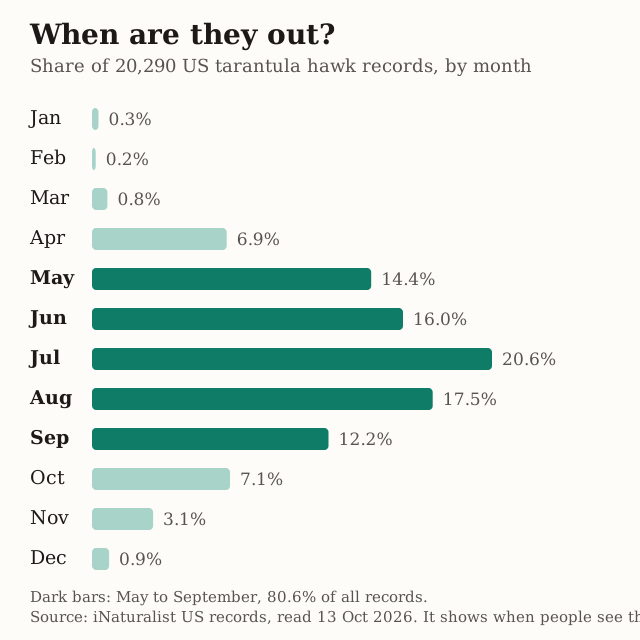
The season shifts with the region. BugGuide gives April to November for the Southwest, and June to September for the eastern species in North Carolina. In the far south of the range, some can be found nearly all year. Expect the most of them in your yard in June, July and August.
How a tarantula hawk hunts a tarantula
A female finds a tarantula, stings it, and drags the paralyzed spider to a burrow. There she lays one egg on its abdomen and seals the entrance. Her larva then feeds on the living spider for several weeks. CSU Extension says the new adult forms inside a cocoon in about 2 to 3 weeks.
The fight is usually one-sided. Gavin Broad, a wasp expert at the Natural History Museum, says the wasps always win and that tarantulas try to flee. The female may use the spider’s own burrow or dig one nearby. She also takes other big spiders, such as trapdoor spiders and wolf spiders, according to CSU Extension.
The tarantula hawk life cycle
The hunt
- What happens
- The female finds a tarantula or other large spider and stings it. The spider is paralyzed but alive
- How long
- Varies
The burrow
- What happens
- She drags it into a burrow, lays one egg on its abdomen and closes the entrance
- How long
- Varies
The larva
- What happens
- The grub hatches, works its way into the spider and feeds, leaving the vital organs until last
- How long
- Several weeks (National Park Service)
The cocoon
- What happens
- After the spider dies, the larva spins a cocoon and turns into an adult
- How long
- About 2 to 3 weeks (CSU Extension)
The adult
- What happens
- The new wasp digs out and spends its life on flowers. Females start hunting after mating
- How long
- About 40 to 50 days for a female
The spider does not always die. CSU Extension notes that if the egg fails to hatch, the tarantula can recover from the venom after several months. That is rare, but tarantula keepers on Reddit describe nursing stung spiders back to health.
What do tarantula hawks eat?
The adults drink nectar. CSU Extension lists the flowers of milkweed, mesquite and soapberry trees, and adds that in California they have been seen eating grapes. Only the larvae eat meat, and their only meal is the spider their mother left them. That makes the adults useful pollinators, especially for milkweed.
How long do tarantula hawks live?
An adult female lives about 40 to 50 days, according to CSU Extension, citing Justin Schmidt. Schmidt argues that tarantula hawks live long adult lives because the painful sting leaves them almost free of predators. Some articles claim 6 to 12 months, but we found no study to back that up.
Tarantula hawk look-alikes
In reader questions online, four insects come up again and again: other big spider wasps, mydas flies, the great black wasp and, in the Northwest, Calopompilus. Check three things: the antennae, the wing color and the length. Tarantula hawks have long antennae, a blue-black body and a length of up to 2 inches.
Many of these copy the tarantula hawk on purpose. Schmidt calls it a huge mimicry complex, with flies, beetles, moths, grasshoppers and other wasps all borrowing the orange-and-black warning. A harmless copy gets the same protection without the sting.
Tarantula hawk or look-alike? Check the antennae first
Antennae
- Tarantula hawk
- Long. Curled on a female
- Entypus spider wasp
- Long. Orange on some eastern species
- Mydas fly
- Clubbed at the tip
- Great black wasp
- Long and black
Wings
- Tarantula hawk
- Orange in the West, black in the East
- Entypus spider wasp
- Orange or dark
- Mydas fly
- Orange or dark. One pair only
- Great black wasp
- Smoky, with a blue sheen. Never orange
Body
- Tarantula hawk
- Blue-black, metallic
- Entypus spider wasp
- Dark
- Mydas fly
- A large, dark fly
- Great black wasp
- All black
Length (inches)
- Tarantula hawk
- 1/2 to 2
- Entypus spider wasp
- Mostly 3/4 to 1 1/8
- Mydas fly
- Up to about 1 1/8 in the US
- Great black wasp
- 3/4 to 1 3/8
What the young eat
- Tarantula hawk
- Tarantulas and other large spiders
- Entypus spider wasp
- Spiders, including wolf spiders
- Mydas fly
- Beetle grubs, in some species
- Great black wasp
- Katydids
Sting
- Tarantula hawk
- 4 out of 4
- Entypus spider wasp
- Females can sting
- Mydas fly
- Cannot sting
- Great black wasp
- 1 out of 4
Entypus spider wasps are close cousins. BugGuide says most are over 20 mm and some reach almost 30 mm, but they rarely reach tarantula hawk size, and only the wing veins tell the two apart for sure. Mydas flies copy the orange wings, but their antennae end in a club, which gives them away. They are flies, so they cannot sting.
The great black wasp visits the same milkweed as the eastern tarantula hawk. It is all black, with black antennae and smoky blue wings, and it hunts katydids. Its sting rates only a 1. In the East, a black ichneumon wasp called Thyreodon atricolor looks almost the same, and BugGuide says the eastern tarantula hawk probably copies it. In the West, including the Northwest, Calopompilus pyrrhomelas is an orange-and-black spider wasp that hunts folding-door spiders and false tarantulas.
A very large wasp with yellow or red markings is something else again. Our guide to giant hornets and cicada killers covers those, and the bee and wasp guide sorts the rest. With a clear photo, the free insect identifier will name it in seconds.
What eats tarantula hawks?
Very little. The roadrunner is one of the few animals that will risk the sting to eat a tarantula hawk, according to the National Park Service. Schmidt found that a sting rated 4 out of 4 gives the wasp near absolute protection from animals with a backbone. Some popular articles go further and say nothing eats them, which the roadrunner proves wrong.
The bright colors and the smell both warn predators off. Schmidt notes that tarantula hawks often seem oblivious to predators as they forage in the open, and for the most part they have little to fear.
A tarantula hawk in your yard, pool or house
Leave it alone, and it will leave you alone. CSU Extension says there are no recommended control measures for tarantula hawks and that intervention is not usually needed. Each adult female lives only about 40 to 50 days, and the wasps come for flowers or to hunt spiders. Keep kids and pets away from them, and net any in the pool.
Why is one in your yard if you have never seen a tarantula? Usually it is the flowers. Adults feed on milkweed, mesquite, soapberry and other blooms. Also, females hunt other large spiders, not just tarantulas. Several at once on a flowering plant is normal in summer. Schmidt has recorded groups of males and females, sometimes of several species, gathering together, and a group like that is not a nest or a swarm.
A few habits keep everyone safe. Wear shoes on bare ground and in the grass in summer. Teach children that big wasps are for looking at, not catching. Wear gloves when you cut back flowering shrubs, and shake out towels and clothes left outside. There is no hive or paper nest to find or remove, because each female works alone.
How to get a tarantula hawk out of your house
Move children and pets out of the room
Close the door behind them. A pet that paws or snaps at the wasp can get stung.
Do not swat it or grab it
Tarantula hawks sting when they are pinned or squeezed. Swatting at one, or brushing it off bare skin, is an easy way to get stung.
Open a window or an outside door
Close the doors to the rest of the house so the open window is the way out. At dusk, switch off the room lights so the outside is brighter.
Give it a few minutes
Stand back and wait. A wasp that came in by mistake may find the opening on its own.
Use a cup and a card if it stays
Wait until it lands on a wall or window. Cover it with a clear cup or jar, slide stiff paper under the rim, and keep the paper pressed flat as you carry it.
Let it go outside
Release it near flowers or shrubs, away from doors and play areas. Walk away calmly once it is free.
Tarantula hawk myths
Most of what goes around about the tarantula hawk comes from its sting, and some of it is wrong. Even the top articles on this wasp disagree on its size, its lifespan and whether anything eats it. Here are 8 claims you will still see, set against what the research and the agencies actually say.
Myth 1
Myth: “Tarantula hawks grow up to 4 inches long.”
Truth: US species are 1/2 to 2 inches long (CSU Extension). The 4 inch (11 cm) figure is for Pepsis heros, the largest species, from South America, as the Natural History Museum notes. No US species comes close.
Myth 2
Myth: “A tarantula hawk sting can kill you.”
Truth: Gram for gram, the venom is about 30 to 45 times weaker than honey bee venom in lab tests (Schmidt 2019). The real danger is an allergic reaction, the same as with any wasp.
Myth 3
Myth: “The pain lasts for hours.”
Truth: The worst of it lasts about 5 minutes (Natural History Museum). The bullet ant is the one whose pain can last up to a day.
Myth 4
Myth: “Tarantula hawks attack people.”
Truth: They are docile and need extreme provocation to sting, says CSU Extension, such as being grabbed, trapped or stepped on.
Myth 5
Myth: “Males sting too.”
Truth: Only females have a stinger (National Park Service). A male, with straight antennae, cannot sting at all.
Myth 6
Myth: “Nothing eats tarantula hawks.”
Truth: The roadrunner does (National Park Service). Very few other animals risk it, which is what the bright colors are for.
Myth 7
Myth: “They only live in the desert.”
Truth: A black-winged species lives from Pennsylvania west to Kansas and south to Florida and Texas (BugGuide).
Myth 8
Myth: “The wasp lays its egg inside the spider.”
Truth: She lays it on the outside of the spider's abdomen. The larva gets in after it hatches (CSU Extension).
When to call someone
Call 911 for breathing trouble, a swollen face or throat, or fainting after any sting. For a pet stung in the mouth or one that collapses, call an emergency vet. A tarantula hawk itself never needs a pest control company, and for anything else, your local extension office can name the insect from a photo.
Who to call, and when
Trouble breathing, swelling of the face or throat, fainting, or a spreading rash after a sting
- Who to call
- 911
- Why
- Signs of a severe allergic reaction (MedlinePlus)
Questions about a sting, or a child who was stung
- Who to call
- Poison Help, 1-800-222-1222
- Why
- Open 24 hours a day, every day (HRSA)
A sting that is red, swollen and more painful days later
- Who to call
- Your doctor
- Why
- Signs of infection (MedlinePlus)
A dog or cat stung in the mouth, vomiting or collapsing
- Who to call
- An emergency vet
- Why
- Swelling in the mouth or throat can block the airway
A big wasp you cannot identify
- Who to call
- Your county extension office
- Why
- Experts can name an insect from a photo or a sample
A tarantula hawk in the yard
- Who to call
- No one
- Why
- No control is recommended (CSU Extension)
Not sure what stung you? Our bite and sting chart compares the usual suspects by how the mark looks and how it felt.
Pest control disclaimer. Photo-based identification can help, but it is not always perfect. For dangerous spiders, large infestations, or anything you are unsure about, contact a licensed pest control professional.
Medical disclaimer. This page is for general information only. It is not a medical diagnosis. If you have severe symptoms, trouble breathing, swelling of the face or throat, fast spreading redness, fever, severe pain, pus, or signs of infection, contact a doctor or your local emergency number.
Frequently asked questions
Can a tarantula survive a tarantula hawk sting?
Is there such a thing as a baby tarantula hawk?
Do tarantula hawks bite?
Can a tarantula hawk paralyze a person?
Why does a tarantula hawk smell?
Is a tarantula hawk the same as a cicada killer?
Related guides
Tarantula spider
Where tarantulas live in the US, how to tell one from a wolf spider, and why the hairs hurt more than the bite.
Bee sting
First aid, the swelling timeline, stings on pets, and how to tell a bee sting from a wasp sting.
Murder hornet
The giant hornet, the cicada killer and the other huge wasps people mix up.
Types of bees
Sort bees from wasps, then find the guide for the one you saw.
Wolf spider
Another big spider that tarantula hawks hunt, and how to tell it from a tarantula.
Insect identifier
Upload a photo and get an identification from the free AI tool.
Sources
- CSU Extension, Tarantula Hawks of Colorado (Benson and Davis, August 2025)
- Natural History Museum, London, Tarantula hawks: the most painful wasp sting in the world explained
- National Park Service, Grand Canyon, Tarantula Hawk
- Schmidt, Venom and the good life in tarantula hawks, Journal of the Kansas Entomological Society 77(4): 402-413 (2004)
- Schmidt, Pain and lethality induced by insect stings, Toxins 11(7): 427 (2019)
- BugGuide, Genus Pepsis, tarantula-hawk wasps
- BugGuide, Genus Hemipepsis
- BugGuide, Pepsis menechma, elegant tarantula-hawk wasp
- BugGuide, Genus Entypus
- BugGuide, Family Mydidae, mydas flies
- BugGuide, Calopompilus pyrrhomelas
- iNaturalist, Pepsis and Hemipepsis observations in the United States (read October 13, 2026)
- MedlinePlus, Insect bites and stings (reviewed October 14, 2025)
- HRSA, Poison Help, 1-800-222-1222
- New Mexico Secretary of State, State insect
- Alcock, A long-term study of male territoriality in the tarantula hawk wasp, The Southwestern Naturalist 62(2): 109-112 (2017)
- Wikipedia, Tarantula hawk
- Wikipedia, Great black wasp (Sphex pensylvanicus)