What is a murder hornet?
A murder hornet is the northern giant hornet, Vespa mandarinia, the largest hornet in the world. Workers are 1 to 1 1/2 inches (25 to 38 mm) long and queens reach 2 inches (51 mm). It is native to East Asia, and it is known for wiping out honey bee hives, not for hunting people.
The head gives it away. Utah State University Extension describes a large orange-yellow head with orange jaws. It sits on a dark brown thorax. The abdomen has bands of yellow and dark brown, and UF/IFAS notes that the last band is all yellow.
It is one of 22 hornet species in the genus Vespa. The Entomological Society of America (ESA) points out that every one of them is native to Asia or common there. In most of the US, the only true hornet you will meet is the European hornet. Penn State Extension says it was first reported here in 1840. A newer arrival, the yellow-legged hornet, is covered below.
The names you will see, and what each one means
Murder hornet
- What it means
- Vespa mandarinia. A nickname, not an official name
- Who uses it
- Japanese tabloids, then US news from 2020
Asian giant hornet
- What it means
- The same species
- Who uses it
- Scientists and agencies until 2022
Northern giant hornet
- What it means
- The same species
- Who uses it
- The official common name since July 2022
Japanese giant hornet
- What it means
- The form of the species that lives in Japan, Vespa mandarinia japonica
- Who uses it
- Research from Japan
Southern giant hornet
- What it means
- A different species, Vespa soror, of a similar size
- Who uses it
- ESA, since 2022
Asian hornet
- What it means
- Usually the yellow-legged hornet, Vespa velutina, a smaller species
- Who uses it
- Britain and Europe
Why is it called a murder hornet?
The name started in Japan. Since at least 2008, some tabloid media there have called it satsujin suzumebachi, which means murderer sparrow hornet. In English, it took off in May 2020 with a New York Times story about a beekeeper in Washington State. Entomologists at Penn State and NC State later traced a flood of worried calls to that one story.
Scientists never adopted it. In July 2022 the ESA chose northern giant hornet instead. Its rules bar names that stoke fear or point at an ethnic group. The old name, Asian giant hornet, also said little, because all 22 Vespa species are Asian. Northern refers to its range in Asia, not to North America.
Are murder hornets still in the US?
No. The last confirmed murder hornet in North America turned up in 2021, and Washington found none from 2022 through 2024. On December 18, 2024, the Washington State Department of Agriculture (WSDA) and the USDA declared it eradicated from the US. British Columbia reports the same.
It only ever lived in one small corner of the continent. That was around Blaine in Whatcom County, Washington, and nearby British Columbia. So a big hornet in New York, Texas or Ohio was never a murder hornet, even in 2020. Utah State noted at the time that it was not known to be established anywhere in North America.
The murder hornet in North America, 2019 to 2026
August 2019
- What happened
- First found in North America, near Nanaimo on Vancouver Island, British Columbia. A nest there is destroyed.
December 2019
- What happened
- Washington confirms two reports near Blaine, the first in the US.
2020
- What happened
- Crews fit live hornets with radio tags, follow them to the first US nest east of Blaine, and destroy it.
2021
- What happened
- Three more nests destroyed in Whatcom County, four in all. British Columbia finds its last hornet, in the Fraser Valley.
2022 to 2024
- What happened
- No hornets detected in Washington.
October 2024
- What happened
- One unconfirmed report from Kitsap County. Officials never obtained the insect.
December 18, 2024
- What happened
- Washington and the USDA declare the hornet eradicated from the US.
2025 to 2026
- What happened
- No new confirmed finds on WSDA's hornet pages. A different invasive hornet, the yellow-legged hornet, is the one to watch now.
Eradicated has a set meaning here. Officials use it after three straight years with no confirmed hornet, which Washington reached at the end of 2024. Reports from the public mattered too. USDA APHIS says nearly half of the confirmed finds came from public reports.
Could murder hornets come back?
Yes, it could happen. Nobody knows how the hornets reached Washington and British Columbia in 2019, so the route may still be open. That is why Washington keeps its reporting line running. A cousin shows how it goes. The yellow-legged hornet reached Georgia in 2023, and in April 2026 someone photographed one alive at the Port of Vancouver in Washington.
What does a murder hornet look like?
A murder hornet is huge, with a big orange-yellow head. Workers are 1 to 1 1/2 inches long and queens reach 2 inches, with wings that span about 3 inches. The thorax is dark brown, and the abdomen has yellow and dark brown bands. The stinger is about 1/4 inch (6 mm) long, according to Utah State.
What a real murder hornet looks like
Every one of these should match. If even one does not, you are looking at something else.
Longer than a US quarter is wide
A quarter is 0.955 inch across. Workers are 1 to 1 1/2 inches and queens up to 2 inches (Utah State).
An orange-yellow head, all over
Wide, with bulging cheeks and a scalloped edge above the jaws (UF/IFAS). The eyes are dark.
Antennae dark brown with orange bases
Utah State lists this as one of the marks to check.
A dark brown thorax
No yellow pattern and no red. This is the middle section, where the wings attach.
Banded abdomen with a yellow tip
Yellow and dark brown bands. The last segment is all yellow (UF/IFAS).
A short stinger, on females only
Utah State gives about 1/4 inch (6 mm), UF/IFAS nearly 1 cm. Males cannot sting.
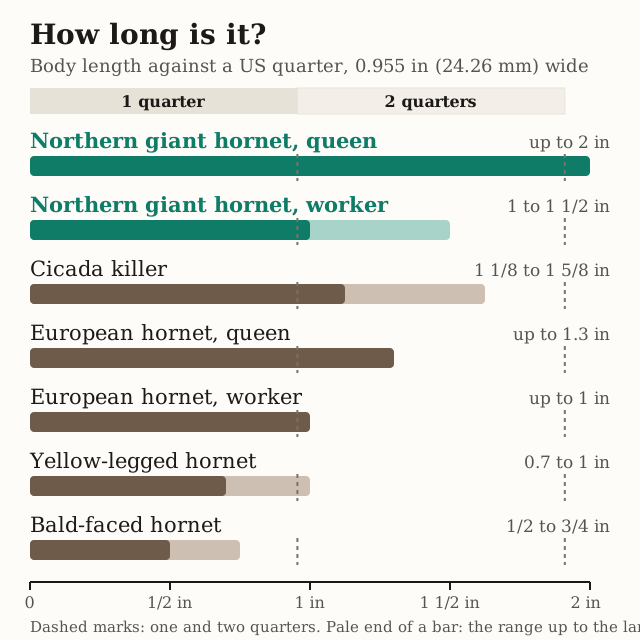
Size is where people go wrong. Three university insect labs handled the 2020 rush of reports. Most people had guessed the insect at 130 to 185% of its real size, even with a coin in the photo. Michael Skvarla and colleagues reported this in American Entomologist in 2022. Not one of the insects was a murder hornet. So measure it, and do not trust your eye.
Is it a murder hornet? The look-alikes
Almost certainly not. In 2020, Penn State’s insect lab alone logged 735 giant hornet requests, and none turned out to be a murder hornet. Reports of European hornets rose 2,456% at Penn State and 10,650% at NC State, and cicada killers rose 2,329% and 4,700%. Those two insects are what most people find.
The 30-second murder hornet check
Go down the list. The first answer that fits usually settles it.
Is it shorter than a US quarter?
Then it is not a murder hornet. Even small workers are about 1 inch long, and a quarter is just under 1 inch across. Yellow-legged hornets, yellowjackets and bald-faced hornets all fall here.
Is the whole head orange-yellow and wide?
That is the murder hornet's mark. A European hornet has a red head with a yellow face. A cicada killer's head is dark red.
Did you see it at night, at a light?
European hornets fly after dark and come to porch lights and lit windows. Penn State calls it the only wasp in the state that flies at night.
Was it digging in bare ground, or carrying a cicada?
That is a cicada killer, a solitary wasp that hunts cicadas from July. The males cannot sting at all.
Is it mostly black, with yellow ends on its legs?
That is a yellow-legged hornet. In South Carolina, Georgia or near a port, report it.
Where are you?
Outside northwest Washington and southwest British Columbia, nobody has ever recorded a murder hornet. Inside that area, report any very large hornet.
Murder hornet or look-alike? Read the head first
Head
- Murder hornet
- Orange-yellow all over, very wide
- European hornet
- Red, with a yellow face
- Cicada killer
- Dark red
- Yellow-legged hornet
- Black, with an orange-yellow face
Length (inches)
- Murder hornet
- 1 to 1 1/2, queens up to 2
- European hornet
- Up to 1, queens up to 1.3
- Cicada killer
- 1 1/8 to 1 5/8
- Yellow-legged hornet
- 0.7 to 1
Against a US quarter
- Murder hornet
- Longer, queens about 2 quarters
- European hornet
- About 1 quarter
- Cicada killer
- Longer, up to 1 3/4 quarters
- Yellow-legged hornet
- Shorter
Thorax
- Murder hornet
- Dark brown
- European hornet
- Red-brown
- Cicada killer
- Dark red
- Yellow-legged hornet
- Black
Abdomen
- Murder hornet
- Yellow and dark brown bands, yellow tip
- European hornet
- Brown front, yellow rear with brown teardrops
- Cicada killer
- Black with pale yellow stripes
- Yellow-legged hornet
- Dark, banded with yellow or orange
Where and when
- Murder hornet
- Northwest Washington only, none since 2021
- European hornet
- Eastern US, at lights at night, late summer and fall
- Cicada killer
- Bare or sandy ground, from early July
- Yellow-legged hornet
- South Carolina and Georgia since 2023
Stings?
- Murder hornet
- Yes, very painful
- European hornet
- Yes, about like a honey bee
- Cicada killer
- Females rarely, males never
- Yellow-legged hornet
- Yes
European hornet
The European hornet, Vespa crabro, is the insect most often mistaken for a murder hornet. Penn State gives workers up to 1 inch (25 mm) and queens up to 1.3 inches (35 mm). It has a red and yellow head and a red-brown thorax. Look for brown teardrop marks on the yellow end of its abdomen.
Its habits give it away. It is the one wasp that flies at night. So a big hornet at a porch light, or bumping a lit window after dark, is almost always this one. Colonies peak in mid-September with 200 to 400 workers, and that is when most people notice them. Queens also wake on warm spring days and wander into houses. That explains the giant hornet crawling across a floor in spring.
It nests in hollow trees and inside walls, in a tan paper shell. It also strips bark from lilacs and other shrubs to drink the sap, and that can kill the twigs. Its sting hurts about as much as a honey bee’s. Unless you are allergic or get stung many times, Penn State says the pain usually fades within a few hours.
Cicada killer
The eastern cicada killer, Sphecius speciosus, is a solitary wasp 1 1/8 to 1 5/8 inches long. It has a dark red head and thorax, brownish wings and pale yellow stripes on a black abdomen. Ohio State says adults appear by early July and live 60 to 75 days. Females dig holes in bare or sandy ground and drag paralyzed cicadas inside.
Each female digs her own burrow, about half an inch wide and 6 to 10 inches deep. A U-shaped pile of soil sits at the door. The males dive at your head and hover in your face, but they cannot sting at all. Females can, though only if handled roughly, and they usually just fly off.
Holes in a lawn worry people for a good reason. One wide hole with a busy stream of yellowjackets is a real hazard. Our guide to holes in the lawn shows how to tell a yellowjacket nest from harmless ground bees.
Yellow-legged hornet
The yellow-legged hornet, Vespa velutina, is the invasive Asian hornet that is actually spreading in the US now. It is smaller than a murder hornet, at 0.7 to 1 inch long. It has a mostly black head, an orange-yellow face and a black thorax. Its legs turn yellow at the ends. Clemson says it first turned up near Savannah, Georgia, in August 2023.
From there it crossed into South Carolina, and the numbers climb every year. Crews there removed 16 nests in 2024 and 139 in 2025. By mid-July 2026 they had removed or scheduled 412 more, nearly all in the Lowcountry. In April 2026, one was photographed alive at the Port of Vancouver in Washington. The state then set traps around the port.
Like the murder hornet, it hunts honey bees. In Europe it has cost beekeepers up to 30% of their hives and honey, according to WSDA. This is the hornet worth reporting today. In South Carolina, use Clemson’s online reporting tool with a photo. Do not try to remove a nest yourself, since a response team will call you. Elsewhere, report it to your state department of agriculture.
Bald-faced hornets, yellowjacket queens and other big wasps
A few more insects fill out the reports. The bald-faced hornet is black and white and only 1/2 to 3/4 inch long. Despite its name, it is a yellowjacket, not a true hornet. Southern yellowjacket queens are big, orange and black. Mississippi State says they show up in spring looking for nest sites.
WSDA also keeps a list of the insects people most often send in as giant hornets. It includes bumble bees, paper wasps, the great golden digger wasp and the elm sawfly. Horntail wood wasps, robber flies and even the Jerusalem cricket make the list too. A big, shiny black bee by a deck is a carpenter bee. Our bee and wasp guide sorts the rest. With a clear photo, the free insect identifier will name it in seconds.
Can a murder hornet kill you?
Rarely. One sting is very painful but carries far too little venom to kill a healthy adult. Entomologist Justin Schmidt told National Geographic it would take about 200 stings to reach a dangerous dose. For honey bees, it takes about 1,000. Most deaths come from allergic reactions or many stings near a nest.
Drop for drop, its venom is actually weaker than a honey bee’s. In lab tests on mice, the dose that kills half of them is 4.1 mg per kg of body weight. For honey bee venom, it is only 2.8 mg. The danger is the amount. Each sting delivers about 10 times the venom of a honey bee sting, and the hornet can sting again and again.
That is why many stings at once are an emergency even without an allergy. UF/IFAS notes that severe reactions have hit people who were not allergic. Deaths have followed kidney failure, heart attacks and organ failure, often after many stings.
How many people die from hornet stings? What the numbers cover
30 to 50 a year in Japan
- What it counts
- A figure widely repeated in 2020 for giant hornet deaths. Most were allergic reactions
- Source
- National Geographic, 2020
About 17 a year in Japan
- What it counts
- All wasp and bee stings, 2008 to 2018: 191 deaths. The records do not single out the giant hornet
- Source
- Japan's health ministry, via Nippon.com
42 deaths, 1,675 injured
- What it counts
- Attacks blamed on the giant hornet in China over four months in 2013
- Source
- UF/IFAS
Those two figures do not fit together. Japan’s official count for all wasps and bees is lower than the number often quoted for the giant hornet alone. So the real murder hornet toll must be smaller than the popular figure, and most of it comes from allergy.
Are murder hornets aggressive?
Not toward people, unless you go near the nest. Utah State says the hornet is generally not aggressive unless its nest or a food source is disturbed. Away from the nest, a hunting worker ignores you because it is looking for insects. Near the nest, or at a beehive it has taken over, it defends hard and stings repeatedly.
If you are stung
Move away from the area first, since a hornet can sting again. Then wash the sting with soap and water. MedlinePlus advises ice wrapped in a cloth, 10 minutes on and 10 minutes off. Take off rings or tight clothing near the sting. Our bee sting first aid guide covers how the swelling should progress and when a reaction is normal.
Why murder hornets are a threat to honey bees
Because a few of them can wipe out a hive in hours. In late summer, workers raid honey bee hives as a group and kill the adult bees. Then they take over the hive and carry off the young to feed their own colony. UF/IFAS says a colony of about 30,000 honey bees can be destroyed in several hours.
That is what alarmed Washington. WSDA cites a USDA estimate that insect pollination adds more than $34 billion a year to US crops. Honey bees do much of that work. The New York Times told the story of a beekeeper near Custer, Washington. In November 2019, he found thousands of his bees dead with their heads torn off, and he later came to suspect the hornet. The hornets attack other insects too. But WSDA notes they are not known to wipe out whole colonies of anything but bees.
How Japanese honey bees fight back
In Japan, where the hornet is native, the local honey bee has a remarkable defense. When a hornet tries to get into the nest, more than 500 bees pile onto it in a tight ball. Then they make heat with their bodies. The ball reaches about 117F (47C), which kills the hornet but not the bees. Masato Ono and colleagues showed this in Nature in 1995.
Where murder hornets nest, and when they are active
Murder hornets nest in hollows, usually underground in old burrows or near tree roots. They do not hang paper balls from branches. In Washington, most of the 4 nests sat inside alder trees. A colony lasts one season. The queen starts it in spring, and raids on hives peak in late summer. New queens and males appear in October.
Only the new queens live through the winter. After mating, each one spends about seven months in the soil, says UF/IFAS. Then she starts her own nest in spring. Workers forage about 1.2 miles (2 km) from the nest and have been tracked as far as 5 miles (8 km). That is why Washington asked people to trap from July through November, when workers are out hunting.
This also changes what you are likely to see. A huge hornet indoors in spring is usually a queen that woke early or is hunting for a nest site. In most of the US, that means a European hornet queen or a yellowjacket queen.
What to do if you think you found one
Keep your distance, take a photo with a coin for scale, and report it. In Washington, call WSDA at 1-800-443-6684. Elsewhere, call your state department of agriculture. Do not try to kill a nest or dig one up. The crews in Washington needed protective suits for that job. Keep a dead hornet in a closed container and freeze it overnight.
How to check and report a suspected murder hornet
Step back and leave it alone
Move away slowly and do not swat at it. Hornets flying in and out of the ground, a tree or a wall mean a nest. Keep well clear, and do not spray it, block it or dig it up.
Note where and when you saw it
Write down the town, the date, the time and what it was doing. A hornet at a light at night, a wasp digging in sand and hornets at a beehive each mean something different.
Photograph it with a coin for scale
Put a coin or a ruler next to it. Washington's agriculture department says it generally cannot confirm a report without a photo or a specimen.
Check the size and the head
Hold the photo against a US quarter. If the body is shorter than the quarter is wide, it is not a murder hornet. If it is longer, look for a head that is orange-yellow all over.
Keep a dead one
Put it in a crush-proof container and freeze it overnight, as New York's agriculture department advises. A whole specimen lets officials confirm the species.
Report it
In Washington, use the state's Hornet Watch form, email [email protected] or call 1-800-443-6684. In South Carolina, use Clemson's yellow-legged hornet reporting tool. Anywhere else, contact your state department of agriculture or state apiary inspector.
What about killing murder hornets yourself? Do not try. You almost certainly do not need to, since yours is very unlikely to be one. For the hornets that do live here, Penn State says a store-bought spray may not even knock one down. It also advises leaving a European hornet nest alone when it threatens no one, since the colony dies in winter. When the nest is in or near the house, hire a licensed pest professional.
Murder hornet myths
Most of what people repeat about the murder hornet comes from the 2020 news cycle. Much of it was wrong even then. Here are seven claims you will still see, set against what the agencies and the research say. The biggest one is that they are spreading, when the last confirmed hornet turned up in 2021.
Myth 1
Myth: “Murder hornets are spreading across the US.”
Truth: They only ever lived in northwest Washington and nearby British Columbia. The last confirmed hornet turned up in 2021, and the US declared them eradicated in December 2024 (WSDA).
Myth 2
Myth: “Any hornet longer than an inch is a murder hornet.”
Truth: Most are European hornets or cicada killers. Three university labs checked about 1,700 requests from 2020 and 2021 and found no murder hornets at all (Skvarla and colleagues, 2022).
Myth 3
Myth: “Murder hornets kill 30 to 50 people a year in Japan.”
Truth: Japan's records count about 17 deaths a year from all wasps and bees combined, 2008 to 2018. The giant hornet's share is smaller still (Nippon.com).
Myth 4
Myth: “Its venom is the most toxic of any insect.”
Truth: Per drop, honey bee venom is stronger. The danger is the amount: about 10 times as much per sting, and the hornet can sting again (National Geographic).
Myth 5
Myth: “Murder hornets hunt people.”
Truth: They hunt insects, mostly bees. Utah State University says the hornet is generally not aggressive unless its nest or a food source is disturbed.
Myth 6
Myth: “It is the only giant hornet in the world.”
Truth: In 2022, the ESA also named the southern giant hornet, Vespa soror. It is a separate species of a similar size.
Myth 7
Myth: “Murder hornets and killer bees are the same thing.”
Truth: Killer bees are Africanized honey bees. They live in the Southwest and Florida, and they are bees, not hornets (UF/IFAS).
When to call someone
Call 911 for breathing trouble or a swollen face or throat after any sting. After many stings, go to an emergency room. Call your state department of agriculture about a large hornet with an orange-yellow head. A dark hornet with yellow legs in the Southeast needs the same call. A nest in your walls needs a licensed pest professional.
Who to call, and when
Breathing trouble, swollen lips, tongue or throat, hives, or collapse after a sting
- Who to call
- 911
- Why
- Signs of a severe allergic reaction (MedlinePlus)
Many stings at once, even with no allergy
- Who to call
- An emergency room
- Why
- Large doses of venom can damage the kidneys and other organs (UF/IFAS)
Questions about a sting
- Who to call
- Poison Help, 1-800-222-1222
- Why
- Free and open 24 hours a day (MedlinePlus)
A hornet longer than a quarter with an orange-yellow head, in Washington
- Who to call
- WSDA: [email protected] or 1-800-443-6684
- Why
- Officials need a photo or a specimen to confirm it (WSDA)
The same in British Columbia, or another state
- Who to call
- Your provincial or state agriculture department
- Why
- WSDA asks people outside Washington to report locally
A dark hornet with yellow leg tips, or hornets hovering at beehives, in the Southeast
- Who to call
- Clemson's reporting tool in South Carolina, or your state agriculture department
- Why
- The yellow-legged hornet is spreading there now (Clemson)
A European hornet nest in a wall or by a door
- Who to call
- A licensed pest professional
- Why
- Penn State advises professional help when a nest is in or near the house
Cicada killers in the lawn
- Who to call
- Usually no one
- Why
- Solitary, rarely sting, and adults live only 60 to 75 days (Ohio State)
Not sure what bit or stung you? Our bite and sting chart compares the usual suspects by how the mark looks and how it felt.
Pest control disclaimer. Photo-based identification can help, but it is not always perfect. For dangerous spiders, large infestations, or anything you are unsure about, contact a licensed pest control professional.
Medical disclaimer. This page is for general information only. It is not a medical diagnosis. If you have severe symptoms, trouble breathing, swelling of the face or throat, fast spreading redness, fever, severe pain, pus, or signs of infection, contact a doctor or your local emergency number.
Frequently asked questions
Are there murder hornets in New York, Oregon or California?
Is a murder hornet a bee, and is it the same as a killer bee?
What is the deadliest hornet in the world?
What is the difference between a hornet and a murder hornet?
Can a murder hornet sting through clothes or a bee suit?
Should I kill a big hornet if I think it is a murder hornet?
What does a murder hornet sting feel like?
Related guides
Bee sting
First aid, the swelling timeline, and how to tell a bee sting from a wasp sting.
Types of bees
Sort bees from wasps, then find the guide for the one you saw.
Ground bees
Many small holes means harmless bees. One busy hole means yellowjackets.
Carpenter bee
The big shiny black bee by your deck, and why the one in your face cannot sting.
Tarantula hawk
The huge blue-black wasp with orange wings, and its famously painful sting.
Insect identifier
Upload a photo and get an identification from the free AI tool.
Bug bite identification
Compare bites and stings by look, timing and feel.
Sources
- Washington State Department of Agriculture, Invasive hornets
- Washington State Department of Agriculture, Northern giant hornet FAQ
- Washington State Department of Agriculture, Northern giant hornet and look-alikes
- USDA APHIS, APHIS in Action: Victory Over the World's Largest Hornet Species
- National Invasive Species Information Center, Northern giant hornet
- Global News, So-called 'murder hornet' eradicated in U.S., officials say (December 18, 2024)
- UF/IFAS Featured Creatures, Northern giant hornet, EENY-754 (2025)
- Utah State University Extension, Asian giant hornet fact sheet (2020)
- Entomological Society of America, Northern giant hornet adopted as common name (July 25, 2022)
- Skvarla, Bertone and Liesch, Murder Hornet Mayhem, American Entomologist 68(2): 38-43 (2022)
- Penn State Extension, European hornet
- Penn State Extension, Murder hornets? (2025)
- Ohio State University Extension, Cicada killer wasp, ENT-63
- Clemson Regulatory Services, July 2026 yellow-legged hornet update
- Mississippi State University Extension, Is that a murder hornet?
- New York State Agriculture and Markets, Northern giant hornet fact sheet
- National Geographic, Why are murder hornet stings so intense? (2020)
- Nippon.com, Japan Data: deaths from wasp and bee stings
- Ono, Igarashi, Ohno and Sasaki, Unusual thermal defence by a honeybee against mass attack by hornets, Nature 377: 334-336 (1995)
- MedlinePlus, Bee, wasp, hornet, or yellow jacket sting
- UF/IFAS, Frequently asked questions about the African honey bee in Florida, ENY-140
- New York Times, 'Murder Hornets' in the U.S.: The Rush to Stop the Asian Giant Hornet (2020)
- Wikipedia, Asian giant hornet (name history)
- United States Mint, Coin specifications