What is a cicada killer?
A cicada killer is a large wasp that hunts cicadas to feed its young. The one most Americans meet is the eastern cicada killer, Sphecius speciosus, found east of the Rockies. It is 1 1/8 to about 2 inches (30 to 50 mm) long, which makes it one of the biggest wasps in North America.
It lives alone. Each female digs her own burrow in bare soil, stocks it with paralyzed cicadas and lays her eggs there. There is no queen, no colony and no paper nest. Many females may still dig in the same sunny patch, so a lawn can end up with dozens of holes.
The adults drink nectar and sap. Only the young eat meat, and their only food is the cicada their mother left them. Cicadas can harm young trees, so these wasps count as beneficial.
The eastern cicada killer at a glance
Length
- What to know
- About 1 1/8 to 2 in (30 to 50 mm). Females are bigger
Colors
- What to know
- Rust-red head and thorax, black abdomen with pale yellow bands, amber wings
Who stings
- What to know
- Females only, and only if handled or stepped on
Nest
- What to know
- One female per burrow, in bare, sunny, dry soil
Young eat
- What to know
- Annual cicadas the mother paralyzes and buries
Adults eat
- What to know
- Nectar and sweet plant sap
Season
- What to know
- Early July to mid-September, peaking in late July
Range
- What to know
- East of the Rockies. Two other species live in the West
Is it a hornet? The other names
It is not a hornet, though people call it a cicada hawk, a sand hornet, a giant cicada killer or simply a killer wasp. True hornets belong to a different family, the Vespidae, and live in colonies. The cicada killer is a sand wasp, in the family Bembicidae. Older guides list it under Crabronidae or Sphecidae, since scientists have moved these wasps around.
What does a cicada killer look like?
A cicada killer looks like an oversized yellowjacket. Most measure 1 1/8 to 1 5/8 inches (29 to 41 mm), and big females reach about 2 inches. The head and thorax are rust-red to dark brown, the abdomen is black with three pale yellow bands, and the wings and legs are amber.
Look closely at the yellow bands. On a cicada killer, black hook-shaped edges cut into the yellow. That detail helps tell it apart from a near twin called the eastern stizus. The abdomen is also more pointed and blacker than a hornet’s.
How to recognize a cicada killer
Most of these should match. The size, the head color and where it lives settle it fastest.
Large: about 1 1/8 to 2 inches long
Longer than a US quarter is wide.
Rust-red head and thorax
Not yellow, and not the orange of a murder hornet's head.
Black abdomen with pale yellow bands
Usually three bands, with black hooked edges cutting into the yellow.
Amber wings and legs
The wings look tinted brown or orange in sunlight.
Flying low over bare ground in July or August
Males hover at head height and chase anything that moves.
Holes about 1/2 inch wide with fresh soil beside them
Or a wasp dragging or carrying a cicada.
How big are cicada killers?
Sources do not agree on the exact size, so here are the figures side by side. Most measured adults are 1 1/8 to 1 5/8 inches long, and the largest females approach 2 inches. Two sources give a low end of 1/2 to 0.6 inch, but we found no measurement behind it.
Cicada killer length, by source
Ohio State Extension
- Length
- 1 1/8 to 1 5/8 in
- Notes
- Males are typically smaller
BugGuide
- Length
- 30 to 40 mm (1 1/8 to 1 5/8 in)
- Notes
- One of the largest North American wasps
UF/IFAS
- Length
- Up to 40 mm (about 1 1/2 in)
- Notes
University of Kentucky
- Length
- Females 1 1/2 to nearly 2 in, males up to 1 1/2 in
- Notes
Penn State Extension
- Length
- Females up to 2 in, males about 1 1/2 in
- Notes
LSU AgCenter
- Length
- 1/2 to 2 in (13 to 50 mm)
- Notes
- No measurement given for the low end
Wikipedia
- Length
- 1.5 to 5.0 cm (0.6 to 2 in)
- Notes
- No source given for the low end
Weight shows the gap between the sexes better than length. In a 1997 study, Joseph Coelho found females were nearly 2.5 times the size of males. So a smaller cicada killer near the holes is usually a male.
Size also changes with place. Jon Hastings and colleagues measured cicada killers from 12 sites in 10 states in 2008. The wasps were bigger wherever the local cicadas were bigger, which helps explain why sources disagree.
Male vs female cicada killer
Only the female, the bigger of the two, can sting. The male has a sharp spine at the tip of his abdomen, a pseudo-stinger, which may poke if you grab him but has no venom. In practice, the wasps hovering at your face and chasing each other are nearly always males.
Males come out first and each guards about one square meter (11 square feet) of bare ground near where females will emerge. They perch on a stone or a low plant and fly at anything that moves, including people, other males and thrown pebbles. Females spend their time digging and hunting, and mostly ignore you.
Is it the biggest wasp in the US?
It is among the biggest, but it shares the title. Tarantula hawks in the Southwest reach about 2 inches, and so do big female cicada killers. Mississippi State Extension calls cicada killers the largest wasps in that state. In the East, a wasp close to 2 inches long in July is almost always a female cicada killer.
Is it a murder hornet? Cicada killer look-alikes
No. The murder hornet was found only in northwest Washington and was declared eradicated from the US in December 2024. In 2020, Penn State saw a 2,329% rise in cicada killer reports as people mistook them for it, Michael Skvarla and colleagues reported. The other look-alikes are the European hornet, the eastern stizus and the yellowjacket.
Check three things: the head color, the pattern on the abdomen and where it lives. Cicada killers nest in the ground and fly by day, while European hornets build paper nests above ground and come to lights at night.
Cicada killer or look-alike? Read the head first
Head
- Cicada killer
- Rust-red to dark brown
- European hornet
- Red, with a yellow face
- Eastern stizus
- Much like a cicada killer
- Yellowjacket
- Black and yellow
- Murder hornet
- Orange-yellow, very wide
Length (inches)
- Cicada killer
- 1 1/8 to 2
- European hornet
- Up to 1, queens 1.3
- Eastern stizus
- About 1 1/4
- Yellowjacket
- About 1/2
- Murder hornet
- 1 to 1 1/2, queens up to 2
Abdomen
- Cicada killer
- Black, pale yellow bands with black hooked edges
- European hornet
- Brown front, yellow rear with brown teardrops
- Eastern stizus
- Yellow marks with smooth edges
- Yellowjacket
- Bright yellow and black bands
- Murder hornet
- Yellow and dark brown bands
Nest
- Cicada killer
- One female per burrow in bare soil
- European hornet
- Paper nest in hollow trees or walls
- Eastern stizus
- Burrows in the ground
- Yellowjacket
- One colony, often in a single ground hole
- Murder hornet
- Not in the US
Young eat
- Cicada killer
- Cicadas
- European hornet
- Other insects
- Eastern stizus
- Katydids
- Yellowjacket
- Insects
- Murder hornet
- Insects, including honey bees
Stings?
- Cicada killer
- Females, rarely
- European hornet
- Yes, about like a honey bee
- Eastern stizus
- Females can
- Yellowjacket
- Readily, and in numbers
- Murder hornet
- Yes, very painful
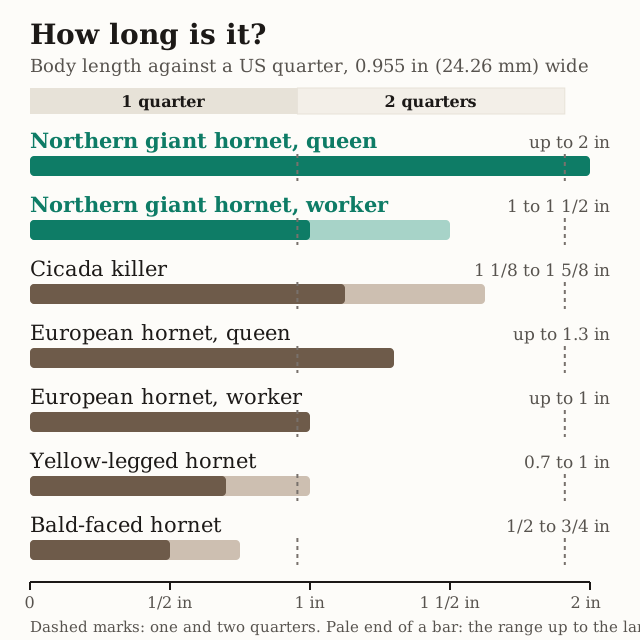
Our murder hornet guide covers the giant hornet and the yellow-legged hornet in full. Among smaller look-alikes, the great golden digger wasp also nests in the ground, but at 15 to 27 mm it is well under 1 1/4 inches long. For a photo match in seconds, try the free insect identifier.
European hornet vs cicada killer
These two cause the most confusion, because both are large, striped and out in late summer. A European hornet worker is up to 1 inch long and a queen 1.3 inches, so it is shorter than a female cicada killer. It has more yellow on the abdomen, with brown teardrop marks, and a rounder rear end.
Behavior settles it. European hornets live in colonies of hundreds, nest in hollow trees and walls, and are the only wasp in Pennsylvania that flies at night. A big wasp at your porch light is a hornet. A big wasp landing at a hole in the lawn is a cicada killer.
Do cicada killers sting?
Only the females, and only rarely. A female, the bigger sex at up to 2 inches long, stings when she is grabbed, trapped in clothing or stepped on barefoot. Males have no stinger at all. The University of Kentucky says stings are almost always the result of a person stepping on or grasping the wasp, not an attack.
The female’s venom is made for cicadas. She uses it to paralyze them, not to defend herself, and she has no colony to protect. Even when you stand beside her burrow, she usually just flies off.
How painful is a cicada killer sting?
Mild by wasp standards, from the little data there is. Justin Schmidt rated two western cicada killers at 1 and 1.5 on his 1 to 4 pain scale, where a honey bee scores 2. He never rated the eastern cicada killer, so a figure you see quoted for it online is not his.
People who have been stung describe it as sharp. One Reddit user in Austin grabbed one by accident and said it was “about as bad as a yellow jacket or bee.” In 1943, the Ohio researchers Dambach and Good were stung while studying them. They reported a sharp pain, then numbness, slight swelling and stiffness that lasted about a week.
Sting pain and venom strength (Schmidt 2019)
Western cicada killer (Sphecius grandis)
- Pain, 1 to 4
- 1.5
- Venom LD50, mg per kg (higher is weaker)
- 46
Pacific cicada killer (S. convallis)
- Pain, 1 to 4
- 1
- Venom LD50, mg per kg (higher is weaker)
- Not measured
Eastern cicada killer (S. speciosus)
- Pain, 1 to 4
- Not rated
- Venom LD50, mg per kg (higher is weaker)
- Not measured
Honey bee
- Pain, 1 to 4
- 2
- Venom LD50, mg per kg (higher is weaker)
- 2.8
German yellowjacket
- Pain, 1 to 4
- 2
- Venom LD50, mg per kg (higher is weaker)
- 2.8
Bald-faced hornet
- Pain, 1 to 4
- 2
- Venom LD50, mg per kg (higher is weaker)
- 6.1
Tarantula hawk
- Pain, 1 to 4
- 4
- Venom LD50, mg per kg (higher is weaker)
- 90 to 120
LD50 is the dose that kills half of a group of lab mice, so a higher number means weaker venom. By that measure, the western cicada killer’s venom is about 16 times weaker than a honey bee’s. Pain and danger are separate things, though, and the danger from any sting is an allergy.
Why do cicada killers dive-bomb you?
The ones that fly at your face are males defending a territory, and they cannot sting. Each male guards a small patch of bare ground for up to 12 days, waiting for females to come out of the soil. He checks out anything that moves through it, including a person walking to the mailbox.
This is the problem behind posts like “can barely walk out front door without an attack.” It is noisy and startling, but it is a bluff. Walk on calmly, since he has nothing to hurt you with.
Are cicada killers dangerous?
For most people, no. A single sting from a solitary wasp is painful but not dangerous, and you will never meet a swarm. The exception is anyone allergic to wasp stings. MedlinePlus says most deaths from insect stings come from allergic reactions, not the venom, and that is the risk to watch.
The Missouri Department of Conservation advises people with a wasp allergy to avoid all wasps, and that includes this one. Otherwise, the real hazards are smaller: a child grabbing one, or a bare foot on a female walking in the grass.
What to do if a cicada killer stings you
Move away first. If any warning sign in the red box appears, call 911 at once and do not wait to see if it passes. Otherwise, wash the sting and cool it. Steps 2 to 4 follow MedlinePlus advice for insect stings.
Move away from the wasp
Step back so it cannot sting again. A cicada killer that stung you was almost certainly grabbed, trapped or stepped on, and it will fly off once it is free. If any warning sign in the red box appears, call 911 right away.
Wash the sting
Clean the spot with soap and water. Wasps do not leave a stinger behind, so there is nothing to scrape out.
Cool it
Hold ice wrapped in a cloth on the sting, 10 minutes on and 10 minutes off. Take off rings or anything tight near the sting in case it swells.
Watch for the warning signs
Keep an eye on the person for the signs in the box below, even after the pain fades. Over the next few days, check for spreading redness, swelling or pain, which can mean an infection.
Kids, dogs and cats
A cicada killer will not go after a child or a pet. Stings happen when a child picks one up or steps on one barefoot, or when a dog snaps at one in the air. In July and August, put shoes on children who play on the lawn, and teach them that big wasps are for watching, not catching.
A pet is most often stung on the face or a paw. Our bee and wasp sting guide lists the signs that mean an emergency vet, such as a sting inside the mouth, vomiting, pale gums or collapse.
The holes in your lawn: cicada killer nests
Each hole is one female’s burrow. It is a round opening about 1/2 inch wide, with a fan of loose soil beside it, often with a shallow trench running through the pile. The tunnel slopes down about 6 to 10 inches (15 to 25 cm) and branches into cells, each holding a paralyzed cicada and one egg.
Females pick bare, loose, well-drained soil in full sun. Favorite spots are thin patches of lawn, the edges of driveways and sidewalks, flower beds, sandboxes and banks. Thick, healthy grass rarely gets them, which is the key to keeping them out.
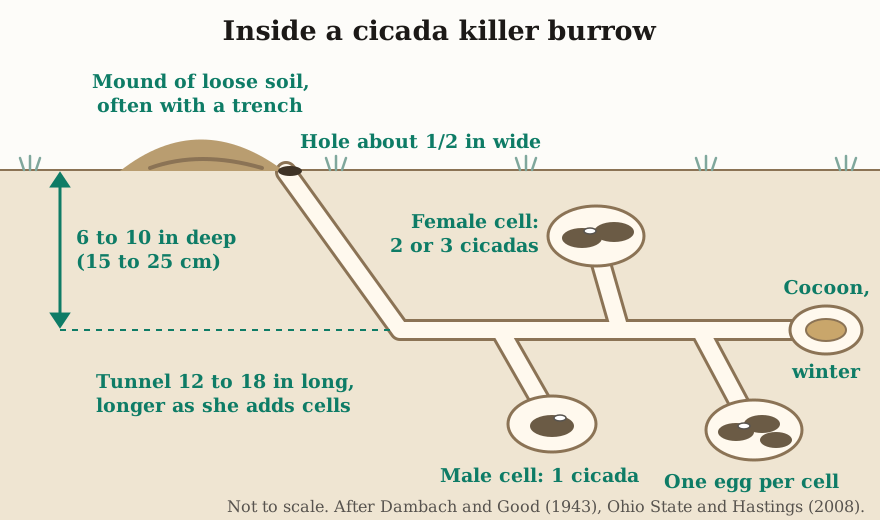
How deep is a cicada killer nest?
Most sources agree the burrow goes down 6 to 12 inches. They disagree a lot on length, from 12 inches to more than 4 feet, and on the number of cells. The table shows each figure next to its source, and the reason they differ follows it.
Cicada killer burrow size, by source
Dambach and Good, 1943 Ohio field study
- Depth
- 6 to 10 in
- Length
- 12 to 18 in to the first cell
- Cells per burrow
- 15.8 on average
Ohio State Extension
- Depth
- 6 to 10 in
- Length
- Not given
- Cells per burrow
- 3 to 4 at first, 10 to 20 in the end
Purdue Extension
- Depth
- 6 to 10 in
- Length
- 12 to 18 in
- Cells per burrow
- 4 to 5, up to 16 larvae
Penn State Extension
- Depth
- Up to 12 in
- Length
- 12 to 24 in
- Cells per burrow
- Not given
University of Kentucky
- Depth
- 12 to 15 in
- Length
- Up to 36 in
- Cells per burrow
- Several
NC State Extension
- Depth
- Not given
- Length
- Up to 40 in
- Cells per burrow
- Not given
UF/IFAS
- Depth
- Not given
- Length
- 1 to 4 ft
- Cells per burrow
- More than 16
Missouri Dept. of Conservation
- Depth
- Not deep
- Length
- 4 ft or more
- Cells per burrow
- 9 or 10 is common
Why the spread? A burrow is not dug in one go. The female adds side branches and cells over her few weeks of work, so a burrow measured in early July is much shorter than the same one in August. Some authors also measure only to the first cell. Depth stays fairly steady, so “6 to 10 inches down” is the safe figure.
The entrance varies too. Most sources give about 1/2 inch, while Purdue and Penn State describe openings up to 1 1/2 inches. Either way, it is one wasp’s front door, not a colony entrance.
How many cicada killers live in a nest?
One adult: the female who dug it. Her burrow may hold up to about 16 young, one per cell, but they stay underground until next summer. What looks like a nest of many wasps is really many burrows dug side by side, plus males patrolling over them. In one Ohio study, burrows averaged 15.8 cells each.
Cicada killer hole or yellowjacket nest?
This matters more than anything else on the page. A cicada killer burrow is safe to walk past, while a yellowjacket nest in the ground can send out dozens of stinging wasps. Read the hole and the traffic before you water, cover or treat anything.
Whose hole is it? Read the traffic first
Traffic
- Cicada killer
- One big wasp, often carrying a cicada
- Ground bees
- One bee at a time, unhurried
- Yellowjackets
- A steady stream, dozens a minute
- Gopher
- None you can see
Hole
- Cicada killer
- About 1/2 in, open
- Ground bees
- About 1/4 in
- Yellowjackets
- Over 1 in
- Gopher
- No open hole, plugged with soil
Around the hole
- Cicada killer
- A fan of loose soil, often with a trench
- Ground bees
- A small volcano of soil
- Yellowjackets
- A bare worn entrance
- Gopher
- A large fan-shaped mound
Time of year
- Cicada killer
- July and August
- Ground bees
- Mostly spring
- Yellowjackets
- Peaks late summer and fall
- Gopher
- Any time
Risk
- Cicada killer
- Rarely stings
- Ground bees
- Almost never stings
- Yellowjackets
- Stings readily, in numbers
- Gopher
- No sting
If you see one wide hole with a busy two-way stream of smaller wasps, stop and keep people and pets away. That is a yellowjacket nest, and our guide to holes in the lawn explains how to handle it. Mounds with no open hole at all are usually a pocket gopher. Small spring holes with a cone of soil around each are the work of mining bees.
How a cicada killer hunts cicadas
A female finds an annual cicada in a tree, stings it to paralyze it, and flies or drags it back to her burrow. The cicada is often heavier than she is: on average 88% heavier, Coelho found in 1997. She lays one egg on it, and her larva eats the still-living cicada over about two weeks.
Getting it home is the hard part. A female with a heavy cicada often climbs a tree or post and glides toward her burrow, then drags it the rest of the way. Hastings and colleagues put her limit at about 2.5 times her own weight. She can bring prey from 100 yards away.
She stocks each cell according to the egg she lays. A cell for a son gets one cicada, rarely two. A cell for a daughter gets two, rarely three, since females grow much bigger. Researchers disagree on whether she prefers female cicadas: the 1943 Ohio study found 7 females to every 3 males, but a 2009 study found no clear bias.
The cicada killer life cycle
Emergence
- What happens
- Males come out first in late June or early July. Females follow and mate
- How long
- Late June to July
Digging and hunting
- What happens
- Each female digs a burrow, then stings and brings in cicadas, one cell at a time
- How long
- The rest of her life, about a month
Egg
- What happens
- One egg per cell, laid on a cicada. The cell is sealed
- How long
- A few days
Larva
- What happens
- The grub eats the paralyzed but living cicada
- How long
- About 2 weeks
Cocoon
- What happens
- The grown larva spins a cocoon of silk and soil and waits out the winter
- How long
- Fall to spring
Pupa
- What happens
- It turns into an adult inside the cocoon
- How long
- About a month in spring
What do cicada killers eat?
The adults drink flower nectar and sweet plant sap. They do not eat plants, fruit or other insects. Only the larvae eat meat, and their food is the dog-day cicadas of the genus Neotibicen, the big green-and-black cicadas that buzz in the trees every summer.
What about periodical cicada years?
The 13-year and 17-year cicadas matter less than you might think. They come out in May and June, mostly before cicada killers are flying. Dambach and Good found that in Ohio they appear too early to be taken. A 2009 survey did record cicada killers taking periodical cicadas, so it happens, but annual cicadas are the main food.
When do cicada killers come out, and when do they go away?
They come out in late June or early July and are gone by mid-September. In 30,417 US records on iNaturalist, 80.5% fall in July and August, and the busiest week is the last week of July. The adults fly for about 60 to 75 days a year, and a single female lives about a month.
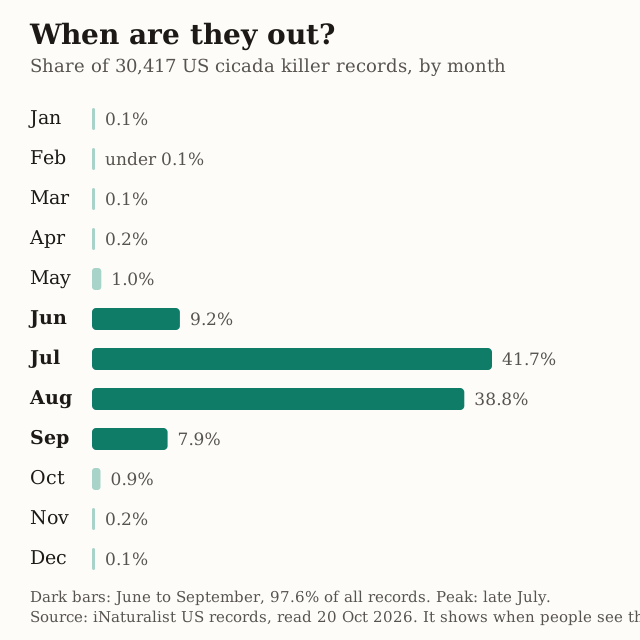
After that the lawn goes quiet until next summer, because the young spend fall, winter and spring underground. So new adults will come out of the same ground next July, close to where their mothers dug.
Do cicada killers come out at night?
No. They are active by day. At night females rest inside their burrows, while males rest on shrubs near the nesting area. That is why extension guides time any treatment for after dark. A large wasp flying to lights at night is a European hornet instead.
Where do cicada killers live?
The eastern cicada killer lives from Ontario to Florida and west to South Dakota, New Mexico and Texas. In US iNaturalist records, Texas leads with 17.1%, followed by New York, Pennsylvania, Illinois and North Carolina. The eastern species has been recorded in 45 states and Washington, D.C.
The table counts records posted to iNaturalist, where people share photos of what they find. So it shows where people meet cicada killers, which leans toward busy, populated states. It is a map of encounters, not of how many wasps live in each place.
Where people find cicada killers: US iNaturalist records by state, read October 2026
Texas
- Records
- 5,371
- Share
- 17.1%
- Notes
- The most of any state. Western cicada killers also turn up in the west of the state
New York
- Records
- 2,934
- Share
- 9.3%
- Notes
- Eastern cicada killer only
Pennsylvania
- Records
- 2,003
- Share
- 6.4%
- Notes
- Eastern cicada killer only
Illinois
- Records
- 1,670
- Share
- 5.3%
- Notes
- Eastern cicada killer only
North Carolina
- Records
- 1,550
- Share
- 4.9%
- Notes
- Eastern cicada killer only
Maryland, Virginia, New Jersey, Massachusetts, Florida
- Records
- 1,077 to 1,372 each
- Share
- 19.9% together
- Notes
- Florida records are almost all the eastern species
Georgia, Ohio, Tennessee, Michigan, Oklahoma, Indiana, Connecticut, Missouri, Minnesota
- Records
- 515 to 987 each
- Share
- 18.7% together
- Notes
- Oklahoma also has a few western cicada killers
Kansas, New Mexico, South Carolina, Alabama, Delaware, D.C., Kentucky, Iowa, Nebraska, Louisiana, Wisconsin, Arkansas, Colorado, New Hampshire, South Dakota
- Records
- 146 to 464 each
- Share
- 14.6% together
- Notes
- New Mexico and Colorado have both eastern and western species
Arizona, California, Idaho, Washington, Oregon, Nevada, Utah
- Records
- 44 to 182 each
- Share
- 2.2% together
- Notes
- Western and Pacific cicada killers, not the eastern one
Rhode Island, Mississippi, Maine, West Virginia, Vermont, Montana, North Dakota, Wyoming
- Records
- 3 to 117 each
- Share
- 1.4% together
- Notes
- Thin records at the edges of the range
Western and Pacific cicada killers
Two more species live in the West. The western cicada killer, Sphecius grandis, ranges from Washington and California east to Nebraska and Texas. The Pacific cicada killer, S. convallis, lives from the West Coast to west Texas. A fourth, S. hogardii, reaches the Florida Keys from the Caribbean.
The names get mixed up. The Smithsonian’s BugInfo page calls S. convallis the western cicada killer, but BugGuide and iNaturalist use that name for S. grandis and call S. convallis the Pacific cicada killer. All three US species look and behave much alike. In California, Oregon, Washington and Idaho, every record we found is one of the western two.
Are cicada killers invasive?
No. Cicada killers are native to North America and have lived alongside cicadas here far longer than lawns have existed. The more crowded lawns of recent decades simply bring them closer to people. The European hornet, a common look-alike, is the one that was introduced from overseas.
What kills cicada killers?
Mostly parasites that attack the young, not predators of the adults. Small flies, such as Senotainia trilineata, parasitize the young in their cells. Velvet ants sneak into burrows and lay eggs in the cells, and their larvae eat the cicada killer pupae. In the 1943 Ohio study, only 38% of 525 cells held a healthy larva.
So a lawn full of cicada killers one summer does not always mean more the next. Weather, parasites and the supply of cicadas all play a part. For the adults, the end comes with the cold, since none survives the winter.
How to get rid of cicada killers
First, ask whether you need to. The adults fly for only 60 to 75 days and are gone by mid-September, the males cannot sting, and the burrows do little harm. If you do want them gone, change the soil: thick grass, regular watering and mulch on bare ground send females elsewhere. Insecticide is the last option, not the first.
The damage is mostly how the lawn looks. The soil piles can smother patches of grass, and in a 1943 Ohio nursery, burrows dug right beside small plants killed some of them. On the plus side, the digging loosens and aerates the soil and helps rain soak in. The Missouri Department of Conservation counts that as a benefit.
How to keep cicada killers out of your lawn
Decide whether you need to act at all
Males cannot sting, females rarely do, and the adults are gone by mid-September. If the burrows are not in a play area or a path, waiting is the cheapest option.
Find the bare, dry spots
Females dig in loose, well-drained soil in full sun, with little grass on it. Walk the yard and mark where the mounds are. Those patches are what draws them back each summer.
Thicken the grass
Seed the thin areas, and lime and fertilize as a soil test advises. Oklahoma State says good lime and fertilizer plus frequent watering can usually end an infestation in one or two seasons.
Water the nesting area during the season
Wet down the busy patch with a sprinkler while the wasps are active. Females prefer dry soil, and Maryland Extension suggests wetting the area down this way.
Cover soil that cannot grow grass
Put mulch or a ground cover on bare beds. Cover sandboxes with a tarp when not in use, and lay landscape fabric under volleyball sand, as Kansas State suggests.
Swat a few if you must
Several extension guides suggest a tennis or badminton racket for wasps flying low over the nests. Most of the ones patrolling the area are males, which cannot sting.
What not to do
Never pour gasoline or other fuel into the holes. It is a fire hazard and it poisons the soil. Boiling water is a common tip on Reddit, but none of the extension guides we read recommend it, and carrying a pot of it across a dark lawn is a real burn risk.
Do not mistake a yellowjacket nest for a cicada killer burrow, either. Wetting or blocking a yellowjacket hole can bring out the whole colony. If the hole has heavy two-way traffic of smaller wasps, leave it to a professional.
Cicada killer myths
A wasp nearly 2 inches long attracts stories, and many are wrong. Several come straight from the murder hornet scare of 2020. Others are repeated in articles that rank well for this wasp. Here are 8 claims you will still see, checked against the extension services and the research.
Myth 1
Myth: “It is a murder hornet.”
Truth: It is a different wasp from a different family. The murder hornet was declared eradicated from the US in December 2024, and it was only ever found in northwest Washington.
Myth 2
Myth: “The one buzzing in my face is about to sting.”
Truth: That is almost always a male guarding his patch of ground. Males have no stinger at all.
Myth 3
Myth: “They attack anyone who comes near the nest.”
Truth: A lone female has no colony to defend and rarely risks herself. One widely read article on Martha Stewart's site says females sting if the nest is disturbed, but the Missouri Department of Conservation and the University of Kentucky say the opposite.
Myth 4
Myth: “There is a queen somewhere in the lawn.”
Truth: Cicada killers have no queen, no workers and no hive. Each female digs and stocks her own burrow.
Myth 5
Myth: “They are an invasive species.”
Truth: They are native to North America. Clemson calls them beneficial native predators.
Myth 6
Myth: “They come to porch lights at night.”
Truth: Females spend the night in their burrows. The big wasp at a lit window after dark is a European hornet.
Myth 7
Myth: “Their sting scores a 2 on the pain index.”
Truth: Justin Schmidt never rated the eastern cicada killer. He rated two western species at 1 and 1.5, below a honey bee's 2.
Myth 8
Myth: “Spraying the lawn will get rid of them.”
Truth: Sprays on the turf rarely work, because the wasps spend their time down in the soil. Thick, watered grass does more.
When to call someone
Call 911 for breathing trouble, a swollen face or throat, or fainting after any sting. For a pet stung in the mouth or one that collapses, call an emergency vet. A cicada killer itself rarely needs a pest company, unless burrows cover a playground or a sports field that you need to use in July and August.
Who to call, and when
Trouble breathing, swelling of the face or throat, fainting, or a spreading rash after a sting
- Who to call
- 911
- Why
- Signs of a severe allergic reaction
Questions about a sting, or a child who was stung
- Who to call
- Poison Help, 1-800-222-1222
- Why
- Open 24 hours a day, every day
A sting that is red, swollen and more painful days later
- Who to call
- Your doctor
- Why
- Signs of infection
A dog or cat stung in the mouth, vomiting or collapsing
- Who to call
- An emergency vet
- Why
- Swelling in the mouth or throat can block the airway
One wide hole with a busy stream of smaller wasps
- Who to call
- A licensed pest professional
- Why
- Probably a yellowjacket nest, which defends itself
Burrows across a playground or field you must use now
- Who to call
- A licensed pest professional or your county extension office
- Why
- Treatment needs the right product and timing
Cicada killers in the lawn
- Who to call
- No one
- Why
- They leave by mid-September
Not sure what stung you? Our bite and sting chart compares the usual suspects, and the guide to bees and wasps sorts the rest.
Pest control disclaimer. Photo-based identification can help, but it is not always perfect. For dangerous spiders, large infestations, or anything you are unsure about, contact a licensed pest control professional.
Medical disclaimer. This page is for general information only. It is not a medical diagnosis. If you have severe symptoms, trouble breathing, swelling of the face or throat, fast spreading redness, fever, severe pain, pus, or signs of infection, contact a doctor or your local emergency number.
Frequently asked questions
Is a cicada killer a type of cicada?
What does a baby cicada killer look like?
Do cicada killers eat bees?
Is a cicada killer the same as a tarantula hawk?
Will cicada killers come back next year?
Related guides
Murder hornet
The giant hornet that is not in your yard, and the European hornet that might be.
Ground bees
Small holes with little volcanoes of soil in spring, and how to tell them from yellowjackets.
Bee sting
First aid, the swelling timeline, stings on pets, and how to tell a bee sting from a wasp sting.
Tarantula hawk
The other giant US wasp, with one of the most painful stings on earth.
Gopher
Fan-shaped dirt mounds with no open hole: a pocket gopher, not a wasp.
Types of bees
Sort bees from wasps, then find the guide for the one you saw.
Insect identifier
Upload a photo and get an identification from the free AI tool.
Sources
- University of Kentucky Entomology, ENTFACT-004 Cicada Killer Wasps (revised February 2022)
- Ohio State University Extension, ENT-63 Cicada Killer
- Penn State Extension, Warning to Cicadas: Watch Out
- Purdue Extension Entomology, E-254 Cicada Killers
- Kansas State Research and Extension, MF3704 Cicada Killer (2025)
- Oklahoma State Extension, Cicada Killer Wasps
- Missouri Department of Conservation, Eastern Cicada-Killer Wasp
- Dambach and Good, Life history and habits of the cicada killer in Ohio, Ohio Journal of Science 43 (1943)
- Hastings, Holliday and Coelho, Body size relationship between Sphecius speciosus and their prey, Florida Entomologist 91(4) (2008)
- Schmidt, Pain and lethality induced by insect stings, Toxins 11(7): 427 (2019)
- BugGuide, Genus Sphecius, cicada killers
- iNaturalist, Sphecius observations in the United States (read October 20, 2026)
- MedlinePlus, Insect bites and stings
- HRSA, Poison Help, 1-800-222-1222