What are mining bees?
Mining bees are solitary bees in the genus Andrena that dig their nests in the ground. People also call them miner bees. Most are about 1/4 to 5/8 inch (6 to 16 mm) long, dark and fuzzy. Each female digs her own burrow, so there is no queen, no hive and no honey.
Andrena is one of the largest groups of bees on Earth, with more than 1,500 species. About 400 to 450 of them live in North America north of Mexico, depending on whose count you use. The genus belongs to the family Andrenidae, which has more than 1,200 species in the same area.
In the US, they are among the first bees of spring. They come out when fruit trees and early wildflowers bloom, often on the first warm days of March or April. That is why a lawn can look empty one week and busy the next.
Mining bees at a glance
Length
- What to know
- Most are 1/4 to 5/8 in (6 to 16 mm)
Look
- What to know
- Dark brown or black and hairy, often with pale bands on the abdomen
Nest
- What to know
- A hole about 1/4 in wide in a cone of loose soil, in bare, sunny ground
Who stings
- What to know
- Females only, and rarely
When
- What to know
- About 3 to 6 weeks in spring in most of the US
Colony
- What to know
- None. Each female works alone, even when hundreds nest side by side
Honey
- What to know
- None
Food
- What to know
- Nectar and pollen from spring flowers
Miner bee, mining bee or chimney bee?
For most people, mining bee and miner bee mean the same thing: the Andrena bees in the lawn. The mix-up starts with the US Forest Service. Its page titled “Miner Bee” is about Anthophora abrupta, a different bee in a different family, and Google often shows it first when you search for mining bees.
Anthophora abrupta is better called the chimney bee. It is bigger, about 1/2 to 2/3 inch (13 to 17 mm) long, with a furry yellow thorax, and it nests in bare clay and creek banks across the eastern US. Its giveaway is a mud tube, up to 3 inches tall, that it builds over each entrance.
A mining bee never builds a tube. Yet Google’s AI Overview for “mining bees” says they are often called chimney bees because of their “dirt turrets”, which mixes the two up. So if you see mud tubes, you have chimney bees. If you see crumbly cones with a hole, you have mining bees. Both are gentle.
Do mining bees sting?
Rarely, and most of them cannot. Male mining bees have no stinger, and they are most of the bees flying low over the lawn. Females have a small stinger but almost never use it. Ohio State’s Joe Boggs reports kneeling among nests for hours without being stung. Stings happen when a bee is stepped on or trapped against skin.
The stinger is a changed egg-laying tube, which is why no male bee of any kind can sting. A female’s sting is small, and several sources say it often cannot get through adult skin. When it does, people describe it as mild. One homeowner in Upstate New York, stung after mowing over a nest, called it “just a small nip” that left no mark.
She also does not die after stinging. That only happens to honey bee workers, whose barbed stingers stay in the skin. A mining bee keeps hers, so there is nothing to scrape out.
Stings come from three situations: bare feet on an active patch, a hand that grabs a bee, and a bee caught inside clothing. Shoes and a little patience prevent all three.
Are mining bees dangerous to kids and pets?
No more than a flower bed in spring. Children can play near an active patch, and so can dogs, because the bees ignore anyone who is not grabbing or stepping on them. Two rules cover it: shoes on in the yard while the bees are out, and look but do not catch.
A dog that snaps at bees can still get stung on the mouth or nose, as with any bee. Watch for swelling of the face or trouble breathing, and call a vet right away if you see either.
The real risk is a mistake about what is in the lawn. A yellowjacket nest is dangerous, and from a distance its entrance can look like one more bee hole. The table in the next section shows how to tell them apart.
Why mining bees look aggressive: the males are patrolling
Most of the bees zigzagging a few inches above the grass are males. They come out of the ground days before the females, then patrol the nest patch, waiting for females to dig out and chasing off other males. Their low, darting flights can look like an attack, but the males have nothing to sting with.
That is why a patch can look like a swarm. It is a mating flight, not an attack. Once most females have mated and started digging, the flying calms down, and the bees you see are busy carrying pollen home.
How to identify a mining bee
A mining bee is a hairy, dark bee, usually 1/4 to 5/8 inch (6 to 16 mm) long, going in and out of a hole in bare soil in spring. Females carry pollen in thick hairs on the upper hind legs and the sides of the thorax. As a result, they look as if they have pollen in their armpits.
The best field mark is on the face. Female mining bees have two bands of short, velvety hair running down the face beside each eye, called facial foveae. In a sharp close-up they look like pale sideways eyebrows. Males lack them, and many have a tuft of pale or shaggy hair on the face instead.
Size figures differ by source, because the genus is so large. The Pollinator Partnership gives 5.5 to 15 mm, Wikipedia gives 8 to 17 mm, and the Missouri Department of Conservation gives 3/8 to 3/4 inch. Still, all three agree that most are honey bee size or smaller.
How to recognize a mining bee
Most of these should match. The hole and the season settle it fastest.
Dark brown or black, and hairy
Often with pale bands across the abdomen. Some have reddish or golden hair.
Honey bee size or smaller
Most are 1/4 to 5/8 inch (6 to 16 mm).
Going in and out of a hole in a cone of loose soil
In bare, sunny, dry ground, often many holes close together.
Pollen on the upper hind legs and the sides of the thorax
Females only. Males carry no pollen.
Pale velvety bands beside the eyes
Females only. Zoom in on a photo of the face.
Out in early spring
Most fly between late February and May, depending on where you live.
A photo rarely settles the species. There are hundreds of Andrena, and many can only be told apart under a microscope. For a lawn, knowing it is a mining bee is all you need. If you want a closer name, a sharp photo of the face in our insect identifier or on iNaturalist is the place to start.
Mining bee holes or something else?
Look at the hole before the insect. A mining bee nest is an open hole about 1/4 inch wide, centered in a loose cone of soil 1 to 2 inches across, and there are usually many. Earthworm casts have no open hole, an ant hill has ants, and a yellowjacket nest is one bigger hole with no cone.
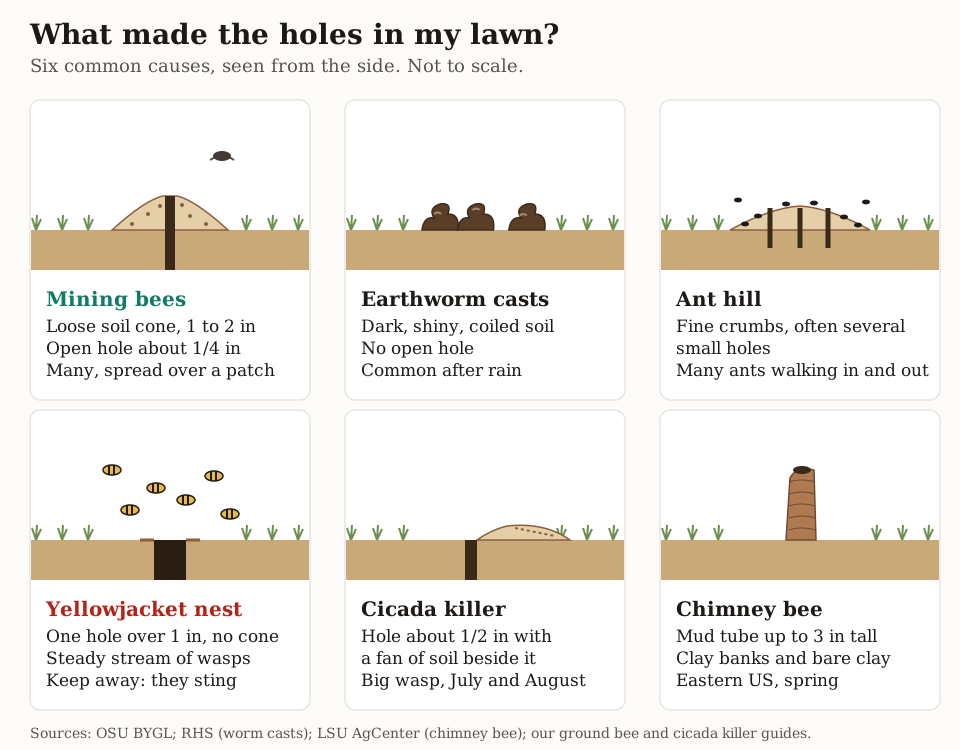
Mining bee nests and the holes mistaken for them
Many loose cones of dry soil, each with an open 1/4 in hole, one bee going in at a time
- Most likely
- Mining bees
- What to do
- Nothing. They leave in a few weeks
Dark, shiny, coiled lumps of mud with no open hole, often after rain
- Most likely
- Earthworm casts
- What to do
- Brush or rake them out once dry
A low pile of fine crumbs, often with several small holes and many ants
- Most likely
- An ant hill
- What to do
- Leave it, or see our ant guide
One hole over 1 in wide, no cone, a steady stream of wasps
- Most likely
- Yellowjackets
- What to do
- Keep away. Do not water or block it
A 1/2 in hole with a fan or trench of soil, and a wasp up to 2 in long, July and August
- Most likely
- Cicada killer
- What to do
- Leave it. Males cannot sting
A mud tube up to 3 in tall over the hole, on bare clay
- Most likely
- Chimney bee
- What to do
- Nothing. As gentle as mining bees
One mound a foot or more across, with no open hole
- Most likely
- Pocket gopher
- What to do
- See our gopher guide
Earthworm casts are the most common mix-up. After a wet night, a lawn can fill with hundreds of little mounds. On Reddit, the top answer to one Michigan homeowner’s photo of them was simply “Earthworms”. Casts are muddy, darker than the soil around them, shiny when fresh and often coiled. By contrast, a mining bee cone is dry and crumbly, the same color as the soil or paler, with a clean hole you can see into.
If you find one busy hole instead of many quiet ones, read our guide to telling ground bees from yellowjackets before you do anything. A huge wasp digging in summer is a cicada killer, and ant hills are covered in our ant guide. For the big fan-shaped mound, see the pocket gopher.
Bees and wasps mistaken for mining bees
Insects people confuse with mining bees
Golden brown, from a hive, never digs
- Insect
- Honey bee
- How it differs
- Lives in a colony of thousands and never nests in a lawn hole
Often metallic green, lands on your skin
- Insect
- Sweat bee
- How it differs
- Also nests in the ground, often in the same patch, but drinks sweat
Slim, almost hairless, red, yellow or black, hovers over the holes
- Insect
- Nomad (cuckoo) bee
- How it differs
- Lays its eggs in mining bee nests. Carries no pollen and does not dig
Smooth, bright yellow and black, pinched waist, late summer
- Insect
- Yellowjacket
- How it differs
- A social wasp that defends one large nest and stings readily
Large, round, very furry, black and yellow
- Insect
- Bumble bee
- How it differs
- Uses one entrance in an old mouse hole, all summer
Large, with a bare, shiny black abdomen, at wood
- Insect
- Carpenter bee
- How it differs
- Drills round holes in wood, not soil
Sweat bees often share the same bare patches, and our sweat bee guide covers the small metallic ones. If the bee is big and round, it is probably a bumble bee, and a shiny black bee at your deck is a carpenter bee.
Inside a mining bee nest
A mining bee nest is a single tunnel dug by one female. It starts at a hole about 1/4 inch wide, the width of a pencil, runs down into the soil, and branches into a few small side chambers called brood cells. Each cell gets one ball of pollen and nectar and one egg, and then she seals it.
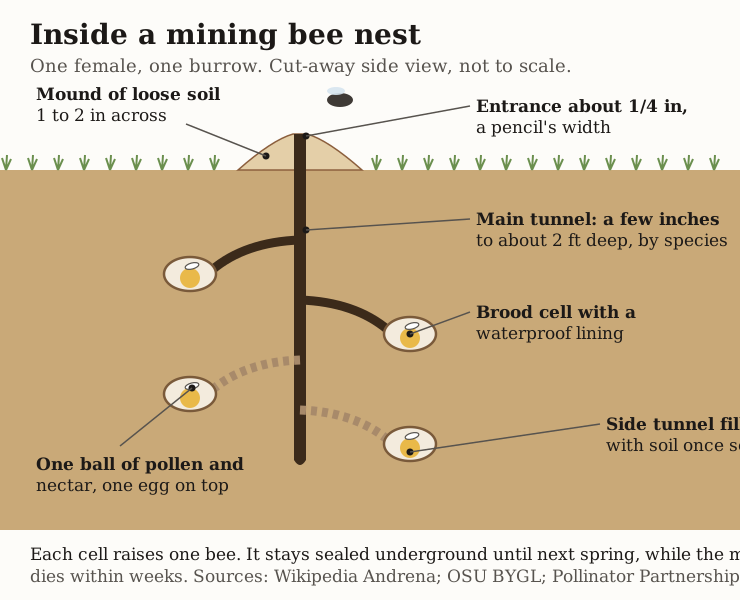
How deep the tunnel goes depends on the species and the soil, and sources give different figures. Ohio State describes burrows several inches deep, while a WFSU nature blog from Florida describes nests a foot or two down. Either way, the cells sit well below a mower blade.
The female lines each cell with a shiny, waterproof coating, which keeps the food from going moldy in damp soil. The cone on top is only the soil she dug out. It is not a roof or a door, and the next rain flattens it.
Why there are so many: aggregations
These bees are solitary, but they all like the same kind of ground. So dozens or thousands of females often nest side by side, which scientists call an aggregation. It looks like a colony. In fact, each burrow belongs to one bee, and the neighbors never work together.
Some aggregations are huge. In 2026, Cornell University researchers estimated that about 5.5 million regular mining bees, Andrena regularis, nest under roughly 1.5 acres (6,000 square meters) of East Lawn Cemetery in Ithaca, New York. Their range ran from about 3 million to 8 million. Bees have been collected at the site since the early 1900s, and the cemetery superintendent told Cornell they have never stung him.
A good site also tends to grow. Young females dig close to where they hatched, so a patch with a few holes one spring can hold many more a few springs later. This is why homeowners often say the bees get worse every year. It is the same population doing well, not a new invasion.
When mining bees come out, and how long they stay
The adults are above ground for only about 3 to 6 weeks a year. In Florida and along the Gulf Coast they fly from late February into March. Across most of the US the season runs from March to May, and in the far North it reaches June. A few species fly in late summer and fall instead.
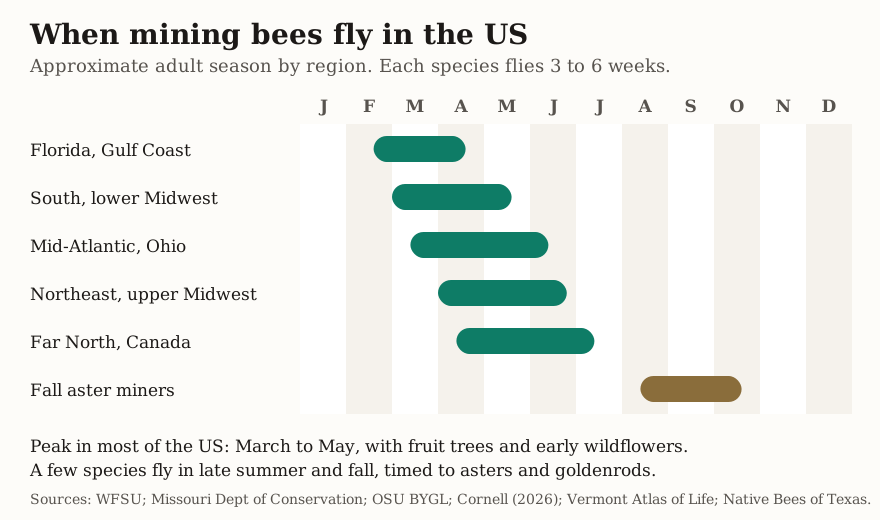
Sources give slightly different lengths for the season. The University of Maryland Extension says about 3 to 4 weeks, Honey Bee Suite says 4 to 6, and Save the Bees USA says the busy part lasts 2 to 4. The exact length depends on the species and the weather, since cold or rainy spells pause the bees.
Males come out first, usually a few days before the females, and Cornell’s team saw them emerge in bursts on warm days. That is why the first sign is often a cloud of bees flying low over the grass with almost no digging. Then the cones appear, and the flying settles down.
Do mining bees come back every year?
Yes, usually to the same spot. The young spend the rest of the year sealed in their cells underground. Next spring they dig out a few inches from where their mother nested. As long as the soil stays bare, sunny and dry, the patch stays attractive, and some sites are used for decades.
What happens underground the rest of the year
Each egg hatches into a grub, which eats its pollen ball over a few weeks. Next it turns into a pupa and, in most species, into an adult by late summer or fall. That adult stays in its sealed cell all winter and digs out in spring. Ohio State describes them overwintering as pupae instead, so the stage may vary by species.
This matters for lawn work. The next generation is in the soil all year, so tilling, regrading or stripping sod over a nest patch kills most of it. Instead, the University of Maryland Extension advises letting the holes fill in on their own and overseeding thin turf in fall.
Do mining bees damage your lawn?
No. The bees eat only nectar and pollen, so they never touch grass roots. The holes are only about 1/4 inch wide, too narrow to harm turf, and the loose soil around each one washes or mows flat within days. If anything, the tunnels let a little air and water into hard ground.
The bees are a sign of the lawn, not the cause of it. Females pick thin, bare, sunny, well-drained spots, so a lawn full of them was usually thin there already. Thicken the grass, and the bees will look elsewhere next spring.
How mining bees live: no queen, no honey
Every mining bee female is her own queen and worker. In her 3 to 6 weeks above ground she mates, digs, gathers pollen and lays her eggs, then dies long before her young come out of the ground. Males live only a few weeks too. There is no colony, no hive and no queen to protect.
So when someone sees hundreds of bees in a yard and says they are moving their queen, as one Reddit reply did, that is honey bee behavior. A honey bee swarm hangs in one tight clump on a branch or fence. By contrast, these bees spread out over the ground, one bee per hole.
Do mining bees make honey?
No. A female packs pollen and nectar into a firm ball for each egg, and the grub eats all of it. Nothing is stored for later, so there is no honey to collect and nothing to draw raccoons or bears to dig.
Specialists on one flower
Many species collect pollen from just one kind of plant, and their emergence is timed to its bloom. For example, the spring beauty mining bee, Andrena erigeniae, raises its young only on pollen from spring beauty (Claytonia). You can spot one by the pink pollen packed on its legs. Late in the year, the aster mining bees of the subgenus Callandrena collect from asters and their relatives.
Others are generalists. Carlin’s mining bee, Andrena carlini, one of the most common spring species in the East, visits many trees and flowers, apples and blueberries among them.
Cuckoo bees and other enemies
Watch a nest patch and you may see slim, almost hairless red, yellow or black bees that look like small wasps, flying slowly over the holes. These are nomad bees, genus Nomada, also called cuckoo bees. A female slips into an open burrow and lays her egg in a cell, and her grub then kills the mining bee egg and eats its food. At the Ithaca cemetery, the regular mining bee’s cuckoo is Nomada imbricata.
They also carry stranger parasites. Twisted-wing insects of the genus Stylops live inside the bee’s abdomen, with only a small bump showing between the segments. A 2023 study cites an 18% infection rate in one Danish aggregation. Flies and blister beetles raid the nests too. None of these harm people, and they are a normal part of a healthy bee site.
Are mining bees good pollinators?
Yes. With 400 to 450 species north of Mexico, they are some of the most important early spring pollinators in North America. They fly in cool March and April weather, when few other bees are out, and they work apples, cherries, blueberries and spring wildflowers.
Even so, these bees need some room. Many native bees are declining, and one Missouri species, Andrena beameri, is ranked vulnerable. The Cornell team pointed out that paving over one cemetery could wipe out millions of bees at once. Leaving a sunny patch of lawn alone each spring is an easy way to help.
Types of mining bees in the US
There are around 400 to 450 kinds of mining bees in North America, and most can only be named with a microscope. These are the ones people meet most often, or that have a feature you can actually see in the field or in a photo.
Mining bees you may meet in the US
Large, stocky females often taken for small bumble bees; often the most common spring species
- Mining bee
- Carlin's mining bee (Andrena carlini)
- Where and when
- The East and Canada, March to May
Forms huge aggregations, including 5.5 million bees under one New York cemetery
- Mining bee
- Regular mining bee (Andrena regularis)
- Where and when
- Northern US and Canada, April and May
Pink spring beauty pollen on the hind legs
- Mining bee
- Spring beauty mining bee (Andrena erigeniae)
- Where and when
- Eastern woodlands, early April to May
Small, 7 to 9 mm; females have rust-orange hair at the back of the thorax
- Mining bee
- Miserable mining bee (Andrena miserabilis)
- Where and when
- Across the US and Canada, early spring
Flies late in the year and collects from asters
- Mining bee
- Aster mining bees (subgenus Callandrena)
- Where and when
- Late summer and fall
Ranked vulnerable; pollinates early coreopsis on prairies
- Mining bee
- Andrena beameri
- Where and when
- Missouri prairies, spring
Ashy, tawny and other mining bees you read about online
Many of the best-known mining bees are European. The ashy mining bee (Andrena cineraria) is black with two gray bands across the thorax. The tawny mining bee (Andrena fulva) is covered in fox-red hair. Both are common in British gardens, and neither lives in North America. The same goes for the early, chocolate and yellow-legged mining bees.
The ivy bee that often appears on the same lists is not a mining bee at all. It is a plasterer bee, Colletes hederae. And if you searched for the ashy mining bee because of Minecraft, it comes from the Productive Bees mod, not from a real US lawn.
Should you get rid of mining bees?
Usually not. Mining bees are harmless, they do no lasting damage, and they leave by themselves within about 3 to 6 weeks. Waiting costs nothing and works every time. If they nest where you truly cannot have them, the lasting fix is to change the soil they choose, not to kill the bees.
Once you are sure, these steps move the bees on without harming them. Start with the ones that cost nothing.
Wait a few weeks
Most nest patches go quiet within 3 to 6 weeks. If nobody needs that part of the yard right now, waiting is the whole solution, and it costs nothing.
Put up a sign
A sign saying the bees are harmless native pollinators helps visitors and delivery drivers. The University of Maryland Extension suggests this when bees nest beside a front walk.
Mow early or late
Mow in the morning or evening, when fewer bees are flying. The blades pass over the burrows. Raise the deck a notch if bees are resting on the grass.
Water the patch, once you are sure they are bees
Mining bees prefer dry soil, so steady watering while they nest can move some on. It does not always work in fast-draining sandy soil, and too much water can bring lawn disease.
Thicken the grass in fall
Overseed and feed the thin spots in autumn, so the soil is covered by next spring. Dense, healthy turf is the most reliable long-term fix.
Cover bare beds
Where grass will not grow, a thick layer of mulch or a dense ground cover keeps the females from reaching the soil. A thin sprinkle of mulch is not enough.
What does not work
Vinegar, peppermint oil, cinnamon and garlic-chili sprays all appear in Google’s AI Overview and on many removal pages. We found no study showing that any of them moves the bees, and vinegar burns grass. Ant killer and foggers do not fit the problem either, and the University of Maryland Extension advised one Maryland homeowner against fogging. Blocking holes with stones does little, because a female simply digs around them.
Never pour gasoline, kerosene or other fuels into the holes. They are a fire and health hazard, and they poison the soil.
Insecticide is rarely justified here. It kills native pollinators that were leaving anyway, and it does nothing about the bare soil that will draw the next generation. If waiting and thicker grass do the job, no insecticide is needed. If one is ever used, it must be an EPA-registered product applied exactly as the label says, because the label is the law, and never on flowers that bees are visiting.
Mining bee myths
Most of what people believe about mining bees comes from honey bees or yellowjackets. Mining bees have no hive, no queen and no honey, and they spend their 3 to 6 weeks above ground digging and gathering pollen. These are the myths we see most often, both in forums and on the pages selling removal.
Myth 1
Myth: “Mining bees are aggressive.”
Truth: The bees flying at you are males, and males have no stinger. Females retreat into their holes. An insect that really defends a hole in your lawn is almost always a yellowjacket.
Myth 2
Myth: “A swarm over the lawn means they are angry.”
Truth: It is a mating flight. Males patrol the patch, waiting for females to dig out of the ground.
Myth 3
Myth: “They have a queen and a hive.”
Truth: Every female nests alone. There is no queen, no hive and no honey. Hundreds of nests side by side are neighbors, not a colony.
Myth 4
Myth: “They are ruining the lawn.”
Truth: They eat no grass and do no lasting damage. They choose ground that was already thin, bare and dry.
Myth 5
Myth: “Mining bees and chimney bees are the same thing.”
Truth: Chimney bees, Anthophora abrupta, build mud tubes over their holes. Mining bees leave loose cones of dry soil.
Myth 6
Myth: “A bee hotel will lure them out of the lawn.”
Truth: Mining bees nest only in the ground. Bee hotels suit mason and leafcutter bees, which nest in holes above ground.
Myth 7
Myth: “Cinnamon or vinegar spray will drive them off.”
Truth: We found no evidence for either. Vinegar also burns grass, which leaves more of the bare soil the bees want.
Myth 8
Myth: “The ashy mining bee lives in the US.”
Truth: It is a European species. The mining bees in American lawns are North American species.
When to call someone
You almost never need a pest control company for mining bees. Call one if you find a single hole over 1 inch wide with a steady stream of wasps, which is a yellowjacket nest, or if you cannot tell and children use the area. For a free identification, ask your county extension office or use our visual bug identification guide.
For a person who was stung, call 911 for any of the signs in the red box above. See a doctor if the sting spreads red and painful, oozes pus or brings a fever over the next few days. The Mayo Clinic also advises a visit if sting symptoms have not gone away within three days.
For more on how these bees fit with the others you meet, start at our types of bees guide. And if you are thinking of a bee house instead, remember it will draw mason bees, not mining bees.
Pest control disclaimer. Photo-based identification can help, but it is not always perfect. For dangerous spiders, large infestations, or anything you are unsure about, contact a licensed pest control professional.
Medical disclaimer. This page is for general information only. It is not a medical diagnosis. If you have severe symptoms, trouble breathing, swelling of the face or throat, fast spreading redness, fever, severe pain, pus, or signs of infection, contact a doctor or your local emergency number.
Frequently asked questions
Do mining bees bite?
Are mining bees out at night?
Can I move a mining bee nest to another spot?
Do mining bees come into houses?
Are mining bees the same as sweat bees?
Related guides
Ground bees
Many small holes or one busy one: how to tell harmless ground bees from yellowjackets.
Sweat bee
The tiny, often metallic green ground nester that lands on you for the salt in your sweat.
Bee sting
First aid, how long swelling lasts, and the signs of an allergic reaction.
Cicada killer
A wasp up to 2 inches long digging holes in lawns in July and August.
Bumble bee
A nest in an old mouse hole or under the shed, and why it ends on its own by fall.
Mason bees
Small blue-black spring bees that nest in holes above ground and use bee houses.
Types of bees
The eight bees you are most likely to meet, identified by size, shine and nest.
Insect identifier
Upload a photo and get an identification from the free AI tool.
Sources
- Cornell Chronicle, 5.5M ground nesting bees make home in Ithaca cemetery (2026)
- Ohio State University BYGL, Miner Bees are Major Pollinators. So, Bee Nice. (Boggs, 2023)
- University of Maryland Extension, Insects and Mites in Home Lawns
- Ask Extension (University of Maryland), encouraging miner bees to move on
- Missouri Department of Conservation, Andrenid Bees (Miner Bees)
- Pollinator Partnership, Pollinator Profile: Mining Bees (Andrena sp.)
- LSU AgCenter, Anthophora abrupta, Chimney Bee (2025)
- Native Bees of Texas, Andrena mining bees
- WFSU, Mining Bees: The Docile Bees Making Mounds on Your Lawn (2025)
- Watching Bees, Spring beauty mining bee (Andrena erigeniae)
- Hoffmann et al., Andrena vaga and Stylops ater, Parasitology (2023)
- Royal Horticultural Society, Worm casts in lawns
- Mayo Clinic, Bee stings: symptoms and causes