What is a bumble bee?
A bumble bee is any of about 250 to 270 species of large, hairy, social bees in the genus Bombus. About 46 of them live in North America. Three features name one: hair over the whole body, bands of black and yellow (sometimes orange, rust or white), and a smooth pollen basket on each hind leg of the female.
They belong to the family Apidae, along with honey bees, digger bees and squash bees, the UMN Bee Lab notes. Most of our native bees live alone. These do not. They live in colonies with a queen and her worker daughters, and the Xerces Society calls them the only truly social bees native to North America.
The exact count depends on the source. The UMN Bee Lab says 45 species live in North America, the Pollinator Partnership says 46, and the USDA Forest Service says 49 for the United States alone. Its western guide puts the US figure at about 40. All of them agree on the broad picture: dozens of species, and a few common ones in any one yard.
Bumble bee or bumblebee?
Both spellings are right. Entomologists write bumble bee as two words because it is a true bee, the same rule that gives us honey bee and house fly. Robert Snodgrass put the rule in writing in 1956: if the insect is what the name says, write two words, Entomology Today explains. Dictionaries and newspapers usually run it together as bumblebee.
The older English name was humble-bee, which Charles Darwin used in 1859, and dumbledore is another old name. Bumblebee replaced them during the 20th century (Wikipedia). The genus name Bombus comes from a Latin word for a buzzing sound (Chesapeake Bay Program).
What does a bumble bee look like?
A bumble bee is a round, heavy bee about 1/2 to 1 inch (13 to 25 mm) long and covered in thick hair, the Missouri Department of Conservation (MDC) says. Most US species are black with yellow bands, and some add orange, rust or a white tail. The abdomen is always fuzzy.
Queens can be longer and small workers shorter, as the table below shows. Females also carry pollen in a smooth basket on each hind leg.
How to tell it is a bumble bee
The real thing matches all five. If one fails, check the look-alikes below.
Fuzzy all over, abdomen included
MDC says the abdomen always has some fuzz. A bare, shiny black abdomen means a carpenter bee.
Four wings
Two pairs, joined by tiny hooks so they can look like one pair (Chesapeake Bay Program). Flies that copy them have only two.
Long, bent antennae
NC State lists long, elbowed antennae as a feature the look-alike flies do not share.
A pollen basket on each hind leg, on females
A smooth, shiny patch ringed with stiff hairs, often packed with a ball of yellow or orange pollen (Xerces Society).
Rounder and hairier than a honey bee
Queens and most workers are bigger too, but small workers can be honey bee size, so trust the hair over the size. A queen in spring can be longer than a US quarter is wide.
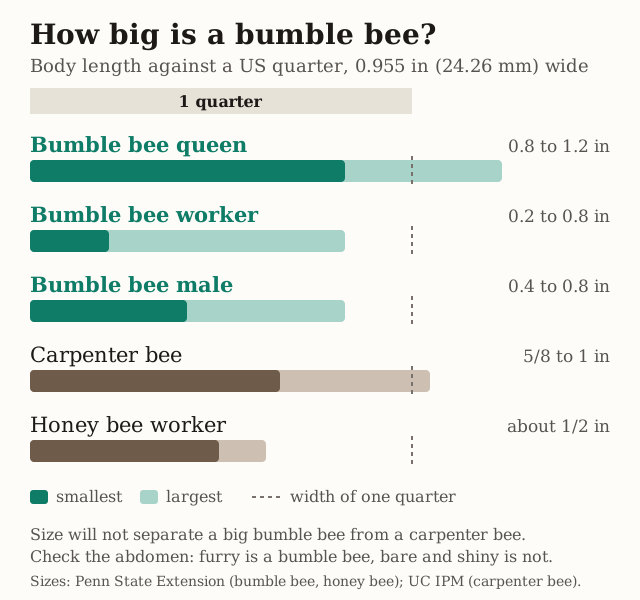
Bumble bee size by caste (Penn State Extension)
Queen
- Length (inches)
- 0.8 to 1.2
- Length (mm)
- 20 to 30
- When you see it
- Early spring, and new queens again in late summer and fall
Worker
- Length (inches)
- 0.2 to 0.8
- Length (mm)
- 5 to 20
- When you see it
- Late spring to fall
Male
- Length (inches)
- 0.4 to 0.8
- Length (mm)
- 10 to 20
- When you see it
- Late summer to early fall
Queen, worker or male?
Size and season tell you most of it. A huge one in early spring is a queen. In summer you mostly see the smaller workers, which vary a lot in size even within one nest. Males turn up in late summer and early fall. They cannot sting and have no pollen baskets, says UMass Extension.
Queen, worker and male bumble bees compared
Size
- Queen
- Largest, 0.8 to 1.2 inches
- Worker
- 0.2 to 0.8 inch
- Male
- 0.4 to 0.8 inch
Season
- Queen
- Spring; new queens in late summer and fall
- Worker
- Late spring to fall
- Male
- Late summer to early fall
Can sting
- Queen
- Yes
- Worker
- Yes
- Male
- No
Pollen baskets
- Queen
- Yes
- Worker
- Yes
- Male
- No
Antennae
- Queen
- One segment fewer than a male
- Worker
- One segment fewer than a male
- Male
- One extra segment
Where it spends the night
- Queen
- In the nest, or underground over winter
- Worker
- In the nest
- Male
- Often on a flower, sometimes in a group
How long it lives
- Queen
- Up to about a year
- Worker
- One to two months
- Male
- A few weeks
So in late summer, the bee asleep on your flower in the evening is most likely a male. UMass Extension explains that males leave the colony and most never return. Instead, they often spend the night on flowers. Nothing is wrong with it, and it will fly off once the day warms up.
Why are bumble bees so fuzzy?
The fur is a winter coat. The UMN Bee Lab says the long, thick hair is an adaptation to cold weather, and the group is more common in colder climates for that reason. They can also make heat with their flight muscles, and queens use that heat to warm their young (USDA Forest Service). As a bonus, the hairs catch pollen as the bee works a flower.
Is it a bumble bee? The look-alikes
Six insects are easy to confuse with an ordinary bumble bee: the carpenter bee, the honey bee, robber flies, hover flies, clearwing moths and cuckoo bumble bees. Three checks sort out nearly all of them. Count the wings (a bee has 4, a fly 2), look at the abdomen, and look for a pollen basket on the hind legs.
Bumble bee look-alikes and the feature that separates each one
Carpenter bee
- The feature that separates it
- Bare, shiny black abdomen with almost no hair
- Other clues
- Same size as a bumble bee; drills round holes in bare wood (MDC)
Honey bee
- The feature that separates it
- Slimmer body; a worker is about 1/2 inch long
- Other clues
- Lives in colonies of 10,000 or more and can swarm (Penn State, BBCT)
Robber fly
- The feature that separates it
- Two wings, a bearded face and a dip between the eyes
- Other clues
- Fleshy foot pads instead of claws (NC State)
Hover fly
- The feature that separates it
- Two wings
- Other clues
- Fleshy foot pads instead of claws (NC State)
Clearwing moth
- The feature that separates it
- Clear patches in the wings; hovers at flowers like a tiny hummingbird
- Other clues
- The snowberry clearwing and other sphinx moths copy bumble bees (MDC)
Cuckoo bumble bee (a bumble bee, but a nest parasite)
- The feature that separates it
- No pollen basket on the hind legs
- Other clues
- Takes over another bumble bee's nest and has no workers of its own (BBCT, USDA FS)
The carpenter bee is the usual mix-up, because the two overlap in size almost completely. Our carpenter bee guide has the full side-by-side. The short version is the abdomen: fur all the way down means a bumble bee, while a bare and shiny abdomen means a carpenter bee.
A big, mostly black bee in spring causes the same doubt. It is often a carpenter bee, but some bumble bee queens are dark too. The common eastern bumble bee has a yellow thorax and first band, and the rest of its abdomen is black (USDA Forest Service). Look for hair on that black abdomen to be sure.
Do bumble bees sting?
Yes, but only the females, and only when pushed. Of the 3 kinds of bee in a colony, queens and workers can sting, and males cannot (UW-Madison). The sting is smooth rather than barbed like a honey bee’s, so a bumble bee can sting more than once and survive. Away from the nest, though, one rarely stings anyone.
MDC says they sting if they are handled roughly or their nest is in danger, but they do not aggressively defend their colonies. In practice, stings come from stepping on a bee barefoot, grabbing one, trapping one in clothing, or running a mower over a nest.
You will see people online insist that these bees die after one sting. That belief comes from honey bees, whose barbed sting stays in the skin. UW-Madison researchers call it a common myth. As a result, one that stings you once can do it again, which is why several stings close together are possible.
Are bumble bees friendly? Can you pet one?
Calm is a better word than friendly. The Bumblebee Conservation Trust says bumblebees are not aggressive and will usually ignore you if you give them space. Some people do stroke them on flowers, and plenty of forum posts show it. Still, a bee that feels pinned can sting, and a female can do it more than once. Watch it, take a photo, and leave it be.
If a bumble bee stings you or your dog
A normal sting hurts, then swells and itches for a day or two. Our bee sting first-aid guide covers the first minute, how long the swelling lasts, and how to tell a normal reaction from an allergy. This bee leaves no stinger behind, so there is nothing to scrape out.
Dogs often get stung on the nose or in the mouth. Our section on stings on dogs and cats lists the signs that need a vet. Do not give a pet any human medicine unless a vet tells you to.
Do bumble bees make honey?
Yes, but only a little, and you cannot harvest it. They store nectar in small wax pots inside the nest, enough to feed the colony for about 2 days of bad weather, the Xerces Society says. A honey bee hive stores far more, because the whole colony has to survive the winter. A bumble bee colony does not.
That is why sources seem to disagree. The UK’s Bumblebee Conservation Trust says bumblebees do not make honey, since they do not store food for winter. Xerces calls the same stores a small amount of honey. Both describe the same thing: a few days of thick nectar, not a winter supply.
Can you eat bumble bee honey? Not in any useful way. The USDA Forest Service notes that they do not make and store large amounts of honey the way honey bees do. Taking it would mean breaking open a nest of stinging bees for the little they have stored.
The reason is the life cycle. Only the new queens live through winter, and each one sleeps alone underground for months without feeding (Penn State Extension). So the colony has no reason to save food past the end of the season.
Where do bumble bees live and nest?
Bumble bees live mostly in the cooler parts of the Northern Hemisphere, with some species in South America. North America has about 46 species. They nest in holes that already exist, most often underground in an old mouse or other rodent burrow, according to the Xerces Society and the USDA Forest Service.
They are not native to mainland Australia. In Africa, they live only north of the Sahara. People brought them to New Zealand in 1885 and 1886, and they turned up in Tasmania in 1992 (Wikipedia). So an Australian reader who sees one is almost certainly in Tasmania.
Queens are not fussy. They take any cavity of the right size, and an old rodent hole is a favorite because it is warm and already lined with fur (Xerces Society). Above ground, they use hollow trees, old bird nests, rock walls and thick tufts of grass. Around houses, the UMN NestQuest project says nests may turn up under building foundations, in birdhouses and even in patio cushions.
They do not chew wood or dig through walls. That means they do not damage a house the way carpenter bees can. A nest in a wall or under a floor is using a gap that was already there.
What does a bumble bee nest look like?
From outside, it is usually just a small hole in the ground or a gap under a step, with bees flying in and out. Inside, it looks nothing like a honey bee comb. UMN NestQuest describes a clump of wax pots and bowls with no neat six-sided cells, and the Bumblebee Conservation Trust calls it messy. A colony holds 50 to 500 bees (Xerces Society).
Found a bumble bee nest? What to do
In most cases, leave it alone. A bumble bee nest lasts 2 to 6 months, usually 2 to 3, dies out by fall, and is never used again, says the Bumblebee Conservation Trust. By the time you notice the traffic, the nest is usually at least 6 weeks old. Keep people and pets back from the entrance until it ends.
The UMN Bee Lab gives the same advice. Watch from a safe distance, confirm the bees with photos, do not disturb the soil, and do not try to move the nest. In other words, the cheapest fix is also the one that works.
How to live with a bumble bee nest until it ends
Check what is using the hole
Watch from a few yards away. Round, fuzzy bees going in and out of one hole are bumble bees. Lots of thin, smooth, yellow and black insects pouring out of a hole in late summer are more likely yellowjackets. Treat that as a wasp nest and keep well away. If you are not sure, send clear photos to iNaturalist or a similar ID project, as the UMN Bee Lab suggests.
Fence off the entrance
Use garden canes or an upturned wire hanging basket to block off the area right around the entrance, so feet, paws and toys stay away. Move play equipment or garden seating if it sits close by. The Bumblebee Conservation Trust suggests these temporary changes while a nest runs its course.
Leave the hole open
Do not block, flood, dig up or spray the nest. Each of those puts you right beside a colony of stinging bees while they defend it. The UMN Bee Lab advises leaving the soil alone and letting the nest finish.
Mow around it
Leave a small uncut patch around the entrance and keep the mower well clear of it. MDC says they sting when their nest is in danger, and a blade over the hole is exactly that.
Wait for the bees to stop
Most nests end in late summer or fall. When you have seen no bees go in or out for at least two weeks, the Bumblebee Conservation Trust says you can assume the nest is over.
Clean up after it ends
Then fill the hole or clear out the bird box. The Trust suggests waiting until October or November to be sure. The bees will not come back to that nest, though a new queen may pick the same spot another year.
Not sure whether the hole is bees or wasps? Our ground bees guide shows how to tell a small bee nest from a yellowjacket nest before you get close.
Sometimes a nest really cannot stay. It may be inside a wall, right by a door, or close to someone who is allergic to stings. In that case, call a licensed pest professional or a local bee rescue. Moving a nest is hard: the Bumblebee Conservation Trust says it cannot move nests or recommend anyone who can.
If you can wait for the nest to end, insecticide treatments are not required. If a professional does treat one, they must use an EPA-registered product exactly as the label says. The label is the law.
The bumble bee year
A colony lasts a single season of about 2 to 6 months. A lone queen starts it in spring, workers take over by early summer, and new queens and males appear from late June to September. By late fall, everything but the new queens has died (UW-Madison, Xerces Society). That calendar explains almost everything you see in your yard.
What bumble bees are doing through the year, and what you will notice
Late winter to spring
- What is happening
- Queens wake after 6 to 9 months underground and hunt for a nest. Xerces notes they can be the first bees out, from February. In Wisconsin, most emerge from mid-April to early May.
- What you see
- Very large bees flying low in a zigzag over the ground; queens resting on the ground
Spring
- What is happening
- The queen builds wax pots, lays her first eggs and keeps them warm. The first workers emerge 2 to 3 weeks after the eggs are laid (UW-Madison); Xerces gives 4 to 5 weeks.
- What you see
- One big bee going in and out of a hole, then a few small ones
Summer
- What is happening
- Workers take over foraging, and the nest grows to between 50 and 500 bees.
- What you see
- Busy traffic at the nest; small and medium bees on flowers
Late summer to fall
- What is happening
- The queen starts laying males and new queens. Males leave and most never return.
- What you see
- Bees asleep on flowers (males); large new queens feeding hard
Late fall and winter
- What is happening
- The old queen, the workers and the males die. Mated new queens dig into loose soil or thatch to hibernate.
- What you see
- Nothing at the nest. A bee found in winter soil is a sleeping queen
Sources do not agree on every number here. The time from egg to first worker is the clearest case, with UW-Madison giving 2 to 3 weeks and the Xerces Society 4 to 5. Weather and species both change it, so treat the calendar as a guide, not a timetable.
Why is that bumble bee so huge?
A very big bumble bee in spring is almost always a queen. She is the only member of last year’s colony still alive, and she can be 1.2 inches (30 mm) long, against 0.2 to 0.8 inch for her workers (Penn State). She flies low and slow while she searches the ground for a nest site.
Through the summer you see mostly workers, so the bees seem to shrink. Then in fall the new queens appear and they look big again. The largest species in the world, Bombus dahlbomii of Chile, reaches about 1.6 inches (40 mm), Wikipedia notes.
Where do bumble bees go in winter?
Only the new queens survive. After mating, each one digs into loose soil or thatch and sleeps there for 6 to 9 months (UW-Madison). The old queen, the workers and the males all die. If you dig a sleeping queen up while gardening, the Bumblebee Conservation Trust says to cover her loosely with the same soil. If she will not settle, leave her somewhere sheltered outside, such as under leaf litter. Do not bring her indoors.
How long do bumble bees live?
It depends on the bee. A queen lives up to about a year, and 6 to 9 months of that is spent asleep underground. Workers live one to two months, according to the Xerces Society. Males live a few weeks. The colony itself lasts a single season, usually 2 to 6 months from the queen’s first eggs to the end.
How long bumble bees live, by caste
Queen
- How long it lives
- Up to about a year, including 6 to 9 months of hibernation
- Source
- Chesapeake Bay Program, Animal Diversity Web; hibernation from Penn State and UW-Madison
Worker
- How long it lives
- One to two months
- Source
- Xerces Society
Male
- How long it lives
- A few weeks
- Source
- Bumblebee Conservation Trust
The nest
- How long it lives
- 2 to 6 months
- Source
- Bumblebee Conservation Trust
For comparison: a honey bee queen
- How long it lives
- Several years
- Source
- Penn State Extension
What do bumble bees eat?
Bumble bees eat nectar for energy and pollen for protein. The Chesapeake Bay Program says a forager carries about 25% of its body weight in nectar and pollen back to the nest. Adults drink nectar. Meanwhile, the workers feed the larvae a mix of nectar and pollen.
They are not picky. These bees visit a wide range of flowers, and the Xerces Society calls them generalists. The UMN Bee Lab lists gooseberry, bee balm, anise hyssop and asters among their favorites. Early food is critical, Xerces says, so willows and other spring-flowering shrubs help queens start their nests.
Some short-tongued species cheat. They bite a hole near the base of a long flower and drink through it, a habit called nectar robbing (USDA Forest Service). Small slits at the base of your flowers may be the sign.
A bumble bee on the ground that is not moving
It is probably resting. Research at Queen Mary University of London found that queens just out of hibernation spend much of their time resting on the ground. Their rests lasted about 30 minutes on average and up to 45, the Bumblebee Conservation Trust reports. So give it time before you step in.
Move it if it is in danger
If it is on a path, a road or a step, slide a leaf or a piece of card under it and set it somewhere sheltered nearby.
Give it 30 to 45 minutes
Leave it alone and check back. Resting on the ground is normal, especially for a queen in spring.
Set it on a flower
If it still has not moved after about 45 minutes and bee-friendly flowers grow nearby, place it gently on one.
Offer sugar water only as a last resort
With no flowers around, mix white sugar and water half and half, and offer a drop or two on a spoon near its head. Do not use honey or brown sugar.
Leave it outside
Give it time and space, and do not take it indoors. Sugar water is a one-off boost, not a diet.
The sugar water step comes straight from the Bumblebee Conservation Trust, and it is a last resort. Honey can carry germs that make bees ill, and brown sugar is harder for them to digest. A flower is always the better meal.
Why bumble bees matter
Bumble bees pollinate wildflowers and crops such as tomatoes, peppers, cranberries, blueberries and squash (Xerces Society, UMN Bee Lab). They fly in cooler weather and dimmer light than many bees, for up to 10 months a year, from February to November. They can also shake pollen loose with a fast buzz that some plants need.
The trick is called buzz pollination. The bee grips the flower with its jaws and vibrates its flight muscles, which shakes loose pollen that would otherwise stay locked inside (Xerces Society). Tomato flowers make no nectar, but these bees visit them anyway to collect pollen this way (USDA Forest Service). Honey bees cannot buzz pollinate at all (Brooklyn Botanic Garden).
Because they work so well, a few species are raised commercially and shipped around the world to pollinate greenhouse crops. That has a cost. The USDA Forest Service says these bees escape, go wild where they are not native, and can pass new diseases to wild bees.
Types of bumble bees you will see in the US
The US has 40 to 49 species, depending on the guide, but a handful make up most sightings. In the East, the common eastern bumble bee is one of the most common in North America. On the Pacific coast, the yellow-faced species is very common. Telling species apart usually means reading the bands on the abdomen.
Common US bumble bees and how to recognize the females (USDA Forest Service guides, Animal Diversity Web, FWS)
Common eastern (Bombus impatiens)
- Where
- East, west to North Dakota and east Texas; common, may be spreading
- Look for
- Yellow thorax and first band; the rest of the abdomen black
Brown-belted (Bombus griseocollis)
- Where
- East; common
- Look for
- Yellow thorax; a brown or yellow crescent on the second band; short hair
Two-spotted (Bombus bimaculatus)
- Where
- East; common
- Look for
- Black spot between the wings; a yellow W on the second band
Half-black (Bombus vagans)
- Where
- East; common, even in shady woods
- Look for
- Yellow on the first two bands, black tail, long face
American (Bombus pensylvanicus)
- Where
- Much of the US; uncommon and declining
- Look for
- Black top of the head; yellow second and third bands; black tail
Yellow-faced (Bombus vosnesenskii)
- Where
- Coastal California, Oregon and Washington; very common
- Look for
- Yellow face; black abdomen with one yellow band near the tip
Black-tailed (Bombus melanopygus)
- Where
- Pacific coast to the Colorado Rockies; common
- Look for
- Yellow first band; second and third bands orange or black
Hunt's (Bombus huntii)
- Where
- Sierra-Cascades east to the Rockies; common
- Look for
- Yellow face; orange second and third bands; black tip
Rusty patched (Bombus affinis)
- Where
- 13 states and Ontario since 2000; endangered
- Look for
- All-black head; workers and males have a rusty patch on the back, queens do not
Color varies within a species, and males are harder still. The Forest Service’s western guide says male color is not the most reliable clue. For a firm species name, send clear photos of the back, face and side to Bumble Bee Watch, where experts check them. For a quick first answer, our free photo bug identifier will tell you whether it is a bumble bee at all.
Not a bumble bee after all? Our guide to the eight kinds of bee you are likely to meet sorts honey bees, carpenter bees, sweat bees and the rest by size, shine and nest.
Bumble bee vs honey bee
A honey bee worker is about 1/2 inch long and lives in a colony of 10,000 to 80,000 that lasts for years (Penn State). A bumble bee colony holds 50 to 500 and dies each fall. Honey bee workers sting once and die. By contrast, a bumble bee can sting again, and it never swarms.
Bumble bee vs honey bee
Size
- Bumble bee
- 0.2 to 1.2 inches, by caste
- Honey bee
- Worker about 1/2 inch (12 to 15 mm)
Colony size
- Bumble bee
- 50 to 500
- Honey bee
- 10,000 to 80,000
Colony life
- Bumble bee
- One season
- Honey bee
- Years; one queen can live several years
Honey
- Bumble bee
- A few days' worth in wax pots
- Honey bee
- Large stores to last the winter
Sting
- Bumble bee
- Smooth; can sting again
- Honey bee
- Barbed; the worker dies
Swarms
- Bumble bee
- Never
- Honey bee
- Yes
Buzz pollination
- Bumble bee
- Yes
- Honey bee
- No
Native to North America
- Bumble bee
- Yes
- Honey bee
- No, brought over in the 1600s
Sources: Penn State Extension, UW-Madison, the Bumblebee Conservation Trust, Brooklyn Botanic Garden and the National Wildlife Federation.
Are bumble bees endangered?
Some are. More than a quarter of North America’s species face some degree of extinction risk, the Xerces Society says. Three US species are protected or proposed for protection: the rusty patched bumble bee (endangered in 2017), Franklin’s bumble bee (endangered in 2021) and Suckley’s cuckoo bumble bee (proposed in December 2024, with no final decision as of October 2026).
The clearest numbers come from a national study. Sydney Cameron and colleagues compared more than 73,000 museum records with over 16,000 bees caught in new surveys. Four of the eight species they studied had dropped in relative abundance by up to 96%, and their ranges had shrunk by 23 to 87% (PNAS, 2011). The declining species also carried more of a parasite called Nosema bombi.
The American bumble bee shows how fast it can happen. It was once among the most widespread species in North America. The US Fish and Wildlife Service (FWS) cites a 2014 IUCN assessment that puts its loss at 89% in abundance, compared with other bees that share its habitat. Franklin’s species has not been seen since a single bee was caught in southern Oregon in 2006 (FWS).
The UMN Bee Lab lists the main causes as habitat loss, pesticides, disease and climate change. Only species that are formally listed have federal protection. If your photo shows a worker with an all-black head and a rusty patch on its back, report it to Bumble Bee Watch: since 2000, that species has turned up in only 13 states and one Canadian province (FWS).
How to help bumble bees
Plant flowers that bloom from early spring to fall, so there is food all season. Leave some bare ground, old rodent holes and thatchy grass for nests (UW-Madison). The National Wildlife Federation suggests holding off on raking and mowing until April or May, and setting the mower blade high. Also keep insecticides off flowers that bees use. Finally, add your photos to Bumble Bee Watch so researchers can track each species.
Bumble bee myths
Most of what people get wrong about these bees comes from mixing them up with honey bees or carpenter bees. Here are 7 claims you will still read online, each set against what the research says. The most common by far is that a bumble bee dies after one sting.
Myth 1
Myth: “A bumble bee dies after it stings you.”
Truth: That is a honey bee worker. A bumble bee's sting is smooth, so it pulls free and the bee flies off. UW-Madison's bumble bee team calls the idea a common myth.
Myth 2
Myth: “Bumble bees live alone.”
Truth: They live in colonies with one queen and her workers. The Xerces Society calls them the only truly social bees native to North America.
Myth 3
Myth: “Science says bumble bees should not be able to fly.”
Truth: Wikipedia traces the story to a 1934 French book on insect flight by Antoine Magnan and calls it folklore. They fly by beating their wings 130 to 240 times a second (Chesapeake Bay Program).
Myth 4
Myth: “Only bumble bees can buzz pollinate.”
Truth: About half of all bee species can, carpenter bees included. Honey bees are the well-known bee that cannot (Brooklyn Botanic Garden).
Myth 5
Myth: “Bumble bees come back to the same nest every year.”
Truth: A nest is used for one season only. The new queens do not even spend the winter in the nest where they were born (Xerces Society).
Myth 6
Myth: “That swarm of bees is bumble bees.”
Truth: They never swarm. Thousands of bees in a cluster are honey bees, so call a local beekeeper (Bumblebee Conservation Trust).
Myth 7
Myth: “Bumble bees chew holes in wood.”
Truth: That is the carpenter bee. They move into holes that already exist, most often an old rodent burrow (Xerces Society, MDC).
When to call someone
Call 911 for trouble breathing or a swollen face or throat after any sting. Call a vet if your dog is stung in the mouth or throat. A nest rarely needs anyone, unless it is inside a wall, by a door, or where an allergic person or pet cannot avoid it. Then call a licensed pest professional or bee rescue.
Who to call, and when
Trouble breathing, swelling of the throat, lips or tongue, hives, or collapse after a sting
- Who to call
- 911
- Why
- Signs of a severe allergic reaction (MedlinePlus)
A sting inside the mouth or throat
- Who to call
- An emergency room, or Poison Help at 1-800-222-1222
- Why
- MedlinePlus advises it; swelling there can block breathing
A dog stung in the mouth or throat, or one that vomits, has pale gums or collapses
- Who to call
- An emergency vet
- Why
- See our bee sting guide's section on pets
A nest inside a wall, by a door, or near someone allergic to stings
- Who to call
- A licensed pest professional or a local bee rescue
- Why
- Nests are hard to move and are best left in place where possible (UMN Bee Lab, BBCT)
Thousands of bees in a cluster on a branch or wall
- Who to call
- A local beekeeper
- Why
- That is a honey bee swarm, not bumble bees (BBCT)
A bee with an all-black head and a rusty patch on its back
- Who to call
- Bumble Bee Watch, with photos
- Why
- It may be the endangered rusty patched bumble bee (FWS)
A nest in the lawn or under a shed, away from the house
- Who to call
- No one
- Why
- It ends on its own within a few months (BBCT)
Pest control disclaimer. Photo-based identification can help, but it is not always perfect. For dangerous spiders, large infestations, or anything you are unsure about, contact a licensed pest control professional.
Medical disclaimer. This page is for general information only. It is not a medical diagnosis. If you have severe symptoms, trouble breathing, swelling of the face or throat, fast spreading redness, fever, severe pain, pus, or signs of infection, contact a doctor or your local emergency number.
Frequently asked questions
A bumble bee got into my house. What should I do?
What eats bumble bees?
Are bumble bees invasive?
Can I keep a bumble bee as a pet?
Related guides
Types of bees
Sort the eight bees you are likely to meet by size, shine and nest.
Carpenter bee
The big shiny black bee by your deck, and why the one in your face cannot sting.
Bee sting
First aid, the swelling timeline, and stings on dogs and cats.
Ground bees
Many small holes means harmless bees. One busy hole means yellowjackets.
Sweat bee
The tiny, often metallic green bee that lands on you for the salt in your sweat.
Insect identifier
Upload a photo and get an identification from the free AI tool.
Sources
- Xerces Society, About bumble bees
- Xerces Society, At-risk bumble bees
- University of Minnesota Bee Lab, Bumble bees
- University of Minnesota NestQuest, Bumble bee nesting 101
- Bumblebee Conservation Trust, Should I feed bumblebees sugar water?
- USDA Forest Service, Bumblebees (Bombus spp.), by David Inouye
- Colla, Richardson and Williams, Bumble Bees of the Eastern United States, USDA Forest Service and Pollinator Partnership (2011)
- Bumblebee Conservation Trust, Bumblebee nests
- Koch, Strange and Williams, Bumble Bees of the Western United States, USDA Forest Service and Pollinator Partnership (2012)
- Penn State Extension, The bumble bee lifestyle
- Bumblebee Conservation Trust, Are bumblebees a threat to pets and children?
- UW-Madison, Bumble Bees of Wisconsin: Life cycle and biology
- UW-Madison, Bumble Bees of Wisconsin: FAQ
- Bumblebee Conservation Trust, Do bumblebees swarm?
- UMass Extension, Male bumble bees
- Missouri Department of Conservation, Bumblebees
- Bumblebee Conservation Trust, I have disturbed a hibernating bumblebee
- NC State Extension, Bumblebee look-a-likes
- Chesapeake Bay Program, Bumble bees
- Bumblebee Conservation Trust, How do I rescue a trapped bumblebee?
- Pollinator Partnership, Bumble bee resources
- National Wildlife Federation, 5 facts about bumble bees and how to help them (2021)
- Bumblebee Conservation Trust, What eats bumblebees?
- Animal Diversity Web, Bombus impatiens
- UC IPM, Carpenter bees, Pest Notes
- US Fish and Wildlife Service, Rusty patched bumble bee
- Bumblebee Conservation Trust, About bumblebees
- US Fish and Wildlife Service, Franklin's bumble bee
- US Fish and Wildlife Service, American bumble bee
- Federal Register, Endangered species status for Suckley's cuckoo bumble bee, proposed rule (December 17, 2024)
- Cameron and colleagues, Patterns of widespread decline in North American bumble bees, PNAS 108(2): 662-667 (2011)
- Brooklyn Botanic Garden, The buzz behind your summer tomatoes
- Entomology Today, Is it honey bee or honeybee? (2014)
- Wikipedia, Bumblebee (names, range and the flight myth)
- MedlinePlus, Bee, wasp, hornet, or yellow jacket sting
- United States Mint, Coin specifications