What are mason bees?
Mason bees are solitary bees in the genus Osmia that nest in existing holes and build the walls inside with mud. About 140 species live in North America, says the US Forest Service, out of 342 described worldwide (NatureServe). Most are about honey bee size or smaller, and many are metallic blue or green.
The name comes from that mud work. The Forest Service says the habit of building with mud is why people call them masons. In the UK the same bees are often called masonry bees or mortar bees, because some of them nest in soft mortar. Not every species uses mud, though. A few line their nests with chewed leaves or even flower petals.
Each female works alone. She finds a hole, stocks it with pollen and nectar, lays her eggs and seals it up. So there is no hive, no queen and no honey. Many females may still nest side by side, which is why a wall or a bee house can look busy. They belong to the family Megachilidae, along with leaf cutter bees.
Are there mason bees in the US? Yes, from coast to coast. The blue orchard bee alone is native from Nova Scotia to Georgia and Texas in the East, and from British Columbia to southern California in the West (Bosch and Kemp). California has the most kinds, with 88 species, says NatureServe.
How to tell it is a mason bee
Most of these should match a female. Males are smaller and carry no pollen.
Early spring
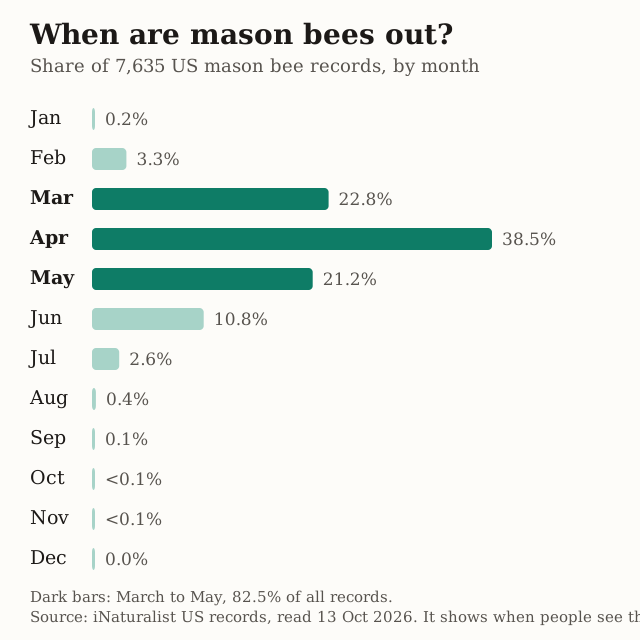
82.5% of US records fall between March and May (iNaturalist). A summer bee is more likely something else.
Metallic blue, green or black
Most North American species are one of these colors (SARE). In poor light a blue one can look black.
Pollen under the belly, not on the legs
Females carry dry pollen in a brush of hairs under the abdomen (Bosch and Kemp). Honey bees pack it on their hind legs.
Going in and out of a small hole
Holes are usually 1/4 to 3/8 inch wide (WSU Extension), in wood, stems, siding gaps or soft mortar.
A mud plug in the hole
A finished nest is sealed with a rough plug of mud, flush with the opening (SARE, WSU).
Calm around people
Females are not aggressive and rarely sting, even when handled (SARE).
Do mason bees sting?
A female mason bee can sting, but she rarely does. She stings only if she is handled roughly or trapped under clothing, says Oregon State University Extension. Males have no stinger at all (Bosch and Kemp). SARE’s pollinator handbook adds that the sting is much less painful than a honey bee’s.
The research handbook on the blue orchard bee puts it plainly. Females have a sting but rarely use it, and they will not sting people unless grabbed (Bosch and Kemp). SARE adds that people who raise them need no protective gear. So you can stand next to a busy bee house or a nesting wall without trouble.
Why so gentle? A honey bee guards a hive full of stored honey and thousands of sisters, so stinging pays. A mason bee has no colony and no honey to defend. Her best move is to fly away, and that is what she nearly always does.
Do mason bees die after stinging? No. Their stinger is not barbed, says the University of Arkansas, so it does not tear out. Honey bee workers have a barbed stinger that stays in the skin, which is why they die after stinging (UC ANR).
You may read that these bees do not sting at all. Even the Chesapeake Bay Program’s field guide says so. That is wrong for females, but it shows how rarely anyone gets stung.
Kids, pets and mason bees
Children are very unlikely to be stung if they watch and do not grab. Teach them not to poke fingers into nest holes or bee house tubes. A dog that snaps at bees in the air can get stung in the mouth. If its face swells or it struggles to breathe, call your vet or an emergency animal clinic right away.
If you have a bee sting allergy, treat any sting seriously. Otherwise, wash the spot and hold something cold on it. Our bee sting first aid guide covers how long swelling lasts and how to tell a normal reaction from an allergic one.
What do mason bees look like?
Most mason bees are 9/32 to 19/32 inch (about 7 to 15 mm) long, says SARE. They are stout, dark bees, usually metallic blue, green or black. The surest sign is dry pollen dusted under the female’s belly instead of packed on her hind legs.
The blue orchard bee, the one most Americans see, is dark metallic blue, sometimes blue-green. According to the US Forest Service, it is not striped brown and orange like a honey bee. A female is about the size of a honey bee but rounder (Bosch and Kemp). In shade or poor light she can look plain black, as UF/IFAS points out.
For scale, a US dime is 0.705 inch (17.9 mm) across. Even the biggest ones are shorter than a dime is wide. A honey bee is 1/2 to 5/8 inch long, says University of Minnesota Extension. In other words, most are honey bee size or a little smaller.
Look closely at a female’s face, and you may see a pair of small horns on the lower face, says SARE. You need a hand lens for that, though. In flight, the dark metallic color and the gold dust under the belly are what to watch for.
Male vs female mason bees
Males are smaller, about two-thirds the size of a honey bee (Bosch and Kemp). They have longer antennae, with 13 segments instead of 12 (UF/IFAS), and a tuft of white hair on the face (SARE). A male has no pollen brush and no stinger, so he cannot hurt you even if he lands on you.
Males come out first in spring and wait near the nest for females. They mate and die soon after, and they do no nest work at all. Females do all the building, so the bee carrying mud or pollen is always a female.
Mason bee look-alikes
The pollen and the color settle most cases. A dark blue bee with pollen under the belly in early spring is a mason bee. The table below compares them with 6 insects people confuse them with, and the one feature that separates each.
Mason bees and their look-alikes
Mason bee
- The feature that separates it
- Dark metallic blue, green or black; dry pollen under the belly; early spring
- Size
- 9/32 to 19/32 inch (7 to 15 mm)
- Nest
- Existing holes, walled and plugged with mud
Honey bee
- The feature that separates it
- Golden brown and striped; pollen packed in balls on the hind legs
- Size
- 1/2 to 5/8 inch
- Nest
- A hive of wax comb, with thousands of bees
Carpenter bee
- The feature that separates it
- Bare, shiny black abdomen; much bigger
- Size
- 3/4 to 7/8 inch
- Nest
- Round 1/2 inch holes it bores in bare wood
Leaf cutter bee
- The feature that separates it
- Dark with pale bands; carries pieces of leaf; summer
- Size
- About 1/2 inch
- Nest
- Existing holes, built from leaf pieces
Green sweat bee
- The feature that separates it
- Bright metallic green head and thorax; males often have a striped abdomen
- Size
- About 3/8 inch (10 to 11 mm)
- Nest
- Burrows in the soil
Blue mud dauber
- The feature that separates it
- A metallic blue wasp with a thin waist and long legs
- Size
- 1/2 to 1 inch
- Nest
- Reuses other mud daubers' nests
Cuckoo wasp
- The feature that separates it
- A wasp, not a bee: metallic green, blue-green or purple, and never carries pollen
- Size
- Varies by species
- Nest
- None of its own: lays eggs in other bees' and wasps' nests
The carpenter bee is the one people worry about, because it does drill wood. Penn State Extension describes its bare, shiny black abdomen and a nearly perfect round hole about 1/2 inch wide. Our carpenter bee guide covers that damage. Small bright green bees on your skin in summer are sweat bees, not masons.
Types of mason bees in the US
The mason bee you are most likely to see in the US is the native blue orchard bee. On October 13, 2026, we counted 7,635 research-grade US records of the genus on iNaturalist, across 51 species. The five most-recorded species hold over 5,700 of them, and two of those five come from Asia.
The most-recorded mason bees in the US (iNaturalist, read October 13, 2026)
Blue orchard bee (Osmia lignaria)
- US records
- 1,523
- Native?
- Yes
- Good to know
- Dark metallic blue; native to most of the US; sold to orchards and gardeners
Hornfaced bee (Osmia cornifrons)
- US records
- 1,213
- Native?
- No, from Japan
- Good to know
- Brought in by USDA in 1977 to pollinate apples; brown with a striped abdomen
Osmia ribifloris (blueberry bee)
- US records
- 1,142
- Native?
- Yes
- Good to know
- Western; bluish-green; tested as a blueberry pollinator
Osmia bucephala
- US records
- 991
- Native?
- Yes
- Good to know
- Native; one of six species that declined in the Mid-Atlantic since 2003
Osmia taurus
- US records
- 862
- Native?
- No, from East Asia
- Good to know
- Arrived by accident; first US record in 2002, now in 22 states
Treat this as a guide, not a census. Research grade means other users agreed on the name from photos, and many species are hard to tell apart that way. Records also follow where people take photos.
The blue orchard bee, or orchard mason bee
The blue orchard bee goes by several names: orchard mason bee, blue mason bee, or BOB to the people who raise it. It is native across most of the US, but UF/IFAS notes it is missing from Florida and parts of the Gulf Coast. Fruit growers use it for apples, pears, cherries, plums and almonds.
There are two kinds, an eastern one and a western one. Bosch and Kemp place the split at about the 100th meridian, while UF/IFAS and SARE put it at the Rocky Mountains. Either way, only the western kind is sold, SARE says, and sellers ship it outside its native range.
The two Asian mason bees, and the decline of native ones
The hornfaced bee was brought from Japan on purpose. USDA records give 1977, and Bosch and Kemp say the late 1970s and early 1980s. Japanese growers had used it on apples since the 1960s, and by 2001 on 75% of the country’s apple acreage (Bosch and Kemp). Osmia taurus came by accident. It was first reported in the US in 2002, in the Mid-Atlantic, and by 2023 it was known from 22 states and southern Ontario (Gutierrez and others). Penn State notes that the two look very much alike.
A 2020 study followed these bees in the Mid-Atlantic from 2003 to 2017. Six native species, the blue orchard bee among them, fell by 76 to 91%. Over the same years Osmia taurus rose by 800%, and the hornfaced bee held steady (LeCroy and others). The authors say other factors besides competition are likely involved, so the link is not proven.
The wider picture is mixed too. NatureServe counts about 139 native species in North America and lists 27% of them as at risk or no longer found. That is one reason the buying advice later on this page matters.
Other mason bees worth knowing
Some species break the mud rule. Osmia californica, a western species, builds with chewed leaf pulp, mud and nectar (SARE). Osmia conjuncta in eastern North America nests inside empty snail shells (Fanaki and others, 2023). In Turkey and Iran, Osmia avosetta lines each cell with two layers of flower petals around a thin layer of mud (Rozen and others, 2010).
In the UK, the common one is the red mason bee, Osmia bicornis, a ginger-haired bee of gardens and old walls. It is the main bee behind the UK search for masonry bees, covered in the walls section below.
Mason bees vs honey bees
Look at where the pollen is. A honey bee packs pollen into a smooth ball on each hind leg, while a mason bee carries it dry under her belly. Honey bees are striped brown and gold and live in colonies of thousands. Mason bees are dark, often metallic blue, and every female nests alone.
Mason bees vs honey bees
Where the pollen rides
- Mason bee
- Dry, in hairs under the belly
- Honey bee
- Packed in balls on the hind legs
Color
- Mason bee
- Dark metallic blue, green or black
- Honey bee
- Golden brown with darker stripes
Size
- Mason bee
- 9/32 to 19/32 inch (7 to 15 mm)
- Honey bee
- 1/2 to 5/8 inch
How it lives
- Mason bee
- Each female nests alone
- Honey bee
- Colonies of tens of thousands, with a queen
Nest
- Mason bee
- Existing holes, walled with mud
- Honey bee
- Wax comb in a hive or hollow tree
Honey and wax
- Mason bee
- None
- Honey bee
- Yes
Sting
- Mason bee
- Females only, rarely; stinger not barbed
- Honey bee
- Workers defend the hive; barbed stinger, the bee dies
Season
- Mason bee
- A few weeks in early spring
- Honey bee
- Spring to fall
Do mason bees make honey? No. They make neither honey nor beeswax, says NIEHS, part of the National Institutes of Health. Instead, each young bee gets a mass of pollen and nectar about the size of a pea (Penn State). It eats that loaf and nothing else until it becomes an adult.
Where do mason bees nest?
Mason bees nest in holes that already exist, about 1/4 to 3/8 inch wide. Wild ones use old beetle tunnels in dead wood, hollow stems and reeds. Around homes they take nail holes, gaps under shingles and siding, cracks in soft mortar and bee houses. Oregon State University Extension is clear that they cannot make holes of their own.
A female starts at the back of the tunnel. First she builds a mud wall at the deepest end (Bosch and Kemp). Then she brings in pollen and nectar, lays one egg on the pile and walls it off with more mud. Stocking one cell takes 15 to 40 trips to flowers, SARE says, and a tunnel ends up with 4 to 12 cells in a row.
The order matters. Females are laid in the deepest cells and males in the cells nearest the entrance. That is why males come out first in spring. Last, the mother leaves an empty space and seals the opening with a thick mud plug, roughly flush with the surface (SARE).
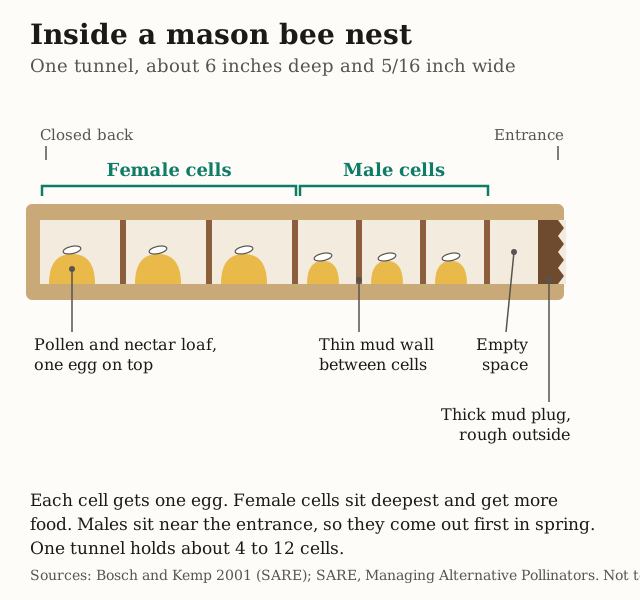
For that work, she needs damp mud with a high clay content (SARE). If there is no clay mud nearby, the bees will not use a nest site, Oregon State says. That is why a dry, sandy yard may have none, even with plenty of holes.
What a mason bee nest looks like
From outside, you see a hole plugged with mud. The University of Arizona says holes in use will be plugged with mud. WSU Extension adds that the mason bee’s plug is always rough on the outside. Behind the plug, the young bees spend the summer growing, then winter as adults inside their cocoons.
Mud nest on your wall? It is usually a wasp
A mud nest built on the surface of a wall, eave or porch ceiling is almost always a wasp nest, not a mason bee nest. Mason bees hide their mud inside a hole. The Missouri Department of Conservation notes that the blue orchard bee builds with mud too, but it puts that mud inside an existing hole (Oregon State).
Whose mud is it?
A hole sealed flush with a rough mud plug
- Who made it
- Mason bee
- Look for
- Small dark bees going in and out in spring
A hole sealed with a smooth mud plug
- Who made it
- Mason wasp
- Look for
- A slim wasp, not a bee, at the hole (Minnesota Bee Atlas)
A mud lump the size of a lemon or a fist, stuck to a wall
- Who made it
- Black-and-yellow mud dauber
- Look for
- A black-and-yellow wasp with a long, thin waist (Missouri Department of Conservation)
Rows of mud tubes 4 to 6 inches long, like organ pipes
- Who made it
- Organ pipe mud dauber
- Look for
- A black wasp with blue wings and white "stockings" on its legs (Missouri Department of Conservation)
An old mud dauber nest with a lumpy, patched surface
- Who made it
- Blue mud dauber
- Look for
- A metallic blue wasp that reuses other nests (Missouri Department of Conservation)
A tiny round mud jug with a narrow neck
- Who made it
- Potter wasp
- Look for
- A small wasp; the jug holds only young (UF/IFAS)
Mud daubers are calm too. Clemson Extension says they rarely sting unless threatened or touched by accident. Purdue Extension adds that they sting very rarely, and only when mishandled. So a mud nest on the wall is a nuisance, not an emergency.
Mason bees in brick, mortar, siding and window frames
Mason bees do not drill into sound brick, mortar or wood. They move into gaps that already exist. WSU Extension says orchard mason bees are not structural pests, and the University of Arizona says they are never destructive to homes. If bees are digging into mortar, that mortar was already soft or crumbling.
In the US, the usual spots are nail holes, gaps under siding and shingles, window frames and cracks. When a Maryland homeowner asked Ask Extension about holes in brick and mortar, the expert said bees were not the culprit, because these bees use existing cavities. An Ohio expert called the mason bee “also known as a mortar bee.” The expert said it usually uses cracks that already exist and is harmless to people.
Soft mortar is a different story. A few UK bees do dig into it. The red mason bee nests in soft or crumbling mortar joints, says BWARS, the UK bee recording society. The hairy-footed flower bee digs into soft mortar and cob walls with its jaws (Buglife). As a result, a wall with very poor mortar can slowly get worse, and BWARS says one species, Davies’ colletes, has a name for undermining mortar joints.
How much damage is that? Inverclyde Council in Scotland says these bees do no damage to good mortar, and only slight damage to old, poorly kept mortar. Test Valley Council adds that the bees point to a problem with the wall, and that many bees can speed up the damage. Nobody we found gives a rate of damage per year.
Fixing soft mortar, and when to do it
The only lasting fix for bees in soft mortar is to repoint it. Oxford City Council says to rake out the joints about 15 mm (5/8 inch) deep and refill them. Use a mortar that is hard enough to stop the bees but not too strong for the bricks. On an old house, ask a mason who works with historic brick.
Timing is a trade-off. Oxford says to repoint in late summer, and Test Valley says late summer or fall. However, BWARS notes that red mason bees spend the winter as adults in cocoons inside the wall, so fall repointing seals them in. Wigan Council says to wait until the new adults have come out. If you want to spare them, put up a bee house near the wall to draw them away, as Rochdale Council suggests.
Masonry bees in the UK, and are they protected?
In the UK, “masonry bees” usually means the red mason bee, sometimes the hairy-footed flower bee. Red mason bees fly from April to June, occasionally from late March, BWARS says, with one generation a year. Councils report them most on sunny, south-facing walls with soft mortar. They are not aggressive, and as in the US, only females can sting.
Are masonry bees protected? No UK bee is listed in Schedule 5 of the Wildlife and Countryside Act 1981, the list of protected insects. The British Pest Control Association says bees are not protected. Even so, Chesterfield Borough Council’s website says they are, so check with your own council if it matters. This is not legal advice.
Mason bees inside the house
A few bees indoors almost always came in through a gap, often around a window frame. Some nest in the frame itself and come out on the wrong side. WSU Extension suggests catching a bee under a jar with a card and letting it out. It also suggests filling openings about 1/4 to 3/8 inch wide and keeping screens tight.
Dead bees on a sill or by a dog bed in spring usually mean the same thing: a nest in or near a frame. In the UK, BWARS notes that red mason bees even nest inside door locks, and Bolton Council says they can block air bricks and keyholes with mud. Find the gap, and you have found the answer.
How to get rid of mason bees without killing them
Most people do not need to get rid of mason bees. WSU Extension recommends no controls, and notes that all bees are sensitive to pesticides. A nesting female lives about 20 days, so the spring rush is over in a few weeks. After that, fill empty holes, and leave the mud-plugged ones until the young chew out next spring.
Why wait on the plugged holes? The young bees inside are sealed in until the next spring (WSU). Filling over a mud plug traps them. Once they are out, usually in March to May, fill or caulk those holes too, and the next generation will nest somewhere else.
What to do about mason bees, by where they are
A few holes in sound brick, wood or siding
- What to do
- Leave them for the season. Caulk empty holes; fill plugged ones after next spring
- Why
- They do not dig their own holes in wood (WSU)
Soft, crumbling mortar
- What to do
- Repoint the joints, about 15 mm deep
- Why
- The only lasting fix (Oxford City Council)
Window or door frames, screen gaps
- What to do
- Block the gaps; put an empty bee house near the door
- Why
- Ask Extension experts in Michigan and Oregon
A wood pile, birdhouse or stored hose
- What to do
- Leave it until winter, then move it
- Why
- The bees are dormant in winter (Ask Extension, Oregon)
A bee house in the wrong place
- What to do
- Move it after dark, within 15 to 20 feet, at the same height. Or wait until fall
- Why
- Xerces Society, which notes the method is untested
Bees indoors
- What to do
- Jar and card, then find the gap
- Why
- They came in through an opening (WSU)
What keeps mason bees away? Mostly, taking away the holes. Fill nail holes and small gaps before spring, and they will nest somewhere else. Rochdale Council suggests fine netting over a wall in spring, while bees are looking for nest sites. We found no test showing that any smell, spray or home remedy repels them.
Can you move a mason bee nest? It is hard during the season, because the female remembers exactly where her hole is. The Xerces Society suggests moving nest material at least an hour after sunset, no more than 15 to 20 feet. In winter, when the bees are dormant, you can move a wood pile, birdhouse or bee house.
If filling the holes and waiting work, no insecticide is needed. If you still choose a pesticide for some other pest on the same spot, use only a product registered by the EPA for that use. Follow the label exactly, because the label is the law. Never spray flowers that bees are visiting.
Mason bee life cycle
Mason bees have one generation a year, and most of that year is spent sealed in the nest. In the US, adults fly mainly from March to May, which holds 82.5% of 7,635 iNaturalist records. April is the peak month, at 38.5%. They come out when the air reaches about 50 to 55F (10 to 13C), says Oregon State.
A mason bee's year
Adult
- When
- Early spring, a few weeks
- What happens
- Males come out first, then females 1 to 3 days later. They mate, and each female builds and stocks her nest (Bosch and Kemp)
Egg
- When
- Spring
- What happens
- One egg on each pollen loaf. It hatches in about a week (SARE)
Larva
- When
- Late spring to early summer
- What happens
- Eats the loaf for about a month, then spins a silk cocoon (SARE)
Prepupa
- When
- Summer
- What happens
- Rests in the cocoon for 1 to 2 months (Bosch and Kemp)
Pupa
- When
- Mid to late summer
- What happens
- Turns into an adult in about a month (Bosch and Kemp)
Adult in cocoon
- When
- Fall and winter
- What happens
- Stays dormant in the sealed nest. It needs a cold winter to come out in spring (SARE)
The season starts earlier in warm places. In western Oregon, the bees come out in February or March, says OSU. In the Mid-Atlantic they fly from about mid-April to mid-June (Penn State). Bosch and Kemp say nesting can start in February at lower latitudes and as late as June in cold areas.
When do mason bees lay eggs? Within a day or two of mating, in spring (SARE). A female lays only about 5 to 15 eggs in her life, though some lay 30 or more. That is a tiny number next to a honey bee queen, and it is one reason every nest counts.
How long do mason bees live?
About a year in total, but only a few weeks of it as a flying adult. A nesting female lives about 20 days on average, say Bosch and Kemp, and up to a month in good conditions (SARE). A USDA and Utah State fact sheet gives 4 to 6 weeks for spring adults. Males die soon after mating (SARE).
Pages that say a mason bee lives 6 to 8 weeks are usually quoting the season, not one bee. Penn State gives 6 to 8 weeks as how long the bees are active in the Mid-Atlantic, from mid-April to mid-June.
Are mason bees good to have around?
Yes. Mason bees are among the best pollinators of spring fruit, such as apples, pears, cherries, plums and almonds. They carry pollen dry and loose, so it rubs off on the next flower. They also fly at temperatures as low as 54F (12C) under cloudy skies, when few other bees are out (Bosch and Kemp).
The way they work explains it. A female lands on top of the flower and scrabbles the pollen into the hairs under her belly. That puts her in contact with the flower’s stigma on almost every visit, say Bosch and Kemp. Stocking a single cell can take about 1,875 flower visits. She also stays close to home, foraging within about 300 feet (100 m) of her nest.
Researchers have measured the difference. In a Spanish study on Red Delicious apples, one visit by a European mason bee gave more than five times the fruit yield of one visit by a nectar-gathering honey bee (Vicens and Bosch, 2000). For orchards, Bosch and Kemp found about 250 nesting females per acre enough for apples, and 300 for almonds. With honey bees, growers use 1 to 2.5 strong hives an acre, each with thousands of foragers.
The pollination numbers you see online
Many popular claims have no study behind them. We traced the common ones. Most lead back to a bee seller, a book by one, or a talk, and then get repeated by other sites. The table sets each one against what the research actually measured.
Mason bee pollination claims, checked
"6 mason bees pollinate a fruit tree that would take 360 honey bees"
- Where it comes from
- Repeated by the Chesapeake Bay Program; a University of Arkansas county page credits it to Crown Bees, a bee seller
- What the research shows
- No study found. Research gives per-acre figures, not per-tree ones
"1 mason bee does the work of 100 honey bees"
- Where it comes from
- A Cornell Cooperative Extension slide deck, with no study. The 2015 TEDx talk it cites says 2 to 3 times better
- What the research shows
- No study found
"95% of flowers visited are pollinated, against 5% for honey bees"
- Where it comes from
- Crown Bees; repeated in an OSU guide with no citation
- What the research shows
- No study found
"2,000 flowers a day, against 15 for a honey bee"
- Where it comes from
- A book by the founder of Crown Bees
- What the research shows
- No study found
"A few hundred mason bees do the work of thousands of honey bees"
- Where it comes from
- Bosch and Kemp, the USDA and SARE handbook
- What the research shows
- Supported: about 250 females an acre for apples, against 1 to 2.5 hives of thousands each
"Mason bees are better pollinators per visit"
- Where it comes from
- Vicens and Bosch 2000, Environmental Entomology
- What the research shows
- Supported, for one species on one apple variety: more than 5 times the yield per visit
So these really are excellent orchard pollinators. The research just measures them per acre and per visit, not in catchy ratios. For a home garden, a small, well-kept bee house near your fruit trees puts that skill to work.
How to attract mason bees
Give mason bees three things: holes about 5/16 inch (8 mm) wide and 6 inches deep, damp clay mud nearby, and early spring flowers. Mount a bee house 3 to 6 feet up in morning sun, under a roof. Put it out before your fruit trees bloom, and clean it every year.
Mason bee house: what works
Hole width
- What works
- 5/16 inch (about 8 mm); 19/64 inch (7.5 mm) is the measured best for blue orchard bees
- Source
- OSU, Penn State; Bosch and Kemp
Hole depth
- What works
- About 6 inches. Short holes give mostly males, because females are laid deeper than about 3 inches
- Source
- OSU, SARE
Material
- What works
- Paper tubes or liners, reeds, or wooden trays that open. Not solid blocks, bamboo or plastic
- Source
- OSU
Height
- What works
- 3 to 6 feet off the ground
- Source
- OSU
Direction
- What works
- Morning sun: east, southeast or south. Shade from hot afternoon sun
- Source
- Xerces Society, OSU, UMN
Shelter
- What works
- A roof over the tubes; mounted firmly, not swaying
- Source
- Xerces Society, MSU
Mud
- What works
- Moist, clay-rich soil close by
- Source
- OSU, SARE
Food
- What works
- Fruit trees, willow, Oregon grape, dandelion, redbud
- Source
- WSU, SARE, MSU
Cleaning
- What works
- Fresh tubes every year, or clean them; old blocks at least every 2 years
- Source
- Penn State, Utah State
How to set up a mason bee house
Choose nesting tubes you can open
Use paper tubes or paper-lined holes about 5/16 inch (8 mm) wide and 6 inches deep, or wooden trays that come apart. OSU Extension advises against solid drilled blocks, bamboo and plastic, which hold moisture and cannot be cleaned.
Pick a sunny, sheltered spot
Mount the house 3 to 6 feet off the ground where it gets morning sun, facing east or southeast. Put it on a wall or a solid post, not a swaying branch, and under a roof that keeps rain off the tubes.
Make sure there is mud
The bees need damp clay soil to build their walls. If your soil is sandy or dry, dig a small hole near the house, line it with plastic and keep it filled with moist soil, as WSU Extension suggests. Soil with clay in it works best (Oregon State).
Keep early flowers close
Fruit trees, willow, Oregon grape and dandelions all feed them in early spring. Keep the flowers within about 300 feet (100 m) of the house, the distance they usually forage.
Put the house out in early spring
Have it up before your fruit trees bloom, when daytime highs reach about 50 to 55F (10 to 13C). That is when the bees come out of their cocoons.
Take it in after nesting ends
Once the bees stop flying, usually by June, move the house into an unheated shed or garage. Penn State Extension says parasitic wasps attack nests left out in June and July.
Open the tubes in fall and store the cocoons
In October or November, open the tubes, take out the cocoons and clean them as your extension guide describes. Store them cold, around 39F (4C), and put them out again next spring. Throw away or clean the used tubes.
Do mason bee houses work?
They do attract bees, but they are not automatically good for them. In a study of nearly 600 bee hotels in Toronto, introduced species made up 47.1% of all the bees recorded. Native wasps used almost three in four hotels each year. Native bees were also parasitized more often than introduced ones (MacIvor and Packer, 2015).
On the other hand, NC State Extension says nobody really knows yet whether hotel bees fare worse than bees in wild nests. Its reading is that the evidence does not argue against a well-kept hotel. The key word is kept. University of Minnesota Extension warns that artificial nests tend to support more non-native bees and parasites than natural nesting areas.
What kills mason bees in a bee house
The main enemies are pollen mites, tiny parasitic wasps, a fungus and one fly. Pollen mites eat the food in a cell and starve the larva, and a single cell can end up with thousands of them (Xerces Society). Wasps called Monodontomerus, only 2 to 4 mm long, push their egg tube through thin nest walls and lay eggs on the young bees inside (Bosch and Kemp; Penn State).
Chalkbrood is a fungus that kills larvae, and Xerces calls it the hardest problem to control. The Houdini fly, a European pest, lays eggs in the pollen, and up to 20 of its larvae in one cell leave the bee with nothing to eat (Penn State). It was first recorded in New York in 2011 and found in Washington State in 2020. An Oregon state insect expert thinks someone moved a dirty nest block (OSU Master Gardener blog).
Birds and mice raid nests too. Penn State suggests plastic hardware cloth fixed 3 to 4 inches in front of the nest to stop woodpeckers. Store tubes over winter where mice cannot reach them. Above all, open and clean the nest every fall, because a dirty nest passes all of these on to the next generation.
Should you buy mason bees?
Often you do not need to. Put up a clean bee house in early spring, and local bees will usually find it. Buying has real risks. SARE notes that sellers ship the western blue orchard bee outside its native range. It adds that bought cocoons may hold parasites, sick larvae, or even no bees.
A 2025 paper found worse. A lab in Toronto ordered cocoons sold as blue orchard bees and found the hornfaced bee in one batch and the European orchard bee in another (MacIvor and Irwin). The USDA does not regulate moving bees between states in the lower 48, though it bans bringing them into Hawaii. Washington officials ask people not to move bee blocks around, because of the Houdini fly.
If you do buy, buy from your own region, and ask which species and subspecies you are getting. In the UK, you may see “bee bricks” sold for solitary bees. A field trial published in 2021 found bees and wasps did use them, but whether they help bee numbers is still untested (Shaw and others, 2021).
Mason bee myths
Most worry about mason bees comes from two myths: that they sting, and that they drill into houses. Neither is true in the way people fear. Here are 9 claims you will see online, checked against extension and research sources.
Myth 1
Myth: “Mason bees do not sting.”
Truth: Females have a stinger but rarely use it, and only when grabbed or trapped. Males have none (Bosch and Kemp, SARE).
Myth 2
Myth: “Mason bees drill holes in brick and wood.”
Truth: They cannot make holes in sound wood or brick, and use ones that already exist (OSU Extension). In the UK, red mason bees can dig into mortar that is already soft (BWARS).
Myth 3
Myth: “A mud nest stuck on the wall is a mason bee nest.”
Truth: Mud lumps and mud tubes built on a surface are mud dauber or potter wasp nests (Missouri Department of Conservation). A mason bee hides its mud inside a hole.
Myth 4
Myth: “One mason bee does the work of 100 honey bees.”
Truth: We found no study behind that number. The research compares whole orchards: about 250 nesting females an acre, or 1 to 2.5 honey bee hives (Bosch and Kemp).
Myth 5
Myth: “Mason bees make honey.”
Truth: They make no honey and no beeswax (OSU Extension; NIEHS). Each young bee gets a small loaf of pollen and nectar.
Myth 6
Myth: “A mason bee lives 6 to 8 weeks.”
Truth: 6 to 8 weeks is the length of the spring season in the Mid-Atlantic (Penn State). A nesting female lives about 20 days on average (Bosch and Kemp), and some sources give up to 4 to 6 weeks.
Myth 7
Myth: “Every bee house helps bees.”
Truth: Dirty, reused houses build up mites, parasitic wasps and chalkbrood (Xerces Society, Penn State). A house helps when it is cleaned every year.
Myth 8
Myth: “All the mason bees in your yard are native.”
Truth: Two Asian species rank second and fifth among US species on iNaturalist. One of them arrived by accident, with its first US record in 2002.
Myth 9
Myth: “Masonry bees are protected by law in the UK.”
Truth: No bee is listed in Schedule 5 of the Wildlife and Countryside Act 1981. They are still worth sparing, and this is not legal advice.
When to call someone
Almost never for the bees themselves. Call 911 for trouble breathing or swelling of the face or throat after any sting. For questions about a sting, Poison Help is free at 1-800-222-1222. For crumbling mortar, call a mason, not an exterminator, since the bees are a sign of the problem rather than its cause.
Who to call, and when
Trouble breathing, swelling of the face, mouth or throat, or fainting after a sting
- Who to call
- 911
- Why
- Signs of a severe allergic reaction (MedlinePlus)
A sting that keeps getting redder, more swollen or more painful over a few days
- Who to call
- A doctor
- Why
- Possible infection (MedlinePlus)
Questions about a sting
- Who to call
- Poison Help, 1-800-222-1222
- Why
- Free, confidential and open 24 hours a day (HRSA)
A pet stung in the mouth, or with a swollen face or trouble breathing
- Who to call
- Your vet or an emergency animal clinic
- Why
- The same warning signs as in people
Mortar crumbling or sand piling at the foot of a wall
- Who to call
- A bricklayer or mason
- Why
- Repointing is the only lasting fix (Oxford City Council)
Not sure what is nesting in your wall
- Who to call
- Your county Extension office
- Why
- Experts can tell bees from wasps and ants from a photo
Bees in your wall, but not a big problem
- Who to call
- Usually nobody
- Why
- WSU recommends no controls for mason bees. If you hire someone, ask for no spraying
Not sure the bee in your wall is a mason bee at all? Try our free photo identifier, or compare it against the eight kinds of bees people meet most.
Pest control disclaimer. Photo-based identification can help, but it is not always perfect. For dangerous spiders, large infestations, or anything you are unsure about, contact a licensed pest control professional.
Medical disclaimer. This page is for general information only. It is not a medical diagnosis. If you have severe symptoms, trouble breathing, swelling of the face or throat, fast spreading redness, fever, severe pain, pus, or signs of infection, contact a doctor or your local emergency number.
Frequently asked questions
Where do mason bees go at night?
What do mason bees eat?
Will mason bees come back next year?
Is the small black 'fly' at my bee house a mason bee?
Are blue mason bees rare?
Related guides
Types of bees
The eight kinds of bees most people meet, and the quickest way to name each one.
Leaf cutter bees
The mason bee's summer cousin, which builds with pieces of leaf instead of mud.
Carpenter bee
The big shiny black bee that really does drill into your deck.
Bee sting
First aid in the first minute, and how to tell a normal reaction from an allergic one.
Ground bees
Many small holes in a dry patch of lawn: harmless solitary bees, or a yellowjacket nest.
How to get rid of carpenter bees
What works on bees that bore into wood, and when to seal the holes.
Sweat bee
The tiny, often metallic green bee that lands on you for the salt in your sweat.
Sources
- Bosch and Kemp, How to Manage the Blue Orchard Bee as an Orchard Pollinator, SAN Handbook 5 (SARE, 2001)
- SARE, Managing Alternative Pollinators, chapter 6: Mason bees, natural history (Mader, Spivak and Evans, 2010)
- SARE, Managing Alternative Pollinators, chapter 6: Mason bees, lifecycle
- SARE, Managing Alternative Pollinators, chapter 6: Preferred nest dimensions
- SARE, Managing Alternative Pollinators, chapter 6: Obtaining and handling bees, trap nesting vs purchasing
- USDA Forest Service, Pollinator of the Month: Blue orchard mason bee (Moisset and Wojcik)
- Oregon State University Extension, Nurturing Mason Bees in Your Backyard in Western Oregon, EM 9130 (Edmunds, Little and Sagili, 2016, reviewed 2022)
- Oregon Master Gardener Association, Clackamas chapter, with OSU Extension, Orchard Mason Bee (10-Minute University)
- Penn State Extension, Orchard Pollination: Solitary Mason Bees (David Biddinger, updated January 13, 2026)
- Penn State Extension, Enemies of Mason Bees (updated August 8, 2024)
- Washington State University Extension, Orchard Mason Bee, PLS-112 (Arthur L. Antonelli, 2003)
- WSU PestSense, Orchard mason bees (reviewed March 23, 2025)
- UF/IFAS, Blue orchard bee, Osmia lignaria, EENY-549 (Estep, Zettel-Nalen and Ellis)
- Utah State University Extension, Blue Orchard Bee: Commercial Pollinator for Orchards, ENT-229-21 (Theresa Pitts-Singer, 2021)
- USDA ARS Ames, Pollinators at the Plant Introduction Station (Osmia cornifrons introduced in 1977)
- NatureServe, Conservation and Management of North American Mason Bees (Young, Schweitzer, Sears and Ormes, 2015)
- LeCroy and others, Decline of six native mason bee species following the arrival of an exotic congener, Scientific Reports 10: 18745 (2020)
- Gutierrez and others, Osmia taurus, a non-native bee species with invasiveness potential, Environmental Entomology 52(2): 149 (2023)
- Vicens and Bosch, Pollinating efficacy of Osmia cornuta and Apis mellifera on 'Red Delicious' apple, Environmental Entomology 29(2): 235 (2000)
- MacIvor and Packer, 'Bee hotels' as tools for native pollinator conservation: a premature verdict?, PLoS ONE 10(3): e0122126 (2015)
- MacIvor and Irwin, Mail-order solitary bee cocoons as a gateway for biological invasion, Journal of Pollination Ecology (2025)
- Fanaki and others, Osmia conjuncta nesting in snail shells, The Canadian Entomologist 155: e22 (2023, author copy)
- Rozen and others, Osmia avosetta nests lined with flower petals, American Museum Novitates 3680 (2010, repository copy)
- Xerces Society, Tunnel Nests for Native Bees (Mader, Shepherd, Vaughan and Guisse, 2013)
- Xerces Society, How to safely relocate stem-nesting bees (S. Morris, June 15, 2026)
- University of Minnesota Extension, Nests for pollinators
- University of Minnesota Extension, Honey bee identification (size)
- Minnesota Bee Atlas, Ancistrocerus antilope (mason wasp nest plugs)
- NC State Extension, What if bee hotels aren't actually good for bees? (Youngsteadt and Favre, 2022)
- Michigan State University Extension, Building and Managing Bee Hotels for Wild Bees, E-3337 (Brokaw and Isaacs, 2017; hosted copy)
- Utah State University Extension, Making and Managing Wild Bee Hotels, ENT-239-22 (2022)
- University of Arizona CALS, Africanized honey bee information sheet 29 (mud-plugged holes)
- University of Arkansas Cooperative Extension, Mason bees are beneficial insects (S. Sanders)
- NIEHS (National Institutes of Health), Mason bees
- Missouri Department of Conservation, Mud daubers (field guide)
- Missouri Conservationist, Missouri's mud daubers (2002)
- University of Arkansas Arthropod Museum, Organ pipe mud dauber
- Clemson Cooperative Extension HGIC 2512, Mud daubers (revised August 14, 2025)
- Purdue Extension E-253-W, Mud daubers (T. J. Gibb, 2018)
- UF/IFAS, Potter wasps of Florida, EENY-403 (E. E. Grissell)
- Penn State Extension, Carpenter bees
- Kansas State Research and Extension, Carpenter bees, MF2946
- Georgia Gwinnett College, Native Bees of Georgia, Agapostemon (green sweat bees)
- WSU HortSense, Cuckoo wasps (Chrysididae)
- UC ANR Bug Squad, Why do honey bees die when they sting? (K. Garvey, 2014)
- Ask Extension, Insect boring holes in brick and mortar, #774644 (Prince George's County, Maryland, 2021)
- Ask Extension, Mortar bees, activity seen in exterior walls in springtime, #825195 (Franklin County, Ohio, 2023)
- Ask Extension, Mason bees in window frames, #746604 (Ingham County, Michigan, 2021)
- Ask Extension, Humanely moving mason bees from a door frame, #928108 (Washington County, Oregon, 2026)
- Ask Extension, Mason bees in my wood pile, #814862 (Washington County, Oregon, 2022)
- Oregon State University Metro Master Gardener blog, A new pest of mason bees: the Houdini fly (Jean R. Natter, 2021)
- Cornell Cooperative Extension Suffolk County, Mason bee presentation (source of the '100 honey bees' figure)
- Chesapeake Bay Program, Mason bees (field guide)
- USDA APHIS, Honey bees and other bees (import and interstate movement)
- BWARS, Osmia bicornis, the red mason bee (G. R. Else)
- BWARS, Colletes daviesanus (G. R. Else)
- Buglife, Hairy-footed flower bee
- The Wildlife Trusts, Red mason bee
- USDA ARS, Agricultural Research, Osmia ribifloris and blueberries (September 2000)
- Utah State University Extension, Beginner's Guide to Common Native Bees (Zesiger and others, 2021)
- Oxford City Council, Mortar bees
- Rochdale Borough Council, Identify and control masonry bees
- Test Valley Borough Council, Bees leaflet
- Inverclyde Council, Mason bees
- Wigan Council, Pest control: bees
- Bolton Council, Seasonal pests leaflet (air bricks and keyholes)
- British Pest Control Association, Bees advice leaflet
- Chesterfield Borough Council, Wasps and bees
- Wildlife and Countryside Act 1981, Schedule 5 (legislation.gov.uk)
- Shaw and others, Bee bricks used by cavity-nesting bees and wasps, Conservation Evidence 18: 10 (2021)
- iNaturalist, genus Osmia, US research-grade records, read October 13, 2026
- MedlinePlus, Insect bites and stings
- HRSA Poison Help, About the Poison Help line
- US EPA, Introduction to pesticide labels
- United States Mint, Coin specifications