What are leaf cutter bees?
Leaf cutter bees are solitary bees in the genus Megachile that build their nests from pieces of leaf. About 242 species live in North America, says the US Forest Service. Most are dark, about the size of a honey bee, with pale bands across the abdomen and a brush of pollen-carrying hairs under the belly.
You will also see the name spelled leafcutter, leaf-cutter or leaf cutting bee, or cut down to cutter bee. All of them mean the same bees. They belong to the family Megachilidae, along with mason bees, resin bees and wool carder bees. Worldwide, that family has more than 4,000 named species.
Each female works alone. First she finds a hole that already exists, such as a hollow stem or an old beetle tunnel. Then she builds a row of cells inside it from cut leaves. She stocks each cell with pollen and nectar, lays one egg, and seals it. So there is no hive, no queen and no honey.
Not sure it is a bee at all? Our guide to the types of bees people actually see covers the eight groups most people meet.
Leaf cutter bug, wasp or beetle?
People who find the damage before the bee often search for a leaf cutter bug, insect, wasp or beetle. In most of the US, smooth round cuts from a leaf edge mean a bee. The one exception is a strip of Texas and Louisiana, where leafcutter ants can strip a small tree in a night. The table in the next section tells them apart.
A leaf-footed bug is a different insect altogether. It sucks juice from fruit and has flat, leaf-shaped flaps on its hind legs, says UC IPM. If that sounds like what you found, see our leaf-footed bug guide instead.
Are leaf cutter bees making the holes in my leaves?
Probably, if the holes are smooth half-circles cut from the leaf edge, about 1/4 to 3/4 inch across. Iowa State Extension says leaf cutter bees cut only from the edge of a leaf or petal, never the middle. Holes in the middle of the leaf, ragged holes or lace-like leaves point to something else.
Look closely at the edge of the cut. It is clean, as if made with a large paper punch, which is exactly how Iowa State describes it. The RHS adds that the pieces are uniform in size, and that many leaves on one plant may be cut. Sizes vary with the bee. UF/IFAS gives 1/4 to 1/2 inch, while Colorado State gives about 3/4 inch.
Why do leaf cutter bees cut leaves? Not to eat them. Bees feed on nectar and pollen, and leaf is their building material. The female flies each piece back to her nest and uses it to build the walls of a cell. In other words, she is taking bricks, not a meal.
What made the holes in your leaves?
Smooth half-circles or circles cut from the edge, 1/4 to 3/4 inch
- Most likely cause
- Leaf cutter bees
- Also look for
- A dark bee flying off with a piece of leaf, and holes nearby plugged with green or brown leaves (UF/IFAS)
Lace: the leaf eaten away between the veins
- Most likely cause
- Japanese beetles
- Also look for
- Metallic green and copper beetles, 1/3 to 1/2 inch, mostly in July and August (UMN Extension)
Windowpanes: see-through patches that later turn brown
- Most likely cause
- Rose slugs, the larvae of a sawfly
- Also look for
- Small, slug-like yellow-green, olive green or black larvae under the leaves (NYBG)
Irregular holes with smooth edges, anywhere on the leaf
- Most likely cause
- Slugs or snails
- Also look for
- Silvery slime trails. They feed at night and on cloudy days (UC IPM)
Chewed holes of any shape, with the leaf still mostly green
- Most likely cause
- Caterpillars or native beetles
- Also look for
- Usually nothing to do: a mostly green plant is fine (UW Extension, Dane County)
Many tiny pits and holes, usually under 1/8 inch
- Most likely cause
- Flea beetles
- Also look for
- Tiny beetles, 1/16 to 1/8 inch long (UMN Extension)
Whole leaves stripped, sometimes overnight, in Texas or Louisiana
- Most likely cause
- Texas leafcutter ants
- Also look for
- Leaf bits on ant trails leading to a nest. Colonies can hold up to 2 million ants (Texas A&M)
The Japanese beetle is an easy one to mix up, since both show up on roses in midsummer. Our Japanese beetle guide shows that damage up close and what to do about it.
Which plants they cut, and whether it hurts them
Leaf cutter bees like thin, smooth leaves. Colorado State University lists rose, green ash, lilac and Virginia creeper as favorites. UF/IFAS adds redbud, azaleas and bougainvillea. A Manitoba fact sheet also names petunias, impatiens, pansies, begonias, raspberries, strawberries and young trees.
On a healthy plant, the damage is cosmetic. UC IPM calls it harmless to otherwise healthy plants. Even so, small plants feel it more. Colorado State notes that where many bees concentrate on one planting, losing that much leaf can be damaging. Ohio State Extension found them working the lower leaves of redbud seedlings, close to the ground.
So how much is too much? An established rose bush or redbud with notched leaves needs nothing. A seedling, a tree planted this year or a small potted plant losing many leaves a week is worth covering. Besides, the cutting stops by itself once the bees finish nesting, an Ask Extension expert told a South Dakota gardener.
Why one bee cuts so many leaves
One female can cut several hundred leaf pieces in her life. For the alfalfa leafcutter bee, SARE’s pollinator handbook gives the numbers. She uses about 15 pieces to build the first cell, and 2 or 3 more to close it, then repeats the process for each cell after it. A tunnel holds 8 to 12 cells, and she plugs the entrance with 10 to 50 round pieces.
Add that up, and one finished tunnel takes roughly 150 to 270 pieces of leaf. A female finishes 2 to 4 tunnels in her life, SARE says. That works out to somewhere between 300 and just over 1,000 pieces, cut over a few weeks. Those are our sums from SARE’s figures, assuming every cell takes about 15 pieces, and they are for one small species. We found no counts for the bigger leaf cutter bees.
That explains the shock many gardeners feel. A rose that looked fine on Monday can be notched all over by the weekend, and only a handful of bees did it.
Do leaf cutter bees sting?
A female leaf cutter bee, about 1/2 inch long, can sting, but only when she is squeezed, trapped or stepped on. Colorado State University says the sting is very mild, much less painful than a honey bee’s or a yellowjacket’s. Males cannot sting at all. Crown Bees, which sells them, says stings are rare.
That gentleness has a reason. A honey bee guards a hive full of stored food and sisters, so stinging pays off. A leaf cutter bee has no colony to defend. UF/IFAS says leaf cutter bees do not defend their nests the way honey bees or bumble bees do. Her best move is to fly off, and that is what she nearly always does.
Do leaf cutter bees die after stinging? No. Honey bees are the only bees with a strongly barbed stinger, and the only ones that die after stinging. Many other bees have smoother stingers and can sting again, Wikipedia notes. Only females carry a stinger at all, because it formed from the tube a female lays eggs through.
What about a leaf cutter bee bite? Their jaws are strong enough to cut leaves. Still, we found no report of one biting a person. When people say a leaf cutter bee bit them, it was most likely a sting.
Children are very unlikely to be stung if they look and do not grab. Teach them not to poke fingers into bee house tubes or the pots where the bees nest. A dog that snaps at bees can get stung in the mouth. If its face swells or it struggles to breathe, call your vet or an emergency animal clinic right away.
If you have a bee sting allergy, treat any sting seriously. Otherwise, treat it like any bee sting: wash the spot and hold something cold on it. Our bee sting first aid guide covers how long swelling lasts and how to tell a normal reaction from an allergic one.
How to identify a leaf cutter bee
Look under the belly. A female leaf cutter bee carries dry pollen on a brush of hairs under her abdomen, not on her legs, so her underside looks dusted yellow or gold. She is dark, usually close to 1/2 inch long, with pale hair bands and a big head. A piece of leaf in flight settles it.
How to tell it is a leaf cutter bee
Most of these should match a female. Males are slimmer and carry no pollen.
Pollen under the belly, not on the legs
Leafcutting bees carry most pollen on hairs under the abdomen (UC IPM). Honey bees pack it into balls on the hind legs.
A dark body with pale bands
Usually blackish or gray, with white or yellowish hair bands across the abdomen (UC IPM).
About honey bee size
Most are close to 1/2 inch. The full range runs from 0.2 to 0.9 inch (5 to 24 mm), says UF/IFAS.
A big head with strong jaws
They have sharp jaws that can cut leaves and flowers. Only the females use them to cut nest material (Chesapeake Bay Program).
The belly working the flower
Females rub the underside against a flower to load the pollen brush. Wikipedia describes the motion as energetic and swimming-like.
A piece of leaf in flight
A dark bee flying with a piece of leaf is the surest sign of all.
Summer
79% of US records fall between June and September (iNaturalist).
How big are leaf cutter bees?
Most leaf cutter bees are about the size of a honey bee, close to 1/2 inch (13 mm) long. The full range runs from 0.2 to 0.9 inch (5 to 24 mm), according to UF/IFAS. The alfalfa leafcutter bee is one of the small ones, at about 1/4 inch, says the Missouri Botanical Garden.
A US dime is 0.705 inch (17.9 mm) across. So the biggest leaf cutter bees are longer than a dime is wide, and the smallest are under a third of it. Watch for one mix-up online: “1/2 inch or 7 to 8 mm” does not add up, because 1/2 inch is about 13 mm.
Male vs female leaf cutter bees
The female is the one you see cutting leaves. She is usually larger, with a pointed abdomen, the pollen brush and a stinger. By contrast, the male is smaller, with a rounder abdomen, longer antennae and no pollen brush, says the Chesapeake Bay Program. He has no stinger either.
Males of some species also have a pale, hairy face and wide front feet fringed with white hair, like small mittens. Watching Bees describes this in the carpenter-mimic leafcutter. The broad-handed leafcutter bee’s name means broad hand, and a USGS Bee Lab photo shows the male’s wide front feet. Males do no nest work at all. They visit flowers, look for mates and die soon after mating.
Leaf cutter bees vs honey bees and other look-alikes
The pollen tells a leaf cutter bee from a honey bee at a glance. A honey bee packs pollen into a smooth ball on each hind leg, while a leaf cutter bee carries it loose under her belly. The table below compares leaf cutter bees with 7 bees and insects people confuse them with, and the one feature that separates each.
Leaf cutter bees and their look-alikes
Leaf cutter bee
- The feature that separates it
- Dry pollen under the belly; carries pieces of leaf
- Size
- 0.2 to 0.9 inch, most about 1/2
- Nest
- Existing holes, built from leaf pieces
Honey bee
- The feature that separates it
- Pollen packed in balls on the hind legs; golden brown
- Size
- About 1/2 inch
- Nest
- A hive of wax comb
Mason bee
- The feature that separates it
- Often metallic blue-black; flies in early spring; walls its nest with mud
- Size
- About 1/2 inch
- Nest
- Existing holes, sealed with mud
Carpenter bee
- The feature that separates it
- Bare, shiny black abdomen; much bigger
- Size
- 3/4 to 1 inch
- Nest
- Round tunnels it bores in bare wood
Giant resin bee
- The feature that separates it
- Very large; yellow-brown hair on the front body; never carries leaves
- Size
- Females 22 to 27 mm (7/8 to 1 1/16 inch)
- Nest
- Old carpenter bee holes, sealed with resin or mud
Sweat bee
- The feature that separates it
- Small and often metallic green; lands on sweaty skin
- Size
- 1/4 to 3/4 inch
- Nest
- Tunnels in bare soil
Cuckoo leaf cutter bee (Coelioxys)
- The feature that separates it
- A sharply pointed tail and no pollen brush
- Size
- Similar or smaller
- Nest
- None of its own: lays its eggs in leaf cutter bee nests
Texas leafcutter ant
- The feature that separates it
- A wingless ant that marches leaf bits along a trail
- Size
- Workers vary in size
- Nest
- Huge underground colonies in Texas and Louisiana
The giant resin bee needs a word, because it turns up in the same bee houses and in old carpenter bee holes. It is a Megachile too, but it builds with resin, wood bits and mud, never leaves. UF/IFAS says it is native to East Asia and was first caught at North Carolina ports in 1994. It now lives in most states east of the Mississippi River.
The giant resin bee is not aggressive toward people, and UF/IFAS says males cannot sting. It is hard on carpenter bees, though. UMD Extension says it can coat them in sticky resin and then kill them. If old carpenter bee holes are your worry, our carpenter bee removal guide covers sealing them at the right time.
Where do leaf cutter bees live?
Leaf cutter bees live around the world, says the Chesapeake Bay Program, and in all 50 US states. iNaturalist holds research-grade US records from every state, Alaska and Hawaii included. They live wherever there are flowers for food and holes for nests: gardens, meadows, forest edges, farms and city yards.
Some states have dozens of kinds. UC IPM counts at least 75 Megachile species in California. Florida has about 63 species in the leaf cutter bee family, says UF/IFAS.
Which leaf cutter bee lives near you
The most-recorded leaf cutter bee changes with the region. On October 13, 2026, we pulled all 21,689 research-grade US records of leaf cutter bees from iNaturalist, leaving out the resin bees that do not cut leaves. Then we found the top species in every state.
The most-recorded leaf cutter bee by region (iNaturalist, US, read October 13, 2026)
Southeast and Mid-Atlantic
- Most-recorded species
- Carpenter-mimic leafcutter bee (Megachile xylocopoides)
- Top in
- 16 states, from Texas and Missouri to New Jersey. In North Carolina it is 1,136 of 1,231 records
- Good to know
- The female is all black with dark blue wings and about honey bee size or a bit bigger, so she passes for a small carpenter bee (Watching Bees, BugGuide)
North and Upper Midwest
- Most-recorded species
- Broad-handed leafcutter bee (Megachile latimanus)
- Top in
- 11 states, from Maine to the Dakotas. In Minnesota it is 711 of 958 records
- Good to know
- Its name means broad hand: the male has wide front feet (USGS Bee Lab)
West Coast and northern Rockies
- Most-recorded species
- Western leafcutter bee (Megachile perihirta)
- Top in
- California, Oregon, Washington, Idaho and Wyoming
- Good to know
- 610 of California's 1,521 records
Southwest and Hawaii
- Most-recorded species
- Megachile policaris (no common name)
- Top in
- Arizona, New Mexico, Oklahoma and Hawaii
- Good to know
- Also second in Texas, with 819 records
Colorado, Utah and Nevada
- Most-recorded species
- Alfalfa leafcutter bee (Megachile rotundata)
- Top in
- Those three states and Rhode Island
- Good to know
- Introduced from Eurasia and raised for alfalfa seed. Ties for first in Nevada and Rhode Island, which have few records
Elsewhere
- Most-recorded species
- Pugnacious leafcutter (Ohio, Pennsylvania, West Virginia); Megachile fortis (Kansas, Indiana, Nebraska); black-and-gray leafcutter (Montana, Alaska); flat-tailed leafcutter (Connecticut); Texas leafcutter (New York)
- Top in
- One to three states each
- Good to know
- Despite its name, the Texas leafcutter tops the list in New York, with 226 records
Read this as a guide, not a census. Research grade on iNaturalist means other users agreed on the name from photos, and many leaf cutter bees are hard to tell apart that way. The Bumblebee Conservation Trust notes that males are hard to separate even from other leaf-cutter species. Records also follow where people take photos, which is one reason Texas, Florida, California and New York lead.
Leaf cutter bee nests
A leaf cutter bee nest is a tunnel about as wide as a pencil, packed with a row of green, cigar-shaped cells. Colorado State University says one finished tunnel holds a dozen or more cells in a tube 4 to 8 inches long. Each cell holds a loaf of pollen and nectar and a single egg.
The female does not drill into sound wood. Instead, she uses a hole that already exists: a hollow stem, a beetle tunnel in dead wood, soft rotted wood, a crack in a wall or a bee house. Colorado State says she may tunnel into soft rotted wood or the pith of thick stems such as rose canes. Even so, it adds, leaf cutter bees do not damage houses or wooden structures.
A few kinds nest in the ground, says the US Forest Service. If you have many small holes in a lawn instead, our ground bees guide covers those.
What a leaf cutter bee nest looks like
From outside, you usually see only a hole plugged with leaf. UF/IFAS says holes plugged with green or brown leaves are the sign that a bee is nesting. Open the tube, and the cells sit end to end like a row of tiny green cigars. Iowa State says each cell is about 1/2 inch long.
Inside each cell is a pasty loaf of food. In the alfalfa leafcutter, it is about two-thirds nectar and one-third pollen, says SARE. The egg hatches, the larva eats the loaf, and then it spins a cocoon inside its leaf wrapping. That is the “leaf cocoon” people find when they clean out an old pot or chair.
They can even use plastic. In a 2013 study, researchers found alfalfa leafcutter bees building cells from cut pieces of plastic bags, and the young still came out as adults (MacIvor and Moore).
Nests in pots, patio furniture and around the house
Leaf cutter bees take whatever hole fits. The RHS lists dry soil in plant pots and wall cavities. The Bumblebee Conservation Trust adds window frames and air bricks. Iowa State mentions gaps in building moldings and plywood siding, and the Manitoba fact sheet names soffits near doors and windows.
Gardeners online report finding nests in patio chairs, under pavers and in old pots, and even in laundry left on the line.
Are they a problem there? Not usually. They do not chew into sound wood, they do not form colonies, and a female is done with her nest in a few weeks. A single bee indoors has usually wandered in through an open door or window. Trap it under a glass with a card, then let it out.
When are leaf cutter bees active?
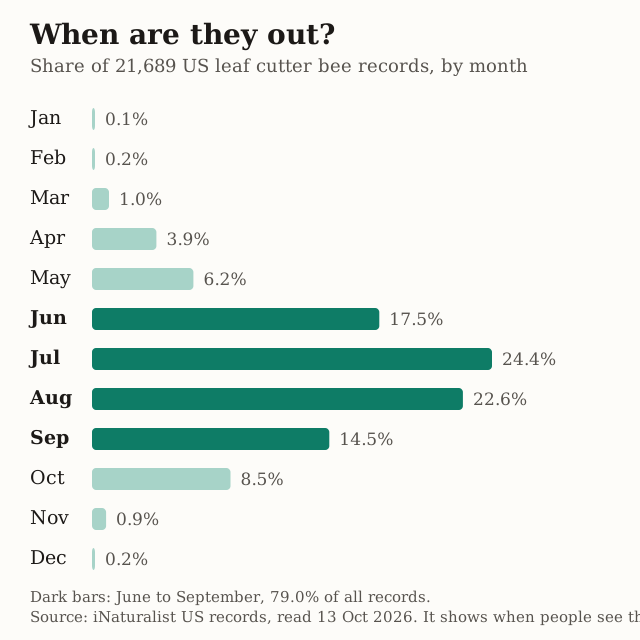
In most of the US, leaf cutter bees fly from June to September. That window holds 79% of the 21,689 US records on iNaturalist, and July is the busiest month at 24.4%. The North has a short season, mostly June to August. Texas and Florida have a much longer one, and Texas peaks in October.
Leaf cutter bee season by state (iNaturalist records, read October 13, 2026)
New York
- Records
- 1,648
- Busiest month
- July (36%)
- Months holding 80% of records
- June to August
Minnesota
- Records
- 958
- Busiest month
- August (38%)
- Months holding 80% of records
- June to August
Colorado
- Records
- 411
- Busiest month
- July (36%)
- Months holding 80% of records
- June to August
Washington
- Records
- 768
- Busiest month
- August (38%)
- Months holding 80% of records
- June to September
Georgia
- Records
- 981
- Busiest month
- July (30%)
- Months holding 80% of records
- June to September
California
- Records
- 1,521
- Busiest month
- July (26%)
- Months holding 80% of records
- May to September
Arizona
- Records
- 143
- Busiest month
- August (20%)
- Months holding 80% of records
- April to September
Texas
- Records
- 3,185
- Busiest month
- October (26%)
- Months holding 80% of records
- May to October
Florida
- Records
- 1,734
- Busiest month
- September (19%)
- Months holding 80% of records
- April to October, with records in every month
Whole US
- Records
- 21,689
- Busiest month
- July (24%)
- Months holding 80% of records
- May to September
Why does Texas peak in October? The records do not say. A long, warm season is the simple answer, but we found no study that tests it. Keep in mind, too, that these counts show when people photograph the bees, not exactly when they fly. Still, they match the extension guides. The Manitoba fact sheet, for example, puts adult activity there from mid-to-late June to mid-to-late August.
Leaf cutter bee life cycle and lifespan
A leaf cutter bee lives about a year, but only 6 to 8 weeks of it as a flying adult. The rest is spent sealed in its cell. Most species have one generation a year, and they spend the winter as a resting larva called a prepupa, says UC IPM.
A leaf cutter bee's year
Egg
- When
- Summer
- What happens
- Laid on a loaf of pollen and nectar in a sealed leaf cell, one egg per cell
Larva
- When
- Summer, for several weeks
- What happens
- Eats the loaf, then spins a dark cocoon (UC IPM)
Prepupa
- When
- Fall and winter
- What happens
- Rests inside the cocoon. This is the stage sold by bee suppliers
Pupa
- When
- Spring to early summer
- What happens
- Turns into an adult inside the cell
Adult
- When
- About 6 to 8 weeks in summer
- What happens
- Chews out, mates, and the female builds new nests. Males come out first (SARE)
A female lives up to 2 months and lays 35 to 40 eggs, Colorado State says. SARE gives an average of about 30 for the alfalfa leafcutter, with 50 or more on record. She finishes 2 to 4 tunnels in that time. Males die soon after mating.
When do leaf cutter bees hatch? Late spring to midsummer, once it is warm. Crown Bees, which sells alfalfa leafcutters, says its bees emerge when daytime temperatures hold at about 75F (24C). In warm places, some young do not wait for spring. In eastern Washington, up to 90% of alfalfa leafcutter eggs laid in June can become adults that same summer, SARE says.
Are leaf cutter bees good or bad?
Good, on almost every count. Most of the 242 North American species are native pollinators of wildflowers, fruits and vegetables. UF/IFAS says growers use them for crops such as alfalfa, blueberries, onions and carrots. The only cost is notched leaves, which UC IPM calls harmless to an otherwise healthy plant.
They are also good at the job. A leaf cutter bee carries pollen dry and loose on her belly, so much of it falls off onto the next flower, The Best Bees Company explains. In the garden that helps summer crops such as squash, tomatoes, peppers and berries, Crown Bees says.
You may read that one leaf cutter bee does the work of 20 honey bees. We could not find a study behind that number. It appears on bee sellers’ sites and even some university garden pages, which credit the USDA but name no study we could find. The documented fact is narrower. Alfalfa flowers snap open when a bee trips them, and honey bees learn to avoid it, so they move little alfalfa pollen. Leaf cutter bees do not avoid it.
The alfalfa leafcutter bee
The alfalfa leafcutter bee, Megachile rotundata, is not native to North America. It reached the US from Eurasia in the late 1930s, says USDA ARS, and by the early 1960s growers knew its value as an alfalfa pollinator (SARE). Researchers now call it the most intensively managed and economically valuable solitary bee in the world (Cecala and Wilson Rankin, after Pitts-Singer and Cane).
Seed growers work at scale. A crop pollination best-practice page on seeds.ca suggests about 2 gallons of bee cells per acre. One gallon holds roughly 10,000 healthy prepupae, so that is about 20,000 bees an acre. Their nest shelters have grown to the size of truck trailers.
Disease is the weak spot. A fungus called chalkbrood kills the larvae. In 2008, USDA ARS reported that US growers had to buy at least half their bees from Canada every year, where the disease is less common.
Near alfalfa seed fields, this bee can cause heavy garden damage, because the numbers in nearby yards can be huge. The Manitoba fact sheet describes damage from light notching to plants stripped bare. Its advice is to contact the bee producer, who may be able to move the shelters deeper into the field.
How to get rid of leaf cutter bees, or just protect your plants
You do not need to get rid of leaf cutter bees, and sprays will not stop the cutting. To protect a plant, cover it with cheesecloth or fine netting as soon as you see fresh cuts. Then leave the cover on for the 6 to 8 weeks the bees are active. Sealing pruned canes and plugging empty holes helps too.
Should I get rid of leaf cutter bees? Most gardeners should not. The RHS says leaf-cutting bees “should not be ‘controlled’,” and UC IPM says not to kill them, because they are important pollinators. They stop on their own once nesting is over.
How to protect a plant from leaf cutter bees
Check that it is leaf cutter bees
Look for smooth half-circles cut from the leaf edge, about 1/4 to 3/4 inch across. Lace-like leaves, see-through windowpanes or slime trails mean a different pest. Use the table near the top of this page.
Decide whether the plant needs help
A healthy, established shrub can lose these pieces with no harm. Protect seedlings, young trees, small potted plants and show roses.
Cover the plant as soon as cutting starts
Drape cheesecloth, fine netting or a floating row cover over the plant. UF/IFAS calls a barrier like cheesecloth a successful way to prevent damage, and says to put it on when you first see cutting.
Leave the cover on until fresh cuts stop
Adults are active for about 6 to 8 weeks. Check every week or two, and take the cover off once no new cuts appear. Keep covers off vegetables while they flower, or they will not be pollinated.
Seal pruned rose canes
After pruning, cap each cut end with a drop or two of white glue, a thumbtack or a dab of wax. UF/IFAS and Colorado State both suggest this, so bees cannot tunnel into the soft pith.
Plug empty holes near the plant
Fill unused holes 1/8 to 7/8 inch wide, as UC IPM suggests. The Manitoba fact sheet says this works best before a bee finishes her first cell. Leave any hole already plugged with leaves, because young bees are sealed inside.
Give the bees somewhere else to go
Set a bee house or a drilled block away from the plants you care about. It gives the bees another place to nest, though we found no test showing that it protects plants.
Why insecticides do not stop the leaf cutting
The bees never eat the leaves. An insecticide on a leaf works on insects that feed on it, and a leaf cutter bee only cuts a piece and flies away. UF/IFAS gives exactly this reason. Colorado State and the Missouri Botanical Garden agree that insecticides do not prevent leaf cutting.
People try anyway. Two gardeners who wrote to Ask Extension had already sprayed Sevin, one on roses in Ohio and one on zinnias in South Dakota. The holes kept coming. Writing about a related bee, UMD Extension warns that spraying would also kill pollinators and other helpful insects.
If the cover works, no insecticide is needed. If you still choose a pesticide for some other pest on the same plant, use only a product registered by the EPA for that plant and pest. Follow the label exactly, because the label is the law. Never spray open flowers that bees are visiting.
What about repellents and home remedies? We found no test showing that peppermint oil, vinegar or any other home remedy keeps leaf cutter bees away. A cover works. A smell has no evidence behind it.
Moving a nest in a pot or chair
Wait until fall if you can. Leaf cutter bees are usually done nesting by late summer or early fall, Crown Bees says. After that, the young are sealed in their cells for the winter, and you can move a pot, chair or bee house gently. Keep it outside in a dry, sheltered spot, so the young get a normal winter.
If it cannot wait, move it in the evening, when the female is inside. The Manitoba fact sheet, written to keep alfalfa leafcutters out of gardens, also picks the evening for moving a nest. Expect to lose that nest, though, because the female may not find it again. If you only need the pot, repot the plant in fall and leave the old soil, with its cells, in a sheltered corner.
How to attract leaf cutter bees
Give them flowers, leaves and holes. A bee house with holes about 1/4 inch (6 mm) wide suits many leaf cutter bees, and commercial growers use 15/64 to 1/4 inch, says SARE. Plant summer flowers close by, and leave a rose, redbud or other thin-leaved shrub they can cut.
For food, The Best Bees Company names legumes, sunflowers and other wildflowers. In the US Forest Service article, the bees are pictured on blanketflower, evening primrose and purple coneflower. For leaves, green ash is on Colorado State’s list, and UW Extension in Dane County shows the same neat circles on buttonbush.
Bee houses: what to know first
Bee houses help, but they are not automatically good. In a 3-year study of nearly 600 bee hotels in Toronto, introduced bees made up 47.1% of all the bees recorded. Native bees were also parasitized more often than introduced ones (MacIvor and Packer, 2015). Native wasps turned up in nearly three in four hotels each year.
To give native bees the best chance, use tubes or holes with paper liners you can replace. Put the house in a sunny, sheltered spot; the Bumblebee Conservation Trust says the patchwork leaf-cutter prefers south-facing nest sites. Then clean or replace the tubes each year. Crown Bees, a bee supplier, says proper care cuts down on pests, parasites and disease.
Should you buy leaf cutter bees?
You can, but you may not need to. Crown Bees, one of the main sellers, ships alfalfa leafcutter cocoons from Saskatchewan, Canada. That species is not native to North America. In the Toronto study, native bees and wasps found the hotels without help, so a well-placed bee house often fills on its own.
Leaf cutter bees in the UK and elsewhere
Leaf cutter bees live in the UK too, where the RHS counts 7 species. They fly from late spring to late summer. The common patchwork leaf-cutter bee flies from June to early September, says the Bumblebee Conservation Trust. As in the US, they sting only if handled, and the RHS says they should not be controlled.
To identify the patchwork leaf-cutter, Megachile centuncularis, look for a bright orange pollen brush under the female’s abdomen. It nests in bramble stems, dead wood, window frames, air bricks and bee hotels. It cuts roses, willowherbs, birch, ash, horse chestnut, lilac and honeysuckle. The RHS gives a wingspan of 8 to 14 mm for British leaf-cutters.
When do leaf cutter bees hatch in the UK? From late spring, and the patchwork leaf-cutter from June. Australia and most other countries have their own Megachile species, and the same advice holds everywhere: the damage is cosmetic, and a cover beats a spray.
Leaf cutter bee myths
Most worry about leaf cutter bees comes from the damage, not the bee. Here are 8 claims you will see online, checked against extension sources. The biggest one is that they eat your plants. They do not, which is exactly why sprays fail.
Myth 1
Myth: “Leaf cutter bees eat leaves.”
Truth: They cut leaves only to build their nests. Bees feed on nectar and pollen (UC IPM).
Myth 2
Myth: “A spray will stop the cutting.”
Truth: Insecticides are usually ineffective, because the bees do not eat the leaves they cut (UF/IFAS). A cover of netting works.
Myth 3
Myth: “The holes mean the plant is sick.”
Truth: The cuts are cosmetic and harmless to an otherwise healthy plant (UC IPM).
Myth 4
Myth: “Leaf cutter bees are aggressive.”
Truth: They sting only when handled (Colorado State University). They also do not defend their nests the way honey bees do (UF/IFAS).
Myth 5
Myth: “Leaf cutter bees damage houses.”
Truth: A leaf cutter bee only uses existing holes and soft, rotted wood. Colorado State says they do not damage houses or wooden structures.
Myth 6
Myth: “They live in hives with a queen.”
Truth: Each female builds and stocks her own nest, alone (UC IPM).
Myth 7
Myth: “One leaf cutter bee does the work of 20 honey bees.”
Truth: We found no study behind that number. The documented fact is narrower: honey bees avoid tripping alfalfa flowers, so they move little alfalfa pollen (Pollinator Best Management Practices, seeds.ca).
Myth 8
Myth: “Their young do not spin cocoons.”
Truth: Each larva spins a dark cocoon inside its leaf cell before winter (UC IPM).
When to call someone
Almost never. Call 911 for trouble breathing or swelling of the face or throat after any sting. For questions about a sting, Poison Help is free at 1-800-222-1222. For the leaves, nobody needs to come out. Your county Extension office can confirm the cause from a photo, and a pest professional is rarely needed.
Who to call, and when
Trouble breathing, swelling of the face, mouth or throat, or fainting after a sting
- Who to call
- 911
- Why
- Signs of a severe allergic reaction (MedlinePlus)
A sting that keeps getting redder, more swollen or more painful over a few days
- Who to call
- A doctor
- Why
- Possible infection (MedlinePlus)
Questions about a sting
- Who to call
- Poison Help, 1-800-222-1222
- Why
- Free, confidential and open 24 hours a day (HRSA)
A pet stung in the mouth, or with a swollen face or trouble breathing
- Who to call
- Your vet or an emergency animal clinic
- Why
- The same warning signs as in people
Not sure what is cutting your leaves
- Who to call
- Your county Extension office or plant diagnostic lab
- Why
- Iowa State's clinic, for example, identifies insects, and other states have their own labs
Heavy damage near an alfalfa seed field
- Who to call
- The bee producer pollinating the field
- Why
- The producer may be able to move the bee shelters deeper into the field (Manitoba fact sheet)
Bees nesting where people keep brushing past them
- Who to call
- Usually nobody. Move the item in fall
- Why
- A professional is rarely needed. If you hire one, ask for no area-wide spraying
Pest control disclaimer. Photo-based identification can help, but it is not always perfect. For dangerous spiders, large infestations, or anything you are unsure about, contact a licensed pest control professional.
Medical disclaimer. This page is for general information only. It is not a medical diagnosis. If you have severe symptoms, trouble breathing, swelling of the face or throat, fast spreading redness, fever, severe pain, pus, or signs of infection, contact a doctor or your local emergency number.
Frequently asked questions
Do leafcutter bees make honey?
Where do leafcutter bees go at night?
Are leaf cutter bees rare?
Do leaf cutter bees come back every year?
How far do leaf cutter bees fly from the nest?
Related guides
Types of bees
The eight kinds of bees most people meet, and the quickest way to name each one.
Bee sting
First aid in the first minute, and how to tell a normal reaction from an allergic one.
Japanese beetles
The metallic beetles that turn rose leaves to lace, and how to tell their damage from a bee's.
Carpenter bee
The big shiny black bee at your deck, and the round holes the giant resin bee later borrows.
Ground bees
Many small holes in a dry patch of lawn: harmless solitary bees, or a yellowjacket nest.
Sweat bee
The tiny, often metallic green bee that lands on you for the salt in your sweat.
Mason bees
Their spring relatives, which wall their nests with mud instead of leaves.
Sources
- UF/IFAS Featured Creatures, Leafcutting bees, Megachilidae, EENY-342 (David Serrano, 2025)
- UF/IFAS Featured Creatures, Giant resin bee, Megachile sculpturalis, EENY-733 (Stevens, Jack and Ellis, 2023)
- UC IPM, Leafcutting bees (Pest Notes, home and landscape)
- Colorado State University Extension, Leafcutter bees, fact sheet 5.576 (W.S. Cranshaw, reviewed August 2025)
- Missouri Botanical Garden, Leaf-cutter bees
- Chesapeake Bay Program, Leafcutter bees, Megachile spp. (field guide)
- US Forest Service, Leaf cutting bees (Megachile spp.), Pollinator of the Month (Beatriz Moisset)
- Iowa State University Extension, Yard and Garden: Leafcutter bees (reviewed April 2024)
- Iowa State University Extension, Why are there holes in my rose leaves? (December 3, 2024)
- Ohio State University Extension BYGL, Leaf cutting bees 'love' redbuds and more
- SARE, Managing Alternative Pollinators, chapter 7: The alfalfa leafcutter bee, life cycle (Mader, Spivak and Evans, 2010)
- Manitoba Agriculture, Protecting ornamental plants from leafcutting bee damage (fact sheet)
- Pollinator Best Management Practices, Alfalfa leafcutter bees (seeds.ca; cites Woodcock 2012, University of Guelph)
- USDA ARS Logan, Alfalfa leafcutting bee (introduced from Eurasia in the late 1930s)
- SARE, Managing Alternative Pollinators, chapter 7: The advance and decline of the US leafcutter industry
- USGS Bee Inventory and Monitoring Lab, Megachile latimanus, male (photo and caption)
- Missouri Department of Conservation, Halictid bees (sweat bees)
- USDA ARS, Agricultural Research, Wonderful wild bees (Marcia Wood, February 2008)
- USDA ARS Carl Hayden Bee Research Center, Bee stings 101
- University of Maryland Extension, Giant resin bee (updated March 1, 2023)
- Texas A&M AgriLife Extension, Insects in the City: Texas leaf cutting ant (Michael Merchant)
- University of Minnesota Extension, Japanese beetles in yards and gardens
- University of Minnesota Extension, Flea beetles
- New York Botanical Garden, There are holes in my rose leaves. What's happening? (March 21, 2025)
- UC IPM, Pest Notes: Snails and slugs, publication 7427 (Wilen and Flint, 2018)
- UW-Madison Extension, Dane County, There are holes in my leaves! (Lisa A. Johnson, August 11, 2025)
- UC IPM, Leaffooted bug
- Ask Extension, Knockout roses are being attacked, #869508 (Franklin County, Ohio, May 2024)
- Ask Extension, Holes in zinnia leaves, #257013 (Minnehaha County, South Dakota, June 2015)
- MacIvor and Moore, Bees collect polyurethane and polyethylene plastics as novel nest materials, Ecosphere 4(12): 155 (2013)
- MacIvor and Packer, 'Bee hotels' as tools for native pollinator conservation: a premature verdict?, PLoS ONE 10(3): e0122126 (2015)
- Cecala and Wilson Rankin, Petals and leaves: quantifying the use of nest building materials by the world's most valuable solitary bee (Dryad, 2021)
- Pitts-Singer and Cane, The alfalfa leaf-cutting bee, Megachile rotundata: the world's most intensively managed solitary bee, Annual Review of Entomology 56: 221-237 (2011)
- iNaturalist, Leafcutter, mortar and resin bees (genus Megachile), US research-grade records, read October 13, 2026
- Watching Bees, Carpenter-mimic leafcutter bee (Megachile xylocopoides)
- BugGuide, Megachile xylocopoides
- Royal Horticultural Society, Leaf-cutting bees
- Bumblebee Conservation Trust, Patchwork leaf-cutter bee
- Wikipedia, Megachilidae (family size, nest sites, foraging, Coelioxys)
- Wikipedia, Bee sting (stingers, barbs and which bees can sting again)
- Crown Bees, Leafcutter bees (supplier guide)
- Crown Bees, Fall care for leafcutter bees: remove, protect, store
- Crown Bees, Leafcutter bee FAQ
- The Best Bees Company, Everything you need to know about the leafcutter bee (Elsa Scott, January 5, 2023)
- MedlinePlus, Insect bites and stings
- HRSA Poison Help, About the Poison Help line
- US EPA, Introduction to pesticide labels
- United States Mint, Coin specifications