What are Japanese beetles?
Japanese beetles (Popillia japonica) are scarab beetles from Japan. They became a major garden pest in the eastern United States. An adult is 1/3 to 1/2 inch (8 to 11 mm) long, with a shiny green head and copper-brown wing covers. White tufts of hair line its sides. It eats the leaves and flowers of more than 300 plants.
The beetle was first found in the United States in 1916, in New Jersey. In Japan it is not a major pest, because natural enemies keep it in check. Here it found lawns for its grubs and hundreds of plants for the adults. With no strong enemies, it spread fast, the University of Kentucky explains.
Adults are strong fliers. Minnesota Extension says they can fly several miles to feed. Most flights are short hops, though. They are most active on warm, sunny days, and they prefer plants in full sun. They also feed in groups, starting at the top of a plant and working down.
A single beetle eats very little. The damage comes from the crowd. And the crowd grows, because chewed leaves give off odors that draw in more beetles. Kentucky researchers found that leaves fed on overnight attracted significantly more Japanese beetles than undamaged leaves (Loughrin and others, 1995). That is why one rose bush is covered while the one beside it is spared.
How to recognize a Japanese beetle
Check each clue below to narrow down what you saw.
1/3 to 1/2 inch (8 to 11 mm) long
An oval body about 1/4 inch wide, according to UF/IFAS. Oregon's look-alike guide allows up to 15 mm. Females are a little larger than males.
A shiny metallic green head and thorax
The front half of the beetle catches the light like green metal.
Copper-brown wing covers
The two hard covers over the back are coppery bronze, not green.
White hair tufts on each side
Small white patches below the wing covers, plus two at the tail. Most look-alikes have none.
In groups on sunny leaves, May to September
Often mating, on roses, grapes, lindens and fruit trees.
Count the white tufts: the five-second check
Look at the beetle from the side. Minnesota Extension counts five small white tufts along each side of the abdomen, just below the wing covers. There are two more at the tip. That makes 12 in all. They are easy to see once you know where to look.
Some guides give other numbers. USDA APHIS mentions six small tufts, and Wikipedia describes a row of tufts without giving a count. So do not get stuck on the count. White tufts along the sides of a green and copper beetle point to a Japanese beetle. Iowa State notes that its closest look-alike, the false Japanese beetle, has none.
Are Japanese beetles harmful?
Not to people or pets. Japanese beetles do not bite or sting, and no vet or poison control source we found lists them as toxic. They are harmful to plants, though. Adults chew the leaves of more than 300 kinds of plants. A 2010 USDA release put their cost to the ornamental plant industry at $450 million a year.
To people
Japanese beetles do not bite or sting people, WebMD notes, and The Old Farmer’s Almanac says the same. You can pick them up with bare hands. We found no medical report of a Japanese beetle bite. A painful bite or a spreading welt points to a different insect, and our bug bite identification guide can help.
To dogs, cats and chickens
We found no veterinary source that lists Japanese beetles as poisonous to pets. The Oregon Department of Agriculture describes them only as a plant pest. Still, if your dog or cat ate a large number, or starts vomiting, drooling or refusing food, call your vet. You can also call the ASPCA Animal Poison Control Center at (888) 426-4435, where a fee may apply.
Be careful with two look-alikes. The rose chafer is a tan beetle with long, spiny legs. It contains a toxin that can kill chickens and other birds, Minnesota Extension warns. Asian lady beetles can stick to a dog’s mouth and cause chemical burns, PetMD reports. Neither one has white tufts, so check for those first.
Many backyard flock owners feed Japanese beetles to their chickens. Reddit’s homesteading forums are full of tips for it. If you do, kill the beetles in plain water, not soapy water. An Ask Extension expert warns that soapy water may give chickens diarrhea.
To your plants
This is where the harm is. Adults feed on the leaves, flowers and fruit of more than 300 plant species, and the grubs feed on grass roots. Healthy, mature trees usually survive, but young or weak plants can be stunted or killed. The grubs can also kill whole patches of lawn.
Is it a Japanese beetle? 10 look-alikes
Check the size, the colors and the white tufts. Japanese beetles are 1/3 to 1/2 inch long, green in front and copper behind, with white tufts along the sides. Most look-alikes are bigger, all one color, or have no tufts. Two common mix-ups are the green June beetle, at 3/4 to 1 inch, and the brown false Japanese beetle.
Table 1. Japanese beetle look-alikes, by the feature that tells them apart.
Green head and thorax, copper wing covers, white tufts on the sides
- What it is
- Japanese beetle (Popillia japonica)
- Size
- 1/3 to 1/2 in (8 to 11 mm)
- Notes
- Eats leaves and flowers; its grubs eat lawn roots
Velvety green to dull brown, edged in yellow-orange; flies low over lawns, buzzing
- What it is
- Green June beetle (Cotinis nitida)
- Size
- 3/4 to 1 in (19 to 25 mm)
- Notes
- Eastern US, Connecticut to Florida and west to Texas (Penn State); cruises 2 to 3 ft above the grass (Ohio State)
Metallic green with brown or tan edges, very large, at ripe fruit
- What it is
- Figeater or green fruit beetle (Cotinis mutabilis)
- Size
- 3/4 to 1 1/3 in
- Notes
- Southwest and California; drawn to ripe and fermenting fruit (UC IPM)
Tan to brown, no white tufts; thorax may look greenish
- What it is
- False Japanese beetle or sand chafer (Strigoderma arbicola)
- Size
- Close to a Japanese beetle
- Notes
- Feeds on leaves; its larvae are white grubs (Iowa State)
Reddish brown to almost black; flies to lights at night
- What it is
- May or June beetle (Phyllophaga)
- Size
- 1/2 to 1 in
- Notes
- Active after dusk in late May and June (Wisconsin)
Pale green to tan, long spiny reddish legs
- What it is
- Rose chafer (Macrodactylus subspinosus)
- Size
- 5/16 to almost 1/2 in
- Notes
- Toxic to chickens and other birds (University of Minnesota)
Straw-colored with black markings
- What it is
- Oriental beetle (Anomala orientalis)
- Size
- About 3/8 in (10 mm)
- Notes
- Its grubs damage lawns (UConn, Rutgers)
Bright metallic green all over, long legs, runs on trails
- What it is
- Six-spotted tiger beetle (Cicindela sexguttata)
- Size
- About 1/2 in
- Notes
- A predator of other insects (University of Minnesota)
Metallic blue-green, on dogbane
- What it is
- Dogbane beetle (Chrysochus auratus)
- Size
- 8 to 10 mm (about 3/8 in)
- Notes
- Feeds on dogbane (University of Kentucky)
Round, domed, red to orange, up to 18 black spots
- What it is
- Asian lady beetle (Harmonia axyridis)
- Size
- About 1/4 in (7 mm)
- Notes
- Gathers on houses in fall (Penn State)
Slender, bullet-shaped, metallic emerald green, on ash trees
- What it is
- Emerald ash borer (Agrilus planipennis)
- Size
- 1/3 to 1/2 in
- Notes
- Kills ash trees; some states ask for reports (Oregon State)
Sizes and features from extension guides at Penn State, Ohio State, UC IPM, Iowa State and others listed in the sources.
Size and tufts settle most cases. Anything over 3/4 inch is too big. So a “giant” or “large” Japanese beetle is almost always a green June beetle or, in the Southwest, a figeater. A brown one with no tufts is a false Japanese beetle or a June beetle. And an all-green beetle running across a trail is a six-spotted tiger beetle, which hunts other insects.
The Asian lady beetle gets mixed up mostly by name, since people also call it the Japanese ladybug. It is round and orange, not green. Our orange ladybug guide covers it. The ladybug vs Asian beetle page shows the one mark that tells the two apart. For a dark beetle at your porch light, see our black beetle guide.
What do Japanese beetles eat?
Japanese beetles eat the leaves, flowers and soft fruit of more than 300 plants. Extension lists from Minnesota and Kentucky name roses, grapes, linden, birch, maples, crabapples, fruit trees, raspberries and basil as favorites. The grubs eat grass roots. A few plants, such as boxwood, lilac and red maple, they mostly leave alone.
What Japanese beetle damage looks like
Adults chew the soft tissue between the leaf veins and leave the veins behind. The leaf ends up looking like lace, which is called skeletonizing. Then the damaged leaves turn brown and may drop, Minnesota Extension says. On roses the beetles also eat the petals and can ruin whole blooms.
Feeding starts at the top of a plant and works down. Trees that are badly hit look scorched, as if by fire, says Kentucky. On fruit, the beetles go for overripe or wounded fruit. You can usually see the beetles too, since they sit in clusters in the sun.
Other beetles skeletonize leaves as well. On beans, the Mexican bean beetle, a plant-eating lady beetle, leaves similar lacy damage, The Old Farmer’s Almanac notes. So check which beetle is on the plant before you act. Smooth half-circles cut from the leaf edge are a different culprit: leaf cutter bees, which take the pieces for their nests.
Table 2. Plants Japanese beetles love, and plants they mostly leave alone.
Trees
- Favorites (expect damage)
- Linden, birch, Norway and Japanese maples, crabapple, apple, cherry, plum, purple-leaf plum, elm, sassafras
- Usually spared
- Red and silver maple, oak, ginkgo, redbud, magnolia, tulip tree, dogwoods
Shrubs and vines
- Favorites (expect damage)
- Roses, grapes, Virginia creeper, raspberries, currants
- Usually spared
- Boxwood, lilac, forsythia, rhododendron, yew, arborvitae, clematis
Flowers and herbs
- Favorites (expect damage)
- Hollyhock, marigold, basil
- Usually spared
- Chrysanthemum, daylily, geranium
Crops
- Favorites (expect damage)
- Soybeans, corn silks, tree fruit
- Usually spared
- Conifers such as spruce, fir and pine
Weeds that feed them
- Favorites (expect damage)
- Multiflora rose, wild grape, poison ivy, smartweed, elder, bracken
- Usually spared
- Not listed
From Minnesota, Kentucky and Wisconsin extension. “Usually spared” means lightly fed on, not immune.
Less preferred does not mean safe. Wikipedia’s host list includes arborvitae, daylily and lilac, which the extension lists count as rarely damaged. So expect a few bites on them in a heavy year.
Can Japanese beetles kill a plant?
Rarely a healthy one. Mature trees and shrubs can lose a lot of leaves and still leaf out next spring, Wisconsin and Minnesota extension say. Young or unhealthy plants are another story. Heavy feeding year after year can stunt them or even kill them.
Wisconsin adds that birch and linden trees stripped badly year after year can attract borers, which can kill the trees. Fruits, vegetables and herbs cope with some leaf loss, but heavy feeding cuts the harvest. Minnesota suggests harvesting often in July and August, which reduces feeding on the parts you eat.
Japanese beetle life cycle
Japanese beetles have one generation a year. Adults come out in early summer, feed and mate for about 4 to 6 weeks, and lay eggs in the soil. The eggs hatch into white grubs that eat grass roots. The grubs spend the winter in the soil and become adults next summer. Each adult lives about 30 to 45 days.
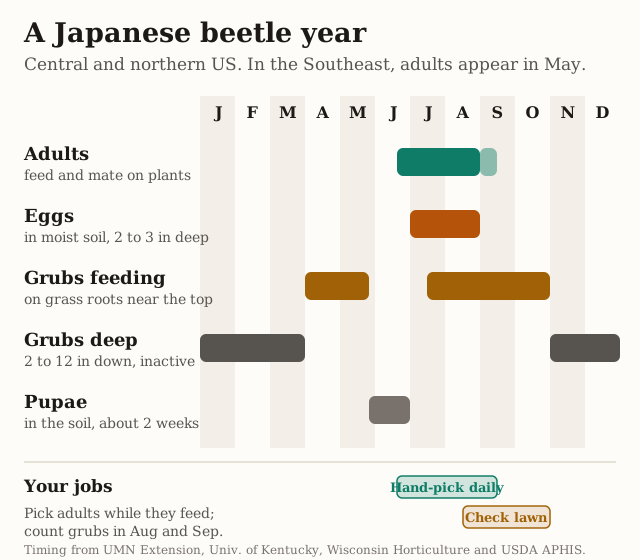
Table 3. Japanese beetle life cycle, stage by stage.
Egg
- When
- July and August
- Where
- 1 to 4 in deep in moist soil, most often 2 to 3 in
- What to look for
- You will not see them; they hatch in about 2 weeks
Grub
- When
- Late July to May
- Where
- Grass roots; 2 to 8 in deep in winter, some deeper
- What to look for
- White, C-shaped, tan head, legs easy to see; up to 1 in
Pupa
- When
- Late May and June
- Where
- A small chamber in the soil
- What to look for
- Shaped like the adult; lasts about 2 weeks
Adult
- When
- May to September, by region
- Where
- Leaves, flowers and fruit in full sun
- What to look for
- 1/3 to 1/2 in, green and copper; lives 30 to 45 days
From Minnesota, Kentucky and Wisconsin extension, USDA APHIS and UF/IFAS.
Japanese beetles lay eggs in the soil, not on leaves
Many people search for Japanese beetle eggs on leaves, but that is not where they are. After mating, a female leaves the plant, usually in the afternoon. She burrows 2 to 3 inches into moist soil to lay her eggs. Then she comes back to feed. She repeats this until she has laid 40 to 60 eggs, according to Kentucky and USDA APHIS.
Eggs need moisture to survive, so females pick damp, grassy spots such as watered lawns. The eggs hatch in about two weeks, Minnesota Extension says. If you find eggs on a leaf, another insect laid them.
The white dots on a Japanese beetle’s back
Those white dots are not Japanese beetle eggs either. They are the eggs of the winsome fly (Istocheta aldrichi). The USDA brought this small fly over from Japan in the early 1920s to fight the beetle. The fly glues an egg to the beetle’s thorax, just behind the head. Its larva bores inside, and the beetle dies within 5 to 6 days.
So leave those beetles alone. Minnesota Extension asks gardeners not to remove or kill any beetle with white eggs on it. One egg is enough. In Minnesota in 2024, the fly parasitized 16 to 30% of beetles at the sites checked, and usually 25 to 55% of females. Gardeners on Reddit, from Minnesota to Nova Scotia, now pass on the same advice.
Japanese beetle grubs
The grub is the stage most people never see. It is a white, C-shaped larva with a tan head and legs that are easy to see. Minnesota Extension says it grows from 1/8 inch when it hatches to about 1 inch long. The grub lives in the soil and eats roots, mostly of lawn grass.
Many lawn grubs look alike, though. To be sure, look at the underside of the tail tip with a magnifier. Penn State Extension explains that Japanese beetle grubs have spines there in a V-shaped pattern, called the raster. Northern masked chafer grubs, another common lawn grub, have a random pattern.
Grubs move deeper as the soil cools. Most spend the winter 2 to 6 inches down, Kentucky says. Wisconsin says 6 to 8 inches is typical, with some below 12. They stop moving below about 50°F (10°C). In spring, once the soil warms past 50°F, they come back up, feed for 4 to 6 weeks and turn into pupae.
When Japanese beetles come out, and when they leave
Adults appear in May and June in the Southeast. In the upper Midwest they come out in late June or early July. Most feeding is over by late August. Wisconsin Extension ties their emergence to about 1,000 growing degree days, a measure of built-up warmth. So a warm spring brings them sooner, and a cool one later.
Table 4. When adult Japanese beetles are active, by region.
Georgia and North Carolina
- First adults
- May to June
- Peak and end
- Not given; APHIS says adults feed for about 4 to 6 weeks
- Source
- UGA, NC State, USDA APHIS
Kentucky
- First adults
- June
- Peak and end
- Heaviest for 4 to 6 weeks from late June, then they die off
- Source
- University of Kentucky
Minnesota and Wisconsin
- First adults
- Late June or early July
- Peak and end
- Mostly July and August; a few into September
- Source
- University of Minnesota, Wisconsin Horticulture
Each adult lives about 30 to 45 days, UF/IFAS says. Some females in lab studies lasted over 100 days. Since they do not all come out on the same day, the season lasts longer than any one beetle.
Why are there so many Japanese beetles this year?
Japanese beetle numbers swing with the weather and with their enemies. A wet summer lets more eggs and young grubs survive, especially in watered lawns. Adults also fly in from miles away. On the other hand, drought, deep frost, a parasitic fly and a grub disease can all cut numbers. In one Michigan study they fell by more than 70%.
Why you suddenly have them
Had none last year and plenty now? The likely reasons are moist soil last summer and beetles flying in from nearby lawns, parks or golf courses. Minnesota Extension notes that dry soil kills many eggs. So a wet summer is often followed by a big beetle year. Kentucky adds that irrigated lawns and golf courses often breed the most grubs, especially in an otherwise dry summer.
Your own lawn matters less than you might think. Adults fly in from miles around, so a neighbor’s lawn can supply your beetles. That is also why treating your lawn for grubs does not stop the adults on your roses.
Why they sometimes seem to vanish
Gardeners on Reddit often ask what happened to the Japanese beetles, from Pennsylvania and Maryland to Ontario. There are real reasons. Iowa State suggested that prolonged, deep frost in the soil caused the low numbers of 2014 to 2016. And Illinois Extension notes that in dry soil many eggs never hatch.
Disease plays a part too. In Michigan, researchers tracked nine golf courses from 1999 to 2018 as a microscopic parasite of the grubs, Ovavesicula popilliae, took hold. Over that time, adult numbers fell 73.2% and grub numbers fell 78.6%, which the authors say is consistent with the infection (Smitley and others, 2022). The winsome fly helps as well, and Minnesota reports it is now common across the Twin Cities and eastern Minnesota.
So a quiet year is not a permanent win. Numbers can climb again when the weather favors the beetles. So the habits further down this page are worth keeping.
Where Japanese beetles came from, and where they live now
Japanese beetles came from Japan. The first ones in the United States turned up in 1916 at a nursery near Riverton, New Jersey. They probably came as grubs in iris bulbs shipped before 1912. Today they live in most states east of the Mississippi except Florida, plus parts of the West, Canada and Europe.
Nobody brought them on purpose. Wikipedia explains that they likely arrived with plants before 1912, when the United States began inspecting imported goods. They reached Canada by 1939, when the first ones were found in Nova Scotia and Quebec.
They spread in two ways. Adults spread about 1 to 5 miles a year on their own, the Colorado Department of Agriculture says. People move them much farther, as grubs in the soil of nursery plants, sod and potted plants. That is why western states restrict nursery stock and sod from infested areas. A federal quarantine also regulates air cargo from infested states, to keep hitchhiking adults from reaching the West.
Table 5. Where Japanese beetles live, and what to do if you find one.
Eastern and central US, except Florida
- Status
- Established in most states
- What to do
- Manage it in your garden; no need to report it
Florida
- Status
- UF/IFAS says it has been unable to establish
- What to do
- Contact your county extension office about a suspected find
Colorado
- Status
- On the Front Range since the early 1990s; found in Grand Junction (Mesa County) in 2022
- What to do
- On the Western Slope, report sightings to Mesa County
Oregon
- Status
- Eradication program; 92% fewer beetles since 2016, with 1,918 trapped in 2025
- What to do
- Report it through the Oregon Invasive Species Hotline, oregoninvasiveshotline.org
Washington
- Status
- Eradication program; 2026 treatments in Benton, Franklin, King and Yakima counties
- What to do
- Report sightings to the Washington State Department of Agriculture
Other western states
- Status
- Kept free by quarantine, with occasional finds
- What to do
- Report it to your state department of agriculture
Europe
- Status
- Azores since the 1970s; Italy 2014; Switzerland 2017; new finds from 2022 to 2026 in more countries, including Germany and Croatia
- What to do
- Report it to your national plant health service
Great Britain
- Status
- Not established; a quarantine pest
- What to do
- Report a suspected find to the government plant health service
From UF/IFAS, three state agriculture departments, Wikipedia and the UK government’s 2026 plan.
The western states were among the last places free of the beetle. As of 2015, Wikipedia says nine of them were still considered free. Oregon and Washington have had outbreaks since, and so has western Colorado. If you live in the West, a single beetle is worth reporting. Oregon believes its current outbreak most likely began with a potted plant brought in from another state.
How to get rid of Japanese beetles
Start the day the first beetles appear. Knock them into soapy water every morning or evening. Cover small plants with fine netting, and leave beetles with white dots alone. Keep bag traps away from the garden. If that is not enough, an insecticide labeled for the plant can protect it for 1 to 4 weeks.
The steps below start with what costs nothing. Sprays come last, and many gardens never need them. In most cases, Minnesota Extension says, the damage is only cosmetic and will not kill plants.
The Japanese beetle routine, start to finish
Start checking when they are due
Check roses, grapes, lindens and fruit trees every day or two. Start in May in the Southeast and in June farther north. The first beetles draw in more, so the first week matters most.
Knock them into soapy water, early
Go out early or in the evening, while the beetles are cool and slow. Hold a bucket of soapy water under the leaves and shake them in. They drown. Do it every day while they are around.
Leave beetles with white dots
A beetle with white dots behind its head carries winsome fly eggs. It will die within about 6 days, so leave it on the plant for the flies.
Net the plants you care about most
Cover small trees, shrubs and vegetables with netting, mesh 1/4 inch or smaller. Leave it on from late June to early September, with the edges fastened down. Wait until fruiting plants finish blooming, so bees can reach the flowers.
Keep bag traps away, or skip them
Traps lure beetles from far away. Many land on your plants instead of in the bag. If you use one at all, hang it well away from the garden.
Spray only what you must protect
Picking and netting not enough? Use an insecticide registered for that plant. Follow the label, and spray in the evening, after bees stop foraging.
Fix next year's problem in late summer
Check the lawn for grubs in August and September. Pull wild grape and multiflora rose, and replace favorites with plants the beetles rarely eat.
1. Hand-picking into soapy water (free)
Hand-picking works best in a small garden with a modest number of beetles. It does two jobs. It removes the beetles that are eating, and it keeps more from being drawn in. Kentucky explains that a plant with beetles on it attracts more beetles. So if you stop them gathering, the plant draws fewer.
Go early in the morning or in the evening, when the beetles are cool and slow, as Minnesota advises. Hold a bucket of soapy water under a branch and tap it. Many beetles drop straight in and drown. Then check your plants again the next day, because new ones keep flying in.
Does dish soap kill Japanese beetles? In a bucket, yes, because they drown. Sprayed on the plant, it does little. Kentucky rates insecticidal soap as generally ineffective against them. Wisconsin finds soaps and oils of very limited use.
Squishing them is fine too. Two entomologists answered this on Ask Extension: Whitney Cranshaw of Colorado State and Dan Potter of Kentucky. Both say crushing the beetles does not attract more of them.
2. Let natural enemies work (free)
Natural enemies do some of the work for you. Besides the winsome fly, a small wasp, Tiphia vernalis, lays its eggs on grubs in spring. USDA entomologists brought it from Korea in the 1920s, Cornell says. Skunks, raccoons, moles and crows dig up and eat grubs too, Minnesota and Wisconsin note. Sadly, they tear up the lawn while they do it.
Birds eat the adults too. The Old Farmer’s Almanac lists starlings, robins, cardinals and crows. The best thing you can do for these helpers is to avoid broad sprays. Those kill the flies and wasps along with the beetles.
3. Netting (low cost)
Netting is the surest way to protect a small plant you care about. Wisconsin suggests nylon insect screen with a mesh of 1/4 inch or smaller. Leave it on from late June to early September, with the edges fastened to the ground. Kentucky suggests cheesecloth or other fine netting for roses, and finer mesh leaves the beetles less room to squeeze through.
However, do not cover plants in bloom that need bees to set fruit. Minnesota Extension suggests hand-picking until the plant has finished blooming and started to set fruit. Then cover it.
4. Why we say skip the bag trap
Japanese beetle traps are very good at attracting beetles. Each one carries two baits. One copies the scent of an unmated female, which draws males. The other is a sweet floral lure that draws both sexes. Together they can pull in thousands of beetles a day, Kentucky says.
The problem is where those beetles land. Kentucky research found that traps attract many more beetles than they catch. As a result, plants near the trap get more damage than they would with no trap at all. A 2009 study in an Illinois soybean field watched what happens. Most arriving beetles landed on plants before they reached the trap. The ones that stayed on the leaves were mostly females. Arriving males sometimes mated with them there (Switzer and others).
That is why extension services in Minnesota, Wisconsin and Georgia all advise against traps. USDA APHIS still lists pheromone traps as a cultural control, which is part of why the advice online is mixed.
Some gardeners on Reddit swear by their traps. Often they hang them far from the garden, or the whole neighborhood traps. That fits Wikipedia’s summary. Traps work best spread across a whole community, set at the edges, away from the plants being protected. So if you try one, hang it as far from your plants as you can.
5. Sprays, last and only if needed
If you are picking, netting and sparing the parasitized beetles, you may not need to spray at all. If the beetles still outrun you on a plant you value, here are the options. Each one lists how long it protects the leaves and whether it harms bees.
Btg (Bacillus thuringiensis galleriae) is a bacterium that kills beetles that eat treated leaves. Minnesota rates it moderately effective, with 1 to 2 weeks of protection. It is not toxic to bees. Neem gives about 3 to 4 days of protection, according to Kentucky. Minnesota adds that it works less well when beetles are many. Pyrethrins work only if you spray them directly on the beetles, and you have to repeat them. They are also toxic to bees, so spray only in the evening, when bees are not out.
Longer-lasting sprays protect for weeks. Chlorantraniliprole lasts 2 to 4 weeks and is low risk to bees, but Wisconsin notes it is sold mostly to professionals. Pyrethroids such as bifenthrin, cyfluthrin, lambda-cyhalothrin and permethrin last about 2 to 3 weeks, and carbaryl lasts 1 to 2 weeks. Both of these are toxic to bees, Minnesota warns.
Systemic insecticides such as imidacloprid are taken up by the plant. Minnesota warns they are very toxic to pollinators. So keep them off flowering plants that bees visit, or wait until bloom is over. For a large tree, hire a certified arborist or a licensed applicator rather than spraying it yourself.
Table 6. Japanese beetle controls compared
Hand-picking into soapy water
- Protects for
- As long as you keep at it
- Evidence
- Good: University of Kentucky, University of Minnesota
- Cost
- Free
- Watch out for
- Takes daily effort
Leaving beetles with white dots
- Protects for
- Future summers
- Evidence
- Good: University of Minnesota
- Cost
- Free
- Watch out for
- Nothing
Netting, 1/4 in mesh or finer
- Protects for
- The whole season
- Evidence
- Good: Wisconsin, University of Kentucky
- Cost
- Low
- Watch out for
- Keeps out pollinators during bloom
Bag traps
- Protects for
- Nothing near the garden
- Evidence
- Poor: more damage near traps (Kentucky); most beetles land short of the trap (Switzer 2009)
- Cost
- Low
- Watch out for
- Draws beetles in
Neem
- Protects for
- 3 to 4 days
- Evidence
- Weak: Kentucky, Wisconsin
- Cost
- Low
- Watch out for
- Fails in heavy years
Btg (Bacillus thuringiensis galleriae)
- Protects for
- 1 to 2 weeks
- Evidence
- Moderate: University of Minnesota
- Cost
- Medium
- Watch out for
- Sold online, Minnesota says
Chlorantraniliprole
- Protects for
- 2 to 4 weeks
- Evidence
- Good: University of Minnesota
- Cost
- Medium
- Watch out for
- Sold mostly to professionals
Pyrethroids
- Protects for
- 2 to 3 weeks
- Evidence
- Good: Minnesota, Kentucky
- Cost
- Low to medium
- Watch out for
- Toxic to bees
Carbaryl
- Protects for
- 1 to 2 weeks
- Evidence
- Good: Minnesota, Kentucky
- Cost
- Low
- Watch out for
- Toxic to bees
Garlic, hot pepper or soap sprays; companion plants
- Protects for
- None proven
- Evidence
- Ineffective: University of Kentucky
- Cost
- Low
- Watch out for
- Wasted effort
Japanese beetle grubs in your lawn
Treat grubs only to save the lawn. Grub control will not reduce the adults on your roses, because beetles fly in from miles around. Action usually pays at about 7 to 10 or more grubs per square foot. Check in August or September. If you need a product, use it from late July to mid-September, while grubs are small.
Grub damage shows up in late summer as pale, brownish patches that look like drought, Wisconsin says. Tug on the grass. If it peels back like a loose carpet with few roots, look for grubs underneath. Skunks, raccoons and crows digging up the lawn are another clue.
To check, dig up a square foot of sod about 3 inches deep in September and count the grubs. UConn says seven or more usually means you need to act. UMaine puts the threshold at 8 to 10 per square foot. Minnesota says healthy turf can take up to 10.
Timing decides whether a grub product works. If the lawn was damaged last year, a preventive product goes down in June or early July. If you wait and see, a curative product works from late July to mid-September. It works best while the grubs are 1/2 inch or smaller. But do not treat in spring, Minnesota advises. The grubs are large and hard to kill by then, and they feed only briefly before turning into pupae.
Beneficial nematodes (Heterorhabditis bacteriophora) can infect grubs, but Minnesota calls their results inconsistent. If you try them, apply them after the eggs hatch. Pick a cool, cloudy day or the evening, and water before and after.
Milky spore is the product most often recommended online. The evidence is poor, though. In Kentucky trials on two golf courses, two milky spore products did not raise disease levels. Nor did they reduce grub numbers (Redmond and Potter, 1995). Minnesota adds that it has not been shown to provide any benefit in modern university trials. The bacteria do occur in the soil naturally, so some grubs get sick anyway.
Finally, a dry lawn helps. Wisconsin suggests not watering the lawn from July to mid-August, when females lay eggs. Drier soil discourages them and kills many eggs and young grubs. Many grub insecticides also pose risks to bees, Wisconsin warns, so follow the label closely.
What does not work, or is not proven
A lot of popular Japanese beetle advice has nothing behind it. Bag traps draw in more beetles than they catch. Milky spore failed in university trials, and garlic sprays and companion plants have not worked in tests. Here is what the evidence says about 9 common claims.
Myth 1
Myth: “Japanese beetles lay their eggs on leaves.”
Truth: Females burrow 2 to 3 inches into moist soil to lay them (University of Kentucky). White dots on a beetle are winsome fly eggs, and eggs on a leaf belong to some other insect.
Myth 2
Myth: “A bag trap will clear them out.”
Truth: Kentucky research found traps attract many more beetles than they catch. Minnesota, Wisconsin and Georgia extension services all advise against them.
Myth 3
Myth: “Squishing one draws in more beetles.”
Truth: Two extension entomologists, Whitney Cranshaw and Dan Potter, say crushing them does not increase attraction. What draws more beetles is the smell of chewed leaves.
Myth 4
Myth: “Milky spore will end the problem in a few years.”
Truth: Field trials found it did not reduce grub numbers (Redmond and Potter, 1995). Minnesota says modern trials show no benefit. It also does nothing about adults that fly in.
Myth 5
Myth: “Treating my lawn for grubs will save my roses.”
Truth: Adults fly in from miles away. So killing grubs in your lawn does not protect your plants, as Kentucky and Minnesota both point out.
Myth 6
Myth: “Garlic, tansy, catnip or marigolds keep them away.”
Truth: Kentucky rates garlic and hot pepper sprays and companion planting as generally ineffective. Minnesota even lists marigold among the plants the beetles prefer.
Myth 7
Myth: “Four o'clocks poison them.”
Truth: Minnesota Extension found no evidence. It cites a 2013 Colgate University study that saw no dead beetles when they ate only four o'clocks. The sap can also irritate your skin.
Myth 8
Myth: “Geraniums kill Japanese beetles.”
Truth: Half true. In USDA lab tests, beetles that ate geranium petals were paralyzed within 30 minutes. Most recovered within 24 hours, and we found no study showing that planting geraniums protects a garden.
Myth 9
Myth: “Neem gets into their eggs and kills the next generation.”
Truth: We found no study behind this claim, which appears on The Old Farmer's Almanac. Kentucky gives neem only 3 to 4 days of protection against feeding.
How to prevent Japanese beetles next year
You cannot stop Japanese beetles from flying in, but you can make your yard less inviting. Choose plants they rarely eat, and pull wild grape and multiflora rose. Keep the lawn dry from July to mid-August, and start picking beetles off the first week they appear. The 6 habits below make next summer easier.
- Pick less-favored plants when you replace something. Red maple, oak, boxwood, lilac, magnolia and yew are rarely damaged, according to Minnesota Extension. The Old Farmer’s Almanac also suggests spreading favorites such as roses around the yard rather than grouping them.
- Remove wild hosts. Kentucky says weeds such as multiflora rose, wild grape, poison ivy and smartweed are a constant source of beetles.
- Skip summer lawn watering if you can. Wisconsin advises not watering turf from July to mid-August, while females are laying eggs.
- Keep plants healthy. USDA APHIS notes that weak, poorly fed plants are more likely to be attacked. Wisconsin advises watering and mulching trees that lose leaves.
- Start early. Early damage draws in more beetles, so Minnesota Extension advises starting as soon as the first ones appear.
- In the West, do not move plants or soil out of an infested area. Oregon believes its current outbreak most likely began with a potted plant from another state.
When to call someone
Usually you will not need to. Japanese beetles are a do-it-yourself job in most gardens. If you find one in a western state that is trying to keep them out, call your state department of agriculture. Call a certified arborist for a large tree stripped every year, and Poison Control at 1-800-222-1222 if someone swallows a pesticide.
- Your state department of agriculture if you find one in a western state that is trying to keep them out. In Oregon, report it through the Oregon Invasive Species Hotline.
- Your county extension office to confirm an identification, to diagnose lawn damage, or to report a suspected find in Florida.
- A certified arborist for large trees that lose most of their leaves year after year, as Wisconsin and Minnesota suggest.
- A licensed lawn care or pest professional if you want grub control applied for you.
- Your vet, or ASPCA Animal Poison Control at (888) 426-4435, if a pet ate many beetles or a pesticide.
- Poison Control, 1-800-222-1222, if a person swallows a pesticide or gets it in the eyes. Call 911 if they have trouble breathing, collapse or have a seizure.
Not sure what you have? Take a clear photo from above and from the side, and upload it to our bug identifier by picture. Our insect identifier can also narrow it down without a photo.
Pest control disclaimer. Photo-based identification can help, but it is not always perfect. For dangerous spiders, large infestations, or anything you are unsure about, contact a licensed pest control professional.
Japanese beetles FAQ
Where do Japanese beetles go at night?
Can Japanese beetles get into my house?
Related guides
Orange ladybug
The Asian lady beetle, also called the Japanese ladybug, and the native orange lady beetles.
Ladybug vs Asian beetle
The white plate behind the head settles it, and why it matters in fall.
Tomato hornworm
The big green caterpillar on tomatoes, and how to clear it without spraying your food.
Thrips
Silver streaks and black specks on rose petals and leaves, and the plan that clears them.
Black beetle
Identify a black beetle by size, shine and where you found it, from June beetles to pantry pests.
Bug identifier by picture
Upload a photo of any beetle for a free identification in seconds.
Sources
- University of Minnesota Extension, Japanese beetles in yards and gardens (Hahn, Weisenhorn, Hutchison and Bugeja, reviewed 2025)
- University of Kentucky Entomology, ENTFACT-451: Japanese Beetles in the Urban Landscape (Potter, Potter and Townsend, revised March 2026)
- University of Wisconsin-Madison Extension, Wisconsin Horticulture: Japanese Beetle (Williamson, Liesch and Pandian, revised January 2026)
- USDA APHIS, Japanese Beetle (last modified September 26, 2025)
- USDA APHIS, Assessment of Biocontrol Possibilities for Japanese Beetle (September 2020)
- UF/IFAS Featured Creatures, Japanese Beetle, Popillia japonica (EENY350, Gyeltshen, Hodges and Bania)
- USDA Agricultural Research Service, Geraniums Could Help Control Devastating Japanese Beetle (March 8, 2010)
- Switzer, Enstrom and Schoenick (2009), Behavioral explanations underlying the lack of trap effectiveness for small-scale management of Japanese beetles, Journal of Economic Entomology
- Smitley and others (2022), Gradual Decline of Japanese Beetle Populations in Michigan Follows Establishment of Ovavesicula popilliae, Journal of Economic Entomology
- Loughrin, Potter and Hamilton-Kemp (1995), Volatile compounds induced by herbivory act as aggregation kairomones for the Japanese beetle, Journal of Chemical Ecology
- Redmond and Potter (1995), Lack of efficacy of in vivo- and putatively in vitro-produced Bacillus popilliae against field populations of Japanese beetle grubs, Journal of Economic Entomology
- Penn State Extension, White Grubs in Home Lawns (updated May 6, 2026)
- Penn State Extension, Green June Beetle
- Ohio State University, Buckeye Yard and Garden onLine: Big Beetles are Cruising Ohio Lawns
- UC Statewide IPM Program, Green Fruit Beetle
- Iowa State University Extension, False Japanese Beetles Present Again This Year (Lewis, June 26, 2015)
- University of Wisconsin-Madison Extension, May/June Beetles (Liesch)
- University of Minnesota Extension, Rose chafers (Hahn)
- UConn Extension, The Oriental Beetle (Allen, 2015)
- Rutgers NJAES, Oriental Beetle (FS1009)
- University of Minnesota Extension, Six-spotted tiger beetle
- University of Kentucky Entomology, ENTFACT-709: Dogbane Beetle (April 2023)
- Penn State Extension, Multicolored Asian Lady Beetle (Skvarla)
- Oregon State University Extension, Emerald Ash Borer (EM 9160)
- Cornell CALS IPM, Spring Tiphia, Tiphia vernalis (Legrand, February 2022)
- University of Maine Cooperative Extension, Fact Sheet #5037: Japanese Beetle
- UConn Home and Garden Education Center, Japanese Beetle (2016)
- University of Illinois, Home, Yard and Garden Pest Newsletter (Nixon, June 21, 2013)
- Iowa State University Extension, How Many Japanese Beetles Will You See This Year? (Lewis, July 16, 2021)
- UGA Cooperative Extension, Japanese Beetles in the Nursery and Landscape (C1167, reviewed June 6, 2025)
- N.C. Cooperative Extension, Lee County Center, Japanese Beetles: Facing the Onslaught (July 13, 2023)
- Ask Extension, Japanese beetles myth or fact? (August 9, 2017)
- Ask Extension, question on feeding Japanese beetles to chickens (July 2023)
- Colorado Department of Agriculture, Japanese Beetle in Colorado
- Oregon Department of Agriculture, Japanese Beetle
- Oregon Department of Agriculture, Japanese Beetle Look-Alikes Guide
- Oregon Department of Agriculture, Japanese Beetle Frequently Asked Questions
- Washington State Department of Agriculture, Japanese Beetle
- Defra, UK Plant Health Risk Register: Contingency plan for Popillia japonica (2026)
- WebMD, What Is a Japanese Beetle?
- PetMD, Asian Lady Beetles: Could They Harm Your Dog? (Fitzsimmons)
- ASPCA, Animal Poison Control Center
- Wikipedia, Japanese beetle
- The Old Farmer's Almanac, Japanese Beetles (Boeckmann, June 3, 2026)