The one reliable test: look behind the head
Between the head and the wing covers sits a small shield-shaped plate. Entomologists call it the pronotum, and on a lady beetle it is usually white or cream with black markings. That plate is where the answer is.
The M-shaped mark
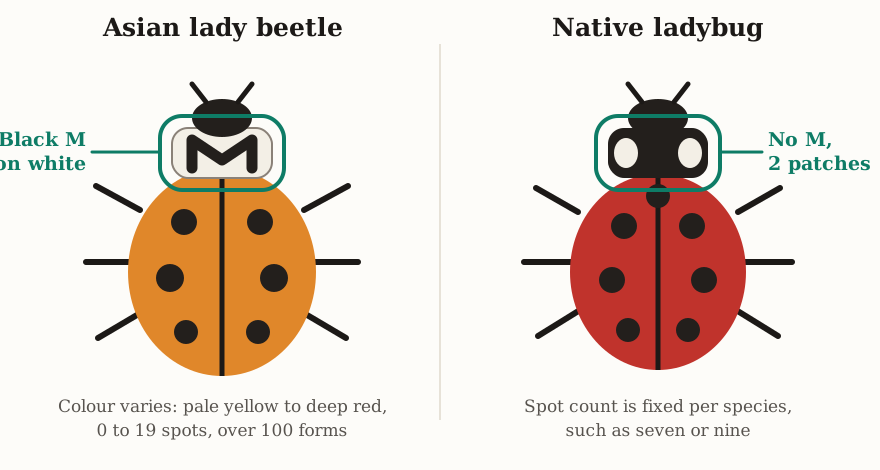
A multicolored Asian lady beetle carries a black M across that white plate. Turn the beetle around and the same mark reads as a W, so people describe it both ways. It can be a bold solid M or a broken row of dots, but the shape is always there.
A native ladybug looks different. Its head is mostly black, with two small white patches at the sides that read like cheeks. There is no M, and once you have seen the two side by side you will not confuse them again.
Why colour tells you almost nothing
Here is the fact that undoes most advice on this subject. UC IPM records more than 100 colour forms of the multicolored Asian lady beetle, running from pale yellowish orange to deep red. The same species can carry no spots at all, or as many as 18 to 19.
So a red beetle with clear spots may well be the Asian species, and an orange one may not be. The name multicolored is a warning label, and it is doing real work.
Ladybug vs Asian beetle, side by side
| Feature | Asian lady beetle | Native ladybug |
|---|---|---|
| Behind the head | White plate with a black M or W | Black head with two small white patches |
| Colour | Pale yellow to deep red, 100+ forms | Usually a consistent red or orange for the species |
| Spots | None, or up to 18 to 19 | A fixed number for the species, such as 7 or 9 |
| Size | About 1/4 inch, roughly 6 mm | Often slightly smaller |
| Shape | Slightly oval and longer | Rounder, more domed |
| In autumn | Masses on sunlit walls, then comes indoors | Overwinters outside under leaf litter and bark |
| Indoors in winter | Common, sometimes in hundreds | Rare |
| If you crush it | Yellow fluid that stains and smells | Also bleeds, though it is seldom an issue indoors |
| Bites | Occasionally, hard enough to feel | Very rarely |
The rules of thumb that do not work
Most of what circulates about this comparison is a shortcut that fails often enough to be useless. Here are the four you will meet most.
| The rule | Does it work? | Why |
|---|---|---|
| Red means native, orange means Asian | No | Asian forms run from yellow through to deep red |
| Count the spots | No | Asian beetles have anywhere from none to 19 |
| Natives never come indoors | Mostly true | Useful as a clue in winter, useless in summer |
| Asian beetles are bigger | Weak | True on average, no help with a single beetle |
| Check behind the head for an M | Yes, every time | The one feature that does not vary with colour form |
Notice what that means in practice. Four of the five tests people are given depend on features the Asian species varies wildly, while the one stable feature barely gets mentioned.
Which ladybug is actually native?
Almost every page on this topic tells you to protect native ladybugs, and almost none of them names one. That is a problem, because you cannot protect a category you cannot recognise.
| Species | Scientific name | Origin | The tell |
|---|---|---|---|
| Multicolored Asian lady beetle | Harmonia axyridis | Introduced | Black M on a white pronotum |
| Seven-spotted lady beetle | Coccinella septempunctata | Introduced from Europe | Exactly seven spots, solid black head |
| Convergent lady beetle | Hippodamia convergens | Native | Two converging white dashes on the pronotum |
| Nine-spotted lady beetle | Coccinella novemnotata | Native, now rare | Nine spots. New York's state insect |
The seven-spot is an import too
This is the part that surprises people. The classic bright red ladybug with seven black spots, the one on every children’s book cover, is Coccinella septempunctata, and it came from Europe. Releases began in the United States around 1959 and it now turns up almost everywhere.
So the tidy story of a native ladybug threatened by a foreign invader is only half right. Two of the commonest lady beetles most Americans meet are both introductions.
The nine-spotted, and why you rarely see one
Before the mid-1980s the nine-spotted lady beetle was among the most common native species in the northeastern United States. Then it collapsed, alongside other natives, as introduced species spread. It is still New York’s state insect, which now reads as a slightly sad piece of trivia.
That decline, rather than the beetles on your window, is the real conservation story here. There is something useful you can do about it, and it is at the bottom of this page.
What the larvae look like
Lady beetle larvae look nothing like the adults, so people find them and assume the worst. They are elongated and spiky, and UC IPM describes them as resembling tiny alligators. They reach about a third of an inch, roughly 8 mm.
On an Asian lady beetle larva, look for bright orange along the top of the first five abdominal segments. The colour is strongest on the final stage before pupation.
Either way, leave them be. A larva eats aphids more or less continuously, so a plant covered in them is a plant being cleaned for free. Our aphid identifier covers what they are eating.
Do Asian lady beetles bite?
Yes, sometimes. University of Minnesota Extension puts it plainly: some can bite hard enough to break human skin, causing minor and short-lived discomfort. It happens when a beetle is looking for moisture or food, not because it is defending anything.
The sensation is a sharp scrape rather than a sting, since a lady beetle has chewing mouthparts and no venom. Wash it, and that is the end of the matter. Our bite identification guide covers the marks that do need attention.
Are ladybugs poisonous?
Not to people in any practical sense. Lady beetles defend themselves with alkaloids carried in their blood, which taste bitter and teach birds to leave them alone. A person who swallowed one would notice the taste and nothing else.
Dogs are the exception worth knowing. A dog that mouths a cluster can end up with beetles stuck to the roof of its mouth, which causes drooling and sore patches. It is uncommon, and it is worth a vet call if your dog seems distressed.
Reflex bleeding, the stain and the smell
Press a lady beetle and it releases yellow fluid from its leg joints. The behaviour is called reflex bleeding, and the fluid is its blood, loaded with the defensive alkaloids above. That is the acrid smell people notice.
It also stains. Light paint, plaster, curtains and pale upholstery all mark, and the stain is stubborn once it dries. So the practical advice writes itself: never squash one against anything you care about.
The same chemistry has a stranger consequence outdoors. When beetles get harvested along with wine grapes, those alkaloids carry into the juice and taint the finished wine with a bitter, peanut-like flavour. Growers watch for them as harvest approaches.
Why they swarm your house in autumn
In their native range these beetles overwinter in cracks on sunlit cliff faces. A house wall is a fair imitation, so on mild autumn days they gather in numbers on the south and west sides where the sun sits longest.
Pale walls attract the biggest groups, because the beetles orient to bright surfaces. Once the temperature drops they move from the wall into whatever gap they can find, and then they go quiet in the wall voids and attic until spring.
That explains the confusing part. Beetles appearing indoors on a warm February afternoon did not come in from outside. They have been in the structure since October and the warmth woke them.
What to do indoors, and what not to do
The live SERP for this topic literally asks whether you should squish them, so here is a direct answer. Do not. Crushing triggers the staining described above, and it achieves nothing at the scale that matters.
- Vacuum them. Fastest, cleanest, no stains. Empty the bag or canister outdoors straight away, because trapped beetles will bleed inside it.
- Use a stocking trick if you want them alive. Slip a knee-high stocking into the vacuum tube, secured at the rim, and the beetles collect in it for release outside.
- Skip the indoor spray. It leaves dead beetles in wall voids, and dead beetles are the allergy problem.
- Leave the ones outdoors alone. They are eating aphids, and they are not the reason any got inside.
Keeping them out next autumn
Exclusion is the only thing that changes next year’s outcome, and the timing matters more than the effort. Do it in late summer, before the first mild spell brings them to the wall.
- Seal gaps of an eighth of an inch or more. UMN Extension gives that figure, and it is smaller than most people expect.
- Caulk around window and door frames, and where utility lines and pipes enter the wall.
- Check soffits, fascia and vents, which are the usual route into an attic.
- Repair torn screens and fit them to attic and soffit vents.
Are they good or bad? An honest answer
Both, and the split runs along the wall of your house. Outdoors the multicolored Asian lady beetle is a serious predator of aphids, scales, psyllids and adelgids, which is exactly why it was introduced in the first place.
Indoors it is a nuisance that stains, smells and triggers allergies. And in the wider picture it has outcompeted native lady beetles across much of the continent, which is the genuine cost and the one that does not show up on your windowsill.
Ladybugs, aphids and your garden
If lady beetles have arrived on a plant, something is feeding them. Nine times out of ten that is aphids, and the beetles are the good news rather than the problem.
So treat the aphids and the beetles move on by themselves. Our guide to getting rid of aphids covers the order that works, and small black bugs helps if you are still not sure what is on the leaves. Spraying an insecticide kills the predators along with the pest, which usually makes the aphids worse.
Help count the natives
There is one genuinely useful thing an ordinary person can do here, and it takes a photograph. The Lost Ladybug Project collects sightings of lady beetles across North America to track which native species survive and where.
Garden photographs are exactly what the dataset is made of. So next time you find one that is not carrying an M, take the picture before you walk away.
Pest control disclaimer. Photo-based identification can help, but it is not always perfect. For dangerous spiders, large infestations, or anything you are unsure about, contact a licensed pest control professional.
Frequently asked questions
Should I squish Asian lady beetles?
Are Asian lady beetles harmful to people?
What attracts Asian lady beetles to your house?
How do I get rid of Asian lady beetles?
Is the Asian lady beetle harmful to plants?
Are ladybugs poisonous?
What's the difference between orange and red ladybugs?
Are orange ladybugs harmless?
What does it mean if you see an orange ladybug?
Do Asian lady beetles bite?
What is the M-shaped marking?
Are all ladybugs in America native?
What is a nine-spotted ladybug?
What do Asian lady beetle larvae look like?
Why do they swarm on my house in autumn?
Do Asian lady beetles come back every year?
Why do I smell something after killing one?
Are Asian lady beetles dangerous to dogs?
Do they ruin wine?
Should I kill them or not?
How do I tell a ladybug from a beetle that just looks like one?
Can I do anything useful about the native decline?
Related guides
Black beetle
Identify a dark beetle by size, shine and where you found it.
Aphid identifier
The prey that brings lady beetles onto your plants in the first place.
Get rid of aphids
Treat the aphids and the beetles move on by themselves.
Bug bite identification
What a lady beetle nip looks like next to bites that matter.
Insect identifier
Upload a photo and let the free AI tool name the beetle.
Sources
- UC IPM, Natural Enemies Gallery: Multicolored Asian Lady Beetle
- University of Minnesota Extension, Multicolored Asian lady beetles
- University of Kentucky Entomology, Asian Lady Beetle Infestation of Structures (EF-416)
- Lost Ladybug Project, Cornell University
- Losey et al., egg predation and the decline of Coccinella novemnotata
- Missouri Department of Conservation, Asian Lady Beetle