Part 1 of 7
Start here
Is it a beetle at all?
Beetles have one feature you can see without a hand lens: a straight seam down the middle of the back, where two hard wing cases meet. Those cases are called elytra, and they are the front pair of wings, hardened into covers. The real flight wings fold up underneath them.
That seam is worth learning, because the two insects people confuse with beetles both fail the test. A cockroach has leathery wings that overlap rather than meet, so there is no clean line, and its antennae are long and whip-like. A true bug, such as a stink bug or an assassin bug, holds its wings crossed over the back, which makes an X rather than a seam.
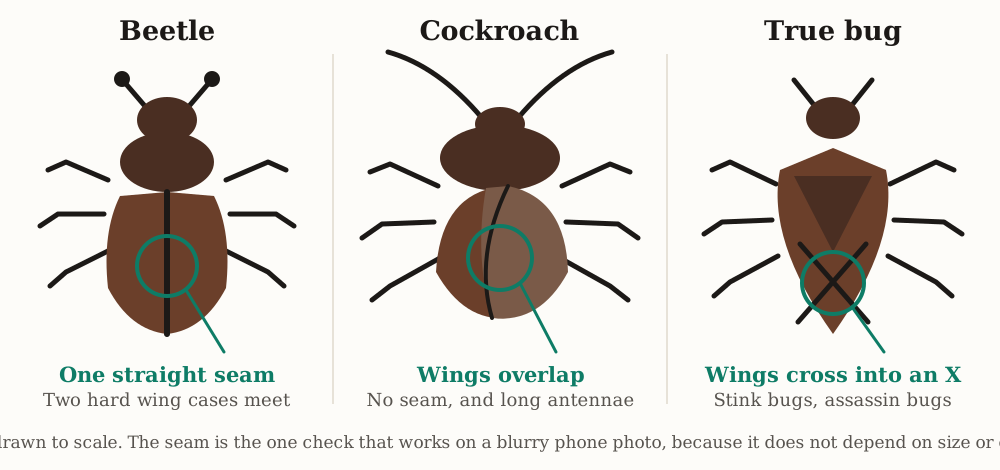
Beetle, cockroach or true bug? The feature that separates them
Back
- Beetle
- Two hard covers meeting in a straight seam
- Cockroach
- Leathery wings that overlap, no seam
- True bug
- Wings crossed into an X
Antennae
- Beetle
- Short, often clubbed or beaded
- Cockroach
- Long, thin and whip-like
- True bug
- Short to medium, 4 or 5 segments
Mouth
- Beetle
- Jaws that chew
- Cockroach
- Jaws that chew
- True bug
- A beak for piercing and sucking
Body
- Beetle
- Hard and often domed
- Cockroach
- Flat, built to squeeze under things
- True bug
- Shield shaped or narrow
When a light goes on
- Beetle
- Keeps walking, or flies at the light
- Cockroach
- Runs for cover at once
- True bug
- Sits still or drops
One more thing to settle early: a weevil is a beetle. So is a ladybug, a firefly and a june bug. Weevils simply carry a long downturned snout with the jaws on the tip. That snout makes them look like a separate kind of insect, when they are beetles with a drill.
Part 2 of 7
Narrow it down by what you can see
Start with size, because it splits the list in half
Size is the first question an entomologist asks, and it eliminates more candidates than color does. An adult fingernail is roughly 12 mm, or half an inch, which makes a useful ruler. Under a third of a fingernail puts you in a short list of indoor species. Longer than a whole fingernail and the beetle almost certainly came from outdoors.
Beetle identification chart by size, with the likeliest types of beetles in each band
Under 1/8 in (3 mm)
- Likely beetles
- Plaster beetle, foreign grain beetle, sawtoothed grain beetle, varied carpet beetle
- Where you find them
- Windowsills, damp new walls, opened packets
1/8 to 1/4 in (3 to 6 mm)
- Likely beetles
- Drugstore and cigarette beetle, flour beetles, weevils, spider beetles, black carpet beetle
- Where you find them
- Cupboards, pantry shelves, pet food bins
1/4 to 1/2 in (6 to 12 mm)
- Likely beetles
- Asian lady beetle, larder beetle, flea beetle, cucumber beetle, small ground beetles
- Where you find them
- Sunny walls in fall, gardens, under doors
1/2 to 1 in (12 to 25 mm)
- Likely beetles
- Japanese beetle, June beetle, most ground beetles, blister beetle, click beetle
- Where you find them
- Lawns, flower beds, porch lights
Over 1 in (25 mm)
- Likely beetles
- Stag beetle, eastern Hercules beetle, palo verde borer, longhorn beetles, eyed click beetle, darkling beetles
- Where you find them
- Outdoors, or indoors by accident
The rule has one useful exception. Beetle larvae are often much longer than the adult they become. So a 1/2 inch bristly grub in a closet can belong to a 1/10 inch adult carpet beetle. Where what you found is soft, pale and nearly legless, measure it anyway, but treat the size as a weak clue.
Then color, in daylight
Color narrows the list fast, as long as you look in daylight rather than under a bulb. Four color groups cover most of what people find: plain shiny black, mottled brown and cream, metallic green, and orange or red with spots. Each one points at a different short list.
Types of beetles by color, and what each color usually means
Plain shiny black
- Likely beetles
- Ground beetle, black carpet beetle, darkling beetle, stag beetle
- What the color tells you
- Usually an outdoor predator or scavenger that came in by accident
Mottled brown, cream and black
- Likely beetles
- Varied carpet beetle, furniture carpet beetle, warehouse beetle
- What the color tells you
- Scales rather than pigment, and a strong sign of a fabric pest
Plain brown or tan
- Likely beetles
- June beetle, pantry beetles, weevils, larder beetle
- What the color tells you
- Either a stored-food beetle or a summer night flier
Metallic green or bronze
- Likely beetles
- Japanese beetle, green June beetle, tiger beetle, dogbane beetle
- What the color tells you
- Almost always outdoors, on leaves or flowers
Orange or red with black spots
- Likely beetles
- Lady beetles and the Asian lady beetle
- What the color tells you
- Warning coloring, and a beetle that is harmless to handle
Yellow with black stripes
- Likely beetles
- Colorado potato beetle, striped cucumber beetle
- What the color tells you
- A garden pest, usually on potatoes or squash
Black is the commonest answer and the hardest, because dozens of unrelated beetles are plain black. If that is what you have, identifying a black beetle works through them by size and shine. For the ones that are not beetles at all, see small black bugs by room. With the orange ones the spots matter more than the color, and our guide to the ladybug and the Asian lady beetle separates the native from the one that gets into houses.
Where you found it decides most of the answer
Indoors, the types of beetles you meet are doing one of four things, and which one tells you how much it matters. Three of them are jobs: eating fabric, eating stored food, or boring into wood. The fourth is the commonest and the least serious, which is simply being somewhere by mistake.
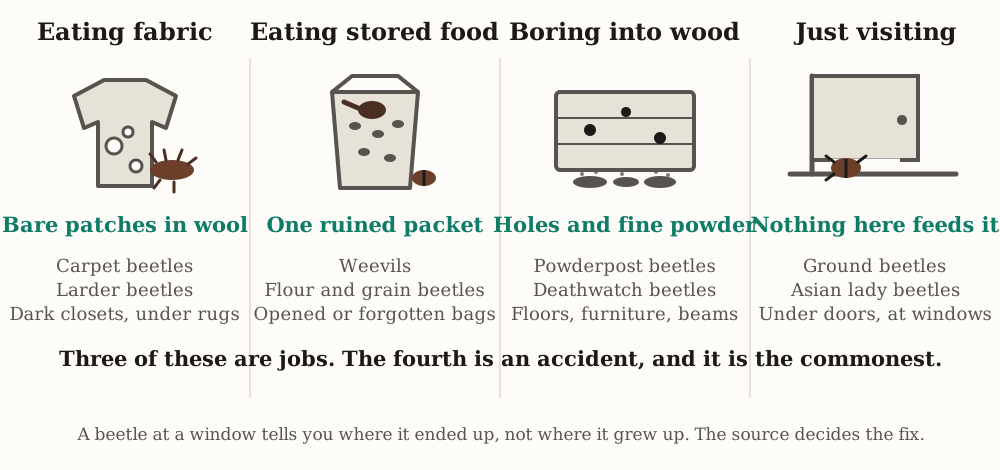
Seven questions that narrow a beetle down
Check each clue below to narrow down what you saw.
Is there a straight seam down its back?
Two hard wing cases meeting in a line down the middle means a beetle. A cockroach’s wings overlap, and a true bug’s cross into an X.
How long is it, against a fingernail?
A fingernail is roughly 12 mm. Under a third of that is a pantry or fabric beetle. Longer than a nail is almost always an outdoor beetle that came in by accident.
What color is it, in daylight?
Plain shiny black, mottled brown and cream, metallic green, or orange with spots. Each points at a different short list.
What was it near?
Wool and a closet, dry food and a cupboard, small round holes in wood, a window, a lawn, or a porch light. The place narrows it faster than the body does.
Is it one, or many?
One is usually a wanderer that came in under a door. Dozens in the same room means something indoors is feeding them.
Does it have a snout?
A long downturned snout with jaws on the tip means a weevil, which is a beetle and is almost always in stored food.
Is it alive and walking, or dead on a sill?
Dead beetles collecting on windowsills point at a population breeding somewhere inside, because adults head for light when they emerge.
Why the place beats the body
Sorting by place is how professionals work, because the source decides the fix. A beetle at a window tells you where it ended up, not where it grew up. So follow the clue before buying anything. Wool and a dark closet point one way. A forgotten bag of flour points another. Small round holes in a floorboard point somewhere else entirely.
Part 3 of 7
The beetles that live indoors
Beetles that eat fabric
Four carpet beetles cause nearly all fabric damage in US homes. Adults run about 1/10 to 3/16 inch and are mottled or plain black, and they are harmless: they feed on pollen and nectar outdoors. The bristly larvae do the damage, and they eat wool, silk, leather, fur, feathers and pet hair.
Carpet beetles and other fabric pests, and how to tell them apart
Varied carpet beetle
- Size and look
- About 1/10 in, round, black with white, brown and yellow scales
- What it damages
- Wool, silk, fur, feathers, pet hair
- Where you see it
- Adults at windows, larvae in closets and under rugs
Black carpet beetle
- Size and look
- 1/8 to 3/16 in, shiny black to dark brown
- What it damages
- The same, plus stored grain
- Where you see it
- Larvae are stiff and golden with a tail tuft
Furniture carpet beetle
- Size and look
- Slightly larger and rounder, white underside
- What it damages
- Upholstery and padding
- Where you see it
- Larvae darken from white to chestnut
Larder beetle
- Size and look
- 1/3 in, dark with a pale band and six dark spots
- What it damages
- Cured meat, pet food, dead insects in wall voids
- Where you see it
- Often near a dead bird or rodent in a cavity
Carpet beetles also explain a question that brings people here in a panic. Itchy marks that look like bites are usually not bites at all. A 2021 report in the CDC journal Emerging Infectious Diseases examined a household cluster of such lesions. They “mimic bites but are allergic reactions to larvae hairs pegged in the skin”, the authors concluded. They “should be distinguished from bites of bed bugs or fleas”. The pattern helps too. Hair reactions tend to be single and scattered on exposed arms, legs and face. Bed bug and flea bites usually come in clusters instead.
Our full guide to carpet beetle control covers finding the source, laundering and freezing, and why spraying clothing is the wrong move.
Beetles in food and the pantry
Pantry beetles are small, brown and nearly all under 1/8 inch. They arrive inside a package, usually one damaged at the store or opened and forgotten, so the answer is almost never on the shelf surface. Finding the infested package matters far more than identifying the species exactly.
Several of them are near twins, and each pair has one separating feature. That is worth knowing, because the twins behave the same and the fix is the same, so you do not need a microscope to act.
Pantry beetle look-alikes and the one feature that separates each pair
Antennae end in an abrupt 3-segment club
- Beetle
- Red flour beetle
- Its twin
- Confused flour beetle widens gradually into 4 segments
Smaller eyes
- Beetle
- Sawtoothed grain beetle
- Its twin
- Merchant grain beetle has noticeably larger eyes
Grooved wing covers
- Beetle
- Drugstore beetle
- Its twin
- Cigarette beetle has smooth wing covers
Eats whole grain, rarely flour
- Beetle
- Rice and granary weevils
- Its twin
- Flour beetles cannot attack whole sound grain
Looks like a tiny shiny spider
- Beetle
- Spider beetles
- Its twin
- Carpet beetle larvae are bristly, not glossy
Treatment is the same whichever twin you have. Throw out the infested package, check every other dry good with a flashlight, and keep what survives in glass, metal or heavy plastic rather than a bag. Freezing at 0°F for four days or heating at 130°F for half an hour clears borderline packets. Insecticides have no place here, because they cannot reach insects inside a package and should not be used near food.
The drugstore beetle identification guide covers the commonest of them in full, including why it turns up in spices and dry pet food more than in flour.
Beetles in wood, and reading the holes
Three groups bore into seasoned wood indoors, and they leave different evidence. Tiny round exit holes with fine powder below them are the sign. That powder tells you more than the beetle does, since you rarely see the adult. UC IPM publication 7418 gives a test you can run with a pen.
Powderpost, deathwatch and false powderpost beetles, from the hole and the dust
Ballpoint pen in the hole
- Powderpost
- Only the tip fits
- Deathwatch
- The tip and part of the angled face fit
- False powderpost
- The whole point usually fits
Feel of the dust
- Powderpost
- Like talcum powder
- Deathwatch
- Gritty
- False powderpost
- Coarse, like powdered borax, and hard to dislodge
Exit holes
- Powderpost
- All the same size
- Deathwatch
- Various sizes
- False powderpost
- All the same size
Wood moisture
- Powderpost
- Attacks wood as dry as 8%
- Deathwatch
- Prefers wood above 14%
- False powderpost
- Not given
Wood it prefers
- Powderpost
- Hardwoods and bamboo
- Deathwatch
- Softwoods, often old or partly decayed
- False powderpost
- Hardwoods
Two corrections are worth making here, because the usual advice online simplifies this into talc against grit. First, there are three groups rather than two. The false powderpost beetle produces the grittiest dust of all, so “gritty means deathwatch” is unreliable. Second, powderpost beetles are not a damp problem. UC IPM records them attacking wood down to 8% moisture, which is drier than a heated house. A dry room therefore does not rule them out.
Naming the group is only half of it. Whether the infestation is still live, whether the wood is structural, and who you need to call are covered in our guide to beetles in the house, along with the dust test that separates beetle frass from termite droppings.
Beetles that are only passing through
Most beetles indoors are not infesting anything. They came in under a door, through a vent or on a cut flower. Then they die within a few days, because your house holds nothing they eat. Four kinds account for most of these visitors, and none damages a house.
Harmless indoor beetles, and what each one is doing there
Ground beetle
- Size
- 1/2 in and up, shiny black, fast
- Why it is inside
- Hunting insects, came in under a door
- What to do
- Sweep it outside and seal the gap
Foreign grain beetle
- Size
- About 1/12 in, brown
- Why it is inside
- Feeding on mold on damp lumber and drywall in wall voids
- What to do
- Dry the building out, and wait
Plaster beetle
- Size
- Under 1/12 in
- Why it is inside
- The same mold, in new or damp construction
- What to do
- Ventilate and dehumidify
Asian lady beetle
- Size
- 1/4 to 1/3 in, orange
- Why it is inside
- Looking for a dry place to spend winter
- What to do
- Vacuum them up and seal entry points
The foreign grain beetle deserves a word on its own, because it alarms people in new houses. It appears in large numbers in late summer, usually August and September, in buildings less than a year or two old. The beetles live in wall voids, eating the mold that grows on lumber and drywall that has not finished drying. They do not bite, they damage nothing, and infestations fade on their own after a year or two as the building dries. No spray shortens that, though ventilation and a dehumidifier do. The humidity numbers that decide it, and the month-by-month calendar for every indoor beetle, are on our household beetles guide.
Part 4 of 7
The beetles that live outdoors
Garden and lawn beetles
Garden types of beetles divide neatly into the ones eating your plants and the ones eating the insects that eat your plants. Five pests account for most complaints, and three groups are worth protecting. Telling them apart before you spray is the whole point, since broad sprays kill both sides.
Garden beetles: the pests, the beneficial ones, and what each does
Japanese beetle
- Size and look
- About 1/2 in, metallic green head, copper wing covers
- What it does
- Skeletonizes leaves of roses, grapes and limes; grubs eat grass roots
- Pest or helper
- Pest
Colorado potato beetle
- Size and look
- About 3/8 in, yellow with 10 black stripes
- What it does
- Strips potato, tomato and eggplant leaves, appearing suddenly in numbers
- Pest or helper
- Pest
Striped cucumber beetle
- Size and look
- 1/3 to 1/2 in, yellow with 3 black stripes
- What it does
- Eats cucurbits and spreads bacterial wilt, which kills the plant
- Pest or helper
- Pest
Flea beetle
- Size and look
- Under 1/8 in, jumps when disturbed
- What it does
- Shot-hole damage on seedlings and brassicas
- Pest or helper
- Pest
Blister beetle
- Size and look
- 3/4 to 1 1/4 in, narrow neck, soft wing covers
- What it does
- Eats foliage and flowers, and carries cantharidin
- Pest or helper
- Pest, and the one to handle carefully
Lady beetles
- Size and look
- 1/8 to 1/3 in, round, red or orange with spots
- What it does
- One adult eats dozens of aphids a day
- Pest or helper
- Helper
Soldier beetle
- Size and look
- About 1/2 in, soft bodied, black and tan
- What it does
- Larvae eat garden pests; adults pollinate
- Pest or helper
- Helper
Ground beetles
- Size and look
- 1/2 in and up, shiny black
- What it does
- Hunt caterpillars, slugs and weed seeds at night
- Pest or helper
- Helper
Blister beetles are the exception to the rule that beetles cannot hurt you. They have no sting and their jaws cannot break skin. Instead they carry cantharidin in their body fluid. The University of Maine Extension describes it as “an odorless blistering agent” that the beetles release “when they are molested or squished”. Blisters commonly appear on the neck and arms, that source notes, after someone swats beetles drawn to lights at night. So if one lands on you, blow it off rather than brushing or crushing it.
Two of these have fuller guides here. Japanese beetle control covers hand-picking, netting and why bag traps make things worse. For the helpers, getting rid of aphids explains why keeping lady beetles around beats spraying.
The big beetles people photograph
A second kind of reader arrives here having met something spectacular on a porch or a trail, rather than something in a cupboard. These are the types of beetles people photograph rather than worry about. Nine groups cover nearly all such finds in the United States. Every one is harmless to people, though the largest can pinch if you grip them.
Large US beetles, and the giveaway for each
Stag beetle
- Size
- 1 to 2 in
- The giveaway
- Antler-like jaws on the male, used against other males
- Where
- Near rotting hardwood, eastern and central US
Eastern Hercules beetle
- Size
- Up to 2 1/2 in
- The giveaway
- A long thoracic horn on the male; greenish and blotched
- Where
- Southeast, at lights in summer
Palo verde borer
- Size
- Up to 3 1/2 in
- The giveaway
- Very long antennae, dark brown, flies heavily at dusk
- Where
- Desert southwest, around palo verde roots
Longhorn beetles
- Size
- 1/2 to 2 in
- The giveaway
- Antennae as long as the body or longer
- Where
- On flowers, logs and firewood
Eyed click beetle
- Size
- 1 to 1 3/4 in
- The giveaway
- Two large false eyespots behind the head; clicks and flips
- Where
- Woodland, eastern US
June beetle
- Size
- 1/2 to 1 in
- The giveaway
- Brown, clumsy, bangs into porch lights in early summer
- Where
- Lawns; its grubs eat grass roots
Green June beetle
- Size
- About 1 in
- The giveaway
- Velvety green with bronze edges, flies noisily by day
- Where
- Southeast, over lawns and fruit
Dung beetle
- Size
- 1/4 to 1 in
- The giveaway
- Rolls or buries dung; some have a small horn
- Where
- Pasture and trails
Darkling and stink beetles
- Size
- 1/2 to 1 1/2 in
- The giveaway
- Dull black, slow; stands on its head and emits a smell
- Where
- Arid west, walking in the open by day
None of these breeds indoors, so one in the house is an accident. Pick it up with a card and a cup, put it out where you found it, and nothing more is needed.
Part 5 of 7
Is it a problem?
Do beetles bite, and are any dangerous?
Almost no beetle bites people. Not one US beetle feeds on blood, so there is no beetle equivalent of a mosquito or a bed bug. Of the thirty-odd types of beetles in this guide, three can cause a skin problem. Each does it in a different way, and none of the three is a bite.
The three ways a beetle can affect skin, and what each one is
A pinch, if you grip it
- Which beetles
- Stag, longhorn and large ground beetles
- Is it a bite?
- A defensive nip that can break skin, and nothing more
Blisters hours later
- Which beetles
- Blister beetles, via cantharidin
- Is it a bite?
- No. A chemical burn from crushing the beetle against skin
An itchy rash that looks like bites
- Which beetles
- Carpet beetle larval hairs
- Is it a bite?
- No. An allergic reaction to hairs lodged in the skin
A mild nip, rarely
- Which beetles
- Asian lady beetle
- Is it a bite?
- A weak scrape rather than a true bite, and harmless
Two further reassurances, because both come up constantly. No beetle in the United States is venomous in any way that matters medically, so a beetle on your skin is not an emergency. And beetles spread no human disease, which separates them from flies and mosquitoes. The damage beetles do is to wool, flour and timber rather than to people.
Why you suddenly have a lot of them
Sudden numbers are the single most common reason people search for this, and there are five explanations. Each one has a different fix, so working out which applies saves money. None of them means a house is unsound.
Five reasons beetles appear in numbers, and what each one points to
Dozens at a porch light after dark, in summer
- The reason
- Night-flying beetles are drawn to light
- What actually helps
- Warm-colored bulbs, and closing the door behind you
Small brown beetles across a counter
- The reason
- A package opened or forgotten months ago
- What actually helps
- Find and bin the package, then check every other dry good
Hundreds in a house under two years old, in late summer
- The reason
- Foreign grain beetles eating mold in drying wall voids
- What actually helps
- Ventilation and a dehumidifier; it ends in a year or two
Orange beetles on a sunny wall in fall
- The reason
- Asian lady beetles looking for winter shelter
- What actually helps
- Seal gaps now, vacuum the rest
Dead beetles collecting on windowsills
- The reason
- Something indoors is breeding and the adults fly to light
- What actually helps
- Treat the sills as a clue and search inward for the source
A sixth case looks alarming in a garden rather than a house. Many beetles have one generation a year, so the whole local population emerges within days of each other. That is why a potato patch can go from clean to covered over a weekend, and why hand-picking early works better than waiting.
Part 6 of 7
Biology worth knowing
Grubs, larvae and whether beetles fly
Every beetle passes through four stages: egg, larva, pupa and adult. The larva looks nothing like the adult, which is why so many identifications fail. Depending on species, that larval stage runs from a few weeks to five years, and it is usually the stage that does the damage.
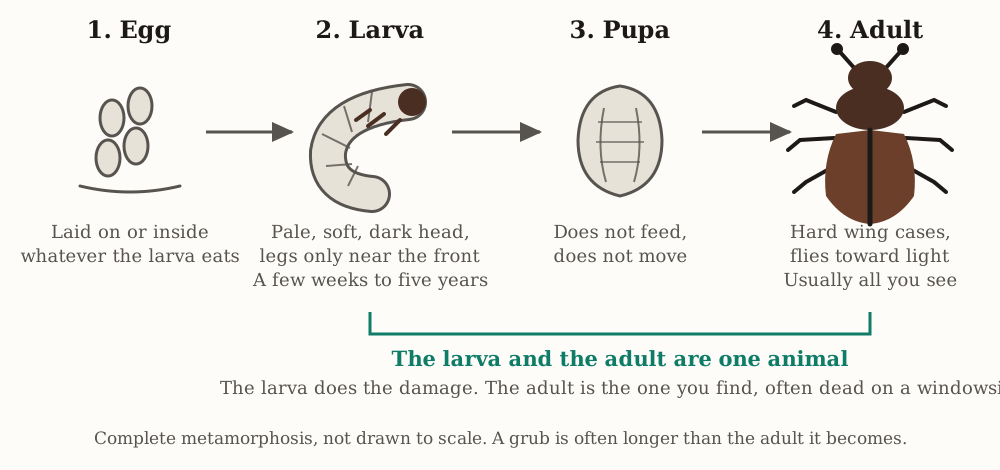
Several beetle larvae have their own common names, which hides the connection. The fat white C-shaped lawn grubs in turf soil are June, chafer or Japanese beetle larvae. Thin wiry larvae in garden soil are wireworms, which become click beetles. The mealworm sold as reptile food is a darkling beetle larva. Bristly larvae in closets are carpet beetles, and the pale larvae inside dry beans are bean weevils.
What beetles eat varies as widely as the group itself. Some chew leaves, some hunt other insects, some eat dead wood, dung or carrion, and the household pests eat fabric, flour and grain. Very few eat anything a person would miss, which is why most beetles never become a problem indoors.
Most beetles can fly, and the mechanics explain why they look so clumsy at it. The hard wing cases have to lift out of the way before the real flight wings unfold from underneath, so takeoff is slow and landings are worse. Hitting a window is a separate problem, and a 2024 study in Nature Communications settled it: insects hold their backs toward the brightest thing in view, which near a bulb traps them in circling flight rather than steering them into the glass. A few groups, including many darkling beetles, have fused wing cases and cannot fly at all.
How many types of beetles are there?
The best current tally is 386,755 described living species, counted by Bouchard and colleagues in 2017. That makes beetles the largest order of animals on Earth, at roughly a quarter of all described animal species. For comparison, there are about 11,000 birds.
The more interesting number is the one nobody can count. A 2015 study in PNAS by Stork and colleagues put the real total near 1.5 million beetle species. Their range ran from 0.9 to 2.1 million, across four independent methods. So the described figure is not how many beetles exist. It is how many we have got around to naming, which is somewhere between a quarter and a third of them.
This is also a question where published answers disagree, which is worth saying plainly. Among the pages currently ranking for this search, one gives over 370,000 species, another about 350,000, another 300,000, and another “more than a quarter million”. Figures for the United States are quoted anywhere from 12,000 to 30,000, with the standard reference work, American Beetles, counting roughly 25,000 north of Mexico. Treat any single round number you see for US beetles with caution.
Part 7 of 7
What to do next
Still not sure what you found?
If the beetle is still in front of you, a photograph settles it faster than a key. Shoot it from directly above, fill the frame, and get the wing cases and the antennae in focus, because those two features carry most of the identification.
Our beetle identifier by picture reads an image directly, and the insect identifier narrows things by wings, legs and body shape if you have no photo. For a bug you cannot photograph at all, our guide to identifying a bug without a photo works through the question by room and behavior instead. The same approach for the other big group of garden insects is in types of bees and wasps.
Pest control disclaimer. Photo-based identification can help, but it is not always perfect. For dangerous spiders, large infestations, or anything you are unsure about, contact a licensed pest control professional.
Types of beetles FAQ
What is the most common type of beetle?
What are the names of all the beetles?
Is this a beetle or a cockroach?
What is the most toxic beetle?
What are the biggest beetles?
What beetle is in my bed?
Do the same beetles come back every year?
What kills beetles in the house?
Related guides
June bug
Four different beetles answer to the name. Which one you have, and whether it bites.
Lawn grubs
The white C-shaped larvae under a dead patch, and whether yours are worth treating at all.
Black beetle
The commonest answer of all: plain black beetles sorted by size, shine and the room you found them in.
House beetles
Every beetle that turns up indoors, sorted by room, and whether yours is damaging anything.
Carpet beetles
The fabric pest behind holes in wool and itchy marks that are not bites.
Drugstore beetle
The small brown beetle in spices, cereal and dry pet food, and how to find its package.
Japanese beetles
Metallic green beetles skeletonizing leaves, and why bag traps make it worse.
Ladybug vs Asian beetle
Telling the native ladybug from the orange beetle that gets into houses in fall.
Orange ladybug
What an orange or yellow ladybug is, and whether the color means anything.
Small black bugs
Fourteen tiny black bugs compared, for when what you found is not a beetle.
Types of bees
The same approach for bees: the eight kinds people actually meet.
Assassin bug
A true bug that gets reported as a beetle, and the crossed wings that give it away.
Bug identifier by picture
Upload a photo for a free identification, with the angles that work for beetles.
Sources
- CDC, Emerging Infectious Diseases: Anthrenus sp. and an Uncommon Cluster of Dermatitis (2021)
- University of Maine Extension, Blister Beetles
- Texas A&M Veterinary Medical Diagnostic Laboratory, Cantharidin Poisoning
- UC IPM Pest Notes 7418, Wood-Boring Beetles in Homes
- Stork et al., New approaches narrow global species estimates for beetles, PNAS (2015)