Most people meet a june bug the same way: a loud thud against a lit window on a warm evening, then a fat brown beetle on its back on the step, legs going. It is one of the least dangerous insects you can find at home, and also one of the most confusing. The name covers several beetles that look nothing alike and behave nothing alike. This page sorts them first, then answers the rest.
Part 1 of 4
Name it
What is a june bug?
A june bug is any of several stout, hard-shelled scarab beetles that appear in late spring and early summer. They measure 1/2 to 1 inch (12 to 25 mm) long, and lights at night draw them hard. The name is a nickname rather than a species. June beetle and May beetle mean the same thing, and in some regions people say July bug.
Most of them belong to the genus Phyllophaga, whose name is Greek for leaf eater. That genus alone holds around 750 species across North and South America. Roughly 200 to 250 of those live in America north of Mexico. Treat any single figure with care, though, because the published numbers disagree sharply. Britannica puts the genus at “nearly 300”. The Missouri Department of Conservation puts North America north of Mexico at “more than 400”. Two of the largest commercial pages on the subject say 100. The specialist scarab literature gives the 750 figure, and it is the one to trust.
There is a further catch, and it shapes the rest of this page. Several beetles outside Phyllophaga also answer to june bug, including two bright green ones and the largest of the lot. They are only loosely related, and they differ in the things you would actually notice.
Which june bug do you have?
Two questions settle it almost every time: what colour is it, and was it flying in daylight or after dark. The brown ones fly at night and bang into lights. The green ones fly in the morning and afternoon and mostly ignore lights. Size sorts the rest, since the largest is nearly twice the length of the smallest.
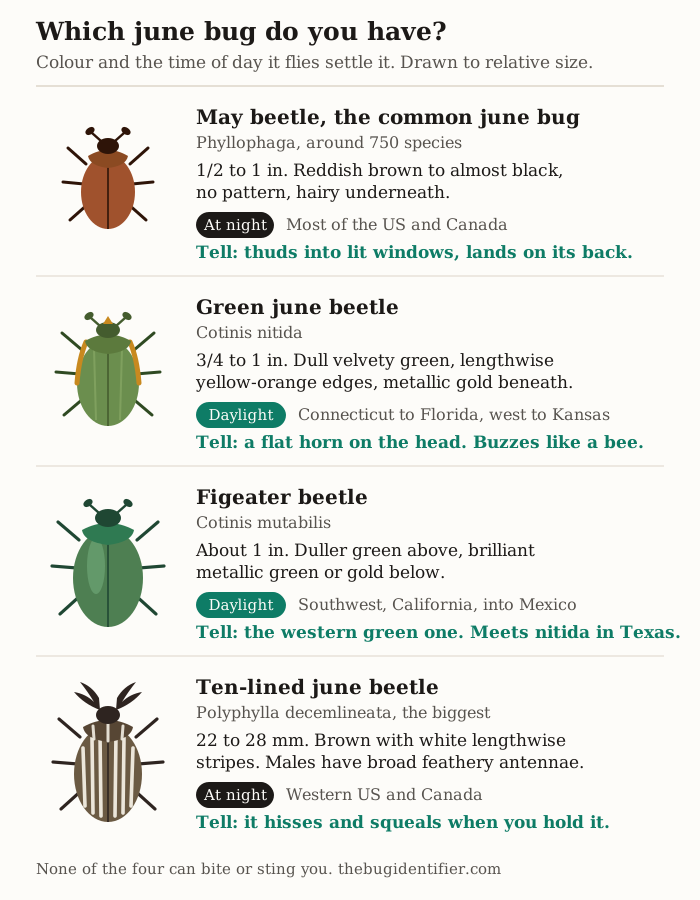
Table 1. The four beetles called a june bug, and the one feature that settles each
May beetle or june bug (Phyllophaga)
- Size
- 1/2 to 1 in
- Colour
- Reddish brown, rusty or almost black, hairy underneath
- When it flies
- After dark
- Where
- Most of the US and Canada
- The tell
- Crashes into lit windows and lands on its back
Green june beetle (Cotinis nitida)
- Size
- 3/4 to 1 in
- Colour
- Dull velvety green with lengthwise yellow-orange edges, metallic green or gold beneath
- When it flies
- Daylight, from early morning
- Where
- Connecticut to Florida, west to Texas, Oklahoma and Kansas
- The tell
- A small flat horn on the head, and a flight that buzzes like a bumble bee
Figeater beetle (Cotinis mutabilis)
- Size
- About 1 in
- Colour
- Duller green above, brilliant metallic green or gold below
- When it flies
- Daylight
- Where
- Southwest and California, into Mexico
- The tell
- The western green one. Ranges meet the green june beetle in Texas
Ten-lined june beetle (Polyphylla decemlineata)
- Size
- 22 to 28 mm, the biggest
- Colour
- Brown with white lengthwise stripes
- When it flies
- After dark
- Where
- Western US and Canada
- The tell
- It hisses and squeals when you hold it, and males have broad feathery antennae
A fifth group turns up in California, and almost nobody names it. UC IPM records Serica species, at 0.4 to 0.6 inch and velvety brown, as the commonest “june beetles” in avocado groves there. If you are in the Southwest with a small plain brown one, that is a likely answer.
A correction worth knowing about
You will find pages, including one from a university extension service, saying the green june beetle is the fig eater. They are two different species living on opposite sides of the country. Cotinis nitida, the green june beetle, is the eastern one. Cotinis mutabilis, the figeater, is the southwestern one, and it has the widest range of any beetle in its genus. Both will happily eat a ripe fig, which is how the names got tangled. Their ranges meet in Texas, so a Texan really can find either.
What a june bug looks like up close
Every june bug shares the same build: an oval, stout, domed body with hard wing covers and six spiny legs. The antennae are short and end in a club, which can press flat or fan open like a feather. That antenna is the single most useful feature on the insect, because it rules out nearly everything else people mistake for a june bug.
The common brown june bug is plain, with no spots or stripes, and noticeably hairy on the underside. Hold one and you will feel the legs hook into your skin, which is what most reported june bug bites turn out to be. The hard wing covers, the elytra, have to swing clear before the real flight wings unfold underneath. That is a large part of why takeoff looks so laboured.
The green june beetle is a different animal to look at. Its back is velvety rather than shiny, dull green with lengthwise stripes edged in yellow-orange, while the underside is brilliant metallic green or gold. Penn State Extension notes the small flat horn on its head, which the brown ones do not have. It flies in broad daylight, low over grass, and people often mistake the sound for a bumble bee.
The ten-lined june beetle is the one people photograph in disbelief. At 22 to 28 mm it is the largest of them, patterned with white stripes down the wing covers. The males carry broad feathery antennae for picking up female pheromones. Washington State University records the behaviour that nobody forgets: it hisses and squeals when handled. The noise is startling and completely harmless.
Part 2 of 4
Is it a problem?
Do june bugs bite?
No. A june bug cannot bite or sting you, and none of the four carries a disease that passes to people. Their mouthparts are built to chew leaves, flowers and soft fruit, and they are not strong enough to break human skin. There is no venom, no stinger and no mouth that can get a purchase on you.
What people feel, and reasonably describe as a bite, is the grip. A june bug clings hard to whatever it lands on, and its legs end in small hooks meant for bark and leaves. Pull one off your arm quickly and the hooks drag, which stings for a moment and can leave a tiny red mark. Nothing has pierced the skin, and nothing needs treating beyond a rinse.
The same answer covers pets. A dog or cat that eats a june bug is almost certainly fine, since there is no venom involved. Several large beetles at once can upset a small dog’s stomach, mostly because of the hard wing cases. Ring your vet if vomiting carries on for more than a day.
If one lands on you, or gets in your hair
This is the commonest worry people actually voice, and it comes up again and again online: a june bug in someone’s hair. It happens because the beetle is a poor flier near a light, not because it was aiming for you. It gets stuck because its hooked legs catch in hair the way they catch in bark. Three things make it painless:
- Do not pull it straight out. That is what drags the hooks and hurts. Work the strands away from the legs instead, or slide a comb under the beetle and lift.
- Turn the light off, or step away from it. Without a bright source the beetle stops circling and will usually crawl or fly off on its own.
- Nothing needs disinfecting afterwards. There is no bite and no sting, so a rinse is plenty.
If one is loose indoors, you do not need a swatter. Turn off the lamp it is circling, open a window or door, and switch on a light outside. Otherwise a glass and a piece of card will catch it against a wall, because a june bug is slow and makes no attempt to escape.
Is it a cockroach, a Japanese beetle, or something else?
Is a june bug a cockroach? No, and people ask Google this so often that the question sits in its own results. The two are not closely related, and three features separate them instantly. A june bug is domed and hard-shelled, with short clubbed antennae, and it flies at light. A cockroach is flat and runs very fast, its antennae are as long as its body, and it heads for the dark when you turn a light on.
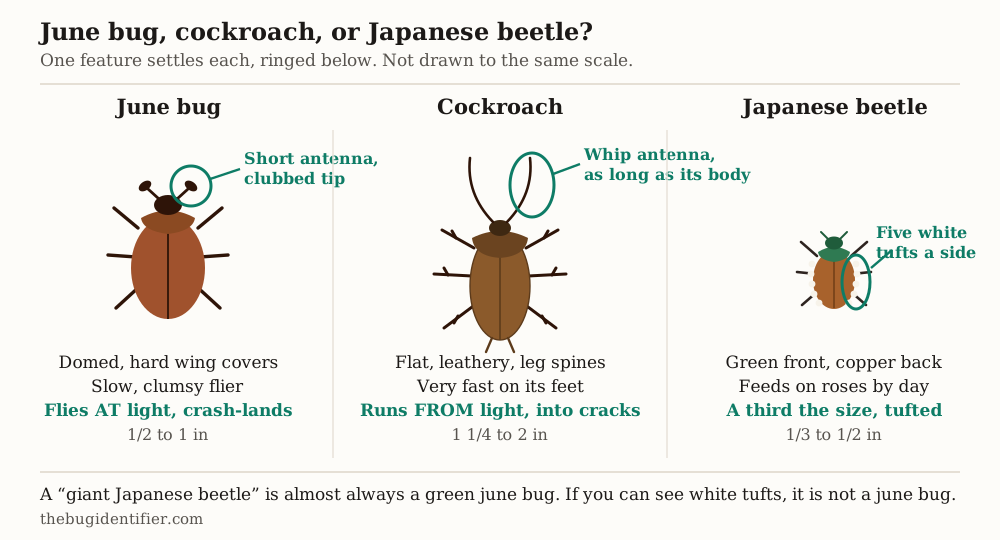
Table 2. June bug look-alikes, and the feature that rules each in or out
Long whip-like antennae, flat body, runs from light
- What you have
- Cockroach
- How it differs from a june bug
- A june bug is domed, slow, and flies straight at the light
Five white hair tufts along each side, about a third the size
- What you have
- Japanese beetle
- How it differs from a june bug
- A metallic green june bug is roughly twice as long and has no tufts
Brown, no tufts, a little smaller and daytime active
- What you have
- False Japanese beetle
- How it differs from a june bug
- Very close to a small june bug. Daytime flight is the clue
Long legs, trailing flight, no hard wing covers
- What you have
- Crane fly or mayfly
- How it differs from a june bug
- No hard shell at all. In some regions people call mayflies june bugs
Hard shell but much flatter, and found in stored food
- What you have
- Pantry or carpet beetle
- How it differs from a june bug
- A fraction of the size, and it does not come to outdoor lights
Sings from trees, bulging eyes, clear veined wings
- What you have
- Cicada
- How it differs from a june bug
- Much larger, noisy by day, and not a beetle
The green ones cause a particular mix-up worth naming. A beetle reported as a giant Japanese beetle is almost always a green june beetle, or a figeater in the Southwest. A real Japanese beetle is about a third of an inch, metallic green in front with copper wing covers. It carries five small white tufts of hair along each side. If you can see tufts, it is not a june bug, and our guide to what a japanese beetle looks like has it close up. For anything else with a hard shell, our round-up of the common types of beetles sorts them by size, colour and shape.
Why june bugs crash into lights
Not because they mistake a bulb for the moon, and not because they are stupid. People repeated that explanation for decades, and a 2024 study in Nature Communications overturned it. The team filmed flying insects around artificial light in three dimensions and found something different. Insects hold a reflex called the dorsal light response: they keep their backs turned toward the brightest part of their view.
Under an open sky, with the brightest thing overhead, that reflex keeps an insect level and the right way up. Near a bulb it goes wrong. Fabian and colleagues found that insects do not steer directly toward a light at all. They turn their backs to it, which throws them into flight paths running across the source rather than at it, and close in that becomes continuous circling that traps the insect.
So a june bug at your window is not heading for you, or for the bulb. A reflex that works everywhere except within a few metres of a lamp has taken over, and the beetle has lost control. The authors were careful about the limits of the work: they measured insects close to a source, and behaviour further out is still unsettled. One practical conclusion falls straight out of it, and it is the basis of the fix further down this page. Change the light, and the problem goes away, because the problem was never the beetle’s intent.
Part 3 of 4
The year underground
When june bug season starts and ends
June bug season runs May to August across most of the US, and peaks through June and July. Adults are out for two to four weeks each, so what feels like one long season is really a relay of overlapping cohorts. In the Southeast they are flying by May, and in the Pacific Northwest the ten-lined june beetle arrives late, from the end of June into July.
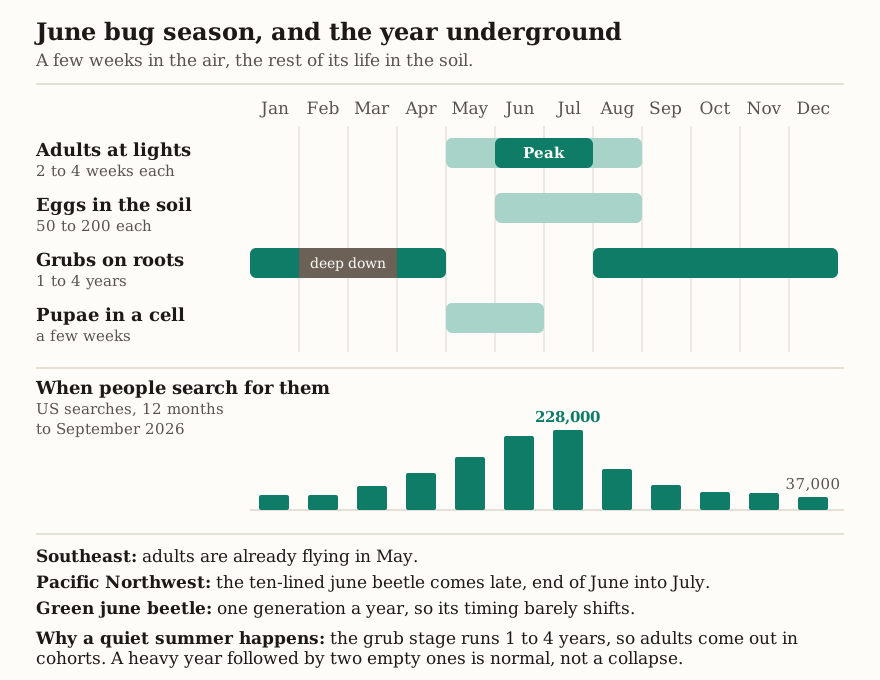
The timing is sharp enough to show up in how people search. Across the two years to September 2026, US searches for june bugs ran at a low of about 31,000 in December. By July they reached 228,000, a sevenfold swing that tracks the beetles themselves almost exactly. If you are reading this in October and have not seen one for weeks, that is the season ending, not an absence.
The life cycle, and why it takes years
A june bug spends almost its whole life underground and only a few weeks in the air. For Phyllophaga, the grub feeds on roots for one to four years depending on the species, then pupates in a small cell in the soil. Britannica puts the whole adult stage at less than a year, and the flying part of it at a few weeks.
There is a detail here that explains a lot of what people notice. After pupating, the new adult stays underground through the following winter and only crawls up to the surface the next spring. Because of that, and because the grub stage can take anything from one to four years, the beetles emerge in cohorts. A neighbourhood can get a heavy year followed by two quiet ones.
Table 3. How long each june bug takes, and how many eggs it lays
May beetle (Phyllophaga)
- Generations
- One every 1 to 4 years
- Grub stage
- 1 to 4 years, deeper in winter
- Eggs
- 50 to 200, buried singly a few inches down
Green june beetle (Cotinis nitida)
- Generations
- One a year
- Grub stage
- Overwinters nearly grown, pupates May to June
- Eggs
- 10 to 30, in a ball of soil about the size of a walnut
Ten-lined june beetle (Polyphylla decemlineata)
- Generations
- One every 2 to 4 years
- Grub stage
- Several years on roots of crops and ornamentals
- Eggs
- Laid in soil near host plants
Serica species (California)
- Generations
- One a year
- Grub stage
- A single year in soil
- Eggs
- Laid in untilled ground and brush land
The green june beetle is worth separating out, because it runs on a faster and tidier schedule. It completes one generation a year. Females prefer moist, organic soil, and they dig in to lay 10 to 30 eggs packed into a walnut-sized ball of earth. Those eggs are about 1/16 inch across, they absorb moisture from the soil, and they hatch in 10 to 15 days.
The white grub, and how to tell whose it is
Turn over a spadeful of soil in summer and the fat white grub you find is probably a june bug larva. It runs 3/4 to 1 3/4 inches long, white-bodied with a brown head, and curls into a C shape at rest. Three pairs of legs sit clustered near the front. Several different beetles produce grubs that look much like this, which matters because the treatments differ.
There is one reliable way to tell them apart, and almost nobody prints it. Look at the underside of the last segment, the blunt end. A june bug grub carries two parallel rows of short spines running side by side, like railroad tracks. A Japanese beetle grub has its spines arranged in a V instead. Entomologists call this pattern the raster, and it is the first thing they look at.
Green june beetle grubs give themselves away without a hand lens, because they do something no other grub does: they crawl on their backs. Their legs wave uselessly in the air while rows of short stiff hairs along the upper surface push them over the ground. Penn State notes that after rain they turn up on sidewalks, in garages and in ground-level swimming pools. A large pale grub swimming on its back in your pool is this species, and it is harmless.
One more clue is useful before you spend money. WebMD makes the point that grubs in a lush, frequently watered lawn are probably the larvae of a different beetle. June bug grubs do their worst damage in grass that gets little water, and especially in new lawns planted where pasture stood recently.
What june bugs damage, and what they do not
The adults do very little. They chew leaves, flowers and soft ripening fruit, and the holes are usually so light that the beetles have moved on before anyone notices. Missouri’s conservation department is blunt about the scale: though they chew plants, they cannot hurt people. For most households the clumsy flying around porch lights is the whole experience.
The grubs are the ones that cost money, and only in numbers. Underground they sever grass roots, which shows up as uneven patches of dying turf. Those lift like a loose carpet when you pull at them, because the roots holding the sod have gone. Britannica lists corn, small grains, potatoes and strawberries among the crops they damage.
Green june beetle grubs damage lawns differently, and it is easy to misread. They seldom eat enough root to kill the grass. Instead they tunnel up at night and push out mounds of loose soil 2 to 3 inches across. The open vertical burrows they leave run 6 to 12 inches deep, about the width of your thumb. Those mounds look like earthworm castings, and the difference is that worm castings are made of distinct pellets while these are loose soil.
Then there is a kind of damage nobody warns you about, which is the hole in your evening. A dozen beetles thudding off a screen door is genuinely unpleasant, and it is the problem most readers actually want solved. That one is fixable in an afternoon.
Part 4 of 4
What to do
What to do about the june bugs at your light
Start with the bulb, not an insecticide. Adult june bugs are at your door for one reason, and the whole problem goes away for the cost of a light fitting. None of the steps below involves spraying anything, and the first one alone usually settles it.
Switch the bulb, not the habit
Warm white or yellow bulbs pull in far fewer june bugs than bright white or mercury vapour ones. Change the fitting nearest the door you use, and you will notice the difference the same evening. This is the one fix that keeps working every summer with no further effort.
Move the light away from the door
A bulb on the wall beside a doorway funnels beetles straight at you as you come in. Shifting the light a few feet to one side, or using a shielded fitting that throws light down rather than out, moves the whole crowd with it.
Turn off what nobody is using
Interior lights draw them to the windows just as outdoor ones do. Closing curtains on the lit side of the house and switching off the porch light when you are not on the porch removes the attraction completely for the few weeks it matters.
Fix the screens
June bugs do not chew their way in, so they are only ever indoors through a gap. A torn screen, a propped door or a missing sweep is the whole story. Patch the mesh and the beetles stay outside bumping against it.
Leave the ones on their backs alone, or flip them
A beetle struggling upside down on the step is not injured or dying. It landed badly and cannot right itself on a smooth surface. Nudge it onto grass with a shoe or a piece of card if you would rather not step over it.
Skip the trap unless you are counting them
Blacklight traps catch june bugs, and UC IPM uses them in orchards to work out when the adults are flying. Around a house they tend to draw in more beetles than they remove, and they catch harmless insects too. Monitoring is what they are good for.
Spraying the adults is not worth doing, and it is worth being clear why. They arrive from untilled ground, pasture and brush nearby rather than breeding at your house. So there is no local population to treat, and new beetles replace the ones you kill every night until the season ends. Broad-spectrum insecticide outdoors also kills the predators and parasitoids that keep grub numbers down, which can leave you worse off. If you ever do reach for a product, use one whose label names the pest and the place you mean to use it. The label is the law.
If the problem is grubs in your lawn
That is a different job from the beetles at your door, and it has its own page. The short version: confirm you actually have grubs before treating, because most brown patches turn out to be drought, disease or dog urine. Cut a square foot of turf 2 to 4 inches deep in a few places and count. Under about five per square foot, a healthy lawn needs nothing. Identify the grub first using the railroad-track check above, since the products and the timings differ between june bug, Japanese beetle and chafer grubs.
The full method, the treatment thresholds the extension services actually publish, the two windows a year when a product reaches them and the three widely sold “grub” products that do nothing are all in our guide to grub damage in a lawn.
What eats june bugs, and can you eat them
Plenty eats them, which is part of why they need no help from you. Skunks, raccoons and moles dig up the grubs, and if you find a patch of your lawn flipped over one morning, that is usually what happened. Birds take grubs near the surface, crows and grackles especially, while bats and frogs take the adults in flight.
Two parasitoids are worth knowing by name. The waved light fly, Pyrgota undata, lays an egg under the wing covers of a flying adult. Its larva feeds inside and eventually kills it. The blue-winged wasp, Scolia dubia, hunts green june beetle grubs: the female digs through soil, paralyses a grub and lays an egg on it. Those wasps peak in August, about half an inch long with two yellow spots on the abdomen. If you see them flying low over your grass in slow looping patterns, they are working.
As for eating them, people do. Both Britannica and Missouri’s conservation department note that anglers prize june bug grubs as free live bait, since they are one of the few kinds plentiful in spring. People in some places eat the adults too, and backyard chickens are famously keen on both stages. We would not suggest eating anything from a lawn that somebody has treated with pesticide.
Why they are called june bugs
Because the adults come out of the soil at the end of spring and the start of summer, which in much of the US means June. The name is regional and loose. May beetle, June beetle, June bug and July bug all name the same insects, and which one you say depends on where you grew up.
Entomologists tend to avoid the term, for a reason that is more than pedantry. In its strict sense a bug means a member of the true bugs, an entirely separate group with piercing mouthparts, and a june bug is a beetle. Missouri’s conservation department adds a genuinely confusing wrinkle. In some parts of America people use june bug for mayflies, which are not beetles either, and which swarm in enormous numbers in early summer. If someone describes june bugs covering a lakeside screen door in clouds, they may well mean mayflies.
Are there fewer june bugs than there used to be?
People ask this a lot, in almost identical words, and the honest answer is that nobody knows. No monitoring programme counts Phyllophaga populations over time, so there is no dataset to consult. Claims of a collapse since the 1960s circulate widely, usually blaming pesticides, and they rest on recollection rather than counts.
Before concluding anything from a quiet summer, there is a better explanation to rule out. These beetles emerge in cohorts on a one to four year cycle, so a big year followed by two empty ones is exactly what you should expect. Missouri’s conservation department puts it well in describing how natural controls keep heavy infestations from being an annual event.
The documented part is narrower and more specific. Insect populations are falling broadly, across many groups. One june beetle is already in serious trouble: Casey’s june beetle, Dinacoma caseyi, joined the US endangered species list in 2011 and survives on a few hundred acres around Palm Springs, California. Among the threats the US Fish and Wildlife Service names for it, alongside development and off-road vehicles, is lighting from urban structures and vehicles. The same artificial light that sends a common june bug tumbling into your screen door also threatens a rarer relative. That is a reason to change a bulb beyond your own comfort.
What does not work, and what is simply wrong
A good deal of june bug advice is harmless but useless, and sources that should know better repeat some of it.
Myth 1
Myth: “June bugs bite, and a june bug bite can get infected.”
Truth: They have no mouthparts capable of breaking skin. The mark people see is from the hooks on the legs, which do not pierce. There is no june bug bite to treat.
Myth 2
Myth: “They fly at your light because they mistake it for the moon.”
Truth: Overturned in 2024. Lunar navigation was one of two long-standing theories, and three-dimensional flight recordings fitted neither. Insects keep their backs to the brightest thing in view, which near a bulb traps them in continuous circling.
Myth 3
Myth: “The green june beetle is the same thing as the fig eater.”
Truth: Two species on opposite sides of the country. Cotinis nitida is eastern, Cotinis mutabilis is southwestern, and their ranges meet in Texas. At least one extension page states otherwise.
Myth 4
Myth: “There are about 100 kinds of june bug.”
Truth: The Phyllophaga genus alone holds around 750 species across the Americas, and roughly 200 to 250 of those live north of Mexico. The 100 figure appears on two of the biggest pages on the subject.
Myth 5
Myth: “A bug zapper will clear them out.”
Truth: It will kill beetles and a great many harmless insects, while continuing to advertise your garden to every june bug in the area. Changing the bulb removes the attraction instead of adding one.
Myth 6
Myth: “A june bug on its back is dying, so it needs rescuing or killing.”
Truth: It landed badly and cannot right itself on a smooth surface. Tip it onto grass and it will walk away. This is normal behaviour, not injury.
Myth 7
Myth: “Treat the lawn as soon as you see grub damage.”
Truth: The damage you can see was done by grubs that are nearly finished. The useful window is mid-May to early August the following year, and only after confirming which grub you have.
Myth 8
Myth: “If june bugs are in the garden, the grubs are killing the lawn.”
Truth: Adults fly in from pasture and untilled ground nearby, so their presence says little about your soil. Confirm grubs by cutting and sifting turf before treating anything.
Still not certain what you are holding? Photograph it from above, in daylight if you can, and run the picture through our bug identification tool before buying anything at all.
Pest control disclaimer. Photo-based identification can help, but it is not always perfect. For dangerous spiders, large infestations, or anything you are unsure about, contact a licensed pest control professional.
June bug FAQ
Do june bugs bite?
Is a june bug a cockroach?
What is the difference between a june bug and a june beetle?
How long do june bugs live?
What attracts june bugs to my house?
Are june bugs dangerous to dogs or cats?
What do june bugs eat?
Why do june bugs fly into me and my porch light?
Should I kill june bugs?
Related guides
Lawn grubs
The white C-shaped larvae under a dead patch, how to count them, and when treating is a waste.
Types of beetles
Name any beetle by size, colour and shape, starting with whether it is a beetle at all.
Japanese beetles
The small metallic green beetle on roses, its white side tufts, and the grubs it leaves behind.
Black beetle
Twenty-two black beetles found indoors, sorted by size and shine.
House beetles
Beetles indoors, sorted by the room and by whether anything is being eaten.
American cockroach
The large flying insect june bugs get mistaken for, and how the two differ.
Grasshoppers
The other big summer garden insect, its bite, and what it does to plants.
Carpet beetles
Small indoor beetles whose larvae eat wool and whose hairs cause an itchy rash.
Pupa
What the stage between grub and beetle looks like, and what to do if you dig one up.
Sources
- Fabian, Sondhi, Allen, Theobald and Lin, Why flying insects gather at artificial light, Nature Communications 15, 689 (2024)
- Penn State Extension, Green June Beetle, Paul Heller (updated 2026)
- Missouri Department of Conservation, May Beetles (June Bugs), Phyllophaga spp.
- Washington State University Department of Entomology, Ten Lined June Beetle
- Encyclopaedia Britannica, June beetle (genus Phyllophaga)
- UC Statewide IPM Program, June Beetles, Avocado Pest Management Guidelines
- US Fish and Wildlife Service, Casey's June Beetle (Dinacoma caseyi), listed endangered 2011