Lawn grubs are the fat, white, C-shaped larvae you find in the soil when you pull back a patch of dead grass. They eat grass roots, and in big enough numbers they kill the turf above them. Most lawns, though, have a few and are perfectly fine. This page helps you work out which lawn you have before you spend any money.
Part 1 of 4
Name it
What lawn grubs are
Lawn grubs are the larval stage of scarab beetles, the family Scarabaeidae. The adults fly in early summer, mate, and lay eggs in the top few inches of lawn soil. Those eggs hatch into grubs that spend most of the year underground, feeding on grass roots, before turning into beetles themselves.
People also call them grub worms, white grubs or grub bugs. None of those is a worm. A grub has a hard head capsule and six legs, which no worm has. The word “grub” simply means a beetle larva, so “grub worm” and “lawn grubs” describe the same animal.
Six beetles account for nearly all the lawn grubs in American turf. Which one you have changes the picture more than most pages admit. One of them crawls along on its back. Another takes three years to grow up. A third is not a scarab at all, so nothing sold for lawn grubs will touch it.
Table 1. Lawn grubs at a glance
What they are
- Lawn grubs
- Larvae of scarab beetles (Scarabaeidae)
Size
- Lawn grubs
- 3/4 in (19 mm) is typical; 1/2 to 2 in (13 to 50 mm) across species
Colour
- Lawn grubs
- Cream to grey body, orange-brown head
Legs
- Lawn grubs
- Three pairs, clustered right behind the head
Shape
- Lawn grubs
- Curled in a C at rest, straight when crawling
Where
- Lawn grubs
- Top 2 in (5 cm) of soil while feeding; 6 to 18 in (15 to 46 cm) down over winter
What they eat
- Lawn grubs
- Grass roots, plus decaying organic matter
Damage season
- Lawn grubs
- Mid-August to October, and again March to early May
Do they bite?
- Lawn grubs
- No. No bite, no sting, no disease
Turn into
- Lawn grubs
- June bugs, Japanese beetles, chafers
What lawn grubs look like
Lawn grubs are cream-white, soft, and curled into a C when you lift them. Each one has a hard orange-brown head and three pairs of legs bunched close behind it, with nothing along the rest of the body. The back end looks darker and swollen, because you are seeing the gut contents through the skin. Full-grown lawn grubs are usually about 3/4 inch (19 mm) long. May and June beetle grubs are the exception, and they reach 2 inches (50 mm).
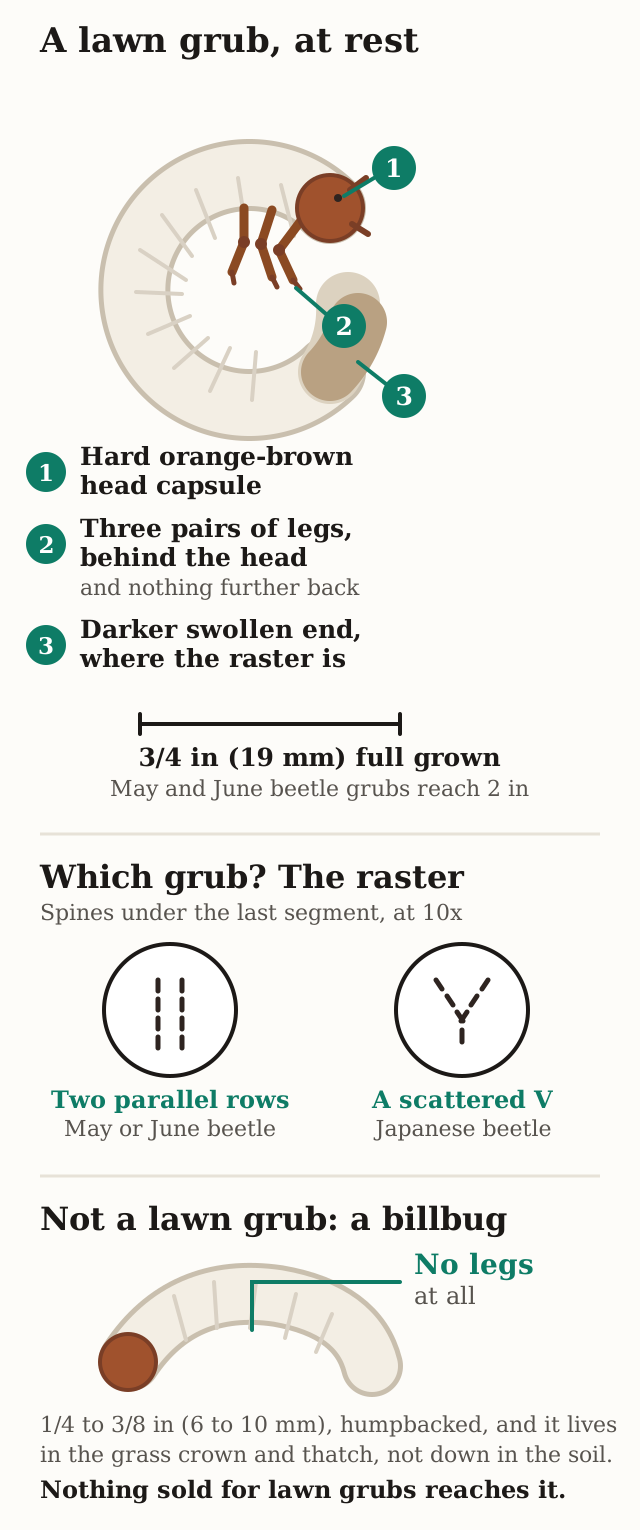
How big lawn grubs get, and when
Size is a date stamp, and this is where a count goes wrong. In April and May, and again in September and October, lawn grubs are at least half an inch long and hard to miss. In late July and early August they have only just hatched. They are tiny then, and they sit right at the line where the roots meet the thatch. So an August count that finds nothing has often just missed them.
The raster pattern, which names the species
Every species of white grub has its own arrangement of small spines and bristles on the underside of the last segment. Entomologists call it the raster, and it is the only reliable way to put a name to a grub. You need a 10x magnifier to see it. It also pays to check several grubs, because two species often share one lawn.
Two patterns matter most to a homeowner. Two parallel rows of short spines, like a tiny railroad track, mean a May or June beetle. A scattered V shape means a Japanese beetle. This matters for a practical reason: milky spore is sold for Japanese beetle grubs only, so the V tells you whether that product has any chance at all. If you would rather start from the adult beetle, our free bug identification tool names it from a photo in seconds.
What is not one of the lawn grubs
Three things get dug up and called grubs. Getting this wrong wastes a whole season, because none of them is touched by a product made for lawn grubs.
Table 2. Lawn grubs and their look-alikes
A true lawn grub
- The one feature that separates it
- Three pairs of legs behind the head
- Where you find it
- Top 2 in of soil, under the roots
A billbug larva
- The one feature that separates it
- No legs at all. Humpbacked, 1/4 to 3/8 in (6 to 10 mm)
- Where you find it
- In the grass crown and lower thatch, not the soil
A crane fly larva
- The one feature that separates it
- Grey, leathery, legless, no hard head capsule
- Where you find it
- Thatch and surface soil, mostly the Pacific Northwest and Northeast
A compost or mulch grub
- The one feature that separates it
- Found in compost, mulch or rotting wood, not under living turf
- Where you find it
- Breaking down dead matter, not eating roots
A billbug is a weevil rather than a scarab, and it belongs with the other snout beetle species. The mix-up is common enough that Purdue Extension writes the difference out: billbug larvae “appear somewhat similar to white grub larvae, except that they are smaller (1/4 to 3/8 inch) and are legless.” They leave their own clue as well. Pull a thinning stem, and if it snaps off at the soil line with fine sawdust-like powder at the broken end, that is billbug frass rather than grub damage. The grey leathery ones are crane fly larvae, which no grub product is labelled for either.
The last row matters too. Plenty of white grubs in a compost heap, a mulch pile or a potted plant are decomposers doing useful work. They are not lawn grubs at all, and there is no reason to kill them.
Which beetle your lawn grubs belong to
Six species cause nearly all the trouble, and they behave differently enough to change what you do. Note the second column especially. A watered lawn and a dry lawn attract different beetles, so neither one is safe.
Table 3. The beetles behind lawn grubs
Does most of the damage, adults never feed
- Beetle
- Masked chafer (Cyclocephala), the annual white grub
- Life cycle
- 1 year
- Where it lays
- Most lawns, across the country
Adults eat your roses and grapes
- Beetle
- Japanese beetle (Popillia japonica)
- Life cycle
- 1 year
- Where it lays
- Irrigated turf, new bluegrass sod, golf courses
Adults fly at dusk and go unseen
- Beetle
- European chafer (Amphimallon majale)
- Life cycle
- 1 year
- Where it lays
- Dry, unirrigated lawns
The biggest grubs of the group
- Beetle
- May or June beetle (Phyllophaga)
- Life cycle
- 2 to 3 years
- Where it lays
- Lawns near oaks
Crawls on its back, legs upward
- Beetle
- Green June beetle (Cotinis nitida)
- Life cycle
- 1 year
- Where it lays
- Lawns with thick thatch
Occasional, prefers other plants' roots
- Beetle
- Oriental beetle, Asiatic garden beetle
- Life cycle
- 1 year
- Where it lays
- Mixed
The masked chafer is the one to expect. Missouri Botanical Garden puts more than 90% of the grub damage in its region on this single annual grub. Because its adults never feed on plants, most people never notice the beetle at all.
Green June beetle grubs are worth knowing by sight, because their damage is different. They tunnel rather than shear roots, and they push loose soil up into little mounds that look like worm casts. The mounds are clearest after heavy rain. An earthworm’s tunnel is pencil-thin, while a green June beetle’s is about the width of a finger.
If you want to see the adults rather than the larvae, our guide to the june bug life cycle covers the brown beetles that hit porch lights. The page on japanese beetle grubs covers the metallic green ones chewing your roses. The hub has the rest of the family under beetle larvae identification.
Part 2 of 4
Rule it in or out
Is it grub damage, or something else?
This is the question worth answering first. Lawn grubs get blamed for most brown patches and cause only some of them. On r/lawncare, thread after thread titled “Is this grub damage?” ends with a top answer of “dog pee” or “heat stress”. The rule is simple: if you dig and there are no grubs, it is not grubs.
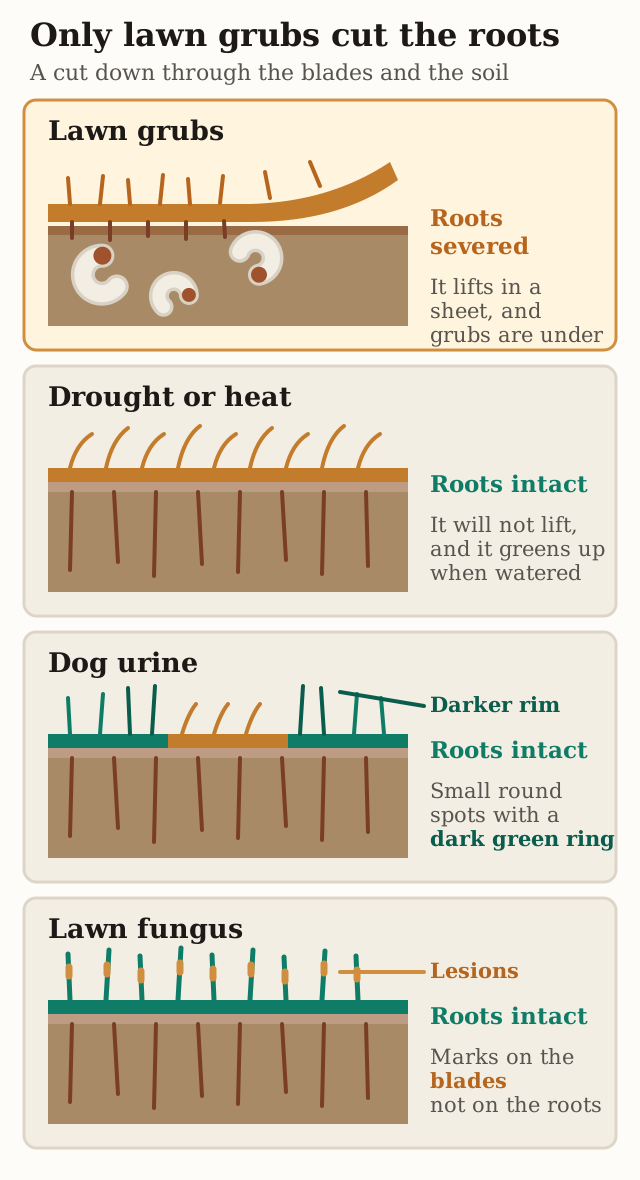
Signs of grubs in lawn
Three signs point at lawn grubs, and all three have to be read together.
- Spongy turf. The lawn feels soft or springy underfoot, often weeks before anything turns brown.
- Turf that lifts like loose carpet. Grab the dead grass and pull. With the roots eaten away, a whole sheet rolls back with nothing holding it down.
- Patches that spread and ignore watering. The grass looks drought-stressed even after a week of real watering. Instead of greening up, the patch keeps getting bigger.
Seven things that look like damage from lawn grubs
Each of these has one test that settles it. Work down the table before buying anything.
Table 4. What else makes a lawn go brown
Lawn grubs
- The test that settles it
- Turf lifts in a sheet and there are grubs under it
- When it happens
- Mid-Aug to Oct, Mar to early May
Drought or heat stress
- The test that settles it
- The turf will not lift: the roots come up with it. Greens up after a week of deep watering
- When it happens
- Hot, dry spells, worst in full sun
Dog urine
- The test that settles it
- Small round spots with a darker green ring around the rim. Roots intact
- When it happens
- Any time, wherever the dog goes
Lawn fungus
- The test that settles it
- Lesions or bands on the individual blades, sometimes a smoke ring in the morning dew. Roots intact
- When it happens
- Warm, humid weather
Chinch bugs
- The test that settles it
- Push a bottomless can 2 in into the soil, fill with water, wait 5 minutes. They float up
- When it happens
- Sunny edges by drives and walls, mid-June to Aug
Sod webworms
- The test that settles it
- Chewed blade tips and green pellets on the surface. A soapy flush brings them up in 5 minutes
- When it happens
- July and August
Billbugs
- The test that settles it
- Stems snap off at the soil line with sawdust-like powder at the break
- When it happens
- Late June through August
Shade and soil compaction belong on the list too, though they look different. Both thin a lawn rather than killing it in patches. Neither gives you the sharp edge that a spreading patch of lawn grubs has.
Why animals digging is not proof
Raccoons, skunks, crows and moles tearing up a lawn gets listed everywhere as a sign of grubs. Google’s own AI Overview repeats it, sourced to a company that sells grub killer. Two extension services say the opposite. UNH Extension is blunt about it: “This isn’t a reliable clue, however, because grub infestations aren’t always accompanied by animal damage and animal damage doesn’t always result from a grub infestation. These animals feed on other insects in the lawn, like earthworms.” The University of Maryland adds that moles have a varied diet and “can live in a lawn without grub problems.”
So treat digging as a reason to go and look, never as the answer. The dig itself is still worth fixing, since a skunk working over wet turf does real damage on its own.
Does Dawn dish soap kill lawn grubs?
No, and it does not count them either. This question turns up in Google’s People Also Ask box on nearly every search about lawn grubs, and no article on the first page answers it. So here is the full answer.
The recipe going around the forums is real, but it is meant for a different insect. UMass Amherst calls it an irritating drench, or soapy flush: one or two tablespoons of lemon-scented dish detergent in two gallons of water, poured over a patch about two feet square. UMass prescribes it for sod webworms, caterpillars that feed on the blades at night and hide by day. The soap irritates them out of their burrows “within five minutes, where they can be counted.”
Lawn grubs are a different problem in a literal sense. They feed below the roots, under the thatch, and the drench never reaches that far down. UMass gives no flush for white grubs at all. Its instruction is to dig instead: “The easiest way to sample for grubs is to dig a square about 6 inches on a side and about 4 to 6 inches deep.”
That makes a negative soap test genuinely misleading. If you flush a patch and nothing comes up, you have not shown the lawn is clean. You have shown that whatever is eating it lives on the soil rather than under it, which points you straight back at the table above. One more caution, since people do try it: a strong soap solution burns grass on a hot sunny day unless you rinse it off afterwards.
How to check for lawn grubs
Pick your spots
Choose three places: the middle of a brown patch, its edge, and a patch of good grass well away from it. Damage shows at the edge first, because the lawn grubs have already finished in the middle.
Cut a square
Using a spade or a lawn edger, cut three sides of a square 1 foot by 1 foot (30 by 30 cm), going 4 to 6 inches (10 to 15 cm) deep. Leave the fourth side as a hinge.
Peel it back
Fold the flap over like a page. If lawn grubs have been working, it lifts easily and the underside shows few roots.
Sift and beat
Break up the soil with a trowel, then knock the trowel edge against the underside of the sod. Many grubs sit in the thick roots just below the thatch, and they will not fall out on their own.
Count what you find
Put them in a cup as you go so you do not count one twice. Write the number down with the spot it came from.
Put it back
Fold the flap down, tread it flat, and water it. Done this way, the lawn heals over in a week or two.
The count is the whole decision, and it takes about ten minutes. Do it in the damaged area and again in a healthy patch nearby. Lawn grubs are patchy, so one square tells you very little. If you cut a smaller square to save your back, scale the answer. UMass uses a 6-inch square, which is a quarter of a square foot, so multiply that count by four.
How many lawn grubs are too many
There is no single number, and the pages that give you one are hiding something real. Here is what the main sources actually say.
Table 5. Treatment thresholds, by source
Michigan State University
- Grubs per square foot
- 5 or more
- What it says at that number
- Healthy, watered turf carries this with no visible damage
UMass Amherst
- Grubs per square foot
- 8 to 10
- What it says at that number
- A healthy turf tolerates this without visible weakening
UMass Amherst, stressed lawn
- Grubs per square foot
- 5
- What it says at that number
- Drought or heavy traffic can weaken turf at this level
University of Maryland
- Grubs per square foot
- 5 to 10
- What it says at that number
- Controls may be needed, varying by grub and grass
UNH Extension
- Grubs per square foot
- 10 or more
- What it says at that number
- A serious infestation
Missouri Botanical Garden
- Grubs per square foot
- Under 10
- What it says at that number
- Control is not required or recommended
The spread looks like disagreement and is not. The threshold is a property of your lawn rather than of the grub. UMass Amherst says so directly: “Normally a healthy turf should be able to tolerate at least eight to ten grubs per square foot without visible weakening. If there are other stresses (such as drought, heavy traffic), the turf may be weakened with as few as five grubs per square foot.”
Species shifts it again. UMass notes that European chafers do more damage than the others, so a lawn holding those lawn grubs tips over sooner than one holding masked chafers at the same count.
A practical reading of all six rows:
- Under 5 per square foot: do nothing. This is a normal lawn.
- 5 to 10, healthy irrigated turf, no visible damage: do nothing, and check again next year.
- 5 to 10, with drought stress, heavy traffic, thin turf or European chafers: worth treating.
- Over 10, with damage you can see: treat, in the right window.
One more figure is worth carrying around. Maryland’s guidance is that most lawns ride out damage to 10 to 15% of the grass without a real loss of quality. A few brown patches in September is not a failed lawn.
Do you need to treat lawn grubs at all?
Most lawns do not, and the free steps work better than the bagged ones. Michigan State puts the common belief plainly and then knocks it down: “There is an erroneous philosophy that because we have European chafers and Japanese beetles in the area, it is necessary to treat for grubs every year. This is not true.”
Start with what costs nothing, because it changes next year’s count rather than this one.
- Mow high, 3 to 4 inches (7.5 to 10 cm). Taller grass grows deeper roots, and deeper roots carry more lawn grubs without showing it. Every source above agrees on this one.
- Keep the lawn on the dry side in June and July. Adult beetles pick moist, lush turf to lay in. Both the eggs and the newly hatched grubs die if the soil dries out. Watering less in those two months is the single cheapest thing you can do.
- Turn off outdoor lights in early summer. Chafers and June beetles fly at night and come to lights, then lay in the turf nearby.
- Leave the lawn alone otherwise. Maryland’s point is easy to miss. An older lawn that has not been routinely sprayed holds enough predators, parasites and insect diseases to keep lawn grubs below damaging levels by itself.
Lawns that are rarely worth treating
Grass type decides a lot of this, and nobody tells you at the store. Tall fescue, zoysia and bermudagrass typically show no noticeable grub damage even when lawn grubs are present, because their root systems are tough enough to carry the loss. The susceptible lawns are Kentucky bluegrass, perennial ryegrass and creeping red fescue. So if your lawn is fescue or zoysia and you are looking at brown patches, the odds have just moved away from grubs and towards everything else in the table above.
Part 3 of 4
Act, if you must
When to treat lawn grubs
Timing matters more than the product, and most of the money wasted on lawn grubs is spent in the wrong month. There are only two windows a year when anything reaches them, yet the shelves are stocked all season.
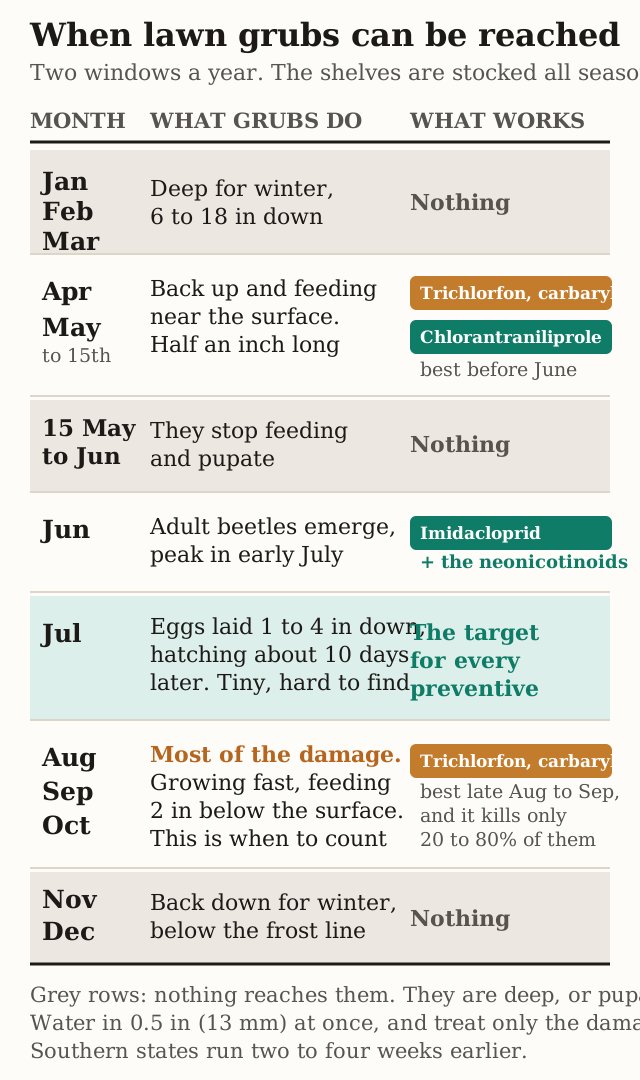
Here is the year, in the order it happens.
- April to mid-May. Lawn grubs that overwintered come back up and feed. Curative products still work on them until about 15 May. After that the grubs stop eating to pupate, and nothing reaches them.
- Mid-May to early June. The dead zone. They are pupating, so no treatment of any kind does anything.
- Mid-June to early July. Adults emerge and fly, peaking in early July. They stay active four to six weeks.
- July into early August. Eggs go into the soil, 1 to 4 inches (2.5 to 10 cm) down, and hatch about ten days later. This is the target for preventive products.
- August to late October. The lawn grubs do most of their growing and most of their damage. Curative products work now, best in late August and September.
- Late October to March. They burrow 6 to 18 inches (15 to 46 cm) down and sit out the cold. Nothing reaches them.
Southern states run the whole calendar two to four weeks earlier. In the far South, where soils stay warm, the autumn feeding window also runs later.
What actually kills lawn grubs
Products split into two kinds that are not interchangeable, and the labels do a poor job of saying so. A preventive goes down before or just as the eggs hatch, and it protects the lawn for the coming autumn and the following spring. A curative kills lawn grubs that are already there, and it is the weaker of the two.
Table 6. Grub control products, by active ingredient
Chlorantraniliprole (Scotts GrubEx)
- Type
- Preventive
- When to apply
- April to mid-July, best before June
- What it will not do
- Will not kill the grubs already in your lawn
Imidacloprid
- Type
- Preventive
- When to apply
- June or July only
- What it will not do
- Nothing in spring. Applied early it leaches or breaks down
Thiamethoxam, clothianidin
- Type
- Preventive
- When to apply
- June or July
- What it will not do
- Little in spring, though clothianidin has some curative action
Halofenozide
- Type
- Preventive
- When to apply
- Mid-June through July
- What it will not do
- Not a rescue treatment
Trichlorfon (24 hour grub killers)
- Type
- Curative
- When to apply
- Late Aug to Sept, or spring up to 15 May
- What it will not do
- Will not protect next year's lawn
Carbaryl
- Type
- Curative
- When to apply
- Same window
- What it will not do
- Same. Also now hard to buy, see below
Three rules apply to every row.
Water it in immediately. The product has to move down through the thatch into the root zone. Twenty-five years of Michigan State trials show that watering straight after application is what makes the difference. Put down at least half an inch (13 mm). You can measure it by standing a few mugs on the lawn and running the sprinkler until the water is half an inch up from the bottom.
Treat only the damaged area. There is no reason to put insecticide over a whole lawn when one corner has the problem. Spot-treating cuts the cost and the harm at the same time.
Check your thatch first. Maryland flags something nobody else does. A thatch layer over half an inch (13 mm) thick binds the insecticide so that it never reaches the lawn grubs, even when you water it in properly. Zoysia, bermudagrass and Kentucky bluegrass build thatch fastest. If yours is thick, dethatch before you treat, or you are paying for nothing.
How well curative products actually work
Not as well as the bag suggests, and the honest numbers are worth knowing before you buy. Michigan State’s research puts trichlorfon and carbaryl at 20 to 80% of lawn grubs killed when applied in September, and 20 to 55% in late October. UNH Extension reports results “as low as 20 to 25%”. Both describe them as clearly weaker than a well-timed preventive.
That is the real argument for waiting. Say you find grubs in late October with the damage already done. The usual advice from both services is to repair the lawn now and put a preventive down next June or July, rather than spend on a curative that may kill a fifth of them.
The carbaryl problem
If you go looking for carbaryl you may not find it. Michigan State records the reason: GardenTech bought the Sevin brand and reformulated it, replacing carbaryl with bifenthrin and zeta-cypermethrin, neither of which works on grubs. The Sevin name is still on the shelf, yet the product inside it is no longer a grub treatment. That leaves trichlorfon as the main curative option most homeowners can actually buy.
Products that will not kill lawn grubs
This is the most expensive mistake on the shelf, so it gets its own section. Products containing only lambda-cyhalothrin, gamma-cyhalothrin, bifenthrin, deltamethrin, cyfluthrin or permethrin do not control lawn grubs. They are pyrethroids, and they bind tightly to organic matter in the thatch, so they never travel down to where the grubs are feeding. They work well on insects living on the grass or the soil surface, which is what they are made for.
Michigan State names two products sold in garden centres that fall into this trap:
- GardenTech Sevin Insect Killer Lawn Granules (zeta-cypermethrin and bifenthrin)
- Spectracide Triazicide Insect Killer for Lawns (gamma-cyhalothrin)
Lawn-care professionals on r/lawncare say the same thing in plainer words: “Regular lawn insect killers won’t handle grubs. Ortho, Sevin, Spectracide, even if it might say or picture grubs on it, does not handle grubs.”
Some products combine a pyrethroid with a real preventive ingredient, and those do work on lawn grubs because of the preventive half. The only way to tell is to read the active ingredients, usually printed small on the lower front corner of the bag.
Natural and biological options for lawn grubs
These are worth a careful look. One of them works well, one works in narrow conditions, and one is sold far more widely than its results justify.
Beneficial nematodes
Nematodes are microscopic worms that hunt lawn grubs through the soil and kill them within a few days. They are the strongest non-chemical option, and also the fussiest, because they are living animals rather than a chemical.
- Match the species to your grub. Heterorhabditis bacteriophora gives good control of Japanese beetle and masked chafer grubs. Steinernema scarabaei covers Japanese beetle, Oriental beetle, Asiatic garden beetle and May or June beetle grubs, though it is harder to find. No single species handles every one of the lawn grubs.
- Apply at dusk, dawn or under cloud. Direct sunlight kills them within about a minute, which is the most common way a bought packet is wasted.
- Keep the soil moist. They move through films of water around soil particles, so they do poorly in dry soil and in heavy clay. Water them in at once and keep the area damp for several days.
- Buy fresh and use them straight away. They are perishable and have to be alive when they go down.
Milky spore
Milky spore is a bacterium, Paenibacillus popilliae, sold for Japanese beetle grubs. It has been on shelves for decades, yet the evidence behind it is weaker than its reputation. The University of Maryland states that “commercially available spores have not been shown to effectively suppress Japanese Beetle grub populations in turfgrass.” UNH Extension adds a regional limit, since spring soils in northern New England are too cold for it to establish. It also targets Japanese beetles only. So if your raster pattern says May or June beetle, it has nothing to act on.
grubGONE and Bt
Bacillus thuringiensis strain galleriae, sold as grubGONE, is the newer biological option. University trials put it at 70 to 80% control of Japanese beetle and masked chafer grubs when applied to newly hatched lawn grubs in July and early August, although some trials found the granular form failing. Keep it away from flower beds, because research published in 2019 showed it can also affect monarch butterfly caterpillars.
Metarhizium, a fungus, has shown up to a 50% reduction in grub density in three-year studies. That is real, but slow.
Home remedies that do not work
Dish soap is covered above: it neither kills lawn grubs nor counts them. Cinnamon, coffee grounds and vinegar come up in the same searches and have no evidence behind them for grubs in soil, while strong vinegar will burn the grass you are trying to save. Nothing you pour on the surface gets past the thatch into the root zone, which is the problem all of these remedies run into.
Letting the lawn’s own predators work
A lawn that is not routinely sprayed builds its own control. The blue-winged wasp (Scolia dubia) hunts lawn grubs through the soil in late summer and leaves people alone entirely. Tiphia vernalis wasps target Japanese beetle and Oriental beetle grubs, while the American pelecinid wasp goes after May and June beetle grubs. Ground beetles, spiders and predatory mites take eggs and small grubs. Flowering plants that bloom in late summer feed the adult wasps and keep them in your yard.
Protecting bees when you treat for lawn grubs
Two of the preventive ingredients, imidacloprid and the other neonicotinoids, are toxic to bees. They can also travel into the pollen and nectar of flowering plants through the roots. Three steps cut the risk sharply.
Mow the lawn first, immediately before you apply, so no clover or dandelion is in flower when the product goes down. Keep granules and spray out of beds. Never let a spreader or a sprayer drift into a flower border. And choose chlorantraniliprole where you can, since the EPA classes it as a low-risk pesticide for its low toxicity to bees and other beneficial insects.
One more piece of restraint helps more than any of them. Michigan State’s point is that simply not applying an insecticide you do not need is the best thing you can do for the pollinators in your yard.
Part 4 of 4
Put it right
Repairing a lawn after lawn grubs have been through it
Settle the grub question first
Count again. If you are over the threshold and still inside a treatment window, treat before you reseed.
Rake off the dead turf
It lifts away easily, which is the one convenient thing about grub damage. Take out the loose thatch and debris with it.
Loosen the soil
Scratch the surface an inch deep so the seed makes contact. On a compacted lawn, core aeration is worth doing at the same time.
Overseed with the right grass
Match the seed to the lawn you have, or move towards tall fescue, which stands up to lawn grubs far better than bluegrass.
Keep it moist until it germinates
Light watering once or twice a day beats one heavy soak, until the new grass is up.
Fertilise to a soil test
Test every two or three years and follow what it says. Guessing at fertiliser does more harm than good.
Then mow high, 3 to 4 inches
It is both the repair and the prevention.
Grass does come back, and a lawn that lost patches in September usually looks normal again by the following summer. The order matters. Deal with the lawn grubs first if the count says to, because new seed will feed whatever is still down there. Autumn is the better season for this in most of the country. Cool-season grass establishes faster then, and the weeds are slowing down.
Cost, and when a lawn service is worth it
A bag of preventive granules covers a typical lawn for roughly the price of one professional visit, so doing it yourself saves real money when the job is simple: one product, one window, one lawn. A service earns its fee when the lawn is large, when you have had damage several years running and want the diagnosis checked, or when your state restricts the product you would otherwise use. Be wary of a yearly programme sold on a lawn that has never had a grub problem. That is the spend Michigan State is warning about.
Are lawn grubs dangerous to people or pets?
No. Lawn grubs cannot bite or sting. Their mouthparts are built for chewing roots and rotting matter rather than skin, and they carry no disease that passes to people or animals. A dog that digs one up and eats it comes to no harm from the grub.
The insecticide is a different matter, and it is the part worth being careful about. Keep children and pets off a treated lawn until it has been watered in and the grass has dried. Follow the re-entry time on the label, and store the product locked away. If a person or a pet swallows a lawn product, call Poison Control on 1-800-222-1222 or your vet, with the bag in your hand so you can read them the active ingredient.
What attracts lawn grubs to a lawn
Beetles choose where to lay, and the lawn itself is what they are choosing. Three things draw them in.
Moist, lush turf in June and July. This is the big one. Adults lay in soil that is warm and damp, and both eggs and newly hatched lawn grubs die when it dries out. A lawn watered hard through those two months is an invitation, which is why keeping it drier then is the cheapest prevention there is.
Outdoor lights. Chafers and June beetles fly at night and come to porch lights and street lamps, then lay in whatever turf is nearest.
Stress that is already there. Lawns thinned by drought, traffic or compaction are more attractive to egg-laying beetles, which is how a lawn gets into a cycle. Japanese beetles in particular favour newer developments laid with Kentucky bluegrass sod.
What does not attract them is anything you did wrong. The adults fly in from wherever they emerged. So killing the lawn grubs under your turf does nothing to stop the beetles chewing your roses, because those arrived from somewhere else. UNH Extension makes that point directly, and it saves a lot of pointless spending.
What lawn grubs turn into
All lawn grubs become beetles. After feeding through autumn and again in spring, the grub moves to within a few inches of the surface and builds a small earthen cell. There it becomes a pupa in the soil, a non-feeding stage that lasts a week or two in late spring. The adult beetle digs out from mid-June, peaks in early July, then flies for four to six weeks before laying the next generation.
Which beetle depends on the grub. Masked chafers and European chafers emerge as brown beetles that fly at night and never touch your plants. Japanese beetles come out metallic green and copper, then go straight for roses, grapes and lindens. May and June beetle grubs take two or three years underground before they emerge as the heavy brown beetles that thump into porch lights.
That last group explains something people notice. Because Phyllophaga grubs sit underground for several years at different stages, some adults emerge every summer, even though any one grub takes three years to get there.
Grubs in garden beds, pots and compost
A white grub in a vegetable bed, a flower border or a plant pot is a different situation, and the lawn products do not apply. Products for lawn grubs are not labelled for garden beds, so using one there is both ineffective and against the label. UNH Extension’s advice for beds is crop rotation, tilling and hand-picking instead.
Grubs in a compost heap or a mulch pile are usually doing something useful. Many white grubs feed on decaying organic matter rather than living roots, and in compost that is exactly the job. Unless you can see them on live roots, leave them alone.
Potted plants are the exception worth acting on. A pot is a small, closed root zone, so even a couple of grubs can take out the roots of a container plant. Tip the pot out, pick them off by hand, and repot.
Lawn grubs FAQ
Does Dawn dish soap really kill grubs?
Can a lawn recover from grubs?
Do grub worms bite?
Is it too late to treat for grubs?
Do grubs die in the winter?
Should I treat for grubs every year?
Pest control disclaimer. Photo-based identification can help, but it is not always perfect. For dangerous spiders, large infestations, or anything you are unsure about, contact a licensed pest control professional.
Related guides
June bug
The brown beetles at your porch light, and which of the four june bugs you actually have.
Japanese beetles
The metallic green beetle on roses, and the grubs it leaves behind in the lawn.
Types of beetles
Name any beetle by size, colour and shape, starting with whether it is a beetle at all.
Crane fly
The long-legged fly whose leathery, legless larvae get mistaken for grubs.
Weevils
Snout beetles, including the billbugs whose legless larvae ruin a grub diagnosis.
Pupa
What the stage between grub and beetle looks like, and what to do if you dig one up.
Mining bees
The other thing digging small holes in a spring lawn, and why it cannot sting you.
Cicada killer
A two-inch wasp that digs holes in lawns in July, and almost never stings.
Sources
- US EPA, Read the Label First: Protect Your Lawn and Garden
- Michigan State University Extension, How to choose and when to apply grub control products for your lawn, Walton and Frank (2026)
- University of Maryland Extension, White Grubs in Lawn and Garden Soil, Talabac (2026)
- UMass Amherst Center for Agriculture, Monitoring Lawn Insects, Vittum
- University of New Hampshire Extension, How do I treat for grubs in my lawn?
- Purdue University Extension, Managing Billbugs in Turfgrass (E-266)
- Missouri Botanical Garden, Grubs in lawn