What are mosquitoes?
A mosquito is a small, slender fly in the family Culicidae. Like other true flies it has 2 wings, and like all insects it has 6 legs. Two features set it apart: a long, straight mouthpart called a proboscis, and tiny scales on its wing veins. CDC counts over 3,700 kinds worldwide, and over 200 in the US and its territories.
The name is Spanish and Portuguese for “little fly”. Most of the US kinds are simply a nuisance. According to CDC, only about 12 types here spread germs that make people sick. Even so, you cannot tell which kind is biting you, so the advice on bites is the same for all of them.
Mosquitoes live on every continent except Antarctica. Texas has the most kinds of any state, 85, and Hawaii the fewest, 6, according to the American Mosquito Control Association (AMCA). In practice, though, the numbers in your yard depend far more on standing water than on the species list.
Are mosquitoes parasites? In a loose sense, yes. Biologists call blood-feeding mosquitoes micropredators: a female takes a small meal from a much larger animal and leaves, rather than living on it the way a flea or a louse does.
How many kinds of mosquitoes are there?
About 3,700 worldwide is the current count, and it keeps growing as experts name new species. Still, you will see lower numbers. Google’s AI Overview gives 3,600, taken from the opening line of Wikipedia’s mosquito article, which says over 3,700 further down. The US count differs too. AMCA gives 174, while CDC’s count of over 200 includes the US territories.
Table 1. How many mosquito species? Three sources, three numbers
CDC (2024)
- Worldwide
- Over 3,700
- In the US
- Over 200, counting the territories
Wikipedia, and Google's AI Overview (2026)
- Worldwide
- 3,600 in its opening line
- In the US
- Not given
American Mosquito Control Association FAQ
- Worldwide
- Upwards of 2,700, an older figure
- In the US
- 174 (176 on its species page)
Is it mosquitoes or mosquitos?
Both spellings are correct. Merriam-Webster lists “mosquitoes” first and “mosquitos” as the less common plural. Scientists and health agencies use “mosquitoes”, and so do we.
How to identify a mosquito
A mosquito is a thin, long-legged fly about 3 to 6 mm (1/8 to 1/4 inch) long, not counting its legs. Look for three things together: a straight proboscis pointing forward from the head, scales along the wing veins and wing edges, and wings folded flat over the back at rest, like closed scissors.
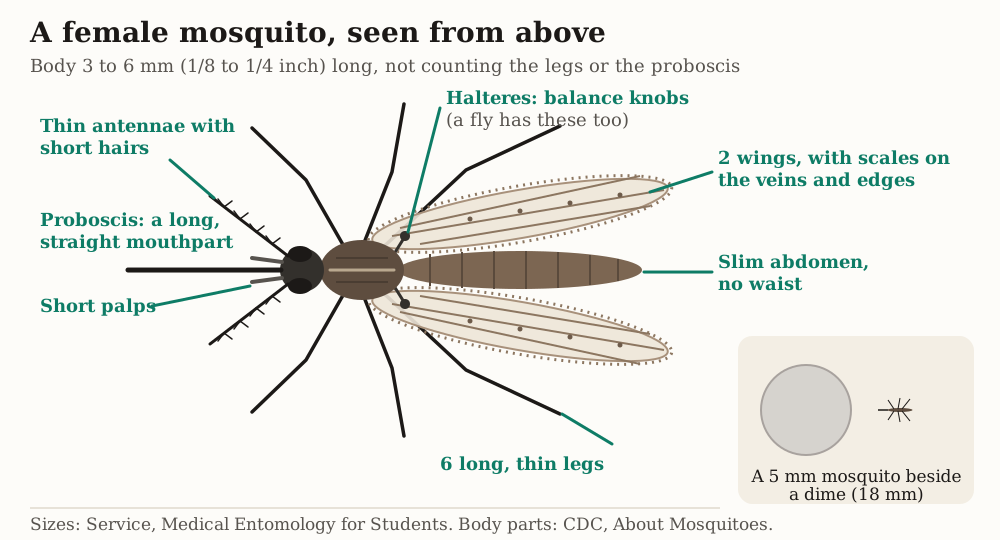
Most kinds are gray, brown or black, and some have white bands on the legs or body. Size varies more than people expect. The smallest are about 2 mm long, and the largest reach 18 to 19 mm (about 3/4 inch). Around the house, a typical mosquito weighs about 2.5 milligrams, roughly a grain of salt or two.
The scales are the surest check, but you need a magnifying glass to see them. A phone camera zoomed in on a dead specimen usually shows the fringe along the back edge of the wing. Without scales, it is some other small fly.
Mosquito or look-alike?
Several harmless insects get called mosquitoes. A long-legged insect the size of your palm is almost always a crane fly, which cannot bite. Our crane fly guide covers the “mosquito hawk” and the “mosquito eater”, the two folk names for the same harmless fly.
Table 2. Mosquito or something else? The one check for each
Long, straight proboscis
- Mosquito
- Yes, pointing forward
- Look-alike
- Crane flies, midges and gnats have no long proboscis
Overall size
- Mosquito
- Body 1/8 to 1/4 inch
- Look-alike
- Crane fly: far bigger and leggier. See crane fly
Scaled wings
- Mosquito
- Yes, on the veins and edges
- Look-alike
- Midges: bare wings, and front legs held forward at rest
Where you see it
- Mosquito
- Outdoors near water, or near you
- Look-alike
- Tiny dark flies at houseplants: fungus gnats
Wing shape
- Mosquito
- Long and narrow
- Look-alike
- Fuzzy, moth-like wings at the sink: drain flies
Does it bite?
- Mosquito
- Females do
- Look-alike
- None of these bite people
Male vs female mosquito: how to tell them apart
Look at the antennae. A male mosquito has bushy, feathery antennae covered in long hairs. A female has thin antennae with only short hairs. In most US kinds, the male also has long, hairy palps beside the proboscis, while the female’s palps are short. Only the female, the one with thin antennae, can bite.
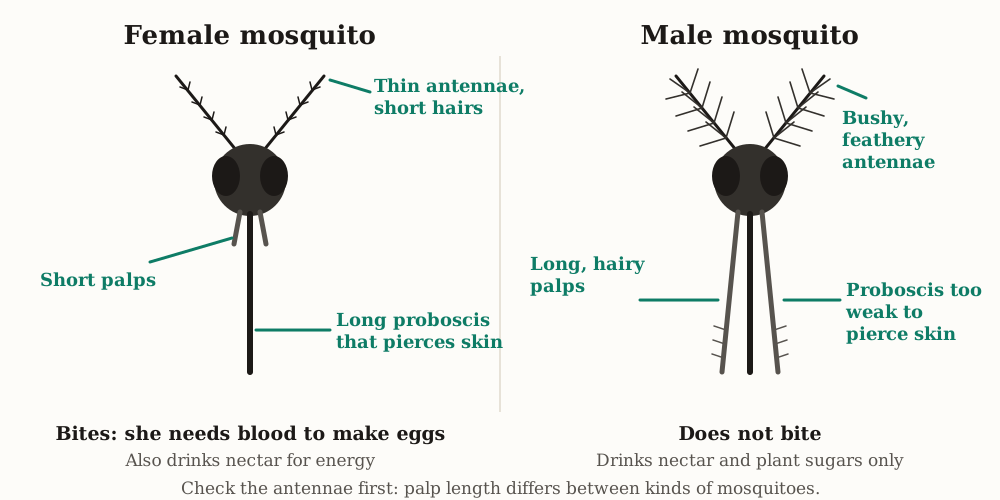
The feathery antennae are how a male finds a mate. Males gather in small swarms at dusk, often over a landmark such as a tree stump or a large rock, and they pick out a female by the sound of her wings. She flies into the swarm, mates once, and then goes looking for blood.
Size is not a reliable way to sex a mosquito, since it varies so much between kinds. Palps vary too, so check the antennae first.
Do male mosquitoes bite?
No. A male’s proboscis is not strong enough to pierce skin, and males never feed on blood, according to CDC. They drink flower nectar and other plant sugars, mate, and usually die within a week. That is why mosquito control programs can safely release sterile or genetically modified males: they mate with wild females, the next generation fails, and the released males cannot bite anyone.
Google’s AI Overview says males lack the needle-like mouthparts needed to pierce skin. That is only half right. A male does have a proboscis, and CDC notes that both sexes use it to drink nectar. Inside it, though, the cutting parts are less developed than the female’s, so it cannot get through skin.
Should you swat a male? There is no need, but in the air you cannot tell. Males of a few kinds also come to people, in order to meet the females that arrive to feed. A 2023 study in Royal Society Open Science found this mainly in Aedes aegypti and the Asian tiger mosquito. Of 13 species caught around human volunteers in the field, only 4 included any males, and repellent on the skin kept the males away too.
What do mosquitoes eat, and why do females need blood?
Both sexes live on sugar: flower nectar, plant juices and honeydew from aphids. Only the female adds blood, and she uses it to make eggs, not to feed herself. One full meal is tiny, about 0.001 to 0.01 milliliter, yet it gives her the protein for a batch of up to a few hundred eggs.
Most kinds cannot make eggs at all without that meal. After feeding, a female rests for 2 to 3 days while the blood digests and the eggs grow. Then she lays them on or near water and goes looking for her next meal.
People are often not the first choice. The AMCA notes that many blood-feeding kinds prefer horses, cattle, smaller mammals or birds. A few kinds, such as the elephant mosquitoes, never take blood at all.
How do mosquitoes find you?
First by the carbon dioxide you breathe out, which can draw a female from about 35 meters (115 feet) away. Closer in, she follows body heat, moisture and skin odor, which comes partly from the bacteria on your skin. That odor is why some people get bitten far more than others. The blood type story is shakier than most sites claim, and our guide to what blood type mosquitoes like sorts the evidence.
Where do mosquitoes breed and live?
Every mosquito starts life in still water. Some kinds use ponds, marshes and ditches, but many breed in small containers: buckets, tires, plant saucers, clogged gutters and even a bottle cap. The Asian tiger mosquito rarely flies more than about 300 feet (90 meters), so the ones biting you were often raised nearby.
The kinds differ in what water they like. Some lay eggs on permanent water. Others are floodwater mosquitoes, which lay eggs on damp soil or on container walls above the waterline. Those eggs hatch only when rain or a sprinkler floods them.
By day, adults rest somewhere cool, dark and humid, such as tall grass and shrubs. The AMCA names the garage as a favorite resting spot and the usual way in to the house, along with torn screens and attic and bathroom vents. Once inside, they hide in dark spots such as closets, laundry rooms and the cabinet under the sink, and come out to bite at night.
Flight range varies widely by kind. Most mosquitoes travel 1 to 3 miles, and house mosquitoes up to about 2 miles (3.2 km). Salt marsh mosquitoes, on the other hand, often travel 20 to 40 miles when hosts are scarce.
Why are there so many mosquitoes right now?
Usually because of rain. Floodwater mosquito eggs can wait dry for months, so a heavy rain, a flood or a hurricane hatches huge numbers at once. CDC notes that nuisance mosquitoes often surge right after heavy rains. For what to do about it, see our guide to getting rid of mosquitoes in the yard and house.
The mosquito life cycle and lifespan
Every mosquito goes through four stages: egg, larva, pupa and adult. The first three live in water. EPA says the whole cycle typically takes about two weeks, but it can range from 4 days to a month, depending on the weather. That speed is why a forgotten bucket can produce biting adults within a week or two.
The larvae are the “wigglers” you may see jerking up and down in a birdbath, and the pupae are the comma-shaped “tumblers”. Culex mosquitoes lay floating rafts of 100 to 300 eggs. In contrast, Aedes eggs stick to container walls and can survive drying out for up to 8 months. Our guide to mosquito larvae, eggs and pupae shows each stage and what to do when you find them.
How long do mosquitoes live?
Adults live about 2 to 4 weeks, CDC says, and females usually outlive males. The AMCA puts most females at 2 to 3 weeks. Females that spend the winter in a garage or culvert can live up to 6 months, while many males last only days. Our page on how long mosquitoes live, indoors and out has the details.
Mosquito season: when do mosquitoes go away?
In most of the US, mosquitoes build through spring and peak from June to September. CDC describes mosquito season as typically June through October, and West Nile cases peak in late August and early September. Mosquitoes fade once evenings drop below about 50°F (10°C), but only a hard frost kills the adults.
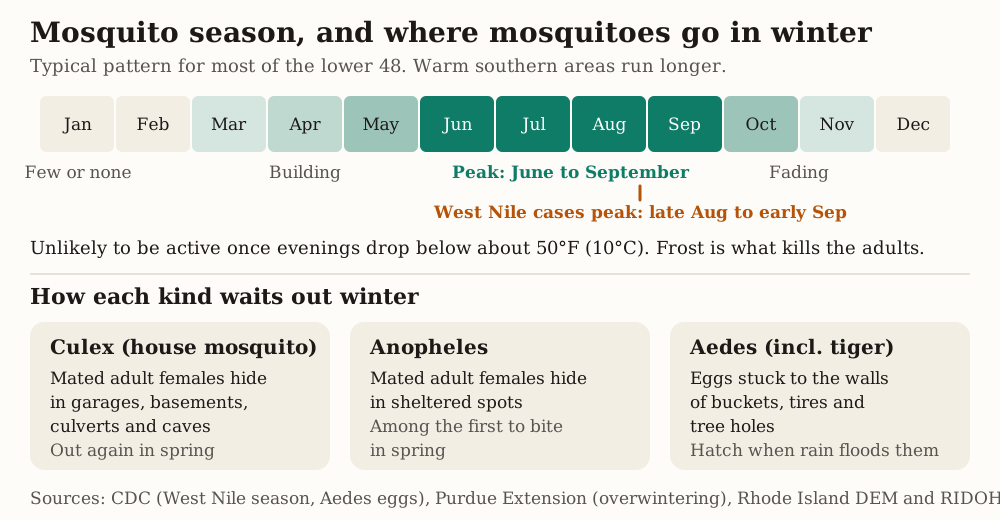
Rhode Island’s environment and health departments put numbers on it in a 2024 state mosquito report. Mosquitoes slow down below 58°F (14°C) and become largely inactive below 50°F (10°C). The adults die only in a hard frost, which the state defines as three hours in a row below 32°F (0°C).
So a cool snap is not the end. A Reddit user in New Jersey described the pattern well: the mosquitoes vanished when it cooled off, then came back on warm days in October and November. In warm, humid places, some kinds stay active all year.
Where do mosquitoes go in the winter?
They do not migrate. Instead, each kind waits out the cold in a different stage. Culex house mosquitoes and Anopheles mosquitoes spend winter as mated adult females, tucked into caves, culverts, garages and basements. Aedes mosquitoes, including the Asian tiger mosquito, die off as adults and leave their eggs to wait on container walls until spring rain floods them.
A Reddit user on r/NoStupidQuestions asked how mosquitoes come back every summer if they all die in winter. The top answer, “Eggs”, is half right. In much of the country, the first biters of spring are females that slept through winter in a sheltered spot.
What time of day are mosquitoes most active?
It depends on the kind. Culex mosquitoes are most active from dusk to dawn, and Anopheles bite late in the evening or at night. Aedes mosquitoes such as the Asian tiger mosquito bite in the daytime too. Most kinds rest in cool shade through the heat of the day, which is why CDC says mosquitoes can bite day and night.
Common types of mosquitoes in the US
Three groups matter most to Americans. Aedes mosquitoes are the black-and-white daytime biters, Culex are the plain brown house mosquitoes that spread West Nile virus, and Anopheles can carry malaria. Two giants round out the list: the gallinipper, a fierce biter, and the elephant mosquito, which never bites.
Table 3. The US mosquitoes people ask about most
Aedes, including the Asian tiger mosquito and Aedes aegypti
- How to know it
- Black with bright white stripes or bands on the legs and body
- When it bites
- Daytime, as well as morning and evening
- Why it matters
- Can spread dengue, Zika and chikungunya. Breeds in small containers. See Asian tiger mosquito
Culex (house mosquitoes)
- How to know it
- Plain brown, no bold markings
- When it bites
- Dusk to dawn, often indoors
- Why it matters
- The main spreader of West Nile virus in the US. Lays egg rafts
Anopheles
- How to know it
- Often dark spots on the wings; a common eastern kind is named for its four
- When it bites
- Late evening and night
- Why it matters
- The only mosquitoes that spread malaria
Gallinipper (Psorophora ciliata)
- How to know it
- Very large and yellowish, with shaggy legs; wingspan 7 to 9 mm
- When it bites
- Day or night, after heavy rains
- Why it matters
- A painful bite. East of the Rockies. Its larvae eat other mosquito larvae
Elephant mosquito (Toxorhynchites)
- How to know it
- The largest of all: up to 18 mm (0.7 inch) long, often colorful
- When it bites
- Never
- Why it matters
- Females drink only nectar. Its larvae eat other mosquito larvae
Which kind is the most harmful? Worldwide, Anopheles, because malaria kills more people than any other mosquito-borne disease. In the US, it is Culex. CDC calls West Nile virus the leading cause of mosquito-borne disease in the lower 48, and Culex is its main carrier.
The Asian tiger mosquito is the one most people recognize on sight. It is an invasive daytime biter, and it breeds in the smallest bits of water around homes. Our Asian tiger mosquito guide shows its markings and how to cut its numbers.
A gallinipper can surprise people. On Reddit’s r/whatsthisbug, a post titled “Very large mosquito!” drew dozens of replies naming it, several from people who had felt its bite. Still, most “giant mosquitoes” indoors turn out to be crane flies.
Mosquito bites: what is normal
A normal mosquito bite is a puffy, reddish bump that appears within minutes. Within a day or so it often turns into a harder, itchy bump. The itch comes from your body reacting to the saliva the mosquito injects as she feeds, CDC explains, and some people react far more strongly than others.
Our guide to mosquito bites: itching, relief and when to worry covers treatment and the signs of an infected bite. Some children and adults swell up far more, which has a name: read about skeeter syndrome, the mosquito bite allergy. Woke up with a row of bites after a night indoors? Compare them with bed bug bites vs mosquito bites. Keep in mind that a photo of a bite cannot tell you which insect made it.
What diseases do mosquitoes carry in the US?
West Nile virus is the most common one. About 2,000 people in the US are diagnosed with it each year, CDC says, and the true number is higher because most infections cause no symptoms. Others include eastern equine encephalitis, La Crosse and St. Louis encephalitis, and outbreaks of dengue in some states and territories.
A mosquito does not carry germs from birth. She picks one up by biting an infected bird, animal or person, and the germ then needs about 2 to 3 weeks to reach her salivary glands, CDC explains. Only then can her bite pass it on.
Table 4. Mosquito-borne diseases in the US: reference only, not a diagnosis
West Nile virus
- Spread mainly by
- Culex mosquitoes
- Where in the US
- Every state in the lower 48
- What CDC says
- About 8 in 10 infected people have no symptoms and about 1 in 5 get a fever. Less than 1% develop severe illness of the brain or spinal cord
Eastern equine encephalitis
- Spread mainly by
- Several kinds; the virus starts in birds
- Where in the US
- Mostly eastern and Gulf Coast states
- What CDC says
- Only a few cases a year, but about 30% of people with severe illness die
La Crosse, St. Louis encephalitis, Jamestown Canyon, Cache Valley
- Spread mainly by
- Several kinds
- Where in the US
- Varies by virus
- What CDC says
- Rare viruses on CDC's list of US mosquito-borne diseases
Dengue, chikungunya, Zika
- Spread mainly by
- Aedes mosquitoes
- Where in the US
- Florida, Texas, Hawaii, Puerto Rico and other territories
- What CDC says
- Local outbreaks have occurred in these places
Malaria
- Spread mainly by
- Anopheles mosquitoes
- Where in the US
- About 2,000 cases a year, mostly in returning travelers
- What CDC says
- In 2023, mosquitoes spread it locally in the US for the first time in 20 years
Worldwide, mosquitoes are a far bigger threat. CDC calls the mosquito the world’s deadliest animal, and malaria alone killed about 610,000 people in 2023. Two things mosquitoes do not spread, though, are Lyme disease, which comes from ticks (see our guide to ticks), and HIV.
Medical disclaimer. This page is for general information only. It is not a medical diagnosis. If you have severe symptoms, trouble breathing, swelling of the face or throat, fast spreading redness, fever, severe pain, pus, or signs of infection, contact a doctor or your local emergency number.
Mosquitoes in Alaska, Hawaii and Iceland
Mosquitoes live almost everywhere people do, from Arctic tundra to tropical islands. Alaska is famous for them, Hawaii had none until ships brought them in about 1826, and Iceland, long one of the few mosquito-free countries, recorded its first wild ones in October 2025. Antarctica is the only continent with none.
Alaska
Alaskans joke that the mosquito is the state bird. Derek Sikes, insect curator at the University of Alaska Fairbanks, told the Anchorage Daily News in 2022 that the state has 35 known species. The big, slow snow mosquitoes appear first, often while snow is still on the ground, because they spent the winter as adults. Later, the tundra swarms can darken the sky.
The good news is that Alaska’s mosquitoes are not known to spread disease to people, Sikes said. A mosquito that can carry West Nile virus has been found there, but the virus has not.
Hawaii
Hawaii has no native mosquitoes. The first, the southern house mosquito, arrived around 1826 in ships’ drinking water barrels, according to the AMCA. People know the year because a new Hawaiian word for a biting fly, “makika”, appeared then. Today the islands have 6 biting species, including both Aedes mosquitoes that can spread dengue.
Iceland
Iceland was mosquito-free until October 2025. Then an insect enthusiast caught three Culiseta annulata mosquitoes, two females and a male, about 20 miles north of Reykjavik. An entomologist at the Natural Science Institute of Iceland told AFP, as CBS News reported, that it was the first record of mosquitoes in the wild there. They may have arrived by ship or container. Whether they survive Icelandic winters is not yet known.
Why do mosquitoes exist, and what eats them?
Mosquitoes have been around for about 100 million years, and they fill a place in the food web. Their larvae feed fish, dragonfly nymphs and water beetles, and adults feed dragonflies, birds, spiders and bats. Some also pollinate flowers, including certain wild orchids. Still, the AMCA says they are not essential to any predator.
What would happen if mosquitoes went extinct? Nobody knows for sure. The AMCA expects other insects to fill the gap, and warns those could be worse. Either way, mosquitoes adapt so well that wiping them out is not possible today. Control programs aim instead at the few kinds that spread disease.
Plenty of animals eat mosquitoes, but none eats enough to control them. That surprises people, because two popular claims say otherwise.
Myth 1
Myth: “A bat eats 1,000 mosquitoes an hour, so a bat house will clear your yard.”
Truth: In every study the American Mosquito Control Association reviewed, mosquitoes made up less than 1% of the gut contents of wild bats. Bat towers built near San Antonio in the 1920s had no effect on mosquito numbers.
Myth 2
Myth: “Purple martins eat thousands of mosquitoes a day.”
Truth: Purple martin experts put mosquitoes at 0 to 3% of the bird's diet. At dusk and at night, when mosquitoes are most active, martins feed up at treetop level, well above them.
Myth 3
Myth: “Eating garlic or taking vitamin B12 keeps mosquitoes off.”
Truth: The American Mosquito Control Association says controlled lab studies found no effect from garlic, vitamin B12 or other pills. Use an EPA-registered repellent instead.
Myth 4
Myth: “Mosquitoes can spread HIV.”
Truth: They cannot. HIV does not multiply inside a mosquito, and the mosquito digests the virus. Mosquitoes also inject saliva through a separate tube from the one that draws up blood.
Myth 5
Myth: “The huge mosquito in the house will give the worst bite.”
Truth: A huge, long-legged insect indoors is usually a crane fly, which cannot bite at all. The largest true mosquitoes in the US, the elephant mosquitoes, never take blood either.
How to avoid mosquito bites and control mosquitoes
The two steps that work best cost little. First, empty anything that holds water at least once a week, so larvae never become adults. Second, use an insect repellent registered by the EPA. CDC lists six active ingredients: DEET, picaridin, IR3535, oil of lemon eucalyptus (OLE), PMD and 2-undecanone.
Follow the label, because the label is the law. CDC says not to use OLE or PMD on children under 3. Mayo Clinic advises no DEET on babies under 2 months, and CDC points to netting over strollers and carriers for young babies. Permethrin goes on clothing and gear only, never on skin. Screens on doors and windows keep the rest outside.
Which repellent? Our picaridin vs DEET comparison covers the two most common. For plant-based options, read which natural mosquito repellents work, and our guide to plants that repel mosquitoes explains why a potted plant does little on its own.
For the yard and house, our mosquito control guide covers dunks, traps and sprays. If you do use an insecticide, choose an EPA-registered product labeled for mosquitoes and follow the label. Two popular gadgets fail: the AMCA cites studies in which bug zappers made no difference to yard mosquito numbers, and ultrasonic repellers showed no effect at all.
Find your mosquito page
Each question below has its own guide. Start with what you have in front of you right now, whether that is a bug, a bite or a backyard, and the table points to the page that answers it in full.
Table 5. What you have, and where to go next
An itchy bump, or many of them
A bite that swelled up huge, often on a child
- Read next
- Skeeter syndrome
Bites after a night in bed, and you suspect bed bugs
- Read next
- Bed bug vs mosquito bites
A huge long-legged bug that looks like a giant mosquito
- Read next
- Crane fly (mosquito hawk)
A black mosquito with white stripes, biting in daylight
- Read next
- Asian tiger mosquito
Wiggling things in a birdbath or bucket
- Read next
- Mosquito larvae and eggs
One mosquito loose in the house for days
- Read next
- How long mosquitoes live
You get bitten far more than everyone else
- Read next
- What blood type mosquitoes like
A yard or house full of mosquitoes
- Read next
- How to get rid of mosquitoes
You want a repellent without DEET
- Read next
- Natural mosquito repellent
You are choosing plants for a patio
- Read next
- Mosquito repellent plants
You are choosing a bug spray
- Read next
- Picaridin vs DEET
Not sure the insect is a mosquito at all? A sharp photo in our free bug identifier will name it. Remember that it can identify the insect, not a bite.
Pest control disclaimer. Photo-based identification can help, but it is not always perfect. For dangerous spiders, large infestations, or anything you are unsure about, contact a licensed pest control professional.
Mosquitoes FAQ
Do mosquitoes prefer fat or skinny people?
How many times can one mosquito bite you in one night?
Is killing mosquitoes good or bad?
Why do mosquitoes buzz in your ears?
Do mosquitoes have teeth?
Do mosquitoes die after they bite you?
Related guides
Mosquito bites
Why bites itch, how long they last, relief, and when a bite needs a doctor.
Skeeter syndrome
The large, hot, swollen reaction to mosquito bites, and when to worry.
How to get rid of mosquitoes
Standing water, dunks, traps and sprays for the yard and the house.
Natural mosquito repellent
Oil of lemon eucalyptus and the other plant-based options, tested.
Plants that repel mosquitoes
What the evidence says about citronella, lavender, catnip and the rest.
Picaridin vs DEET
Strength, feel, safety and protection time, side by side.
What blood type do mosquitoes like?
The type O claim, the retracted study, and what really draws them.
Mosquito larvae
Eggs, wigglers and tumblers in water, and how to stop them.
How long do mosquitoes live?
Males, females, winter survivors, and one trapped in your house.
Asian tiger mosquito
The black-and-white daytime biter that breeds in bottle caps.
Crane fly
The giant harmless “mosquito hawk” that cannot bite.
Bed bug vs mosquito bites
Pattern, timing and place: how to tell the two apart.
Bug bite identification
Mosquito bites compared with flea, bed bug, tick and spider bites.
Fungus gnats
The tiny mosquito-like flies around houseplants, and how to clear them.
Sources
- CDC, About mosquitoes
- CDC, Symptoms of West Nile
- CDC, Preventing mosquito bites
- EPA, Mosquito life cycle
- Purdue Extension, Mosquitoes (public health and medical entomology)
- American Mosquito Control Association, Frequently asked questions
- Paris and others, How often are male mosquitoes attracted to humans? Royal Society Open Science (2023)