Does natural mosquito repellent work?
Some natural mosquito repellent ingredients work very well, and most do not last. Registered oil of lemon eucalyptus kept protecting through a 4-hour lab test, much like DEET. By contrast, essential oils such as citronella and peppermint usually wear off in 20 minutes to 2 hours, because they evaporate from the skin.
The reason is simple chemistry. A 2011 review of plant-based repellents explains that most plant oils are highly volatile. They work well for a short time after you put them on, then they evaporate and leave you unprotected. PMD, the compound in refined lemon eucalyptus, evaporates more slowly, so it keeps working for several hours.
So the useful question is not “natural or chemical?” but “registered or not?” An EPA registration number on the label means the maker sent the EPA data showing the product works. Most natural mosquito repellent sprays made from essential oils skip that step legally, because their oils are on a low-risk list. The EPA says plainly that those products have not been evaluated for effectiveness.
Whether a short-lived spray is good enough depends on where you are. The American Academy of Pediatrics says natural repellents may be fine when there is no worry about a serious insect-borne illness. When there is, it advises an EPA-registered product. Our mosquito guide covers which mosquitoes live near you and when they bite.
Which natural mosquito repellents are EPA-registered and CDC-backed?
CDC recommends six active ingredients, and three of them come from plants. Oil of lemon eucalyptus (OLE) and 2-undecanone are plant-derived. PMD is the active compound in OLE, made in a lab. The other three, DEET, picaridin and IR3535, are synthetic. All six are registered with the EPA, which means they were checked for safety and for how well they work.
- Oil of lemon eucalyptus (OLE). A refined extract from the leaves of the lemon-scented gum tree. The EPA lists 6 registered products. Not for children under 3, CDC says.
- PMD (para-menthane-3,8-diol). The compound that does the work in OLE. Also 6 registered products, with the same age limit.
- 2-undecanone. First taken from a wild tomato plant and registered in 2007. Only 1 product is registered. CDC sets no age limit for it.
That makes two plant-derived ingredients on CDC’s list, not one. Google’s AI Overview for this search called OLE the only one and said it lasts up to 3 hours. In fact, 2-undecanone comes from a plant too, and how long OLE lasts depends on its strength, from about 2 hours to about 6, as the skin section below shows.
The EPA’s own list holds two more plant ingredients, catnip oil (4 products) and oil of citronella (3 products). However, CDC leaves both off its list of recommended ingredients. Catnip has a clear mechanism: its main compound, nepetalactone, triggers an irritant receptor in mosquitoes, a 2021 study found. Still, there are few tests of catnip products on human skin.
The registered plant options do work. In a 2008 North Carolina State study, a 7.75% 2-undecanone spray matched 7% DEET over 6 hours against Asian tiger mosquitoes. Then in field trials it did as well as 25% DEET. Meanwhile, PMD has also cut malaria in a clinical trial, the 2011 review notes.
Oil of lemon eucalyptus vs lemon eucalyptus essential oil
They are not the same, and the difference matters. Registered OLE is a refined product with a set amount of PMD. On the other hand, the “pure” lemon eucalyptus essential oil sold for diffusers has not been tested for safety or for how well it works as a repellent. CDC does not recommend it.
The history explains why. Lemon eucalyptus turned up in plant screenings in the 1960s. Later, researchers found that the liquid left over after distilling the essential oil repelled mosquitoes far better than the oil itself. That leftover is rich in PMD. The essential oil, by contrast, repels for about 1 hour, the 2011 review notes.
How to tell if a natural repellent is registered
Turn the bottle over before you buy. Three things on the label tell you what you are getting:
- An EPA Reg. No. No number means the EPA has not reviewed how well it works.
- The active ingredient and its percentage. Look for oil of lemon eucalyptus, PMD or 2-undecanone.
- The age limit and the hours of protection. Some labels carry an EPA graphic with the hours for mosquitoes and ticks.
The EPA’s free online search tool lets you filter registered repellents by ingredient and by how many hours you need. Brand names change often, so the ingredient is what counts.
How long natural mosquito repellents last: the published tests
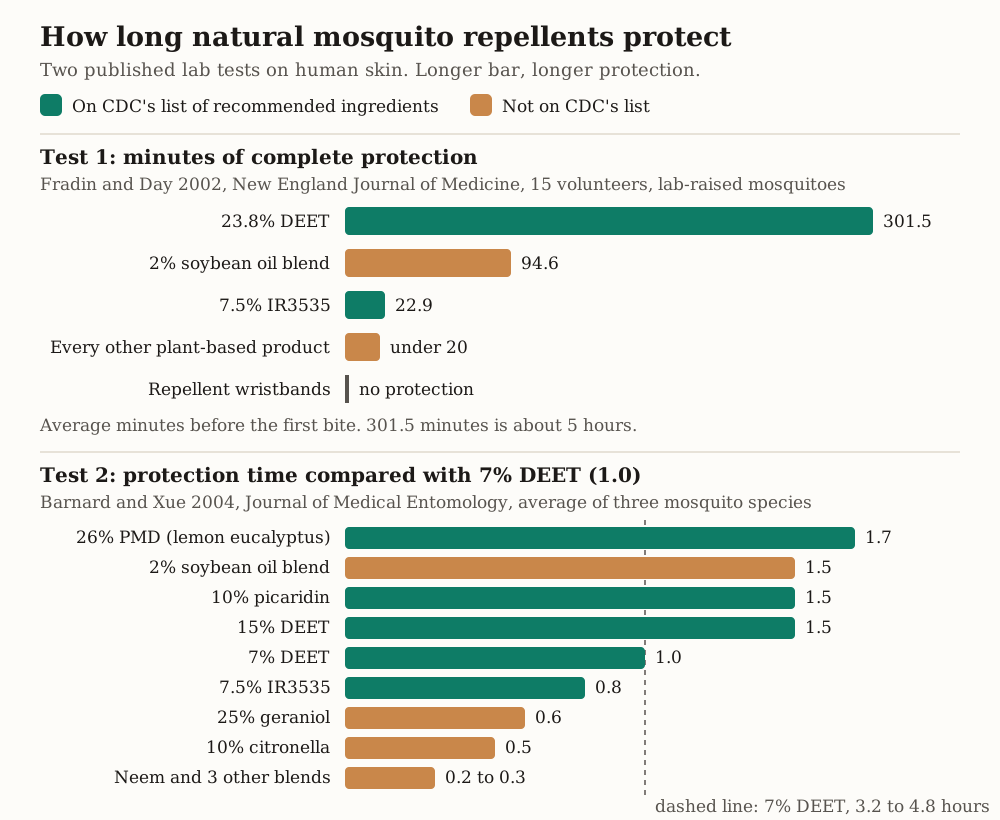
In head-to-head lab tests, 23.8% DEET protected for about 5 hours and a 2% soybean oil blend for 94.6 minutes. Every other plant-based product lasted under 20 minutes. In a second test, 26% PMD from lemon eucalyptus lasted 1.7 times as long as 7% DEET, and 10% citronella half as long.
The first numbers come from Mark Fradin and Jonathan Day, whose 2002 study in the New England Journal of Medicine is still the most quoted test of store-bought repellents. Fifteen volunteers tried each product in a controlled lab, and the clock ran until the first bite. Repellent wristbands gave no protection at all.
The second set comes from Daniel Barnard and Rui-De Xue at the US Department of Agriculture. In 2004 they tested 12 repellents against three kinds of mosquito. The PMD product, the soybean oil blend, picaridin and 15% DEET all averaged 7.2 hours or more. In contrast, citronella, neem and three other botanical blends averaged 0.9 to 2.3 hours.
Newer tests point the same way. In 2015, a New Mexico State University team led by Stacy Rodriguez found that a 30% lemon eucalyptus spray kept yellow fever mosquitoes away for the whole 4-hour test, about as well as DEET. Meanwhile, a 5% geraniol spray did nothing, and a 10% citronella spray barely worked against that species.
The same team tested wearables in a wind tunnel in 2017. With no repellent, 89% of mosquitoes flew toward the volunteer. With 30% lemon eucalyptus, only 30% did, close to 98% DEET at 34%. Yet geraniol bracelets, a sound device and a citronella candle made no difference.
Lab tests have limits, so read the table below as a guide. Results change with the mosquito species, the strength of the product and how much you sweat. Even so, the natural mosquito repellent ranking has held up across 20 years of tests: OLE and PMD near the top, most oils near the bottom.
Each natural ingredient, rated by the published tests
Oil of lemon eucalyptus (OLE) or PMD
- EPA and CDC status
- Registered; on CDC's list; not under age 3
- Best published result
- 26% PMD lasted 1.7 times as long as 7% DEET (Barnard and Xue 2004); 30% OLE worked through a 4-hour test (Rodriguez 2015)
- Our read
- The natural option that works for hours
2-undecanone
- EPA and CDC status
- Registered (1 product); on CDC's list
- Best published result
- 7.75% matched 7% DEET over 6 hours against Asian tiger mosquitoes (Witting-Bissinger 2008)
- Our read
- Works; few products to choose from
Soybean oil blend
- EPA and CDC status
- Not registered (low-risk list)
- Best published result
- 94.6 minutes (Fradin and Day 2002). Soybean oil alone does not repel, the 2011 review notes
- Our read
- Fair, for short outings
Citronella oil
- EPA and CDC status
- Registered in 3 products; not on CDC's list
- Best published result
- Half as long as 7% DEET (Barnard and Xue 2004); a 10% spray barely worked against yellow fever mosquitoes (Rodriguez 2015)
- Our read
- Short: about 2 hours at best
Clove and thyme oils
- EPA and CDC status
- Not registered
- Best published result
- 1.5 to 3.5 hours, but only at 25% strength or more; failed at 5% and 10% (Barnard 1999)
- Our read
- Work only at strengths that irritate skin
Peppermint oil
- EPA and CDC status
- Not registered (low-risk list)
- Best published result
- Repelled only at high strength (Barnard 1999); cut attraction in a lab tube (Mitra 2020)
- Our read
- Weak at skin-safe strengths
Cinnamon, spearmint, lemongrass oils
- EPA and CDC status
- Not registered
- Best published result
- Cut attraction in a lab tube (Mitra 2020); 25% lemongrass gave 74% protection for 2.5 hours (Moore 2007)
- Our read
- Some effect, short
Geraniol
- EPA and CDC status
- Not registered as a skin repellent
- Best published result
- 25% lasted 0.6 times as long as 7% DEET (Barnard and Xue 2004); 5% spray and bracelets did nothing (Rodriguez 2015, 2017)
- Our read
- Weak
Neem oil
- EPA and CDC status
- Not registered for skin
- Best published result
- 0.3 times as long as 7% DEET (Barnard and Xue 2004)
- Our read
- Weak, and can irritate skin
Lavender, tea tree, eucalyptus oils
- EPA and CDC status
- Not registered
- Best published result
- No good skin test found for lavender or tea tree; one eucalyptus oil repelled only at high strength, and its main compound not at all, in a 2022 lab test (Costa)
- Our read
- Unproven
Catnip oil
- EPA and CDC status
- Registered in 4 products; not on CDC's list
- Best published result
- Triggers an irritant receptor in mosquitoes (Melo 2021); few skin tests
- Our read
- Promising, not yet proven on skin
Vitamin B1 patch or pills
- EPA and CDC status
- Not a repellent
- Best published result
- No effect (Ives and Paskewitz 2005; Rodriguez 2015)
- Our read
- Does not work
Wristbands and bracelets
- EPA and CDC status
- Not registered as repellents
- Best published result
- No protection (Fradin and Day 2002; Revay 2013; Rodriguez 2017)
- Our read
- Does not work
Sound devices and apps
- EPA and CDC status
- Not registered
- Best published result
- No effect in 10 field studies (Cochrane review, 2007)
- Our read
- Does not work
Strengths are the percentages in the products tested. EPA product counts are from the EPA’s list of skin-applied repellent ingredients.
What smells do mosquitoes hate?
The smells that repel mosquitoes best in tests are lemon eucalyptus (PMD), clove, thyme, cinnamon, peppermint, spearmint and lemongrass. None of them works for long unless it is refined into a registered product. Mosquitoes do not “hate” a scent so much as get confused or irritated by it, and the effect fades as it evaporates.
A 2020 New Mexico State study tested 21 ingredients from the EPA’s low-risk list. Cinnamon, peppermint, spearmint, lemongrass and garlic oils all reduced how many mosquitoes flew toward a person. However, of five store-bought sprays made only from those ingredients, just one worked, and only for up to 30 minutes.
Some popular scents have almost no testing at all. For example, we found no good human skin test for lavender, despite its place on most lists. Eucalyptus is weaker than its name suggests: in a 2022 lab test, its main compound, 1,8-cineole, did not repel yellow fever mosquitoes at any strength, and the whole oil worked only at high strength.
Growing these plants is a different question. A potted plant gives off far less scent than a natural mosquito repellent on your skin. Our guide to plants that repel mosquitoes covers what a garden can and cannot do.
Essential oils for mosquitoes, one by one
Essential oils repel mosquitoes for minutes to about 2 hours, and only at strengths that can irritate skin. In a USDA test of five oils, none prevented bites at 5% or 10%. In a Thai test of 38 oils, none lasted 2 hours at 10% or 50%. Only a few undiluted oils, including clove, citronella and patchouli, reached 2 hours.
That matters because undiluted oils should not go on skin. Poison Control warns that many essential oils cause rashes and some are poisonous when absorbed or swallowed. Here is what the evidence says for each oil people ask about most.
Does peppermint oil repel mosquitoes?
Peppermint oil repels mosquitoes a little, for a short time. In a 1999 USDA test on human skin, only high concentrations of peppermint oil repelled yellow fever mosquitoes, and the author notes it can irritate skin. A 2020 lab study also found it reduced attraction. Even so, at the strength in a homemade spray, expect little.
Does tea tree oil repel mosquitoes?
We found no independent skin test showing that tea tree oil keeps mosquitoes off. Meanwhile, the ASPCA warns that as few as 7 or 8 drops of concentrated tea tree oil can harm a pet. That is a poor trade for an unproven benefit.
Do mosquitoes hate lavender?
Probably not as much as the lists claim. The study Healthline cites tested lavender oil on hairless mice in 2002, not on people. We found no good test on human skin. Lavender is pleasant to wear, but treat it as a scent, not as protection.
One mix-up needs fixing too. Google’s AI Overview for this search said lavender and catnip oils both contain nepetalactone. They do not. Nepetalactone is the compound in catnip that irritates mosquitoes, while lavender’s main compounds are linalool and linalyl acetate. Mosquito Authority’s blog says mosquitoes hate lavender because of that linalool. Pure linalool does repel in diffusers, as the dryer sheet answer below shows, but a dab of lavender oil releases far less, for far less time.
Lemongrass, clove and cinnamon oils
These three have the best results among the plain oils. In a field test in Bolivia, a 25% lemongrass oil gave 74% protection for 2.5 hours. Clove oil lasted 2 to 4 hours undiluted in the Thai test, and 1.5 to 3.5 hours at high strength in the USDA test. However, the USDA researcher noted that clove and thyme can irritate skin, and both volunteers found their smell unacceptable at 25% or more.
Citronella oil on skin
Citronella is the best-known natural repellent, yet it is one of the weakest on skin. The 2011 review says citronella works about as well as DEET at first, then evaporates within about 2 hours. In Barnard and Xue’s test, 10% citronella lasted half as long as 7% DEET. Higher strengths can cause skin sensitivity.
Citronella oil also does not come from lemongrass, whatever Google’s AI Overview and The Spruce say. It is distilled mainly from two other grasses, Cymbopogon nardus and Cymbopogon winterianus. Lemongrass, Cymbopogon citratus, is a cousin in the same genus, with its own oil and its own test results above.
Does eucalyptus repel mosquitoes?
Ordinary eucalyptus oil is not the same as oil of lemon eucalyptus. It comes from other eucalyptus trees. In the 2022 lab test, one such oil repelled only at high strength, and its main compound did not repel at all. Only the refined lemon eucalyptus product, OLE, is on CDC’s list. Look for “oil of lemon eucalyptus” and an EPA number on the label.
Does patchouli oil repel mosquitoes? The 2026 study
A 2026 lab study found that a patchouli cream kept mosquitoes off for 3 hours. Researchers at the Federal University of Amapá, in Brazil, mixed patchouli oil into a cream at 200 parts per million. Volunteers then held treated forearms in cages of 50 yellow fever mosquitoes, and the cream gave full protection for the whole 3-hour test.
The study, in the journal ACS Omega, drew headlines such as Outside’s “It Works as Well as DEET.” That goes further than the data. The test stopped at 3 hours, so nobody knows when protection would fade. Also, it used one species in a cage, and the paper does not say how many volunteers took part or which DEET product, at what strength, it was compared with.
Patchouli is not new to the tests, either. In the Thai test of 38 oils, undiluted patchouli was one of the few to last 2 hours. Still, it is not EPA-registered, and the authors say safety studies are still needed. The Outside article also suggests stirring patchouli into lotion at home, which no test supports. Its list of EPA-approved plant oils is off as well: the registered ingredient is oil of lemon eucalyptus, not eucalyptus oil.
Pennyroyal oil: skip it
Ehrlich Pest Control’s scent list suggests rubbing crushed pennyroyal leaves on your clothes, then warns that the plant is toxic if swallowed and not for use around children or pets. Skip it. Pennyroyal is a small mint rich in pulegone, a compound that can damage the liver, so its oil is dangerous for people and pets alike.
Homemade mosquito repellent: why we do not give a recipe
We do not publish a homemade mosquito repellent recipe, because no tested recipe exists. Oils at 5% to 10% failed to prevent bites in lab tests, and most online recipes are far weaker. Stronger mixes irritate skin, and none has a label, a tested strength or an age limit. A registered OLE product is the safe way to go natural.
Look at a typical recipe. One that ranks for this search adds 10 to 15 drops of essential oil to 2 cups of water and vinegar. That is well under 1% oil, far below the 5% and 10% mixes that failed in the USDA test. We also found no test of vinegar as a repellent.
Going stronger brings other risks. The 2011 review warns that many oils cause skin rashes, especially in sunlight. In addition, Poison Control notes that children have thin skin and immature livers, which may make oils more harmful to them. A homemade spray also has no child-resistant cap.
Homemade OLE is the most common trap. Healthline, the top result for this search, tells readers to mix lemon eucalyptus essential oil with a carrier oil. That is the pure oil CDC does not recommend, because it has never been tested for safety or for how well it works. The registered product is a different, refined extract.
If you want a plant-based repellent that works, buy one with oil of lemon eucalyptus, PMD or 2-undecanone and an EPA number on the label. Treat any natural mosquito repellent you mix at home as a scent that may buy you a few minutes, and keep it away from babies.
Natural mosquito repellent for skin: how to use it
Use a registered plant-based repellent on exposed skin only, never under clothing, and follow the label for how much and how often. The pediatricians’ guide says 8% to 10% oil of lemon eucalyptus protects for up to 2 hours, and 30% to 40% for about 6 hours. Pick the strength that matches your time outside.
These rules come from the EPA and CDC, and they apply to every natural mosquito repellent and every other skin repellent:
- Apply it to exposed skin and, if the label allows, clothing. Never put it under clothing.
- Keep it away from eyes and mouth. For your face, spray your hands first, then rub it on.
- Never use it over cuts, wounds or irritated skin.
- If you wear sunscreen, put the sunscreen on first and the repellent second.
- Reapply as the label directs, sooner if you start getting bitten.
- Wash it off with soap and water when you come inside.
CDC’s Yellow Book adds a useful rule of thumb. Products with less than 10% active ingredient may protect for only 1 to 2 hours. If you are pregnant or breastfeeding, CDC says registered repellents are safe and effective when used as directed.
For a direct comparison of the two most common synthetic options, see our picaridin vs DEET comparison. The same skin rules apply to them.
Natural mosquito repellent for babies and kids
Do not use oil of lemon eucalyptus or PMD on children under 3, CDC says. For a young baby, CDC points to netting over strollers and carriers, plus clothing that covers arms and legs. For children 3 and older, a registered OLE or PMD product is the natural option with real testing. Keep essential oils off babies entirely.
The advice for the youngest babies differs by source. CDC’s Yellow Book and the EPA set no age limit for DEET, picaridin, IR3535 or 2-undecanone. Even so, Mayo Clinic advises no DEET under 2 months and no picaridin under 6 months, and a 2020 CDC fact sheet said not to use any insect repellent on babies younger than 2 months. So follow the label, and ask your pediatrician before using any repellent on a young baby.
There is one label exception for OLE. The EPA allows some products with OLE as the only active ingredient, at 30% or less, on children under 3. Read the label: if it does not say so, do not use it on a toddler. Also, 2-undecanone has no age limit, but it is sold in only one registered product.
For any child, the EPA and pediatricians advise:
- An adult applies it. Never let a child handle the bottle, and never put repellent on a child’s hands.
- Rub it on the face from your own hands, avoiding the eyes and mouth.
- Choose a lotion, stick or pump spray over an aerosol a child could breathe in.
- Wash it off with soap and water at the end of the day.
- Store repellents locked away or out of reach.
Parents on Reddit ask this every summer, often after trying an “all natural” spray that did not work. One mother of a toddler with 8 to 10 bites at a time wrote that her natural repellent “seems to not work.” The replies mostly pointed to registered products and long sleeves, which is also what the evidence supports.
Patches and bracelets sold as a natural mosquito repellent for babies are not a shortcut. In published tests, neither a lemon eucalyptus sticker nor a vitamin B1 patch reduced bites, and bracelets did nothing. For a child who swells badly after bites, our guide to mosquito bite allergy in children explains what to watch for.
Does it repel mosquitoes? Vicks, vanilla, dryer sheets and more
Most household mosquito tricks have never been tested, and the few that have mostly failed. We found no published test of Vicks VapoRub, vanilla extract, dryer sheets, Listerine or Irish Spring soap against mosquitoes. Garlic rubbed on skin has a small effect. Eating garlic and taking vitamin B do nothing.
Household remedies, and what the evidence says
Vicks VapoRub
- What the evidence says
- Not tested on mosquitoes. Its labeled active ingredients are camphor 4.7%, menthol 2.6% and eucalyptus oil 1.2%. The label says do not use under age 2
- Our verdict
- Skip it, especially near children
Vanilla extract
- What the evidence says
- Not tested. Vanillin helped other oils last longer in a 2001 lab blend (Tawatsin), but the extract alone is mostly alcohol
- Our verdict
- Unproven
Garlic on skin
- What the evidence says
- A moderate effect when rubbed on, the 2011 review says, and stronger repellents exist
- Our verdict
- Weak
Listerine
- What the evidence says
- Not tested. Its four oils total well under 1%, and the rest is mostly water and 21.6% alcohol
- Our verdict
- Unproven
Dryer sheets
- What the evidence says
- No published test on mosquitoes found
- Our verdict
- Unproven
Irish Spring and other soaps
- What the evidence says
- Irish Spring is untested. In a 2023 test of four other soaps, some made people more attractive to mosquitoes and some less, depending on the person
- Our verdict
- Unpredictable
Vinegar
- What the evidence says
- No published test as a repellent found
- Our verdict
- Unproven
Coffee grounds, spread or burned; smoke
- What the evidence says
- No test of coffee grounds found, spread in beds or burned. Smoke from burned husks gave 35% to 51% protection in Bolivia (Moore 2007)
- Our verdict
- A little, while you sit in the smoke
Coconut oil
- What the evidence says
- Some repellent effect, far less than DEET, the 2011 review notes
- Our verdict
- Weak
A popular bath oil
- What the evidence says
- Cut attraction of one species for about 2 hours, not the other (Rodriguez 2015)
- Our verdict
- Inconsistent
Cedar oil
- What the evidence says
- Failed to repel on human skin (Barnard 1999)
- Our verdict
- Does not work
Rubbing alcohol
- What the evidence says
- Not a repellent and not registered. It is flammable
- Our verdict
- Never use it
Does Vicks keep mosquitoes away?
We found no test of Vicks VapoRub against mosquitoes. Its oils, camphor, menthol and eucalyptus, are the kind that evaporate within minutes to hours. The bigger issue is safety. The label says not to use it on children under 2, and Poison Control warns that even a small amount of swallowed camphor can cause seizures in a child.
Does vanilla extract repel mosquitoes?
There is no test of vanilla extract alone. The idea may come from lab work in Thailand, where adding 5% vanillin to plant oils such as citronella made them last up to 8 hours in cages. That was vanillin mixed into an oil, not kitchen vanilla on bare skin.
Do dryer sheets repel mosquitoes?
We found no published test of dryer sheets against mosquitoes. The Spruce credits linalool, a floral scent compound used in some sheets. Linalool does repel when concentrated: in a 2009 Israeli trial, diffusers of it cut mosquitoes indoors by 93%. However, a sheet tucked in a pocket gives off only a trace, and even strong oils fade within hours. Treat dryer sheets as unproven.
Listerine and Irish Spring soap
Neither has been tested on mosquitoes. Listerine’s label lists eucalyptol, menthol, methyl salicylate and thymol, each under 0.1%, so it is far weaker than the oils that already failed at 5%. Soap is more interesting. In 2023, Virginia Tech researchers found four soaps changed how mosquitoes chose between people. Still, the effect depended on the person, and some soaps made people more attractive.
Why some people get bitten more in the first place is a separate question. Our guide to whether mosquitoes prefer one blood type looks at what the studies show.
Vitamin B1, garlic pills and anything you swallow
Nothing you eat or swallow repels mosquitoes. A 2005 University of Wisconsin study found no effect from vitamin B supplements, and a 2005 double-blind trial found none from eating garlic. Vitamin B1 skin patches failed in two separate lab tests. CDC lists vitamin B and garlic as ineffective.
The vitamin B idea is old and stubborn. The Wisconsin team, Anthony Ives and Susan Paskewitz, tested several dosing plans on human skin odors and found no change in how attractive people were. In the garlic trial, at the University of Connecticut, volunteers who ate garlic were bitten as often as when they took a placebo.
The patches fared no better. A 300 mg vitamin B1 patch had no effect on either mosquito species in the 2015 New Mexico State test, and a similar patch failed in a 2013 test in Israel. Our bug bite identification guide reaches the same verdict on supplements.
Bracelets, patches, sound devices and apps
Repellent bracelets, stickers, vitamin patches, ultrasonic devices and phone apps did not protect people in published tests. Wristbands gave no protection in the 2002 test, and a 2007 review of 10 field studies found sound devices had no effect. The only wearables that worked were small diffusers that blow a vapor around you.
A 2013 field test in Israel put seven wearable products against two mosquito species. Two citronella and geraniol wristbands, a lemon eucalyptus sticker for clothing, a vitamin B1 patch and a sonic keychain all failed. Two personal diffusers worked, cutting bites on the arms by more than 90%. One spreads an insecticide. The other spreads a blend of plant oils, including cinnamon, geranium and peppermint.
The 2017 New Mexico State test agreed. Three geraniol bracelets and a sonic device made no difference to how many mosquitoes flew toward a volunteer. Phone apps that play high-pitched sounds rely on the same idea, and no test shows that sound repels mosquitoes. Pediatricians list wristbands and ultrasonic devices as not proven.
How to keep mosquitoes away without chemicals
The most reliable chemical-free protection is physical: loose long sleeves, screens, netting and a fan. CDC lists clothing, screens, air conditioning and dumping standing water weekly alongside repellent. In a Michigan wetland test, a fan blowing toward a person, with repellent vapor in the air, cut mosquito landings by 75%.
A repellent put on at dusk will not last the night, a common complaint on Reddit. So indoors at night, rely on the same physical tools. Close the windows or check the screens, run a fan beside the bed, and put a net over a crib. If mosquitoes keep turning up inside, there is usually water breeding them close by. Our guide to getting rid of mosquitoes in the house and yard covers finding and clearing it.
Timing helps less than people think. CDC notes that mosquitoes bite day and night. For instance, the Asian tiger mosquito is a daytime biter, so staying in at dusk does not avoid it.
How to keep mosquitoes away with fewer chemicals
Cover up first
Wear loose, long-sleeved shirts and long pants, as CDC advises. Loose clothing keeps the fabric away from your skin, where a mosquito would bite through. Covered skin needs no repellent at all.
Put moving air where you sit or sleep
Use a fan on the porch, at the picnic table or beside the bed. Pediatricians suggest fans in outdoor eating areas. Mosquitoes struggle to land in a breeze, so aim the fan at people.
Keep them outside the house
Close doors, repair holes in window and door screens, and use air conditioning if you have it. These are CDC's first steps for indoor mosquitoes.
Net babies and beds
Cover strollers and baby carriers with mosquito netting, as CDC advises, and use a net over a crib or bed where mosquitoes get in. For a baby under 2 months, rely on netting and clothing, and ask your pediatrician before using any repellent.
Empty standing water every week
Once a week, tip out or scrub buckets, saucers, toys, birdbaths and pet bowls left outside. Mosquitoes need standing water to breed, so fewer pools near the house means fewer biters.
Add a registered plant-based repellent when you need one
For time outdoors at dusk, on a hike or anywhere mosquitoes still find you, use oil of lemon eucalyptus, PMD or 2-undecanone on exposed skin. Follow the label for how much and how often. The label is the law.
Camping or hiking? The same order applies: cover up, sleep under a net or in a closed tent, and carry a registered repellent. Permethrin on clothing is not natural, but it keeps working through several washes. Our guide to preventing tick bites with treated clothing explains how to use it safely.
Natural options for the yard
No natural spray, candle or plant protects a whole yard for long. A citronella candle made no difference at about 3 feet (1 m) in the 2017 New Mexico State test. In an Israeli test, citronella candles cut mosquitoes indoors by only 14%. Dumping standing water each week does more than any scent.
Diffusers did better than candles in that Israeli study. A geraniol diffuser cut mosquitoes by 97% indoors, and by 75% outdoors at traps about 20 feet (6 m) away. Still, the protection stays close to the device. For the full yard plan, from water to traps to when a spray is worth it, see our guide to mosquito control around the home.
Natural mosquito repellents and pets
Many natural mosquito repellent oils are risky for dogs and cats. The ASPCA warns that concentrated essential oils can poison pets that walk through them, get them on their coat or have them applied directly. As few as 7 or 8 drops of concentrated tea tree oil can cause problems. Never put a human repellent on a pet.
The EPA puts it simply: do not use any repellent on an animal unless the label says it is for animals. Keep oil bottles and diffusers where pets cannot reach them, and do not spray oils where pets sleep or eat. Signs of a problem include unsteady walking, low energy and, after swallowing, vomiting or diarrhea.
Natural repellent myths, corrected
Many myths about natural mosquito repellent oils and sprays come from the pages that rank for them, not just from forums. Below are 12 claims, the pages that make them, and what the evidence says. Each correction names its source, so you can check it before you spend money on a spray or a bracelet.
Myth 1
Myth: “The CDC has approved eucalyptus oil as a mosquito repellent.”
Truth: Healthline says so. CDC recommends registered oil of lemon eucalyptus, a refined product. It does not recommend pure lemon eucalyptus oil, and ordinary eucalyptus oil is a different oil again.
Myth 2
Myth: “Oil of lemon eucalyptus is the only plant-based repellent CDC recommends, and it lasts up to 3 hours.”
Truth: Google's AI Overview for this search said so in October 2026. CDC lists 2-undecanone as plant-derived too. OLE's hours depend on strength: pediatricians give up to 2 hours at 8% to 10% and about 6 hours at 30% to 40%.
Myth 3
Myth: “Mix lemon eucalyptus oil with a carrier oil to make your own OLE.”
Truth: Healthline gives this recipe. That is the untested pure oil CDC does not recommend. The repellent compound, PMD, comes from refining, and the plain essential oil repels for about an hour (Maia and Moore 2011).
Myth 4
Myth: “Eating garlic masks your scent from mosquitoes.”
Truth: Mosquito Magnet says so. In a double-blind trial, people who ate garlic were bitten as often as on a placebo (Rajan 2005). CDC lists garlic as ineffective.
Myth 5
Myth: “Citronella or eucalyptus oil can be applied directly to the skin.”
Truth: Mosquito Magnet suggests both. Poison Control advises diluting essential oils, and the USDA found clove, thyme and peppermint oils irritate skin at high strength.
Myth 6
Myth: “Citronella oil is made from lemongrass.”
Truth: Both Google's AI Overview and The Spruce say so. Citronella oil is distilled mainly from Cymbopogon nardus and Cymbopogon winterianus. Lemongrass, Cymbopogon citratus, is a related grass with a different oil (Maia and Moore 2011).
Myth 7
Myth: “A vinegar and essential oil spray is effective and safe for skin.”
Truth: Farm and Fleet says so for a 10 to 15 drop recipe. Oils at 5% and 10% failed to prevent bites in a USDA test, and we found no test of vinegar.
Myth 8
Myth: “Geranium oil can be applied to a pet's coat.”
Truth: Farm and Fleet suggests it. The ASPCA advises never applying essential oils directly to pets, and the EPA says not to use a repellent on an animal unless its label allows it.
Myth 9
Myth: “DEET is the risky choice and natural repellents are the safe one.”
Truth: Healthline says DEET products may cause health problems. The EPA approves DEET for children with no age limit. The 2011 review warns that natural does not equal safe, and plant repellents lack DEET's long safety record.
Myth 10
Myth: “A vitamin B1 patch makes you invisible to mosquitoes.”
Truth: Patches failed in two separate tests (Revay 2013; Rodriguez 2015), and B vitamins taken by mouth did nothing (Ives and Paskewitz 2005).
Myth 11
Myth: “Mosquitoes detest lavender and stay away at all costs.”
Truth: Mosquito Magnet says so. We found no good test of lavender on human skin; the study usually cited used hairless mice.
Myth 12
Myth: “Lavender oil contains nepetalactone, the same compound as catnip.”
Truth: This mix-up appeared in Google's AI Overview for this search. Nepetalactone is catnip's compound. Lavender's main compounds are linalool and linalyl acetate.
When natural is not enough
Switch to a registered repellent when disease is a real risk: travel to areas with dengue, malaria or Zika, a West Nile warning near home, or long hours outside at peak season. CDC advises travelers to avoid unregistered natural repellents. Registered OLE and PMD still count as a natural mosquito repellent in those cases.
When to move past a homemade or essential oil spray
Travel to an area with dengue, malaria or Zika
- What the experts say
- CDC: avoid unregistered natural repellents
- What to use
- A registered repellent at the strength the label gives for your hours outside
A West Nile warning from your health department
- What the experts say
- Pediatricians: natural repellents only when there is no serious disease risk
- What to use
- A registered repellent, plus long sleeves at dusk and dawn
Still getting bitten with a natural spray
- What the experts say
- Most oils fade within 2 hours in tests
- What to use
- Registered OLE or PMD, or see our picaridin vs DEET comparison
A child who swells badly after bites
- What the experts say
- Fewer bites means fewer big reactions
- What to use
- Clothing, netting and a registered repellent suited to the child's age
A baby under 2 months
- What the experts say
- CDC: netting over strollers and carriers; a 2020 CDC fact sheet advised no repellent at this age
- What to use
- Netting and covering clothes; ask your pediatrician before any repellent
If you feel unwell with a fever in the days or weeks after mosquito bites, see a doctor and mention the bites. Most bites are only itchy, and our guide to mosquito bites and the itch covers what is normal and when a bite needs a doctor.
Pest control disclaimer. Photo-based identification can help, but it is not always perfect. For dangerous spiders, large infestations, or anything you are unsure about, contact a licensed pest control professional.
Natural mosquito repellent FAQ
What is the best homemade mosquito repellent?
How do the Amish keep mosquitoes away?
What perfumes do mosquitoes hate?
Is a natural mosquito repellent safe during pregnancy?
Is citronella the same as lemon eucalyptus?
Do I need to reapply natural repellent after swimming or sweating?
Related guides
Mosquitoes
The mosquitoes of the US, how they live, when they bite and what they carry.
Picaridin vs DEET
The two leading synthetic repellents side by side: protection time, feel and safety.
Plants that repel mosquitoes
Citronella, catnip, lavender and more: what a garden can and cannot do.
How to get rid of mosquitoes
Standing water, the house and the yard: the steps that cut mosquito numbers.
What blood type do mosquitoes like?
Why some people get bitten more, and what the studies really show.
How to prevent ticks
Repellents and permethrin clothing for tick country, compared.
Sources
- CDC, Preventing Mosquito Bites (August 28, 2024)
- CDC Yellow Book, Mosquitoes, Ticks and Other Arthropods (repellents, pure lemon eucalyptus oil, children)
- US EPA, Skin-Applied Repellent Ingredients
- US EPA, Regulation of Skin-Applied Repellents (unregistered products not evaluated for effectiveness)
- American Academy of Pediatrics, HealthyChildren.org, How to Choose an Insect Repellent for Your Child
- ASPCA, Is the Latest Home Trend Harmful to Your Pets? (essential oils, ASPCA Animal Poison Control Center)
- Poison Control (National Capital Poison Center), Essential oils: Poisonous when misused
- Maia MF, Moore SJ. Plant-based insect repellents: a review of their efficacy, development and testing. Malaria Journal 10(Suppl 1):S11 (2011)